“C-A-L-Y-P-T-R-A, calyptra,” spelled Elizabeth quickly, casting an anxious glance toward the little schoolhouse across the field.
Mrs. Patterson stood in the doorway, a dust-cloth in one hand, and in the other Elizabeth’s spelling-book. Elizabeth had hoped to get away this morning without this reviewing of the lesson; but just as she was tying on her sunbonnet, and calling out, rather hurriedly, “Good-by, mama!” Mrs. Patterson remembered that Elizabeth had not been able to spell several words correctly the evening before. Mr. Patterson always declared that his wife followed Elizabeth halfway to the schoolhouse with the spelling-book in her hand. And Mrs. Patterson admitted that she was proud of her little daughter’s record as a “speller,” and was always ready to hear her lessons—sometimes too ready, Elizabeth thought.
“Cantharis!”
“C-a-n-t-h-e—no c-a-n-t-h-a-r-i-s,” the lesson proceeded; then Elizabeth interrupted: “I must go now, mama. Here come Leslie and the boys.”
“Well, remember caryatides and caryopsis, those two words you missed again this morning,” her mother answered as she stooped to kiss her.
Elizabeth joined her schoolmates in a race across the field, and Mrs. Patterson returned to her dusting.
Just before the class in spelling was called, Elizabeth remembered her mother’s advice, and looked over her lesson carefully.
“I am at the foot of the class to-day, but then I don’t want to miss,” she considered, “and I might have a chance to go up a little way.”
The late afternoon sun glimmered through the uncurtained windows, and rested upon the little line drawn up for the spelling class—the last recitation of the day.
Elizabeth had stood for a term at the head, and this afternoon as she took her place at the foot of the class, she wondered where she would stand when the lesson was over. Most of the good spellers were near her, so she had little expectation of a misspelled word’s reaching her.
The lesson was rather hard, and there were many words misspelled, but they were all spelled correctly before they reached the foot of the class. Two or three of the hardest words came to the girl who stood by Elizabeth; but as they came to her in turn, and she spelled them correctly, there was no opportunity for Elizabeth to leave her place at the foot. This girl was a new scholar; and though she was a shy, timid child, and sometimes misspelled words through sheer nervousness, she was already gaining a reputation as one of the best spellers in the class.
“Caryatides!” the teacher gave out, and Elizabeth spelled the word over to herself as the boy at the head of the class tried and failed.
The word passed along down the line, and Elizabeth’s heart beat quickly at the possibility of its reaching her.
“S’pose it should come to me, and I should spell down the whole class; but no, Annie will spell it—if she does not get too scared.”
Annie, the new girl, grew more and more nervous as the word passed from pupil to pupil. When at last it came to her, she spelled it correctly, but in such a hesitating, confused manner that the teacher evidently misunderstood.
“Next!” she called.
Elizabeth hesitated a moment. Surely Annie had spelled the word correctly. And she repeated it, letter for letter, in a clear, distinct voice.
“Right!” exclaimed the teacher. “Well done, Elizabeth; you may take your place at the head.”
“But—I—spelled—” stammered Annie.
“What is it, Annie?” asked the teacher.
“N—nothing,” she faltered, and began to cry.
“Never mind, Annie. Go to the head of the class, Elizabeth. Now, let us go on with the lesson.”
Elizabeth looked troubled as she walked up the line. She had spelled the word correctly, and mama would be so glad to have her at the head of the class again. But, had not Annie spelled it just as she had? Well, the teacher must be right, and she must have misunderstood Annie. Anyway it was not her fault. She would not think any more about it.
The lesson was nearly over, the teacher pronounced the last word and shut the book. “S’pose Annie did spell the word right,” Elizabeth’s troubled thoughts ran on: “well, why didn’t she say so? It is too late now, anyway, and it was not my fault. Was it?”
The troubled face cleared a little, and Elizabeth’s voice spoke up bravely, if a little tremulously, “Miss Dean, I think Annie spelled that word correctly.”
“What word, Elizabeth?” Miss Dean inquired, as she turned to dismiss the class. “Oh, do you mean the one you spelled?” she continued.
“Yes, Miss Dean.”14
Miss Dean looked from Elizabeth to Annie. “Will you spell ‘caryatides’ exactly as you did before, Annie? I do not think I misunderstood,” she said, a little doubtfully.
“C-a-r-y-a-t-i-d-e-s,” spelled Annie, in a low voice, but very distinctly.
“And you are sure that is just as you had it before?”
“Yes, indeed,” returned Annie.
“You understood it so, Elizabeth?”
“Yes, Miss Dean. I should have spoken at once,” Elizabeth replied, flushing painfully, “but I—I—”
“Yes, you should, and Annie should have made herself understood. I am glad that you spoke, Elizabeth,” continued Miss Dean. “And I beg your pardon, Annie. You may exchange places.”
Annie’s eyes spoke her gratitude as the girls passed each other, and Elizabeth returned to her place at the foot of the class, but with a happy heart.—M. Palmer Sweet, in Boys and Girls.
WHEN GRANDMA WAS A LITTLE GIRL
By Elizabeth Rosser
We can not play outdoors to-day;
See how the snowflakes dance and whirl!
So let us go upstairs and play
We lived when Grandma was a girl.
In summer, when the fields were gay
With flowers, she helped to rake the hay,
Or went to school two miles away—
When Grandma was a little girl.
And stormy winter days like this
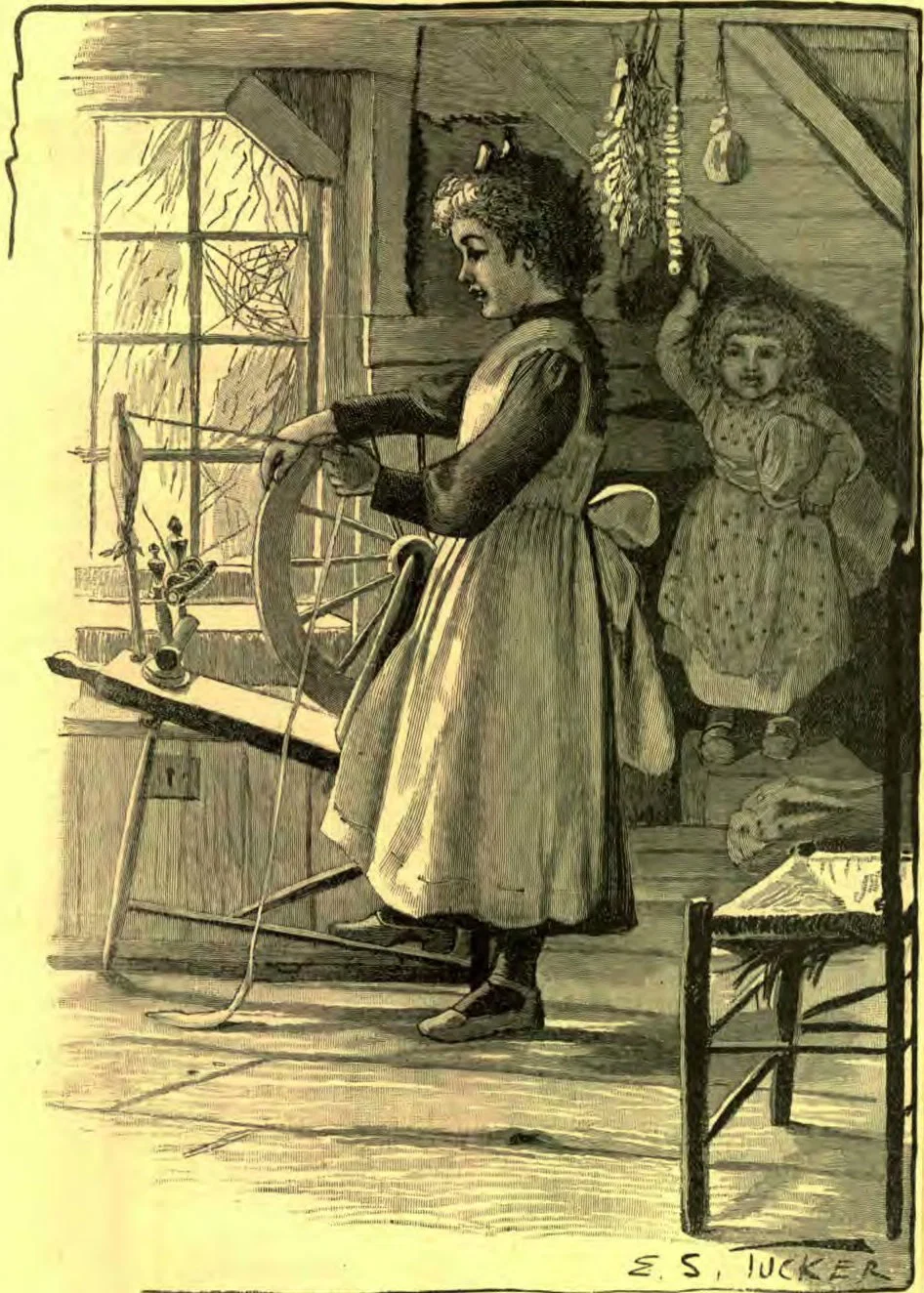
She kept her spinning-wheel a-whirl;
For every lass knew how to spin
When Grandma was a little girl.
Such pretty patchwork, row on row,
With patient hands she made them grow;
For folks had no machines to sow
When Grandma was a little girl.
Her knitting-needles,—how they flew!
She learned to narrow and to purl,
She made her hose and mittens, too—
When Grandma was a little girl.
With happy heart for work or play,
And song on lips through all the day,—
Thus passed the busy hours away
When Grandma was a little girl.
—ELIZABETH ROSSER.
WHEN GRANDMA WAS A LITTLE GIRL
BEREAN LIBRARY STUDY
Revelation 10: “Thoughts on the Revelation,” Pages 488-496 (January 13-19)
Clothed with a Cloud.—Although the face of the angel was like the sun, yet its clothing was a cloud. This would seem to indicate the manner in which the message was given. It was given in great power, yet it was not all understood; it was partly covered with clouds. If the believers had understood all, they would never have been disappointed.
The Little Book.—There is only one book that the Lord ever commanded to be sealed,—the book of Daniel,—and of that book the Lord said, “Seal the book, even to the time of the end,” indicating that when that time was reached, the book should be opened. The period known in the Bible as “the time of the end” began in 1798, when the twelve hundred and sixty years of papal rule ceased. Dan. 11:33-35; 12:6-9. In the vision of the tenth of Revelation the angel holds a “little book open;” this must be the book of Daniel, which was to be unsealed in the time of the end; for there would be no special force in the angel’s holding any other book of the Bible open, as the other books were never closed, but have always been open.
World-Wide Message.—What a forcible picture is here presented! The angel stands with his right foot on the sea and his left foot upon the land, holding that open book out to the inhabitants of all the earth. With a loud voice he tries to arrest the attention of the busy multitudes, wrapped up in the cares and pleasures of the world. His voice is compared to the roar of a lion. Many years ago I was staying for a while in the suburb of a city where there was a menagerie containing several large lions. Although more than a mile away, I well remember how one night, when the lions were disturbed in an unusual manner, their terrible roar rang out on the stillness of the midnight air, causing a feeling of alarm everywhere. The sounding of the first angel’s message went through the earth like a lion’s roar. Many heeded it, and prepared to meet their Lord; even scoffers felt alarm, and were quiet when they came up to the day on which the Lord was expected to appear.
Time No Longer.—This can not mean literal time; for the last verse of the chapter says, “Thou must prophesy again before many peoples, and nations, and tongues, and kings,” bringing to view another world-wide message to be given after this. In the Bible are given several lines of prophecy, which have definite dates for their beginning and close. One period, the twelve hundred and sixty years, ended in 1798; another, the three hundred and ninety-one years and fifteen days, ended Aug. 11, 1840. The longest period of prophetic time given in the Bible is the twenty-three hundred days of Daniel 8:14. This began 457 B. C., and ended 1844 A. D. There is no definite date given for any line of prophecy that reaches later than 1844. Prophetic time ceased in 1844; the angel said, “Time shall be no longer.” The book of Daniel is the only book that contains the prophecy of the twenty-three hundred days.
Eating the Book.—How often when one is especially interested in reading some worldly book, the expression is used, “He is devouring that book.” It would be a great blessing to us if we were often found devouring the Bible. We never say that one is devouring a book if his interest is so meager that the least word will attract his attention from it. Have you ever eaten the Bible? Do you become so absorbed in reading it that you do not realize the passage of time? “Thy words were found, and I did eat them; and thy word was unto me the joy and rejoicing of mine heart.” Jer. 15:16. Can you say those words from the heart? If so, you will experience the spiritual strength expressed in the following: “Thy word have I hid in mine heart, that I might not sin against thee.” We receive no physical strength from food by simply looking at it and dallying with it; in order to be physically strong, we must eat it. Spiritual strength comes from eating God’s word, giving it prayerful study.
Sweet, Then Bitter.—When God’s people took the book of Daniel from the angel’s hand, and ate it up, it caused great rejoicing. As they studied the different lines of prophecy, they learned that the coming of the Lord was near. In the eighth and ninth chapters of Daniel they learned that the sanctuary was to be cleansed in 1844; and supposing the earth to be the sanctuary, they expected that the Lord would come in 1844. They overlooked the teaching of the Bible in regard to the heavenly sanctuary. Even their enemies never discovered their mistake. “God’s people were then accepted of him. Jesus looked upon them with pleasure; for his image was reflected in them. . . . They had placed their affections on heaven, and in sweet anticipation had tasted immortal deliverance; but their hopes were not realized. . . . The world laughed, and mocked, and reproached them; and those who had believed without a doubt that Jesus would ere then have come . . . felt as did the disciples at the sepulcher of Christ, ‘They have taken away the Lord, . . . and we know not where they have laid him.’”—“Early Writings,” page 103. This disappointment was indeed bitter, but it led the believers to study the Bible more carefully, and God revealed to them the light of the heavenly sanctuary, where Christ had entered upon the work of the judgment.
What One Newspaper Pays.—It is said that a New York newspaper, the Sun, pays eight dollars a column for matter that it accepts. In order to secure payment, “the contributor must cut from the paper the contributed article, and mail it to the business office on or before Thursday, in order to receive payment on the Saturday following.” Most of the great metropolitan dailies pay for contributions at about the same rate.
Automobile Mowing-Machines.—Among the many agricultural implements exhibited at the recent Paris Exposition were some automobile mowing-machines, propelled by gasoline engines. After a practical test, in the presence of the exposition officials and many leading agriculturists, the new machines were pronounced a success. The test was made in a field of second-growth lucerne, where the machines were able to cut about an acre an hour.
Where the Dollar Sign Came From.—Although there are eight or nine theories as to the origin of the dollar sign, yet, according to Marcus Baker, secretary of the United States Board of Geographical Names, it was invented and first published in 1797, by Rev. Chauncey Lee, of Rutland, Vt.; and it “was a part of a general system invented by him for designing mills, cents, dimes, dollars, and eagles. In his system, one stroke designated a mill, two strokes a cent, three strokes a dime, four strokes a dollar, while an eagle was designated by the letter E.” These symbols appeared in a quaint little arithmetic published in Lansingburg, N. Y., and called “The American Accomptant.”
The American Dentist Abroad.—Dentists are generally able to make a good living anywhere. That this truism applies not only to those who practice in this country, but to those in foreign lands, is supported by the following statement from the pen of the well-known foreign missionary, Margherita Arlina Hamm: “The American dentist reaps a golden harvest in almost every foreign land, even down to the most benighted. The ladies of the khedive’s harem [in Egypt] have a distinguished American surgeon-dentist attend to their dental wants; and the seraglio of the sultan himself is as familiar with the electric bell, the automatic hammer, and the improved dental chair, as are the members of New York’s ‘four hundred.’”
Count Zeppelin’s Air-Ship.—An air-ship has finally been made that will do all that is claimed for it. So successful have its trial flights proved, that the German government has purchased the ship for its own use. It is a long, cigar-shaped affair, composed of seventeen separate balloon compartments filled with hydrogen gas. It measures four hundred and seven feet in length, and is thirty-nine feet in diameter. It has traveled against a wind blowing twenty-six feet a second; can be guided up or down, or to right or left, at15will; and its greatest speed so far has been five miles in seventeen and one-half minutes. The crew may consist of as many as five persons. Though long, and weighing twenty-two thousand pounds, the air-ship is so well constructed that it is very stiff, and at the end of a trip through the air, settles down upon the surface of a body of water as gracefully as a sea-gull. In fact, it alights so easily that it does not take in any water. Count Zeppelin spent over two hundred thousand dollars in its construction, the framework being of aluminum and the rest of the air-ship requiring the best and lightest materials obtainable.
A Telegram from China.—It is, indeed, a wonder that cipher messages from China do not contain many more mistakes than they do, considering the number of times they must be transcribed, and the places through which they must pass. For instance, “the message from Minister Conger was filed at Tientsin. The operator ticked it off to the cable station at Hongkong. From there it was sent to Singapore; it entered India, was caught up at Madras, and hurried on to Bombay; with lightning wings it flew to Aden, in Arabia; where it was put on the cable to Suez, Africa. Then began the race toward Europe, by way of Malta, Gibraltar, and Lisbon, ending on the eastern hemisphere at London. From the English capital it made another deep-sea journey to New York; and from there was telegraphed overland to Washington, having been transcribed no fewer than fifteen times.”
1. Aaron and Miriam spoke against Moses, their brother. Why did they do this? Num. 12: 1;
2. What questions did they ask? V. 2.
3. What was the character of Moses? V. 3;
4. When the Lord heard the murmuring of Aaron and Miriam, what command did he give? To whom? V. 4.
5. How did the Lord appear to them? V. 5.
6. What did he say to Aaron and Miriam concerning his way of speaking to men? V. 6.
7. Would he follow this rule in revealing himself to Moses? Why? V. 7.
8. In what way would he speak with his servant Moses? V. 8 (first part).
9. What question did the Lord then ask? V. 8 (last part);
10. What is said of the Lord’s feelings toward Aaron and Miriam? What did he do? V. 9;
11. As the cloud departed, what was Miriam’s condition? V. 10;
12. What did Aaron say to Moses? Vs. 11, 12.
13. What prayer did Moses at once offer? V. 13;
14. What did the Lord say should be done with her? V. 14.
15. How long was she to be separated from the camp? What did the people do meanwhile? V. 15.
NOTES
Our Ignorance of Ourselves and Our Falls
By Theodore L. Cuyler
THERE is no one in this world of whom we are ofttimes so utterly ignorant as we are of the person who walks in our own shoes, and the things which we least anticipate are our own pitiful falls into sin.—Theodore L. Cuyler, D. D.
GRAND TRUNK RY. SYSTEM.
Taking Effect Dec. 16, 1900.
Trains leave Battle Creek.
WEST-BOUND.
No. 2, Mail and Express, to Chicago — 12.15 P. M.
No. 1, Chicago Express, to Chicago — 8.30 A. M.
No. 3, Lehigh Valley Express, to Chicago — 3.50 P. M.
No. 5, International Express — 2.17 A. M.
No. 75, Mixed, to South Bend — 8.30 A. M.
Nos. 9 and 75, daily, except Sunday.
Nos. 1, 3, and 5, daily.
EAST-BOUND.
No. 8, Mail and Express, East and Detroit — 3.45 P. M.
No. 4, Lehigh Express, East and Canada — 8.22 P. M.
No. 6, Atlantic Express, East and Detroit — 2.10 A. M.
No. 2, Express, East and Detroit — 6.50 A. M.
No. 74, Mixed, starts from Nichols yard — 7.15 A. M.
Nos. 8 and 74, daily, except Sunday.
Nos. 4, 6, and 2, daily.
W. C. CUNLIFFE, Agent,
BATTLE CREEK.
Our Premium Testament
By Editor
As an aid to daily Bible study, and to memorizing the Scriptures, there is nothing better than a pocket-edition. We have secured a beautiful Vest-pocket New Testament, size 4 x 2¾ in., that we offer, postpaid, with the INSTRUCTOR one year, for only $1.00. Well printed, in ruby type, as shown; Flexible Covers, Round Corners, Red under Gold Edges,—a splendid little book.
ST. MATTHEW, 13.
42 The queen of the south shall rise up in the judgment with this generation, and shall condemn it: for she came from the uttermost parts of the earth to hear the wisdom of Solomon; and, behold, a greater than Solomon is here. 43 When the unclean spirit is gone out of a man, he walketh through dry places, seeking rest, and findeth none. 44 Then he saith, I will return into my house from whence I came out; and when he is come, he findeth it empty, swept, and garnished. 45 Then goeth he, and taketh
50 For whosoever shall do the will of my Father which is in heaven, the same is my brother, and sister, and mother.
CHAPTER 13.
3 The parable of the sower and the seed is the exposition. 24 The parable of the tares, 31 of the mustard-seed, 33 of the leaven, 44 of the hidden treasure, 45 of the pearl, 47 of the dragnet. 53 Christ is contemned of his own countrymen.
1 The same day went Jesus out of the house, and sat by the sea side. 2 And, great multitudes were gathered together unto him, so that he went into a ship, and sat; and the whole multitude stood on the shore.
This offer is made to both renewals and new subscribers. Address—
THE YOUTH'S INSTRUCTOR, BATTLE CREEK, MICH.
SELF-PRONOUNCING S.S. Teachers’ Reference Bible
By Editor
Contains the Celebrated Teachers’ Helps,
Comprising nearly 400 pages. Also a complete series of fifteen new maps.
DESCRIPTION
IMPERIAL SEAL BINDING, TUCK EDGES, known as “DIVINITY CIRCUIT.” ROUNDED CORNERS, FULL RED UNDER GILT EDGES.
We offer this Bible, postpaid, for only six new yearly subscriptions at 75 cents; or twelve new six months’ subscriptions at 40 cents.
We will also send it, postpaid, with the INSTRUCTOR one year for $2.25. For 20 cents extra we will stamp your name in gold upon the cover. Address—
THE YOUTH’S INSTRUCTOR,
Battle Creek, Mich.
THE HOUSE WE LIVE IN.
By Vesta J. Farnsworth
By Vesta J. Farnsworth.
This book tells how the human body is made, by comparing its parts to the different parts of a house. It also tells how to care for the body. In doing so, many other interesting things are told in a pleasing way. It is printed in large, clear type, with many instructive pictures. It contains 218 pages, and is nicely bound in cloth, with a home scene on the front cover. Price, 75c.
We offer the YOUTH'S INSTRUCTOR for one year and this beautiful book, postpaid, for $1.15; or, we will send the book, postpaid, for five new subscriptions at 75 cents each. Address—
The Youth's Instructor,Battle Creek, Mich.
DO NOT FORGET
By Editor
That next week, with the issue of January 17, that excellent new series of articles on “The Little Foxes That Spoil the Vines” will be begun. The first article tells how a zealous young worker lost out of his life the love for his Saviour, which had actuated him; how the apparently trivial cause was searched out; and the result that followed its removal. It is entitled “Sinning against Light.” Other numbers in the series have the following titles: “First Steps in Dishonesty and Crime;” “The Fruit of One Falsehood;” “The Danger of Tampering with Error;” etc., etc.
If you have the INSTRUCTOR yourself, why not send it to some friend, who, by these articles, may be won back to a hope in the One who is able to deliver from sin and self, and thus saved to a life of usefulness in God’s cause? All the articles of this series, remember, and six extra numbers, will be sent to any address in the United States or Canada for only twenty-five cents.
WINNING THROUGH DIFFICULTIES
It has been well said that “courtesy and good sense are always young;” and it might as truly be added that stories of brave and determined effort in the face of poverty, work-filled days, and obstacles that by the ease-lover would be thought insurmountable, are always fresh and interesting. One of the best of these is that told in a recent number of the Saturday Evening Post concerning Colonel John D. Miley, who lost his life through overwork in the Philippines.
When he was ten years old, John Miley took upon himself the care of his mother and three younger brothers. The ten acres of land upon which the family lived was converted into a truck-garden, and early and late the lad worked at hoeing, weeding, and gathering and selling the produce. In the summer he was up and away at half-past three in the morning. Not much time, you think, for study? Very many boys would have thought so, too—would have thought they were doing their whole duty to the world and to themselves when the heavy round of daily tasks was faithfully done. But this boy found that when driving to and from market, he could hold a book in one hand; and by improving just such scraps of time, he acquired a complete mastery of the addition, subtraction, multiplication, and division tables, and a fair knowledge of geography.
He had a great desire to go to West Point; and a retired army officer, who took a friendly interest in the lad, told him the branches with which he must be familiar in order to pass the examinations.
So the work of the truck-farm and the efforts at self-education went on; and finally, in 1883, the young man entered a competitive examination for an appointment to West Point. How he won this honor is told thus by the Post:—
“A dozen or more youngsters, the sons of bankers, legislators, judges, merchants, and rich farmers, all graduates of high schools, were down for examination. They were dressed in the height of fashion, looking prim, bright, and confident. Just before the session began, a tall, homely, awkward, plainly dressed young fellow entered the room, and took a seat without an invitation. The others looked at him and laughed, one remarking that ‘Mr. Hayseed had evidently gotten into the wrong pew.’
“When the roll was called, the awkward boy answered to the name of John D. Miley. His answer was the signal for another laugh by the graduates. ‘Wonder what Homespun expects here,’ queried one, while another said, ‘I wish I was as sure of getting the appointment as that hedge-fence is of missing it.’
“When the examination papers were distributed, the boy from Belleville made a quick and easy task of answering the questions, and was watching the others work when the chief examiner asked: ‘Are you stuck?’
“‘No, sir; I’m through,’ said Miley.
“Then the examiner joined the boys in laughter. He and they supposed that the ‘hedge-fence’ had given it up for a bad job.
“After waiting some time for instructions, Miley asked when his papers would be examined.
“‘Not until the young gentlemen are through, too,’ replied the examiner.
“‘About when will that be, sir?’
“‘All will be ready to turn in their papers by the middle of the afternoon.’
“It was 11 A. M. ‘Any objections to my taking a walk about town, sir?’
“‘None whatever, if you will return.’
“John folded up his papers, put them in his pocket, and started away.
“‘But you must not take your papers from this room. Put them in an envelope, seal it, and I will retain it until the others are ready.’
“The delegate from Belleville sauntered about town until noon, feasted on a ten-cent lunch, and at three o’clock re-entered the room to find a state of great confusion. The papers of all but two had been examined. It had leaked out that Miley was many points ahead. He had made no mistakes. An hour later all the papers had been examined. There was a quiet consultation between the examiner and a leading citizen, who had been a professor in a college; and the examiner began to ask Miley all kinds of hard questions, every one of which he was able to answer promptly.
“The market peddler had won on his own merits. No one had helped him. He had no political, social, or financial pull. He left the room with a happy heart when the chairman of the examining committee told him that his was by far the best list of answers, and that he would receive the appointment.”
It is almost unnecessary to add that, a few years later, he was graduated with honors from the academy at West Point, and that his subsequent career was marked by continued advancement. It is pleasant to know, too, that whatever honor came to him, his first thought was always for his mother—his “partner” in the old truck-farming days—and his brothers.
Such a life can not fail to be an incentive to other boys in similar circumstances.