The Youth’s Instructor, Vol. 49, No. 2.

WUN CHAO

The Youth’s Instructor

Jan 10, 1901

Review and Herald Publishing Company · Battle Creek, Mich. · Jan 10, 1901

WUN CHAO

No doubt it was the best thing in the world for Wun Chao when the two American girls, Amanda Holly and Grace Bennett, made up their minds to go to China as missionaries. On the other hand, the two missionaries never had reason to regret their friendship for the brave Chinese boy. The time was when Wun Chao was a motherless and fatherless outcast, living with a coarse, brutal Chinaman at Soo-choo, at whose beck and call the boy was little better than a slave, day and night. The old Tang-yu enforced his commands with blows from a bamboo cane, which hurt worse than any other sort of weapon, so Wun Chao thought.
The boy was only fourteen years old when the missionaries first came to Soo-choo, but he was beginning to exhibit some of the results of the hard usage to which he had been subjected. His bringing up had made him obdurate and hard of heart, and it was plain that he was nearly in a fit condition to join the ever-increasing hordes of the most disreputable of the Chinese criminals. Poor Wun Chao was of the sort of which Boxers are made; and had not Providence intervened, nothing could have kept him from that catastrophe by which thousands of China’s population have been perverted and brutalized.
The two young missionaries, Amanda Holly and Grace Bennett, did not go to China without a thorough preparation. During their last two years in an American college, they had the unusual opportunity of gaining a certain proficiency in the use of the language from a young Chinese girl at a near-by medical school. From her they also learned much about Chinese customs and usages that was of great value to them in their earlier experiences in the Celestial Kingdom. Their way was thus happily paved for them to a great extent: and when they performed the long, tedious journey to China, they arrived eventually at Soo-choo with a good “working knowledge” of both the place and the people.
The girls found their principals there dealing with a strong opposition, fighting against great odds, and doing courageously the work of ten times their number; but the young missionaries had been warned of these things beforehand, and as they were altogether sincere in their purpose, they entered upon their labors with true missionary ardor.
It was at the very first of their coming, and while they were getting acquainted with Soo-choo, that they ran across Wun Chao. They were passing by a narrow, ill-smelling alley, when the boy, looking quite like the dirty little vagabond he was, ran out shrieking, and groveled in the dust before them. A big Chinaman followed him closely, and started to beat him as he lay there. The missionaries interposed, and were able to buy off the scowling brute for a small sum.
They took Wun Chao home to the mission, where they washed, clothed, and fed him, and made a respectable, if not an attractive, looking boy of him. This was the first telling work of the girls in China, and it was one that they never found occasion to be sorry for.
Then they lost sight of Wun for a few days. When he came to them again, he was in a most deplorable condition. His “guardian” had stripped him of his new clothes, and dressed him in a ragged, sorry-looking suit. Again the missionaries fed and clothed him; then they began to teach him. They found him intelligent and eager to learn. On his part, he discovered them to be real friends, since they asked of him nothing but obedience, which, from the first, he was ready enough to give.
Four times did Wun Chao lose his new clothes, and four times did his new friends patiently reclothe him and care for him. The fifth time he came back with his new suit intact. Tang-yu had evidently given up the fight; the missionaries had scored a victory.
Wun Chao learned rapidly, and in a few weeks he was able to express himself very well in English, both in speaking and in writing. He went back and forth to Tang-yu, as usual; but he was given the freedom of the mission house, where he might stay whenever he should choose so to do. But this, it appeared, Tang-yu would not agree to.
The boy became indispensable to the missionaries in their work about headquarters. One by one, he dropped a number of bad habits; and he learned from the daily example set by his friends to tell the truth, to hide nothing, and to obey. He signified that he was ready to obey the slightest wish of the young Americans who had saved him from the wrath of Tang-yu, and who never for a moment tired of making him welcome and teaching him a better way of living. He would run errands until there were no more errands to run, and would bring in boys and girls to be fed and clothed, until it seemed he would never arrive at the end of his list of acquaintances.
The little mission had much to contend with. Opposition to Christian teaching in the town had been fearful from the first. How the earliest missionaries had ever gained a foothold was a matter of the greatest wonder to all who had come after them. The rabble seemed determined to discourage every Christian effort; and the Chinese men, women, and children who finally decided to cast in their lot with the missionaries possessed the spirit of martyrs, so much insult and abuse were they forced to undergo at the hands of the townspeople.
Lately, the ill-feeling of the people began to assume more serious proportions. It was not uncommon to find windows broken in the mission house, and thefts became of frequent occurrence. Appeals to the officials resulted in a few minor punishments; but those in authority looked upon the mission as a trifling affair, and passed lightly over the earnest appeals for help from the uncalled-for outrages.
Rumors began to come in from other cities and missions of outrages more serious than any that had yet occurred at Soo-choo. One day a friend brought the information of a riot of the rabble at Peking, and news of the work of the dreaded Boxers from still other sources was not wanting. At a certain inland district a missionary had been killed, but nothing had been done about it. The Christian colony at Soo-choo was naturally disturbed at these rumors, the more so as not one of its members could walk any distance from the mission without receiving an insult of some sort. FRANK WALCOTT HUTT.
(Concluded next week)

ENOUGH

I AM so weak, dear Lord, I can not stand One moment without thee; But O, the tenderness of thine unfolding! And O, the faithfulness of thine upholding! And O, the strength of thy right hand! That strength is enough for me.
I am so needy, Lord, and yet I know All fullness dwells in thee; And hour by hour that never-failing treasure Supplies and fills in overflowing measure My least, my greatest need. And so Thy grace is enough for me.
—Frances R. Havergal.

The Lord Is My Shepherd

The Lord is my shepherd; I shall not want. He maketh me to lie down in green pastures: He leadeth me beside the still waters.

OUR SCHOOL IN HONOLULU

THE capacity of our building for both boarding and school work is about one hundred. No doubt to some at home these Chinese students are regarded as a sedate, investigative, religiously inclined class of young people. To us there is actually a lot of mischievous, roguish schoolboys. True, there is a commingling of older ones, who are a little more studious, but for the most part they compare to the general run of schoolchildren from seven to eighteen years of age at home. And it is from these that those are to be found who are to be brought to a knowledge of the truth, and, in turn, become workers for their countrymen. The oldest boys now in school have started with their A B C in this school, and you may thus know something of what it is to train them in a new religion, while the old is being practiced in their homes. But it seems the only way, as long as there are none to teach them in the Chinese language, and it is difficult to find time to study the language while there are so many things requiring time and attention in the regular school work. But we trust and pray that this will not long continue. Surely the signs of the times among the nations portend wondrous things; but remember that now, and until probation closes, between us and the coming of Christ lies our duty toward China and the rest of the unentered fields of the world. Shall we not pray ardently that God will thrust forth laborers into his vineyard? It may be that the response to such a prayer will be the offering of some of you to the work here.
Oh, how I long to see every youth laying his heart bare before God, and pleading, “What wilt thou have me to do?” If such were the earnest plea, the answer would surely come, “Go, work to-day in my vineyard.” How shameful to see even one taking the talent given by his Father, and sneaking away to hide it in the ground; that is, in the earth,—in seeking only earthly gain and glory—and the only true kind, too—for all eternity. It is like working all day for a handful of worthless tin tags, when you might as well be working for coffers of gold. Dear young friends, learn to choose only the real of life. Don’t deal in counterfeit happiness, counterfeit glory, or any other iniquitous fraud that the great satanic counterfeiter has devised.
Here in our little cottage we are situated among Hawaiians, Japanese, Chinese, and Portuguese, besides the usual mixed multitude of every nation that goes to make up a city. The families of the three teachers of our school are the only white families for a quarter of a mile or more. The work of the school is wholly for the Chinese, and many of them are deeply interested in it—interested, I mean, to the extent of hundreds and thousands of dollars. The pleasant, neat, comfortable school building that they have erected at their own expense testifies to an interest that is more than passing; while to know of the real sacrifices that some of the heathen Chinese have made to build a school for Seventh-day Adventists to teach in, might set some of us to querying whether they had not learned some lessons from the lowly Man of Nazareth, even though they have not yet learned to pronounce his name. I am glad that God has told us that such will be rewarded for their friendliness to his cause on earth. And we feel here as if there are some whom we would love to meet in the home of the saved, though we may never be privileged to grasp their hands in church fellowship.—Dr. Albert Carey, in a letter to the Young People’s Society of Christian Volunteers of Ohio.

REJOICE IN THE LORD ALWAY

In this life we shall be tempted and tried. Friends may prove treacherous, enemies may be inspired by Satan to cause sadness. In these trials let us turn to the Strong for strength. There we shall find comfort, consolation, and tender sympathy.
Christ interposes between us and the difficulties that appear so formidable. The flame and the flood are behind him. Then lift him up, with voice and song, and let the melody of thanksgiving and praise ascend to heaven in your life service. Keep cheerful, full of faith and courage and hope. Elijah was subject to like passions as we are, yet the Lord was his strength. He prayed most earnestly, and the Lord heard his prayer. Let us, under all circumstances, preserve our confidence in Christ. He is to be everything to us,—the first, the last, the best in everything. Then let us educate our tongues to speak forth his praise, not only when we feel gladness and joy, but at all times.
Let us keep the heart full of God’s precious promises, that we may speak words that will be a comfort and strength to others. Thus we may learn the language of the heavenly angels, who, if we are faithful, will be our companions through the eternal ages. Every day we should make advancement in gaining perfection of character, and this we shall certainly do if we press toward the mark of the prize of our high calling in Christ Jesus. Let us not talk of the great power of Satan, but of the great power of God. We are to speak even as Christ spoke, allowing no harsh, impatient words to fall from our lips. Thus we shall be a savor of life to all with whom we come in contact.
In every soul two powers are struggling earnestly for the victory. Unbelief marshals its forces, led by Satan, to cut us off from the source of our strength. Faith marshals its forces, led by Christ, the author and finisher of our faith. Hour by hour, in the sight of the heavenly universe, the conflict goes forward. This is a hand-to-hand fight, and the great question is, Which shall obtain the mastery? This question each must decide for himself. In this warfare all must take a part, fighting on one side or the other. From the conflict there is no release.
Paul says to those who are fighting on the side of truth: “We wrestle not against flesh and blood, but against principalities, against powers, against the rulers of the darkness of this world, against spiritual wickedness in high places.” We are urged to prepare for this conflict. “Be strong in the Lord, and in the power of his might. Put on the whole armor of God, that ye may be able to stand against the wiles of the devil.” The warning is repeated, “Wherefore take unto you the whole armor of God, that ye may be able to withstand in the evil day, and having done all, to stand.”
He who is mighty in counsel, to whom all power in heaven and earth has been given, will come to the help of those who trust in him. In the Scriptures we read that in certain places Christ could not do many mighty works, because of the unbelief existing there. It is of great importance that we have a faith that will not wait for the evidence of sight before it ventures to advance. “Through faith we understand that the worlds were framed by the word of God, so that things which are seen were not made of things which do appear. By faith Abel offered unto God a more excellent sacrifice than Cain, by which he obtained witness that he was righteous, God testifying of his gifts: and by it he being dead yet speaketh. By faith Enoch was translated that he should not see death; and was not found, because God had translated him: for before his translation he had this testimony, that he pleased God. But without faith it is impossible to please him: for he that cometh to God must believe that he is, and that he is a rewarder of them that diligently seek him.”
MRS. E. G. WHITE.

A LESSON FROM THE CENSUS

The twelfth United States census has been taken, and the reports have been partially made. Of the one hundred and fifty-nine cities containing 25,000 inhabitants, or over, only thirty-eight have over 100,000 apiece. Fifteen, or less than one tenth, have a population of over 250,000 apiece, and these contain over 10,600,000 persons, or about one seventh of all the people in the United States. The united population of these cities is twice that of the United States in 1800.
Pursuing the comparison still further, we find that New York, Chicago, and Philadelphia, together, have over 6,428,000 inhabitants, being more than that of St. Louis, Boston, Baltimore, Cleveland, Buffalo, San Francisco, Cincinnati, Pittsburg, New Orleans, Detroit, Milwaukee, and Washington, D. C., combined. The cities mentioned rank in population as given, starting with 3,437,000 inhabitants, and ending with 278,000.
In the large cities are much of the wealth and power of the nation — influences potent for good or evil. But the evil predominates and calls loudly for recruits. Shall not the call for workers to save some from its ranks also find a ready response?
JAMES C. ANDERSON.

Maxims on Cleanliness, Hospitality, Piety, and Contentment

“The ornament of a house is cleanliness; The honor of a house is hospitality; The blessing of a house is piety; The happiness of a house is contentedness.”

INASMUCH

THOU, too, my Lord, an hungered? All the day My soul has sought for bread, and sought in vain. Men shut their doors on me, and turned away— But thou, who feedest all, was thine the pain? Thou, too, my Lord, my Lord? So beats in thee The pure, deep pulse of that humanity Which thou hast borne, and still dost bear, for me?
Thou, too, my Lord, athirst? Not so—not so! Forgive, dear Christ! Forget—for I forget! I will be glad, if thou must bear my woe, And rich, if thou must grieve with my regret. Judge not, O Judge of all! So pleads in me The unguessed grace of that divinity Which, in thy day, shall lift me up to thee
— Mabel Earle.

THE DARK SIDE OF A DARK CITY

Our large cities are rapidly becoming moral cesspools of society, and the problem that confronts the Christian worker is, How shall these moral swamps be drained? At the first glimpse of these modern Sodoms the most courageous are sometimes tempted to give up in despair; but as the lily grows pure and sweet amid the filth and slime of the pools, so in these great centers of iniquity there are thousands of men and women who are developing noble characters. Other thousands there are whom the ruthless heel of unfortunate circumstances seems to have ground into the very depths of despair, yet the sentiments of the well-known song apply in a striking manner to many of them:—
“Down in the human heart, Crushed by the tempter, Feelings lie buried that grace can restore; Touched by a loving heart, Wakened by kindness, Chords that were broken will vibrate once more.”
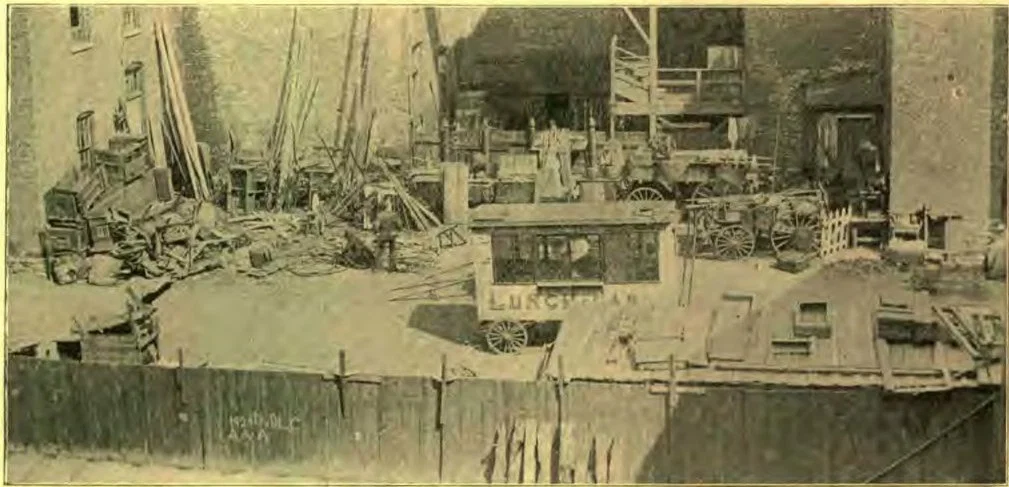
A BACK YARD IN THE SLUMS
Dear young friends,—you who had your father's green meadow for a playground; who daily saw the sparkling dew, and had the fragrance of roses wafted to you by gentle breezes; whose soul has been inspired by the sweet melody of the birds; who still cherish the memory of a fond mother's kisses, and the affectionate caresses of a godly father,—are you congratulating yourselves that you are neither criminals, crooks, nor drunkards? If so, reflect a moment upon what you might have been if your playground had been in the yard shown in the accompanying illustration. This is no fancy sketch, but is a photograph taken from one of our Training School windows, and represents our very adjoining premises.
Suppose, in addition, that your daily associates and playmates had been composed of ordinary street waifs, a good illustration of whom is also given. Study these faces, and you must conclude that they are already old in sin and iniquity. Many of these children have entirely lost track of their parents, while thousands of others always associate the thought of father and mother with kicks, cuffs, and brutal blows.
Chicago has enough saloons, if placed side by side, to make a solid wall over fifty miles long. There is one ward where one fourth of the entire population is arrested every year for various offenses. It is estimated that there are over sixty thousand morphine fiends in this city alone. It must not be imagined, however, that Chicago is all wretchedness and squalor. This city possesses magnificent parks, and about forty miles of beautifully kept boulevards, many of them lined on either side with elegant residences.
Next week we will tell about some of the work that is being done for the Master in this great city.
DAVID PAULSON, M. D.

GUARDING THE THOUGHTS

Our thoughts make us. They are silent builders, working day and night on the walls of the temple of character which each one of us is rearing. What our ordinary thoughts are, that we become. As a man “thinketh in his heart, so is he.” If his thoughts are white, a white life grows up. If he thinks vain, empty thoughts, the life will be vain and empty. If his imaginations and mental recreations are stained and unworthy, a life stained and unholy will be the outcome.
So we see how important it is that we guard our thoughts. They need guarding, too, and it is no easy task. Thoughts, fancies, feelings, and imaginations flow through the mind like a river. Some persons suppose that it is no matter what they think, as long as they do not let wrong thoughts take form in expression. Hating another in the heart, they say, does no harm if it does not show itself in word or act. Indulgence in impure fancies is not sinful, they think, if the fancies lead to no evil acts. But this is not true. Wrong thoughts are sins, even though they find no expression in act.
It is well to understand where sin begins. Temptation is not sin. Jesus was tempted in all points like as we are, yet without sin. Evil thoughts came to the door of his heart, and clamored for admittance. If he had opened to them, welcoming them, he would have sinned. But he refused to let them in, and kept his heart pure and clean through all his three and thirty years of human life in this world.
That is what we should seek to do. We can not live without being tempted, but we may resist temptations. We can not keep evil thoughts from buzzing about our ears, but we can keep them from coming into our hearts to nest and home there. We can refuse to read any book or paper which contains words that would start evil thoughts in our mind. We can shut our ears against any irritating, debasing, or indecent words. We can turn our eyes away firmly from seeing anything that would suggest evil.
CHILDREN OF THE SLUMS
There is a Bible promise that if we will take everything to God in prayer, the peace of God shall guard our thoughts. It is the figure of the sentinel that the words suggest. In the camp, in war time, in the most perilous hour, soldiers sleep in quietness and confidence because, all about the camp, sentinels wake and watch. So it is that God’s peace sentinels the very thoughts of him who makes God his intimate, confidential friend. We must let God keep us, or we can not be kept.
— M. C. Hazard, in the Well Spring.

TRANSFORMATION

Upon the work table in the laboratory I noticed beneath a glass a tiny cube of gleaming gold resting upon a cube of dull lead. When I asked my friend, the chemist, what experiment he was trying with his little metal cubes, he answered, “Come in again in a month, and I will show you.”
A month later I found the chemist working at his leaden cube with test-tube, Bunsen burner, and chemical acids.
“What are you doing to the lead?” I asked.
“Oh,” he replied, “just making sure of what the lead has been doing,” mixing, as he spoke, two liquids, which, on coming together, took a pale yellowish tinge.
“Sesquioxide of iron and protochloride of tin,” he said, dipping into the liquid a glass rod, which he then plunged into the vessel containing the lead in its latest estate.
“Watch,” he said; and as he drew the rod through the liquid, I saw in its track a delicate purple tinge.
“It is pretty,” I said, “but what does it mean?”
“It surely means gold,” he answered.
“Gold!” said I, in surprise; “but it was the leaden, not the golden, cube which you had there.”
“Yes,” the chemist replied; “only the lead has been in good company, a month with gold, and it has gained some of the gold particles by being with the noble metal; that is what comes of keeping good company.”
I wondered that the lead cube resting in contact with the gold should be permeated by its tiny, precious particles; but I remembered that I had seen human creatures gain gold from good company, and reverently I thought of the One of human kind who was perfectly pure, with no alloy of sin, and of what it must mean to live in his presence, in holy touch with him; for even so may our lower natures be permeated by his glorious life, till, at last, forever with him, we may be transformed, made in truth like him.—Selected.

WHITE MESSENGERS

A BRIGHT, interesting group had gathered in the sitting-room. It consisted of Mrs. Lane and her four children, whose ages ranged from five to fifteen. The wood fire leaped and crackled in the grate; the thoughtful, tell-me-a-story look upon the faces of the children proclaimed that it was that charming time, “between the dark and the daylight,” known as “the children’s hour.”
Suddenly the sound of a passing train near by attracted their attention.
“Doesn’t it seem strange,” remarked Will, the eldest, “to think of the people on that train? How they have come from every direction, and with such different objects? What interesting histories some of them must have!”
“Yes,” said Mrs. Lane, “I have often thought of that, and also of the white messengers many trains carry.”
“White messengers?” asked Will; “what do you mean, mother?”
“Why, that white messengers go north and south, east and west, all the time.”
“Oh, I know what mama means,” said five-year-old Katie, “I saw one to-day getting dinner ready.”
At this there was a general laugh.
“You mean the cook in the dining-car,” said Lizzie. “I don’t think mama means him.”
“These messengers,” Mrs. Lane explained, “are many in number. Each is burdened with a particular message to a certain individual.”
“I have been in the cars many times,” mused Flora, “and I never saw one.”
“That was because these travelers have a car to themselves.”
“What kind of messages do they carry?” asked Will.
“Oh, all kinds. Some bear sorrowful tidings, and will cause hearts to ache. Others carry stings like a wasp’s, and no one likes to meet them. One came to me yesterday, which seemed like a white-winged angel, the message delivered was so sweet and beautiful. All day and all night these messengers are flitting in all directions.”
“I wish I could see one,” and Lizzie gazed out of the window, as if expecting one to materialize for her especial benefit. Just then the postman’s knock was heard. “Open the door, Lizzie,” said her mother, “and perhaps you will see one.”
“Letters! letters!” cried Will, “why didn’t I think of that before?”
“Why, of course!” said Lizzie, “why didn’t we?”
An hour later Will still sat gazing thoughtfully into the fire. “Writing is really a wonderful art, isn’t it, mother?” he said at length. “I remember reading of a woman who sent a message to her husband by an Indian. She wrote a few words on a chip, and gave it to the man to deliver. When the Indian found that the white man, by a glance at the chip, knew about things at home, he was dumbfounded. He said afterward that he didn’t hear the piece of wood say a word, but somehow it told the man something, for all that.”
“I suppose he thought some enchantment had been used,” his mother replied. “We should be very thankful that we have this way of communicating with our absent friends. Let us be careful always to put this useful art to a good purpose.”
VIOLA E. SMITH.

AT THE PAN-AMERICAN EXPOSITION

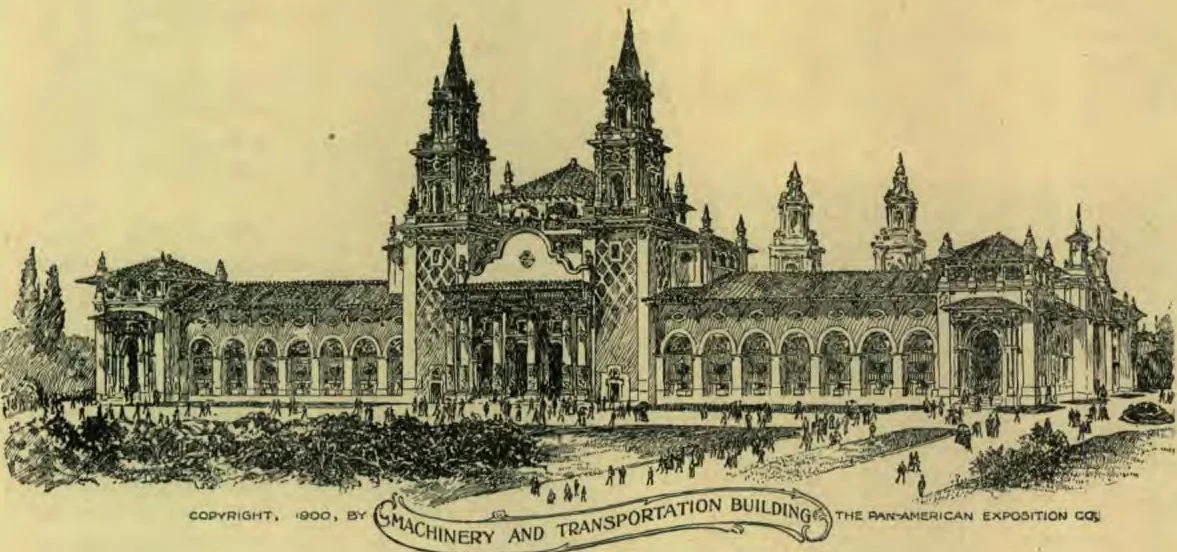
One of the big buildings of the Exposition will be that devoted to Machinery and Transportation. The work on this building is very ornate, with roofs laid with red tile, and the cemented walls brilliant with color. The colors are to be of reds and yellows in light tints. The loggias, balconies, pavilions, etc., are to be ornamented with shrubs, vines, and flowers, blending with the coloring of the building. The openings are grilled with specimens of wrought-iron rejas, or grill screens, such as are seen in examples of Spanish architecture of the sixteenth century. The building has a large central court, one hundred by one hundred and seventy-five feet in extent, with a beautiful fountain in the center, and a border on each side of flowering shrubs, ornamental trees, and rare plants. Of its numerous entrances, the principal ones are in the center of the four façades. Once inside the structure, the size will be appreciated. All the towers, pavilions and other proper spaces are to be brilliantly illuminated, and made gay with banners and flags.
MACHINERY AND TRANSPORTATION BUILDING
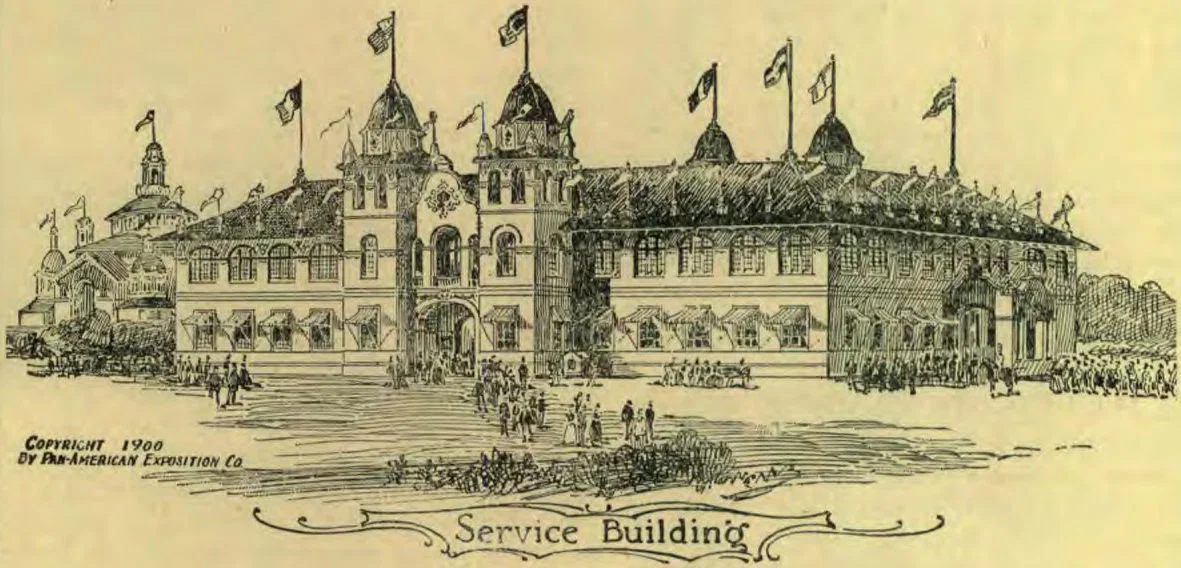
The large Service Building, although small in comparison with the larger Exposition structures, was completed in thirty-two working days, and was the first building erected on the grounds. It is the present home of a large corps of officers and employees having immediate charge of the constructive work of the Exposition. This handsome building is on the west side of the grounds, and is ninety-five by one hundred and forty-five feet, two stories high. A broad, arched driveway on the north side leads to an inner court. To the right and left of the driveway are entrances to the corridors that open into the various rooms.
In this building are the offices of the director of works, the landscape architect, superintendent of building construction, purchasing agent, chief engineer, and the mechanical and electrical engineer, with their numerous assistants. On the second floor is a large drafting-room for the use of architects, with fire-proof vaults at hand for their valuable drawings. In this building will also be the headquarters for the police and hospital service, the fire department, and the officers in charge of the transportation and installation of exhibits, and other officers. The building is equipped with cellar, kitchen, dining-room, and numerous sleeping apartments for the accommodation and comfort of those whose work requires their continuous presence on the grounds.
Service Building
Service Building
MARK BENNETT.

Two Kinds of Ambition: Desire and Purpose

Ambition is of two kinds. There is the ambition of desire. Nothing is more common. Every man would like to be wise and rich and great. If wishes were wings, all would be angels. But ambition that succeeds is made of sterner stuff.
There is, again, the ambition of purpose. This is the motive power of life. Wish is vain until it turns to will. Will begets work. The ambition of desire is common because it costs nothing. The ambition of purpose is rare because it exacts toil and self-denial, lays the lash on the back of indolence, restrains the appetite, curbs unruly passion, scorns delight, and lives laborious days.
Few reach the top, because few are willing to climb. We fail of success because we will not pay the price.—Selected.

REST

“God’s acre” rests in silence, calm and sweet, Scarcely broken by a wild bird’s distant cry; Its marble tombs gleam in the morning light As white as drifts that round about them lie.
The stars, reflected from the tranquil face Of the deep pool that lies below the hill, Tell naught of depths oft torn by wind’s rough hand, But sleeping now beneath its surface, still.
The quiet waters, dreaming ’neath the stars, To sad hearts bring a vision of repose. The “silent city’s” sweet, alluring peace Suggests a future rest from present woes.
For nature seems wrapped in a happy dream, Without a sigh to mar her slumber deep; While winter sunbeams, gleaming on her face, Reveal her faintly smiling in her sleep.
MINNIE ROSELLA STEVENS.
Continue reading: A VICTORY IN SPELLING