THE record of the Jews from the time that the first band of Hebrew slaves was brought to the "Eternal City" to grace the chariot wheels of great Pompey, as he returned in triumph from the conquest of Jerusalem, until the present day, when a Jew rules the destiny of "the Ancient Capital of the Cæsars," would make volumes of interesting history. While under the Roman rule, the Jews were at times "commanded to depart from Rome," and were subject to many humiliating conditions, their real hardships overtook them when the papal power laid its iron hand heavily upon them. Pope Eugenius IV (1431-39) forbad Christians from trading, eating, or dwelling with them, and prohibited them from walking in the streets, from building new synagogs, or from occupying any public office. Afterward Pope Paul IV (1555), in order to heap greater ignominy upon them, compelled them to run races down one of the principal thoroughfares of Rome amid the hoots of the populace. These races were run during the carnival just before the beginning of Lent. On this occasion the asses ran first, then the Jews with only a band around their loins, followed by the Barbary horses.
Finally, after being subjected to this barbarous humiliation for over two hundred years, the heart of one pope became so softened toward the Jews that he allowed them to pay a sum equivalent to 1,500 francs annually instead of running the customary races. While this change somewhat ameliorated their condition, they still were subjected to infamous treatment, as one can see from the following quotation from Gregorovius:
"On the first Saturday in the Carnival, it was the custom for the heads of the Jews in Rome to appear as a deputation before the Conservators in the Capitol. Throwing themselves upon their knees, they offered a nosegay and twenty scudi with a request that this might be employed to ornament the balcony in which the Roman Senator sat in the Piazza del Popolo. In like manner they went to the Senator, and, after the ancient custom, implored permission to remain in Rome. The Senator placed his foot on their foreheads, ordered them to stand up, and replied in the accustomed formula that the Jews were not adopted in Rome, but allowed from compassion to remain there."
However, Pope Paul IV, animated by that burning charity of which we have heard so much of late, shut up the whole Jewish population of Rome within the walls of the Ghetto (or Jewish quarter) and commanded that they should never appear outside of it, unless the men wore yellow hats or the women yellow veils; for as the papal bull says, "It is most absurd and unsuitable that the Jews, whose crime has plunged them into everlasting slavery, under the plea that Christian magnanimity allows them, should presume to dwell and mix with Christians, not bearing any mark of distinction."
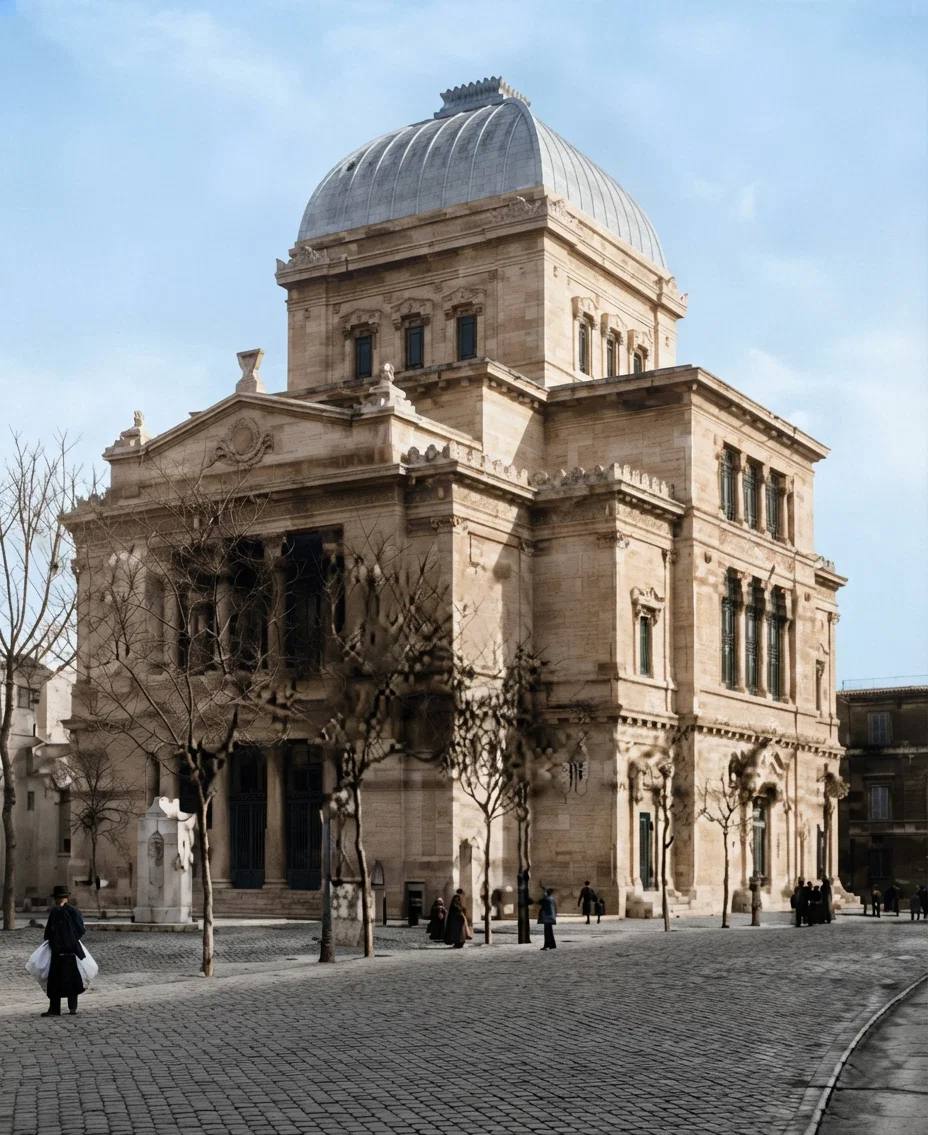
New Jewish Synagog, erected a few years ago in the Ghetto.
The day when the Jews were shut up within the walls of the Ghetto remains famous in their annals as a time of great mourning, and there is still to be seen the Gate of Weeping at which many of them stood to give vent to their great grief. Under Clement XI and Innocent XIII, all trade was forbidden to the Jews except that in old clothes, rags, and iron. It seems that the Papacy must have indoctrinated very well in this matter for they have ever since been faithful to their charge.
Finally, one pope, seeing that among his predecessors one had provided athletic sports for the Jews (racing them down the Corso with the wild horses), another had fenced them in, and still another had assigned them a business (junk-dealers), nothing remained for him to do but to teach them religion. So Gregory XIII forced the Jews to hear a sermon every week at a Catholic church. Every Sunday, police agents were sent into the Ghetto to drive men, women, and children into the church with scourges and lash them while there if they appeared to be inattentive. One writer of that time gives us this graphic description of the scene:
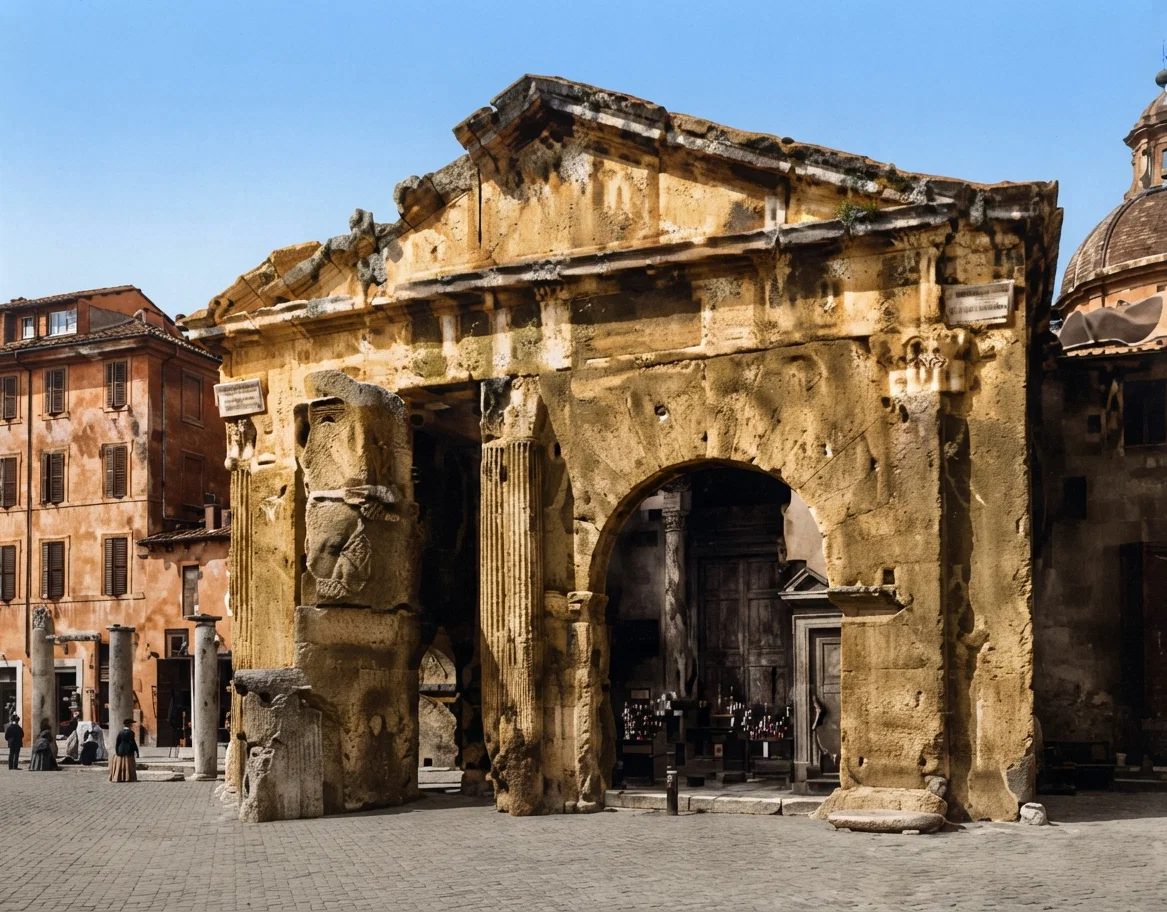
The Church of St. Angelo in Pescheria, where the Jews were compelled to attend church during papal rule. The portico is a remnant from the time of the Roman Empire.
"Now was come about the Holy Cross day, and now must my lord (the bishop) preach his first sermon to the Jews. As it was of old cared for in the merciful bowels of the church, that so to speak, a crumb at least from her conspicuous table here in Rome should be, tho but once yearly, cast to the famishing dogs, untrampled and bespitten upon beneath the feet of the guests; and a moving sight in truth this of so many of the besotted, blind, restive, and ready-to-perish Hebrews materially brought—nay (for He saith, 'Compel them to come in') haled, as it were, by the head and hair and against their obstinate hearts, to partake of the heavenly grace."
Surely one could say that the church left no stone unturned in its attempt to force religion down the Jews' throat, for they did this work of converting them with a vengeance. To complete the picture nothing could be more striking than the words of Browning describing the feelings of the Jews under these circumstances:
"Groan all together now, whee-hee-hee,
It's a work, it's a work, ah wo is me,
It began when a herd of us, picked and placed,
Were spurred thru the Corso, stripped to the waist;
Jew-brutes with sweat and blood well spent
To usher in worthily Christian Lent.
It grew when the hangman entered our bounds,
Yelled, pricked us out to his church like hounds.
It got to a pitch, when the hand indeed
Which gutted my purse would throttle my creed.
And it overflows, when, to even the odd,
Men I helped to their sins, help me to their God."
This custom of compelling the Jews to attend church and listen to a sermon weekly was only abolished by Pius IX, the predecessor of the last pope. By the same pope also the walls of the Ghetto were removed so that the Jews can circulate freely in the city. This race that has been despised and ill-treated by the Papacy for so many centuries has finally triumphed in the home of Catholicism, and a representative of the Jewish people occupies to-day the highest post of honor that is in the power of the city of Rome to bestow upon any man.
The present mayor of Rome, strange to say, is not only a Jew, but an Englishman; for Ernest Nathan was born in London, England, in 1848, of a good English family. Joseph Mazzini, the famous Italian patriot, found a refuge from the political storm that was raging in Italy during the days preceding the Italian independence in the Nathan household in London. The manuscripts and private papers of the great Italian statesman fell into the hands of the present mayor of Rome, who has written some very valuable books on the life of Mazzini. By a special act of Parliament he was made an Italian citizen in 1888.
Having been closely connected with Joseph Mazzini, who is the idol of the popular parties, he is highly esteemed by the Italian people. In the last election the clerical party that had held the reins of the municipal government at Rome from time immemorial, seeing its utter inability to cope with the well-organized popular parties, gave up the fight and did not even present its candidates to the voters. Consequently the municipal government fell completely into the hands of the liberal and socialist parties. As the power of electing the mayor of Rome lies in the city council, that body amid great enthusiasm elected Ernest Nathan by a unanimous vote. The new mayor is an indefatigable worker and has already shown great capabilities in the administration of his office.
It is needless to say that the pope and his party do not look with much pleasure upon the new state of things in their home. They are in hopes, however, that after a short experience with the popular parties the people11will be satisfied to return under the protection of the maternal wing of the church. But at all events the Jews have emerged from their position of being "dogs," kicked and scuffed by the Papacy, to that of rulers of the "Eternal City."
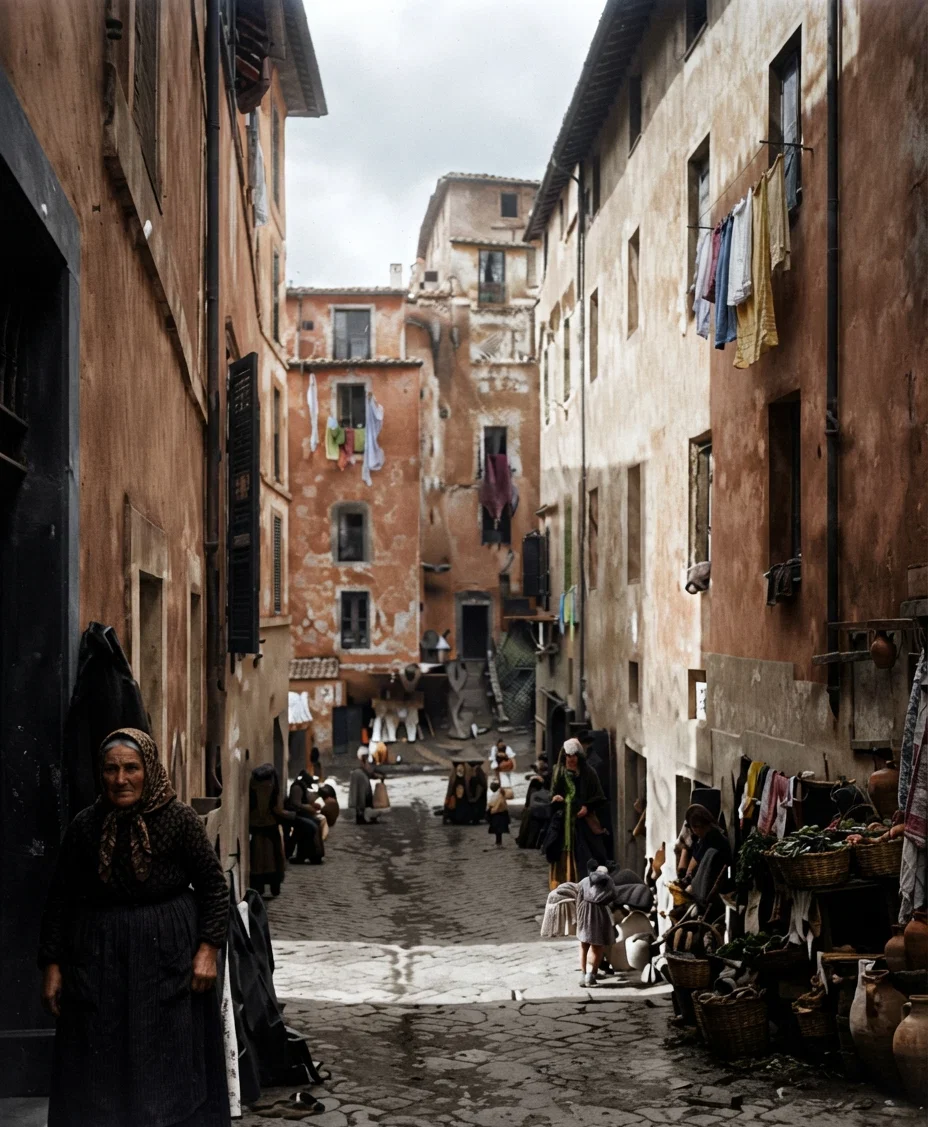
A Characteristic Scene of the Ghetto.
C. E. MILTON.
Items of Interest
By Editor
"The Western Watchman" notes the fact that the Catholic Total Abstinence Union, of Eastern Pennsylvania, in a series of resolutions adopted, declare that the game of baseball is conducive to temperance and morality, in that it promotes healthy bodies and clean minds. We wonder if that will help some of our Sunday-law friends to be more lenient to Sunday baseball.
We note as a matter of interest that a candle ten feet high, which will burn for two years or more, was manufactured in New York recently for an Italian. It measures eight inches in diameter, and weighs 310 pounds; its sides are decorated with pictures of flowers and reproductions of paintings of a religious nature. It is made entirely of beeswax and cost $300. Presumably it will be placed before some shrine for religious purposes.
The seven lean years recorded in the latter part of Genesis of the famine in Egypt finds confirmation in the Egyptian records themselves. The hieroglyphic inscriptions translated by Brugsch Bey show that 1,700 years before the Christian era the Nile for seven consecutive years did not overflow, and famine, pestilence, and misery followed. "We know," he says, "that the date of the seven years of fruitlessness mentioned in Genesis was B.C. 1700, and thus what has been looked upon as a fancy, has thru these hieroglyphics become a matter of history." The failure of the Nile to overflow, the withering of the vegetation, the lands devoid of crops, famine, and the consequent scourges, are all depicted in the pictures which the student has been able to decipher. And yet he who believes the word had all this information and much more long before.
"The Ave Maria," a Catholic paper, thinks that a good many Protestants nowadays "would be secretly rejoiced if a division of the school fund or some other plan permitting of the teaching of religion in the schools were effectively carried out. Admission of error is not a pleasant task, but this country is rapidly awakening to the fact that the legitimate product of godless schools is not a moral, tho he may be a clever, citizen." And yet while there should by all means be religious teaching in connection with education, or all true education ought to be based on religion, it is not the place of the state to teach it.
The arsenals of the Philippines are being filled with war material, the entrances to Manila and Subig Bays are being fortified, and military roads are being laid out along the coast. So a recent San Francisco paper states. It continues: "Since the first of the present year the shipments of ammunition thru this port amount to about 25,000,000 rounds of cartridges, and in addition to this there have been shipments totaling nearly 35,000 new Springfield rifles. There are, however, less than 20,000 troops in the archipelago."
Fifty wasted years.—Despatches from Paris tell of the death of a woman who has lived the life of a recluse for fifty years because of the death of her husband on her wedding-day. The blinds of her house were never opened, and in all the years her servants never permitted a person to enter her presence, and they never spoke a word to her. She leaves her fortune to found a home for old people; but how much better for her and doubtless many more, had she devoted those wasted years to some useful purpose.
Floods at Lincoln, Neb., July 6, caused great damage to property, and nineteen were reported drowned. The water was as deep as fifteen feet in places, the wells are filled with surface water, gas and electric plants inundated, and all traffic paralyzed. Hundreds were rescued from the lowlands with boats.
The Socialist nominee for the presidency, Martin R. Preston, is a convict serving a twenty-five year term for murder in Nevada. He is also under the constitutional age. The candidate for vice-president is Donald Munro.
The pope, in a recent pontifical document, removed Great Britain, Holland, Canada, and the United States from the jurisdiction of the propaganda, so these countries will no longer be considered missionary lands.
A destructive fire occurred in Boston July 8 which caused the loss of more than one million dollars in property. A quarter of a mile of the dockage was destroyed. One life was lost.
Intoxicated schoolchildren are said to be causing considerable annoyance to the teachers of Geneva, Switzerland. The new vintage of wine coming on, the people allow their children to use the old wine to make room for the new. Tramps are given wine when they ask for a drink, and it is rare to see a child in that district without a little gourd of wine slung across his shoulders for personal consumption.
About one hundred theater cases were dismissed from Judge Porterfield's docket in Kansas City, June 24. Fifteen hundred Sunday-closing cases still remain in Judge Wallace's court. Thus far, since the Sunday-closing crusade started last September, eight theater cases have been tried, resulting in four acquittals, two hung juries, and two convictions, with a fine of one dollar in each conviction. It costs Jackson county about $75.00 a day in jury fees alone during the trials of these cases.
President Roosevelt is being besieged by magazine representatives, who offer fancy prices for African hunting stories. The highest price offered is $12,000 each for five stories, more than the President receives yearly in his present position.
An earthquake of from ten seconds to half a minute was felt in the lower part of Mexico June 30. Some property was destroyed, but no lives are reported lost.
Was Jesus a Socialist?
AMONG Socialists Jesus has frequently been claimed as one of themselves. "One would like to say that He was," observes a writer in "The Interior" (Chicago), for He was "social in the largest sense, because He sacrificed Himself for the welfare of other men." But since "socialist" in the modern world has come to mean (the writer interprets) "the adherent of an economic cult that would reorganize society on the public ownership of property," he does not allow the ranking of Jesus among them. Against what he calls the "rash assertions of agitators," he places this "proposition" as capable of being established from the Gospels:
"NEITHER SOCIALISM NOR ANY OTHER ECONOMIC DOCTRINE EVER ENTERED INTO THE TEACHINGS OF JESUS OF NAZARETH.
"He simply paid no attention to the economic phases of life. He treated industrial questions exactly as He treated political questions; He let them alone.
"There were doubtless two reasons for this. Jesus didn't come into the world to meddle with the clock of human progress. Some day the world would learn that democracy is better government than despotism, free labor a better industrial system than slavery, and would get hold of the facts all the stronger for having had to dig them out. Jesus had no time to stop to teach the world what it would eventually come at on its own account.
"The second and positive reason why He did not concern Himself with social questions was because it was part of His mission to throw temporal considerations into the background.
"HIS PRINCIPAL TEACHING BUSINESS WAS TO SPREAD A DOCTRINE OF LIFE THAT MADE A MAN'S ECONOMIC CONDITION A SECONDARY MATTER.
"Here Jesus differs from socialism the whole length of the diameter. The thoroughgoing socialist thinks poverty the worst thing that can happen to a man. His great plea is to abolish poverty. Jesus didn't think being poor mattered much—not at all if the man was the right sort. He was poor Himself, and didn't care in the least.
"The overmastering principle that decides how Jesus looks at any or all human circumstances on this earth is this:
"IF A MAN DOES THE WILL OF THE FATHER IN HEAVEN, NOTHING IN HIS EARTHLY CIRCUMSTANCES CAN BE WRONG.
"This confidence is half a faith that the Father will compel circumstances to turn out favorably; half a faith that a man who lives for the Father can be happy in any circumstances."
The nearest Jesus ever came to an economic question, the writer points out, was "when He saw that some certain man's economic condition was hindering his development in unselfish, God-loving, and man-loving character." He goes on:
"Modern social philosophers say it is the poor who don't have a fair chance at fine character, but Jesus thought different—He considered the rich the most handicapped.
"When with His marvelous inlook into the heart the Master understood that the rich young ruler thought so much about his wealth that he couldn't think much about his neighbors, the prescription for cure was instantaneous and unsparing: 'Sell that which thou hast, and give to the poor.' Jesus didn't speak so much of hate for the property but out of yearning for the man. If He could in this way give the youth a big heart full of spontaneous impulse to help people, He knew it would be worth the price.
"But where He didn't find worldly possessions hindering the growth of a man's nobler character, He simply ignored them. Giving half delivered Zaccheus from the bondage of avarice, and Jesus asked no more. He was equally at home with the poor and with the rich. He loved both for common qualities which are counted in no coin on earth.
"JESUS TAUGHT NEIGHBOR-LOVE ABSOLUTELY, NOT AS AN INCIDENT BUT AS AN ESSENTIAL OF RELIGION, BUT HE NEVER SO MUCH AS HINTED AT A SOCIAL PROGRAM FOR DEMONSTRATING THAT ASPECT OF RELIGION.
"Jesus was no program-builder. This is one of the very hardest things for the modern age to comprehend in the Master. The latter-day must have an organization at work, or it thinks it has nothing. But Jesus had an unbounded faith in the power of a spirit at work in and thru the lives of individual men.
"Likewise, when He said, 'Thou shalt love thy neighbor as thyself,' He did not deposit the dynamic of that love in some artificial social body, either then existent or afterward to be created, but He imported it by contact to the affections and wills of His friends, and left them to extend it in the same manner."—Literary Digest.
The True Man.
By James Russell Lowell
He stood upon the world's broad threshold wide,
The din of battle and of slaughter rose;
He saw God stand upon the weaker side,
That sank in seeming loss before its foes;
Many there were that made great haste and sold
Unto the cunning enemy their swords;
He scorned their gifts of fame and power and gold,
And, underneath their soft and flowery words,
Heard the cold serpent hiss; therefore he went
And humbly joined him unto the weaker part;
Fanatic named and fool, yet well content
So he could be the nearer to God's heart,
And feel its solemn pulses sending blood
Thru all the wide-spread veins of endless good.
—Lowell.
Modern Greece
By Prof. W. E. Howell
By Prof. W. E. Howell
all this pageantry passes in vision before the mind of one who has just returned from viewing what he can scarcely trust his natural eyes to believe is real.
All week long the bells in every church tower and chapel have been sounding the call to service twice a day. All week long the devotees to this ceremonial system have been crowding the places of worship in the early morning and in the evening till midnight. All week long butter and cheese and milk and olive-oil and eggs and flesh have been absent from the tables of those who observe the forty-days' fast before Easter. All week long one might have heard in the streets and gathering places the remark, So many days, and the fast will be over.
The Common Priests, who receive no pay, but live off the charities of the people, the fees they collect for petty services, and the sale of articles used by worshipers in their devotions.
And why all this unusual stir? It is Passion Week, the last week of the long fast before Easter. It is the Great Week (as the Greeks call it) the week whose services commemorate the greatest events of Christendom—the betrayal, the death, the burial and the resurrection of Christ.
On Wednesday evening the theme of the service is the betrayal by Judas. On Friday evening, in addition to the service in the church, a raised, life-size image of Christ in the tomb, upon a piece of rich tapestry, is borne from every church thru the streets at nine o'clock, at the head of a long procession of the faithful, pausing at the principal street crossings and public squares for a brief service by the priests, interspersed with frequent repetitions of "Lord, have mercy," by the psalterers and assembled people, and finally returning to the churches at eleven or twelve o'clock. In the procession lighted tapers are borne as a sign of respect to the dead, and occasionally a more devout one passes thru the throng to kiss the icon when it halts.
On Saturday night the people assemble at the various churches at midnight to commemorate the resurrection of Christ, which is said to have taken place at that hour. The culminating part of the service is held in the open air. At the Metropolitan Church, where all governmental functions are held, and where the chief functionary of the Orthodox Church of Greece presides, a large platform is erected in the large square before the church. On this stand civil, military, and ecclesiastical officials and prominent citizens assemble to hear the presiding bishop make the formal announcement, "Christos aneste," "Christ is risen!" This enunciation is the signal for the shooting of sky-rockets and firecrackers, the burning of phosphorus-sticks, and a general jubilee—Greece's nearest approach to a Fourth-of-July celebration in the United States. It also closes the prolonged fast, and the people return immediately to their houses at this untimely hour to eat roast lamb and whatsoever their souls lust after.
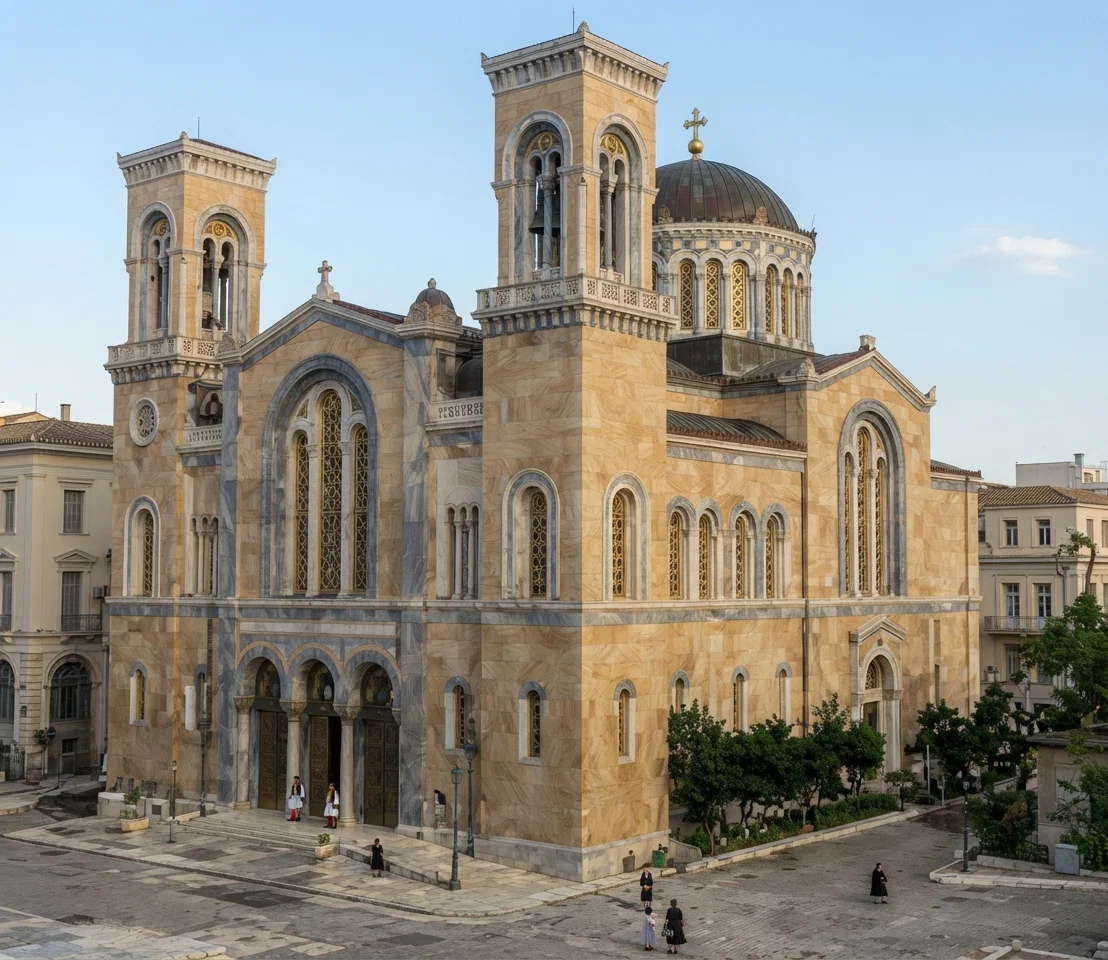
Metropolitan Church, where all state and royal functions are held.
During the two days preceding, the market places echo with the bleating of lambs (for in Athens all small animals are slaughtered in the stalls where their flesh is exposed for sale), and the gutters run with the blood of innocents. For this paschal feast in the night, and for the continual feasts of the three holidays following, the rich man provides a lamb for his servants, and every peasant manages to procure a lamb for this season, one of the few times in the year when he is able to provide meat for himself and his family.
During Sunday, Monday, and Tuesday one may see lambs roasting whole on iron spits revolving over a bed of charcoal embers, in the back yard, in vacant lots, along the sidewalks, or anywhere the feaster may see fit to set his stakes. It is a time when Greek hospitality is in full exercise. Not only does each householder have many of his friends to share his feast, but if a stranger happens along, he is served to a piece of lamb on a fork and a glass of wine. In truth, wine flows freely these days. The numerous refreshment houses are thronged with all classes, and this is one of the only two or13three occasions in the year when a Greek may be seen drunk, and then only one here and there of the lower classes, and they only drunk enough to be merry or impudent.
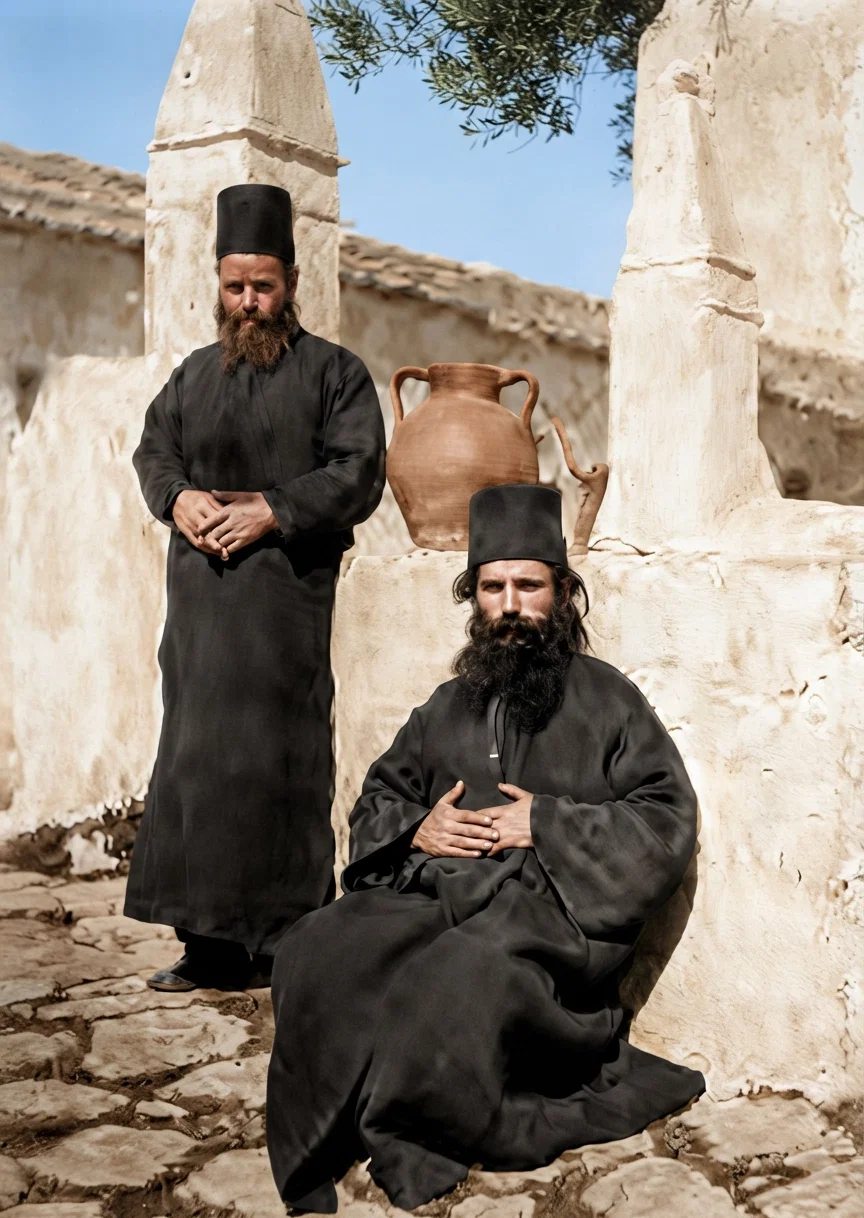
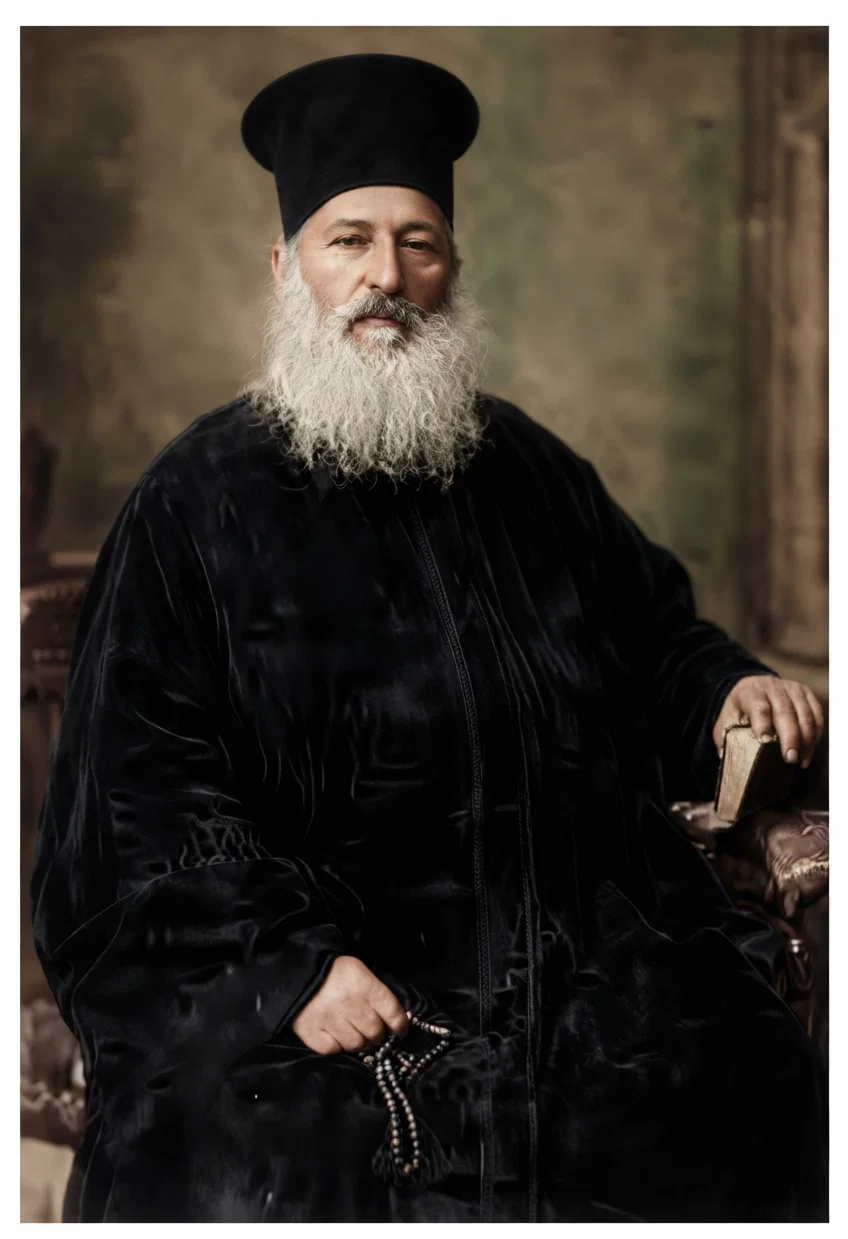
A Typical Priest of the Better Class.
During these days, too, the common form of greeting is "Christ is risen, how are you to-day?" The phrase "Christ is risen" is used in so common and careless a manner as almost to cause a shudder to one not accustomed to it. A fair sample is the following advertisement circulated as a handbill when business opened again on Wednesday:
"CHRIST IS RISEN
"Attention Gentlemen!
"Since it is a consequence of the fact that the paschal festivities derange your stomach, you ought to procure a bottle of — Avoid counterfeits. Make haste!"
During the week preceding Easter, Athens was one great egg market. The use of eggs being forbidden during the fast, the peasants had saved up eggs for Easter, and now was their harvest. Not only were all kinds of provision stores well stocked, but temporary stands filled with eggs and dyes were set up along the sidewalks, in every nook and corner, and even out into the streets, while baskets of them were hawked thru the city by numerous venders. Part of the eggs were colored, red prevailing, some having a picture of Christ on the cross drawn in gold on the red background. These colored eggs were one item on the bill-of-fare at every feast following the breaking of the fast, and a part of every hand-to-mouth lunch eaten on the street by bootblacks, porters, and other street runners.
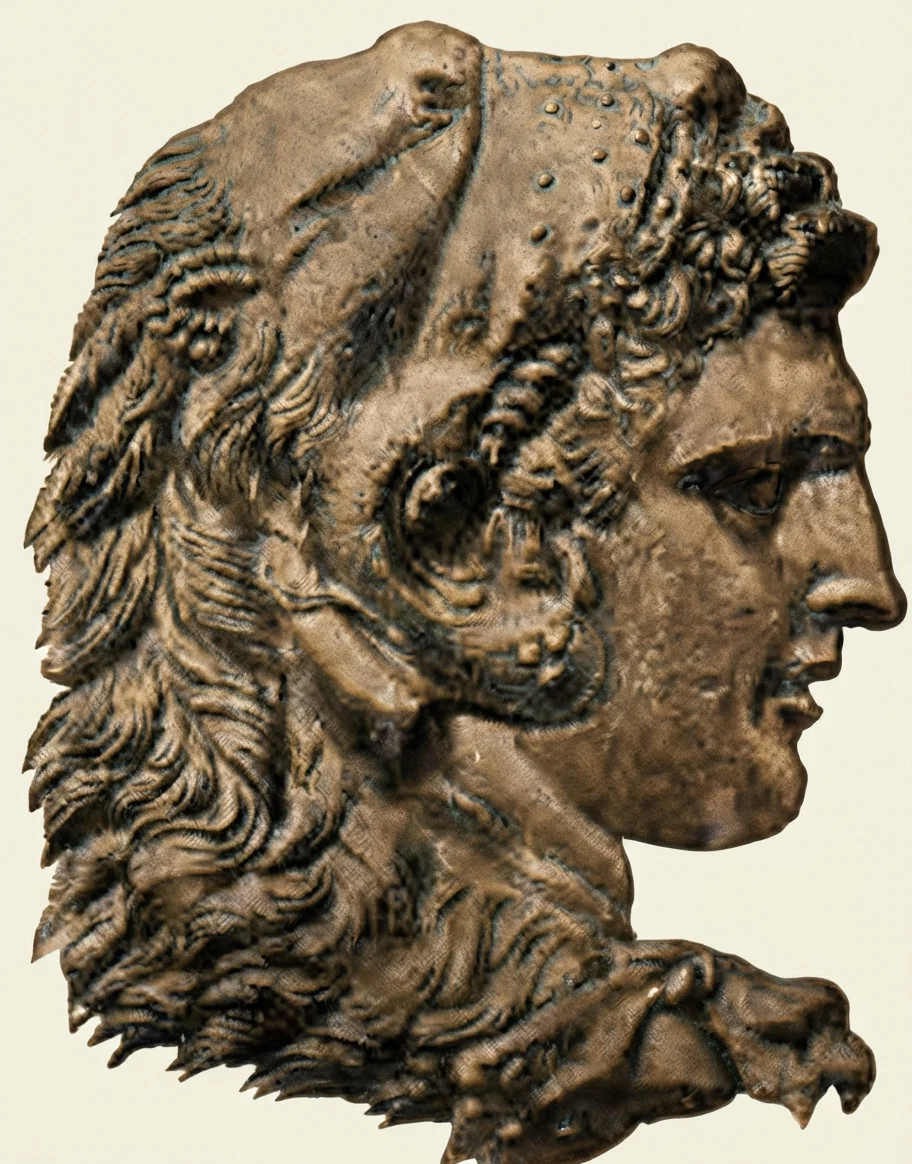
Alexander the Great, the impersonation of the Pan-Hellenic Union. "Let us rescue Macedonia," the words of Alexander, is the motto of the Macedonian party in Greece.
Another curious sight, analogous to that of the eggs, during these busy days of the Great Week, is the sale of candles. As for the eggs so for the candles, temporary stands are built everywhere. Candles of every size from three feet long and two inches thick at the base to the size and length of a very small lead pencil, of two colors, white and yellow, some plain and some highly ornamented, are suspended from a high frame for the purpose or laid in parallel rows on the table below. The vender sits or stands behind with a pair of scales or steelyards to weigh out the desired quantity. The whole structure is decked with gay-colored streamers of paper, some of the individual candles being likewise decorated. Here the high and low surge along and make their purchases, no one offering the least complaint at the blocking of thorafares by these and other ecclesiastical supplies, such as prayer-books, church rituals, sacred relics, icons of the Virgin Mary, and ghastly colored pictures of the sufferings of Christ during His trial and crucifixion.
This dealing in candles is no small business when it is remembered that every one is a member of the church, and that the oftener the worshiper goes to church and the more candles he buys when he does go, the better he has discharged his religious obligations.
Numerous stores are engaged solely in the preparation and sale of church candles only. Candles, too, constitute one of the sources of revenue to the poorly paid priests who are under the constant temptation of making their religion pay. A worshiper buys one or more candles at the door of the church, which he places lighted before the proper icon, where they burn during his devotions. On his departure, the candles, perhaps one sixth to one fourth burned, are removed, extinguished, and put away to be melted over and sold again.
The foregoing description affords just a glimpse of the observance of the greatest fast and feast of the Holy Orthodox Catholic and Apostolic Church, as it calls itself. The feast-days are legion, the fasts are numerous, and the ritual never ending and little varied. The multitudes thus fed upon husks go empty away. Some feel their leanness of soul, and long for the Father's house. When they are shown the way thither and turn to Him, will He not welcome them in the way, and quickly kill for them the fatted calf?