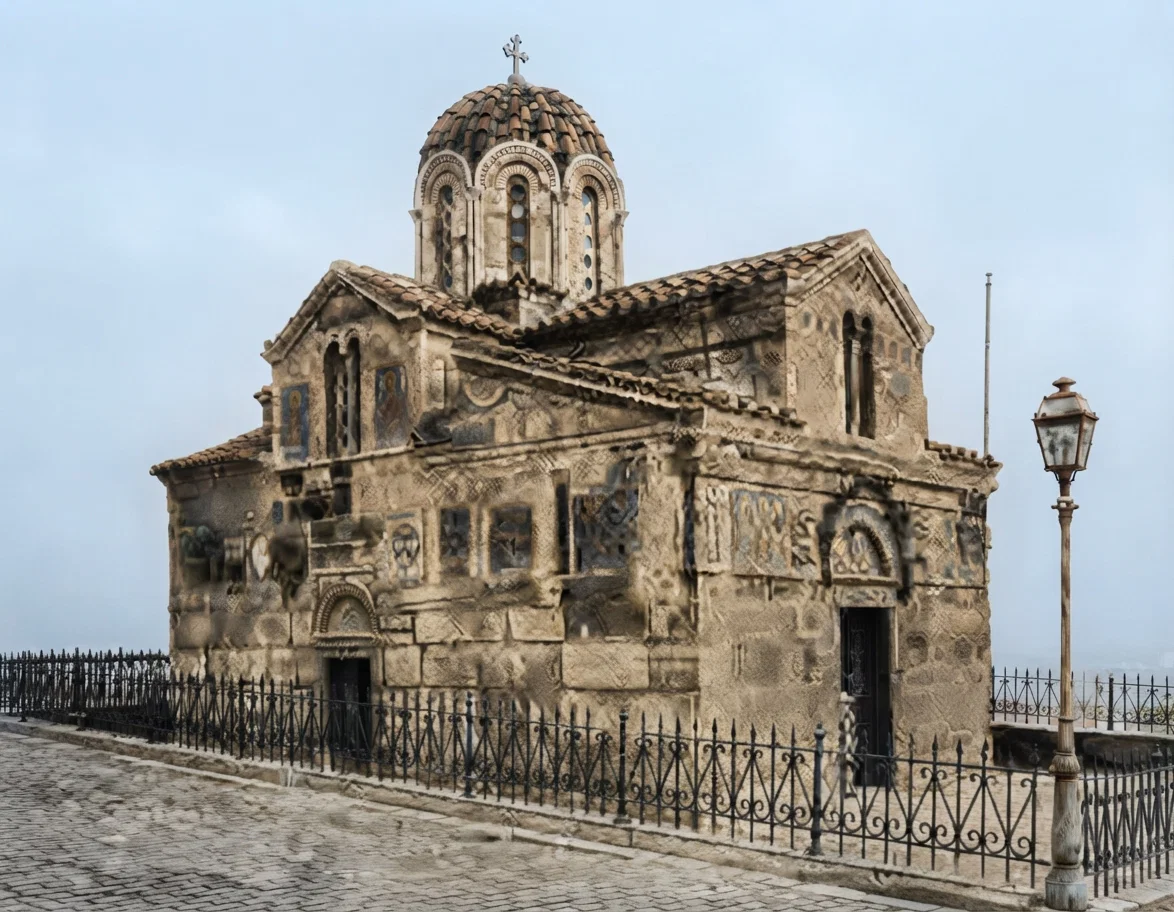
Older Byzantine Type, formerly the Metropolitan or First Church of Greece.
Eastertide.
THE echoes of the noisy, spectacular celebration of Easter by the Greeks have not yet died away. The smoke of myriads of tapers is still smudging the inner walls of the seventy churches in Athens, and of the scores of chapels dedicated to various saints in the neighboring villages and country, while the scent of tallow and beeswax is still discernible in the hazy atmosphere of the public squares and leading thorofares. The chanting by the priests of the same liturgy that their predecessors have chanted for centuries gone by, and the responses of the psalterers and boy choruses—the only music ever heard by the worshiper—still resound within the ubiquitous temple of Byzantine architecture.
The blast of the buglers heralding the approach of the icon of Christ in the tomb as it is borne horizontally upon the shoulders of white-haired priests thru the streets; the tramp of the soldiery with their clanking arms as they accompany the bier of the dead Christ; the playing of funeral dirges with muffled drums and horns; the flickering candles of thousands of high and low pressing their way in one vast throng in the wake of the bier to pay their respects to the dead; crosses, crosses everywhere—on the standards borne aloft before the bier, on the priests' robes, on the national flags hung along the way, on the cap of every soldier, dangling from the necklaces of women and children, on every church and chapel passed by, and, conspicuous above all, those visionary crosses described upon the breast by the countless multitudes who fill the streets and balconies, as they bare their heads to do honor to the passing picture upon a piece of tapestry,—
Archbishop of Patras, a seaport on the Gulf of Corinth.
Our Work and Workers.
By Editor
BROTHER V. B. WATTS baptized four candidates at Lincoln, Ark., June 13.
JULY 4, five were baptized as the result of tent-meetings at Hill City, Kan.
SIX members were added to the church at Hopewell Cape, N. S., June 21, by baptism.
BROTHER C. H. Miller writes of baptizing five dear souls at Tekama and one at Calhoun, Neb.
AT the close of the camp-meeting recently held at Seattle, Wash., forty-six went forward in baptism.
JULY 4, Brother L. Zecchetto baptized eight believers from the French settlement at Woonsocket, R. I.
AT Gangeville, Cal., Brethren B. L. Howe and C. M. Gardner baptized thirty-five June 27. Several more are deeply stirred.
NINE children and youth were buried with their Lord in baptism at Modesto, Cal., June 22, by Brother C. M. Gardener.
NINETY-TWO have united with the Denver (Colo.) church since the beginning of the conference year. Five were baptized June 27.
CAMP-MEETING for the Greater New York Conference was held at New Rochelle, June 4 to 14. At its close seventeen were baptized.
BROTHER FRED JOHNSON baptized six at Sebeka, Minn., recently. These embraced the message thru the labors of Brother O. J. Nerlund.
THE clerk of the church at Columbus, Ohio, reports the addition of four by baptism June 20, and six more expecting soon to unite with them.
BROTHER C. D. M. WILLIAMS writes from Honolulu that the brethren have dedicated a new house of worship. Brother R. C. Porter preached the dedicatory sermon while on his way to South Africa.
THE Upper Columbia Conference, at its annual meeting at Spokane, Wash., early in June, received six new churches with a total membership of one hundred twelve.
FIVE adults at Harwarden, Iowa, have begun the observance of all the commandments, and others are thinking seriously of taking the step as the result of the labors of Brother and Sister L. P. Syp and Ross Syp.
A LETTER from Brother J. A. Leland, Albuquerque, N. Mex., states: "The church here is growing. On May 21, six dear souls were baptized, and there are several others to follow soon in the same ordinance."
ENCOURAGING reports come from the labors of several brethren at Rosehill, N. Dak., where twenty-three new members rejoice in the light of the truth. A church of twenty-nine has been organized by Brother C. Leer.
MEETINGS at Boulder, Colo., conducted by Brethren Meade MacGuire and E. E. Farnsworth, closed with the baptism of twenty-nine. In all, thirty-five united with the church by baptism during the month of June.
AT Alexander, Texas, Brother G. A. Lagrone has been busy meeting error. The opposers to the truth have helped bring six to take their stand for it. A Sabbath-school of twenty-two members has been organized.
BROTHER J. ERNEST BOND writes from Douglas, Ariz., under date of July 12: "We have just held baptismal services and organized a company here. Fifteen were baptized; others will follow in a few days. Each family represented has taken the SIGNS."
BROTHER W. M. HEALEY writes from Escondido, Cal.: "Sabbath, June 6, I baptized six of the older pupils of the Escondido church school. I have reason to believe that the school did much toward bringing these young people to take their stand on the Lord's side."
REPORTING the annual conference and camp-meeting of the Wyoming Conference, held at Crawford, Neb., Brother Chas. Thompson writes: "Twenty-seven were baptized during the meeting, six new churches were admitted to the conference, twelve new tents were pledged for camp-meeting accommodations, and on the last Sunday an offering was taken for missions amounting to over $1,100." Brother J. H. Wheeler was reelected president.
THE Northern Union Reaper reports three splendid camp-meetings in the Northern Union Conference. The first was at Minneapolis, Minn., where one thousand were camped on the grounds, and fifty-five were baptized. At the second, at Woonsocket, S. Dak., about the same number were baptized. The third was held at Velva, N. Dak. Meetings were held daily in four languages, English, Russian, Scandinavian, and German. Ninety-six were baptized, and $25,000 was given for home and foreign missions.
Wanted for Missionary Work.
By Editor
CLEAN copies of the Signs of the Times and the Youth's Instructor for reading-rack. Address Alex. Lofgren, 903 W. 52nd St., Ballard, Wash.
CLEAN copies of any of our denominational papers for use in jail and general distribution. Address Mrs. Julia W. Jenssen, 99 E. 17th St., Paterson, N. J.
Signs of the Times and Watchman. Address Christ Wilking, R. R. 28, Box 12, Wellston, Mo.
Signs, Review, Watchman, Life and Health, Life Boat, Instructor, tracts, pamphlets, Sabbath-school Quarterlies. Address W. H. Reed, Adkins, Wis.
LATE, clean copies of the Signs of the Times, Watchman, Liberty, Life and Health, Youth's Instructor, and Little Friend, for free distribution in U. S. Navy Yard reading-rack. Address A. V. Dyberg, 220 Main St., North Vallejo, Cal.
The Church—Its Organization, Order, and Discipline.—This is the title of a 183-page pamphlet by Elder J. N. Loughborough. The book is just what the title implies, outlining by Scriptural quotations the organization, order, and discipline in the ancient church and in the apostolic church. Giving a history of this, the last church, from its founding in 1844 to the present time, and explaining the organization, order, and discipline of the church and the conference. This little book should be in the hands of all Seventh-day Adventists. Paper covers. Price, 25 cents, post-paid. Address, Pacific Press, Mountain View, Cal.
Bibles.—Remember that we are headquarters for anything in the Bible line. We shall be pleased to send you our catalog of Bible selections on application. Pacific Press Publishing Co., Mountain View, Cal.
Literary Notices.
By Editor
"The History of Babylonia and Assyria." By Hugo Winckler, Ph.D., professor in the University of Berlin. Translated and edited by James Alexander Craig, Ph.D., professor of Semitic languages and literature in the University of Michigan. Price, $1.50, net. Charles Scribner's Sons, New York City.
Dr. Winckler has the reputation of being one of the thorough scholars in Biblical research, one of the foremost Semitic linguists, and a specialist in Assyriology. The book first appeared in 1899. It was revised and edited up to date in 1907 by Dr. Craig, and this is the translation, revised by the author, so it is as nearly an up-to-date work on Assyria and Babylonia as we possess. The object of the work is to tell the plain story as far as history and archeology reveal of the earliest inhabitants of Babylon and Assyria; of the various dynasties and changes of the Babylonian Empire; the Elamites as rulers of Babylon; and finally, Babylon under the Chaldeans and subject to Assyria. In the same way the Assyrian field is covered. Part three of the book is a consideration of the new Babylonian-Chaldean kingdom. There is a very copious index and an excellent map. In addition to this the book is at a reasonable price, placing it within the limits of all who may desire to investigate. The author, altho not writing for that purpose, agrees with the Bible in placing Babylonian civilization and Babylonian influence paramount, in the earliest days of history extending far beyond her own bounds into that of all neighboring lands, including Egypt.
"New England Struggles for Religious Liberty." By Rev. David B. Ford. American Baptist Publishing Society, Philadelphia.
The author of this book has found abundant material for his facts in the vast mass of matter which the Puritans and other New England peoples and communities have left behind them. And from these historical facts and stories, he has gleaned and placed in a convenient volume the struggle for religious liberty. Part One and Part Two deal with the Puritans in their relations to the anti-Baptists and Quakers; and Part Three, the subsequent struggles for religious liberty and its final triumph. An interesting story it indeed is, as the struggle for liberty always must be to those in whose hearts there is longing for freedom. The part which Baptists acted is quite fully set forth, and the heroic efforts which they made, until finally church and state were entirely separated. He who would understand the meaning of religious liberty in America and the danger which menaces the country now, should read Mr. Ford's work.
"Winning the Boy." By Lilburn Merrill, M.D., with an introduction by Judge Ben B. Lindsey, president of the International Juvenile Court Society. Price, 75 cents. Fleming H. Revel Company, New York and Chicago.
This is an interesting, helpful, and timely book for those who are dealing with boys; and who do not? One may not agree with all that Dr. Merrill has said regarding the boy; he may not think the doctor's methods which he suggests are always the best; he may not find himself able to put them into practise; but we do not know who can read the book without getting help from it. It certainly offers hints and suggests helps with a constant, whole-souled sympathy for the boy that is refreshing. The scope of the ground is indicated in the following titles: The Heart of a Boy, Transition to Manhood, Study of the Individual Boy, Fresh Air Work with Boys, Religious Meetings for Boys, and Clubs for Boys. We can only say, read the book; it tells its own story in its own way, but it is worth reading.
"Health for the Million." A book of practical health-culture, which helps toward the Prevention of the Diseases, and the Attainment of the Highest Physical Efficiency. By Alfred B. Olsen, M.D., Superintendent of the Surrey Hills Hydropathic, and of the Leicester Sanitarium; and M. Ellsworth Olsen, M.A., editor of (London) Good Health. Richard J. James, 3 and 4, London House Yard, Paternoster Row, E. C., London, England. Price two shillings, six pence, which would be about 75 cents in America, including postage.
It is not the design of the book to give long symptoms of diseases. It leads forward to health instead of back to ailments and troubles. Of course it must recognize conditions, and it finds these conditions in the great, sick mass of humanity. Its aim and object are to lead the ailing from the wrong habits and customs and practices which have resulted in these untoward conditions to the simple, straightforward habits of health. If followed, it will lead from unnatural conditions to natural conditions; and with the natural conditions will come health. The scope of the book is indicated by the chapter headings: What Is Health? Physical Restoration; Good Physique and How to Train for It; The Heart, Blood-Vessels, and Blood; Hygiene of the Nose and Throat; Care of the Lungs; How We Digest Our Food; Liver Complaints; Hygiene of the Brain and Nerves; Care of Sight and Hearing; Hygiene of the Hair and Scalp; Care of the Teeth; Headache; Rheumatic Disorders and Other Ailments. The book deals with Nature's Remedies, Love and Marriage, Infant Feeding, The Growing Child, Woman's Health, Rational Beauty Culture, Personal and Home Hygiene, Food in Relation to Health, First Aid to the Injured, with some good, strong protests on natural narcotics, how they affect the body, especially the effects of cigarettes upon boys. There is a full table of contents with an excellent index. The introduction is written by G. Sims Woodhead, M.A., M.D., Fellow Trinity Hall, and professor of Pathology, University of Cambridge.
"Church History." By Rev. H. T. Besse. 534 pages; price, $2.75. Holzapfel Publishing Co., Cleona, Pa.
The aim of this book is to give in as simple and condensed form as possible, the great salient facts of church history, brief biographies of the reformers, and list of the principal American and European churches, with considerable space to missions. The author set himself a very difficult task to adequately cover so much ground in so small a volume. He has also to quite an extent departed from the idea of history and delved more or less into theology and religion, aiming to give the teaching of the word according to his views, as well as the history of the church. There are many Bible students who will hardly agree with him in his interpretations of the prophecies of the Apocalypse, or of his view of the gifts in the church. In his statistics the author has not consulted the latest authorities, having evidently depended upon general statements and year books which are out of date. Yet on the whole the facts which are given us are of interest and value to those who are not able to counsel the more expensive works, if they will not depend upon his later statistics. The great age of the author—eighty-four—has naturally had its effect in the last revision of his work.
"The Covenant of Salt" as Based on the Significance of Salt in Primitive Thought. By H. Clay Trumbell. Charles Scribner's Sons, New York City.
An excellent little book. One may not always agree with the conclusions of the author, but he will feel to thank him continually for the light which he throws on various passages of Scripture. The author made long and faithful study; some of it upon the very ground of Oriental symbolism. And in the light of that symbolism the subject of the book is presented. The Characteristics of the Covenant; The Covenant of Salt; The Bible References to the Rite; Salt Representing Blood and Life; Salt in Sacrifices; Exorcism and Divination; A Savor of Life or of Death; The Meaning of These Various Rites and the Times When They Originated. Some splendid thoughts are presented in the supplement—The Ten Commandments as a Covenant of Love. The book has a topical index, and also a Scriptural index. Every Bible student ought to have the little book in his library.
"The Story of the Revised New Testament" (American Standard Edition). Matthew Brown Riddle, one of the revisers. Price, 50 cents. Sunday School Times Co., Philadelphia.
This little work of nearly a hundred pages, by one of the American revisers of the Bible, is full of instruction for the Bible student. It gives a history which every Bible student ought to know. The reason for the revision, all the members and methods of cooperation, the Greek texts which the revisers used, the emended renderings and reasons for them, the American Appendix found in the first prints of the revised Bible, the continuation of the study between the time when that appeared in 1881, and the time when the American Standard Version appeared in 1897, how the American revised New Testament was prepared, the accepting of the American Revised Bible in its distinctive features, showing its superiority over the older versions, are all given to us first-hand by one who was connected with the work all the way thru. Many of those who read the Bible are ignorant of what is told in the little volume. Some have really unfounded prejudice against the American Revised Version. There is no reason for this prejudice; it is simply based on lack of knowledge and love for the old Bible. He who reads this story will not reverence the old Bible less, but will be glad indeed for the better version which has been given us by the able scholars of the American Standard Version.
"Hallowed Hymns New and Old." A collection of 266 hymns, edited and compiled by Allan Sankey. Price, in board binding, 35 cents; in full cloth, 40 cents; in extra cloth and gold, 50 cents. Published by The Biglow & Main Co., Lakeside Building, Chicago.
Many old favorites are to be found in the collection, together with a number of the popular hymns of to-day; several of the old songs appear with new tunes. The book is adapted for religious services of all kinds. It is an excellent collection.
"How to Read Plans." By Charles G. Peker. Industrial Publication Co., New York City. Price, 50 cents.
This volume gives simple, practical illustrations and explanations of the various lines, marks, and symbols and other devices that are used on working drawings, enabling the workman to correctly follow the plans and produce successfully the thing designed by the draftsman or architect. Many a workman is handicapped because he can not read the plans that are placed in his hands. This book is just what is needed to help him out. It is small enough to be readily digested, and yet is plain enough and complete enough to make it a reliable, practical help.
"The Thirteenth, the Greatest of Centuries." By James J. Walsh, M.D., Ph.D., LL.D. Price, $2.50, net, postage, 20 cents extra. Illustrated. Catholic Summer School Press, New York City.
The general argument of the book is to show that the thirteenth century was the greatest of all centuries, as shown in the development of the universities, cathedrals, arts, and crafts; the author holding that there was the beginning of modern democracy; that the scholastic method of education was there developed; the largest universities of all time, there founded; and from that time to the present there has been little change in the character of the great educational institutions of the world. We think, however, that the author has greatly overestimated his argument or his evidence. He has evidently given so much more thought to that century than others that he has lost his true sense of perspective. He looks at it from a purely traditional view-point, himself being a Catholic, of course his views are modified by the position of the church in that century and its influence upon the world. The character of a century is somewhat indicated by the books it reads. This forms his thirteenth chapter—"The Three Most-Read Books;" but these three books are none of them books of reality, but romance and fiction, that is apart from the Bible. The book is worthy of note, however, as giving us a Roman Catholic view of what constitutes the greatest of centuries. The careful student will find that the beginnings of true democracy and religious liberty date back to the first century rather than to the thirteenth.
"A Supplemental Bible Question Course of Fifty-two Lessons." By John D. Smith. Price, 50 cents. Sunday School Times Co., Philadelphia.
The whole design of the book is to make those who are questioned familiar with the Bible as a book in its general outline teachings. There is an appendix which contains the Ten Commandments, the Beatitudes, the Lord's Prayer, and other great scriptures. An excellent little book to have in a family.
"The Russian Bastile." By Simon O. Pollock. Price, 50 cents. Charles R. Kerr and Co., Chicago.
This is a story written during the short period of the days of liberty in Russia, when there was hope that the old Schlusselburg political prison would no longer be used as a political dungeon; when it was hoped that autocracy was overthrown; but that hope has vanished; autocracy seems to be again restored; the one who wrote the preface to the book, in 1907, is now in prison in Russia. It is an interesting little book, illustrated by the faces of those who have suffered for freedom in the great Russian Empire.
"Hodgson's Practical Bungalows and Cottages." By Fred T. Hodgson. Frederick J. Drake and Co., 350 Wabash Ave., Chicago, publishers.
This book contains 125 designs of attractive bungalows, with floor plans, giving also the approximate cost of each. Any one contemplating building will find in this volume much suggestive and helpful matter.
"Missionary Missiles." Compiled by A. W. Roffe, Toronto, Canada. It is simply a compilation of facts and sentiments pertaining to the missionary15work. A little booklet bound in red paper covers. These are placed under different heads, such as: Fuel for Missionary Fires, Campaign Crackers, Marching Orders, Missionary Interest, Missions and Money, Facts from the Nations, etc., a good little pamphlet for the missionary worker to have.
"Socialism: The Mallock-Wilshire Argument." Pamphlet; 54 pages; price, ten cents. Wilshire Book Company, 200 William St., New York.
But little is quoted of Mr. Mallock's arguments; Mr. Wilshire states the substance of them and the conclusions so fairly, we presume, as an opponent could, and then answers them. One gets in the little pamphlet, however, some views of socialists quite clearly defined as to both the negative and positive side, by one of the ablest exponents of Socialism.
"Mr. Mallock's Ability." By Morris Hillquit (Socialist Literature Company, 15 Spruce Street, New York) is devoted to the same task of combatting Mr. Mallock, and to show that the gentleman has utterly misconceived the philosophy of Socialism.
How a Little Girl Went to Africa. By Leona M. Bicknell. The story of a trip to Africa, told by a little girl of eight or nine years. She writes first of the long voyage, of the great sea, and of the great cities she saw at stopping-places; then of the far-off country, of the queer little African children and their home life, of the Boer War, of the ostrich farms and the diamond mines, of the strange tropical fruits and flowers, etc. The book is also finely illustrated with some of the strange, queer African scenes. 172 pages. Cloth bound, $1.00. Address this office.
Bible Text-Book. By O. A. Johnson. A pocket edition of Bible-readings on 49 subjects, covering in a concise and complete way the Prophecies, the Third Angel's Message, Two Covenants, Law of God, Sabbath Question, and many other kindred topics. 208 pages. Cloth, net, 30 cents; leather, 50 cents. Address this office.
DATE OF EXPIRATION.
By Editor
THE Signs wrapper bears date of last issue due on your subscription. Unless renewed in advance, paper stops with expiration date.
If herewith is an order-blank, you will know you have overlooked sending renewal. You will not wish to miss a single issue. Back numbers often can not be furnished.
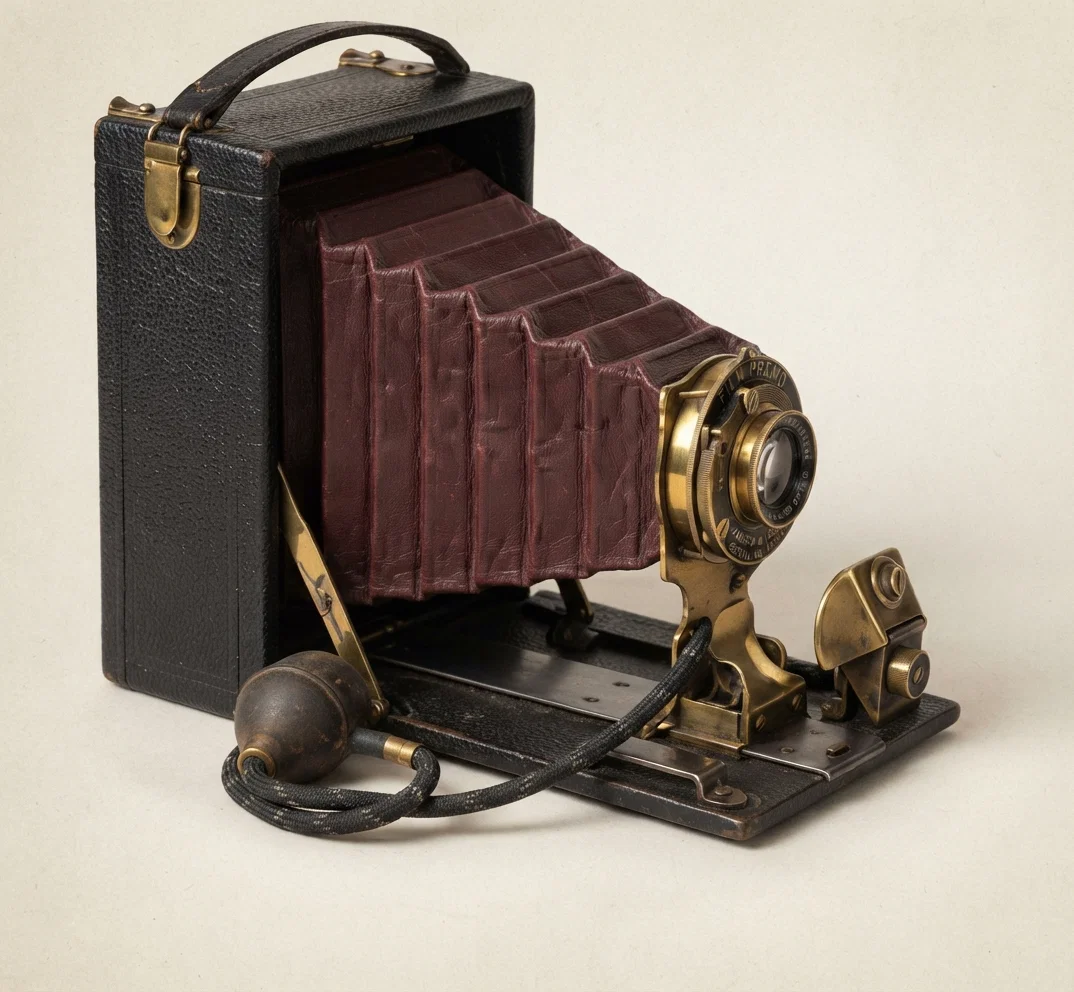
Film
Premos
For the happy days of vacation time
¶ They are the lightest and most compact of cameras—the easiest to load and operate.
¶ It will take you but a few moments at the dealer's to verify these facts, and they're worth verifying, for they're the essential points of all camera construction.
¶ Notice also that Film Premos load in daylight, offer the choice of tray or tank development, and have finer lenses and shutters than you'll find on any other cameras at the price.
Two Styles
¶ FILM PREMO NO. 1, 3¼ x 4¼, $10.00; 3¼ x 5½, $12.50; 4 x 5, $12.50; 5 x 7, $20.00; FILM PREMO NO. 3, 3¼ x 4¼, $21.00; 3¼ x 5½, $20.00; 4 x 5, $23.00.
¶ Our latest booklet, "O, for a Camera," and catalog of over 50 different styles and sizes, at the dealer's, or mailed free on request.
Rochester Optical Division
Eastman Kodak Company
72 South Street
Rochester, N. Y.
To Our Subscribers
By Editor
As already announced, our next number will be in magazine form, 64 pages (7 1/4 x 9 1/2 inches), with cover. In order that there may be no misunderstanding or just cause for criticism, we again call attention to our plans for the future.
Beginning with August, the first number in each month will contain from 48 to 64 pages, with cover in colors, a new and appropriate design appearing every month.
Each following week in the month it will contain 16 pages, magazine form, without cover.
Practically the same departments will be maintained in the monthly magazine as in our present weekly issues.
Facsimile of Cover for August.
Review of the World Events.
The first article in each monthly will consist of brief notes on important current events in the physical, social, religious, and political world, and the bearing they have on the fulfilment of prophecy. In other words, it will be a review and outlook of world conditions with a prophetic setting.
Bible-Readings.
Each number of the magazine will contain one or more short Bible-readings on some important topic.
Temperance.
In this department instruction will be given on true Christian temperance in all its various phases.
The Home.
Here it will be our purpose to present matter of interest and instruction to every member of the family.
Special Features.
Each number of the monthly magazine will also contain an article on some topic of special interest to all. The leading theme in the August number will be on the subject of "WAR PREPARATIONS AND THEIR MEANING." This article is fully illustrated with half-tone engravings showing the development of the battle-ship and the gun during the last ten years. The facts and statistics that are given are truly startling.
The leading theme of the September number will be on the wonderful increase of destructive insects, and that of the October number on the subject of finance, the heaping together of riches, and the outcome.
The subscription price for the monthly magazine including the weekly numbers following in each month remains the same as heretofore—$1.50 per year.
All our regular subscribers, including those taking clubs, will receive all these issues at the same price.
The monthly magazine alone (12 numbers) will be furnished at $1.00 per year.
We trust that all our subscribers will be pleased with the change in the form of the SIGNS, and that it will result in largely increasing our subscription list.
We desire to secure an active agent in every city and town to solicit subscriptions and to sell the magazine in offices, stores, and from house to house. Special terms on application.
Address SIGNS OF THE TIMES, Mountain View, Cal.
Imported Beauties
Special 100 Bible Cards $3.00; 100 Heavy Paper Mottoes 12x16, $6.00; (27,000 sold in April and first half of May). We have four languages: English, German, Danish, and Swedish. The more you buy, the less they are. 15 for $1.00. Address with stamp.
HAMPTON ART COMPANY
Lock Box 257
Hampton, Iowa
Example or Legislation
By Editor
Men use slang for two reasons: Some because it seems smart; some because they lack thought or knowledge as to how to express it.
This is the last issue of our large-page SIGNS OF THE TIMES. But do not get the idea that the paper is suspended. It will be published weekly just the same as ever at the same price, but in more convenient form. The first issue in each month will be larger, and will contain much more reading-matter. The subsequent issues of the month will be the same number of pages as at the present, but one half the size. For terms, etc., see pages 14 and 15.
Do You Wish a Share in This?—A sanitarium for the colored sick and suffering ones is soon to be opened in Nashville, Tenn. It starts in very limited circumstances. The manager writes us and asks what we can do for them in the typewriters we have offered for sale. We have three Wellingtons and one L. C. Smith. The Wellingtons are $60.00 machines, the L. C. Smith a $100 machine. All have been used some, but are practically as good as new. The Wellingtons would be worth for wear at the regular price about $45.00 to $50.00 each; the L. C. Smith, from $75.00 to $80.00. We will donate a Wellington at one half this price if some friend or friends of the work will donate the other half. If we receive more than enough to send a machine, we will donate it to the institution itself. Let us hear from you quickly. This is the last and only notice, except to state results. Send to the SIGNS OF THE TIMES, Mountain View, Cal., stating the money is for colored sanitarium typewriter.
Example or Legislation.
"A London vicar," writing to the Church Times, says, in speaking of the clergy of the Church of England: "Surely we are the last people in the world to raise a voice in favor of any sort of legislation as to Sunday labor or Sunday trading, while facts are what they are. If we are to guide the public conscience in this matter, let us first bring our practise into line with our preaching in the management of the affairs immediately under our control—that is, in the conduct of the public worship of the church." That is ever true. Christianity can ever do more by consistent teaching and example than by legislation. With the former there will be no plea for the latter.
The Bible in a New Tongue
By Editor
The Bible in a New Tongue.—The American Bible Society has just completed and published a translation of a considerable portion of the Scriptures into the Chamoro language, the native tongue of about four fifths of the population of the island of Guam, ceded to the United States after the Spanish War. This is the first time this dialect has been embodied in written form; it is therefore tantamount to the creation of a written language for these people. Roman characters are used in the translation.
Transverts.—The Independent uses the word "transverts" to designate the "two score clergymen and divinity students who have within a few months left the Protestant Episcopal Church to join the Catholic Church, or who are now under instruction to be received. To call them "converts" implies approval; to call them "perverts" expresses disapproval. The term "vert" is occasionally used, but that is no word—they are "transverts," men who pass across the line whether for good or ill. A few years ago they would have been called in any Protestant journal "perverts." The Independent editorial indicates the change which has taken place.
The face often reveals characteristics which we would hide if it were possible. There are those who have such control of their own wills,—rather, their wills have such control of their physical life,—that they can conceal their thoughts. But even then the face indicates the character, tho it does not reveal the feelings of the moment. But suppose it were possible for every one we meet to read our thoughts, how careful we would be! There is One who can do this; and a record is kept, a record that soon every man will meet. Shall not every one strive so to live that the thoughts of the heart might safely be made bare to the public gaze?
The absinth habit has grown so strong in France that in the past six years the sale of the drug has almost doubled. So serious has the matter become that the government is taking steps to make its sale a penal offense. The greatest foe the reformers have to meet is the mercenary spirit of the men who have invested in the nefarious enterprise.
"Essentials of English," or a copy of it, has just been laid upon our table. The author of the work is a master in English, Professor George W. Rine. He has taught it for many years in connection with Healdsburg College, and elsewhere, and could have a position any time in connection with some one of the great universities of our land. The book is, as stated in the preface, "a manual of the working principles of English composition," a natural bridge, so to speak, connecting grammar and rhetoric. Applied Grammar, Punctuation, Letter Writing, Principles of Effective Composition, and Accuracy in the Use of Words, are the five parts in which the work divides. We commend it to teachers and students. Bound in cloth, 75 cents. It may be obtained at this office or any of our branch offices, or state tract societies.
Sir Robert Gillespie Reid, bridge and railroad builder, died at Montreal, June 3. Among the noted bridges in Canada and the United States built by him are the International Bridge across the Niagara River near Buffalo, the Lachine Bridge, three quarters of a mile long, across the St. Lawrence, and the International Bridge across the Rio Grande. He has been called the "greatest benefactor of Newfoundland," on account of the great railroad and steamship lines constructed in that island.
A well-gotten-up illustrated pamphlet, containing a fine map of the state, entitled "California Resources and Possibilities," has been received, published by the California State Board of Trade, San Francisco, Cal. This report is up to date, and prospective settlers in any part of the state would do well to consult it. It may be obtained from the above publishers.
"The American Newspaper Annual," issued by N. W. Ayer and Son, 300-308 Chestnut St., Philadelphia, is indeed a standard book of reference on all matters pertaining to newspapers in the United States and Canada. In addition to carefully prepared lists of newspapers, it gives a description of every town where newspapers are published, sixty-five maps of states and provinces, and classified lists of newspapers. It is a mine of information.
Some photo reproductions have been received giving views of Garden City Sanitarium, San Jose, Cal., under the efficient management of Dr. L. J. Belknap. Many improvements have been made in the last year. It is an ideal home for the sick or weary.