Your ShelfYour Projects

Review and Herald, Vol. 90, No. 36.

LORD OF THE AGES
Earlier text: LORD OF THE AGES

Editorial

A Humble People, but a Great Work

Retrospective and Prospective

A HUMBLE people, but a mighty message! Frail human instrumentalities, but great principles fraught with eternal consequences! This, in a word, describes the messengers and the message as represented in this movement.
It started in weakness. A few humble, devoted men and women were led by searching the Scriptures of Truth to understand the “times and the seasons” of the world’s history, as revealed on the prophetic page. They heard the call of God to give to their fellows the message for this day. They responded, forsaking all, as did the disciples of old, to follow the Master. They were not great men according to the world’s standard. But they were intelligent men, brave and loyal; and because they dedicated to Heaven the powers of their mind and the affections of their heart, God was pleased to accept them as the bearers of mighty truth.
With Heaven’s guidance they built wisely and well, probably far beyond their own conceptions. The foundation of the work in which we are engaged was established. From a small beginning it has spread out to all the world. Truly may we exclaim, “Behold, how God hath wrought in behalf of his work!”
But much remains to be done. We have but touched the borders of some of the world’s great centers of population. Consider even in the United States, where this movement started and where it has made its greatest progress, the large areas yet unworked. Think of New York, Philadelphia, Baltimore, Chicago, New Orleans, and other great cities where we have gained just a foothold. Think of the many smaller cities from Maine to California and from the Great Lakes to the Gulf, with contiguous rural districts, into which the herald of this movement has never entered. Then consider the great unentered regions in Europe, Asia, Africa, South America, Australia, and the islands of the sea. “There is yet much land to be possessed.”
This great field calls for a consecration of all to God—property, talents, and life service. We cannot rest in the achievement of the past; we must lift up our eyes and look on the fields spread out before us. They make to us today a call for a new consecration.
Truly the work before us is great, and we of ourselves have no power to accomplish it; but we serve a great God, a mighty Captain. We are weak, but he is strong; we are humble men and women, but we carry a great message. The power is in the Captain we serve. The principles for which we stand are life-giving. Truth is mighty, and will prevail because it has in it the vitality of heaven.
We can trust to our Leader the outcome. He will make a short work in the earth, and he will use us provided only that we submit to be used. By ways known and unknown to us he will give to others the news of his soon coming. Through the Bible worker, through the canvasser, through the gospel minister, by tongue and pen, in public print and missionary letter, the message will be heralded. By usual and unusual ways the seed will be sown, in the country place, in the busy thoroughfares of travel, in the great centers. Watched by angels, watered by the Spirit, it will spring up into bounteous harvests, which in turn will furnish seed for other fields.
It behooves us to be watchful, faithful, and diligent. The eye of God is upon us. We stand before him as did Elijah. He takes note of our labor, of the spirit with which we labor, of the burden of soul we carry for the unsaved. He will not leave us to failure. He will not pass unrecognized at last our willing, faithful service. F. M. W.

Judson’s Counsel to Missionary Candidates

THIS autumn season finds many of our fellow workers on the way to mission fields, or in earnest preparation to go forward. For their special benefit we print a portion of the letter that Adoniram Judson, the pioneer apostle of Burma, wrote to a band of student volunteers in 1832. The counsel is just as good for workers already in the fields as for those newly entering mission service.
“You are contemplating a missionary life,” Judson wrote from Burma; and added:—
Then let it be a missionary life; that is, come out for life, and not for a limited term. Do not fancy that you have a true missionary spirit while you are intending all along to leave the heathen soon after acquiring their language. Leave them! for what? To spend the rest of your days in enjoying the ease and plenty of your native land? . . .
Beware of the reaction which will take place soon after reaching your field of labor. There you will perhaps find native Christians, of whose merits or demerits you cannot judge correctly without some familiar acquaintance with their language. Some appearances will combine to disappoint and disgust you. You will meet with disappointments and discouragements, of which it is impossible to form a correct idea from written accounts, and which will lead you, at first, almost to regret that you have embarked in the cause. You will see men and women whom you have been accustomed to view through a telescope some thousands of miles long. Such an instrument is apt to magnify. Beware, therefore, of the reaction you will experience from a combination of all these causes, lest you become disheartened at commencing your work, or take up a prejudice against some persons and places, which will embitter all your future lives.
Beware of the greater reaction which will take place after you have acquired the language, and become fatigued and worn out with preaching the gospel to a disobedient and gainsaying people. You will sometimes long for a quiet retreat, where you can find a respite from the tug of toiling at native work—the incessant, intolerable friction of the missionary grindstone. And Satan will sympathize with you in this matter; and he will present some chapel of ease, in which to officiate in your native tongue, some government situation, some professorship or editorship, some literary or scientific pursuit, some supernumerary translation, or, at least some system of schools; anything, in a word, that will help you, without much surrender of character, to slip out of real missionary work. . . .
Beware of pride; not the pride of proud men, but the pride of humble men—that secret pride which is apt to grow out of the consciousness that we are esteemed by the great and good. This pride sometimes eats out the vitals of religion before its existence is suspected. In order to check its operations, it may be well to remember how we appear in the sight of God, and how we should appear in the sight of our fellow men, if all were known. Endeavor to let all be known. Confess your faults freely, and as publicly as circumstances will require or admit. When you have done something of which you are ashamed, and by which, perhaps, some person has been injured, (and what man is exempt?) be glad not only to make reparation, but improve the opportunity for subduing your pride. . . .
Beware of that indolence which leads to a neglect of bodily exercise. The poor health and premature death of most Europeans in the East must be eminently ascribed to the most wanton neglect of bodily exercise.
Beware of genteel living. Maintain as little intercourse as possible with fashionable European society. The mode of living adopted by many missionaries in the East is quite inconsistent with that familiar intercourse with the natives which is essential to a missionary.
There are many points of self-denial that I should like to touch upon,—but a consciousness of my own deficiency constrains me to be silent. I have also left untouched several topics of vital importance, it having been my aim to select such only as appear to me to have been not much noticed nor enforced. I hope you will excuse the monitorial style that I have accidentally adopted. I assure you, I mean no harm.
It is sound counsel, all will agree, just as valuable to the missionary worker now as in that day of the beginning of modern mission enterprise.
W. A. S.

Putting the World Under Bondage

SATAN promised man exaltation from the sphere of the human to the sphere of the divine if only man would reject God's word, disobey God, and obey him.
The sequel showed that, instead of becoming a god through disobedience, man became a bond-servant of the disobedient and fallen angel. Instead of glory, he had purchased bondage; instead of freedom, slavery; instead of joy perpetual, sorrow leading to obliteration in death.
But God said: "I will put enmity . . . between thy seed and her seed." Therein is the germ of a mighty hope. God has never in any age left man hopeless; and the arms of humanity, from the days of Eden until now, have been stretching out through the bars of this house of bondage, reaching toward freedom. That freedom can come only through the promised Seed, who voluntarily took the form of the human bond-servant that he might lift man, through obedience, out of darkness and despair and bondage and death into light and hope and liberty and eternal life. It is a wonderful thing that He who was free should become a servant that he might liberate mankind from servitude to sin and Satan.
It was a wonderful battle that began with the offer of Jesus Christ. The Battle of the Pyramids lasted for hours, the Battle of Gettysburg lasted for days, the civil war for a few years; but here is a battle that has been raging for six thousand years, and its culmination is yet to be. When that battle is finished, it will be found that the seed of those who fell have triumphed over him who caused them to fall.
Between the fall of man and the completion of his redemption there is to be no time when he will be free from this warfare with the world, the flesh, and the devil. The bitterness of the conflict is not sweetened with age. We read in 2 Tim. 3: 12, 13, that "all that will live godly in Christ Jesus shall suffer persecution," and that "evil men and seducers shall wax worse and worse, deceiving, and being deceived." Our Saviour also warns us of the continuation of this conflict in these words: "They shall put you out of the synagogues: yea, the hour cometh, that whosoever killeth you shall think that he offereth service unto God." John 16: 2.
The purpose of this oppression is to keep mankind in spiritual bondage. When Satan came into this world, it was with the purpose of making man his slave, and whatever method would contribute to that end he has employed.
The human race has suffered much. The blood of the martyrs of Jesus has been shed in every land. They were tired of bondage; they sought liberty, and they bought it with their lives. No matter how dark the night of this world has been, it has never been left without some representatives of the kingdom of light. God has always had his Waldenses, his Albigenses, and his Anabaptists witnessing for him in the world, and signing the covenant of loyalty in their own blood. When the soil of Europe was wet with the blood of the Anabaptists, they coined the declaration that every man "has the right to worship God according to the dictates of his own conscience."
While this world has suffered much in this warfare between the king of ruin and the Prince of Peace, it has not been the only sufferer. The inhabitants of this world have been afflicted; but we must not forget that Heaven has been afflicted also. Was it not an affliction to see the work of Lucifer going on unchecked among the angels of God, until he had succeeded in causing one third of the angelic host to turn their backs upon their Maker and upon their former associates? How true it is that whether we look to heaven or earth, we find that "the trail of the serpent is over all."
When Satan had done his work, when the last angelic being had accepted his leadership that could be induced to do so, "there was war in heaven," and Satan and all who had chosen to be his were cast out to return no more. Heaven was free from his iniquitous operations; but earth must suffer on until the purpose of God's patience with sin should be fully worked out here. Nevertheless, the casting of Satan and his hosts out of heaven is a harbinger, or forerunner, of a similar consummation in this earth of ours, when Satan and all that are his, whether wicked angels or wicked men, will be swept out of existence in the fires of purification that will wrap the world in their embrace. "And the day that cometh shall burn them up, saith Jehovah of hosts, that it shall leave them neither root nor branch." Mal. 4: 1.
When that has been accomplished, the victory will be complete, for that consummation does not come until the question of sin's certain discontinuance has been settled with the utmost surety. They who have decided to stand loyal to God will have made that decision in the face of all that Satan could do to make them turn away from God. They will have turned their backs upon all the allurements of this world, upon all the blandishments of the great deceiver, upon all the desires of the flesh. They will have proved true to God in spite of threats of pain and of death. They will have chosen God in preference to all things, even life itself, and in spite of all things, even death itself. They who have made such a decision under such conditions will not carry into the purified kingdom of righteousness any of the deadly germs of sin. That is what God means when he tells us through the prophet Nahum: "He [Jehovah] will make a full end; affliction shall not rise up the second time." Chapter 1: 9. That does not refer to the affliction of human beings alone, but to the whole universe of God.
That puts an end to bondage, and brings in everlasting liberty. It puts an end to sin, and brings in everlasting righteousness. It puts an end to death, and brings in everlasting life for all the children of our God. That blessed consummation is soon to be, and in it every child of this earth may share if he will.
C. M. S.

A Strange Idea

As illustrating the strange conceptions that many have of the truths of the second coming of Christ, take the following from a report of a Millennial Dawn lecture in Washington:—
The ministers of the various churches should pay more attention to the stranger within their gates; perchance he may be the meek and lowly Nazarene. He urged the need of this attention on account of the fact that many believe today that Christ is now upon earth for the second time, and man cannot distinguish him.
It was to meet just such erroneous ideas of the glorious second coming of Christ that Jesus left the instruction: “Wherefore, if they shall say unto you, Behold, he is in the desert; go not forth: behold, he is in the secret chambers; believe it not. For as the lightning cometh out of the east, and shineth even unto the west; so shall also the coming of the Son of man be.” Matt. 24: 26, 27.
The same old truths of the second advent that have been dear to the hearts of Adventist believers all through the years are still the truths for this time, and new and unthought-of truths to the multitude. It is our one business in life to proclaim the message of the Lord's soon coming. W. A. S.

Our European Annual Meetings

ON July 8, I sailed from New York on the "Crown Prinz Cecilie" of the North German Lloyd, to attend the summer meetings in Europe. Our passenger list numbered about 1,500 and the crew 700, making 2,200 souls on board. The furnaces consumed 750 tons of coal a day, in supplying power required to transport this fair-sized town across the ocean at the rate of twenty-three miles an hour. The sea was like a mill-pond all the way. This, with the excellent service on board, made the voyage a very pleasant one.

Our Hamburg Headquarters

As I was to be in Hamburg but one night on my way to the East German Union conference, I telegraphed an appointment for a meeting in the chapel that evening. This gave me an opportunity to meet the workers in the offices and a number of the brethren and sisters living in Hamburg. It was a pleasure to meet Brother and Sister Conradi and their large force of associate workers in the various offices at the headquarters of the European Division Conference.
Our Hamburg publishing house has grown to large proportions. It now represents an investment of about $210,000, with liabilities of only $40,000, and these are fully covered by legacies. Last year's gains were about $24,000. Here books, pamphlets, tracts, and periodicals are printed in twenty different languages. At the present time twenty papers are published for the different nationalities of Europe. The German paper, Herold der Wahrheit, has the largest circulation. It is issued fortnightly, with an average circulation of 110,000. The value of the literature sent out from the Hamburg office during the past fiscal year amounted to about $250,000. For the carrying forward of this work, the office employs one hundred persons.
At this headquarters is a branch of the health-food factory at Friedensau. The sales from this branch last year reached the astonishing sum of $80,000. This line of work has become so large that the brethren have decided to move the main factory from Friedensau to Hamburg. A large block of ground has been purchased in a good location and the factory building is now being erected. When completed, the plant will cost about $100,000. This new location will make it possible not only to carry on this department of work to much better advantage, but also greatly to enlarge the enterprise, which already yields substantial help financially to the general work.
At the Hamburg headquarters are located the offices of the European Division Conference and the treasurers of the three union conferences in Germany, also the Danube Union. Here all the accounts are kept, disbursements made, and statistics prepared. Altogether, there are at present one hundred and twenty persons employed at this headquarters. This includes the employees in the publishing house. As I visited the different parts of the factory and the various offices, and saw this large, busy, devoted band of workers, I was deeply impressed with the marvelous progress this movement of the third angel's message is making in this part of the world. It is the growth of the cause in only a section of Europe that calls for these institutions, with their many facilities and the labor of this staff of workers. In other sections are located the headquarters of union conferences, carrying on similar work.

The East German Union Conference

In company with Brother and Sister Conradi, and Brother L. J. Spicer, Elder Conradi's secretary, I came to Friedensau, to attend the quadrennial session of the East German Union Conference. This union represents the eastern part of Germany and has its headquarters at Berlin. It has six local conferences, two mission fields, and territory known as the East German Union District. In this union district are located the headquarters of the union conference, and the various institutions at Friedensau. The population of this union is about 34,000,000. The statistics report a membership of 6,200, with 108 conference laborers. The tithe for 1912 amounted to $103,764, and the offerings to missions reached $24,000.
Nearly 2,000 of the brethren and sisters of this conference came from different parts of this union to attend the Friedensau meeting, which was held July 16-26. These large camp-meetings held at Friedensau each summer are occasions of great encouragement and blessing to our people in Germany. Here they meet for Bible study, for counsel and planning regarding the work to be done, and for renewing their consecration to the Lord. Once each day during the meeting that has just closed, all the conference workers present gathered in the chapel of the college for Bible study, these meetings were conducted by Elder Conradi and the writer. It was a great pleasure to counsel with these workers regarding plans of labor, and to join them in the consecration of our lives to the Lord for better and more efficient service.
The reports presented by the different workers and the managers of the various institutions were very encouraging. Advancement is being made all along the line. Elder H. F. Schuberth was re-elected president of the union.
One of the best and most impressive meetings of the conference was the farewell given to a number of the workers, who had accepted the call to foreign fields. Brother and Sister O. Staubert were to go to Persia to join Brother F. F. Oster; Brother and Sister J. Erzberger, Jr., were appointed to Beirut; Brother P. Bridde was to go to Constantinople; and Brother D. Delhove was assigned to the Kongo. All hearts were touched as these dear workers bore their farewell testimonies to fellow workers, brethren and sisters, relatives, and their native land. Surely this cause must go forward in triumph as long as our people maintain this spirit of consecration to the world-wide work.
A. G. DANIELLS.

Note and Comment

Recognizing the Danger

THE Continent of August 21 recognizes in the efforts of Roman Catholics to exclude certain publications from the mails a real menace to the freedom of the press and the freedom of the people. We quote: —
The Knights of Columbus in their central national organization have taken official measures to induce the Postmaster-General, if they can, to exclude from the mails the anti-Catholic weekly published in Aurora, Mo.—the Menace. The Continent has no confidence in the Menace at all—does not regard it as in any sense a credit or a strength to Protestantism. We both detest its spirit and doubt its sincerity. Nevertheless we see clearly that if Catholic influence should appear at all likely to accomplish its object in this direction, every American loyal to the original ideas of the republic must stand up in defense of the Menace, obnoxious though it is. If a precedent were established for suppressing the Menace by a blanket executive order simply because it criticizes Catholicism, no paper would thereafter be safe which pointed out the tyrannies of Rome in even the mildest terms. The principle of free speech and free press in this country is no academic thesis; it is a vital necessity for a free democracy. The sincere democrat therefore must stand up for the liberty of saying and printing many things that he himself likes neither to see nor to hear. But of course the Roman Church, being in fundamental nature the most anti-democratic organization on earth, can have no appreciation of any such liberty and fits itself to this American condition only under stress of necessity. In consequence, it must be watched with special keenness where the liberty of the press is involved. There are laws sufficient to keep the Menace from printing slander and obscenity, and if the Romanists can curb it any under those laws, well and good. But they must not be allowed to go a step farther than that.The American Federation of Catholic Societies, with a claimed membership of three million, is also demanding a censorship of the mails in the interests of the Catholic Church.

In the Name of the Master

HAROLD W. CLARK
"Go in the name of the Master." A promise goes with the command; For the one who has called us to labor Has pledged close beside us to stand.
"Go ye, and, lo, I am with you." On our ears fall the words, plain and clear; And look! In response to the summons, The hosts of his workers appear.
Among them are faces familiar, Sweet memories of school-days they bring. Though scattered, with one aim they labor, These heralds of Jesus our king.
They went "in the name of the Master," Though parting with friends gave them pain; And the Master, whose love they are telling, Leads on, over mountain and plain.
And see! "In the name of the Master," They labor 'neath India's skies, In Africa's dark land I see them; Though sometimes one sickens and dies,
Yet onward they press, by their trials Undaunted; though met by the sword, A famine, or floods, still they shrink not; They go on in the name of their Lord.
In Burma and China they labor, While fever and pestilence rage, And the heathen, like waves of the ocean All boundless, their bloody wars wage.
And I ask them, "O, why do ye suffer, And give up the blessings of home?" But back to my ears comes the chorus, "In the name of the Master we've come."
Afar in the cold, northern winter, Still other dear faces appear: Through tempests and storms they are pressing, To tell of His coming so near.
And oft in the blasts of the north wind, Though the cry of the wolves it may bring, They think of their mission from heaven, And go on in the name of the King.
North, south, east, and west they are scattered, The message of mercy to give, To carry the news of salvation, That the sinner through Jesus may live.
And I think, as in memory I see them, Of the homes they have left far behind, Of the fathers and mothers who gave them, The wheat for His garner to bind.
I think of the friends and the loved ones, Whom on earth I never may see; And though sad is the parting, yet ever I whisper, "Dear Lord, 'tis for thee."
'Tis all "in the name of the Master;" O, wonderful name, that will lead Men and women to sacrifice, suffer, And even for his sake to bleed!
And the Master, in tender compassion, With heart full of love, a reward Doth prepare for the faithful Who go in the name of their Lord.
Then onward with courage and valor! Away with all doubting and fears! And the glorious name of the Master We'll praise through eternity's years.
Sonningdale, Saskatchewan, Canada.

A Debate on the Sabbath Question in Honan, China
J. J. WESTRUP
WHAT I write is with a view to glorifying the dear Lord, and strengthening in the truth some who may be weak. The truth is spreading rapidly all through this province. It has reached even to the northern extremity, and some evangelists have already taken their stand for the truth so far as they know it.
Some three weeks ago we received an invitation from the foreign pastors to attend their general meeting, and publicly discuss our doctrines. We received the invitation only a week before the time appointed, but decided to go, and I asked my two evangelists to go with me. We have been helping all we could in the building of the mission homes, so there was not much time for preparation, but as I told my two Chinese brethren, we have all the truth on our side and need fear nothing.
You can imagine with what a feeling of absolute dependence upon God we met the seven foreign pastors, and some one hundred Chinese pastors, evangelists, and workers besides hundreds of others who filled the large church. What power there is in God and his blessed truth! We three were cool and calm throughout the debate, presenting the truth without fear or favor, confident that the Lord was on our side. They soon became excited, and called names, and used methods that were very improper. We gave them the positive truth from the first, and did not spend much time in refuting their unfounded statements.
They began by taking the position that there was only one law, and that that was abolished. They had never taken such a position before, but here as everywhere, when unwilling to acknowledge that they keep a wrong day, they are driven to madness in their attempt to get some show of Scriptural proof for their unbiblical position.
We showed them plainly that the Bible speaks of the ceremonial law and the moral law, and then we produced one of their own tracts, written by one of their own pastors in Peking and printed by their own press, a tract they are continually selling, which states plainly that there are two laws, and that while the ceremonial law was done away in Christ, the moral law expresses the very character of God and cannot be changed, but abides forever.
The tract goes on to show that while the moral law cannot be changed, the seventh-day Sabbath was moved over to the resurrection day about 200 A. D., as the church Fathers told them.
After that we produced a chart of the ten commandments which they scatter among their own people, and asked them: "If the commandments are done away, why do you have this chart of the commandments, and why do your ministers use it continually in preaching? And you also refer to Heb. 8:10, saying that the law is written in the heart of the believer. When we come to the real point, your position and ours in regard to the law are the same. We believe that by faith in Jesus Christ we are forgiven, cleansed, purified; and a forgiven man must have the law written in the heart, and not sin, for sin is the transgression of the law. You believe exactly the same. The only place where we differ is in regard to the fourth commandment, which you say has been changed, and we say has not been and cannot be changed. Therefore, produce your evidence for that change."
They then brought forth a long chart of Gamble's theory, in which he tries to prove that Jesus did not keep the same day every year, but that one year he kept the seventh day, another year Sunday, and the third year Monday.
I answered: "Gamble bases his whole argument on the Passover sabbath, which of course was movable, as it came on a certain date. He confuses the weekly Sabbaths of the Lord with the feast sabbaths. Leviticus 23. Every child can count seven, and knows plainly which day of the week is the seventh day, and Jesus certainly knew as much. It took Gamble eighteen years to work out his very intricate, complicated, movable theory, and it will take these Chinese brethren that many years more to understand his theory. Thank God, the Sabbath truth is so plain and simple that a little child can understand it at once. Feasts and dates may change, but that does not affect the seventh day. The Jews keep it today all over the world, the same day that Jesus kept; and all the calendars of the world show that the seventh day precedes Sunday."
Then as a last resort they cited John 20:26-31 (the only Bible proof they attempted to bring forward) and the church Fathers, saying that the Sabbath had been gradually changed from the seventh to the first day of the week. We replied we could not confidently base our eternal interest on the church Fathers. We want a "Thus saith the Lord" for everything we believe. When I went to the Episcopal Theological Seminary, we carefully studied all the writings of the church Fathers, that we might know for ourselves how they contradicted one another and how they held many theories contrary to the Bible, so that whenever we met Roman Catholics (who base a great deal of their teaching on the church Fathers) we might be able to show their errors; but these ministers were now producing those writings as a foundation for the Sunday sabbath. We agreed with them that the change was brought about gradually. Paul, in 2 Thess. 2:7, says: "The mystery of iniquity doth already work" (the Chinese Bible says: "The lawless business doth already work"), and in Rom. 14:5 we see that there was some confusion then. Thus this lawlessness began in the days of Paul, and in the days of Constantine it had proceeded so far that he issued a command trying to compel all Christians to keep the sun's day. In 364 A. D., he and the church passed laws that were to punish and curse every one that kept the Sabbath instead of Sunday.
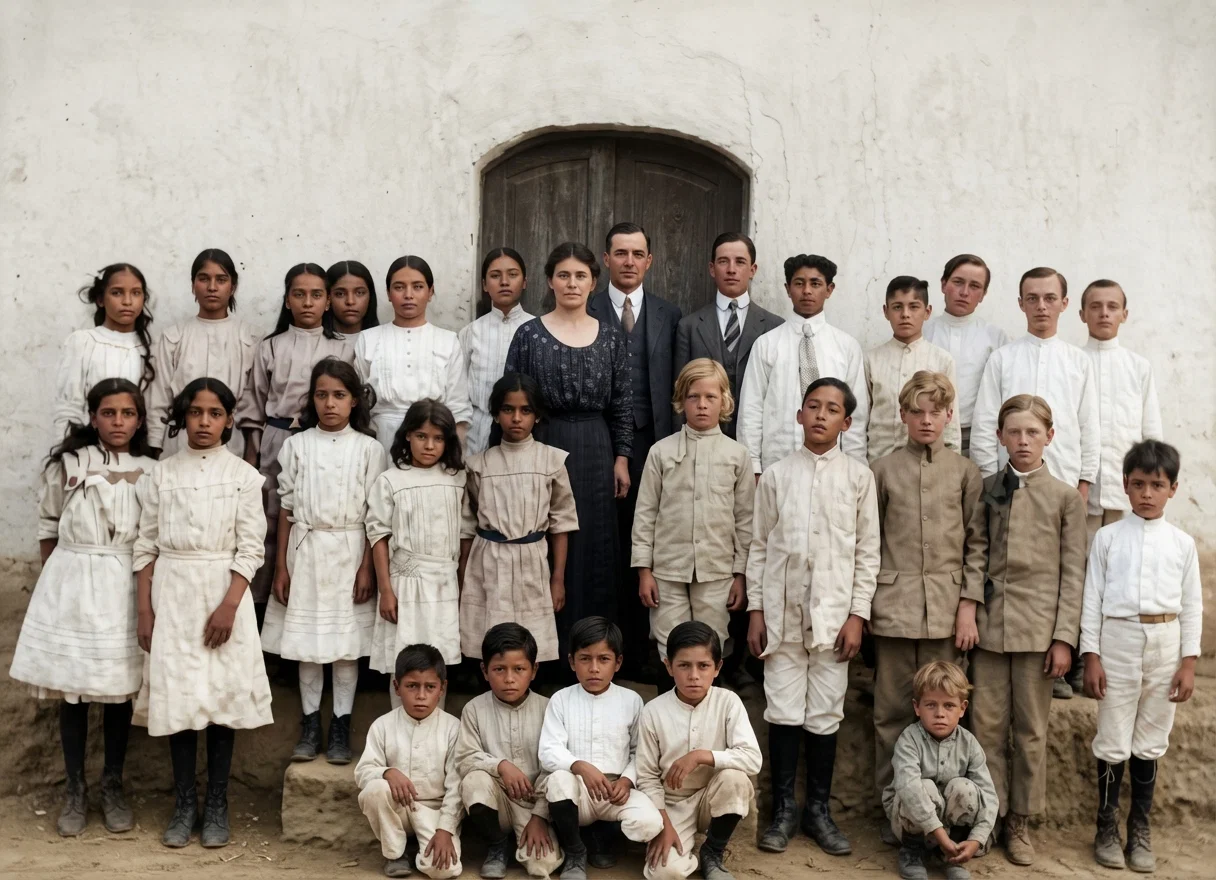
SCHOOL AT SIGUATEPEQUE, HONDURAS, CONDUCTED BY KARL J. SNOW AND WIFE
One of our evangelists presented Dan. 7:25, showing that God had plainly told us that the Roman power would attempt to change the Sabbath; he showed that this prophecy has been fulfilled, and then he read from a Roman Catholic catechism their own declaration that they had changed it.
What a blessing it is to have the straight Bible truth! These Sunday-keepers, unwilling to acknowledge their mistake, are thoroughly confused and do not know what straw of evidence to cling to. When we see their confusion, we learn to value the truth more than ever. We expect to see a blessed result from this debate.

Life and Immortality

THE Christian Standard of August 23, in its Family Altar department, quotes, under the title "Gems of Thought," the following text, and makes thereon the comment which follows it:—
Jesus Christ hath abolished death and brought life and immortality to light through the gospel. 2 Tim. 1:10.
Men have always been immortal, but they did not know it. They suspected it and longed for it, but were in doubt about it. Adam was as really immortal as John, but there was a veil over the eyes of one, and the other saw clearly. Christ had demonstrated it to John; had brought it to light.
The only statement in the above that is not contrary to the Scripture is the one which declares that "Adam was as really immortal as John;" for neither of them possessed it. It is very strange indeed that if Jesus came simply to remove a veil and demonstrate to man that man is immortal and always had been, he should have inspired the same apostolic penman to write these words concerning "the blessed and only Potentate, the King of kings, and Lord of lords:" "Who only hath immortality, dwelling in light unapproachable." It is strange, also, that if Jesus Christ came to demonstrate, through the gospel, that men have and always have had immortality, the gospel should be utterly silent concerning such a fact. It would be difficult to produce a more direct and striking denial of Scripture teaching than that contained in the above-quoted comments on the text given. From the day when God declared in Eden that death would follow disobedience, Satan has been endeavoring to make men believe that man could not die, that he was immortal. Over and over have the Scriptures declared man's mortality, the certainty of his eternal death if he continued in sin, and has made it plain that man's only hope of life beyond this life lies in submission to God's will and acceptance of Christ and his sacrifice in man's behalf. In spite of this the old contradiction of God and of his Word continues, and innumerable souls are deceived thereby. The ashes of the wicked under the feet of the righteous (Mal. 4:1-3) ought to settle the question of man's mortality, if no other text existed on the subject.
THE steady advance of surgery in the treatment of wounds received in warfare is shown in the statistics of three wars. In the American civil war the mortality of the wounded was 13.2 per cent; in the Franco-Prussian war, 11 per cent; in the Russo-Japanese war, 5 per cent.

The School in Honduras

IN a letter from Brother Karl J. Snow, who, with his wife, has been doing faithful work in Honduras by teaching school and doing missionary work in other ways, as opportunity has afforded, we find the following interesting paragraphs: —
"The influence of our school is not local, but has gone to all parts of the republic. People are watching to see what we do. I feel we must make a success of it by all means for it will help others in starting here. Work here is different from what it is at home, for the government is watching all new enterprises and the report of failure or progress is spread all over the country. We have a fine proposition to go to Comayagua with our school. They promise us fifty students to start with.
"When the work went hard and I was asked why I stayed, my answer was, 'I do not know.' It is yet to be seen why we stayed.
"One man took his little boy out of school because he said he would not study. The grandfather, hearing of it, came and asked me to take him into our home and said he would pay his bills. We did so. Now we have two boys and a girl living with us. [These are indicated in the picture by a small cross.] When it comes time for worship, they get the song-books, pick out a hymn, and sing with all the earnestness of their beings. One man has acknowledged the Sabbath and other points of our faith, and is just waiting to see his way clear to step out.
"I shall enclose a picture of our school. Some of the pupils were absent.
"Our courage never was better. We need your prayers."
Continue reading: Some Needs of the Mexican Field