Your ShelfYour Projects

Review and Herald, Vol. 90, No. 36.

LORD OF THE AGES
Earlier text: Some Needs of the Mexican Field

The Foreign Mission Seminary as a Center of Learning

IN the course of my visits to various churches in different parts of the Middle West and East in the last few weeks in the interests of the denominational history, I have been asked many questions in regard to the Foreign Mission Seminary, and it is to answer some of these questions that I take the liberty to write these lines for the REVIEW.
Some seem to labor under the impression that because the Seminary makes a specialty of training young men and women for the foreign fields, it does not carry the higher collegiate studies. This is essentially untrue. While the Seminary does not at present conduct a regular course leading up to the degree of A. B., it does carry a large list of collegiate studies, including all those which are most helpful in training young men for the ministry, and for Bible teaching in our schools.
Moreover, and this is a matter of great moment, in carrying on these studies the Seminary has the advantage of using the Library of Congress, one of the great world libraries, with a collection of books and pamphlets, some of them very rare ones, numbering two million. The fact that a five-cent ride on the trolley-car will land a student of the Seminary right in front of this library, where he will have free access to this magnificent collection of books, as well as the cordial assistance of the men in charge, who are specialists in various lines of research, is something that every student hungry for knowledge will take into account; for it is not simply text-book study of a subject that counts most in these days, but it is being able to go into it thoroughly, to consult not one but many authorities, and arrive at conclusions which will take in all that has been said of importance on the subject.
Not only does the Seminary student have this unique opportunity for research, but he is assisted in it by his teachers, and the work of the school is planned with this in view. As teachers we set it before us not so much to develop the memory, but to train the judgment, to stimulate original inquiry, to give the mind breadth of view, insight, power of discrimination. And we can do this the better because the general class of students who come here are not young people sent here by their parents, but young men and women who come of their own accord because they are hungry for knowledge.
If it is thought that thoroughness and depth are not needed for the foreign field, that is a great mistake. Our most experienced leaders in the great mission field are insistently calling for young men with the highest intellectual fitness, and we feel as teachers that if a good training is required for the home field, how much more is it necessary that the workers who are sent thousands of miles away at heavy expense should be men and women who have made the very most of their talents by very thorough intellectual training.
As a matter of fact, we have in addition to the young people who are preparing for the foreign field, a goodly number who are getting ready to give the message in the large cities of the United States, and these find that their needs intellectually as well as spiritually are very much the same as those of the men and women in training for the foreign field. M. E. OLSEN.

Battle Creek College Association

AT the last General Conference a reunion was held of Battle Creek College teachers and students, which was attended by about two hundred and fifty persons. Near the close of the Conference an association was formed for the purpose of collecting, preserving, and circulating information concerning the College, its teachers, and its students. A constitution was adopted, and secretaries were chosen as follows:—
General: C. C. Lewis; North American Division: M. E. Cady; South America: R. H. Habenicht, M. D.; Europe: Guy Dail; Asia: Riley Russell, M. D.; Africa: W. H. Anderson; Australasia: E. H. Gates. Nearly one hundred persons joined this association, although many did not have opportunity to do so, since the Conference was nearly over.
The association authorized the secretary to prepare a booklet containing, (a) a report of the reunion; (b) a report of the organization of the association; (c) a copy of the constitution; (d) a list of the charter members; (e) the addresses of two hundred and fifty teachers and students present at the reunion.
This report is now ready, and is being mailed to all charter members. It forms a neat booklet of twenty pages, with cover printed in blue and gold.
The charter membership list will be held open until Jan. 1, 1914. All Battle Creek College students and teachers who will send to the secretary the membership fee of fifty cents, together with the last year of their attendance at the College, the course from which they were graduated, if graduates, their present office or occupation, and their post-office address, will be enrolled as charter members, their names and addresses being printed on a leaflet to be inserted in the booklet described above. Any corrections or additions will also be made if sent to the secretary before Jan. 1, 1914. A copy of the booklet will be mailed to each member.
A large photograph was taken of nearly one hundred of the old teachers and students. Probably no such reminder of the "old College days" will ever again be available. A copy of this photograph will be mailed to any address for fifty cents.
Also a copy of the booklet will be mailed for fifty cents to any person, whether member of the association or not.
Address the secretary, C. C. Lewis, Takoma Park, D. C.

Pacific Union Conference

We have just closed our second camp-meeting in this union conference. The first was held in Stockton in the California-Nevada Conference, and the second at San Jose in the California Conference. There were perhaps five or six hundred in attendance at the Stockton meeting, and seven or eight hundred at the San Jose meeting.
We had the assistance of W. A. Spicer a part of the time at both these meetings. He rendered very efficient help indeed. The Lord greatly blessed the effort of his servant to lift the standard higher and still higher, and also to encourage the believers in the leadership of the Lord in this great movement.
Elders I. H. Evans and Meade MacGuire were with us the last Sabbath of the San Jose meeting. Elder R. C. Porter also spent a few days with us at the close of the San Jose meeting. This was a source of great inspiration to our people, and the help rendered was greatly appreciated. We were also blessed at both these meetings with the assistance of several of our missionaries from foreign fields. We were favored at the Stockton meeting with the assistance of Elder C. L. Butterfield, of Korea. He gave a very interesting and profitable talk on the work in his field. Elder R. W. Munson's two sons were present and spoke of our work in the East Indies, especially in Sumatra and Java. The assistance of Elders Butterfield, of Korea; Okohira, of Japan; J. S. James, of India; R. W. Munson, of the East Indies; and Walter Bond, of Spain, was much appreciated at San Jose. Their reports came as a great inspiration to our people. As we listened to the providences of God as related by our earnest missionaries, we were reminded of the cloud which overshadowed Israel as they journeyed from Egypt to Canaan. Truly the cloud is guiding Israel today, and soon it will lead us into the heavenly Canaan.
Day after day as these meetings progressed, the deep movings of the Spirit of God were more and more manifest. Deliverance came to those who were in bondage, and great victories were experienced by all. We certainly enjoy the showers of blessings that are now falling on the people of God, in both the early and the latter rain; and we expect to see more and more of the outpouring of this Spirit. Soon the light of God's glory is to be seen on his people as never before.
Quite a number were baptized at the close of each of these meetings, but I am not prepared to give the exact number at this writing. Very few changes were made in the executive committees of the conferences. The officers remain the same.
Let us continue to pray that the Lord will unseal the fountain of life and pour upon his people at this time the refreshing showers of the latter rain.
E. E. ANDROSS.

The General Conference Missionary Exhibit

WITH the passing of time our General Conference sessions become increasingly missionary, both in spirit and in fact. The horizon of our missionary vision is constantly enlarged; this is largely due to the fact that with intense interest we follow our missionaries with our prayers and our offerings as they push on to new, extended fields in all parts of the world. The recent World Conference afforded striking evidence of this fact. A considerable number of the delegates were missionaries direct from the mission fields, the heathen, non-Christian lands. By their lively, inspiring reports and their many missionary "talks" the atmosphere of the entire Conference was made decidedly missionary.
In order to make still more emphatic and realistic the needs of those heathen lands, the missionaries (true to the missionary instinct) brought with them a considerable collection of "native" articles from nearly every country of the great heathen world. These articles were made to constitute the missionary exhibit, a no inconsiderable feature of the Conference.
Conspicuous and of highest interest in this collection were the "gods many," like those of the Old Testament, whose senseless impotence is set forth with such scathing irony in the Psalms and in the prophecy of Isaiah. (See Psalm 115; Isaiah 44.) Not to mention others, there were the god of war, grim-visaged, with his six arms; the queen of heaven in all her serene majesty and supreme indifference; and the goddess of maternity, the special object of worship by prospective mothers. The ground of rejoicing that these and many others were present at the Conference was that they were all disgraced or dethroned gods; that is, they no longer held sway over the people who had formerly feared them and bowed down to them. They had been cast aside for the God who "hearest prayer," and to whom "shall all flesh come."
To illustrate in a concrete way the conditions in which our workers must labor to win hearts for the message, a considerable collection of war implements, especially from Central Africa and the islands, was brought by the missionaries to the Conference. In this collection was the bow with its poison-pointed arrows, the spear, the club, the shield, the helmet, and other war apparatus, striking evidences of that savage element in the human, whether civilized or uncivilized. Next may be mentioned a class of articles illustrative of the arts of peace, such as the crude aprons made from the bark of trees, or from the fiber of the lace-tree, pounded into a pulp, the beautiful and skilfully wrought garments made from the cotton, the grass, or the silkworm fiber, much of which equaled if not excelled the best we have. To this was added the many pieces of needlework which excited the wonder and admiration of all present. Some of these latter were banners on which were worked with great skill many strange characters of these alien peoples, indicative of the gratitude that now fills their hearts for the newfound light,—the experience of deliverance from sin and the knowledge of the soon-coming kingdom.
Of special interest to the Conference delegates were the many specimen copies of the various books, pamphlets, tracts, papers, etc., issued in the scores of vernaculars in different parts of the world, which serve as channels through which the message is finding its way to the minds and hearts of the people. These are indeed silent evidences of the progress of our cause; but when seen in their true significance, they must be regarded as the best proofs that the work is both deepening and made permanent.
Still another unique feature of this exhibit was the large map (9 x 12 feet) on which were indicated the principal mission stations of all Protestant societies in the entire non-Christian world. The chief object of this map was to give a bird's-eye view of the missionary invasion of the heathen world. On a white background small red dots indicated the mission stations of all other Protestant denominations, while those of our denomination were shown by small blue stars.
On the basis of the general fact represented on this map and as a further elucidation of the missionary situation of the world of today, a set of very interesting statistics had been worked out and placed on a chart that hung just opposite the map. These statistics follow: The total number of Protestant principal missionary societies appointing and sending missionaries is 377. If all the aid societies and committees cooperating with the above societies are included, the total rises to 995. The total number of Seventh-day Adventist missionaries, according to last report, aggregated 599; all other Protestant missionaries numbered 24,092. The principal mission stations of our denomination counted 170; all other Protestants totalled 12,123. Receipts for foreign mission work contributed by our entire body amounted to $606,708; all other Protestant denominations gave the sum of $37,914,834. The mission offering per capita of membership in our denomination was $5.56, while the corresponding figure by all other Protestant Christians stood at 26 cents. For every 182 members in our church we have one missionary set as a light in the heathen, non-Christian world; all the other Protestant churches have one missionary in the field for every 5,945 members.
In respect to the last two items the chart exhibited very graphically the immense lead we as a people hold over the aggregated Protestant bodies, and it is certainly a cause for much thankfulness that the Lord has so blessed us; yet we do well to remember that measured separately there are some other Protestant bodies that are close seconds to us, and that in view of the coming King we are called to "higher ground." Let us, then, mend our pace and go forward.
J. N. ANDERSON.

Medical Missionary Department

W. A. RUBLE, M. D. - General Secretary
L. A. HANSEN - Assistant Secretary
H. W. MILLER, M. D. - N. Am. Div. Secretary

Graduating Exercises, England

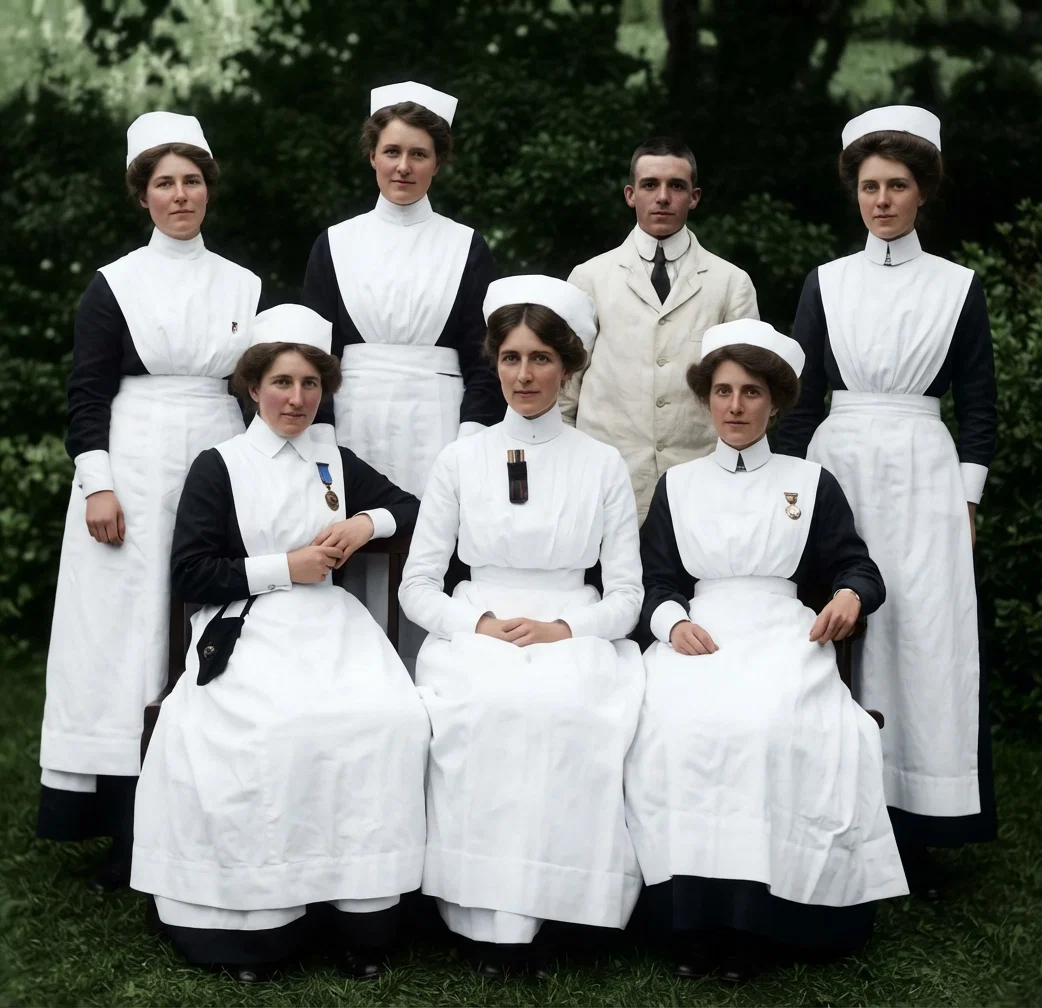
ON July 17, 1913, a goodly number gathered at the Caterham Sanitarium, England, to attend the nurses' graduating exercises, when a class of five completed their three years' training.
Light refreshments were served at six o'clock in the sanitarium dining-rooms, where the tables were laden with a generous supply of tempting delicacies. Following this pleasant item the guests, patients, and graduates assembled in the gymnasium for the exercises proper. The class motto, "Saved to Serve," was artistically done in evergreen at the front, and was the key-note of the program.
GRADUATING CLASS, CATERHAM SANITARIUM
After the opening hymn, whose title corresponded with the motto, Dr. C. H. Hayton, superintendent of the Stanborough Park Sanitarium, offered prayer, invoking the blessing of God on the class as they were about to go forth to engage in medical missionary work, either at home or in the wider fields beyond.
Elder W. J. Fitzgerald, president of the British Union Conference, occupied the chair, and made a few appropriate remarks prior to the graduating address, which was delivered by Elder S. G. Haughey, president of the South England Conference.
It has always been the intention of the leaders of the work to open treatment-rooms in the cities, and Elder Haughey called attention to the sanitarium medical mission that it is now hoped will very soon be opened in London for the benefit of those who are unable financially to visit our institutions for the needed treatment and care. He appealed to all those who are interested in this line of work to be liberal with their donations, as it will require considerable funds to equip and maintain such a mission.
Miss A. M. Clark read a paper presenting the principles, aim, and standard of a new gild that it is hoped will soon be organized among sanitarium workers, The Service of Joy. An appropriate and attractive badge has been prepared for the members of the gild on which are represented various symbols indicating its fundamental principles.
Dr. A. B. Olsen, superintendent of the Caterham Sanitarium, presented a diploma to each of the five graduates: Misses Edith Crooks, Margaret Harrison, Isabel Johnstone, and Ebba Schmitt, and Mr. William Kirkwood. Dr. Olsen congratulated the class, not so much on what they had done, but on what they had faithfully tried to do. He said that the diplomas were a token, not that they had finished learning, but that they had completed the preparatory course, and were going on to the higher school of experience and self-training.
Mr. Kirkwood responded in the name of the class, thanking the doctor and his associates for the kind interest that had been shown them during their three years' study, and for their words of encouragement at times when the way seemed hard.
To close the exercises, the audience joined in singing "Praise God From Whom All Blessings Flow," and Elder W. T. Bartlett pronounced the benediction.
After the program, the graduates were heartily congratulated by their friends and the guests who were present, and received many cordial good wishes for their success in their chosen work of ministering to the diseased bodies and sin-sick souls of needy men and women.
LOIS L. WAKEHAM.

Nurses' Postgraduate Course

THE unusual advantages offered in connection with the postgraduate course for nurses given by the Washington Foreign Mission Seminary should appeal to many of our nurses who wish further preparation for the work to which they have been called. We can well believe that it was in the providence of God, and by his blessing, that this means of advanced education and special training was made possible. Those who have already realized its blessings have many words of praise and gratitude in its behalf.
Being especially intended for the graduate nurse, the course makes first provision for advanced instruction and experience in practical medical missionary lines. Being under the direction of those who are well acquainted with the requirements for effective missionary work in various fields and whose whole purpose is the preparation of well-qualified workers, this course is made to include such subjects as are the most essential. Ample facilities for thorough work are offered. Special consideration is given to the individual needs of workers preparing for special fields.
Among the advantages offered students in this course may be mentioned the practical work that is given in connection with the Washington Sanitarium City Dispensary. This institution is located in a part of the city that affords the best kind of material for clinical study and personal experience. Many cases come to the dispensary, and the surrounding territory offers a large field for house-to-house work. The range of diseases treated is a wide one; and, as the work is comparatively new, the possibilities of its development are largely to be realized. While the dispensary has not been long established, its work has proved a most positive success from its very beginning. Those who are acquainted with its progress feel that marked blessing has attended it. For some time serious consideration has been given to the question of enlarging the dispensary quarters on account of the growth of its work. Those taking the postgraduate course are given three months' experience at the dispensary under the direction and supervision of qualified workers. This experience alone is considered a most valuable one by those securing it.
The city of Washington is now being recognized as first in the opportunities offered students and scholars for preparatory, collegiate, and postgraduate study, for research, and for broad culture. The fact that the city is the seat of government, the home of its various departments, and the storehouse of the researches of the government since its foundation, has naturally given impetus to the growth of schools, colleges, scientific and artistic institutions, and societies for research. Under the government there are, for instance, the Smithsonian Institution and the National Museum, with their wealth of material relating to natural history, ethnology, etc. Then there is the Library of Congress, without its equal in this country, its contents available to all who would use them. The statistical and scientific bureaus of the various departments with their equipment for study and research are also available to the student. The Army Medical Museum, the Hygienic Laboratory, the Bureau of Standards, the Botanical and Zoological Gardens, and other facilities offered by the government, form a field of opportunity not available elsewhere. The gathering of many scientific societies and the holding of national and international congresses and conventions still further enlarge the field of valuable instruction. It was a rare opportunity, for instance, for those in Washington to attend the sessions of the great International Congress on Hygiene and Demography held here last year, the first time it had ever been held in the United States.
The discriminating student can find profitable use for spare time in taking advantage of the many facilities offered in Washington for special study. The teachers of the Foreign Mission Seminary are always glad to cooperate, by counsel and assistance, to obtain the very best and the most out of these opportunities. The Seminary affords each year a course of lectures for entertainment and edification, given by the best talent obtainable from our own leading speakers and from other prominent lecturers.
The regular educational advantages offered by the Seminary may be utilized by the postgraduate as occasion may demand and circumstances will permit. Where earlier educational opportunities have been withheld or neglected, the student may be able to make up studies that are lacking. If one has already been engaged in field work and has learned by experience what is most needed for a better preparation, he can avail himself of the opportunity of special studies.
Conditions attending the usual nurses' training course are sometimes such as not to permit of the most thorough course in systematic Bible study and in practical methods of spiritual work, consequently many of our nurses feel unprepared to engage in labor calling for experience in this direction. Others, who have had some training, may wish to add to it. Both these classes will find help in the classes in Bible and Bible workers' training. Actual experience in holding Bible readings is given under the supervision of experienced workers.
It is not necessary to speak of the general benefits of a postgraduate course. Many of our nurses are already interested in securing such wherever possible. But we may well consider the advantage of taking such work under conditions and influences that will make for the highest good in every respect. Spending six months or a year in special study and training in an institution where every influence is toward higher living, where the instructors are God-fearing men and women, where the associate students are Christian workers, where only the truth is taught and error is fought, where there is an absence of those demoralizing worldly influences that cannot help affecting most persons, certainly presents a situation that our workers must readily appreciate.
One who is desirous of being better fitted for work in God's cause must make careful selection of the elements in his training. Only under unusual conditions can we consistently choose surroundings abounding in detrimental influences and greatly lacking in the helpful. With the course offered by our own Foreign Mission Seminary, covering so fully the needs in medical subjects and experience, and at the same time affording the best of spiritual conditions, our nurses can feel quite free in planning on postgraduate work. Write to M. E. Kern, Takoma Park, D. C., for full information regarding the course.
L. A. H.

Field Notes

Four new believers have been added to the church at Austin, Minn.
THE workers in Knoxville, Tenn., report six new Sabbath-keepers in that place.
SINCE the first of the year four new members have been added to the Montgomery (Ala.) church.
ELDERS J. W. Boynton and G. A. Thompson write of the baptism of seven persons at Sedro Woolley, Wash.
ON a recent Sabbath twenty-two candidates received baptism at Newark, N. J., and united with the church at that place.
THE elder of the Blythedale (Md.) church reports two members added to their little company, and one person ready for baptism.
As the result of a series of meetings conducted at Laton, Cal., by Elders H. C. Basney and C. W. Fuller, nine persons have been baptized, and a church of eighteen members organized.
RECENTLY Elder H. E. Reeder baptized five believers at Carroll, Wyo., and organized a church of eleven members. At Buffalo a church of six members was organized, two receiving baptism at the time. Elder Reeder also baptized four persons at Bigtrails.

Health Reform and Nurses' Training-Schools

I HAD not been long in training-school work before I realized the fact that our nurses in training had very little respect for, or appreciation of, the great principles of health reform which the Lord has given us, and for which our sanitarium system stands.
I found that most of them came into our sanitariums having no idea of healthful dress, either wearing corsets or, leaving them off because they understood that they were not allowed in the institution, wearing their garments with no system of proper adjustment; so that, easily discouraged, they soon slipped back into their corsets, if great pressure was not brought to bear to keep them from it.
I soon noticed, also, that it was considered nothing very wrong — in fact, a rather good joke and a most enjoyable variation in the monotony of sanitarium life — for them to break over occasionally and get a beefsteak dinner; or, perhaps, in event of a birthday or other festal occasion, an opportunity to indulge in roast chicken — quite a treat, provided it could be done without the knowledge of the faculty.
I also found that many nurses out on outside cases, by indulging, no doubt thoughtlessly, in things not strictly considered health reform even by those only slightly acquainted with our sanitarium system and plan of living, lost the confidence of the people in whose homes they were nursing, these people often sending back for a strictly loyal sanitarium nurse, recognizing in their lack of loyalty to principle an evidence of weakness somewhere. I found that oftentimes our nurses were not letting their light shine before their patients in regard to these things, but that they showed by actions and thoughtless remarks that they considered the principles of health reform of but little importance, — all right for sick people and while in a sanitarium, but not practical for all occasions and conditions.
I noticed that a large percentage of graduate nurses leaving our sanitariums, went out into the world into professional nursing, adhering in almost no degree to sanitarium principles, thereby bringing our whole system of healthful living and rational treatment into disrepute, apparently proving to the people of the world that sanitarium ideas are of little value. If they are of value, why not appreciated and lived out by people trained in such institutions?
I began to realize that young people in our sanitariums had no conception of the true meaning of health reform, but were living it out mechanically while in the institution because it was the line of the least resistance. They were simply going with the crowd. After leaving the sanitarium, they found themselves in different surroundings, more nearly in the line of their natural tendencies, and still drifted with the crowd, and many will continue to do so to their ultimate destruction, for invariably those graduate nurses not living out health reform are the ones who lose their love for all phases of the truth.
I pondered these things; I began to wonder whether or not there was that in health reform that could inspire one to loyalty. Was it worth while? Surely it must be, or the Lord would not have given it to us. Just how important was it? As I studied, I began to see this branch of the third angel's message in a light I had never thought of before. I tried to present it in the proper way to our nurses; endeavored to give them a sense of their responsibility, as sanitarium nurses, to be true to the principles represented by the institution; tried to show them the need of more loyalty among our workers to these great truths in regard to the care of the body.
As I talked to them, making, perhaps, some slight impression upon their minds, a greater light began to break in upon my own. More and more, as I studied and endeavored to teach, I saw the beauty of health reform and the goodness of God in giving it to us; that it was given that our bodies might be kept in such a condition of health that we should have clear, keen minds, able to grasp spiritual truths; well-poised nervous systems free from irritable, impatient tendencies; and physical strength to do well the work given us to do; thus reaching a degree of happiness and joy in this life impossible to attain otherwise, and also removing from our experiences the most potent obstacles to our attainment of eternal salvation. I saw that, without a clear conception and the carrying out of health reform, our people could never reach that degree of spiritual perfection necessary for translation; that we never could be the shining lights to the world that we must be to draw souls to this truth.
It came to my mind more forcibly than ever before that the people thronged after Christ, not because he forgave sins, but because he healed diseases; and that if we as a people are to "arise and shine," we must take advantage of our opportunity to be physically well; and that is what we shall be, every one, if we but follow in the light the Lord has given. Then will the people of the world come to us for what we can give them physically; and, having accepted that, they will be prone to accept all. When we prove to them God's mercy in a physical way, showing them in ourselves, as living examples, the reasonableness of God's physical truths, they will be constrained to listen to the spiritual lessons we can give them.
It is hard for finite minds to grasp spiritual things. Christ ever had to use physical law to illustrate divine truth. So we, as we prove to the world God's love to us in a physical way, shall be able to establish their confidence in God's everlasting mercy and infinite wisdom in things not at first so easily understood. What a depth of mercy, love, and wisdom!
I had been reared a Seventh-day Adventist, rigidly taught in health reform, but had never understood it. I began to understand now wherein we had failed. I began to see why we found among the ranks of our people such a disregard for laws of healthful living; why these young people coming to us from Adventist homes to enter our training-school lived out sanitarium principles only because they had to; why there was so little love for this provision of the Lord for us in our preparation for his coming. They did not know. They had not seen. And how could they ever know or understand if our sanitarium workers went through a sanitarium experience and training, coming out blindly with eyes unopened? how could they ever grasp it if the ones who must be their educators did not see?
Our nurses must be inspired; with all their young blood and the enthusiasm born of consecration, they must take the message to our people in a way that it has never been taken before; and in the taking of it they will see. They may begin in the dark, but in the end they will praise the Lord for a new vision.
BELLE WOOD-COMSTOCK, M. D. (To be concluded)
Continue reading: News and Miscellany