AN oriental standard of honesty is developing rapidly in the great nation of the Occident. Those acquainted with the Chinese character tell us that it is not considered wrong to steal small sums, or even large sums, from one to whom they are proportionately small. We used to be taught that stealing in itself is wrong in the very least. The principle itself is evil and subversive of all righteousness in whatsoever degree exercised.
That principle is manifest in this country in peculations from the national State or municipal governments, from railway companies or other great corporations. The matter of such stealing is treated so lightly that from a moral view it is painful and alarming.
In nothing has this tendency been more manifest in a national way than in the demands upon the government for pensions. Now in this we have nothing to say against any deserving, honorable applicant for a pension. Those who are disabled or have become afflicted in the service of their country deserve recognition by their government. We are speaking of false claims and allowances as a sign of the times, as reported in reliable journals. For instance, the "floor correspondent" of the Independent tells us that "nine thousand [pension] bills of various sorts have been introduced into the House this session." To the committee on invalid pensions were referred 3,600 of these. How will they ever get through them? One afternoon "the House, in spite of opposition by Mr. Loud, succeeded in disposing of ninety-six pension cases. Mr. Loud had the boldness to declare that ninety-five per cent. of the pension cases reported here for action should never receive the favorable consideration of any legislative body." But they received the favorable consideration of Congress, and so will many more. How truly is Isaiah 59 reflected in public proceedings to-day!
STARTLING, IF TRUE.
By George B. Thompson
THE following, copied from the Christian Work, by the Living Church, into their issue of March 31, 1900, presents a startling picture of the irreligion of one of our most populous cities:—
"Miss Helen Clark, director of the Mott Street Evangel Band, this city, told a startling story at the Methodist ministers' meeting a few days ago, and has since supplemented it with an interview in a morning paper. If the half of what Miss Clark says is fact, the city of New York is the best field in the world for mission work. Sixty-five per cent. of the inhabitants of the city, it is claimed, are entirely without religion. That does not mean they are without the Protestant religion only, but that they are neither Christians, Buddhists, Jews, nor Mohammedans. The city of Tokyo is mentioned by way of comparison, that being a heathen metropolis of considerable extent; but if the figures are accurate, the pagan population of this metropolis of New York exceeds by 100,000 that of Tokyo—that is to say, in this city there are 1,300,000 people who never bow the knee to Jehovah, no, not even to Baal or Ashtaroth.
"These reports, we may add, have a peculiar timeliness, because New York is anticipating for this spring the assembling of the most powerful and representative missionary conference, the most really ecumenical, ever brought together. What could be more appropriate than that this center of heathenism should gather delegates from all the world to discuss means for enlightening the world? What an added incentive to missionary work it must be to a devoted disseminator of Gospel seed, to know that while he is planting the fertile soil of India or China, the stony ground of the seventh, tenth, and thirteenth wards are behind him!
"To stand aloof while such disclosures are being made, and refer to the alleged facts as matters of interest only to members of church societies, is as short-sighted as it is fallacious. If it is true that a large majority of the people in all the boroughs of Greater New York are heathen, most, if not all, of them given over to ignorance, to vice and crime, then it is high time for the Christian and all right-minded people of New York to arouse themselves and meet the duty of the hour—or who shall say what peril may not confront them in the future?"
If these statistics are true, they present a dreadful picture, one which points to a time similar to the days of Noah. Think of it! sixty-five per cent. openly irreligious, a hundred thousand more in New York City without religion of any sort than there are pagans in Tokyo, Japan! Of the other thirty-five per cent., some are Buddhists, some are Mohammedans, some are Jews, and a large percentage are Roman Catholics. The rest are scattered through the various Protestant denominations, and many while professing to be Christians show by their life that they are not converted.
And yet this is one of the most enlightened cities of America. Its churches and educational centers are legion, but, according to the statements narrated above, it is almost wholly given over to the synagog of Satan. Shall we conclude that New York City contains more sinners in proportion than other congested centers of population?—Hardly. And in the face of all this we are told that this is a "Christian nation;" and some talk of the speedy conversion of the world, and a dawn of righteousness which will cover the whole earth! We are convinced, not only from observation, but from the teachings of the Bible as well, that there will never be a "Christian nation" on this earth till the Saviour comes, and the "righteous nation which keepeth the truth"—the redeemed—enter the city of God. The millennium, or world's conversion, is but a figment of the imagination. A time of trouble such as never was hastens on instead.
G. B. THOMPSON.
Rome, N. Y.
SWEAT SHOPS.
SWEAT shop is a term that is applied to a class of dens in which human beings work for the very smallest pittance on which they can live. To bring the evils of this system again before the readers of the SIGNS, we quote a few paragraphs from a report recently made by Mrs. Ellen M. Henrotin, before the Industrial Sub-commission, in Chicago:—
"There are 13,000 men, 11,000 women, 500 boys, and 1,600 girls engaged in the garment-makers' trade in Chicago. The unorganized condition of this trade brings about peculiar results. The boss sweaters, contrary to the general belief, are growing poor as a result of the constant reduction in prices.
"Of the thirty-six shops visited a year ago, we found one-third had moved, which in itself shows poverty. At another place visited I found a woman, assisted by a consumptive-looking girl of sixteen years, finishing overalls, at ten cents a dozen pair. This finishing consists of turning up the bottoms, working the buttonholes, and sewing on the buttons. This woman had three children attending school. She and the girl worked continually, and the two earned thirty-five cents a day.
"Young girls are subjected to much harm in these trades. The enormous number of girls from 16 to 20 years of age employed in this capacity is appalling and certainly is a menace to the future generation."
Another witness before the same commission said:—
"The evil of the sweat-shop system is the irregularity of the work. Poor people work night and day for two months, then business becomes slack, and they do nothing for three or four months."
Think of the misery that comes to a family that has to pay rent and buy fuel (or rather freeze for want of fuel in a cold place like Chicago) and clothing and provisions with but thirty-five cents a day! And then consider further that this income is not regular. They may be driven with work for a short time, and then have to do without for a much longer period.
All of this suffering is in one of the principal cities of a land that boasts that it is "Christian." It is in a city that contains professors of Christianity who have incomes of millions annually. It is in a city where it is eloquently taught that the time for the millennium is at hand, yes, that it has even already begun.
Now ask yourself the serious question, Is it like Christ to enjoy all the luxuries that millions of dollars bring, and pass with closed eyes every day in a luxuriant equipage right by the very doors of such destitution and suffering? The Son of God devoted His life to ministering to the necessities of the poor and needy, and in this He set an example for all who should ever after follow Him. And is not the Christianity a mere name, a hollow hypocritical profession only, when it passes without concern the sufferings of these poor "sweated" workers?
It is true that some hearts are touched, and they are doing all they can to relieve the distress. But there are so few who feel any concern over the matter that it is impossible for them to supply all the relief that is needed.
One of the darkest sides of this picture is that many of those who are exacting such grinding labor from these poor people make the claim of being Christians. And when the number of Christians is counted, these go in among the rest to swell the sum as it appears in the lists of the statistician. But can such people be called Christians indeed? No follower of the real Christ can find a heart in him that will grind any one, much less those who are so poor as to be helpless.
Then is it not perfectly evident that the facts in the case do not warrant any one in saying that we have reached the dawning of what is popularly known as the millennium? This world was never so full of grinding greed and covetousness. The outlook for the conversion of the world was never so dark as now. But he who really studies and understands the prophecies knows that covetousness, and the oppressing of the poor by the rich, are among the things that are to especially mark the last days. Any one who is at all acquainted with the Lord's dealings with the children of men, knows perfectly well that He can not much longer endure the conditions of wickedness that are filling this whole world with such deep distress. He will surely fulfil His promise to send His Son to this world the second time, and that glorious day can not long be postponed. We should not be blinded by any false theories, but should hasten to get ready to meet the Saviour at His coming. The time is right at hand. Everything shows it. T.
THERE is much being said about the rush of business, and that we are to have a period of prosperity and good times. But what is the foundation for such statements? There are strikes and rumors of strikes in Chicago; there are strikes and rumors of strikes in New York, Mount Vernon, Newark; and so it goes. There is an immense amount of smothered-up discontent in the land, and can there be any settled prosperity while such conditions exist? And let it be ever remembered and told everywhere that we are in the time of the end of this world's history, and there will be no more settled good times for this world till the coming of the Son of man in the clouds of heaven. At that time all who have learned from Him how to do the right will enter upon an eternity of prosperity and good times. But all who are not prepared will be drowned in the most intensely remorsed despair. All who are deceived into looking to this world for good times will be awfully disappointed; for we are at the time of the end, and the most fearful experiences that the world has ever known are just before us. These days that are now allotted to us should be spent in earnest, careful preparation for the great events that are right upon us. This preparation should consist of the deepest and fullest repentance and consecration on our own part, and then in earnestly carrying to every one in the world the message that Jesus is about to come in power and great glory to destroy all sin, with every unrepentant sinner.
GUILFORD, Connecticut, a town of 6,000 inhabitants, having more money in its treasury than was necessary for its municipal expenses, has decided by vote to collect no taxes during the coming year. The town officials are receiving many letters from professors of political economy, asking how it is done. The secret, peculiar, but enviable condition is in the fact that Guilford is a prohibition town, and that what officers the town has see to it that the liquor law is enforced. For five years the tax rate has been only one cent on a thousand dollars, and the police force consists of a few special constables. Thus is shown the folly of the idea that in order for a town to pay its bills, it must share in the profits of the liquor business by demanding from the liquor dealers a portion of their illegitimate gains.
THE forces of the South African republics are showing much activity in the immediate vicinity of the British armies, both in the Orange Free State and in Natal. The loss of thousands of draught animals and cavalry horses has seriously impeded the progress of the English. The necessity for winter clothing also serves to keep back the British advance. Engagements of minor importance are continually taking place wherever the opposing forces come in touch with each other. The enforced idleness of the British is acting as a tonic to the Boers, and many of the Free State burghers are rejoining the Transvaalers, some voluntarily, and some through fear of violence at the hands of their countrymen.
THERE is a strong hint of the fact that war is still on in the Philippines in the urgent requests of Generals Young and Bell for more troops to enable them to hold the territory to which they have been assigned in those islands. The Filipinos have broken up their commands into small parties, which are terrorizing the peaceful natives, and occasionally attacking the towns garrisoned by the Americans. A town within four miles of Manila was the scene of one of these attacks a few days ago. The rainy season is about beginning, in which very little campaigning is possible for the American troops, and what is attempted will be accompanied by the most discouraging hardships.
THE circulation statement of the Treasury Department for the year ended April 1, 1900, shows more money per capita in the United States than for any previous year. The total amount of money in the United States during the year past was $2,021,274,506, or $26.12 for each individual. But the fact that the greater portion of this is in the hands of the few very wealthy men, trusts, and syndicates, who are heaping up their treasure at the expense of the masses and doubling their facilities for doing it, takes away any feeling of gladness which the statement might otherwise bring to the common people.
THE Senate has passed the Puerto Rico Tariff Bill. In the language of Senator Bacon, this is "the first law passed by this republic declaring that the people for whom Congress has legislated are not citizens of the United States." From the ungranted but earnest petitions of the Puerto Ricans for free trade with the United States, it is certainly evident that they are being governed without their consent.
IN a recent lecture in New York City Ira D. Sankey stated that the well-known writer of hymns that have cheered the hearts of so many, Mrs. Fanny Crosby, is now over eighty years old, and is both blind and destitute. She is living in New York, and Mr. Sankey proposed that half of the proceeds of his lecture be given to her.
SINCE January 1 the American army in the Philippines has lost 19 officers and 229 men, killed and wounded. During the same time the Filipinos have lost 2,879 killed, wounded, and captured, besides 3,051 small arms and 165 pieces of artillery. This report does not include deaths from disease in the hospital.
THE continuance of war in South Africa is having a demoralizing effect upon the natives. The Ashanti tribes have armed themselves and are fighting each other. Disturbances of a similar nature are taking place in Swaziland, and among other tribes, while respect for "white man's law" is rapidly waning.
THE great granite dam across the Colorado River near Austin, Texas, broke on April 8, and the rushing water that came down the river valley swept to destruction everything in its path. The exact loss of life is not known, but is placed at nearly 100. The property loss will amount to over $2,000,000.
ANOTHER prehistoric city, covering several hundred acres, has been discovered near an Indian village in the State of Oaxaca, Mexico. The ruins are almost completely covered with earth, but the excavations so far made seem to indicate that the discovery is of considerable archaeological importance.
THE Union Signal reports that the W. C. T. U. Convention recently held in Calcutta, India, was most successful and encouraging. Let the good work of the women in spreading the principles of Gospel temperance continue to spread to the farthest and darkest corners of the whole earth.
ON April 3, General Cronje, the captured Boer commander, left Cape Town in company with 1,000 other Boer prisoners, for the island of St. Helena. The Boers are threatening to send the British prisoners to Koomatipoort, the worst fever town in the Transvaal, as an act of retaliation.
ON the same day that Queen Victoria was being enthusiastically greeted in Dublin, Ireland (April 4), the life of the Prince of Wales was attempted at a railway station in Brussels, by a youth of fifteen years. The shot flew wide of its mark, and the boy was captured.
PORTUGAL'S permission to England to transport men and war supplies through Portuguese territory from Delagoa Bay to the Transvaal is arousing considerable animosity in both France and Russia, and is condemned by the press of both these countries.
SO MANY American soldiers in the Philippines have been rendered insane by the exacting service there, or driven to suicide, that a resolution was introduced in the House of Representatives on April 9, asking that investigations be made in reference thereto.
AT a school-boys' pro-Boer rally held in Philadelphia on April 9, a resolution of sympathy with the Boers was signed by 22,000 boys. This resolution was intrusted to a fourteen-year-old boy, who will undertake to present it in person to President Kruger.
ANOTHER attempt has been made in Congress to reopen the question of governmental support of sectarian schools for the Indians. It was in the form of an amendment to the Indian Appropriation Bill, and was defeated by a vote of 30 to 16.
IT is stated upon good authority that England spends $5,000,000 a year on the game of football, and that she is responsible for 70,000 chests of opium being sent to China from India.
IT is reported, on what seems good authority, that Mrs. George Dewey has left the Catholic Church and re-entered the fold of the Episcopalians.
A CHAPTER TO CHILDREN.
By George C. Tenney
WHILE we all admit that children, as well as grown people, have rights to which they are entitled, it is true that there are some wrongs to which children are exposed even if they are not entitled. The child is born into the world with a sacred obligation resting upon him toward his parents, and that obligation never ceases while he and his parents live. It is true that, as his immediate dependence upon his parents decreases, his own independence increases in certain directions. But, as his independence increases, his accountability also increases. Many children are anxious for the time when restraint will no longer be brought to bear upon them. It seems like an irksome bondage to be in any measure accountable to father or mother, and they fondly imagine that to overleap those restraints would at once land them into the realms of perfect liberty, where their manhood or womanhood can assert itself to the full.11
Now the thoughtful child knows better than that. He knows full well that a person always steps out from the sponsorship of father and mother into personal accountability to God.
The wise child will wish rather to abide under that sponsorship until called upon to act and live for himself. Then will it be early enough to assume the awful responsibility of his own actions. Many and many a person at the bar of God will wish with anguish of soul that the days of their personal accountability had been postponed until they had learned to avoid some of the deeds whose dreadful consequences they must now meet. God in mercy provided that the child, up to the age of accountability, could hide behind the responsibility of parents. But, foolishly enough, many children regard this great privilege as a disagreeable restraint, from which they are anxious to escape. The desire to escape the espionage of parents leads children to disregard the claims of all older people to respect.
In consequence of all this, children become heady and high-minded. They can not brook restraint, and their impetuosity goes with them into manhood and mature age. The abounding crimes and violence of these days are the result of the unrestrained license which children demand. It would be well if many of our boys would pause a moment and consider the painful position into which their parents are thrust. Here is a boy who demands the liberty of his own will. His parents well know that this means his ruin, and therefore feel that they can not grant all that he asks and be faithful to their obligations. But he insists that unless his way be conceded, and all restraint be swept away, he will leave the family and go into the world, where he can enjoy the fullest license. This the parents see would be fatal to their son. But what are they to do? Many prefer to suffer their unreasonable children to remain at home, domineering the family and overrunning all restraint, appearing not to think for a moment that there is anything in this world that is entitled to any consideration that does not coincide with their ideas or will.
Some will say that this sad picture does not represent all the children. We thank God that that is true. If it did we should be hopelessly lost. It is a sight that angels delight to witness when they behold an example of true filial love and obedience. The child that is willing to submit his will to the leadership of his parents is learning precious lessons that will be of the utmost value to him in all days to come.
G. C. TENNEY.
IMPRESSION AND EXPRESSION.
By Frederick Griggs
ANY impression upon the mind of the child can not be said to be complete and satisfactory until he is able to give expression to the same. One reason that children fail so often in turning to a good account the instruction which is given them, both at home and at school, is because it is not sufficiently impressed upon their minds. They are told something, either in the form of instruction or admonition, once, and then they are expected to remember that which is told them. But the Bible does not put it in that way. It says that it is line upon line and precept upon precept; 'here a little, and there a little;' and, indeed, it is necessary to repeat over and over again counsel and instruction which we give children.
I would not indicate by this that I think we should tell a child to do a thing several times before we get him to move, but, rather, that we must remember that a child's memory is not a long one, and that when he comes to do the same thing later on, he may have to be reminded. If parents and teachers would have a child give expression, or, in other words, repeat what has been said to him, it would often be found that the impression he had received was not a correct one. If it is accurate, it will tend to remain in the mind of the child very much more permanently.
The activities of the child should be employed. He is not simply a passive, receptive being. Paul puts this in its true light when, in speaking of the development of Christian energy and strength, he says: 'Work out your own salvation with fear and trembling. For it is God which worketh in you both to will and to do of His good pleasure.' We are to work out what God works in. This is a vital principle of all development. The majority of men in the world do not live up to their ideals. They set for themselves tasks which they never perform. They determine upon careers to which they never attain. They day dream and build air castles. To know the right or to be impressed is one thing, and to do the right or to give expression, quite another.
Thus the matter of impression and expression and their relation to each other touching the little affairs of childhood, assume great proportions in the affairs of manhood and womanhood. We see the relation of impression and expression early illustrated in children at school, who, when asked some question in reference to their lesson, often reply that they know the answer, but can not tell it. As a matter of fact, they do not know it if they can not tell it, or at least it can be safely said that their knowledge of it is of no benefit whatever to themselves or any one else. That which we know we can generally tell and perform.
But this is also true, that in attempting to tell or perform that which is not perfectly clear in the mind, our own understanding of it is clarified. This is illustrated by the fact that people have begun to argue with others upon some subject, politics, religion, or otherwise, not being perfectly sure of the positions which they were attempting to maintain, or that those positions were right; but, as the argument progressed and they gave expression to what thoughts they had, more thoughts upon the same subject came to them, and before long they were exceedingly certain of that which at first they asserted with a very doubtful mind. It would seem that any parent or teacher would only have to call experiences of this kind to mind in order to at once realize this great educational truth, a truth which is full of importance to the physical, mental, and moral development of the child.
No child can grow physically without activity, neither can he grow mentally or spiritually without activity; and if our education and training of the child were more a drawing forth process than a pouring in and cramming method, we would have far more effective results.
A child is told to do an errand. He is not asked to tell what he is to do. He makes mistakes in performing his work, and, perhaps, is punished as the result. This is largely due to negligence on the part of the one giving instructions to the child. While he apparently gave attention, yet some other thoughts crowded themselves in with the instruction. These thoughts were, in all probability, related to that which he was to do, and yet they tended to make him confused, and consequently he forgot or interpreted his instruction wrongly. Accuracy is one of the most necessary elements in the development of character. Its lack is generally the result of failure of expression. We heard, we saw, we thought, but we did not give forth.
Children have very vivid imaginations, and, consequently, imagination plays its part in twisting the instruction. Here is one cause of children's lies. They are often accused of falsehoods, when, as a matter of fact, the spirit of falsehood is the furthest from them. Their apparent falsehood is only indefiniteness,—ideas not clearly defined. Cultivating accuracy of expression overcome a multitude of these evils—accuracy in observation, description, reproduction, drawing, music, story-telling, or whatever forms of activity most nearly touch the child and strike at the root cause of his carelessness.
But how are we to know that the child is accurate?—Simply by having him make, draw, or talk,—doing in all of its various forms.
Disobedience and carelessness in children more often result from carelessness on the part of teachers and parents than from any other source whatever. Children are told to do certain things, and then, after the impression has been made on the mind, the instructor feels that his duty is done, and leaves it entirely to the child to carry out this instruction, instead of seeing that the child does it as directed, after having clearly stated what he is to do. We have no right to require a child to walk in a way that is not clear to him, and, as a general rule, when the way is clear to him his own natural activities impel him to walk therein.
FREDERICK GRIGGS.
THE RETURN OF THE SPRING.
By Sarah E. Sprague
If you wait for the breath of the lilacs
To tell the return of the spring,
And must see the red breast of the robin
To know the glad note he will sing;
If you hear not his song, clear and happy,
Inwoven with ev'ry warm breeze
That floats joyously up from the Southland
To bring the green back to the trees;
If you see not the hue of arbutus
In every pink-tinted cloud;
If you see not, 'mid lingering snowdrifts,
That jonquils and crocuses crowd;
If you smell not the breath of the flowers
Ere yet they have started from earth;
If you feel not the sap when ascending,
And know not the violet's birth;
If you see but the first pussy-willows,
In silver-gray hoods that they wear,
And you feel not the thrill of your childhood,
The dropping of years and of care—
You will miss all the message of spring-time,
And hear not her footsteps advance
By the paths known of birds and of blossoms,
With sunbeams and youth all a-dance.
—Sarah E. Sprague.
A MESSAGE TO MANILA.
By Ainslee's Magazine
Travels Three-fifths the Circuit of the Globe.
TO PAY practically twenty-five dollars for a brief ten-word message to the Philippines may seem extravagant, but when one reflects that it travels three-fifths of the distance around the globe in completing the journey, passing under the direction of half a dozen different companies, the cost seems far from exorbitant.
The ordinary course of such a message would be from New York to Cape Breton, Nova Scotia, thence to Heart's Content, Newfoundland, where it dives under the Atlantic, to reappear on the coast of Ireland. From here it is forwarded to London, which is the great center and clearing-house for the cable business of the whole world. From London the message will be forwarded either across the English Channel and overland to Marseilles, or by the Eastern Telegraph Company's line around the Spanish peninsula, stopping at Lisbon. Through the Mediterranean the route leads to Alexandria, across Egypt by land, down the Red Sea to Aden, through the Arabian Sea to Bombay, over India by land, across the Bay of Bengal to Singapore, along the coast to Hongkong, and across the China Sea to Manila. Notwithstanding the many lands and many hands through which it passes, the message is forwarded with reasonable promptness, with perfect secrecy, and all the way in English.
—Ainslee's Magazine.
FLIRTING.
I DIDN'T think!' A woman flings the whiteness of her reputation in the dust, and, waking to the realization of her loss, when the cruel glare of the world's disapproval reveals it, she seeks to plead her thoughtlessness as an entreaty of the world's pardon. But the flint-hearted world is slow to grant it, if she be a woman.
'You have thrown your rose in the dust; go live there with it,' the world cries, and there is no appeal, altho the dust becomes the grave of all that is bright and lovely and sweet in thoughtless woman's really innocent life.
A young girl flirts with a stranger on the street. The result is something disagreeable, and straightway comes the excuse: 'Why, I didn't think! I meant no harm; I just wanted to have a little fun.' Now, look me straight in the eye, young gossamer-head, while I tell you what I know. The girl who will flirt with strange men in public places, however harmless and innocent it may appear, places herself in that man's estimation upon a level with the most abandoned of her sex, and courts the same regard. Strong language, perhaps you think, but I tell you it is Gospel truth, and I feel like going into orders and preaching from a pulpit whenever I see a thoughtless, gay, and giddy girl tiptoeing her way upon the road that leads direct to destruction.
The boat that dances like a feather on the current a mile above Niagara's plunge is just as much lost as when it enters the swirling, swinging wrath of waters, unless some strong hand head it up-stream and out of danger. A flirtation to-day is a ripple merely, but to-morrow it will be a breaker, and then a whirlpool, and after that comes hopeless loss of character.
Girls, I have seen you gather up your roses from their vases at night and fold them away in damp paper to protect their loveliness for another day. I have seen you pluck the jewels, sparkling like the sun, from your fingers and your ears, and lay them in velvet caskets, which you locked with a silver key, for safe keeping. You do all this for flowers, which a thousand suns shall duplicate in beauty, and for jewels, for which a handful of dollars can reimburse your loss, but you are infinitely careless with the delicate rose of maidenliness, which, once faded, no summer shining can ever woo back to freshness, and with the unsullied jewel of personal reputation, which all the wealth of kings can never buy back again, once lost.
See to it that you preserve that modesty and womanliness without which the prettiest girl in the world is no better than a bit of scentless lawn in a milliner's window, as compared to the white rose in the garden, around which the honey-bees gather. See to it that you lock up the unsullied splendor of the jewel of your reputation as carefully as you do your diamonds, and carry the key within your heart.
—Anonymous.
Spencerian Pens
New Series No. 37.
Insert a pencil to jerk the pen from holder.
Prevents ink flowing back and soiling fingers.
Samples on receipt of return postage. Ask for 37.
SPENCERIAN PEN CO., New York, N. Y.
2,500 IN USE
Lambert’s Nut Butter Mills
Are the original and only perfect nut grinders on the market, having stood the test of five years' general use. Ball Bearing, easily operated, make the finest kind of butter, warranted to give satisfaction.
All kinds of health foods, nuts, and machinery. Specialties: Spanish and Virginia varieties of shelled peanuts. All orders promptly filled. Send to-day.
JOSEPH LAMBERT
336 W. Main Street, Battle Creek, Mich.
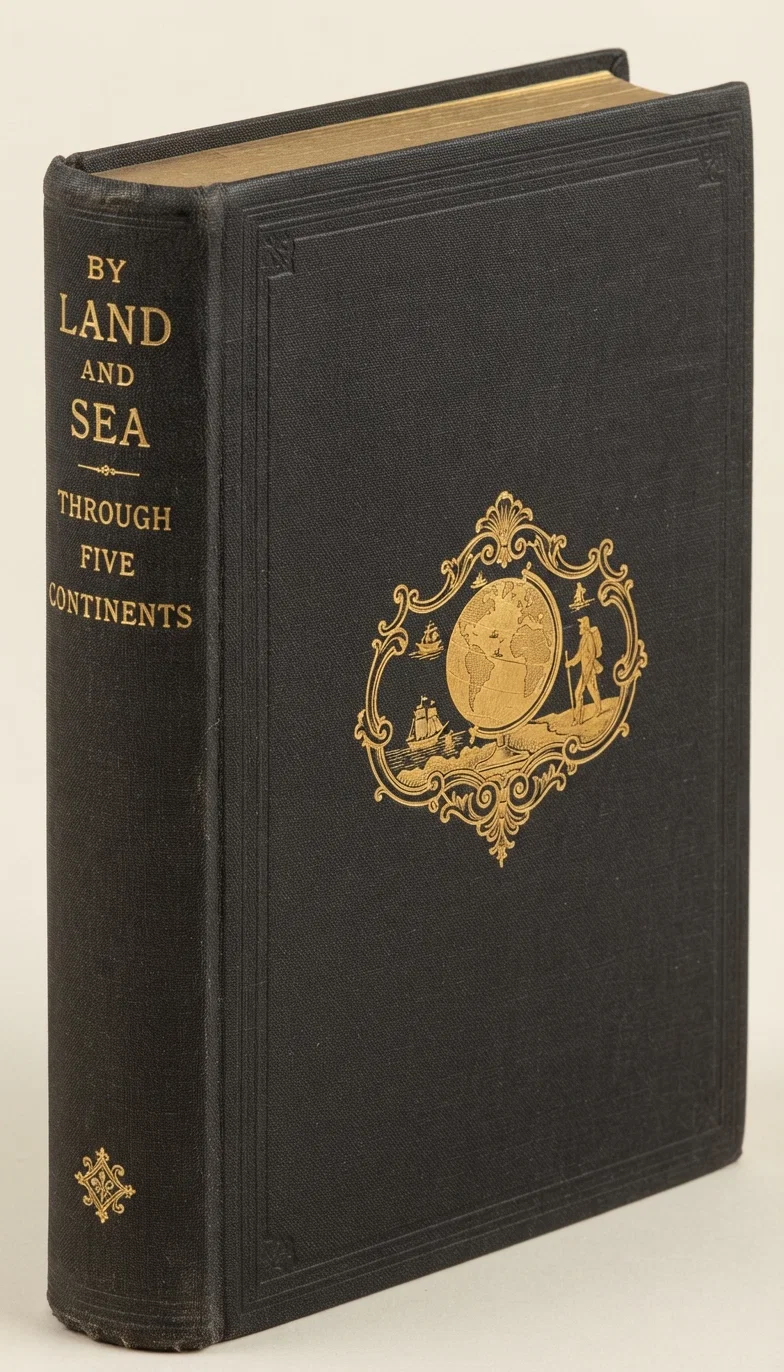
THROUGH FIVE CONTINENTS
By Editor
BY LAND AND SEA
THROUGH FIVE CONTINENTS
Size 9 1/2 x 7 x 1 3/8 inches
A beautiful volume, comprising thirty-six chapters of most interesting descriptions of other lands and climes, of seas and islands, of cities and country, of peculiar people and their odd habits, queer customs, strange likes and dislikes, and a thousand other things all told in a most charming and entertaining manner.
It is highly instructive, and can not fail to be of interest and profit to every reader. Illustrated with one hundred and forty-four fine half-tones and wood cuts.
Bound in Fine Cloth
Regular price, $2.75
Sent post-paid with "SIGNS" one year, for only - - - - $2.10
SENT FREE for five new yearly subscriptions and one renewal, or for six new subscriptions at $1.00 each
Address, SIGNS OF THE TIMES
Oakland, Cal.
Wonders OF THE 19TH CENTURY
By Editor
Is a 32-page tract. Its object is to recount and describe some of the principal inventions of this closing century, and to show their significance.
It contains fifteen illustrations. Is an easy seller.
Price, 5c each or $2.00 per 100.
PACIFIC PRESS PUBLISHING CO., Oakland, Cal.
New York City Kansas City, Mo.
Curious Facts About Sculptures and Buttons
"Vidal, one of the most famous sculptors of France, was stone blind at the time when he executed some of his most famous works."
"Many of the so-called 'vegetable ivory' buttons used on dresses, cloaks, etc., are made of potatoes treated with sulphuric acid."