"A CALCULATION of the amount of fluid perspired by an acre of cabbages is very curious. If the cabbages are planted in rows eighteen inches apart and eighteen inches from each other, it is estimated that in the course of twelve hours no less than ten and one-fifth tons weight of water will have been insensibly perspired by their fleshy leaves."
THE CHEAPENING TELEGRAPH.
THE increase in the use of the telegraph for business purposes, says Ainslee's Magazine, has been accompanied by a steady reduction in the cost of messages. When the first Atlantic cable was laid, the price of a twenty-word message between London and New York was $100, or $5.00 per word. Now the commercial rate between the two cities is twenty-five cents per word. To telegraph ten words from Chicago to New York in 1866 cost $2.05. Now it costs forty cents.
Telegraphing to distant parts of the world is still an expensive business. The rate per word for a message from San Francisco to Auckland, New Zealand, for example, is $2.87. From New York to Manila the rate is $2.45. The charge is not always in ratio to the distance. The rate from New York to some South American or West Indian ports is nearly two dollars per word, but in reaching these points the messages travel twice across the Atlantic.
PRESENT TRUTH IN FIJI.
By J. E. Fulton
THE readers of the SIGNS will be pleased to hear of the continued interest in our work in Fiji. We last wrote you that a number had decided to obey the Lord's Sabbath. We have recently had some further evidences of the Lord's power on men's hearts.
Since we first told you of our work, we have had baptism on two occasions, which have been precious seasons to us. There never has been, we believe, an immersion in Fiji, so this is really the first baptism. It was a very solemn and blessed scene. Twelve have been baptized—one white sister and eleven natives.
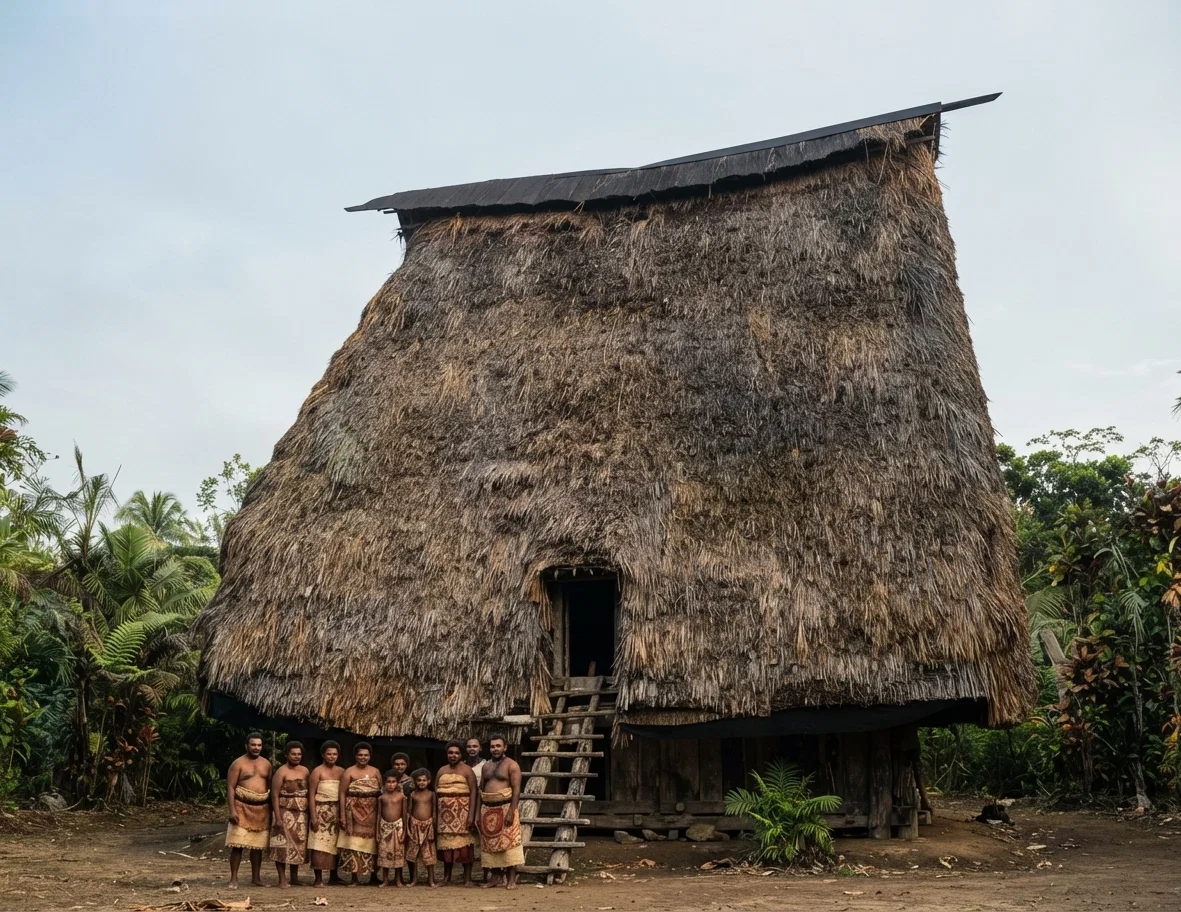
Native Chief's House, Fiji,
Our first Sabbath-keeper and first native to receive baptism is Pauliasi Bunoa, who for nearly thirty years has labored as teacher and preacher for the Wesleyans. He was sent as a missionary to New Hebrides, where he underwent hardships and afflictions for the cause of Christ. His acceptance of present truth has been a great encouragement to us, and his counsel is of great assistance to us. We firmly believe the Lord has raised him up.
Another who was baptized is Ratu Ambrose, the leading chief of the district. He has been a very wicked man, but the Lord has given him victory over his evil habits, and he is earnest in spreading the truth.
We have been making a special effort in behalf of some young men, who, tho they observed the form, had not the truth very deeply in the heart. We are rejoiced to say last Sabbath brought victory to some, who made a confession of Christ and threw away their tobacco and kava, the use of which was holding them away from the blessing. Some of these will be baptized soon.
Giving up tobacco means something to Fijians, who use it, old and young of both sexes. But God has taken away the appetite from some, who praise Him for better health and brighter minds.
Our church-and-school room is now completed. We are glad to get into larger quarters. Our Sabbath-school numbers about fifty-five.
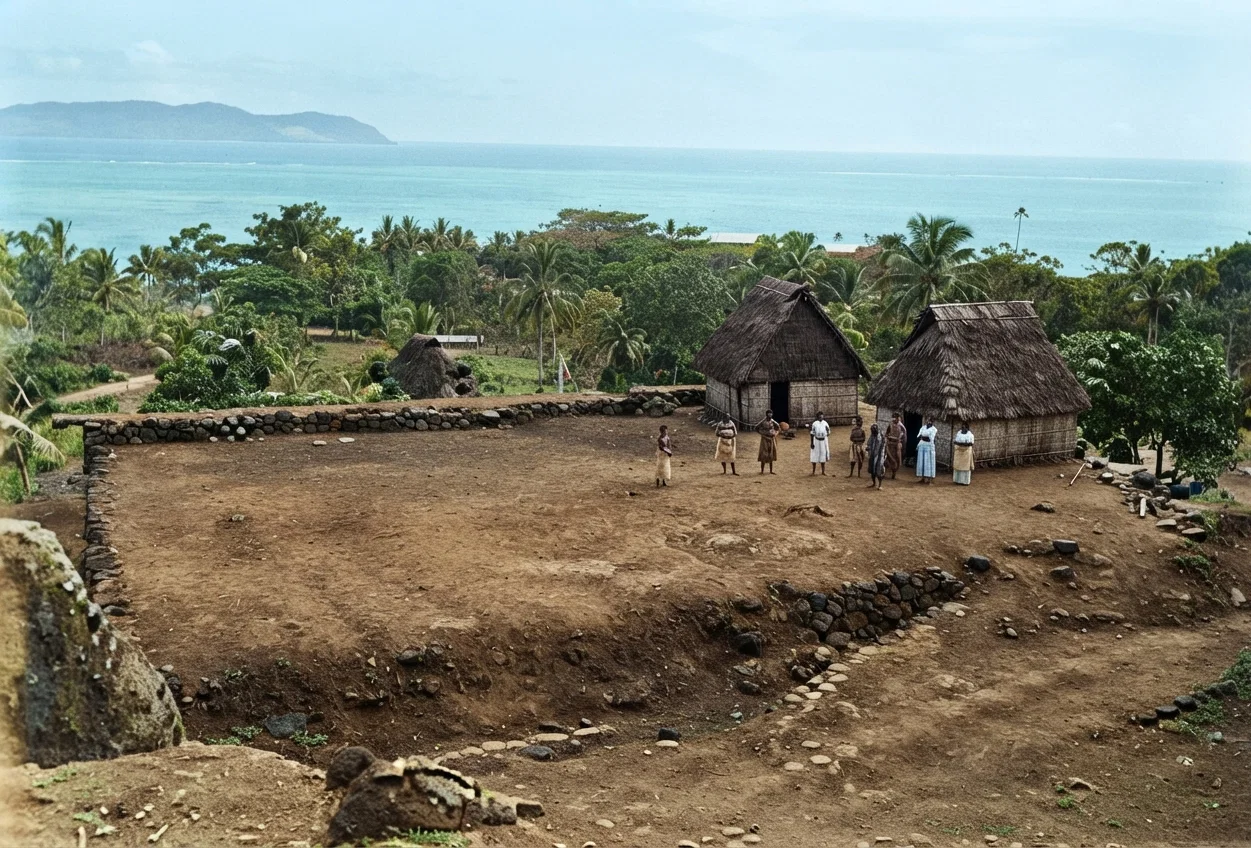
Bau, Chief Town in Fiji—Old Cannibal Town of King Cakabau.
We are in great need of a native building for our young men. A native-built house costing $20 or $25 would do. We have not, at present, quarters for some young people who wish to go to school. What shall we do? Shall we lose some young people on this account? Pray for us. And who will help?
J. E. FULTON.
Suva, Fiji Islands, Dec. 19, 1899.
TAKING HIS MOTHER IN A WHEEL-BARROW.
By Rev. F. Brown
[By Rev. F. Brown, in The Gospel in All Lands.]
A CHINESE boy, in one respect at least, is an object of pity. To be taught that the earth is flat, that China is the center of the world, and that all outside countries are inhabited by untamed savages, is an injustice which would not be tolerated in any country excepting China. There are hundreds of thousands of boys and girls in this land who are being taught this nonsense, and who are led to look upon boys and girls of other countries as "foreign devils." It will be seen how needful it is that missionaries should have Christian schools in which to teach the children of the converts.
Every foreign boy knows the area and population of China, and it all can be summed up in the fact that it is a country of "magnificent distances."
It was in the fall of 1896 that Chang-tai came from An-chai, in the province of Shan-tung, full three hundred miles, that he might gain a Christian education. He was only fourteen years old, but he probably knew more then about geography and arithmetic than the officials of the cities through which he passed, and he was happy in the thought that it had been arranged that he should continue his studies further, and if possible become a minister of the Gospel.
Native Church, Fiji.
Twenty years before, his grandfather had traveled this same road, and, while seeing the sights of Peking, wandered into a Methodist chapel, and there, being impressed with the truth of the Gospel, found a friend in Jesus. Returning to his home, he took with him the "pearl of great price." His wife was much impressed with the change which had come over him, and decided to seek the same blessing. But the distance was great, the dangers of travel were many, and then, supposing she went so far and did not find all she had wished for? But, on the other hand: "Suppose I die without the hope realized by my husband? It is the lot of men to have the best of everything in this land." Thus she reasoned with herself, but could find no consolation. "Perhaps this 'good news' is not for me," she said mournfully one day in the presence of her son, Cheng-pei. "Perhaps this good news is not for me," rang in his ears for days, when a happy thought took possession of him. He went to his mother and told her that he would take his wheelbarrow and push her to Peking if she was willing. She hesitated at first, but Cheng-pei would take no refusal; so, having gained the consent of his father, the day was fixed. Bright and early in the morning the bundles were fastened on one side of the barrow, which his mother balanced by sitting on the other side. Weary days and even weeks passed, pushing the barrow over rough roads worn deep with the constant use of centuries.
But every journey has an end, and so with this one. Looking up, they saw the grimy walls of the "dirtiest city of the world" before them. With what joy they hailed the sight! "Now it will soon be seen whether the good news is for me or not," said the mother. The city was reached and the mission compound found, and with it a welcome. Cheng-pei was happy now. Not only would his mother hear the Gospel, but he would have the chance of learning something of it too. After a sojourn of some weeks, the travelers turned their faces homeward, and, tho the road was quite as long as when they came, it was not so lonely; for Jesus was with them, to comfort, help, and bless.
Home was reached, and Cheng-pei's mother began to witness for Jesus, and continues in the same blessed work to this day. She is telling the story of the Gospel to poor women who are13
Weeping, watching, and despairing,
By a nameless longing stirred;
They are sitting in the darkness,
Waiting for the living Word.
Cheng-pei is now a man, an ordained elder in the mission, and one of our most trusted leaders, while Chang-tai, his son, is a most hopeful student in the Tientsin Intermediate School for Boys.
Thus is the hope of missions centered in the youth of this land. A gentleman called at the school one day as we were mourning over the fact that some of our boys must go home, for lack of funds. Hearing the story of Chang-tai, he said, "I will be responsible for his education till the year 1900." Thus were our hearts gladdened. God may have a Paul, a John, or a Peter among the dear lads at present under our influence.
OUR GOD.
By C. M. Snow
THERE is no God like our God,
No help so wondrous strong;
For, few and weary tho we be,
With Him we are a throng.
No arm in all the universe
His power can defy,
Yet in the hollow of His hand
The weak securely lie.
I can not doubt that searching word
At which the heavens flee;
It calms the tempest of my fears,
And stills my Galilee.
It thrills the million moving spheres
That gem the shimmering space,
Yet finds in hearts that yearn for God
A glad abiding-place.
He whispers in the winds that ope
His treasure-house of hail;
He sends the rain and gentle dew,
That harvest may not fail.
He speaks adown the darkening skies
In voice of thunder loud;
His sword of light, His falchion bright,
Is brandished in the cloud.
And yet there glows in every rose
That drinks the sparkling dew,
In modest grace and smiling face,
God's wondrous love to you.
I hear it in the rustling trees,
I read it in the sea;
Its carols run from sun to sun
In one grand harmony.
Oakland, Cal. C. M. SNOW.
REFLEX INFLUENCE OF MISSIONARY WORK.
By David Paulson, M.D.
ONE day as I was working in my room in the Training School Home in Chicago, making preparations to leave for a meeting in an adjoining State, one of our medical-mission young men came in to ask me to go with him to see a sad case which he had found. I did not feel that I had the time at my disposal, but he seemed disappointed and said it was a very pitiful case. All at once there flashed across my mind the parable of the good Samaritan, and how the priest and Levite were so busy going up to the temple to officiate that they did not have time to turn aside to serve Christ in the person of one of His unfortunate brethren who lay in distress by the roadside.
I changed my mind and accompanied the young man. He led me to the very center of the slum district of Chicago, and then into a house whose general appearance, as well as that of the men and women who were lounging around in front of it, suggested that its occupants did not earn their livelihood in any legitimate manner.
We climbed the weary length of four flights of stairs, the last one being almost dark as midnight, and passed into a small room where no light of heaven's sun could ever penetrate, being lit only by a small, smoky lamp. On some rough boards was a bed of straw with an oilcloth spread over it. There lay the emaciated form of a young man, while his aged father, true to that paternal instinct that we often see preserved even under these trying circumstances, was attempting to offer him some kind of assistance.
I found upon a brief examination that he had two deep abscesses in the small of his back, out of which was oozing foul pus. To all appearances, there was no food in that room for the next meal, and the father told me, with tears in his eyes, that his son had been in this condition for several months, and that he had not been able to earn anything during that time.
O, how glad I was that I was acquainted with a Gospel that reached even to the very bottom of sin and degradation! How eagerly they tried to catch the thought that the Lord could work some good even out of all this!
Reader, do you sometimes feel discontented with your home and its pleasant surroundings, and with the opportunities that God in His mercy has showered upon you so richly? If so, unless your case is incurable, go and familiarize yourself with these scenes of suffering, and you will return to your allotted position where God has placed you, and almost imagine that you have been transported into the Garden of Eden.
DAVID PAULSON, M.D.
OUR WORK AND WORKERS.
By Editor
TWO PERSONS were recently baptized at Greeley, Colo., by Brother W. Zeigler.
THE Montana colporter wagon is now in the field, in charge of Brother Philip Quinn.
THE brethren of Loup City, Neb., are actively moving in the matter of building a house of worship.
THE initial steps have been taken for the erection of a new house of worship by the church in Wilmington, Del.
AT Colo., Iowa, Brother H. Johnson has been holding meetings in the Christian house of worship with a good interest.
THE News reports the baptism of four candidates in Baltimore, on the 4th ult., by Brother K. C. Russell, president of Chesapeake Conference.
THE weekly circulation of Present Truth, our London journal, is over sixteen thousand, and these are mostly sold by single copies from house to house.
AT Leadville, Colo., Brother H. M. J. Richards was granted the use of the Baptist Church for administration of the ordinance of baptism. Two candidates were baptized.
THE brethren at Rock Hall, Md., are making the most of the church-school idea. They have a day school of nineteen pupils, and a night school with an enrolment of twenty-one.
A NEW house of worship was dedicated at Boelus, Neb., on the 20th ult. Brother N. P. Nelson, president of the conference, and Brethren J. W. Boynton and R. W. Brown were present.
WE recently stated that Drs. D. W. and Eva A. Reid had gone to Salt Lake City to locate. They now desire us to state that, not finding conditions favorable to a location in that city, they have settled in Missoula, Mont., 321 East Front Street, where they are ready to treat those who are suffering from disease. Correspondence solicited. Address, Box 234, Missoula, Mont.
THE Nebraska Reporter says: "Mrs. C. S. Hammond, of Minden, ordered a supply of the Educational SIGNS, and sold sixty in one hour." Now will any one tell us what is the difference between the people of Minden, Neb., and those in other places where none of that issue has been sold? The question is worthy of consideration, especially by the brethren and sisters in or adjacent to those other places.
SOME time since we mentioned the destruction of the church building in Washington, D. C., by fire. This occurred December 26, but the brethren took hold with a will to rebuild, and the new edifice was ready for service March 10, when the pulpit was occupied by Brother A. E. Place, president of Atlantic Conference. On the following day the dedication took place, the sermon being preached by Brother K. C. Russell. Brethren A. F. Ballenger, G. B. Wheeler, A. Kalstrom, and H. W. Herrell also took part in the services of the occasion. The rebuilding was accomplished with commendable promptitude.
THE work of Christians is specifically set forth in the following extract from "The Desire of Ages," p. 369:—
"Christ has bidden us, through the prophet, 'Deal thy bread to the hungry,' and 'satisfy the afflicted soul;' 'when thou seest the naked that thou cover him,' and 'bring the poor that are cast out to thy house.' He has bidden us, 'Go ye into all the world, and preach the Gospel to every creature.' But how often our hearts sink, and faith fails us, as we see how great is the need, and how small the means in our hands! Like Andrew, looking upon the five barley loaves and the two little fishes, we exclaim, 'What are they among so many?' Often we hesitate, unwilling to give all that we have, fearing to spend and to be spent for others. But Jesus has bidden us, 'Give ye them to eat.' His command is a promise, and behind it is the same power that fed the multitude beside the sea. In Christ's act of supplying the temporal necessities of a hungry multitude, is wrapped up a deep spiritual lesson, for all His workers. Christ received from the Father: He imparted to the disciples; they imparted to the multitude; and the people, to one another. So all who are united to Christ will receive from Him the bread of life, the heavenly food, and impart it to others."
PERIODICALS WANTED.
By Editor
ANY of our publications will be used in missionary work if sent post-paid to Mrs. S. C. Phillips, Huntsville, Ala.
SIGNS, Sentinels, tracts, etc., for reading-rooms in hotels and other public places. Address, post-paid, A. A. King, Box 85, Purdy, Mo.
LATE clean copies of the SIGNS, also tracts, for missionary work. Address, post-paid, V. O. Cole, Gen. Agt., 230 Cedar Street, Jackson, Tenn.
India as a Missionary Field
India.—The importance of this wonderful country as a missionary field is emphasized in the following statement by Rev. Edward Storrow, of the London Missionary Society:—
"India is isolated from the remainder of Asia by two oceans, and the highest and broadest mountain ranges on the earth. Within these spacious, well-defined limits, lies an empire rich, fertile, and varied, with almost all the gifts of nature, having an area and population equal to that of all Europe, Russia excepted. Its extent is equal to nearly two-thirds of the United States, while its population is almost five times as great. It is the dwelling-place of about one-fifth of the human race, or more than twice the population of the Roman Empire in its palmiest days (according to Gibbon). British rule is direct and absolute over more than two-thirds of this vast population, and supreme and unchallenged over the 650 semi-independent and feudatory States of the remaining third. The origin of these millions of people, with their diversities of race, language, religion, and civilization, can only be glanced at, and, indeed, for the most part these lie outside the limits of definite history."
Two Significant Pictures.
Following are two pictures representing two phases of what the world is called upon to recognize as the Christian church. One shows the church as it was in apostolic times, and as it must be in order to do effective missionary work in the name of the Master; the other shows a declining, time-serving, nominal church. They are taken from the Missionary Review:—
SEVEN FEATURES OF A MISSIONARY CHURCH.
A church that knows how to keep praying.
A church that knows the divine enduement.
A church that is united in love and labor.
A church that makes obedience to Christ its law.
A church that as a body witnesses to Christ.
A church that knows separation from the world.
A church that works on spiritual lines.
SEVEN FEATURES OF A DECLINING CHURCH.
The skepticism that doubts the authority of the Word of God.
The dethronement of Jesus Christ from His proper deity.
The selfishness that ignores the debt to a lost world.
The worldliness that practically unseats the Holy Spirit from His place as overseer.
The caste spirit that destroys sympathy with man as man.
The preaching that substitutes popular lectures for Gospel themes.
The spirit that changes churches into select religious clubs.
Mormonism Not Decadent
Mormonism Not Decadent.—Arrangements for the largest colonization scheme ever proposed in the West have been consummated. The Big Horn Basin, in Northern Wyoming, is about to be settled by Mormons. Arrangements have been made with the Wyoming authorities whereby the Mormons have the privilege of selecting 200,000 acres of land in that wonderfully fertile basin, and a committee of prominent Mormons is now engaged in fixing the locations. Many families in Utah are selling their property and packing up their household goods in preparation for the removal, which at its beginning will consist of at least 30,000 people.—Missionary Review.
The Boers and Missionaries
A LETTER in the London Christian of recent date, while expressing deep sympathy with the present sufferings of the Boers, nevertheless emphasizes the fact that the Boer Government has never been favorable to missionaries; that the instinct of isolation peculiar to that people causes them to repel the foreign element, and to make life hard, not for natives only, but for the missionaries who seek to uplift the native population. The laws and edicts issued by the Boer Government are cited as proving this position.
Not Every Swaggerer Is a Soldier
"We must not account every one a soldier who swaggers with a sword."
16 "But the eleven disciples went into Galilee, unto the mountain where Jesus had appointed them. And when they saw 17 Him, they worshiped Him; but some doubted. And Jesus 18 came to them and spake unto them, saying, All authority hath 19 been given unto Me in heaven and on earth. Go ye therefore, and make disciples of all the nations, baptizing them into the 20 name of the Father and of the Son and of the Holy Ghost; teaching them to observe all things whatsoever I commanded you; and lo, I am with you always, even unto the end of the world."
15 "And He said unto them, Go ye into all the world, and 16 preach the Gospel to the whole creation. He that believeth and is baptized shall be saved; but he that disbelieveth shall 17 be condemned. And these signs shall follow them that believe; in My name shall they cast out devils; they shall speak 18 with new tongues; they shall take up serpents, and if they drink any deadly thing, it shall in nowise hurt them; they 19 shall lay hands on the sick, and they shall recover."
20 "So then the Lord Jesus, after He had spoken unto them, was received up into heaven, and sat down at the right hand of God. And they went forth, and preached everywhere, the Lord working with them, and confirming the word by the signs that followed. Amen."
47 "And that repentance and remission of sins should be preached in His name unto all the nations, beginning from 48 Jerusalem. Ye are witnesses of these things. And behold, I 49 send forth the promise of My Father upon you; but tarry ye in the city, until ye be clothed with power from on high."
4 "And, being assembled together with them, He charged them not to depart from Jerusalem, but to wait for the promise 5 of the Father, which, said He, ye heard from Me; for John indeed baptized with water; but ye shall be baptized with the Holy Ghost not many days hence."
8 "But ye shall receive power, when the Holy Ghost is come upon you; and ye shall be My witnesses both in Jerusalem, and in all Judea and Samaria, and unto the uttermost part of the earth."
6 "And I saw another angel flying in mid-heaven, having an eternal Gospel to proclaim unto them that dwell on the earth; 7 and unto every nation and tribe and tongue and people; and he saith with a great voice, Fear God, and give Him glory; for the hour of His judgment is come; and worship Him that made the heaven and the earth and sea and fountains of waters."
14 "And I saw, and behold, a white cloud; and on the cloud I saw one sitting like unto a Son of man, having on His head a golden crown, and in His hand a sharp sickle."
SUGGESTIVE QUESTIONS.
NOTE.—The texts inclosed in marks of parentheses, while not essential to the lesson study, will be found to throw much light upon the lesson, and are suggested for those who wish to study further.
What would be the effect of accepting or rejecting it? Verse 16. (Rom. 1:16.)
Where was their work to begin? Luke 24:47. Note 1.
Why could they speak with positiveness and assurance concerning the life, death, and resurrection of Christ? Verse 48. (2 Peter 1:16-18.)
What did He promise to send them to qualify them for their work? In order to receive it, what were they to do? Verse 49.
To what did the promise of the Father refer? Acts 1:4, 5, 8. Note 2.
What signs were to follow believers in the Gospel message? Mark 16:17, 18.
What experience did the disciples have as they went forth to preach the Gospel? Verse 20. (Acts 3:1-8, 8:5-8.)
How extensively will the Gospel be preached? What will then take place? Matt. 24:14.
What proclamation becomes a part of the Gospel message just before the second coming of Christ? Rev. 14:6, 7, 14. Note 3. (Rev. 6:13 to 7:1-4; 10:6-11.)
Side Lights.—"Desire of Ages," chapter 80.
NOTES.
1. Jerusalem.—True missionary work begins at home, the very next thing to our hand. The only true way to prepare for foreign mission work is to do home mission work, and then when God sends us to other lands it will be still home mission work.
2. Holy Ghost.—In other places translated the Holy Spirit, the same as the Spirit, the Spirit of God, the Spirit of Christ. It represents the Deity in operation. It brings all blessings to him who receives it.
3. Judgment.—All that the Lord sends to the children of men to warn, reprove, command, invite, entreat, etc., is a part of the Gospel, not something hitched on. The Gospel always meets present demands, as in Noah's day the warning of a flood; in these days, a warning of judgment, a reform on everything, and the good news of Jesus' coming.
20 "Then began He to upbraid the cities wherein most of His 21 mighty works were done, because they repented not. Woe unto thee, Chorazin! woe unto thee, Bethsaida! for if the mighty works had been done in Tyre and Sidon which were done in you, they would have repented long ago in sackcloth 22 and ashes. Howbeit I say unto you, it shall be more tolerable 23 for Tyre and Sidon in the day of judgment, than for you. And thou, Capernaum, shalt thou be exalted unto heaven? thou shalt go down unto Hades; for if the mighty works had been done in Sodom which were done in thee, it would have remained until this day. Howbeit I say unto you, that it shall be more tolerable for the land of Sodom in the day of judgment, than for thee.
25 "At that season Jesus answered and said, I thank Thee, O Father, Lord of heaven and earth, that Thou didst hide these 26 things from the wise and understanding, and didst reveal 27 them unto babes; yea, Father, for so it was well-pleasing in 27 Thy sight. All things have been delivered unto Me of My Father; and no one knoweth the Son, save the Father; neither doth any know the Father, save the Son, and he to whom 28 ever the Son willeth to reveal Him. Come unto Me, all ye 29 that labor and are heavy laden, and I will give you rest. 30 Take My yoke upon you, and learn of Me; for I am meek and 30 lowly in heart; and ye shall find rest unto your souls. For My yoke is easy, and My burden is light."
Golden Text: "Come unto Me, all ye that labor and are heavy laden, and I will give you rest." Matt. 11:28.
SUGGESTIVE QUESTIONS
(1) After Jesus had finished His discourse in regard to John, what did He begin to do? Why did He do this? V. 20. (2) Upon what two cities did He pronounce woe? With what cities did He contrast them? and what did He say of these? V. 21. Note 1. (3) What will be the comparative conditions of these cities in the day of judgment? V. 22. (4) What other city did He upbraid? What did He declare in regard to Capernaum? With what city did He compare it? and what did He say of that city? V. 23. (5) How would its condition compare with that of Capernaum in the judgment? V. 24. (6) For what did Jesus especially thank the Father at this time? What great principle of the Gospel is involved in this saying? V. 25. Note 2. (7) Why could the Saviour thank the Father in this matter? V. 26. (8) What did the Saviour say had been put into His hands? Who only had perfect knowledge of the Son? Who only knows the Father? Who may know Him? V. 27. (9) What gracious invitation does the Saviour extend to all? V. 28. Note 3. (10) What does He ask all to do? What reason does the Saviour give for their learning of Him? If we truly learn of Him who is meek and lowly, what must we also become? In doing this, what blessed experience will be ours? V. 29. Note 4. (11) What does the Saviour say of the yoke which He asks His followers to take? What of the burden which He gives them? V. 30.
NOTES.
1. Woe unto thee, Chorazin!—This is not a wish of the Saviour's that woe should come upon Chorazin and Bethsaida, but a simple statement of the result of their course; and their woe would be the greater, because they remained unrepentant even after the convincing works which Jesus did among their people. There is in this statement of the Saviour an indication of the fact that God treats men according to the light they have had. The punishment of the wicked inhabitants of Tyre and Sidon would not be as great as that of the people of Chorazin and Bethsaida, for their light had not been so great. It is not recorded that any miracles were performed in either of these two cities; but we know from John 21:25 that many miracles were performed by the Saviour which are not recorded.
2. Didst hide these things from the wise and understanding, etc.—Had these things been first revealed to those who were considered wise and of great understanding, the credit would have been given to their wisdom instead of to the revelations of God; but it was revealed unto those who were considered babes in knowledge, who were not puffed up with learning, ones who could be taught. This is in perfect harmony with the Saviour's teaching that except we become as children we can not enter the kingdom of heaven. "Human science is too limited to comprehend the atonement. The plan of redemption is so far-reaching that philosophy can not explain it. It will ever remain a mystery that the most profound reasoning can not fathom. The science of salvation can not be explained, but it can be known by experience. Only he who sees his own sinfulness can discern the preciousness of the Saviour."—Desire of Ages.
3. Come unto Me, all ye that labor.—"In these words Christ is speaking to every human being. Whether they know it or not, all are weary and heavy laden. All are weighed down with burdens that only Christ can remove. The heaviest burden that we bear is the burden of sin. If we were left to bear this burden, it would crush us. But the sinless One has taken our place. 'The Lord hath laid upon Him the iniquity of us all.' He has borne the burden of our guilt. He will take the load from our weary shoulders. He will give us rest. The burden of care and sorrow also He will bear; for He carries us upon His heart. The Elder Brother of our race is by the eternal throne."—Desire of Ages.
4. Take My yoke upon you.—"The yoke that binds to service is the law of God. The great law of love revealed in Eden, proclaimed upon Sinai, and in the new covenant written in the heart, is that which binds the human worker to the will of God. If we were left to follow our own inclinations, we should fall into Satan's ranks and become possessors of his attributes. Therefore God confines us to His will. When our will is swallowed up in the will of God, and we use His gifts to bless others, we shall find life's burden light. He who walks in the way of God's commandments is walking in company with Christ, and in His love the heart is at rest. And He says, 'O that thou hadst harkened to My commandments! then had thy peace been as a river, and thy righteousness as the waves of the sea.' Isa. 48:18."—Desire of Ages.
Salesmen Wanted
Wanted.—Salesmen in every county and town. We offer you something useful, attractive, salable. Commissions liberal. Address,
A. K. ATTEBERRY,
Keenville, Ill.
PRAYER By A. T. Pierson, will bring new life and light into your church, missionary society and home. Price, $1.00 per 100
PACIFIC PRESS PUBLISHING CO.
New York City Oakland, Cal. Kansas City, Mo.