To make a radical cure of a cold, let the patient abstain entirely from food for at least twenty-four hours. Should the bowels be at all inactive, it is desirable that they be thoroughly flushed with warm water. The patient should drink freely of pure water, taking a brisk walk in the open air, and then a Turkish bath. This may be followed by an oil rub, sometimes called a Roman bath, which mollifies the skin, making it more flexible and active. He will find a permanent benefit therefrom. The internal pressure will be relieved, and the cure perfected. Necessarily, chronic cases need more persevering treatment, but each day will show progress, and only perseverance is needed to triumph ultimately over the morbid action. If colds were always promptly and properly treated, there would be many less cases of influenza, pneumonia, or even consumption to be cared for. It would be like turning the stream in the right direction at the fountain head. We well know that many victims of influenza do not regain their normal condition of health for several years afterward.
When this plan is faithfully carried out, the individual is free from any symptom of disease, rarely finds a handkerchief necessary, or even a need of clearing the throat. The converse may be quickly proved by a short season of greasy and highly seasoned food, and an extra meal added to the usual supply. The old proverb, “Feed a cold and starve a fever,” is an absurdity; for one suffering with a cold has already an inward fever on hand; and the more he is fed, the worse he will become. Feed a cold, and you will be sure to have a fever to starve.
All harassing forms of coughing can be avoided by simply obeying the laws of health. The cough is a process of nature to relieve itself of impurities, which are then thrown off by the mucous membrane instead of by the usual excretory organs. By purifying the system, by eliminating the impurities through the natural channels, we relieve the determination of the blood and nervous energy to the mucous membrane, and the cough vanishes. By drinking freely of hot water every hour, this happy result can be materially hastened. This is much better than taking the ordinary cough mixtures, which disorder digestion and spoil the appetite. The water should be taken as hot as can be borne, and it relieves by promoting the secretions as well as the expectoration.
A simple “cold in the head” may be successfully treated by drawing hot water into the nostrils and then blowing it out, repeating the process several times, until the nose is thoroughly cleaned. This is a simple and effective way of strengthening the membranes. It is both soothing and curative, and may be done morning and evening while washing the face. Whenever hoarseness is apparent, the one remedy is rest.
Like other diseases, a cold is not a thing which leaves no trace. It should be treated with as much care as would be given to many other diseases. If neglected, it is liable to bring on serious complications. Every period of disease through which a person passes, whatever its nature, is a permanent impairment of the vitality. Therefore, catching cold, or the beginning of any disease, is to be avoided as much as the losing of a valued possession. Lack of attention to such matters, which seem so simple in themselves, causes one to grow old sooner than he otherwise would.
For those in fair health, the practice of cold bathing in the morning is to be commended, particularly if a warm shower precedes the cold, or a short season in a warm room precedes the cold plunge. This is then most invigorating, and helps to tone up the skin to be unmindful of external changes of temperature, and makes the person less liable to take cold.—C. H. Shepard, M. D.
The Joy of Yielding to the Beloved's Will
“THERE is no joy comparable to the joy of the loving heart that yields to the Beloved’s will.”
Laboring Among the Copts in Egypt
By Louis Passebois
LOUIS PASSEBOIS
The fame of that great nation from which the Copts mainly derive their origin, renders this people objects of much interest, especially to one who has had the privilege of examining the wonderful monuments of ancient Egypt.
The Copts at present, it is said, compose about one fourteenth of the population of Egypt; and about ten thousand of them are in Cairo. In some parts of Upper Egypt are villages inhabited exclusively by persons of this race, especially in the district called the Fayoom.
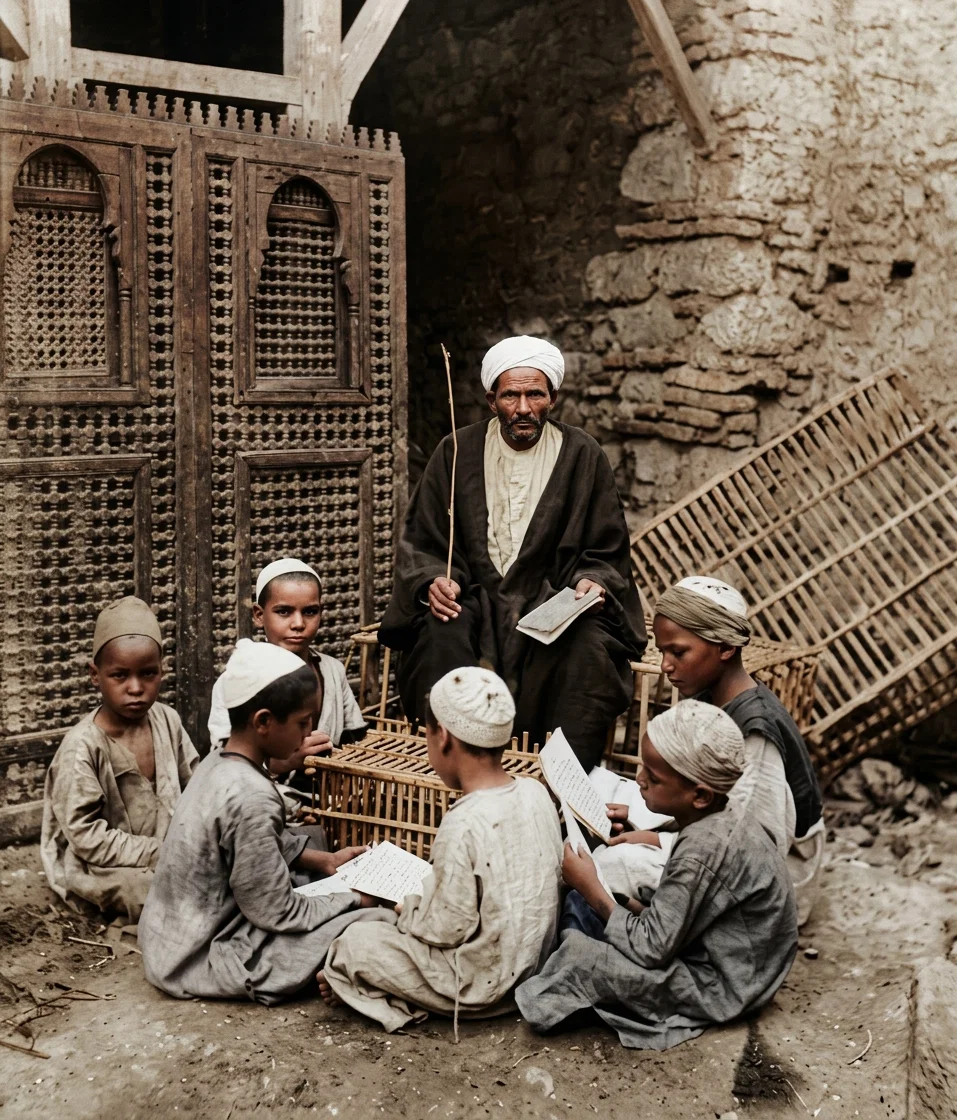
A NATIVE SCHOOL
The vast number of ruined convents and churches existing in different parts of Egypt shows that the Copts were greater in number a few centuries ago; but every year some embrace the faith of El-Islam, and become intermixed by marriage with Moslems. Thus the number of Christian Copts has been reduced to the present small population.
They have not altogether lost their ancient language, their liturgy and several of their religious books being written in it. But the Coptic has become a dead language, understood by very few persons, and the Arabic has been adopted in its stead; though at present there is a movement on foot for its revival, and it is now being taught in their schools. Many speak English, and thus the way is open to labor among them. Generally they love to study the Bible, but have many traditions. To them we are to look for workers to labor among the Islams.
Quite a number are interested in the truth, and some would keep the Sabbath, but, being employees of the government, it is a difficult thing for them to do so. Egypt has no industries whatever; and when young men come out of school, the only source of work is employment under the government. Even the commercial houses will not employ them, as the majority of these houses are European, and engage their workers from Europe.
With the exception of a small proportion who profess the Romish or the Greek faith, the Copts are Christians of the sect called the Jacobites, from Jacob Baradæus, a Syrian, who was a chief propagator of the Eutychian doctrines. The Coptic church recommends baptism of boys at the age of forty days and girls at the age of eighty days, if they are well and healthy, but earlier if they are ill and in apparent danger of death; for it is a prevailing belief among these people that if a child dies unbaptized, he will be blind in the next life, and the parents must do penance for the sin of which they are guilty in not having had the child baptized.
Most of the Copts circumcise their sons at the age of seven or eight years.
The Copts have numerous schools, and are generally better educated than the Mussulmans, occupying most of the government positions. But very few of their women are able to read or write.
In their prayers the Copts somewhat resemble the Moslems. I am informed that there are very few of them who do not comply with a precept of their church which enjoins them to pray seven times in the course of the day. The first prayer is said at daybreak, the second at the third hour, the third at the sixth hour, the fourth at the ninth hour, the fifth at the eleventh hour, the sixth at the twelfth hour,—sunset,—and the seventh at midnight. In the seven prayers of each day those persons who have learned to read repeat the whole book of Psalms. The illiterate repeat at each prayer hour the Lord’s prayer seven times, and, “O my Lord! have mercy!” forty-one times. Previous to prayer, persons of the better classes wash their hands and face, and some also wash their feet. They always face the east while praying. Their ordinary prayers, or at least the latter and shorter form, they often repeat while walking or riding or otherwise actively employed.
Confession is required of all members of the Coptic church, and is indispensable before receiving the sacrament of the Lord’s supper. The Copts observe long and arduous fasts. They also hold that pilgrimage to Jerusalem is incumbent on all who are able to perform it. The pilgrims compose a numerous caravan. They pass the passion week and Easter at Jerusalem, and on the third day after the passion week proceed to the Jordan, in which they bathe.
They almost universally abstain from the eating of swine’s flesh. Their ordinary domestic habits are Oriental, and very nearly the same as those of their Moslem fellow countrymen. They pass their hours of leisure chiefly in the same manner, enjoying their pipe and coffee. Their meals, and the manner of eating, also are similar, but they drink brandy at all hours of the day, and often to great excess. The women are not allowed to be seen in the street without a veil.
Recently we have had meetings in our mission home, which were well attended by Copts and Greeks. The services were conducted in English and Arabic, and much interest has been manifested. A few days ago I received a letter from a Copt who is a government employee, a railway station master. He has attended some of our meetings and studied present truth. He writes that he is anxious to be free from his employment, and go into a school where he and his wife may study the Word of God and prepare to work for him. We hope that his prayer may be answered, and that both he and his wife may become wise in the Word of God, and be able to teach it to their people. As yet we have no lady workers to labor among these native women groping in darkness; and a man, no matter how often he visits the home, may see the men, but is never allowed to talk to the women.
Several other Copts are much interested, especially two young men in the school of telegraphy. They have been coming to our house almost every night to study the Bible, and have told me that their one desire is to prepare themselves for the ministry, to be instruments in God’s hand to carry the everlasting gospel to those who are far from him. A Greek young man also is much in favor of the truth, and desires to keep the Sabbath; but being young,—only sixteen,—his parents have put him into employment. The Word of God is working upon his heart, and we believe that the time is not far distant when he will, by the help of God, keep the commandments of God and the faith of Jesus.
We are in great need of a school, that14we may train some of these young people for the work, and of a printing press, that we may print literature in the Arabic. We hope that the day is not far distant when these needs will be supplied.
Cairo, Egypt.
The Work in Scandinavia
By Louis R. Conradi
L. R. CONRADI
EN ROUTE to and returning from Finland, we met the representative brethren of the Skodsborg and Frederikshavn institutions, as well as the leading brethren of the Danish field. The Skodsborg Sanatorium has had its best run of patients the past year, and the outlook is favorable for that institution.
During the summer months they had a fair patronage at Frederikshavn. This is the first year Frederikshavn ever had a physician permanently located there (Dr. N. P. Nelson), and they have made enough to pay his salary, and the institution will, perhaps, have a smaller deficit than last year. The poor season has militated against our work there, and none of the brethren felt that the work had been given a thorough trial, so it has been decided to continue the branch institution, and we hope that it may open up more favorably next spring. The brethren concerned are anxious to make the work a success, and Dr. Nelson is determined to do his best for the institution.
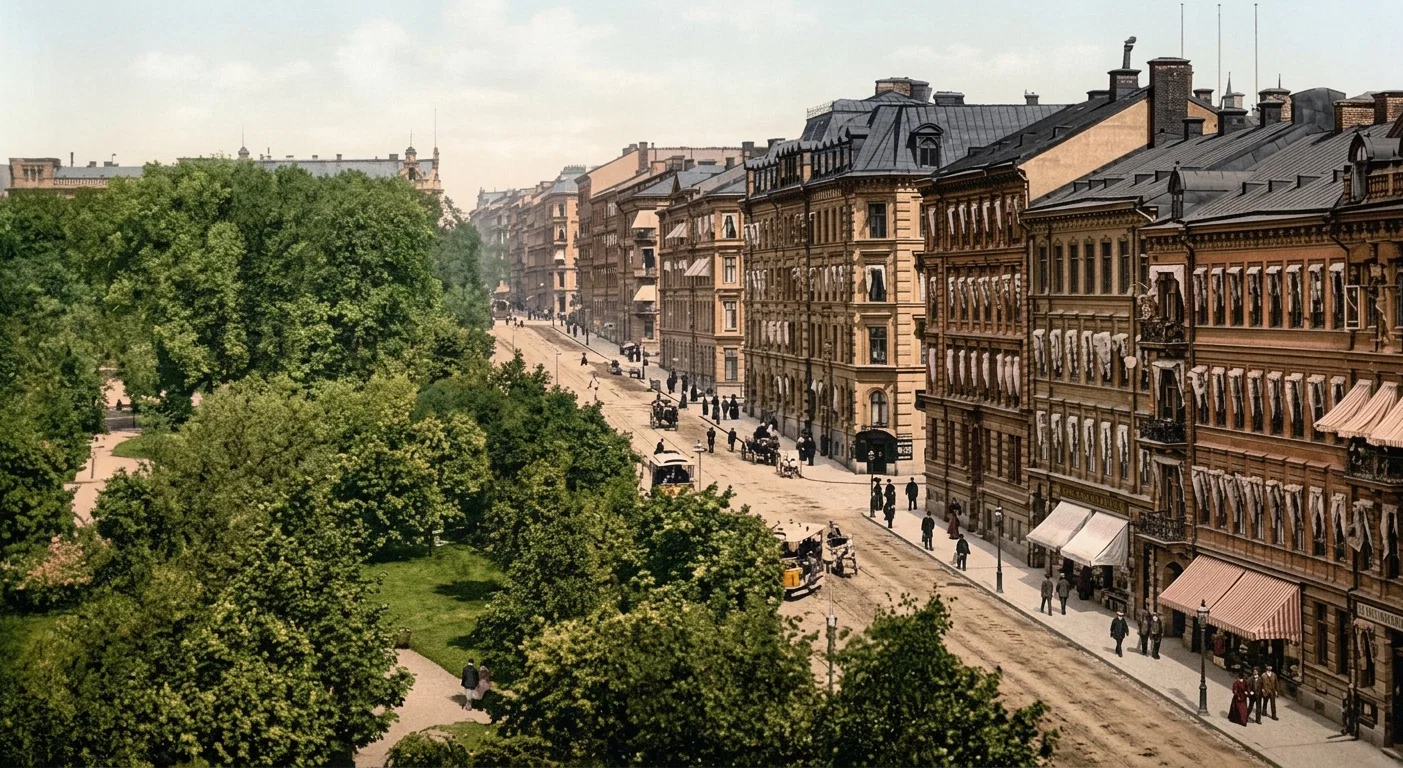
A STREET IN STOCKHOLM
The Danish health journal, largely through the efforts of Brother Hendrickson, has a circulation of five thousand copies monthly in Denmark alone. As two editions of this paper were being published, one in Denmark and another in Norway, arrangements were made to have both editions printed by our house in Christiania. This gives much-needed work to our Norway brethren, furnishes the paper to our Danish brethren just as reasonably as they secured it before, and provides for the publication of the Norwegian edition at a trifling cost.
I found that the weather had been so cold all over Norway, especially in the northern sections, that the harvests are nearly an entire failure, and in some places in Finland, Sweden, and Norway the government is obliged to help the people in order to keep them from starvation. As Norway, especially, has passed through quite a crisis in its cities, this comes still worse on the people there, as the crisis has now struck the country districts.
However, during the year ending June 30, 1902, the Norwegian books sold amounted to more than $8,000 in value; the tithe to $4,560. Fifty-eight persons were baptized, and six were added by vote. The present membership is six hundred and ninety-eight.
The president of the Denmark Conference, Brother P. A. Hansen, reports some successful meetings in Frederikshavn. The church there has been strengthened by quite a number of additions to its membership. Their book sales for the twelve months ending June 30, 1902, were over $4,200; their tithe was $4,760. Twenty persons were baptized, and nineteen were added by vote. The present membership is six hundred and forty-six.
We had an interesting meeting with the conference committee in Orebro, Sweden, October 13-15, where the work for the coming winter was laid out, and important publishing interests considered. Their book sales for the year were nearly $17,000; the tithe was $3,450. Twenty-five persons were baptized, and sixteen were added by vote, bringing the membership up to seven hundred and ninety-four. (Year ending June 30.)
Steps were taken to increase the circulation of our Swedish journals, and also to get out additional books in connection with Finland, so that both countries may be provided with a new book simultaneously. We find that co-operation in these Scandinavian countries will save means in many ways, and by a little planning a number of difficulties may be overcome.
We are glad that Brother Nils Anderson, who has been a faithful Bible worker in Sweden, has answered the call to go to Iceland. He expects to sail from Copenhagen, October 28, taking a steamer direct to Seydisfjord, in the eastern part of the island, where Elder Ostlund is now located. It has taken almost a year to find the proper person for that field. We are glad to send one who seems so promising.
In Orebro Brother C. Kahlström, who has been carrying forward a medical mission there for some time, has rented a nice apartment in the center of the city, and put in a bath room and an electric-light bath. He reports encouragingly of his work.
The Swedish Conference expects to take hold of the circulation of “Christ’s Object Lessons,” and push this vigorously throughout the field, for the benefit of their educational institution at Nyhyttan. They have recently finished a new building for the accommodation of the teacher. At the time of our visit, there were not so many students in the school as formerly.
In general, the work in Scandinavia seems to be going forward, and we believe there are better days before it. We trust that the cause of God here may be remembered by our people everywhere; for the effectual, fervent prayer of the righteous availeth much.
Triumphs of Missions in Madagascar
WHEN Madagascar was first entered by missionaries (1820), the people were found to bear all the marks of heathen and idolatrous degradation. Homes could not be said to exist. Infanticide was common, slavery universal. They attributed to their idols all power, but neither goodness, virtue, nor love. They were mere personifications of human greed, licentiousness, malice, deceit, and cruelty; and the people were like to them.
At first the missionaries enjoyed the favor and protection of the rulers. They had, however, labored eight years without gaining a single convert, when a change in the government brought on a long period of vigorous persecution. The eight years following the breaking out of persecution witnessed the gathering of several thousand converts, many of whom were government officials and leaders in the army. With the success of Christianity, persecution was intensified, until, in 1836, the missionaries were forcibly expelled from the island, and for twenty-five years the church there was without outside assistance.
These twenty-five years recorded a series of persecutions for intensity and extent scarcely excelled in the history of the Christian church. The ingenuity of cruelty seemed exhausted. They were chopped in pieces, cast into pits, where boiling water was thrown upon them until they died. They were condemned to slavery for life, were hurled from precipices, chained together by links forged about their necks, and driven out to die. They were sold as slaves into perpetual exile. Thus, for a quarter of a century, this young church was absolutely isolated from all communication with the churches in other lands, while it underwent a persecution whose martyrs are numbered by the thousand.
Finally, a change in the government15brought religious liberty for the islands. Those in prison were released; those who had been sold as slaves were set free; exiles were permitted to return. It was a year of jubilee. The missionary’s return was the occasion for a triumphal procession which escorted him throughout the island. He found everywhere that this infant church had not only been able to endure, but had actually grown fivefold, and religious teaching had completely permeated the island. Many of the sites where martyrs fell were now commemorated by the erection of Christian churches. Converts were multiplied with almost unparalleled rapidity. The desire for the Word of God was so great that for some time the presses were unable to keep pace with the demand. Sabbath observance, Christian marriage, industry, and honesty took the place of lawlessness and sloth.
In the midst of these joyous triumphs a Christian queen came to the throne. The coronation throne was covered with a canopy, on the four sides of which were written the mottoes: “Glory to God,” “Peace on earth,” “Good will to men,” and “God with us.” Her example was of far-reaching influence. One hundred churches were erected within one year.
In 1895 there were enrolled 375,000 Christian adherents. A glance at your missionary map of the world will reveal to you the fact that about three fourths of the island is regarded as Protestant Christian.
“Except a grain of wheat fall into the earth and die, it abideth by itself alone; but if it die, it beareth much fruit.”—Morning Star.