PERHAPS the interview that Cardinal Gibbons had with the President at the White House on September 20 was a kind of prelude to the remarkable conference that the chief executive had with Archbishop Chapelle on October 21. We should keep close watch of the influence that the Catholic power is gaining over this government, for it is fulfilling prophecy. This is no time now to cling to cherished dogma, and thus allow prejudice to blind our eyes to the light of truth. Every one, as he prizes the rewards of eternity, should be studying the Word of God for himself, so that he may know what the Lord has to say concerning the thrilling events of these times. God has spoken distinctly through His Word. Let all the world give heed.
OCTOBER 2 was the first day for paying taxes in the Greater New York. That day was made memorable by the amount of taxes paid by sixteen men. The one of the sixteen whose taxes were the highest paid $406,895.96; then follow four others who paid over $250,000 each, and seven more who paid over $100,000 each, while the remaining four paid from $36,000 to $75,000 each. When men have to pay such large taxes what must be their vast wealth? But the great hoarding of wealth in these times is only interesting as we view the subject in the light cast upon it by the prophets. Have you ever studied the scriptures that so clearly predict the piling up of these colossal fortunes in our times?
A YOUNG man attending the California University, while practising at the Rugby game of football a few days since, had his neck broken, and died soon after. It is a slander on barbarism to say that Rugby football is barbarous. Every year furnishes its record of promising young men who are either killed or crippled while playing at this game. There are many ways of getting both exercise and recreation without taking the risk of being killed. Then why not choose the methods that are devoid of danger?
A NAVAL battle on the Magdalena River was fought between the government forces and the rebels of Colombia on October 24, in which about 200 men were either killed or drowned. The rebels had hastily transformed half a dozen river steamers into war ships, and they were repulsed, after a fierce battle of four hours' duration, by the government war ships Hercules and Colombia. Colonel Nevaro, a rebel leader, was killed.
A NUMBER of women were arrested a few days since in New York City for keeping a pool-room. It is to observed that the betting and racing craze of these times has taken possession of the women quite as fully as the men.
A YOUNG man from St. Louis was drowned a few weeks ago while submitting to a preliminary ceremony preparatory to being initiated into the Kappa Alpha Fraternity of Cornell University.
VICE-PRESIDENT HOBART is believed to be upon his death-bed. There seems to be no hope of recovery from his present sickness.
THE New York World since last July has been calling attention to a big railroad combine that is being formed, that will include all the roads of the Eastern and Middle States. The pool, or trust, when formed will represent a capital of $2,186,614,294. What fabulous proportions these big combines of wealth are reaching! And how literally are they fulfilling prophecy. Read what is said in the fifth chapter of James in regard to the heaping together of treasure in the last days.
ENGLAND'S preparations for her war in the Transvaal place her on the greatest war footing that she has occupied since the stormy days of Napoleon. And there is the melancholy prospect that her army and navy will never be lessened, but rather that they will be increased more and more. And all the other nations will feel that they must increase their war strength; and so the work will go till the battle of the great day of God is reached.
FREDERICK WEYERHAUSER, one of the greatest lumber merchants of Wisconsin and Minnesota, has just purchased a million acres of timber land on the Pacific Coast from the Northern Pacific R. R. Company. He says he has purchased the land merely as an investment. He believes that there will be a big advance in the price of timber on the coast and that he will reap a handsome profit from his deal.
IT has been decided by the War Department, so says a despatch, to begin the manufacture of the high explosive thorite for use in the Philippines. It is too bad that these poor heathen are to be treated to such frightful materials of slaughter. It is certain that men can not be under the banner of the Prince of Peace while they are using their utmost abilities to kill their fellow-men.
THE Filipino Congress has elected a commission of native priests to proceed to Rome to explain to the pope the abuses and iniquities of the friars and ask for corrective intervention. Aguinaldo, in a recent speech at Tarlac, characterized the friars as intriguers and abusers of honor, law, and morality, and declared they compassed Spain's downfall in the Philippines.
A BOY eight years of age living in Virginia, attempted to commit suicide by pouring kerosene over himself and setting it on fire. The fire was put out, but there is little hope that the child will recover. He gave as his reason for the deed that his parents were unkind to him. When the suicide mania strikes the children, it shows an alarming condition of things.
SIX men who call themselves the "prophets and evangelists of the Catholic Apostolic Church," have been holding meetings in New York City recently. The burden of their teaching is that the second coming of Christ is right at hand. There can be no doubt but that they are right upon this point, whatever may be their teaching upon other themes.
THE New York World gives an itemized list of expenditures, showing that Sir Thomas Lipton expended $950,000 in building his yacht, Shamrock, and carrying out the race with her for "America's cup." It is only in the times of colossal fortunes that such vast sums can be so incidentally spent by single individuals in their favorite sports.
CERTIFICATES of incorporation of the Anglo-American Rapid Vehicle Company of New York have just been filed in Delaware. The capital stock of the company is placed at $75,000,000, and it is formed for the purpose of combining the most important English and American automobile companies.
THE United States Army, according to General Corbin's recent report, now numbers 99,160 men. Of these there are now 32,315 in the Philippines, and enough more are ordered to go there at once to make the American Army in those islands 65,725 strong by December 1.
THE New York Journal says that some fears are entertained of an epidemic of typhoid fever in Elmira, N. Y. "An investigation has disclosed that the wife of a milkman, on whose route six cases of the disease have developed, is ill with the fever."
Six thousand six hundred and nineteen American soldiers were killed in action or died from wounds or disease in camp between May 1, 1898, and June 30, 1889.
THE national debt was decreased $2,766,199 during the month of October.
CHURCH FAIRS.
The Catholic Mirror classes church fairs as “necessary evils.” The Mirror says:—
“Fairs being an evil, and being necessary, the problem to be met is not so much to obviate their necessity as it is to palliate their concomitant evils. One of these evils, and perhaps that which arouses the strongest condemnation of the average layman, is the forwardness of young girls. Many girls, self-respecting and respected by others, modest and demure in accord with their Catholic home training or the excellent discipline of convent or parochial school, throw lightly aside all their previously-conceived and well-confirmed notions of what is proper and becoming and enter with too great zest the eager contests of the fair room. Maidens who would hitherto have blushed at the very idea of speaking to a stranger, flock to the stores and offices of merchants and business men in quest of donations of money or goods, and, too frequently, when forward request is met with refusal, polite or otherwise, it may be, seek by boisterous cajolery, by unmaidenly importunity, to reverse the first denial. In the bazaar room similar scenes, only in a more exaggerated degree, are witnessed. Girls, in the effort, not so much to assist the church in paying off its debt as to be victorious in some contest, or to have the table for which they are working come out first, venture much and sacrifice much. They will address those to whom, perhaps in any other circumstances, they would disdain to speak. Undesirable acquaintanceships may be formed, which later can not with ease be dissolved.”
No form of evil can be a necessity to the true Christianity. And a “fair,” or anything else that will mislead young girls, as described in the foregoing extract, should be banished from the church of Christ. We need only to study the life and teaching of Jesus of Nazareth in order to see that they are altogether out of harmony with church fairs and all the rest of the inventions that professing Christians have devised to take the place of the pleasure and also the sacrifice of out-and-out giving to the cause of God.
Is not the almost universal assent, not only by Catholics, but by Protestants as well, to the idea that church fairs and the like are a necessity, a most marked indication of a great apostasy among professing Christians? The world has absorbed almost all who profess the name of Christ. The church is filled with hypocrisy. And this is true to such an alarming extent that it is one of the significant signs of our times. Have you ever considered seriously what it portends? T.
W. N. G
By W. N. G.
interests in jeopardy, and that the reports concerning her sinister influence in the Philippines are a subject having two sides, it is decidedly assumptive to ask that Rome's representative shall be the sole arbiter in the case, and that the people of the United States shall implicitly take his report in preference to all others concerning the condition of affairs in the islands. This is assuming extraordinary credulity on the part of an intelligent people. What next?
W. N. G
THE CABLE BREAKS.
By S.
THIS is a Christian nation, according to the decision of the Supreme Court, rendered some time since. Now, the business of the Christian is to preach and teach Christianity. If this were a Christian nation (which it is not), it would be its chief business to propagate Christianity. But the government, through its military representative in the Philippines, has forbidden the distribution of tracts or Bibles in those islands.
A Christian who will not allow the people an opportunity of reading the Bible or Christian literature—who will not distribute copies of God's Word, nor allow those to do it who would—has little comprehension of the great commission, to say the least. Nevertheless the government is paying the salary of a Catholic priest (appointed ostensibly to the work of a chaplain), who goes to the Philippines as the acknowledged assistant of Archbishop Chapelle in his work of reconstructing the Catholic propaganda in the Philippines.
The archbishop desired an assistant in that work in those islands who had had an experience there. He found such an one, and the government pays the passage of this assistant of the archbishop, and pays his salary besides. Surely, then, the government is interested in religious work in the islands—that particular kind, even tho it has forbidden the Bible to be distributed or evangelical work to be done; but that particular kind of religion has always been opposed to those things. The decision that this is a Christian nation was based partially upon the fact that America was discovered by Columbus, a Catholic, who was sent out by the Catholic king and queen of a Catholic country; and the government is certainly living up to Catholic Christian principles in paying Catholics to propagate their faith in the Philippines, and refusing to allow others to labor there, even at their own expense.
Verily, the nation has broken her anchor chain, and is drifting toward the maelstrom. The tendency to join civil and religious things in this country is playing sad havoc with the foundation stones of our republic. The separation of Church and State, our country's most vital principle, has been abandoned. Instead of continuing at the work of repairing and strengthening its walls, the nation has gone down into the plain of Ono to confer with Sanballat and Tobiah, while the forces of the latter are preparing to sweep over the walls and overwhelm the country.
Will the nation take heed?—We fear not; in fact, it is not so written; and it is the business of the true Christian to stand in his lot and place, performing faithfully the duties laid upon him, awake to every onslaught of the enemy, and prepared for these rapid changes that are so swiftly ushering in the great day of God. S.
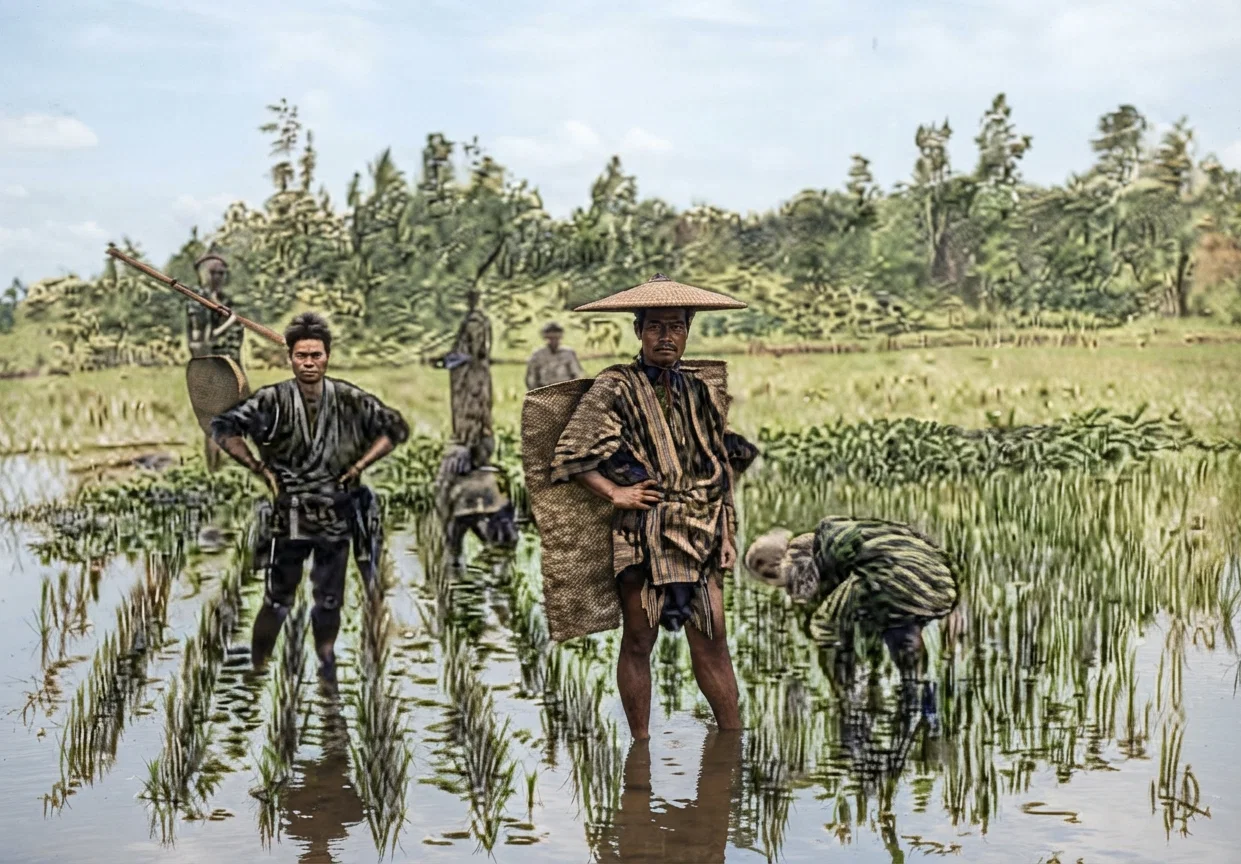
Rice Culture in the Philippines.
PRODUCTS, INDUSTRIES, AND RESOURCES OF THE PHILIPPINES.
By Eugene G. Wood
THE products, industries, and resources of the Philippines are many and varied. The soil is fertile and adapted to all semi-tropical and tropical products. The woods abound with a great variety of fruits; oranges, lemons, bananas, pineapples, mangoes, chicos, etc., are found growing uncultivated in great abundance, and may be gathered in their season. Tomatoes and a peculiar kind of potato are found in quantities, but of an inferior quality.
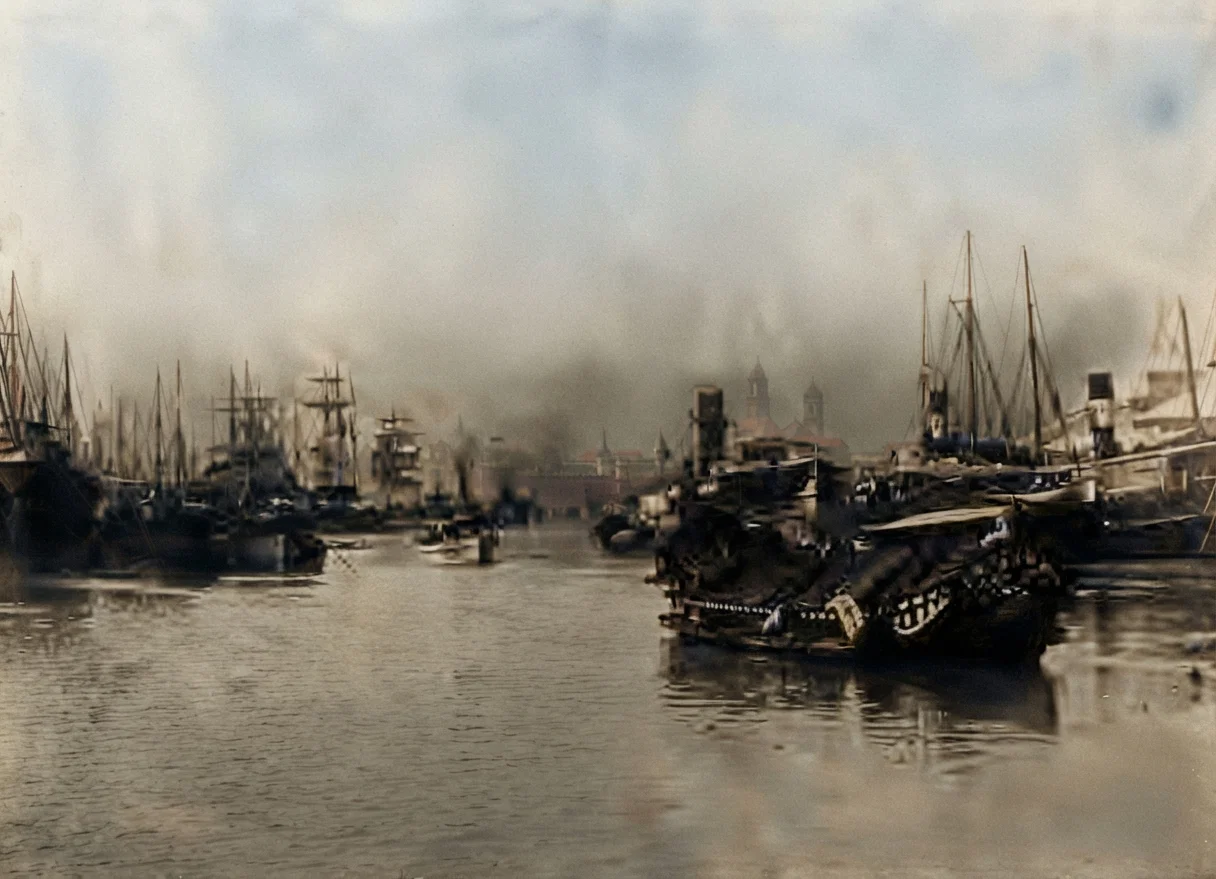
Shipping on the Pasig River.
Many varieties of sweet-potatoes, also radishes and peanuts, grow with very little cultivation. Sugar-cane, hemp, tobacco, rice, coconuts, coffee, indigo, and rubber are the chief products of the Philippines.
Sugar-cane is grown extensively throughout the entire Philippine group; but around the towns of San Fernando, Malolos, and Malabon, on the island of Luzon, and the entire island of Negros, one of the Vasayan group, it is one of the principal agricultural products. The soil produces but one crop a year, and there is but one crop at a planting.
The method of extracting the sugar and molasses from the cane is quite crude. The cane is ground between huge wooden rollers, turned by the caraboo, or water buffalo, and the juice is boiled down in large cast-iron kettles. When sufficiently boiled it is poured into earthen jars and left to stand for some weeks. It is then emptied out onto mats and divided into three parts, according to color, depending upon drainage. The contents of the upper portion of the jar are fairly light, the middle quite dark, and the bottom as black as tar. The sugar from the upper and middle portion of the jar is dried and bleached, and packed for market, while that in the lower portion is stored in mats to redrain. Such sugar is sold in the home markets from at 1 3/4 to 2 1/2 cents per pound, according to the grade. The molasses is sold at the distiller's, to be manufactured into alcohol and rum.
With such primitive methods it would be impossible to do much in the United States with the sugar industry; but in the Philippines they can work on a crop of cane for months.
The wages of the day laborer on these plantations are from $1.25 to $1.50 per week. There is an overseer to each twelve of these laborers, who receives about $3.00 per week.
The Vasayan group of islands produces about 19,650,000 pounds of sugar annually. In Manila hemp the Philippines possess a unique product, but this is a misnomer, as it is no relation to the hemp plant. Its native name is abaca, and it is a product of a species of plantain or banana which differs very slightly from the edible variety. It is a hardy plant, growing from twelve to fifteen feet in height, and suffers very little from any enemy except drought. It grows best in the hilly volcanic formation in the eastern part of the islands. It is a perennial plant, like its fruit-bearing relative, giving out new shoots month after month from the original root. A large tract of land is necessary to form a successful plantation, as it takes about three years for a stalk to reach maturity. As yet the crude native implements are used in the harvesting of the hemp.
Tobacco is raised in large quantities throughout the interior of Luzon and the southern islands.
Rice, the principal article of food, is raised in large quantities throughout the entire Philippine group. It is planted in beds and when about six inches high it is transplanted in rows in the fields. Unirrigated rice fields produce but one crop a year and produce about one-sixth the quantity per acre of irrigated rice land. When the land is irrigated it will produce two crops a year of about 2,000 pounds each per acre. One man is supposed to cultivate about two acres under the present system of cultivation.
The cultivation of the coconut tree is general throughout the islands. The nut is used for food purposes and the making of oil, while cloth is made from the fiber of the leaf of the tree, pinia cloth being the finest grade. It sells for more than silk in the home markets.
It is said for many years a superior grade of coffee has been grown on the mountain slopes of the interior, and that coffee plantations are quite profitable.
The rubber plant is met with in many parts of Luzon and Mindanao. Of the profitable species two or three are native of Philippine soil. It is thought that no industry in the archipelago could excel the cultivation of rubber, if proper attention be devoted to it.
The products of the islands are brought into Manila, the chief center of commerce, by the Pasig River, a line of small steamers running to all the different islands of the group, and the railroad running from Manila to Dagupan. This road runs around the western coast of the island through the fertile valleys and a succession of rice and sugar fields intercepting Caloocan, Malolos, Pampanga, Tarloc, and11finally terminating at Dagupan, on the shallow gulf of Lingayen.
Much is said about the mineral resources of the Philippines, and many odd reasons are given why the mines have not been developed,—one, a superstition of the natives who think it is mortal sin to disturb the earth, but the principal reasons being the hostile condition of natives in the interior of the islands, and the Spanish Government, who imposed such heavy revenue that no foreign government would invest their capital.
The rock formation is largely of volcanic origin. Large beds of almost pure sulphur are deposited near Cavite. The iron deposits are said to be of pyrites, limonite, or bog iron ore, and hemitite, or red iron ore. At Augot is found one of the richest deposits known in the Philippines. This property was once worked by an English firm, who, after the heavy tax imposed upon them by the Spanish Government, were unable to make it profitable, so eventually had to abandon the property. At the present time the mine is worked by native Filipinos, who are said to make enough in one day to sustain them for a week.
Petroleum is found in Luzon and Mindanao. It is used by the natives as medicine and for household use, but not industrially.
Among the metals which have been found are quicksilver, zinc, tin, copper, platinum, and lead. Whether they exist in paying quantities is not known as yet.
Gold is said to exist in large quantities throughout the islands; but the Spanish would not work the mines, or allow foreigners to come in and carry off the profit. At the present time no mining is being done by Europeans in the Philippines. There is said to be about five hundred square miles where placer gold can be found, and about fifty places where exists gold-bearing quartz in true fissure veins. One ledge worked by natives in Northern Luzon has been examined by English assayists of Hongkong and said to average from ten to one hundred dollars per ton.
Most every scientist who has visited the Philippines has given his belief that a great mining future is in store for the islands. And the Chinese yellow book speaks of the island as abounding with precious metals.
A dark-looking ore containing gold, copper, lead, and silver, called serpentine rock, has been brought into Manila.
The most of the rock found in the Philippines is not what is called free-milling ore, but assays very high, and with proper machinery would afford a great source of income to the country if systematically worked.
The prospector will meet many almost insurmountable obstacles when going into the interior, but nothing will form a barrier to the energetic man. Large deposits of soft coal are found in the island of Luzon. The coal is said to be of good steaming quality and quite accessible. These mines were shut down some time ago by the insurrectors.
GO AND TELL.
By A. B. Simpson
SEND the Gospel of salvation
To a world of dying men;
Tell it out to ev'ry nation,
Till the Lord shall come again.
CHORUS—
Go and tell them, go and tell them,
Jesus died for sinful men.
Go and tell them, go and tell them,
He is coming back again.
Tell it out to China's millions,
Tell it out in fair Japan,
Tell it by the mighty Kongo,
Tell it in the dark Soudan.
'Mid the lone Tibetan mountains,
By the Orinoco's strand,
O'er the burning sands of India,
Tell it out in every land.
Christ is gath'ring out a people
To His name from every race;
Haste to give the invitation,
Ere shall end the day of grace.
Give the Gospel as a witness
To a world of sinful men,
Till the bride shall be completed,
And the Lord shall come again.
—A. B. Simpson.
OUR WORK AND WORKERS.
By Editor
At the last quarterly meeting of the church at Santa Ana, Cal., eight members were added.
In the Reporter we note reference to church schools at Amery, Bloomville, and Stevens Point, Wis.
A CHURCH of nineteen members has been organized at Rossland, B. C., by Brother W. W. Steward.
THE president of Upper Columbia Conference reports $2,000 on hand toward the work of opening a mission in China.
WOULD the person who sends the Signs of the Times to G. Clurry, blacksmith, Sledmore, Yorkshire, England, change his address to Bridlington Quay, Yorkshire, England?
Two MEMBERS added to the church at Ashland and two to the church at Sanborn, Wis., are reported by Brother N. P. Neilsen.
A GENERAL meeting for General Conference district No. 1 is to be held at South Lancaster, Mass., November 28 to December 10.
IT has been recommended by the General Conference Committee that Brother A. F. Ballenger make the Chesapeake Conference his field of labor.
THE Reaper reports that Walla Walla College has recently supplied eight teachers for church schools, and four others are to be sent out in the near future.
SINCE August 2 Sister Anna Jensen reports ninety orders for the Signs at Green Bay, Wis. She now has one hundred families reading the paper in that city.
CHURCH schools are in operation or about to be opened at the following places in California: Centralia, Crystal Springs, Escondido, Fresno, Garden Grove, Hanford, Napa, San Francisco, San Jose, and San Pasqual.
THE organization of a church of twenty-three members at Pepperwood, Humboldt County, Cal., is reported by Brother N. C. McClure. The company had built a new house of worship previous to the organization.
ON the 1st inst. Brother W. L. H. Baker and family sailed from San Francisco, on the steamer Moana, for Australia. They have formerly spent several years in the Southern Continent, but have been visiting the past summer at Grinnell, Iowa, Brother Baker's old home. On the same steamer were Mrs. E. H. Gates and two daughters, en route to Sydney, N. S. W.; also Professor Paap and wife, who go from Healdsburg College to join the teaching force at Avondale Industrial Academy, N. S. W.; and Mrs. Coril, who is on the way to join her husband in New Zealand.
THE HARVEST NUMBER.
ONE of our correspondents writes: "We have 600 of Harvest Signs. They are the finest in every way that have ever been published." That is what everybody who sees it says.
Another says: "I can not see why the special numbers sold at 10 cents should not be a blessing and aid the taking of subscriptions in all cases." And so it will, we are sure. It will do much good in many directions.
A third says: "We are not saying much to you, but we are working as hard as we can for the Signs. You will doubtless hear from us again very soon in the way of a large order for this place. We are organizing the churches into working societies, and expect to see great things accomplished."
What may we not expect when all our churches become working societies? Many of them are becoming such, and the Lord is richly blessing them. What, dear reader, are you doing in the Master's vineyard?
TESTIMONIAL FROM EXPERIENCE.
EXPERIENCE is better than unsupported theory. Brother George W. Reaser, president of Upper Columbia Conference, gives in the Reaper some results of a proper use of our "pioneer missionary paper," the Signs of the Times. Speaking of its use in that conference, he says:—
"It is impossible to estimate the amount of good that was accomplished in the circulation of the Quarter-Centennial number. Many have accepted the truth as the visible results of the work in which nearly all of our people engaged so heartily about a year ago; but what the ultimate results will be, eternity alone will tell. One of the encouraging features of that movement was a marked increase in the regular yearly subscriptions to the Signs of the Times, even to five hundred per cent. above the number of subscriptions taken during the corresponding period of the previous year. I am confident that the World's Harvest number will be the best copy of our missionary paper, in every respect, ever published, and that no one will be disappointed either in the character of the work or in the contents. One great object in getting out these special issues of the Signs is to furnish something with which all our people can work, for we are convinced that many will enter the work permanently if once they are started, and the Signs is the best thing that we know of with which to start. It is certain that no issue of the paper can be better for that, and for any and all purposes, than the forthcoming World's Harvest number."
PERIODICALS WANTED.
CLEAN copies of any of our denominational papers and tracts, for missionary work. Address, post-paid, N. E. Moore, 1200 Oak Grove Street, Fort Worth, Texas.
FREE GIFT CARDS
By Editor
For the convenience of those who wish to send presentation cards or messages with books they are ordering to friends not in their vicinity, we have prepared the following forms which are printed on regular visiting card paper, the names will be written in by us if so desired, and the cards enclosed in such volumes as ordered.
FORM NO. 1 ACTUAL SIZE, 1½x3
PRESENTED TO
With the hope that you will receive from its perusal the spiritual strength and divine comfort which it has brought to your friend.
This card would be especially appropriate to accompany such volumes as,
Steps to Christ . . . prices, $0.50 and $0.85
Mount of Blessing . . . " 75 " 1.00
Great Controversy . . . " 2.25 " 4.50
Desire of Ages . . . " 3.50 " 7.00
Abiding Spirit . . . " 40 " 75
Patriarchs and Prophets . . . " 2.25 " 4.50
Christ-Filled Life . . . " 35
By Still Waters . . . " 35
A description of the above books will be found in the Harvest SIGNS, or will be sent free on request.
FORM NO. 2 ACTUAL SIZE, 1½x3
TO
Please accept this volume as a token of the kind regards and best wishes of
The above card might be properly placed in any of our publications, and when thus enclosed would add a personal touch to the gift that would be lacking were the book mailed in its original wrapper.
In this connection we wish to call attention to a few of the
NEW BOOKS
which have recently been received, and which will make gifts of genuine merit
Birds That Hunt and Are Hunted . . price $2.00
Bird Neighbors . . . . " 2.00
THE TWO BOOKS, $3.50
The above books contain one hundred colored engravings of birds, which are well calculated to interest boys in protecting the beautiful creatures they so often unthinkingly destroy.
In the Tiger Jungle . . . . price $1.00
On the Indian Trail . . . . " 1.00
In Afric's Forest and Jungle . . " 1.00
Minute Man on the Frontier . . " 1.25
Great Missionaries of the Church . " 1.50
The five volumes here mentioned are stories of missionary labors in various fields and are worthy of a place in every library.
ADDRESS
Pacific Press Publishing Co.
OAKLAND, CALIFORNIA
39 Bond Street, New York City
18 W. Fifth St., Kansas City, Mo.
“I KICKS AG’IN IT, SAH.”
By Dr. A. J. Gordon
SUCH was the vehement exclamation of Brother Moses. My first acquaintance with Moses began thus:—
Soon after the close of the war a neighbor said to me one day: “I wish you would call in and see my colored man, who has recently come to me from the South. I assure you he is a character.”
I called one morning according to request, and after a pleasant introduction, I said, “Brother Moses, I wish you would tell me your Christian experience, if you can spare time for it.”
“I allers has time for dat, sah,” he replied. “It was on the sixth day of October, 1853, at 3 o’clock in de morning, in massa’s corn-field in de Virginny, that the Lord spoke peace to my soul.
“I had been a-mournin’ for weeks, yet all de while more or less confidential in myself, and settin’ store by de heaps of good works and prayers and repentin’s I’d done. But at last these deceitful refuges began to gib way, and de foundations of de great deep broke up in my soul, and for three days and nights I could neither eat, drink, nor sleep, a-mournin’ and a-wailin’ for my sins.
“At last, nigh sunrise, in the third day, out in de corn-field, I says: ‘Lord, You must save dis despairin’ sinner, or he’ll die. I know I’s wicked, and vile, and rebellious, but den You’s all-merciful and forgibin’.”
“He reached out His hand edgeways toward me; and if dat hand had been a sharp, two-edged sword, it wouldn’t cut me open quicker’n it did, separatin’ de joints and de marrer, and layin’ bare de corruption of my heart. I never dreamed what a heap of blackness dar was in dat heart till dat mornin’. Den, quicker’n I can tell, He reached out His hand agin, so kinder soft and tender, and closed me up, and didn’t leave a rent or a scar or a sore place in my heart, and He says to me, ‘Son, dy sins, which is many, is forgiben dee.’
“Den I know’d I’d been born’ ag’in, dat old things had passed away, and all things had become new. From dat day I’s been surer dat I’s born’d again ‘an I am dat I was born’d de first time. Dat’s my experience. Some folks don’t believe it, but I knows it, for it’s what I’s tasted and seen.”
“Have you any special religious interest in your church?” I asked Moses.
“No room for any interest,” he replied. “De church is so lumbered up wid fairs, and festivals, and jollifications, dat de Sperit’s got no chance to work among us. Leastwise dats my solemn ‘pinion, dough some says I’s heady and setful. But I’s sick of it, sah. I goes to church Sunday, and, de fust thing, de minister gets up, and reads a long program of de worldly doin’s and goin’s for de week—de music and de supper, and de grammatic readings, and what not—twenty-five cents admission, and all must come. I tell ye, I kicks ag’in it, sah, and will, long’s I hab bref in my body.”
“What do you mean by saying you kick against it?” I asked.
“I rebukes it, sah, in de name of de Lord. Last Sunday I spoke out in meetin’ and said: ‘Bredren, what’s ye been redeemed for, and brought into the church? Didn’t de Lord tell you dat you’s to be de light of de world and de salt of de earth? Well, when I sees how much time some of you gibs to fairs and festivals, and den you can’t come to de prayer meetin’ ‘cause you’s so busy, I says, if you ever was de Lord’s true salt, you’ve lost your flavor; and if you don’t look out, you’ll be cast out, trodden underfoot of men.’”
“But, Brother Moses,” I asked, wishing to draw out further wisdom from this deep fountain, “don’t you think these things are necessary for making the church attractive to the masses, and inviting to the young?”
“No, sah,” he replied with great warmth. “No, sah: Christians is de salt of de world, and dey is put into de world to preserve it from corruption. But some’s got de idee dat you must bring corruption into de church so’s to preserve de salt, as dough de Gospel is goin’ to die out unless it’s sugared and seasoned wid carnal ‘musements. Dat’s de pop’lar notion. But I kicks ag’in it, sah.”
“Yes; but the people say there is no harm in a social gathering, and a plain supper, and a little music and reading for entertaining the people,” I continued.
“Well, dat’s de question,” replied Moses. “I takes de Scriptures for my standpoint of faith and practise, and I have searched in vain to find where de ‘postels and elders ever got up suppers of turkey, and chickens, and sandwiches, and cold tongue, and den invited de bredren to come to church and eat ‘em at twenty cents a head. No, brudder, ‘musements in de church is unsanctifying, howsomever folks may think ‘bout it.
“We had a festival in our meetin’-house two weeks back. I looks in a few minutes, and sees de crowd dere and de doin’s. Fust de pianny and de fiddle strikes up, and den all de young folks’ feet begin to shuffle and scrape under de seat, like the unthinkin’ horse rushin’ into battle. And sez I, ‘Take off the ‘straint and how long ‘fore dis whole company’d be a-dancin’ and a-waltzin’ in de house of God?’
“Den dey had de guess cake, and de waffles, and waffled off a calico quilt to de one dat drawed de prize; and sez I, ‘What’s dis but edicatin’ people to gamblin’ and lotteries?’ Den de grammatic reader comes on, all dressed up wid ribbons an’ furbelows; sez I ag’in, ‘What’s dis but jus’ nussin’ our young ‘uns for de stage and de theater?’ I tell you, I kicks ag’in it, sah, and allers shall.
“Well, next night was prayer-meetin’; only twenty out, an’ all as mum as if de Lord had never opened their mouths; and when I warns ‘em about it, dey says, ‘Brudder Moses, de Spirit didn’t move us.’ I’s prayin’ ‘bout it night and day. It’s ‘cause de Lord’s children don’t think, dey does so. You remember how He says, ‘My people do not consider.’”
Reader, Moses is a real character and not a myth. He was born in slavery, and if he is able to read, it is only a recent acquirement. But his mind is saturated with the Scripture as he has caught his phraseology from the rude preachers of his race. May it not be that he is one of the “babes” to whom the Father has revealed some things which He has hid “from the wise and prudent”?—Dr. A. J. Gordon.
“IT’S ON THE INSIDE.”
WHILE walking down the street one day, I passed a store where a man was washing the large plate-glass show-window. There was one soiled spot which defied efforts to remove it. After rubbing hard at it, using much soap13and water, and failing to remove it, he found out the trouble. "It's on the inside," he called out to some one in the store.
Many are striving to cleanse the soul from its stains. They wash it with the tears of sorrow; they scrub it with the soap of good resolves; they rub it with the chamois of morality, but still the consciousness of it is not removed. The trouble is, "it's on the inside." It is the heart that is bad. If the fountain is bitter, the stream will not be sweet.
Nothing but the blood of Jesus applied by the mighty hand of the Holy Spirit can cleanse the inside; for God's Spirit alone can reach the inside.—Selected.
WHEN BABY PRAYS.
By A. J. Waterhouse
WHEN baby by her crib at night
Enfolds her little hands to pray—
Dear little hands, so soft and white—
I listen while the sweet lips say,
“Now I 'ay me down to s'eep,
I p'ay the Lord my soul to teep;”
And listening years are backward rolled;
The past is as a tale untold.
And, standing by my mother mild—
Dear mother, with your hair of white—
Again I am a little child,
And say again, as yester night,
“If I s'ould die before I wate,
I p'ay the Lord my soul to tate;”
And half it seems in baby’s plea
The olden faith comes back to me.
Ah, me! I know my faith is but
A phantom of the long ago,
Yet when my babe, with eyelids shut,
Repeats the words I used to know,
“Now I 'ay me down to s'eep,
I p'ay the Lord my soul to teep;”
Someway, someway, the world doubts flee;
The old, sweet faith comes back to me.
It comes again, the old, sweet faith;
It is my own, it is my own,
And doubt has fled, the gloomy wraith,
Before a baby’s words alone,
“If I s'ould die before I wate,
I p'ay the Lord my soul to tate.”
So for a baby’s lisping plea
My thanks, dear Lord, my thanks to Thee.
—A. J. Waterhouse.