A LITTLE girl in a wretched attic, whose mother had no bread, knelt down by the bedside and said slowly:—
“Give us this day our daily bread.”
Then she went out into the street and began to wonder where God kept His bread. She turned around the corner and saw a well-filled baker shop; so she entered confidently and said to the baker:—
“I’ve come for it.”
“Come for what?”
“My daily bread,” she answered, pointing to the tempting loaves. “I’ll take two, if you please—one for mother and one for me.”
“All right,” said the baker, putting them into a bag and giving them to his little customer, who started at once to go into the street.
“Stop, you little rogue; where is your money?”
“I haven’t any,” she said simply.
“Haven’t any!” he repeated. “You little thief, what brought you here, then?”
The hard words frightened the little girl, who, bursting into tears, said:—
“Mother is sick and hungry. In my prayers I said, ‘Give us this day our daily bread,’ and then I thought God meant me to bring it, and so I came.”
The rough but kind-hearted baker was softened by the child’s simple tale, and instead of chiding her he said:—
“You poor, dear girl! Here, take this to your mother.” And he filled a large basket for her.—Selected.
The Jones Umbrella "Roof"
COVER YOUR OWN UMBRELLA
Don't throw away your old one—make it new for $1.00. Recovering only takes one minute. No sewing. A clumsy man can do it as well as a clever woman.
WHAT TO DO.—Take the measure (in inches) of your old umbrella. Count the number of outside ribs. State if the center rod is of steel or wood. Full instructions for putting on the cover will be sent with all orders. Our special price-list of different sizes and qualities mailed on request.
Send for our free book, "Umbrella Economy," anyway. Your umbrella will wear out some day, and you will be glad that you know about
THE JONES-MULLEN CO., 396-398 Broadway, New York
TEN DAYS' FREE TRIAL. Send us $1.00 and we will mail you, PREPAID, a Union Twilled Silk, 26-inch "Adjustable Roof" (28-inch, $1.25; 30-inch, $1.50). If the "Roof" is not all you expected, or hoped for, return AT OUR EXPENSE and get your money back by return mail—no questions asked.
LESSON X.—SABBATH, DECEMBER 9, 1899.
By Editor
SIGNS OF CHRIST'S SECOND COMING.
Mount of Olives, A.D. 31.
Lesson Scripture, Matt. 24:21-51, R.V.
21 "For then shall be great tribulation, such as hath not been from the beginning of the world until now, no, nor ever shall 22 be. And except those days had been shortened, no flesh would have been saved; but for the elect's sake those days 23 shall be shortened. Then if any man shall say unto you, Lo, here is the Christ, or, Here; believe it not. For there shall arise false christs, and false prophets, and shall show great signs and wonders; so as to lead astray, if possible, even the 25 elect. Behold, I have told you beforehand. If therefore they 26 shall say unto you, Behold, He is in the wilderness; go not forth; Behold, He is in the inner chambers; believe it not. 27 For as the lightning cometh forth from the east, and is seen 28 even unto the west; so shall be the coming of the Son of man. Wheresoever the carcass is, there will the eagles be gathered together.
29 "But immediately, after the tribulation of those days, the sun shall be darkened, and the moon shall not give her light, 30 and the stars shall fall from heaven, and the powers of the heavens shall be shaken; and then shall appear the sign of the 30 Son of man in heaven; and then shall all the tribes of the earth mourn, and they shall see the Son of man coming on the 31 clouds of heaven with power and great glory. And He shall send forth His angels with a great sound of a trumpet, and they shall gather together His elect from the four winds, from one end of heaven to the other.
32 "Now from the fig tree learn her parable: when her branch is now become tender, and putteth forth its leaves, ye know 33 that the summer is nigh; even so ye also, when ye see all these 34 things, know ye that He is nigh, even at the doors. Verily I 35 say unto you, This generation shall not pass away, till all 36 these things be accomplished. Heaven and earth shall pass 36 away, but My words shall not pass away. But of that day 37 and hour knoweth no one, not even the angels of heaven, 38 neither the Son, but the Father only. And as were the days of 39 Noah, so shall be the coming of the Son of man. For as in those days which were before the flood they were eating and drinking, marrying and giving in marriage, until the day that 40 Noah entered into the ark, and they knew not until the flood 40 came, and took them all away; so shall be the coming of the 41 Son of man. Then shall two men be in the field; one is taken, 42 and one is left; two women shall be grinding at the mill; one 43 is taken, and one is left. Watch therefore; for ye know not on 43 what day your Lord cometh. But know this, that if the master of the house had known in what watch the thief was coming, he would have watched, and would not have suffered his 44 house to be broken through. Therefore be ye also ready; for 45 in an hour that ye think not the Son of man cometh. Who then is the faithful and wise servant, whom his lord hath set 46 over his household, to give them their food in due season? 47 Blessed is that servant, whom his lord when he cometh shall 48 find so doing. Verily I say unto you, that he will set him over 48 all that he hath. But if that evil servant shall say in his heart, 49 My lord tarrieth; and shall begin to beat his fellow-servants, 50 and shall eat and drink with the drunken; the lord of that 51 servant shall come in a day when he expecteth not, and in an hour when he knoweth not, and shall cut him asunder, and appoint his portion with the hypocrites; there shall be the weeping and gnashing of teeth."
Note.—The texts inclosed in marks of parentheses, while not essential to the lesson study, will be found to throw much light upon the lesson, and are suggested for those who wish to study further.
SUGGESTIVE QUESTIONS.
Having foretold the overthrow of the temple, what did Jesus say would come next in order? Matt. 24:21. (Dan. 9:26, 27; 7:25.)
How did the Lord say a remnant of His people would be saved from destruction under the persecution foretold? Verse 22. Note 1.
What warning did He give against false christs and false prophets? Verses 23-26. (2 Thess. 2:9-12.)
How may we know that these local demonstrations are not the second coming of the Lord? Verse 27.
What events were to begin to take place immediately after the cessation of persecution? Verse 29. (Luke 21:25, 26.)
Tell when each of these events took place, and under what circumstances. (Joel 2:30, 31; Rev. 6:12, 13.)
What was to be the next sign in the heavens? What was to accompany it? Verse 30. (Joel 3:14-16.)
What parable does the Saviour give to illustrate the subject? Relate the parable. Verse 32.
How near is the Lord's coming when the signs have been shown in the sun, moon, and stars? Verse 33. (Luke 21:28-31.)
What interest will that generation have in the Lord's coming, who witness the signs already noticed? Verses 34, 35. (Luke 21:34-36.)
Will any one know beforehand the exact time when probation will close? Verse 36. Note 2. (Mark 13:32.)
In what condition will the world be just prior to Christ's second coming? Verses 37-39. (Luke 17:26-30; 2 Tim. 3:1-7.)
What is the duty of the faithful? Why? Verses 42-47. (1 Thess. 5:6-8.)
If, on the other hand, some think that the Lord's coming is being delayed, what is sure to follow in their cases? Verses 48-51.
Side Lights.—"Desire of Ages," chapter 69.
NOTES.
1. Except those days.—These days of persecution were predicted to be 1,260 years in duration. Dan. 7:25. But, as foretold in the text, these days were shortened, lest all of God's people should be destroyed. In the providence of God various causes operated to stop the general persecution of God's people prior to the close of the 1,260 years, which began in 538 A.D. and ended in 1798. The enlightenment of Europe through the powerful influence of the Reformation resulted in a public sentiment which would not allow such persecutions as had been prevalent, and edicts of toleration were issued by ruling monarchs of Europe about 1775-76. Since the latter date there has been no general persecution. The student should note the exactness of the prophecy. In Matthew the record says, "Immediately after the tribulation of those days shall the sun be darkened, and the moon shall not give her light." In Mark it says, "In those days, after that tribulation." The darkening of the sun and moon, May 18, 1780, occurred "immediately after the tribulation of those days," and these events came "in those days after that tribulation." Any darkening of the sun and moon occurring on any date not included between 1776 and 1798 could not be the signs foretold by our Saviour.
2. No man knoweth.—"No man maketh known," is the sense of the text. Several translations render the text14in this way. We have a parallel in 1 Cor. 2:2, where Paul says, "I determined not to know," that is, I determined not to make known. The day and hour of Christ's coming will not be made known by man, angels, nor by the Son, but by the Father only. And certainly no man can make known the time till it is made known by the Father. As He has not revealed the time in the Scriptures, we know it has not yet been revealed.
A DRUNKARD HORSE.
By T.
An expressman in New York has a three-year-old colt that he has taught to drink beer and whisky and to chew tobacco. The animal is also very fond of mustard and other hot condiments. And, contrary to his horse nature, he eats meat with a relish, seeming to enjoy it quite as much if not more than his normal diet of hay, grass, and grain.
This horse frequently goes the round of the saloons with his owner, and many persons treat him in order to see him drink. In one evening not long since he drank one hundred and twenty glasses of beer. Of course it made the poor creature dead drunk.
This animal seems to feel all of the miseries in getting over one of his drunks that is experienced by the man who drinks. And he seems to appreciate the various things that are resorted to for "sobering up" quite as much as his inhuman master, who has taught him in these evil ways.
It may furnish amusement to coarse, rough men to thus educate a brute to debase himself, but what a shame it is that the vices and debaucheries of men should be trained into the dumb animals! T.
EARLY DAYS OF YALE.
AN article in the Self Culture Magazine for November reveals a different condition in Yale's early days than now exists. It would be well if some of the old-time discipline existed now. Here is an extract from the article:—
The early period of Yale's history was full of interest, yet full of struggle. The tuition fee at first was twenty shillings a year, which was raised to forty shillings on the settlement of the Congregational faith of the college, and in 1726 twenty-three scholars graduated. During the régime of Elisha Williams (1726-1739) life at Yale was (as was the time) simple and severe. Board cost five shillings a week ($1.25), and every student was required to read the Scriptures daily—
—yt ye word of Christ may Dwell in Him richly & yt he may be filled with ye knowledge of ye will of God in all wisdom & spiritual understanding.
Among other rules were the following:—
No student shall go into any tavern, victualling-house, or inn to eat or Drink, except he shall be called by his parents, or some sufficient person, yt ye rector shall except of. . . . No student shall use ye company or familiar acquaintance of a Dissolute person, nor intermeddle with men's business, nor intrude himself into ye chambers of students, nor shall any undergraduate go att Courts, elections, keeping high days, or go a hunting, or fowling [without leave, nor shall any be out of his room after 9 at night, nor have a] light in his chamber after eleven, nor before four in ye morning.
Prayers were to be at 6 A.M. in summer, and sunrise in winter, and between 4 and 5 P.M. These and all rules the student had to write out for himself on entering college and assent to them strictly.
13 "Your words have been stout against Me, saith the Lord. 14 Yet ye say, Wherein have we spoken against Thee? Ye have said, It is vain to serve God; and what profit is it that we have kept His charge, and that we have walked mournfully before 15 the Lord of hosts? And now we call the proud happy; yea, they that work wickedness are built up; yea, they tempt God, 16 and are delivered. Then they that feared the Lord spake one with another; and the Lord hearkened, and heard, and a book of remembrance was written before Him, for them that feared 17 the Lord, and that thought upon His name. And they shall be Mine, saith the Lord of hosts, in the day that I do make, even a peculiar treasure; and I will spare them, as a man 18 spareth his own son that serveth him. Then shall ye return and discern between the righteous and the wicked, between him that serveth God and him that serveth him not.
1 "For, behold, the day cometh; it burneth as a furnace; and all the proud, and all that work wickedness, shall be stubble; and the day that cometh shall burn them up, saith the 2 Lord of hosts, that it shall leave them neither root nor branch. But unto you that fear My name shall the Sun of Righteousness arise with healing in His wings; and ye shall go forth, and 3 gambol as calves of the stall. And ye shall tread down the wicked; for they shall be ashes under the soles of your feet in 4 the day that I do make, saith the Lord of hosts. "Remember ye the law of Moses My servant, which I commanded 5 unto him in Horeb for all Israel, even statutes and 6 judgments. Behold, I will send you Elijah the prophet before the great and terrible day of the Lord come. And he shall turn the heart of the fathers to the children, and the heart of the children to their fathers; lest I come and smite the earth with a curse."
Golden Text: "Whatsoever a man soweth, that shall he also reap." Gal. 6:7.
SUGGESTIVE QUESTIONS.
(1) What is the object and where is the application of the book of Malachi? Note 1. (2) What charge does the Lord bring against His people? What do the people reply? V. 13. Note 2. (3) What had they said by their acts? V. 14, 15. (4) How do the true servants of God do? V. 16. (5) How does the Lord regard it? (6) What does the Lord promise them? V. 17. (7) What will be discerned in the judgment?15V. 18. Note 3. (8) What shall be the harvest of the wicked? V. 1. Note 4. (9) What promise is left for the righteous? Vs. 2, 3. Note 5. (10) What are God's people told to remember? V. 4. Note 6. (11) Who will be sent as a forerunner of the great day of God? V. 5. (12) What will be the work of the forerunner? V. 6. Note 7.
NOTES.
1. Malachi means "My messenger." The prophet bears a great twofold message to God's people in both dispensations. It had a local and limited and specific application to the Jews previous to Christ's first advent, when formalism had replaced vital godliness, and tradition was hiding God's commandments. Malachi predicts the preparatory message for both Christ's first and second advent. Both comings are presented in Mal. 3:1, 2. All could "abide" Christ's coming to die. Only the good can abide the day of His coming to judgment. His first coming was a great day; but only His second coming could be called "the great and terrible day of the Lord." Read the first part of chapter 3, and connect with this lesson.
2. Against Me.—They murmured against God. They did righteousness for pay, and said: "What profit is it? The wicked is regarded of God as better than we." The only true, acceptable righteousness before God is righteousness for righteousness' sake, whatever may come. When it looks dark, the true servants will still believe, cheer one another, and comfort themselves in the fact that God's name is Faithful and True.
3. Then.—In the judgment, in the great and terrible day of the Lord. Now when acts seem the same, motives can not be discerned. The judgment of God will uncover motive, and will show whether the deed is done for self or God.
4. The day cometh.—The great and terrible day that only the righteous can abide. See 2 Thess. 1:7-9; Rev. 14:9-12; 18:8; Matt. 3:12; 2 Peter 3. Then will the wicked, those who will not have Christ's living presence within them now, perish in the glory of His revealed presence,—root, Satan, and branch, the wicked. All sin and all that is identified with sin will perish forever, and God's universe will be clean.
5. Fear My name.—Who choose God's character. Sun of Righteousness.—Jesus Christ, the healer, as sunlight is a disease destroyer and builder up. Tread down the wicked.—Not in anger; but after God has destroyed them, and made all things new. Dust shall return to dust; the wicked as organized beings will not be. Ps. 37:9-11. Thus "the righteous shall be recompensed in the earth; much more the wicked and the sinner."
6. The law of Moses.—As the end approaches, the types of the law of Moses will meet their fulfilment. Christ's work as priest is there shown to be almost finished; the great antitypical day of atonement almost at an end, the judgment impending; the rule of the judgment, God's holy law; the down-trodden Sabbath again lifted up. All these are revealed in what we are told to remember.
7. Turn the heart of the fathers with the children. Read as in the margin, "with" instead of "to." The thought is that the last reformation will be such that there must be a general turning to God, or God will smite the earth with a curse, with "utter destruction," as rendered by some. Would we escape? Then let us turn to the Lord with all our hearts. See Zeph. 2:1-3.
"THEN shall the kingdom of heaven be likened unto ten virgins, which took their lamps, and went forth to meet the bridegroom. And five of them were foolish, and five were wise. For the foolish, when they took their lamps, took no oil with them; but the wise took oil in their vessels with their lamps. Now while the bridegroom tarried, they all slumbered and slept. But at midnight there is a cry, Behold, the bridegroom! Come ye forth to meet him. Then all those virgins arose, and trimmed their lamps. And the foolish said unto the wise, Give us of your oil; for our lamps are going out. But the wise answered, saying, Peradventure there will not be enough for us and you: go ye rather to them that sell, and buy for yourselves. And while they went away to buy, the bridegroom came; and they that were ready went in with him to the marriage feast: and the door was shut. Afterward come also the other virgins, saying, Lord, Lord, open to us. But he answered and said, Verily I say unto you, I know you not.
"Watch therefore, for ye know not the day nor the hour.
"For it is as when a man, going into another country, called his own servants, and delivered unto them his goods. And unto one he gave five talents, to another two, to another one; to each according to his several ability; and he went on his journey. Straightway he that received the five talents went and traded with them, and made other five talents. In like manner he also that received the two gained other two. But he that received the one went away and digged in the earth, and hid his lord's money. Now after a long time the lord of those servants cometh, and maketh a reckoning with them. And he that received the five talents came and brought other five talents, saying, Lord, thou deliveredst unto me five talents: lo, I have gained other five talents. His lord said unto him, Well done, good and faithful servant; thou hast been faithful over a few things, I will set thee over many things: enter thou into the joy of thy lord. And he also that received the two talents came and said, Lord, thou deliveredst unto me two talents: lo, I have gained other two talents. His lord said unto him, Well done, good and faithful servant; thou hast been faithful over a few things, I will set thee over many things: enter thou into the joy of thy lord. And he also that had received the one talent came and said, Lord, I knew thee that thou art a hard man, reaping where thou didst not sow, and gathering where thou didst not scatter; and I was afraid, and went away and hid thy talent in the earth: lo, thou hast thine own. But his lord answered and said unto him, Thou wicked and slothful servant, thou knewest that I reap where I sowed not, and gather where I did not scatter; thou oughtest therefore to have put my money to the bankers, and at my coming I should have received back mine own with interest. Take ye away therefore the talent from him, and give it unto him that hath the ten talents. For unto every one that hath shall be given, and he shall have abundance: but from him that hath not, even that which he hath shall be taken away. And cast ye out the unprofitable servant into the outer darkness: there shall be the weeping and gnashing of teeth."
SUGGESTIVE QUESTIONS.
1. To what did Christ liken the kingdom of heaven when the signs were proclaiming the coming King near at hand? Matt. 25:1. Note 1. (Rev. 10:7; Matt. 24:3.)
2. In what mental state were these virgins? Verse 5. (Matt. 24:42, 24:43.)
3. How did the actions of the two classes differ? Verses 3, 4.
4. What were they all doing while the bridegroom tarried? Verse 5. (1 Thess. 5:6.)
5. When word came of the approaching King, what did all do? Verses 6, 7. (Luke 17:25, 26.)
6. What did the foolish virgins then do? Verse 8.
7. What answer did they receive from the others? Verse 9.
8. Before they could procure a fresh supply of oil, what took place? Verse 10. (Amos 8:11, 12.)
9. When they returned from their fruitless attempt, what did they say? Verse 11. (Matt. 7:21; Luke 13:25, 26.)
10. How was their request answered? Verse 12. (Luke 13:25, 26.)
11. What alone can prevent us from being counted among the foolish virgins at the day of the Lord's coming? Verse 13.
12. To what did the Lord again liken His kingdom? Verse 14.
13. In what proportion were His goods distributed? Verse 15. (Rom. 12:6-8; 1 Cor. 12:11, 28.) Note 2.
14. How did these different ones use the talents intrusted to them? Verses 16-18.
15. What words of commendation were spoken to the first two classes? Verses 19-21.
16. What did the unfaithful servant say to excuse his fault? Verses 24, 25.
17. How did the Lord meet his excuse? Verses 26, 27.
18. What sentence was then passed upon him? Verses 28-30.
NOTES.
1. Unto ten virgins.—The parable of the ten virgins met its fulfilment in the experience of God's people in 1844, when the great Advent movement reached its climax. This included a period of six months, ending with Oct. 22, 1844. The midnight cry was given, commencing in July of that year and continuing till October 22. See "Life of William Miller," "Life Sketches," and "Last Day Tokens."
2. His goods.—The talents in this parable represent the gifts which God bestows upon His people to use for Him. They include all temporal and spiritual blessings, and they are given "to every man according to his several ability" (verse 15); that is, according to his ability to use them (see Eph. 4:8-16; 1 Corinthians 12). While the principles taught in this parable have always applied to the experience of God's people, they will be understood better and be applied more fully in the last days.
NOTE.—Read Malachi 1, and 2 Cor. 8 and 9. Consult to memory Mal. 3:10. The secret of joyous, bountiful giving—the key—is found in 2 Cor. 8:5, "First gave their own selves to the Lord." And this is but following the example of Christ, "who gave HIMSELF for us, that He might redeem us from all iniquity, and purify unto Himself a people for His own possession, zealous of good works." Titus 2:14, R.V.
6 "A son honoreth his father, and a servant his master, if then I be a father, where is Mine honor? and if I be a master, where is My fear? saith the Lord of hosts unto you, O priests, that despise My name. And ye say, Wherein have we despised Thy name? Ye offer polluted bread upon Mine altar. And ye say, Wherein have we polluted Thee? In that ye say, The table of the Lord is contemptible. And when ye offer the blind for sacrifice, it is no evil! and when ye offer the lame and sick, it is no evil! Present it now unto thy governor; will he be pleased with thee? or will he accept thy person? saith the Lord of hosts. And now, I pray you, entreat the favor of God, that He may be gracious unto us: this hath been by your means; will He accept any of your persons? saith the Lord of hosts. O that there were one among you that would shut the doors, that ye might not kindle fire on Mine altar in vain! I have no pleasure in you, saith the Lord of hosts, neither will I accept an offering at your hand. For from the rising of the sun even unto the going down of the same My name is great among the Gentiles; and in every place incense is offered unto My name, and a pure offering; for My name is great among the Gentiles, saith the Lord of hosts."
8 "Will a man rob God? yet ye rob Me. But ye say, Wherein have we robbed Thee? In tithes and offerings. 9 Ye are cursed with the curse; for ye rob Me, even this whole nation. 10 Bring ye the whole tithe into the storehouse, that there may be meat in Mine house, and prove Me now herewith, saith the Lord of hosts, if I will not open you the windows of heaven, and pour you out a blessing, that there shall not be room enough to receive it. 11 And I will rebuke the devourer for your sakes, and he shall not destroy the fruits of your ground; neither shall your vine cast her fruit before the time in the field, saith the Lord of hosts. 12 And all nations shall call you happy; for ye shall be a delightsome land, saith the Lord of hosts."
Golden Text: "God loveth a cheerful giver."
SUGGESTIVE QUESTIONS.
(1) What had a father a right to expect from a son, or a master from a servant? What question does the Lord ask the people concerning their relation to Him? Of what unworthy conduct were the priests guilty? Yet what question did they ask concerning it? Verse 6. (2) What had they done which showed they were not honoring God? What question did they ask about this? How does the Lord say they had dishonored Him? V. 7. Note 1. (3) What had they been really saying in offering the blind and lame and sick for sacrifice? What test did the Lord propose to them to convince them that they were not honoring Him? V. 8. (4) What does the prophet entreat them to do for their own sakes? Who alone were responsible for this condition of things? What question does the Lord Himself ask? V. 9. Note 2. (5) What wish does the Lord express in reference to His people? What does He say of those who had been thus doing? V. 10. Note 3. (6) What pointed question does the Lord ask of every one who professes His name? What does God say of His people? What question do the people ask? How does the Lord answer such a question now, as well as then? Chapter 3, verse 8. Note 4. (7) What is the result of this robbery? How extensive is it? V. 9. (8) After plainly telling the faults of the people, and the result, what command does the Lord give? What could the people do in obeying this command? What would be the result to the people? V. 10. (9) What protection did He guarantee them? V. 11. (10) Having cheered the Lord in this matter and received His blessing, what assurances does the Lord give? V. 12.
NOTES.
1. The table of the Lord is contemptible.—This was the language of inference from the manner in which the table had been treated by the people. Instead of bringing the best for a sacrifice or an offering, they brought of the very poorest, that which was worthless, or measurably so, that which was polluted and unfit for their own use. Christians to-day are doing the same thing in effect when only the "small change" is given to the work of the Lord, and dollars are squandered in self-pleasing. He who gives little to the Lord has little treasure above, and consequently has little heart interest there and little spiritual growth here. The spiritual dearth of the present time is due in large measure to the smallness of offerings for the Lord's work, and vice versa.
2. Will He accept any of your persons?—After what has gone before, the answer is plain that He will not accept either them or their offerings. Such offerings could not have been given with a heart that was pure or acceptable in the sight of God; and the acceptable heart is the most precious gift we can offer. Such a heart could not dictate the offering of such things as the Lord condemns in these chapters.
3. Shut the doors.—The Lord would rather have the doors of His sanctuary closed than he have such offerings placed upon the altar or brought within His house. It were better to refrain from any pretense of offering than offer that which is dishonoring to His cause.
4. Tithes and offerings.—In these things the people had committed robbery against God. The Lord has never given His people the control or use of more than nine-tenths of their income. The one-tenth He reserved for His own work. When the whole ten-tenths of our earnings or products are used for ourselves, we are making use of that to which God has never given us a title or claim. "All the tithe of the land, whether of the seed of the land, or of the fruit of the tree, is the Lord's; it is holy unto the Lord." "The tenth shall be holy unto the Lord." Lev. 27:30, 32. The Saviour recognizes tithing as a God-appointed institution even in His day. See Matt. 23:23. While condemning the Jews for lack of faith and for perverting judgment and refusing mercy, the Saviour tells them that the paying of tithes (which they did) is only what they ought to do.
Bolton & Strong
90% OF AMERICAN WOMEN
wash dishes three times each day. If you are one of these, wear a pair of "Goodyear" Rubber Gloves and always have soft, white hands. Sent by mail, post-paid, on receipt of $1.50. Agents wanted. Address, M. O. Dept., M. F. Reese Supply Co., Setauket, N. Y.
Scripture Answers to Worldly Questions
A tract that is calculated to be a help to those who are halting between two opinions. A. G. L. No. 33. 25 cents per 100.
PACIFIC PRESS PUBLISHING CO.
New York City Oakland, Cal. Kansas City, Mo.
How They Look
By Editor
THE COVERS of several of our late publications have been reduced by photographic process, and are here reproduced that our readers may gain an idea of their appearance. While these covers are not in themselves of importance, they often aid in fixing titles upon the mind.
A FRIEND IN THE KITCHEN—The aim of this book is to educate people away from flesh eating by setting before them such a variety of wholesome and palatable dishes as will fully take its place.
NATURAL FOOD OF MAN is a Scriptural setting forth of man's primitive and best diet, by M. C. Wilcox, and a collection of excellent recipes of thoroughly hygienic dishes, by Mrs. Flora Leadsworth.
THE ZIONIST CONGRESS AT BASLE. In the foreground is seen the portrait of Doctor Herzl, President of the Congress, and in the background the city of Basle, with the Cathedral.
THE RETURN OF THE JEWS is an extremely interesting treatise on the much-talked-of question as to whether or not the Jews will return to Palestine. It is written from the standpoint of prophecy.
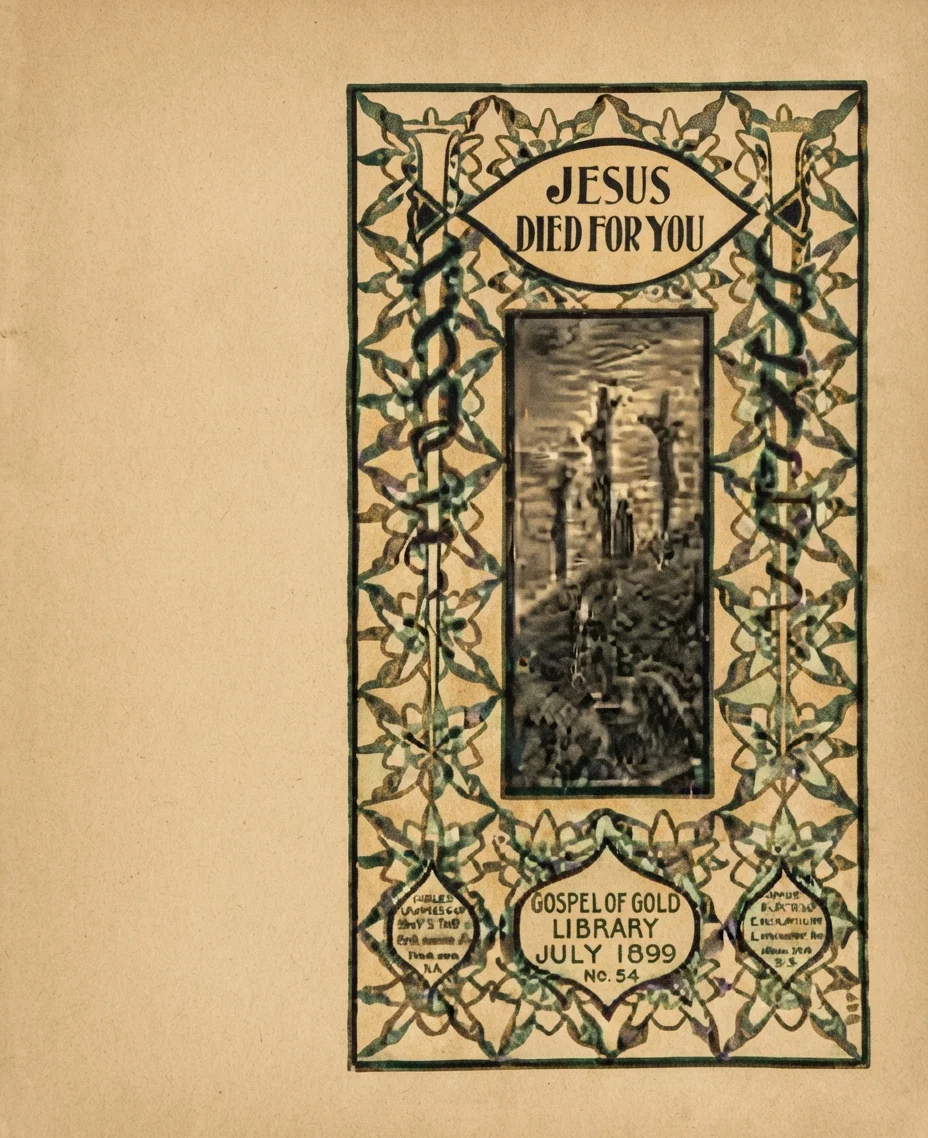
JESUS DIED FOR YOU—An especially good tract for mission work, in that it is brief, and breathes forth a message warm from the Throne of Love.
All our new as well as standard publications will be found at the office of your State Tract Society. For additional information address:
Pacific Press Publishing Co.
Oakland, California
39 Bond St., New York City 18 W. 5th St., Kansas City, Mo.