ACCORDING to my promise in the last number of the INSTRUCTOR, I will tell you how to use the steel scraper. As I have already mentioned, it is a tool that could hardly be dispensed with in working cross-grained lumber; that is, wood in which the grain runs both ways, well represented by locking your fingers together. This tool is equally useful in dressing veneering, which is always thin. The use of the plane would chip out the veneer, thus ruining it; but with the scraper, it can be worked down smooth without injury.
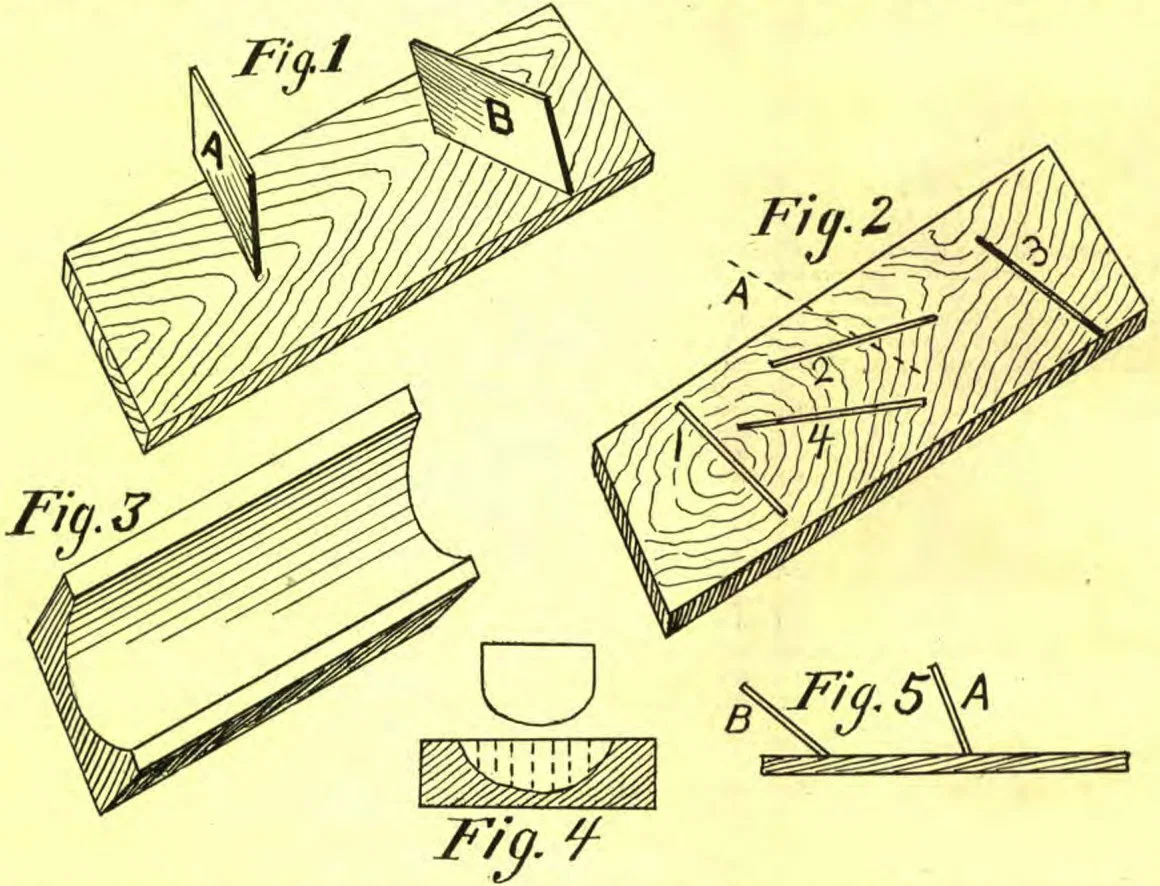
Fig. 1 shows the grain of the wood as it appears many times in boards, also scrapers a and b placed in their proper position with the grain. Notice particularly that the scrapers stand square with the grain.
Fig. 2 shows a board with two knots in it. You will see that the grain in this board does not run the same as that shown in Fig. 1, but, instead, is all chopped up, making it more difficult to work. But when such lumber is worked down true and smooth, and polished, it looks much richer than a straight-grained stick, and shows the wonderful beauty that the Creator of the lily has hidden in our forest trees.
At a, Fig. 2, you will see a dotted line. Notice that this line runs across the board with the grain of the wood; also that the streaks which look dark in the etchings are always lighter colored in a piece of timber, while the grain between, which looks light, is darker. Especially is this true of oak lumber. The dark grain is generally soft, while the light grain is hard. If you should use the scraper as indicated by the dotted line, you would work out the soft grain of the wood, and instead of making your board smooth, you would make the surface uneven, something like a washboard. In Fig. 2, at 1, 2, 3, 4, you will see the position of the scraper should be held in order to do smooth work upon a board grained like this. Constantly change the position of the scraper to keep it across the hard grains; then your work will be smooth.
Sometimes it is necessary to get out a molding of some sort, and smooth it up.
In Fig. 3 you will see a piece of lumber which has been hollowed out. If you are where you can use a buzz-saw, you can easily chip out the thin pieces by setting the saw a few times, and running it through the board (see dotted lines in Fig. 4); and with a plane, and a scraper made round on one edge, you can dress it out smooth.
In Fig. 5, at a, you will see about the position the scraper should have in order to do good work. Should you lay it over, as at b, the scraper would soon lose its edge.
If you follow the directions about sharpening and using this tool, you can use it to good advantage. “If at first you don’t succeed, try, try again.”
A few words about the use of sandpaper will fit in nicely here. Work that is to be finished in oil or varnish should never be sandpapered across the grain, but always lengthwise of it. Sometimes when wood is to be painted, especially soft wood, we work across the grain, because we can true it down more easily. For sandpapering you should have a block of soft wood about three or four inches square and one inch thick, over which to fold the paper. A block of cork, which you can get at almost any drug store, is better still. I have sometimes seen pieces three or four feet square. The druggist will cut off for you what you want. The numbers of the sandpaper I use most of are 1½, 1, ½, and 0.
Should there be any points in these articles you do not fully understand, or should you want further information concerning anything, be free to write. It will cost you only the postage. W. K. LOUGHBOROUGH.
Preparing Young Men for Positions of Trust
By J. R. Miller
LET young men make themselves ready for positions of trust, and they will be called to their position at the right time. God’s clock is never too slow.—J. R. Miller.
Never Give Up: Harriet Beecher Stowe on Perseverance
“WHEN you get into a tight place,” says Harriet Beecher Stowe, “and everything goes against you, till it seems as if you could not hold on a minute longer, never give up then; for that is just the place and time that the tide will turn.”
Seizing the Value of Today
To-day is worth more than a thousand tomorrows.
NOTE AND COMMENT
African Liquor Traffic.—Statistics previous to 1890 showed that 12,000,000 gallons of spirituous liquors was annually sent from Europe and America to Africa. One half the produce of the natives on the Kongo is said to be paid for with liquor.
An Aged Teacher.—Manuel Garcia, now living in London, is said to be the oldest teacher of music in the world, in actual practise of his profession. He was born in Spain, and was driven from his home by Wellington in his advance on Badajoz. Nearly seventy-four years ago he sang in New York City.
A Wise Decision.—The New York City Board of Aldermen recently passed a most undesirable resolution, asking permission for some one to solicit contributions from the children in the public schools of that city to build a war-ship. The mayor killed the act with his veto, thus earning the gratitude of all parents who desire to keep the war-spirit from their children.
Attention to Details Begets Confidence.—On the trial trip of the “Oregon,” her builder, who was aboard, said to the admiral in charge, “What’s your hurry, admiral? What are you excited about?” The officer replied, “Why are you not excited? The breaking of a ten-cent bolt may cost you a hundred thousand dollars.” “Yes,” he answered; “I fully realize that; but it is not going to break. I know them all personally.”
International Complications in Samoa.—The triple protectorate maintained by Great Britain, Germany, and the United States over these southern Pacific islands has for several weeks been involved in the native dispute as to who shall be king. Now comes the news of a conflict on a German plantation between British and American troops on one side, and natives on the other, in which nine white persons were killed, and several wounded. It is said that the Samoans were urged on by the German representative. The manager of the plantation has been arrested.
A Queer Construction.—Shortly before Congress adjourned, an act was passed forbidding the sale of intoxicating liquors in any military camp in this country. The terms are very explicit, and no doubt can be entertained concerning the mind of the lawmakers. The Secretary of War, without waiting for a test case to be brought by opponents of the bill, immediately sought, and evidently obtained, what he wished from the attorney-general, which is a decision to the effect that the bill prohibiting the sale of liquors does not mean that such sale should be prohibited!
Conclusion of Peace.—The culminating event of an international transaction that changed the maps of two hemispheres, and made the United States recognized as a world-power among the nations, took place in Washington, Tuesday, April 11. It was the exchange of the ratifications of a treaty between Spain and this country. The words “conclusion of peace,” which are used by the papers in this connection to indicate that peace is the end reached, may be used equally well to express the thought that we have reached the end of peace. The present difficulties in the Philippines show plainly that while we are at peace with Spain, we have not yet attained peace.
TIME: Evening of the feast and the Sabbath day. PLACE: The publican's house and the corn-field. PERSONS: Jesus and his disciples, publicans, sinners, and Pharisees.
QUESTIONS.
What was the vocation of the first disciples chosen? Relate the incident of the calling of the publican, Matthew. Matt. 9: 9. What did Matthew do to honor Christ, and introduce him to his friends and relatives? Luke 5: 29. Who were prominent guests at the feast? Matt. 9: 10. What question did the scribes and Pharisees raise on this occasion? V. 11. To whom did they go with the complaint? What did Jesus say in vindication of his presence there? V. 12. What did he advise his criticizers to go and learn? V. 13. What was the difference between the Pharisees and other sinners? What question did John's disciples now ask? V. 14. How did Jesus make the matter plain? V. 15. What further illustrations did he use to teach the nature of God's work? Vs. 16, 17. While passing through the fields on a Sabbath day, what did the disciples do? Mark 2: 23. Who criticized them? V. 24. On what ground? What was Jesus' reply? Vs. 25, 26. What other instance was cited by the Saviour to show that the Sabbath law permitted works of necessity? Matt. 12: 5. What did he say of himself in this connection? V. 6. For whom was the Sabbath made? Mark 2: 27. Who is its Lord? V. 28.
NOTES.
1. Matthew's joy in Christ led him to do the Saviour public honor, and he made a feast at his house, inviting his relatives and friends. “Not only were publicans included, but many others who were of doubtful reputation, and were proscribed by their more scrupulous neighbors. . . . Jesus sat as an honored guest at the table of the publicans, by his sympathy and social kindness showing that he recognized the dignity of humanity; and men longed to become worthy of his confidence. Upon their thirsty hearts his words fell with blessed, life-giving power. New impulses were awakened, and the possibility of a new life opened to these outcasts of society.”—“The Desire of Ages,” page 274.
2. From the opening of Christ's ministry the religious leaders had looked jealously upon his influence over the people. They had set spies upon his track, and had tried to find some excuse for denouncing him; but they had looked in vain. The report that he was feasting with Matthew, the publican, in company with persons of doubtful reputation, was grasped as a possible, and apparently righteous, reason for carrying out their sinister designs. Their narrow selfishness, their hateful self-righteousness, forbade their understanding the glory of Christ's infinite love, that made him rejoice in the opportunity that brought him in contact with receptive hearts.
3. The accusation of the Pharisees—that Jesus was a friend of sinners—constitutes his most glorious title. How blessed that it is true! Jesus is the only true friend of sinners. Sinful men and women draw back their robes of self-righteousness from one who has made a mistake; but to the Sinless One, the repentant sinner is drawn by the force of sympathy and love. Joyfully we may sing here, and amid the shining hosts of heaven, “What a friend we have in Jesus!”
4. “I am not come to call the righteous, but sinners to repentance.” To the Pharisees this answer could furnish no clue to their true state, but left the solution of the situation to their preconceived opinion of sinners and themselves. But he told them: “Go ye and learn what that meaneth, I will have mercy, and not sacrifice.” In learning the meaning of mercy, they would learn the character of God, and see themselves as sinful, distorted creatures in their idea of exaction and sacrifice for his service.
5. John's disciples were in mourning because of their leader's imprisonment. The work of Christ was but dimly understood; and as they came fasting, stirred by the Pharisees to ask why Christ and his disciples did not fast, Jesus answered them tenderly, using the figure that John himself had employed,—that of the bridegroom, with the children of the bridechamber.
6. The accusation of the Pharisees, that the disciples were doing an unlawful deed in plucking and eating grain on the Sabbath, was refuted by the Lord of the Sabbath. He who made the worlds, and instituted the Sabbath as a memorial of his creative power, and as a pledge of the restoration of the world and the redemption of man, led the blinded Pharisees on, step by step, citing David's extremity and the priests' toil, up to his own work, and his followers' need in that work, and acquitting the accused, as Lord of the Sabbath. All work essential to man's redemption is in harmony with the law of the Sabbath. Again he bade them learn the meaning of mercy; for who can truly worship God without a knowledge of his love? The spirit that prompted the Pharisees to turn away from those who needed help, saying, “Stand by thyself, come not near to me; for I am holier than thou,” would prevent them from understanding the significance and spirit of the Sabbath, and utterly blind them to the character of the Friend of sinners. God is love. The invisible things of God are understood by the things he has made; therefore nature proclaims God. Christ also came to declare him. In sunbeam and flower, in star and mountain, in river and ocean, the lesson of love is written, as well as in the face of him who reveals his glory. The Sabbath is a sign of the soul's rest in God's love, and furnishes a blessed, holy day for the uninterrupted contemplation of his love. If it also brings an opportunity for Christly ministry to the sick, the afflicted, the heart-broken, it furnishes experience in God's love; for it is in ministry that the blessed tides of revelation flow into the soul. Then beware of the leaven of the Pharisees, that turns to forms, petrifies sympathy, stints the love of God, and makes the Sabbath a sign, not of liberty, but of bondage. “He that loveth not knoweth not God; for God is love.”
To what does Jesus liken himself and his Father? How does the Father treat the branches? How are the disciples made clean? Where did Jesus bid them abide? Why? How only can the branches bear fruit? What is the memory verse? What will be done with those who abide not in Christ? What promise of answer to prayer did Jesus make? How could the disciples glorify the Father? What fruit ought every Christian to bear? Gal. 5: 22, 23. In what are we urged to continue? What is the condition of abiding? What relations existed between Christ and his Father? Why had Jesus thus spoken to them?
NOTES.
1. Jesus and his disciples were on their way to Gethsemane. . . . The Saviour had been explaining to his disciples his mission to the world, and the spiritual relation to him which they were to sustain. Now he illustrates the lesson. The moon is shining brightly, and reveals to him a flourishing grape-vine. . . . He employs it as a symbol.—“The Desire of Ages,” page 674.
2. The Great Teacher ever made use of the things of nature and daily experience to illustrate spiritual truth. Though the face of nature has been marred because of man’s sin, it is still the writing of God, and reveals the love and purpose of its designer. By the use Christ made of nature, it is evident that it was not designed simply to satisfy our material needs, but to unfold redemption’s plan, and illustrate heavenly and eternal relations.
3. On the hills of Palestine our Heavenly Father had planted this goodly Vine, and he himself was the Husbandman. Many were attracted by the beauty of this Vine, and declared its heavenly origin. But to the leaders in Israel it appeared as a root out of a dry ground. They took the plant, and bruised it, and trampled it under their unholy feet. Their thought was to destroy it forever. But the heavenly Husbandman never lost sight of his plant. After men thought they had killed it, he took it, and replanted it on the other side of the wall. The vine-stock was no longer visible; . . . but the branches of the Vine hung over the wall.—Id., page 675.
4. “Ye are the branches.” That heavenly Vine, which men and devils have sought to destroy from the earth, proves its vitality through the branches that hang over the wall. “Ye are my witnesses.”
5. “Every branch in me that beareth not fruit he taketh away.” The branch that bears no fruit is the one that draws no life from the vine. “There are a great many withered Christians who, in their early Christian experience, put forth green branches and fragrant blossoms, and presented much to the church. . . . They have gradually withered; their zeal has drooped, their love grown faint, and their freshness of joy disappeared.” Does this describe your condition? If so, do not give up in utter discouragement. “Repent, and do the first works.”
6. The foes of the natural vine furnish us with illustrations of the foes that would destroy the fruit of the spiritual branch. The “dodder,” a species of parasite, attacks the vine, sapping its nourishment, and strangling the branch. So self wrestles to kill the Christ-life from the soul. The grape-mildew, a white fungus mold, converts the fruit into a sour, watery mass. So doubt ruins the developing fruit of the Christian life. The little red spider is the pest of vineyards; for it punctures the fruit, and sips its juice. So irritability, impatience, and what may seem trifling sins, injure the clusters of grace. Rust is a destroyer to the vineyard. It follows the handling of grapes. So self-consciousness and affectation take away the luster of goodness. The foes of the soul-branch can not flourish unless the Husbandman has complete control, and the branch abides in the Vine. Physicians declare that physical health can be maintained only as there is in our bodies power to overcome germs; so spiritual life can not flourish except as heavenly vitality overpowers and annihilates the germs that attack it.
A POINT.
By Editor
WHEN showing to your friends the excellent features of the YOUTH'S INSTRUCTOR, special mention should be made of the numerous notes and helps on the International Lesson which this paper contains, not to be found in any other publication. We are not copying from other papers or lesson quarterlies; but are paying a competent person to make appropriate selections from the best books and other writings of the best authors, so that the choicest thoughts of the clearest thinkers in the world will be given you every week in this department, in addition to the regular questions.
ANOTHER POINT.
By Editor
THIS is the planting and sprouting and growing season. If you keep your eyes open, you will not only find plenty of vacant ground that you can secure permission to use free of charge for missionary purposes; but you will also see lots and spots here and there that you can induce others to cultivate, if not on a missionary basis for their Sunday-schools, at least as a source of profit to themselves. In either case the ILLUSTRATED HINTS ON GARDENING will be worth to them more than the price of the INSTRUCTOR for a year. Please try this immediately, reading to wide-awake people the entire last-page of this paper, in addition to calling special attention to the valuable notes on the International Lesson and the practical time- and money- and soil-saving hints in our Gardening department.
AN OLD FRIEND.
By Editor
AS SUCH the INSTRUCTOR greets its thousands of readers this week. After careful thought and earnest prayer, those having the work of the INSTRUCTOR in charge decided that in order to give the greatest variety and amount of reading-matter, at the lowest possible price, as well as for convenience in illustration, it was not only desirable but imperative to return to the generally accepted form of youth’s paper.
By reading the Prospectus, you will learn of a few of the treats the INSTRUCTOR has in store for you. Other features not mentioned there, which will appear later, will be of interest to every studious INSTRUCTOR reader.
Boys and girls, this is your paper: it is made for you; and all connected with it are determined that it shall be filled, from the first line to the closing sentence, with help for you,—that it shall, in fact, be true to its name, and the high standard its editors have always tried to maintain.
Subscription Renewal Notice for the Youth's Instructor
APRIL, 1899.
If the yellow address-label on first page of this paper, or on the wrapper, bears this month and year (John Brown 25/99), it indicates that the following blank should be filled out by you now, and mailed to Review and Herald, Battle Creek, Mich., before the end of this month :—
Enclosed find $......... (money-order, express order, registered letter, or bank draft), for which please send ..... copies of the YOUTH'S INSTRUCTOR ...... months to above address.
P. S.—If you object to clipping this out of your paper, or wish to forward other subscriptions, please write names and full addresses on a separate sheet, stating amount enclosed for that purpose.
Christ and the Young Ruler: Hoffman's Painting
THE illustration on the first page is reproduced from a photograph of the famous painting, “Christ and the Young Ruler,” by Henrich Hoffman, a German artist. It represents the Saviour at the moment when, his heart filled with unutterable love and longing, he said, “One thing thou lackest.” This artist has portrayed many other incidents in the Saviour’s life. His “Christ and the Doctors” and “Christ in the Garden” are known and loved everywhere.
AN APPEAL.
By C. V. S. Boettger
Dear Friends, Young and Old: Would you not like to help in the work?—Of course you would. Well, here is an opportunity. Send me your Youth’s Instructors or Our Little Friend, and I will gladly distribute them, and tell you of the result or experience. We have hundreds of orphans here, and many children in hospitals, who would rejoice to see and read your papers. Hundreds of men and women may thus be reached by them. You can help us; will you do it?
C. V. S. Boettger.
218 Bank St., Christian Help Mission, Ottawa, Ontario.
MORE PAPERS WANTED.
By Thos. Pasmore
Thos. Pasmore, Derwent, Middlesex Co., Ontario, can put to a good use all your old copies of the Instructor. Save your papers, and pass them on.
Christian Educator Twenty-Five Cent Coupon Offer
That remarkable coupon offer, by which the Christian Educator can be had one year for only twenty-five cents, is still in force. Send at once for a free sample copy.
Review and Herald Pub. Co., Battle Creek, Mich.
To Reach BATTLE CREEK
FROM
CHICAGO, BUFFALO, DETROIT, OR TOLEDO,
Purchase Tickets Reading over the MICHIGAN CENTRAL “The Niagara Falls Route.”
A First-class Line for First-class Travel between Chicago and New York and Boston. Elegantly equipped through trains pass Battle Creek in each direction daily.
R. N. R. WHEELER, Ticket Agent, Battle Creek.
O. W. RUGGLES, Gen'l P. and T. Agt., Chicago, Ill.
TAKE THE Canadian Pacific Railway
for . . . CHATHAM, OTTAWA, MONTREAL, LONDON, GALT, QUEBEC, WOODSTOCK, TORONTO, BOSTON, PORTLAND, and
All points in New England, the Maritime Provinces, Great Britain, and the Continent.
Illustrated literature, time-tables, and full particulars, upon application to—
J. FRANCIS LEE, GEN. AGENT,
Passenger Dept. 228 SOUTH CLARK ST., CHICAGO.
Branch: 76 Ottawa St., Grand Rapids, Mich. Offices: Room D, Chamber of Commerce, Cincinnati, Ohio. 315 Chestnut St., St. Louis, Mo.
Grand Trunk Railway System
Time Card in Effect February 5, 1899.
C. & G. T. DIVISION.
WEST-BOUND FROM BATTLE CREEK.
LEAVE.
No. 11, Mail and Express, to Chicago 12.00 M.
No. 1, Chicago Express, to Chicago 9.00 A. M.
No. 3, Lehigh Valley Express, to Chicago 3.40 P. M.
No. 5, Pacific Express, to Chicago, with sleeper 12.55 A. M.
No. 75, Mixed, to South Bend 7.30 A. M.
Nos. 11 and 75, daily, except Sunday. Nos. 1, 3, and 5, daily.
EAST-BOUND FROM BATTLE CREEK.
No. 10, Mail and Express, to Pt. Huron, East, and Detroit 3.45 P. M.
No. 4, Lehigh Express, to Pt. Huron and East 8.27 P. M.
No. 6, Atlantic Express, to Pt. Huron, East, and Detroit 2.25 A. M.
No. 8, Lehigh Exp. to Saginaw, Bay City, Pt. Huron, and East 6.50 A. M.
No. 74, Mixed, to Durand (Starts at Nichols) 7.35 A. M.
Nos. 10 and 74, daily, except Sunday. Nos. 4, 6, and 8, daily.
E. H. HUGHES,
A. G. P. & T. Agt. Chicago, Ill.
A. S. PARKER,
Ticket Agent, Battle Creek.
A QUEER COMBINATION.
By Editor
On the first page of this paper, or on the wrapper in which it came, is a small yellow address-label, with the year, month, and day of the month to which your subscription extends. If on that label you find “Apr., 99,” it means that you should renew, and the small figures name the day when the paper should stop.
Hereafter our subscribers are to be notified through the paper, by this plain, inexpensive method, instead of by printing a special letter, bearing a special letter-head, enclosed in a special envelope, addressed by a special copyist, and carried by a one-cent postage-stamp, which alone costs eight times as much as to send you a full copy of the INSTRUCTOR; or, in all, about $1,000 needless expense in five years (on the basis of our present circulation), and more, if readers increase.
This $1,000, now given in part to paper-makers, and to railroad companies who carry government mails, can be used to much better advantage in making the INSTRUCTOR so excellent that as soon as your attention is called to the fact that the time has expired, you will need no expensive coddling to induce you to renew. If you prefer thus to receive, and also enable other readers to receive, the value of this $1,000 during the next few years, rather than that we use it in elaborate notifications of expiring subscriptions, kindly keep your eye on the address-label as we call attention to it once a month, whether you receive one copy or many.
If your subscription expires this month, and you object to mutilating your INSTRUCTOR by clipping out the following blank (notwithstanding only advertising matter is printed on the opposite side), kindly use writing-paper, being particular to give YOUR NAME AND FULL ADDRESS PLAINLY, following the form indicated below, and stating the amount that you enclose, sending post-office money-order, express order, bank draft, or registered letter.
Look over the full last-page Prospectus, show it to your neighbors and friends, and see how easily you can secure a club of from “5 to 9 copies,” which will be sent to one address for only 55 cents each; or 50 cents each in a club of ten, thus giving you $2.50 if you secure the 10 names at 75 cents each, and all are sent to you, or to any other person, in one package. If you choose to give your 25-cent commission to each of the 10 persons, they coming to you every week for their INSTRUCTOR, or you delivering to them, we do not object. But please remember that there is no reduced rate on fewer than five copies to one address. See subscription terms at head of this page.