The Youth’s Instructor, Vol. 47, No. 17.

THE SUPREME TEST

The Youth’s Instructor

Apr 27, 1899

Review and Herald Publishing Company · Battle Creek, Mich. · Apr 27, 1899

THE SUPREME TEST.
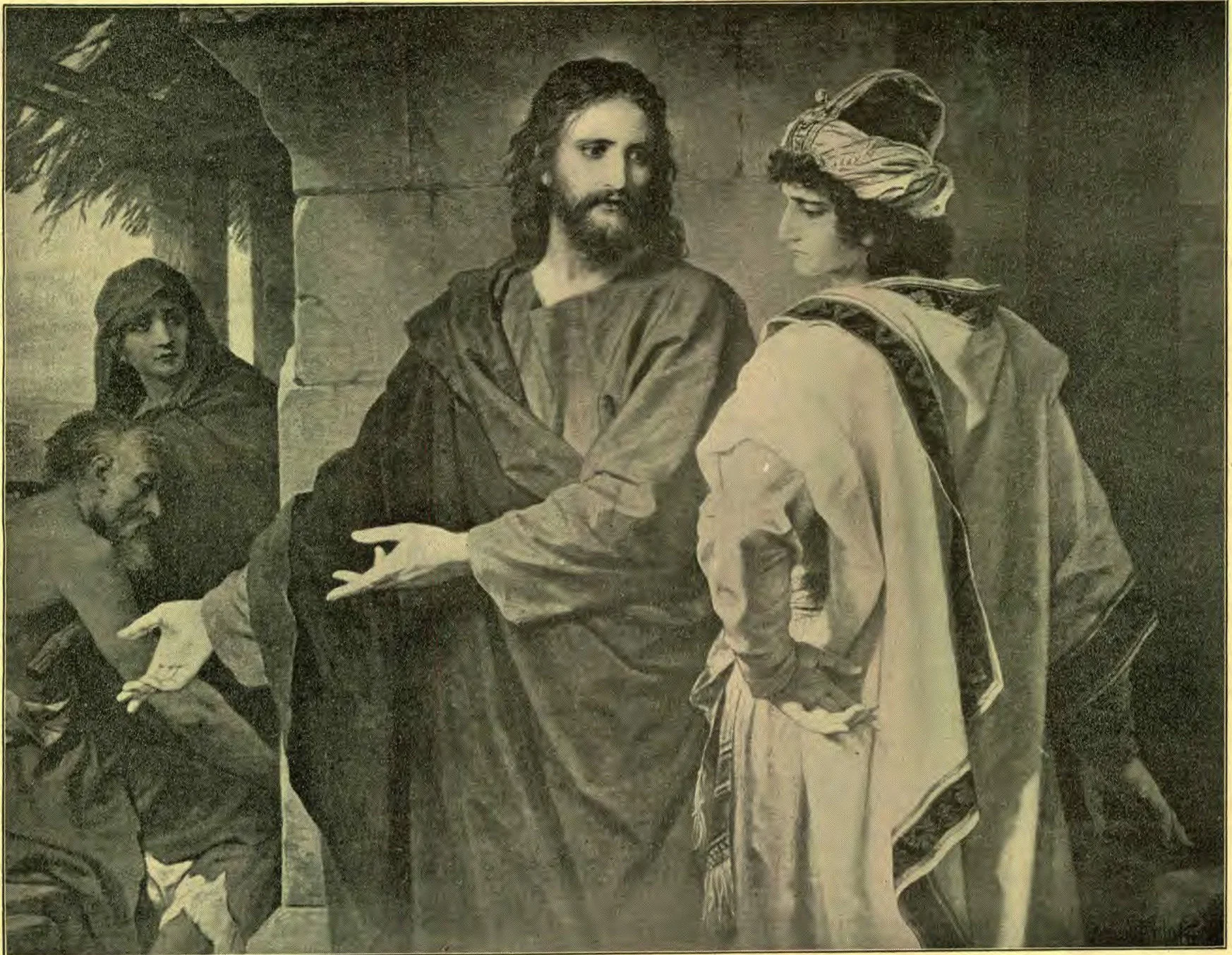
When Jesus left the coasts of Galilee, on his way to Jerusalem,—the city which he was to enter in triumph, hailed as the Son of David, and to leave by the way of the cross,—great multitudes followed him.
“SELL THAT THOU HAST, AND GIVE TO THE POOR.”
In the crowd that thronged his steps there were the aged, the infirm, the suffering; “and he healed them all:” there were the Pharisees, who came to catch him with questions, and to quibble over the writings of Moses; and he answered them: there were mothers, anxious that his hands should rest in blessing upon their children; and he rebuked his disciples when they would have sent these away, and took the little ones in his arms, and blessed them, saying, “Of such is the kingdom of heaven.” And when he had laid his hands on them, he departed thence. But there was one who still followed him out of the throng,—a young ruler, who had vast possessions but an unsatisfied heart. Perhaps he had debated for a while the question of following the lowly Nazarene at all, and so drawing attention to himself; for we read that he “came running,” as if not to lose any time, once his mind was made up.
Kneeling before the Saviour, he said, “Good Master, what good thing shall I do, that I may have eternal life?” What good thing shall I do! He was eager, or thought he was, to earn eternal life for himself. Many since his day have been anxious to pay their own way through to the kingdom; and too often with the same sad result that followed in this case,—when the time came to show their faith by their works, they failed to stand the test.
Jesus did not immediately reply to his question, but sought to draw from the young ruler an acknowledgment of his own divinity. “Why callest thou me good? there is none good but one, that is, God,” was to ask, in another way, “Whom say ye that I am?” Then, as he was silent, the Saviour said: “Thou knowest the commandments, Do not commit adultery, Do not kill, Do not steal, Do not bear false witness, Defraud not, Honor thy father and mother.”
The Saviour knew that the young man had been brought up from earliest childhood in the strict observance of the law. In all outward forms—prayers, fastings, washings, and all manner of observances—he failed not; yet his heart was not at peace. Filled with self-righteousness, yet troubled by his great unrest, he said, “All these things have I kept from my youth up: what lack I yet?”
“Then Jesus beholding him loved him, and said unto him, If thou wilt be perfect, go and sell that thou hast, and give to the poor, and thou shalt have treasure in heaven: and come, follow me.” Since the ruler would have something to do, the Saviour met him on that ground, and gave him a task that would test his faith. Well the Saviour knew, as he read the troubled heart before him, that where his treasure was, his heart would be,—that if he would pass this crucial test, and put his treasure in heaven, his heart would go with it.
In the invitation, “Follow me,” Jesus offered to the young prince the greatest honor ever bestowed upon men,—the honor of becoming one of his chosen disciples. It was the call given to Philip, to Matthew at the receipt of custom, to the sons of Zebedee at their work, to Peter and Andrew at their fishing. All these gladly left everything, and followed him.
How the heart of Jesus yearned over the young man! with what earnest longing he desired to see him make the right choice! but he did not put forth one atom of his mighty power to influence his decision. He was free to choose his master. He had seen the Saviour’s mighty works; he had listened to his words of wisdom and love; and in answer to his question as to what he should do, he had been told to do something that would require the exercise of great faith. Will he stand that supreme test? The struggle is short; but alas! self gains the victory. “And when he heard this, he was very sorrowful: for he was very rich.”
“He went away.” Of his own choice he left the divine Son of God, and went back to his people, his houses, his lands, choosing the god of this world for his master. Thus the gospel narrative leaves him. There is no sadder failure recorded in the Scriptures.
The choice set before this young man is set before you to-day. Whom will you serve? Great possessions are not needed to keep you from taking up Christ’s cross, bearing his burden, and wearing his yoke. A very little thing may stand in the way. Whatever it is, O, hasten to-day to lay it down at his feet, and to do his bidding!

THE RESURRECTION OF LAZARUS.

V.

By shedding Jesus’ blood the Jewish people were about to divorce themselves from heaven. Christ knew that some of those now apparently so sympathetic would soon close against themselves the door of hope and the gates of the city of God. A scene was about to take place, in his humiliation and crucifixion, that would result in the destruction of Jerusalem, and at that time none would make lamentation for the dead. If the Jewish people had only appreciated the privileges and opportunities so mercifully granted them, the calamity about to fall upon them would have been averted. But in their prejudice they closed their eyes to all evidence.
Christ’s pleadings and importunities over them had been the reproaches of unrequited love. “O Jerusalem, Jerusalem,” he said, as from the Mount of Olives he beheld the city and wept over it, “thou that killest the prophets, and stonest them which are sent unto thee, how often would I have gathered thy children together, even as a hen gathereth her chickens under her wings, and ye would not!” You would not come to me, that you might have life.
Standing there, in the very shadow of the cross, despised and rejected by those to whom he had come to give life, Christ might appropriately have lifted up his voice, and said: “Seek ye the Lord while he may be found, call ye upon him while he is near: let the wicked forsake his way, and the unrighteous man his thoughts: and let him return unto the Lord, and he will have mercy upon him; and to our God; for he will abundantly pardon. For my thoughts are not your thoughts, neither are your ways my ways, saith the Lord. For as the heavens are higher than the earth, so are my ways higher than your ways, and my thoughts than your thoughts.”
Christ was ever touched by human sorrow; but a far greater grief filled his soul as he thought of his unbelieving people. He saw that those who now refused to accept him would from that time erect around themselves walls of impenetrable darkness and unbelief, through which the light from heaven could not enter. The retribution that was coming upon Jerusalem was plainly portrayed before him. He saw Jerusalem besieged by the Roman legions. He knew that many now weeping for Lazarus would die in the siege of the city, and in their death there would be no hope. They would not rise again to receive life eternal, but to receive the second death.
It was not only because of the scene before him that Christ wept. The weight of the grief of ages was upon him. He saw the terrible effects of the transgression of the law of God. He saw that in the history of the world, beginning with the death of Abel, the conflict between good and evil had been unceasing. Looking down the years to come, he saw the suffering and sorrow, the tears and death, that were to be the lot of men. His heart was pierced with the pain of the human family of all ages and in all lands. The woes of the sinful race were heavy upon his soul; and the fountain of his tears was broken up, as he longed to relieve all their distress.
“Jesus therefore again groaning in himself cometh to the grave.” Lazarus had been laid in a cave in a rock, and a massive stone had been placed before the entrance. “Take ye away the stone,” Christ said. Thinking that he wished only to look upon the dead, Martha said, “Lord, by this time he stinketh: for he hath been dead four days.” This statement, made before the raising of Lazarus, left no room for Christ’s enemies to say that a deception had been practised. In the past the Pharisees had circulated false statements regarding the most wonderful manifestations of the power of God. Already Christ had raised to life the daughter of Jairus and the son of the widow of Nain. Of the first of these he had said, “The damsel is not dead, but sleepeth.” The people knew that she was indeed dead; but as she had been sick for only a short time before her death, Christ’s enemies, the Pharisees, in an effort to destroy the effect of the miracle, declared that the child had not been dead; that Jesus himself had said that she was only asleep. They tried to make it appear that Jesus could not cure diseases, that there was false play about his miracles. But in this case, if evidence could break stubborn hearts, decided reformation must surely be made. This miracle marked the Jews’ most solemn period of responsibility. Here they decided their own destiny; for no stronger evidence could be given them. MRS. E. G. WHITE.

A Commonplace Life

"A COMMONPLACE life"! we say, and we sigh, But why should we sigh as we say? The commonplace sun, in the commonplace sky, Makes up the commonplace day; The moon and the stars are commonplace things, And the flower that blooms, and the bird that sings; But dark were the sky, and sad our lot, If the birds ne’er sang, and the sun shone not. — Susan Coolidge.

CAN AND COULD.

“It’ll be moonlight to-night,” said a schoolboy; “won’t you join our skating party?”
“No,” replied Can, “you know there wasn’t a boy in my class that had his arithmetic lesson to-day, and the teacher gave it to us again. I can master it, and I will. That lesson must not beat me twice. I mean to make sure of it, so you’ll have to excuse me from joining your party.”
“Shall I not help you?” asked his elder sister.
“Let me try it first,” replied Can; “I feel like going at it with a will; for I’ve heard that ‘where there’s a will, there’s a way.’” He did not stop till every example was worked out.
“If I only could learn this horrid lesson!” exclaimed his classmate, Could, who made a few random figures on his slate, and then began to draw dogs’ heads.
“Is that the way you study your lesson?” asked his mother, reprovingly.
“If I only could get it,” replied the boy, fretfully, “I should be glad to work at it with all my might; but it’s too hard and dry for anybody.”
“Surely you could learn some of it, if you would only try,” said his mother, and as this could not be gainsaid, Could looked at his book again. But the next moment he jumped from his chair, and ran to the window.
“Oh, this splendid moonlight!” he exclaimed. “It’s really too bad to lose that skating. I think I’ll go.”
“But your lessons are not prepared,” said his mother.
“I know that,” answered Could; “but when I come back, there’ll be time enough for them.”
Off he went, and the next day, in the class, he drawled: “I would have learned the lesson if I could.”
Can and Could both had to drive cows to pasture, and to hoe in the garden. Can’s cows were regularly cropping the grass on the hillside long before Could was out of bed. Can easily kept ahead of weeds by hoeing before they got much start. Could waited until there was “some real need of hoeing, to keep the weeds down,” but the weeds had such a start then that they soon got ahead of him, and ahead of the crops, too, which were hardly worth gathering, although Can’s garden yielded bountifully.
“If I could have had such a garden as that,” said Could, “I should have been glad to hoe up every weed; but my garden was so poor that it didn’t make much difference whether I hoed or not.”
“If I could only be a Howard, how much I would do to reform men!” exclaimed Could. “Sometime I mean to do something on a large scale in this world.”
Can was never heard to express such noble sentiments; but he attended diligently to business, and, as he prospered, employed many men at fair wages, thus enabling them to support their families in comfort.
Can, by diligence and economy, became prosperous and happy; Could, by indolence and procrastination, became discontented and unhappy. Will you be—Can or Could?—Selected.

MAKING HOME PEACEFUL.

XXI.

ONE evening before going to the store, and after praying to God for strength and grace to do his duty, Mr. Beardsley asked Reginald to step into the library for a few minutes’ talk with him. The lad had been out until very late the evening before, and his father had decided that something must be done.
“I don’t care to talk with you; I am just going over to Harry Coleman’s. Will Green is at the gate now, waiting for me.”
“Never mind, my son,” said his father, firmly. “I will tell him he need not wait; he can go alone as well,—or I will invite him in.”
While his father stepped to the hall door, Reginald turned an appealing look toward his mother; but at that moment she had left the room. There was no alternative; he knew that Will Green would not come into the house at his father’s invitation. With an angry flush mantling his cheek, he stepped into the library, and took a seat as far as possible from his father’s chair.
“Come nearer, Reginald, we are only going to have a little talk; that’s all.” The father’s voice trembled with earnestness as he continued: “I am sure I have never done my duty by you, Reginald. I have failed in not making myself more of a companion for you, and I am sure I have made a mistake all along. I have not brought up my children in the wisdom and fear of God. There is not a day that I do not regret the past more than I can express; and I know that I am only doing a duty that should have been done long ago, when I tell you now that I must insist that you quit the company of bad boys upon the streets, and come home evenings at a reasonable hour.”
“Reasonable hour!” sneered the lad, his voice trembling with passion. “Seems to me I’m getting old enough to be my own judge as to what company I shall keep.”
“O Reginald!” pleaded his father; “don’t you understand? I am older than you; and you surely should be willing to abide by my judgment, when I have only the tenderest feelings of love in my heart for you. You are quite welcome to bring any of your companions here whenever you like. You have a cozy room, and I am sure your mother and I will try, and do try, to make your home a pleasant one for you. My dear boy, why will you choose the streets? You have your books and piano; I am sorry these things are getting to be distasteful to you. We are trying to make your home happy for you, and O, how I wish you would try as earnestly to make your parents’ home a peaceful one. You are very dear to me, Reginald; I don’t suppose you can understand the depths of a father’s love.”
If the stubborn boy had looked into the tender face bent toward him so appealingly at that moment, he would have seen tears of affection and love upon the cheek pale with emotion. But he had so long been accustomed to having his own way, that the seeds of selfishness had already taken firm root in his heart, and he had no notion of being “domineered over,” as he called it. If he had even then heeded the still, small voice of conscience, faint though it was, he would have thrown his arms around his father’s neck, and begged his forgiveness for causing those tears of grief. As it was, he only repeated his father’s words, with a bitter sneer: “A father’s love! Great evidence I’ve had of it to-night, I think!”
Ah, there was one evidence of love which had always been lacking in the management of James Beardsley’s son.
“What is that?” you ask, in surprise. Reginald Beardsley has always been surrounded by everything necessary to his happiness. He has never known what it was to deny himself in ever so slight a degree for the benefit of others. His every whim has been gratified by an indulgent mother and an affectionate father. His home has been made pleasant, and his surroundings cheerful and attractive.
Well, what was the mistake that James Beardsley and his wife had made in bringing up their son? Perhaps the Wise Man, with the divine light of Inspiration directing his pen, can tell us. Listen: “He that spareth his rod hateth his son: but he that loveth him chasteneth him betimes.”
“Oh, but,” I hear some one say, “we have outgrown such a heathenish doctrine as that; the world is too enlightened for such teaching.”
Ah! there are many nowadays whose fancied wisdom is so much greater than that of Solomon, though his pen was guided by the almighty Spirit of Him who is the great source of all wisdom, that much I fear I shall bring upon myself the criticism of some sage of this nineteenth century for being so bold as to repeat such texts as these. However, I am sure Solomon would not have approved of making use of “the rod” except in love, and in that same wisdom that inspired him to write these words.
Just then Mrs. Beardsley came into the room. “What is the trouble, James?” she asked.
Before Mr. Beardsley could answer, Reginald exclaimed, with the confident air of one sure of gaining his case, “Oh, he’s chosen this evening to give me a free lecture, because I was going over to see Harry Coleman and Will Green.”
“Dear me, James! really, I’m getting tired of acting the part of peacemaker. Why will you insist upon preaching to the boy so much? I’m as anxious for him to do right as you are,” continued the unwise woman, “but I don’t believe in tormenting him all the time. Do let him go, if he wants to.”
“Father, help me!” exclaimed James Beardsley, who felt as if it would perhaps have been better to leave unsaid the words which were so lightly esteemed. With a heavy heart he saw Reginald, a gleam of exultation in his eyes, put on his cap, preparatory to going out into the street.
“Can’t you see, James,” continued Mrs. Beardsley, “that you are making a great fuss about nothing? I don’t believe there’s anything very bad about Will Green. His father is one of the wealthiest men in town, and a church-member. I’d hate to offend him.”
“Yes, Ellen, but I’ve seen the young man worse for liquor, a number of times,” replied her husband, earnestly, while such a feeling of utter loneliness came over him as he had never felt before. Must he walk the long pathway of life alone? Must his dear wife ever be a stranger to the God he himself had so long slighted and neglected?
MRS. L. D. AVERY-STUTTLE.
(To be continued.)

IN A GLASS HOUSE.

THEY'VE got a glass house in the garden, A little house out in the sun; I watched while the gardener built it Until it was finally done.
Now what do you think it was made for? I do not believe that you know; But I do. Now isn't it funny? 'Tis to hurry the flowers to grow!
And I'm sure that it does, for the pansies Have blossomed as full as can be, And there isn't a flower in the garden, And scarcely a leaf on a tree.
So I've wondered and wondered a long time — Please answer me this if you can; Do you think if I lived in one like it, I should hurry and grow to a man?
— Selected.

A HAPPY HEART.

“When it drizzles and drizzles, If we cheerfully smile, We can make the weather, By working together, As fair as we choose in a little while; For who will notice that clouds are drear, If pleasant faces are always near? And who will remember that skies are gray, If he carries a happy heart all day?”

BREATHING: THE DIAPHRAGM.

IN our last study we learned about the two acts in breathing. “Inspiration” is inhaling pure air, oxygen, to nourish every cell and tissue. In this act, both circulation and assimilation are stimulated to activity. The second act, expiration, or exhaling, throws off poisons through the lungs. Usually we breathe once for every four heart-beats, and inhale from sixteen to twenty times a minute. The act of breathing is slower during sleep. Coughing, sneezing, and laughing are due to expiratory action. Hiccoughs, yawning, and sobbing are the result of inspiratory action. The amount of air taken in by an ordinary breath is about twenty-five cubic inches, or less than a pint.
The readers of the INSTRUCTOR will be interested to compute the amount breathed in twenty-four hours. As the lungs are very elastic, they are capable of holding more than a pint of air. By taking a full, deep breath, fully expanding the lungs, a much larger amount may be received. The average lungs will, in this act, hold about three hundred and twenty-five cubic inches of air. The watery vapor daily expelled from the lungs is estimated at from half a pint to a pint and a half. The general causes of incorrect breathing are faulty positions of the body, muscular tension, tight clothing, and weak abdominal muscles.
The most important thing to study right here, is the large muscle, called the diaphragm, that separates the lungs from the abdominal viscera. It is a broad muscle attached to the lower ribs. When at rest, the diaphragm is dome-shaped, rising up into the cavity of the chest. In breathing, the ribs are thrown apart laterally (sidewise); this draws the diaphragm down. As the diaphragm flattens, it compresses the liver, stomach, and other organs lying close up under it, thus gently stimulating them, and kneading, or “massaging,” them.
The process of natural breathing may be described as threefold in its external appearance: (1) upper chest movement, slight; (2) rib-breathing (lateral), distinct; (3) abdominal breathing (forward), marked.
As the air is drawn in, the diaphragm flattens, throwing the ribs apart, and causing the abdomen to protrude. In a deep inspiration this action is clearly seen. The lungs, filling with air, swell up like a gas-bag, pushing the ribs apart, and then the action of the diaphragm begins. The intercostal and abdominal muscles assist, secondarily to the diaphragm, in breathing. The air is expelled from the lungs by the relaxation of the chest muscles, the natural elasticity of the lungs, and the contraction of the abdominal muscles. The natural action of the lungs is much like that of a pair of bellows, the nozzle of the bellows representing the trachea; the bellows representing the lungs; and the two handles, the ribs to which are attached the diaphragm. When inspiration occurs, the ribs separate. The natural movement of the chest is greatest at the waist region.
The contractions of the diaphragm are animated almost exclusively by the phrenic nerve. The experiments of the early physiologists upon this nerve were of great interest. The mental condition of one in sorrow, manifested in the action of the nerves of brain and diaphragm, resulting in sobbing and hiccough, were of special interest to ancient experimenters. The spasmodic contractions of the diaphragm, generally beyond the control of the will, and the sounds made by breathing, were matters of interest then, and are subjects of study now.
To-day we are greatly benefited by the information gained by faithful men in years gone by. We are indebted to them; and as the Word says that “whatsoever things were written aforetime were written for our learning,” let us learn the good, the pure, the true in all things.
MRS. M. D. McKEE.

THE SOIL AND EARLY PLANTING.

AFTER the Lord had destroyed all the trees and plants by the flood, he promised Noah that as long as the earth remained, seed-time and harvest, and cold and heat, and summer and winter, and day and night should not cease. Believing this promise, let us plant a garden for the Lord.
“But where shall we who live in large towns and cities plant a garden?” some of you ask. “If I only lived on a farm,” you say, “I would plant a large garden for the Lord, and give him all the profits.”
In every large town there are many vacant lots, some that never have any crop but weeds and grass. Go to the man who owns such a lot, and tell him you want to plant a missionary garden, and that all the profits will be used to educate the heathen. If he should refuse to let you use his lot, do not be discouraged. Remember that you are working for the Lord, and that in him your work is not in vain. Perhaps he wants you to plant some gospel seed before you plant your garden seed. Go to another with your request, remembering the promise, “In due season we shall reap, if we faint not.”
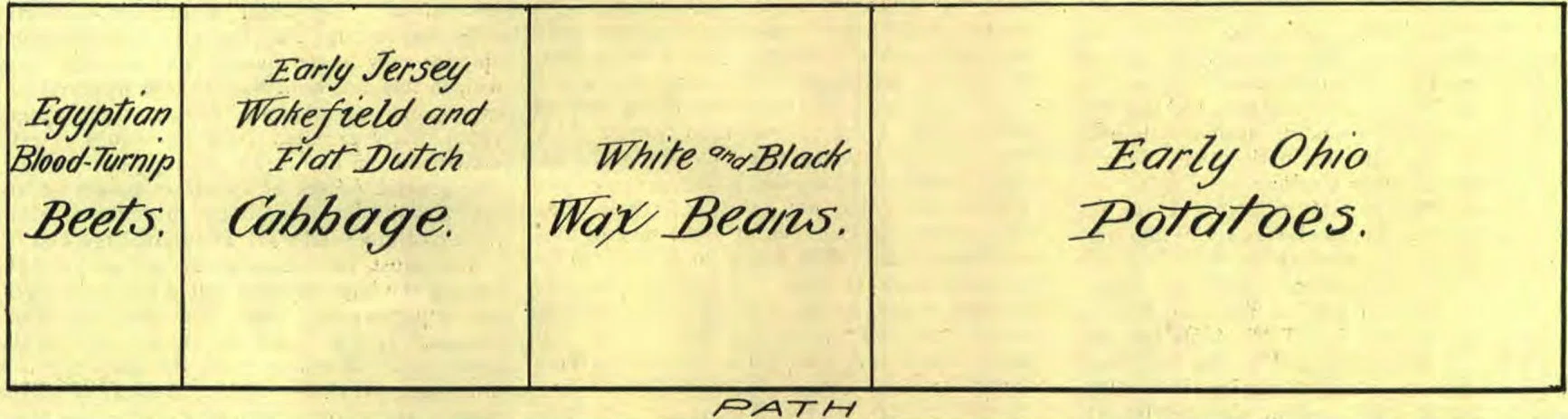
PATH
PATH
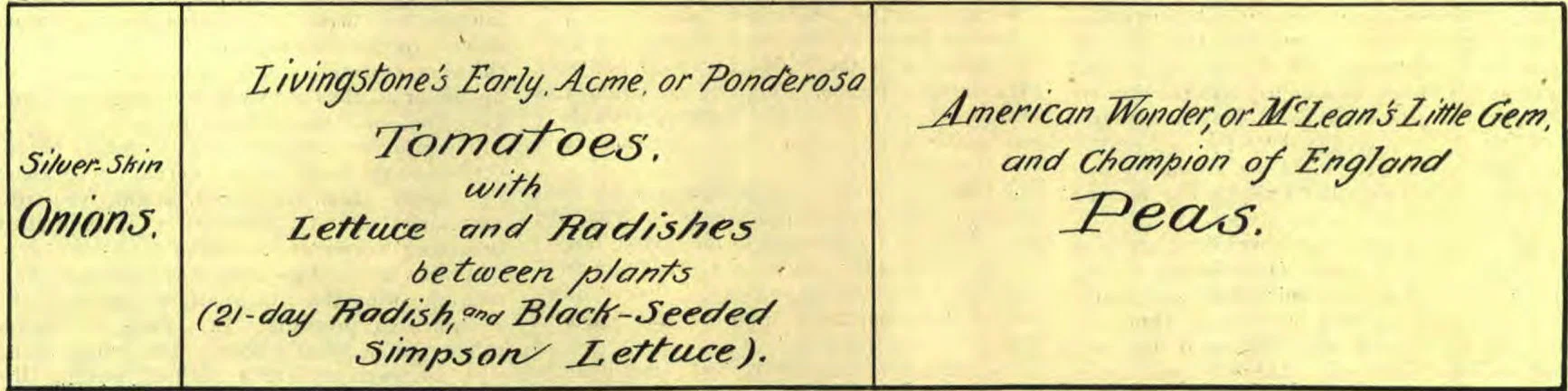
Silver-Skin Onions.

Livingstone’s Early, Acme, or Ponderosa Tomatoes, with Lettuce and Radishes between plants (21-day Radish and Black-Seeded Simpson Lettuce).

American Wonder, or McLean’s Little Gem, and Champion of England Peas.
Silver-Skin Onions. Livingstone’s Early, Acme, or Ponderosa Tomatoes, with Lettuce and Radishes between plants (21-day Radish and Black-Seeded Simpson Lettuce). American Wonder, or McLean’s Little Gem, and Champion of England Peas.
In selecting the ground for your garden, do not choose a place where the rubbish from the city has been heaped. Be careful not to choose too large a place, or you may find that you have more land than you can properly attend to. Many men who live near large cities make a living from a single acre, or even smaller plots. They plant lettuce and radishes between the tomatoes, and not infrequently between the early cabbages, to economize space. We will apply some of their methods in our gardening.
The garden that I have planned is to be thirty by sixty feet in size. Of course those living in the country can have a larger garden than the one planned here, though one of this size is large enough for beginners.
Having selected your garden-plot, the next thing is to prepare the ground for the seed. Never try to do anything with the soil while it is wet; for it will “bake” after the sun shines on it a few days. Different soils must be treated according to their nature. One kind will need a large quantity of well-decomposed stable manure; another will not need any fertilizer. If the decomposed manure can not be obtained, new manure may be used, but it must be spread very sparingly, or it will burn the vegetation.
The next thing is to plow, or turn up, the soil. If a horse and plow can not be obtained, the next best thing is to spade the ground thoroughly. To what depth should the soil be turned up?—That will depend on the nature of the soil. Do not dig or plow deeper than the black soil. If the soil is black to the depth of twelve or fourteen inches, stir it up to that depth. After this is done, rake the soil thoroughly until all the large lumps are broken up, when it is ready for the seed. Buy a one- or two-ounce packet of twenty-one-day radishes, or some other variety that matures quickly. For lettuce buy a one-ounce packet of Black-seeded Simpson, or some other early variety. A quart of onion-sets and a quart of American Wonder peas will be sufficient for a garden of this size. If the garden is larger, buy more seed.
Lettuce and radishes should be planted first. Lettuce (Lactuca sativa) may be planted in rows about ten or twelve inches apart. Stretch a line, to keep the rows straight, and make a trench about one fourth of an inch deep. Drop the seed into the trench, six or eight to the inch. Carefully draw the soil back over the seed, and press it down firmly with the hoe.
Radishes (Raphanus sativus) should be planted in rows ten or twelve inches apart, in a trench one inch in depth. Drop the seed in the trench, four to the inch, and cover as directed above. Do not plant all the radish and lettuce seed at one time, if you wish a succession of crops.
Onions (Allium Cepa) should be planted in rows about eight inches apart. If you plant sets, put them in just deep enough to allow them to peep through; but if you plant the seed, delay planting until it is time to plant the late garden.
Peas (Pisum sativum) may be planted in succession, as well as radishes and lettuce. If the dwarf kinds, such as the American Wonder, are used, put them in rows about one foot apart. Stretch the line from north to south, if the high-growing varieties are used, so as to allow the sunlight to enter between the rows. Dig a trench by the line about four or five inches deep; drop the seed in, four to the inch; draw the soil back, and press down firmly.
Raising the beds above the level of the ground is largely a matter of taste. If the soil is well-drained, and not of a clayey nature, it is not necessary.
ARTHUR F. HUGHES.

A SUGGESTION.

I WOULD like to suggest that every member of the INSTRUCTOR family take an interest in having his home premises a model not only of neatness and order, but also of beauty. I would not for a moment encourage that kind of tidiness and stiffness that would convey the impression that the occupants were asleep, or had shut up the house, and gone away; but let the grounds about your house show that somebody lives there. Have the lawn, if there is one, well kept. Have plenty of flowers. If it is best to have them in the front yard, make a neat bed,—round, oval, or star-shaped,—or have a narrow strip by the walk, or near the house. If the front yard is all right, with its fresh green grass, then improve the back yard. Remove the rubbish and everything unsightly, and make the yard beautiful and attractive. Keep it free from weeds; and do not forget that in order to have abundance of bloom, the flowers must be picked freely. You can make the house attractive with flowers here and there. If there are, as is often the case, sick neighbors, be sure to present them with a loose handful, well interspersed with green foliage; and you will know for yourself the truthfulness of the Saviour’s words, “It is more blessed to give than to receive.” How much better it is that both boys and girls spend a part of their time in this way, than at play, or, still worse, in idleness.
Those who live in the crowded city can have a box about eight inches deep for the windowsill or veranda, with holes in the bottom, and filled with rich soil. With a little attention, such a window-garden may become a source of enjoyment all summer long.
It is too late this season to talk of hotbeds, or flowers that must be started that way; but there are many kinds that will favor us, even now. Asters, Balsams, Calendula, Candytuft, African and French Marigolds, Nasturtiums, Phlox Drummondii, Scabiosa, or Mourning-bride, Petunia, Mignonette, Sweet Alyssum, and Sweet Peas are some of these. The four last named can not be sowed too early; the others should wait till the ground is warm.
If you live in the vicinity of a florist, visit him; and by a small outlay you can get a good supply of plants which it is now too late, to start for this season.
J. Q. FOY.

Apple Blossoms and the Ripening Pippin

FIRST the trees blossom, and then they unblossom; And then there is left but a little green ball That will biggen and brighten and sweeten and ripen, And bounce in my basket, a pippin, next fall. — Wide Awake.

THE CHLOROPHYL CELL.

III.

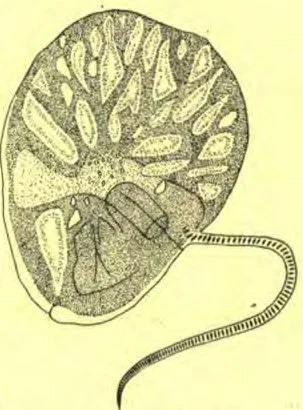
A CAREFUL examination of the teeming life of this lower depth of ocean reveals, among others, the atom of life shown in Fig. 1. It is called Protozoa (“first animal”), and is a diminutive, but very active little creature, the largest measuring, in diameter, one eighth of a line. A line is one twelfth of an inch; so it would take ninety-six of the largest of these animals, lying side by side, to measure an inch; but of the smallest it would require 1,120, lying side by side, to cover one inch of width. These tiny creatures congregate in millions, causing the water to glow with phosphorescent light wherever they appear. But we know that this is not the creature we are looking for, because this one is a wanderer, migratory, and very active, and has organs. There are still lower forms of life—but where?
FIG. I. PROTOZOA.
FIG. I. PROTOZOA.
Well, let us return to the land once more. There is one field we have not explored yet, and that is found both on the land and in the water,—the vegetable world. Here we may find the little creature.
“But you said the food creator was an animal!” you exclaim. No; I said it was a creature. “Well, a vegetable can not be a creature. Vegetation is not alive.” You are wrong. Vegetables are composed of creatures, and all are very much alive. If a small portion of a growing plant is placed under a powerful microscope, certain living forms are brought to light. These are called cells. Between each cell and those surrounding it, and apparently separating the cells from one another, is a substance that is different from the material composing the wall of the cell. It was formerly supposed that because of this separating substance, the cells of plants did not communicate in any way; but the walls of adjoining cells have been dissolved with acid, and it has been found that exceedingly delicate threads pass from cell to cell, forming a kind of nervous communication. Before this discovery, it was not understood how sensation was possible in plant-life, as, for instance, in the sensitive-plant.
The interior of a cell is a substance, the composition of which is still practically unknown. Scattered through the protoplasm of some of the cells are occasional diamond-shaped dark spots. These are corpuscles, and are composed of chlorophyll, the substance that makes vegetation look green.
All cells do not contain chlorophyll, but all green cells (the cells which do have it), create food for all other (white) cells to consume, or live upon; so that, as all life is composed of cells, the chlorophyll cell creates food for all other cells, and therefore for every living thing in the earth, air, and water.
W. S. CHAPMAN.
Continue reading: HOW TO USE THE STEEL WOOD-SCRAPER