NATURALLY every man is a monopolist, if he himself can wield the monopoly. Naturally he is a monarchist, if he himself can be the monarch. Naturally he thinks his way is right, and if he had the power his way would prevail. It is not those who have power and position in a monarchy who clamor for a democracy or a republic; it is the nethermost classes who are restless and dissatisfied—because they are under. Nor do those who seek independence of a sovereignty always want republicanism; oftener they seek another monarchy where individually they hope in some way to secure more power. Naturally men are under the dominion of sin, and sin was brought into the world by one whose aim was and is to be above every one else, not excepting the Creator Himself. Hence the race is imbued with his spirit.
If there were a place on earth where we would naturally expect to find the people naturally republican in spirit, that place would be the United States of America. This because of the unselfish principles which actuated the leaders of the Revolution and the founders of the government, and because of more than a century of republican pretension. But the policy conceded by a people does not infallibly indicate their spirit. After independence had been gained, even at that early day, a republican form of government was by no means unanimous. Many men in official position in the petty colonies were loath to compromise their power, and their influence was felt in a marked degree. But when it becomes clear to men in position that their places are uncertain, they would rather be deemed equal with all others than to be underneath. And as equality is the highest eminence to be attained by the masses, policy, rather than spirit, settles at that point—as far as human affairs may be said to be settled.
There are marked evidences that republicanism is not any more a natural temper of man in the United States than anywhere else. One of these evidences is the mania for secret societies, all of which are monarchical or imperial in spirit and in practise. Freemasonry is essentially imperial in its aristocratic degrees, in its official titles, in its regalias, and in almost every feature. Even the order's own claim of antiquity locates its origin at a time in the world's history when republicanism was unknown. All the other secret societies are modeled after masonry in the main. About all the features of ancient and modern imperial aristocracy are imitated, and therefore perpetuated, in these institutions; and they now permeate every avenue of society, not excepting the churches.
Another evidence of the imperial spirit in the people is the military spirit everywhere manifested. After the Civil War the hundreds of thousands of volunteer soldiers discharged from the army were more or less anxious to retain some semblance of military character. There was a glamor about it that was fascinating, and on certain occasions they could be the recipients of distinction not accorded to others. Hence the Grand Army of the Republic was organized, to retain as far as possible the military prestige of war veterans. It was also understood to be a kind of reserve volunteer emergency army, and the membership oath was almost equivalent to that of the regular army. In the South an organization of somewhat similar character has been maintained. So, from that day to this, both North and South, the military spirit has been fostered by the veterans and imbibed by the youth. The latter have been educated to look upon military display as the acme of patriotism, and military prowess as the height of heroism. This delusion received a new impetus in the late war with Spain, and the popular boast of to-day is that this nation is a great military and naval power.
Now the point to be noted here is that militarism is the cap sheaf of imperialism; and a people whose inclination is to seek military prestige are not republican in spirit, even if that form of government be their policy. And the emphasis of this spirit is seen on the Fourth of July, the memorial of American independence, when the chief memorial demonstration—from the three-year-old boy to the gray-haired veteran—is the burning of gunpowder. If the people were imbued with the spirit of republicanism,—the equality of man,—there would not be so much made of the implements and elements whose principal purpose is the destruction of men. The disregard of men's lives is a characteristic of imperialism. But for such disregard, the imperial principle could not have found a basis in human government.
Naturally this imperial military spirit, which has been so tenaciously maintained by the veterans and their contemporaries, and consequently inculcated in the minds of their posterity, must find vent somewhere, somehow. Hence the readiness on every pretext to clamor for war. Hence the popular cry8for war with Great Britain over the Venezuelan boundary dispute, which was happily averted by the diplomacy of the Cleveland administration. Hence the outburst of war with Spain, when there arose the pretext of “humane” interference in Cuba, overriding the efforts of the McKinley administration to check the war spirit and accomplish the desired end by peaceful means. By this time the imperial military spirit had become uncontrollable. Hence expansion into foreign lands, that imperial militarism might find enlarged pastures in which to feed.
Then we have the imperial spirit in business monopoly—combines and trusts for the concentration of capital and trade in the hands of a few, that they may wield power over their fellow-men. The spirit of republicanism, the equality of men, is eliminated from business circles where the trust combines have control. To make these secure there must needs be the imperial political methods which imperial control of capital makes possible. The monopoly spirit is the imperial spirit; there is no true republicanism in it. But we must not imagine that the monopoly spirit is confined to the great capitalists, the great corporations, or the great combines. It permeates the whole body. All that stands in the way of monopoly on the part of the smallest dealer, or tradesman, or even the day laborer, is competition.
Nowhere is the spirit of imperial monopoly more manifest than in the labor union. It purports to be a necessary defense of labor against the aggregations and combines of capital; but it is the same spirit. The great trust aims to destroy all business in its line that does not become tributary to its interest. The labor union sometimes goes even farther; it says to the employer, “If you do not yield to union dictation, not only shall your business be destroyed, but, if possible, your property also.” Nor is this all; it says to the laborer who is averse to being governed by the arbitrary rule of the labor trust, “You and your family shall be starved out, and if you persist in seeking employment in competition with union men, even your life may be forfeited.” No laborer is deemed even worthy of existence who manifests enough republican independence to labor in his own way, and hold aloof from the imperial union yoke.
The imperial character of the labor union is especially shown in its members being subject to the dictation of a few leaders. At the arbitrary command of these leaders, the union laborer must at any moment yield implicit obedience; at any moment he may be ordered by the labor dictator to drop his work and remain idle until authorized to resume work. The very means he has adopted in order to become a partner in dominion over others, makes him practically a servile subject. No matter what the necessity of himself and family, no matter if his employer be observing the union rules, no matter if it cost him the loss of his situation permanently, he is ordered to stop work, and stop he must. He inquires the cause, and is informed that the laborers in that line of work hundreds of miles distant have a grievance against their employer.
Furthermore, the spirit of imperialism is leading the church into efforts to control the government, and to dictate its policy. This effort is extensively organized, and is growing apace. Church control of the State is always imperial; there never can be any degree of union between the Church and the State in a true republic.
So, from every point of view, we see this unrepublican, unchristian spirit of dictation, of rule or ruin, in political, business, labor, and even religious circles. Everywhere is seen the disposition, the ambition, not merely to be equal in station, but to exercise dominion. This is imperialism, whatever the national profession. And it is the spirit of the people, rather than the nominal form of government, that shows the true national character. G.
THE ATTITUDE OF ROME TOWARD THE UNITED STATES.
By G.
NOTHING more clearly indicates the “manifest destiny” of the United States of America than the attitude of the Roman Church toward the republic. No one denies, no one questions, that the polity of Rome is fundamentally monarchical; that but for Protestantism and its influence, Rome never would have tolerated republicanism in any degree. Freedom of conscience never has been a Roman doctrine only as that doctrine could be applied exclusively to the Roman conscience. A Catholic journal of recent date advocates the memorializing of Catholic effort for religious freedom in Maryland in colonial times. It is a fact that strenuous effort was made to that end by Catholics, and final success was won in Maryland simultaneously with Protestant effort in Virginia. But Catholics were then in the minority, and Catholics were then in danger, as were the Baptists of Virginia, of being overcome altogether by the intolerant Puritan element which was carrying a high hand in New England.
The Catholics of Maryland were contending for liberty for Catholics. All precedent shows that they could have no interest in the welfare of any other religionists only as such others might be viewed in the light of material helps against a common foe. Going back as far as the edict of Milan—which granted “liberty and full freedom to Christians to observe their own mode of worship,” and commanded that the church property confiscated by Dioclesian should be restored to the whole body of Christians—that decree was construed to mean only Catholics, on the ground that no others were entitled to the name Christian. In short, the Papacy, which is Roman Catholicism concreted, was possible only by the exclusion of everything opposed to it. The attitude of Rome toward the government of the United States as late as 1871 is thus expressed by the Catholic World, in its issue of September of that year:—
“As it is interpreted by the liberal sectarian journals that are doing their best to revolutionize it, and is beginning to be interpreted by no small portion of the American people, or is interpreted by the Protestant principle so widely diffused amongst us, . . . we do not accept it, or hold it to be any government at all, or as capable of performing any of the proper functions of government; and if it continues to be interpreted by the revolutionary principles of Protestantism, it is sure to fail. . . . Hence it is we so often say that if the American republic is to be sustained and preserved at all, it must be by the rejection of the principle of the Reformation, and the acceptance of the Catholic principle by the American people.”
But in 1892 there was handed down from the United States Supreme Bench the dictum that “this is a Christian nation.” And from this time onward Rome had a pretext for recognizing the republic. In September, 1894, Bishop Keane, then of Washington, D. C., returned from a visit to Rome, and in an interview said:—
“The policy of the pope, in view of the late overtures in Italy, is the union of the church with the great democratic powers of the future—that is, America and France. This is his hope, and toward it all his remarkable energies are bent.”
A few days afterward it was announced that the bishop was the bearer of a rescript from the pope, of which it was said:—
“The papal rescript elevates the United States to the first rank as a Catholic nation. Heretofore this country has stood before the church as a missionary country. It had no more recognition officially at Rome than had China. . . . By the new rescript the country is freed from the propaganda and is declared to be a Catholic country. . . . The importance, not only to Catholics, but to all citizens of the United States, of this radical change in the relations to Rome of the church in America, can scarcely be overestimated.”
This change comes by the wholesale usurpation of the name Christian by the Church of Rome, just as in the interpretation of the edict of Milan in the third century. In the dictum of the Supreme Court of the United States that “this is a Christian nation,” the argument was based upon Catholic claims, from the commission of Ferdinand and Isabella to Columbus onward. Thus the precedent was given to Rome to assume that, being a “Christian nation,” this was therefore a “Catholic country”—elevated from the position of a Catholic “missionary country.”
Add to this an expression from a letter from the Vatican, dated October 14, 1894, emphasizing the sympathy of Pope Leo XIII. for the United States, in which occur these words:—
“This ever-ready sympathy has its base in the fundamental interests of the holy see, in a peculiar conception of the part to be held by the church and the Papacy in the times to come. . . . That is why Leo XIII. turns all his soul, full of ideality, to what is improperly called his American policy. It should be rightly called his Catholic universal policy.”
Two months later (January 6, 1895) in an encyclical letter to the hierarchy in America, Pope Leo XIII. says:—
“We highly esteem and love exceedingly the young and vigorous American nation, in which we plainly discern latent forces for the advancement alike of civilization and of Christianity [Catholicism, of course]. The fact that Catholicity with you is in good condition, nay, is even enjoying a prosperous growth, is by all means to be attributed to the fecundity with which God has endowed His church; . . . but she would bring forth more abundant fruits if, in addition to liberty, she enjoyed the favor of the laws and the patronage of the public authority.”
The “patronage of the public authority” is falling into Rome’s way very fast, especially in our “colonial possessions” and in Cuba, and the influence of these will eventually be felt in “the favor of the laws.” It is the boast of Rome that “Rome never changes.” Therefore her changed attitude toward the United States of America must logically be because of changed conditions or prospectively changed conditions in the government, such changes in the conditions as will enable Rome to utilize the republic just as she has used monarchies in the past. If Rome can not establish here a full-fledged monarchical union of Church and State, as of old in the Old World, she will be content to secure an “image” to that condition, which will be practically the same as far as the church’s influence is concerned. The church’s aim, as expressed in a letter from the Vatican, and published in New York, July 11, 1892—a few months after the “Christian nation” decision was uttered by the Supreme Court—is this: “What the church has done in the past for others, she will now do for the United States.” G.
LOVE VERSUS FORCE.
By L. A. P.
No one at all observing, unless his vision be obscured by the mists of error, can fail to remark the significance attending the attitude of the mass of professed Christians towards the spirit of militarism so prevalent nowadays.
While some deprecate this growing spirit, yet the vast majority of the church is fostering and encouraging it. We hear of "our army," "our navy," "our Christian arms," from Christian pulpit and press, as tho these were a part of the equipment of the heavenly kingdom. While teaching and professedly practising the gentle law of love and peace, and honoring the command, "Thou shalt not kill," the church, possessed of a perverted conception of what constitutes true patriotism and that it is her office to teach it, is inculcating the idea of carnal warfare, whose actuating principle is self-love, self-seeking and hate, by her "boys' brigades" and laudation of the nation's battle heroes, so styled.
It is zeal that prompts to this attitude, and love of country no doubt—perhaps more of the latter, with an admixture of national pride. But it is a zeal and a love of the wrong sort for the Christian and the true church of Christ. It is the same zeal that justifies the victories of "Christian arms" over the presumably heathen or intolerant forces of other lands, as tho thus the door would be more effectually opened for the entry of the Gospel of the kingdom. No question but that He who rules over all will cause9even the wrath of man to result in His praise; but is it for a moment seriously believed that the God of love is behind wars prompted by pride and insincere motives? No thoughtful man will assert that a really wider door is now opened than stood before the pioneers, men of God who went forth among savages and heathen, when as yet no earthly power had cleared a path for them with shot and shell.
A development of the same spirit, also, is the demand for the protection of Protestant missionaries in their foreign operations, of which and of indemnity claims the world is hearing much of late years. Claims are based on the ground of injustice done citizens of another and usually powerful earthly government, and the attempt to collect damages brings to the front the only means at the behest of the earthly power, which in one way or another is force,—its army, its navy. Now it is right for the Christian missionary—who is supposed to live peaceably with all men everywhere—to take advantage of whatever favorable conditions may exist for spreading the Gospel to earth's dark corners, but a sad mistake is made when any foreign civil power, whose arm is flesh, is appealed to for protection against persecution or outrage; for Christianity and its adherents are at once identified, in the minds of the heathen, with the principles of the government appealed to, which principles are those of force and not love.
Above all is the real principle of the matter. Who sends the missionary forth upon his mission? Does the civil government send him? If so, then it is his prerogative to use the weapons and equipments of earthly powers, and when these fail the single individual, to appeal to the home government. Does Christ send him? Then his weapons are spiritual,—the sword of the Spirit, which is the word of God, and its power the power of the Spirit. Then the Majesty of heaven is the One to whom to appeal, and the power that will protect him. The ultimatum of love and the operation of the Spirit is death of the old man, and a new and living creation; the ultimatum of force is death of the physical man. Said Christ to the two self-righteous and offended disciples who would call down fire from heaven and consume the Samaritans who refused to receive them: "Ye know not what manner of spirit ye are of. The Son of man is not come to destroy men's lives, but to save them." To Peter, who would do valiant deeds by force of arms through zeal for the Master, He said, "Put up again thy sword into his place; for all they that take the sword shall perish with the sword." If more of Christ's Spirit and methods were present in missionary fields, we should hear less of outrages and nothing of indemnity claims and salutary effects of consular representations.
But there is a trouble at the root of the whole matter. A sensible lack and loss of divine power is felt in the church, and in proportion as the spirit of materialism has entered, there has been consequent seeking to visible sources,—the temporal,—for power. The true, the simple, the spiritually real doctrines and ideals of the Word are gradually transformed into doctrines of men and ideals of human conception. The church flatters the State, and more and more dictates its wishes and will to the civil power. And thus the spirit of the age, the spirit of expansion and militarism and war, takes possession of professed servants of Christ, even as it does the man of the world, with far greater field for dire results.
What is the whole attitude but a confession of lack of faith in a divine commission and loss of divine power? Jesus answered Pilate, "My kingdom is not of this world; if My kingdom were of this world, then would My servants fight." No, His servants do not fight with carnal weapons, for they are citizens of a kingdom of peace, and their Master is the Prince of Peace. Christ's kingdom is wholly spiritual in this age of sin, and citizens of that kingdom, in every function pertaining to it, are to keep free from alliances with earthly governments. Christ's language before the Roman governor at once and forever falsifies the claim that the State, with its power, is or can of right be in any sense whatever the servant of the church, which arrangement has been for ages the claim of the Catholic Church. And when it was such, witness the "persuasive" influences that operated wherever the flag and the cross were carried.
There is vast significance in the drift of the church of to-day, but in the light of prophecy and of history the end should not be difficult to see, and it is not far distant.
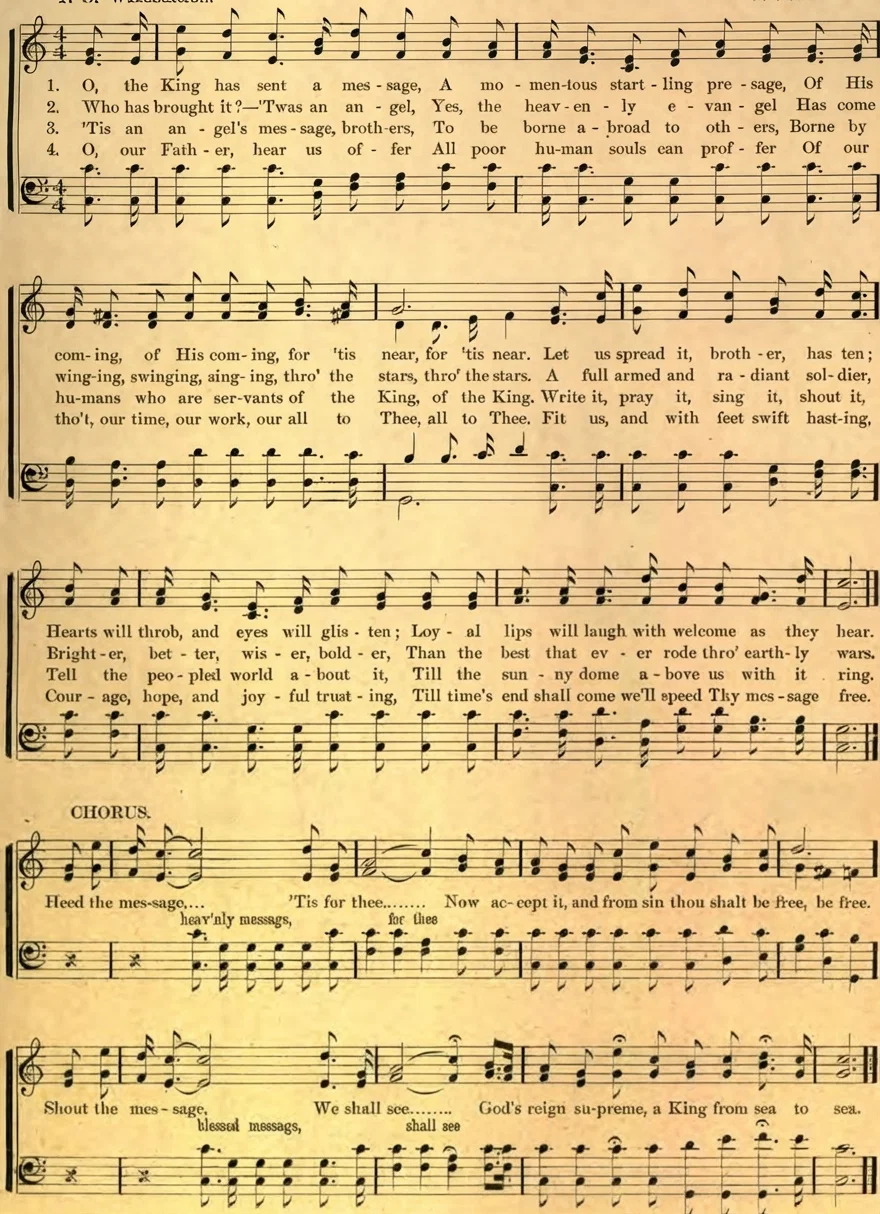
A Message From the King.
"And I saw another angel fly in the midst of heaven, having the everlasting gospel to preach unto them that dwell on the earth, and to every nation, and kindred, and tongue, and people."—Rev. 14: 6.
T. R. WILLIAMSON. S. J. HERRICK.
Copyright 1900, by S. J. Herrick.
This song and music will appear in a forth-coming book entitled, "Song Herald and Jubilee Trumpet."
AID OF PROTECTORATES TO MISSIONARIES.
It has been said that missionaries from America in foreign lands needed American government influence, or an American protectorate, or something of the kind. This is denied by the Rev. James L. Barton, secretary of the American Board of Foreign Missions, who says:—
"Hitherto our missionaries have gone to the ends of the earth carrying on their work, and it has never been charged upon them that they were the forerunners of the colonies to be planted, which in turn were to lead to a protectorate from the home country, if not annexation. Missionaries from England, Germany, and France have been open to these charges, and thereby their influence has been greatly narrowed and their efforts misinterpreted, while our own missionaries have been entirely unhampered."
The true missionary of Jesus Christ represents no earthly country or government. He is an ambassador for Christ and of heaven, and as such has no business to entangle himself with any earthly powers. If he would stand free in God alone, he would not have to apologize continually for the unchristian things done by falsely called "Christian" nations.
The framers of the Constitution recognized the eternal principle that man's relation with his God is above human legislation, and his rights of conscience inalienable. Reasoning was not necessary to establish this truth; we are conscious of it in our own bosoms. It is this consciousness which, in defiance of human laws, has sustained so many martyrs in tortures and in flames. They felt that their duty to God was superior to human enactments, and that man could exercise no authority over their consciences. It is an inborn principle which nothing can eradicate. The bigot, in the pride of his authority, may lose sight of it; but, strip him of his power, prescribe a faith to him which his conscience rejects, threaten him in turn with the dungeon and the fagot, and the spirit which God has implanted in him rises up in rebellion, and defies you.—Report of House of Representatives, 1830.
Every religious sect, however meek in its origin, commenced the work of persecution as soon as it acquired political power.—Report of House of Representatives, 1830.
A BRAND FROM THE BURNING.
By Hart Hall
IT was late in the night. The October wind was whirling through the nearly-deserted streets, blowing the dust about in clouds and causing loose boards of the occasional dilapidated buildings in a squalid part of the city to squeak and clatter.
The hanging sign-boards swung about with a mournful creaking, and sputtering electric lights swinging back and forth, lighted up at times dark corners of the alleys, and caused the shadows of buildings and poles to move uncannily about.
As if in mockery of the dismal night, the sound of drunken carousals from the many saloons in the vicinity would occasionally break out with startling hideousness, causing the burly policeman on his beat to pause and listen for any indication that his presence was needed.
The doors of one of these brawling places of iniquity opened suddenly, emitting a shaft of yellow light and fresh howls of profanity and vulgar song. A young man stepped out, and drawing his thin coat tightly about him as a protection from the chilly wind, walked slowly along the street, turning in finally at the entrance of a cheap lodging-house.
He was pale and emaciated from debauchery and disease. His haggard countenance, and his soiled and worn clothes, spoke more graphically than words possibly could, of a dissipated, wasted life. As far as it had gone, it was a close parallel indeed to the life of the prodigal in the parable; parents deserted, substance wasted, the final but inevitable degradation. He had taken every step, thinking it would be as low as he could ever get; but at last, sick and despairing, he had decided to take his own life.
It was with this determination in view that he climbed the narrow stairway of the tenement. He thought as he entered his room that it would be his death chamber, and that on the coming day when his body was discovered, it would be sent to the morgue, there to be numbered with the unknown dead.
Lighting a candle that was projecting from the neck of a bottle, he gazed about on the miserable surroundings. Satisfying himself that there was no chance of being watched, he sat down upon the rickety bed—the only article of furniture in the room that afforded the opportunity of a seat—and drew from his pocket a little vial marked conspicuously with a skull and cross-bones, and placed it beside the candle on an old box that served as a stand. Then, with his bowed head resting on his hands, he thought over for the hundredth time the deed he was about to do. Finally, reaching the same conclusion that he had so many times before, that there was no other way out of his distress, no other step to take, he whispered half incoherently to himself that it would do no good to wait longer; there was no one to bid good-by, no word to leave, no preparation to make; he would have the job over with. So, picking up the bottle, he started to remove the cork, when a voice coming from an adjoining room attracted his attention.
Listening attentively—the thin partition being no barrier to the sound—he heard an old man's voice slowly and reverently uttering what he quickly remembered was in the Bible.
In his deep despair the words seemed to come to him like a voice from heaven. Like a drowning man grasping at an object he hopes will save him, so the unfortunate wreck, hoping for something, he knew not what, leaned forward, scarcely breathing in his eagerness to hear every word.
“Let not your heart be troubled; ye believe in God, believe also in Me. In My Father's house are many mansions; if it were not so, I would have told you. I go to prepare a place for you. And if I go and prepare a place for you, I will come again, and receive you unto Myself; that where I am, there ye may be also.”
“ I believe in God; I believe in God—O God, help me!” the young man whispered brokenly.
As he listened, his eyes glued to the wall in the direction from which the sound came, all the bitter past, with its woes and despair, seemed to fade away into forgetfulness. The surroundings seemed to change. Instead of the miserable lodging apartment, he was in the large sitting-room at home, a child again, sitting in his little chair by the fireplace, listening as his father read the words that were now being borne to his ears.
How reverently the sacred words were read, how earnestly they were explained and commented upon, as the father sought to apply its thought to their lives, seeking to instil into the young mind of his child the precious truths of God!
After the reading was over, they all knelt to pray. He felt his mother's arm steal around him, drawing him closer to her, holding his little hand with a loving clasp in hers, and when in turn she prayed, she asked the Lord, her lips trembling with anxious love, to bless their little boy, to give them the wisdom to bring him up to be an honor to God, and a blessing and a strength to them in their old age.
When she said, “ Amen,” he repeated after her, with his childish lisp, the words: “ Our Father which art in heaven, Hallowed be Thy name. Thy kingdom come. Thy will be done in earth, as it is in heaven. Give us this day our daily bread. And forgive us our debts, as we forgive our debtors. And lead us not into temptation, but deliver us from evil; for Thine is the kingdom, and the power, and the glory, forever. Amen.”
A fit of coughing in the adjoining room aroused him from his reverie. Bitter, remorseful tears were coursing down his cheeks; and, prompted by the hope that there might yet be an escape from his wretched condition, he flung himself upon his knees, with a hoarse sob, burying his face in his arms.
His lips could frame no words, but his heart cried out to the One who is mighty and able to save from every condition.
For a long time he remained oblivious to everything but his heart's anxious supplications; but at last, raising his head, he heard again the quavering voice, now the voice of prayer. It was a prayer full of assurance, and faith born of a long, deep experience in the things of God, yet burdened with a weight of sorrow and suffering with which the Lord tries His faithful ones.
As the unhappy youth listened, the tears of repentance continued to flow, and sobs shook his wasted frame. He murmured over the words that he heard, as a prayer of his own heart; and the faith that God gives came to him, and he believed that his prayer was heard.
Suddenly he heard something that caused him to rise quickly, and his heart almost ceased to beat in his amazement. He had heard his mother's name spoken.
“ O Lord, Vonnie is gone,” the supplicant was saying; “ Thou hast taken her away from me, and I will soon go, too!
“ I don't want to live much longer. This world is too full of sorrow and trouble; I long for that day to come when I can be with Thee. But, O Lord, I have one desire yet, one purpose, for which I have come to this wicked place, this abode of sin! Thou knowest how my heart is set on it, and I rely upon Thee to accomplish that purpose for me, for without Thee I can do nothing.
“ O God! that purpose is to find my boy, my only child, my Jeff.
“ O God! help me to find him. Heed my petition, that the remaining days of Thy servant may be strengthened by the help of his only child.
“ Thou knowest why he left us; if it was through my mistake, I beseech Thee to forgive; but guide me to him, Lord; help me to find my Jeff.”
“ Father!” cried a hoarse voice. Then there was a heavy rap, rap, on the door of the old man's room; the flimsy fastenings gave way and it swung back, the dim candle light revealing to the old man's astonished gaze the haggard youth standing in the doorway. “ Father!” he cried again, brokenly, “ I heard you; it's I—Jeff. I heard you from the next room. I didn't know you wanted me to come back; but I want to. May I go home with you. I am so sick of my life. Will you forgive me, father? Can you forgive me?”
The old man gave a strange cry of bewilderment and joy, and sprang forward with outstretched arms, clasping his son with an embrace11of fervent love that only parents know.
And when the cold, gray light of the dawning day crept into the room, it revealed father and son bowed side by side in thankful prayer to God. And as the rays of the sun struggled through the cobwebs and soot on the window-panes, brightening up the dingy room, the rays of the Sun of Righteousness shone for the first time into a heart grimy and dark from the vilifying effects of sin.
Los Angeles, Cal. HART HALL.
"WHY ON EARTH DO PEOPLE SMOKE?"
By Edward Royds
[Edward Royds, in "British Anti-tobacco Journal."]
He sat amid a cloud of smoke;
No sound the evening stillness broke.
His little son was sitting by,
And every now and then would sigh.
Tommy, stretched on the garden chair,
His eyes so bright, his legs so bare,
Then opened wide those wistful eyes,
And, in a tone of great surprise,
Said, "Father, dear, don't think I joke,
But why on earth do people smoke?"
His father leaned upon his book,
And then put on a puzzled look:
"My boy, I do not know at all."
And then he let his features fall,
And, giving him a playful poke,
He slowly said, "Why don't you smoke?"
The saucer eyes came bigger still,
And then with tears began to fill:
"I have tried hard, but found I couldn't;
You mustn't think it's 'cause I wouldn't;
I did try hard to learn it, dad,
But, O, it made me feel so bad!
I longed to smoke before I tried,
But, O, I thought I should have died!"
His father smiled, and then again,
With emphasis, the question came,
"But, father, dear, don't think I joke,
Why ever do the people smoke?"
Then came the answer, low and clear:
"You puzzle father, Tommy, dear;
But, just to keep you from suspense,
I think it is 'for want of sense.'"