ONCE in the beautiful long ago there grew in a quiet garden a group of tall white lilies—seven fair sisters springing from one parent root. In all that garden of flowers they were the loveliest.
The sunshine of love warmed and cherished them, gladdening each passing day. The gentle rain and dew from heaven refreshed them. The rich garden soil nourished and supplied their life. And so they grew and flourished and bloomed in those golden days—tossed by every breeze of enjoyment—innocent and care free, joyous, happy, and beloved.
No shadow of coming danger or sorrow marred the perfect joy of those happy days.
But one dewy morn, before the busy hum of every-day life had begun in the garden, there appeared a magnificent stranger. Of elegant bearing and artful address, he made the rounds of the garden, paying his respects to all the more attractive flowers; then, selecting the queen lily of the family group, he plied his seductive art.
Day by day, by delicate, insinuating flatteries, he wooed the lovely flower, who, unsuspicious of guile, bent her graceful head to listen to all that the charming stranger was pleased to say.
A whisper ran round the garden that the handsome stranger was paying court to the lily, and envious criticism, and nods and gestures of piqued pride, were exchanged among the less-favored flowers. Yet, oblivious to all else save the one object, he advanced deeper and deeper toward the heart of the flower. One by one the outposts of the citadel of her heart were won—the invisible barriers with which God has hedged about the sacred dignity of maidenhood. One by one these defenses were surrendered to the magnetic charm of the wooer, till she yielded up to him the keys of her very being, not without trembling and distress, for her guardian angel had often uttered the “still small voice” of warning, causing her to hesitate and tremble on the verge of a great temptation. But the voice of the tempter was so tender and reassuring—his vows were so eloquent with expressions of love and loyalty, that the fears were soothed; the tempter triumphed, and the guardian angel turned away and wept. For one brief month the seducer lingered, and then he was gone, never to return.
But a blight had fallen on the lovely flower—blasting and mildew and desolation. If a thunderbolt had fallen from a clear sky and riven her to the earth, the ruin could not have been more awful and complete.
Prostrate she lay among her sister flowers, all her snowy petals bruised and stained and defiled in the dust of her humiliation. The gossiping nettle stung and wounded her; the serpent hissed at her. Cruel eyes of scorn mocked her sin and sorrow and pointed the finger of shame at her. Careless feet trampled her in the dust.
But comfort was near the perishing flower. A kind hand lifted the poor ruined one from the dust and whispered of the Life-giver and Healer—the Friend of sinners. The gentle dews of heaven fell upon her prostrate form. The sunshine of God’s love and comfort warmed her into new life, and hope sprang up again in the poor perishing heart.
Out of the ruins of that blasted life sprang up a new and tender hope—a bud of promise that should grow and ripen into a new life in Christ Jesus.
Daily, as she gained courage and faith and trust in the hand that was helping her, she grew, and the beautiful new life unfolded. She saw the world with new eyes. All the precious opportunities—the blessings of life, which before she had so lightly prized or taken as a matter of course, without thanks to the Giver—all the kind and loving counsel of friends she had despised—all the true and deeper meanings of life came into her soul like a new revelation of God’s love, now that her heart was tender and open to the teachings of the Comforter.
How her glad, new spirit goes up in rich fragrance to God, the Author of her being, and now her Saviour, Restorer, and Friend. She has become humble and teachable as a child (Matt. 18:2, 3) who looks to its Father for instruction and help in everything.
At last she stands renewed in the beauty of holiness—a pure white soul in the sight of God, her reproach all washed away in the precious blood of Christ.
Dear reader, whoever you are, have you not already guessed the meaning of this parable?
Jesus, who forgave the woman, “the sinner,” can reach your case, however low you may have fallen. And what He can do for the destroyed He can also do for the destroyer if you seek him as David did, with “a broken and contrite heart,” for forgiveness and cleansing. Will you not this day resolve and pray for a life of purity and holiness through Christ Jesus our Lord?
A HAIR ON THE PEN.
“WHY didn’t you keep that boy?” asked one merchant of another, referring to a boy who had applied for a position in his office.
“I tried him, but he wrote all morning with a hair on his pen. I don’t want a boy who hasn’t sufficient gumption to remove a hair from a pen.”
“That is a very slight thing for which to condemn a lad.”
“Pardon me, but I think it a very sufficient reason. There was a hair on the pen when he began to write, for I put it there to test him. I am satisfied that I read his character from that one thing.”—Anon.
WORK FOR GIRL GRADUATES.
“THE work you are to do, dear child, your Heavenly Father knows all about, and in due time He will bring it to you, or lead you to it,” writes Margaret E. Sangster to girl graduates, in the Ladies’ Home Journal. “Your part is to be ready, to make the most of your powers, and, in any period of indecision, or of doubt, to go forward one step at a time as the way is made plain, sitting still and doing nothing when that is evidently the Lord’s appointment for you. And, if you will believe me, there is not the most remote village in the land, nor the loneliest farmhouse, nor the narrowest apartment in a crowded city street, where a bright and clever girl, with a well-trained mind and two capable hands, can not find plenty to do. Fathers and mothers growing old need the brightness their girls can bring to them. Little children, small brothers and sisters, other girls not so well off, struggling lads and lasses trying against odds to fit themselves for college, kitchens badly managed and wastefully administered, sick-rooms lonely and sorrowful, are in want of the ministries our college graduates can bestow. Meanwhile the position to which your heart turns will surely open in good season.”
INTERESTING AND INSTRUCTIVE.
Compressed cork in the form of tiles, which is now on the market, is said to make an admirable flooring because of its noiselessness and its waterproof qualities. It is also inimical to germs.
A cavity in the form of a "natural well," whose depth exceeds that of any other known, has been discovered by Mr. E. A. Martel, in the Department of Hautes Alpes. The well has been sounded to the depth of about 1,017 feet, but it is believed that the actual bottom has not yet been reached.
A French inventor, M. Mercadier, states that he has solved the problem of sending a number of despatches simultaneously on a single wire. Messages have been transmitted between Paris and Pau. Twelve independent message currents were sent on the circuit at once in either direction, making a total of twenty-four telegrams.
During the volcanic eruption in the Hawaiian Islands last summer the smoke rose to a height of between five and six miles, and then drifted away to the northeast. At a distance of 600 miles from Hawaii it settled upon the surface of the sea, and was then carried back by the northeast wind to its place of origin, where it arrived a fortnight after its original departure, and covered the entire group of islands with its heavy pall.
The specimens of fossil dinosaurs belonging to the collection of the late Prof. O. C. Marsh, which were turned over to the National Museum in Washington, have been appraised by experts, who estimate the skulls of the monster triceratops, or "three-horned beast," as worth at least $5,000 apiece, while the other skulls vary in value from $50 to $250. The head and neck of the triceratops were covered by an enormous bony helmet, seven or eight feet long.
The Christmas-tree business has assumed large proportions, and the result is that considerable injury is done to forests by the cutting of young firs, which serve for Christmas trees and other decorative purposes. Some hold that this thinning out improves the forests, but the Hon. J. Sterling Morton, ex-Secretary of Agriculture, states that this is not the case, and forests which have not been thinned out for Christmas decorations, produce unequaled specimens of the long and straight coniferæ.
By comparing the price of diamonds at the mines in South Africa with their prices in the jewelry shops, one can obtain an idea of the cost involved in mounting and polishing, and the profit of traders. A diamond weighing one carat, mounted in a ring, may cost the buyer $100 or more, but at Kimberley the average value of diamonds is only $6.33 per carat. The value, of course, varies with the size and purity of the stones, but the total value of the 22,843 carats of diamonds found in the Transvaal in 1898 was only $212,812, an average of $9.32 per carat.
A German novelty consists of India rubber nails for use in places where ordinary nails are liable to corrosion. It is said that they may be driven into soft woods in sizes up to one inch long, without boring a hole for their reception. In larger sizes it is necessary to bore holes to start them, and for the largest sizes, holes for their entire length. They are said to be very useful in chemical factories, dye houses, breweries, etc., and they are also used in building accumulator cells and other electrical apparatus. It is said that they clinch fairly well. They may be used about explosives where a spark from a nail head when struck by a hammer might prove fatal.
LIMA. No. 1.
By G. H. Baber
[Pastor G. H. Baber, editor "Las Signes del Tiempos."]
LIMA is a place for the day-dreamer of America. What native American of twenty years has not dreamed of Lima? For all, Lima is an illusion; and for very few, a reality."—N. Avellanda.
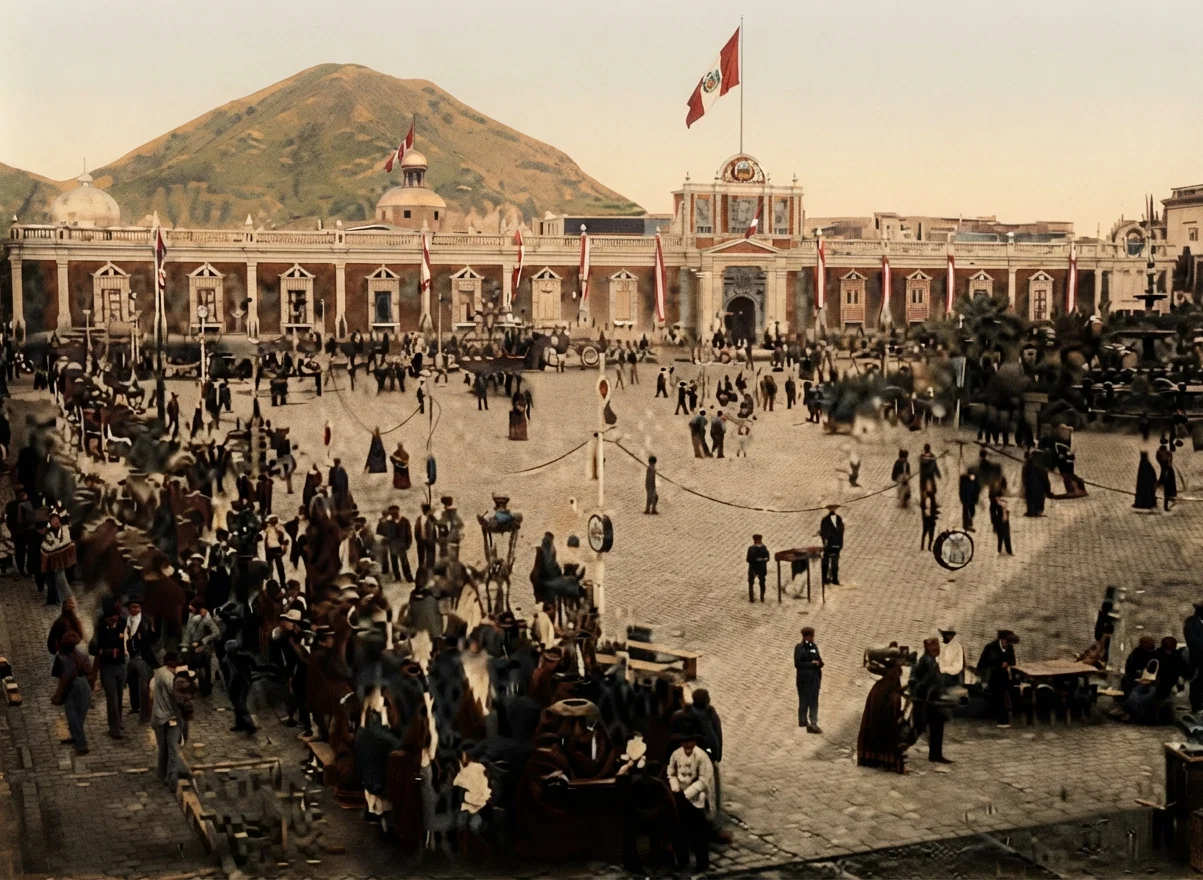
This capital city of the Peruvian republic is situated in latitude 12° south, at an elevation of about 400 feet above the sea level, in the most central and extensive valley of the Peruvian coast. It is six miles from the sea, abutting the outlying hills of the Cordilleras.
The River Rimac, with its soft, clear water, traverses the city from east to west, leaving about four-fifths on the south side.
Lima was founded by Francisco Pizarro in 1535, and named by him the "City of the Kings," but the natives soon and wisely gave it the name of Lima, a word said to signify the presence of an oracle.
The population of the city is certainly very fluctuating, or the census takers fail in their duty. The figures given range from 100,000 to double that number. Without giving statistics, the impression of a transient is that a large majority are not descendants of the white races. The copper color, with its varying shades toward the white, seems to predominate. Nearly all have fine features and polite manners; but they show a debility in physical structure. They are evidently a "dying nation."
The most popular entertainment for all classes seems to be the weekly bull-fight. Every Sunday afternoon, the women having gone to mass in the forenoon, the mixed multitude, rich and poor, white and black, old and young, turn out to witness this barbarous, dark-age diversion, and show by their relish of such brutal scenes that they are not so far removed from that bloody age as they should be, considering the length of time that has elapsed.
Usually six or seven bulls are sacrificed on the altar of public amusement on each occasion. The bull is usually harassed by men on horseback until it is tired, when the would-be gladiator sallies forth with great pomp, salutes the judges and the rest of the spectators, and then proceeds to show his skill by sticking a sword into the tired animal. Sometimes he is skilful and drives the weapon to the vital part; and sometimes he is bungling and only wounds the poor creature, which runs around the ring seeking a friend or a way of escape from such heartless enemies. He often carries away the sword of his antagonist, the handle being on one side and the point on the other, the blade having been thrust entirely through the body, while the blood gushes from his mouth and nostrils. He is usually killed in one way or another before the fight ends.
Sometimes, however, justice prevails, and the bull gets the best of it. Within the present month a burly, athletic fellow was so badly treated by his four-legged opponent that he had to confess to the judge that he was hors de combat. Then the crowd broke forth with, "Bravo Toro!" and hissed the unfortunate torero, telling him he ought to go to prison. He was the fourth man wounded on that day. The incapacity of some of the fighters and the removal of several bulls from the ring enraged the spectators to such an extent that a regular tumult ensued. They broke benches, chairs, and doors, and hurled them into the ring. They wounded several persons quite seriously, and tried to burn the edifice.
The editor of El Comercio, the best daily in Lima, concludes his account of the occurrence as follows: "The riot of yesterday in the bull ring is the best argument against a savage diversion, that ought to disappear from the customs of a polished people. The so-called attachment for bull-baiting has decreased and is decreasing more and more each day."
The flesh of the dead bulls is put on the market and is eagerly sought for food, under the impression that it possesses virtues not found in ordinary meat. Is it any wonder that such people consider themselves greatly disgraced by having the pure Gospel of Jesus preached in their city?
Altho in the tropics, and half surrounded by mountains, this city enjoys a climate unsurpassed for softness and tranquillity. Balmy spring all the year round seems to be a good definition for the word "climate" in Lima. The sun vail and the sea breeze are scarcely ever absent at the same time. An arrangement by no means left to chance, but a beneficent provision of Him who commands the clouds from above and causes the east wind to blow; who commands the sun and it riseth not; who covers the sun with a cloud, and appoints the moon for seasons; who telleth the number of the stars and calleth them all by name; who covereth the heavens with clouds; who prepareth rain for the earth; who maketh grass to grow upon the mountains; who giveth snow like wool and scattereth hoarfrost like ashes; "He casteth forth His ice like morsels; who can stand before His cold? He sendeth out His word, and melteth them; He causeth His wind to blow, and the waters flow;" who maketh a tabernacle for a shadow in the daytime from the heat, and for a place of refuge, and for a covert from storm and from rain.
Plaza of Lima, Peru.
Then praise Him, sun and moon and all ye stars of light; "praise the Lord from the earth, ye dragons, and all deeps; fire, and hail; snow, and vapors; stormy wind fulfilling His word; mountains, and all hills; fruitful trees, and all cedars; beasts, and all cattle; creeping things, and birds of wing; kings of the earth, and all people; princes, and all judges of the earth; both young men, and maidens; old men, and children; let them praise the name of the Lord." "Let everything that hath breath praise the Lord. Praise ye the Lord."
NOW.
By Adelaide Ann Proctor
RISE; for the day is passing,
And you lie dreaming on;
The others have buckled their armor,
And forth to the fight have gone.
A place in the ranks awaits you;
Each man has some part to play;
The past and the future are nothing
In the face of the stern to-day.
Rise from your dreams of the future—
Of gaining some hard-fought field;
Of storming some airy fortress,
Or bidding some giant yield;
Your future has deeds of glory,
Of honor (God grant it may),
But your arm will never be stronger,
Or the need so great as to-day.
Rise; if the past detains you,
Her sunshine and storms forget;
No chains so unworthy to hold you
As those of a vain regret.
Sad or bright, she is lifeless ever;
Cast her phantom arms away,
Nor look back, save to learn the lesson
Of a nobler strife to-day.
Rise; for the day is passing;
The sound that you scarcely hear
Is the enemy marching to battle—
Arise; for the foe is here.
Stay not to sharpen your weapons,
Or the hour will strike at last,
When, from dreams of a coming battle,
You may wake to find it past.
—Adelaide Ann Proctor.
The Missionary’s Burden
A MISSIONARY in Foochow, overwhelmed with the work that is at hand, exclaims: ‘‘O, if I could only multiply myself by 10, so that each of the 10 would have only 100,000 souls for whose evangelization to be responsible! The churches at home know nothing of this stress. Even here one has to go frequently from village to village in order to realize the needs of the masses.’’ How many ministers in America are content with a parish of far less than one thousand!—Missionary Herald.
LAUS DEO! IT IS DONE!
By Eugene Manlove Rhodes
[Eugene Manlove Rhodes, in the "Springfield Republican."]
"For the first time in our history, we have taken our proper place among the nations as a world power."—Senator Lodge.
WE have won!
Now our childish past is done!
Now comes manhood's high estate,
And our grateful heads we raise
For the crown of England's praise,
While the nations hail us great!
All in vain
The dark Tagal's blood and pain!
Asia's first republic falls,
Crushed beneath our giant strength,
And we proudly claim at length
Room and space in Glory's halls!
It is done!
Nevermore beneath the sun
For our banner shall we blush!
The old nations, one and all,
They that hold the world in thrall,
See our rivalry, and hush
In their mirth,
And the rulers of the earth
Whisper to each other low,
"They have thrown behind them—see!
Their old mask of liberty,
They will give us blow for blow!"
"And the rag
That they vaunted Freedom's flag,
Now shall share with us the spoil
Of the groaning earth—and they
Shall dispute with us the prey
Of our centuries of toil!"
"It shall wave
O'er the subject and the slave,
Never Cæsar in the past
Flew his eagles yet so far
In the flaming winds of war,
As this flag shall win at last!"
We are strong!
We shall wear the laurel long!
In the battle's dust and smoke,
Nations yet untamed shall drain
To the dregs the cup of pain—
Fall, and pass beneath our yoke!
Give us fame!
Let our sons no more in shame
Rust in dull, ignoble peace!
The delusive spell is broke
That our dreaming grandsires spoke!
Our long lethargy shall cease.
Deep and wide
Our foundations dig with pride!
Never yet in all God's years
Hath been reared such monument
As this empire. For cement
We will build with—blood and tears
Till the flood
Of man's vengeance swells in blood,
Till God's wrath rains on our land,
Till the winds of Freedom beat,
And in darkness and defeat
Falls that house built on the sand!
Some Current Verse
By Editor
[It has been said that the present wars have inspired no true or great patriotic poems. We would suggest that the greatest and best poetic productions, some of which are loyally patriotic, are on the wrong side, to draw the acclaim of a multitude who are wedded to "country, right or wrong," more than to principles of right. The following productions are all passable verse, and some ring with true poetry while the sentiment of all will find some response in liberty-loving hearts. We quote them not for any political sentiment they may contain, but for the moral element in them.]
RECESSIONAL.
By Rudyard Kipling
God of our fathers, known of old—
Lord of our far-flung battle-line—
Beneath whose awful hand we hold
Dominion over palm and pine—
Lord God of hosts, be with us yet,
Lest we forget—lest we forget!
The tumult and the shouting dies—
The captains and the kings depart—
Still stands Thine ancient sacrifice,
An humble and a contrite heart.
Lord God of hosts be with us yet,
Lest we forget—lest we forget!
Far-called our navies melt away—
On dune and headland sinks the fire—
Lo, all our pomp of yesterday,
Is one with Nineveh and Tyre!
Judge of the nations, spare us yet,
Lest we forget, lest we forget!
If, drunk with sight of power, we loose
Wild tongues that have not Thee in awe—
Such boasting as the Gentiles use,
Or lesser breeds without the law—
Lord God of hosts, be with us yet,
Lest we forget, lest we forget!
For heathen heart that puts her trust
In reeking tube and iron shard—
All valiant dust that builds on dust,
And guarding calls not Thee to guard—
For frantic boast and foolish word,
Thy mercy on Thy people, Lord!
Amen.
CONFESSIONAL.
By Howard S. Taylor
[Dr. Howard S. Taylor, in the "Chicago Times-Herald."]
God of our sires who hither fled
Across a strange and stormy sea,
Who suffered exile, toiled and bled,
To make themselves and children free;
God of the pilgrims, smite us not.
We have forgot! We have forgot!
How runs the story? Far away
We hear the epoch-opening gun
Fired by our minute men at bay
Upon the green at Lexington;
But, far and faint, we heed it not.
Lord God of hosts, we have forgot!
The Bill of Rights our fathers signed
And sealed with shot and saber stroke,
Their just appeal to all mankind,
Their prayers sent up through battle smoke,
Their faith humane, without a blot.
Lord Christ, forgive; we have forgot!
Ah, if where sunset islands lie,
Thy brave, brown men their blood shall spill,
Shall strike for liberty and die,
Slain by the heirs of Bunker Hill,
Thou wilt remember, wilt Thou not?
Though we, Thy people, have forgot!
We have forgot! A Roman lust
Profanes our ancient holy things;
We trample justice in the dust,
We have the rabies of the kings—
The scarlet rage of gun and sword.
Have mercy on Thy people, Lord!
Amen.
THE CROSS HIGH OVER ALL.
[Author not known.]
MIGHT is throned o'er right and justice; law gives place to tyranny;
Truth is meshed in webs of falsehood, with no hand to set her free;
A great nation's name is tarnished, while in chains weeps liberty.
And the Cross high over all!
Look ye forth, ye Christian nations, o'er the old earth's lands afar;
Ye of differing race and kindred, guided by the same white star;
Lo! the heavens are rent asunder by Greed's flaming simitar.
And the Cross high over all!
Ye who prate of God's great mercy, swords unsheathed in your hands;
Ye who prate of God's great justice, deaf yourselves to its demands;
Ye who prate of God's forgiveness, and stain red the old Nile's sands,
With the Cross high over all!
Ye who prate of truth and freedom, for whose life your fathers died!
Ye, the prophets of that freedom, which to-day hangs crucified,
In those far Pacific islands, lapped in empire's blood-red tide,
And the Cross high over all!
FOR WHAT?
The battle before Ladysmith has continued two days and still is in progress. The loss of life on both sides already has been very considerable.—Press despatch.
The life-tide is flowing, the red river runs,
And Northland and Southland now weep for their sons;
By African hillocks the corpses are strewn,
Where bullets have whistled their dolorous tune;
There is never a palace but woe may be there;
There is never a hovel but 'waiteth despair,
And mothers are weeping for those who come not—
Just God of the nations, for what?—for what?
Is there ever a rood of the African earth
That is worth these, the bravest and noblest of birth?
Is there ever a diamond yet lost in the mine
Worth blood that has flowed like a river of wine?
Let heart-broken mothers in anguish reply,
Give heed to the answer outborne on a sigh;
Give heed, ye of title, who scheme and who plot—
Just God of the nations, for what?—for what?
The corpses that African kopjes bestrew,
Each beareth a curse, O ye plotters, for you.
No wail from the stricken who languish and die
But a stern malediction is heard in that cry.
The red ground is covered with dying and dead,
But a voice yet arises from blood that ye shed,
A voice that shall answer your uttermost plot,
O planners and schemers—for what?—for what?
Just God of the nations, somehow and somewhere,
Thou knowest man's sorrow and heedest his care;
Before Thee the ways of the plotters are vain;
Thou knowest how paltry the thing they would gain,
And how red is its price. O, then, by the blood
That has stained Afric's plains with its dark crimson flood,
Be not the sad voice of our travail forgot,
While life-ties are sundered—for what?—for what?
PUT UP THE SWORD.
By James Jeffrey Roche
[James Jeffrey Roche, in "The Century."]
I HAVE sung of the soldier's glory
As I never shall sing again;
I have gazed on the shambles gory,
I have smelled of the slaughter-pen.
There is blood in the ink-well clotted,
There are stains on the laurel-leaf,
And the pages of Fame are blotted
With the tears of a needless grief.
The bird is slaughtered for fashion,
And the beast is killed for sport,
And never the word "compassion"
Is whispered at Moloch's court.
For the parent seal in the water
Is slain, and her child must die,
That some sister or wife or daughter
Her beauty may beautify.
And the merciful thought we smother—
For such is the way of man—
As we murder the useless mother
For the "unborn astrakhan."
But a season of rest comes never
For the rarest sport of all;
Will His patience endure forever
Who noteth a sparrow's fall?
When the volleys of hell are sweeping
The sea and the battle plain,
Do you think that our God is sleeping
And never to wake again?
When hunger and ravenous fever
Are slaying the wasted frame
Shall we worship the red deceiver,
The devil that men call Fame?
We may swing the censer to cover
The odor of blood—in vain;
God asks us over and over,
"Where is thy brother, Cain?"
A FABLE FOR THE TIMES.
By W. Colegrove, LL.D.
[W. Colegrove, LL.D.]
A GREAT eagle, one day,
Who would piously prey,
Took his seat on a towering cliff by the sea;
And, observing from there
The land, water, and air,
He considered what best for his dinner would be.
Pretty soon he perceived
(So at least he believed)
A good prospect of daintily dining on fish;
And in truth he was glad
That such game could be had;
For at that time of year 'twas his favorite dish.
A fish-hawk he descried,
With his pinions spread wide,
Overhanging the face of the billowy brine.
"Good for him," thought the king
Of the birds, "for he'll bring
From the deep a fair prize that will shortly be mine."
Then the hawk, with a lunge
And a desperate plunge,
Takes a shad in the depth of its watery lair;
Thence, emerging, he draws
The big fish with his claws;
And in triumph he bears it aloft through the air.
"What a sight to behold!"
Says his majesty bold;
"How the tyrant's abusing the innocent shad!"
In an instant he starts;
And like lightning he darts,
And denounces the hawk for his government bad.
In surprise and dismay
Hawk releases his prey;
And the fish is returning toward water,—the elf!
But the eagle declares,
With magnificent airs,
"The poor thing is not able to care for itself!"
So he plunges head first,
As if fearing the worst;
And his powerful talons are holding the shad.
"Let me go," says the fish;
"For 'tis freedom I wish!"
Says the eagle, "Your conduct is horribly sad.
"How ungrateful you are,
Since I've traveled so far
To emancipate you from the tyrannous hawk,
To pretend you've a claim
To the home whence you came;
And how grossly depraved thus of freedom to talk!
"For in fact I've designed,
And had only in mind,
As distinctly I said in my late proclamation,
To secure for your race
A superior place
By means of benevolent assimilation."
Thereupon through the air,
Spite of protest and prayer,
The poor fish was borne off to the bird's habitation;
And the bird was so filled
With the fish that he'd killed
That he died of benevolent assimilation.
24 "AND from thence He arose, and went away into the borders of Tyre and Sidon. And He entered into a house, and would 25 have no man know it; and He could not be hid. But straightway a woman, whose little daughter had an unclean spirit, 26 having heard of Him, came and fell down at His feet. Now the woman was a Greek, a Syrophenician by race. And she besought Him that He would cast forth the devil out of her 27 daughter. And He said unto her, Let the children first be filled; for it is not meet to take the children's bread and cast 28 it to the dogs. But she answered and saith unto Him, Yea, Lord; even the dogs under the table eat of the children's 29 crumbs. And He said unto her, For this saying go thy way; 30 the devil is gone out of thy daughter. And she went away unto her house, and found the child laid upon the bed, and the devil gone out."
NOTE.—The parallel account of the incident mentioned in this lesson will be found in Matt. 15:21-28. In 1 Kings 17:8-24 will be found an account of help being rendered by Elijah to a woman of this region. For instances of other examples of great faith, the teacher may turn to Luke 7:6 and onward, Matt. 9:18; 8:2, and Mark 9:24.
(1) Leaving Capernaum, where did Jesus and His disciples go? What did He do in order that He might be alone there? What does the record say in regard to this? V. 24. Note 1. (2) Who at once learned of His presence there? What cause had she for being interested in Jesus? What did the woman do? V. 25. (3) What was this woman's nationality? To what particular race did she belong? What request did she make of Jesus? V. 26. Note 2. (4) What reply did Jesus make to her request? What did He say would be an improper thing for Him to do? V. 27. Note 3. (5) What response did the woman make to Jesus' reply to her entreaty? V. 28. (6) On account of this reply, what did Jesus tell her to do? What did He declare in reference to her daughter? V. 29. Note 4. (7) On going to her house, what did the woman find? V. 30.
NOTES.
1. Went away into the borders of Tyre and Sidon.—Two flourishing seaports, and capitals of Phenicia, a narrow, level district along the shore of the Mediterranean. Sidon was twenty miles north of Tyre. Tyre is about thirty-five miles, and Sidon fifty-five miles, from Capernaum. The Saviour's purpose in going to the borders of these heathen cities was not simply to escape the opposition of the scribes and Pharisees. Neither was it for the sole purpose of healing the daughter of this woman. "The Saviour's visit to Phenicia and the miracle there performed had a yet wider purpose. The same agencies that barred men away from Christ eighteen hundred years ago are at work to-day. The spirit which built up the partition wall between Jew and Gentile is still active. Pride and prejudice have built strong walls of separation between different classes of men. There are no barriers that man or Satan can erect but that faith can penetrate. In faith the woman of Phenicia flung herself against the barriers that had been piled up between Jew and Gentile. It is thus that Christ desires us to trust in Him. The blessings of salvation are for every soul. Caste is hateful to God. He ignores everything of this character. In His sight the souls of all men are of equal value. Without distinction of age, or rank, or nationality, or religious privilege, all are invited to come unto Him and live."—Desire of Ages.
2. A Greek, a Syrophenician by race.—The woman was a Greek-speaking Gentile, under the influence of Grecian customs; a Syrian Phenician as distinguished from the Carthaginian Phenicians. She was a representative of a vast multitude of pagans, as she represented Shem and Ham by descent, and Japheth by language and civilization.
3. Let the children first be filled.—This woman's faith in Christ showed her to be one of the "children" in fact. Jesus said it was not meet (not proper) to take the children's bread and cast it to the dogs. Nevertheless, He gave her her desire after proving her faith. The term "dogs" was frequently applied to the Gentiles by the Jews. Christ does not use it as a term of reproach to her, but as a test of her faith. The Saviour first proves that she is one of the children of the household, and then grants her petition.
4. For this saying go thy way.—"The trial of her faith brought her greater blessings than would have been possible if her first request had been answered immediately. The trial of the woman's faith was a school where new lessons of faith were learned. When a current of electricity is to be developed from an unnoticed flow into a great light, it must be made to pass through a smaller wire and a poor conductor. These obstacles bring out the brilliant electric light and the most intense heat."—Peloubet. There is a lesson for the Christian to-day in the unwavering faith of the Syrophenician woman. The delays and obstacles which she encountered could not quench it. She made them stepping-stones to the blessing which she needed.
6 "I MARVEL that ye are so quickly removing from Him that called you in the grace of Christ unto a different gospel: which is not another gospel; only there are some that trouble you, and would pervert the Gospel of Christ. 8 But tho we, or an angel from heaven, should preach unto you any gospel other than that which we preached unto you, let him be anathema. 9 As we have said before, so say I now again, If any man preach unto you any gospel other than that which ye received, let him be anathema. 10 For am I now persuading men, or God? or am I seeking to please men? if I were still pleasing men, I should not be a servant of Christ."
NOTE.—Read these verses, in connection with the preceding ones, not less than fifty times during the week. Five hundred times would be better. Always read from the beginning, so as to note the connection. Make it a point to know the text thoroughly as you go along. It is so short each week that you can easily do it. Remember that we are studying the book of Galatians—not about the book, but the book itself. If you do not become perfectly familiar with the text, then of course you do not have the lesson; but if you master the portion each week, always reviewing from the beginning, you will have the entire Epistle in mind at the close of the study.
QUESTIONS.
What was the apostle's state of mind as he wrote this Epistle?—"I marvel."
With whom, then, must they once have been connected?
To what were they being removed?
Is there really any other gospel than "the Gospel of God, concerning His Son Jesus Christ" (Rom. 1: 1-3)? Compare Gal. 1: 7 with 1 Cor. 3: 11.
What were some doing?—"There be some that trouble you."
By what means would they do this?—"And would pervert the Gospel of Christ."
Then what was this other gospel which some were preaching?
What should be the fate of any one who would preach a different gospel from what Paul had preached?
How far-reaching is this curse?
What shows that Paul did not pronounce the anathema without deliberate thought?
Since any one, even an angel, who should venture to preach a different gospel than Paul preached, would bring a curse upon himself, what does this prove as to this Gospel?
What question did Paul ask concerning himself? See note on verse 10.
Whom only did Paul seek to please?
Whom would those seek to please who preached a different gospel?
When it is clear that the class is thoroughly familiar with the text, questions may be asked that will involve a knowledge of the relation of the various statements in the text to one another, and also to other portions of Scripture. The suggestions that are appended will be a help in this.
2. IN what condition are they who depart from God? Eph. 2: 11, 12. Into what, then, were the Galatian brethren falling?
3. IN removing from God, the Galatian churches were taking up with a perverted gospel, a counterfeit gospel. It promised salvation, but in another way from what God offers it. Since the Epistle to the Galatians was called out by the fact that the churches were getting confused ideas of the Gospel, and were adopting a perverted gospel, with what must it specially deal?
4. THERE is only one Gospel, and that is "the power of God unto salvation to every one that believeth." Rom. 1: 16. A perverted gospel must be one which offers salvation by some other power than that of God.
5. THERE is no other power than that of God, so that whoever presents "another gospel" to men, leads them to trust in nothing for salvation. Such an one is justly accursed, because he brings a curse upon others.
6. THERE are angels that "kept not their first estate" (Jude 6) who are intent upon leading men to destruction. Such ones, "transformed as the ministers of righteousness" and appearing as angels of light, need to be guarded against. 2 Cor. 11: 13-15. How can we distinguish them from the true messengers of God?
7. "Do I now persuade men or God?" When one persuades another, he seeks to win him, to conciliate him. That is the idea of the word here rendered "persuade," as may be seen from the next sentence. The French of Segond has it, "Is it the favor of men that I desire, or that of God?"
8. HE who labors to please men is not only not the servant of God, but is an unfaithful servant of man. Col. 3: 22-24. He who pleases God can best serve men. Prov. 16: 7.
9. FROM the verses already studied, what do you conclude as to the amount of influence human opinions could have on Paul's preaching? What verse in the first lesson contains in part the same thought as verse 10?
PACIFIC PRESS
Publishing Co.
Printers
OAKLAND, CAL.
Branches at
San Francisco
Kansas City
New York
Printers
Publishers
Binders
Etc.
Publishers’ Printing Services
By Editor
P u b l i s h e r s
SIGNS OF THE TIMES
OUR LITTLE FRIEND
# # # Etc. # # #
First-class facilities for
the execution of every
description of modern
printing and publishing
Orders for general print-
ing will receive most
careful attention # # #