The Youth’s Instructor, Vol. 63, No. 36.

Distributed Five Thousand Temperance “Instructors”

The Youth’s Instructor

Sep 7, 1915

Review and Herald Publishing Assn. · Takoma Park Station, Washington, D. C. · Sep 7, 1915

Distributed Five Thousand Temperance “Instructors”

WHEN it was learned that the Flying Squadron was to visit New York City, arrangements were made by Elder J. E. Jayne and his coworkers to distribute a large number of the Temperance INSTRUCTOR. Elder Jayne gives the following account of their work:—
“We communicated with those in charge of the meetings to see if arrangements could be made to use the Temperance number of the INSTRUCTOR in connection with the work. Mrs. Helen J. Andruss, State secretary of the W. C. T. U., communicated directly with ex-Governor Hanly, and completed the arrangements to do so.
“To secure money with which to pay for the INSTRUCTORS, it was decided to send out solicitors. Each solicitor carried an INSTRUCTOR, an envelope in which the contributor could place his donation, and an authorization card. Mrs. Helen J. Andruss gladly signed our authorization cards, and furnished the names of persons whom she believed would help in purchasing the INSTRUCTOR. Later, she signed receipts sent to the donors.
“About one hundred and fifty of our people volunteered to help in this work. An excellent spirit prevailed. The solicitors went to business men and to the general public, and money was secured with which 5,000 copies of the Temperance number of the YOUTH’S INSTRUCTOR were circulated. The quality of this paper and the character of our effort were highly appreciated. The Flying Squadron and the W. C. T. U. workers united with our workers in circulating the INSTRUCTOR. It was a pleasing sight and a profitable effort.
“The wife of one of the ministers of the city secured three hundred copies for use among the young people of her church. Another worker for young people has secured a similar number. Those holding noonday meetings for men upon the streets of the city, have requested and received a supply for use there. Mrs. J. M. Calvert, one of our Bible workers, took charge of the detail of this work. The Lord greatly blessed the efforts of herself and her associates.”

Takoma Park Sabbath School Members Honored for Memorizing Sermon on the Mount

Four of the members of the intermediate division of the Takoma Park (D. C.) Sabbath school have been presented with a book by the leader of the division for having memorized the Sermon on the Mount, which includes the fifth, sixth, and seventh chapters of Matthew’s Gospel.

Violets Among Nettles

VIOLETS among nettles! They exist, and a joyous discovery it is to find the bewitching clusters surrounded by the prickly nettle. In the garden of life let us look for the violets of character in our weak and erring brother. These once found, the nettles are soon forgotten.

Reaching the Visitation of God's Wrath

“HAVE we reached the visitation of God’s wrath? The many startling statements in the September issue of the Watchman ought to impress all with a determination to spread everywhere the awakening news of the speedily approaching end.”

Calling

“I HEAR the voice Of One who calleth, Calleth sweet and clear, For men to reap for him A harvest white. Oh, soul of mine, rise up and answer him Before the night, The long night falleth, And the day be gone, thy day be gone.”

Wartime Inventions: Paper Lifeboats, Gas Masks, and Aviation

A PAPER lifeboat that can be packed away in the space of about one cubic foot, but that, when inflated, is seaworthy and durable, is the invention of a retired admiral of the Japanese Navy.
THE names of the Canadian soldiers killed, wounded, or made prisoners in Flanders in a single week, fill four columns of a Montreal newspaper. That is only Canada; there are eleven nations at war.
THE French have invented a gas mask that is successful in withstanding the deadly chlorine bombs the Germans have used with such gruesome effect. This mask fits closely over the nose and mouth, and must be wet with a five-per-cent solution of hyposulphite of soda.
MRS. RICHARD H. DANA, wife of a Boston lawyer and daughter of the poet Longfellow by his second wife, Frances E. Appleton, died on July 21, at Lancaster, Massachusetts. She was one of the three children mentioned in the poem “The Children’s Hour.”
AT the request of Thomas A. Edison the American Society of Aeronautic Engineers, a new body composed of the foremost authorities on flying, has just been organized. The society will work in conjunction with the navy board which is to investigate naval inventions.
ROSELLE, known in the Gulf States and the West Indies as Jamaica sorrel, has suddenly acquired a high commercial value in the Philippines, Hawaii, and other Pacific islands, where the buds are raised for jams and jellies. One Chicago concern uses from $50,000 to $100,000 worth every year.
PATENTS have been issued for an aerial torpedo boat, a huge flying machine which will carry and launch torpedoes from the air. This will make it possible to attack even ships lying in protected harbors. The torpedoes will dive into the water, and then proceed on their course in the usual way.
“AN arctic explorer who thought he was traveling poleward at the rate of ten miles a day, found that the ice floe on which he was sledging was, on the contrary, drifting equatorward at the rate of twelve miles a day. Had he not looked skyward, he would not have discovered his mistake. Such is the condition of those who say, ‘I believe,’ and yet keep their gaze upon the earth and things earthly.”

I Will Help You

A FROSTY chill was in the air,— How plainly I remember!— The bright autumnal fires had paled, Save here and there an ember; The sky looked hard, the hills were bare, And there were tokens everywhere That it had come — November.
I locked the time-worn schoolhouse door, The village seat of learning, Across the smooth, well-trodden path My homeward footsteps turning; My heart a troubled question bore, And in my mind, as oft before, A vexing thought was burning.
“Why is it uphill all the way?” Thus ran my meditations; The lessons had gone wrong that day, And I had lost my patience. “Is there no way to soften care, And make it easier to bear Life’s sorrows and vexations?”
Across my pathway, through the wood, A fallen tree was lying; On this there sat two little girls, And one of them was crying. I heard her sob: “And if I could, I’d get my lessons awful good; But what’s the use of trying?”
And then the little hooded head Sank on the other’s shoulder, The little weeper sought the arms That opened to enfold her. Against the young heart, kind and true, She nestled close, and neither knew That I was a beholder.
And then I heard — ah! ne’er was known Such judgment without malice, Nor queenlier counsel ever heard In senate house or palace: “I should have failed there, I am sure. Don’t be discouraged, try once more; And I will help you, Alice.”
“And I will help you.” This is how To soften care and grieving; Life is made easier to bear By helping and by giving, Here was the answer I had sought, And I, the teacher, being taught The secret of true living.
If “I will help you” were the rule, How changed beyond all measure Life would become! Each heavy load Would be a golden treasure; Pain and vexation be forgot; Hope would prevail in every lot, And life be only pleasure.
— Wolston Dixey, in “Pieces for Every Occasion.”

Village Life in India

V. L. MANN, M. D.
THE sun has just set on a bright day in the middle of January. The breeze does not give a sensation of either coolness or warmth, and were it not for its motion, would not be appreciable to the senses. The dry, parched earth that has not felt a drop of rain for five months does not reveal a green thing save a few clumps of mango trees dotted here and there. The narrow, winding roads leading to the village are marked occasionally along their courses by clouds of dust made by traffic returning to the village. First comes a bail-gari (ox cart), wending its way slowly with a load of wood gathered from the jungle. Next is a herd of cows trudging their weary way after a scant day's picking in the sun-burned jungle. After these a herd of lean, lank, almost hairless, ugly, clumsy buffaloes, with their cowlike forms and backward-curved horns, come from a day spent wallowing in the mud and a pond of water, which perchance may have been fed by a spring or been caught during the rainy season of months ago, awkwardly making their way to their shelter of a mud hut for the night. Last of all comes a herd of goats cantering along with their tiny bells of a high-pitched tone, the most active and best kept of all, because of their ability to climb and gain access to food. They are putting up the best fight in this survival of the fittest in a land of famine. Between these flocks will be seen an occasional foot passenger coming from a distant village or from the weary toil of the day. These having settled in their places for the night, nothing now mars the stillness of the twilight except the shout of children flying kites, and the sharp screech of a bird making his last call before he takes his place among the trees for the night.
The clear blue sky is broken by small, fluffy-like clouds; “in the unscarred heavens they leave no wake.” The rose-tinted horizon is narrowing, narrowing, until now darkness prevails, and the scavengers of the night hold dominion. The fox, with its merry call, makes the most melancholy mind amused; the “Who, who, who are you?” of the time-honored owl is heard in the distance; and the weird cry of the jackal sends a chill through the nerves of the most sanguine. These sounds break the stillness of the night. Meanwhile the families gather within their small mud huts. These are made without windows and with but one door, and are lighted with a small tin lamp, or chiragh, which gives only the light of a candle. The day's supply of water, the bundle of sticks to make the fire for the cooking of the dal, rice, and chupatties, and the ground grain, have been prepared by the housewife and the daughters.
If a visitor arrives, every one as a token of respect rises and greets him with a low, graceful bow. Touching the forehead several times with the right hand, he says, “Salaam, huzur” (Peace, your honor). The dogs of the village, which as a rule are a half-starved, mangy-looking lot, having been quieted and assured that the intruder has no hostile intentions, a charpoy—a small bed made of a bamboo frame strung with rope—is brought for a seat. The huqqa (the Indian pipe) is offered to the visitor as the ever-necessary token of peace and good will. To the one who has to refuse, it is embarrassing, as well as to the giver, as this is a time-honored custom. But any fear of a lack of friendship can generally be overcome by a few words of explanation and the acceptance of some other gift. The next thing offered is generally something to eat, when again one has to be careful, as disease, which is very prevalent in India, is constantly being spread by foodstuffs; but a cup of boiling juice from the sugar cane or a cup of boiling milk can be accepted with little fear of contracting cholera, enteric fever, or dysentery. One can accept something to eat and take it home with him, and discard it if there is any fear that it may cause disease. Off to one side one will hear a roaring noise which comes from a crude furnace made of mud. Through a round hole the fire is fed with dry, crushed sugar cane stalks. Over the furnace and within an inclosure are large vats which contain juice from the sugar cane cut during the day by the men, and carried to the village by the women and children, where it is crushed with a simple cog-wheel arrangement. The juice is boiled down and made into shira (molasses) and andraki (native sugar). The visit over, the salaams again given, the visitor steps out into the light of the full moon, which gives a much brighter light than our full moon in the States.
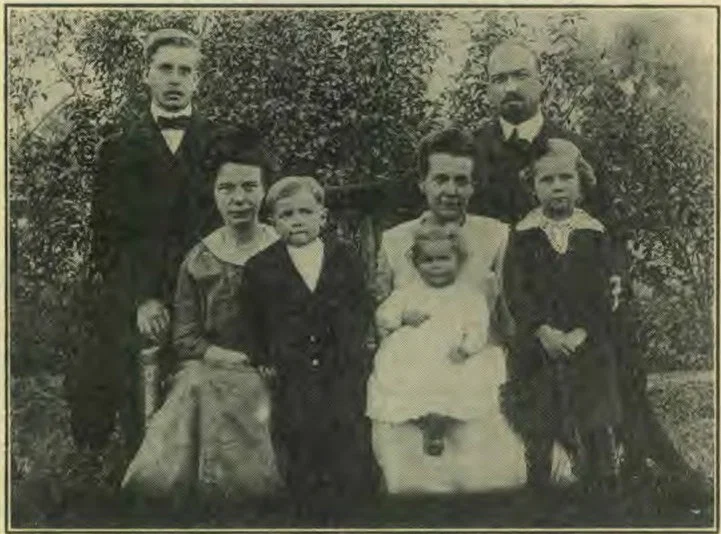
DR. AND MRS. MANN AND MR. AND MRS. LOASBY
The native turns in for the night on a charpoy, and makes himself comfortable by rolling himself in a quilt or blanket. On taking the train from the station late at night, generally one has to pick his way carefully among outstretched bodies upon the floor, wrapped up snugly head and foot. It is a peculiar thing, but the Indian, like the ostrich, seems to think by covering his head he protects his whole body. During the coolest evenings of the cold season, the natives will be found going around with their heads, shoulders, and thighs wrapped in a blanket, and from the midthigh downward perfectly bare. The Indian is an early riser. The dawn always finds him about, as his religion demands of him certain duties before sunrise. The early morning hours are spent in grinding the meal at the mill, made of two crude, circular, flat stones, turned around on each other by the hands of the faithful housewife. This is a typical example of the two women “grinding at the mill; the one shall be taken, and the other left.”
The water is also brought in the morning hours by the housewife from the village well. The well plays a very important part in the life of the villager. The women who are putting in their day's supply of water are found chattering, relating their tales of woe or joy. The well is a great means of spreading cholera, dysentery, and enteric fever. The district authorities are doing all they can to improve the condition of the village water supply, and to keep it pure.
An Indian village consists of fifty to five hundred meanly built mud huts, all packed together in a small space. Five to ten persons sometimes live in a ten-by-twelve-foot hut. The walls are made very thick to protect from the extreme heat of the sun. No windows, no ventilation, and but one door characterize the village hut.
The monotony of village life is broken by trading at the bazaar and by a funeral or wedding ceremony. The bazaar, the place of business, is a number of low, mean-looking stalls eight by twelve feet, located on either side of the main thoroughfare of the town, to which the villagers go for trading. In this row of shops will be found cloth, iron, brass, sweetmeat, spice, native dried fruit, tobacco, pan, grain, and flour. The shoe dealer also is here. There is generally a notion shop and a native restaurant. The busiest time of day in the bazaar is in the morning up to midday, when in the hot season everything is closed until three o'clock in the afternoon. From this time on until eight or nine at night, the bazaar will be found fairly busy.
Funeral processions, which at first glance, especially to the new in the country, are hard to distinguish from marriage processions, are led with music and dancing. Everybody seems to be happy. Still, at the accustomed time many Indians show great grief for their departed loved ones, but the majority are so constituted that they soon get over the loss. The Mohammedan buries, while the Hindu burns, the dead. The Hindu is fond of consigning his dead to the waters of the Ganges River, which he considers sacred; but the British government has put a stop to this practice, because of the contamination of the water.
A marriage procession consists of the participants in the ceremony, who may be a couple four or five years of age, gay dresses, music, singing, and dancing. Far into the small hours of the night the time is spent in drumming, singing, dancing, and feasting. There is often great diversity in the ages of those who are married. A woman of twenty-five years of age, who did menial work in one of our dispensaries, upon questioning was found to have a husband at home who was six or seven years of age.
The children of the village need mentioning, as it is in this period of life that the Indian looks his brightest and best. In spite of their dirty, entirely nude little bodies, they are as bright and as interesting as any children. Later in life they lose their brightness, and their faces assume a dull look. This is probably due to the lack of food and other necessaries. At the age of six or seven years, clothes are put on the children. They are not given the full dress at once, but a piece of apparel is added each year until the shirt and dotahi (loin and limb cloth) are both worn in the case of men, and a full outfit in the case of women. The child is made to bear responsibilities when it is very young. Sisters of six years of age are seen carrying their little brothers who are half as old and sometimes nearly as large as themselves. The boys also are put to work when very young. I have seen a juti-walla (shoemaker) who was only six or seven years of age. Boys of this age are as keen on making and exacting pice (money) from a customer as are their parents. Under these responsibilities and because of deprivations they age rapidly. In taking the history of an Indian you will be surprised, because you will doubtless overestimate his age by twenty years. The early marriage so common in India also is responsible for the premature aging.
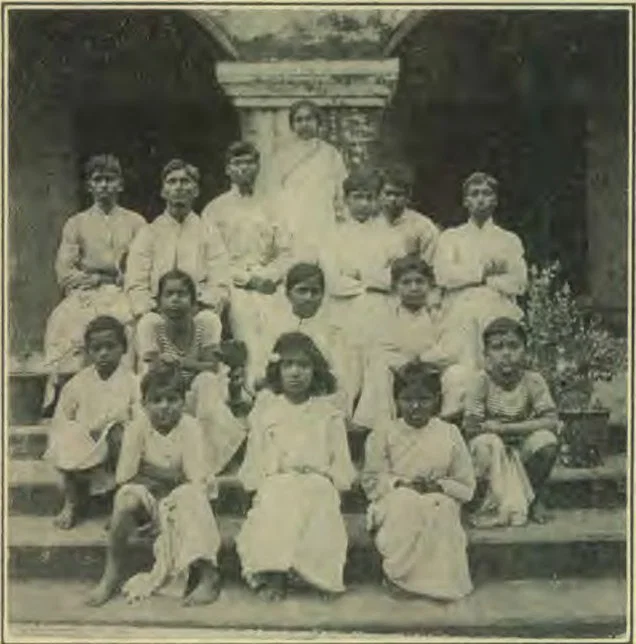
A GROUP OF YOUNG PEOPLE, INDIA
The food of the villager consists of rice, dal (a legume), and wheat flour. Those who have the money to spare eat a great deal of native sweets, which are mixtures of coconut, milk, ghee (fat from boiled cream), and sugar. They are tempting even to the European, but are not a wise investment. Children of the better-to-do class will be frequently seen with their pice (half cent), looking up the sweetmeat shop. There are also cheap vegetables indigenous to India, which are eaten by the Indian people. It costs the average Indian three or four cents a day for food. Many of the working class get only about two dollars a month wages. The majority of Americans can learn how to cook rice from the Indian. He boils his rice until it is done, after which he drains off the hot water and dashes a cup of cold water over it, which he also drains off, and then sets it over the fire again for a few minutes. The rice comes out flaky and mealy. Dal is cooked by boiling, and is used in conjunction with the rice. The Indian eats his food very hot with peppers. It would be intolerable to the European. The flour of the wheat is used in an unbolted condition. It is made into chupatties, a kind of pancake without any rising material. After mixing the flour and water, the dough is rolled by letting it fall from one hand to the other until it has been molded into a sheet as thin as heavy paper. It is then baked over a live fire. The finished product is eight or twelve inches in diameter and nicely browned on both sides. It does not make bad eating. It is a convenience to the traveler in the villages. Gram (a legume) is eaten either boiled or roasted. The latter method of preparing it makes it very palatable. Gram, boiled milk, boiled rice, and chupatties, if prepared fresh in your presence, can be eaten with impunity in the villages without fear of disease. Boiled rice with sugar and milk is a dish greatly relished by the native.
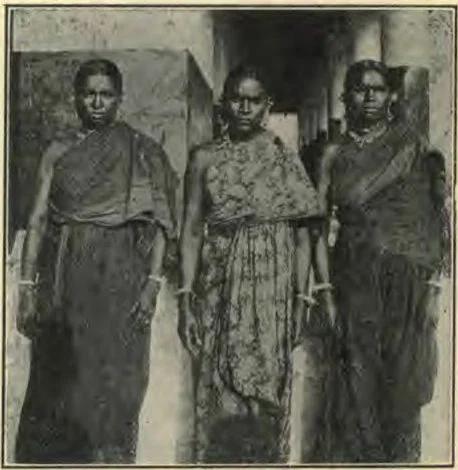
BEJEWELED INDIAN WOMEN, EACH WEARING $750 WORTH
Utensils for eating and cooking purposes are made of brass. They are of different shapes and sizes. The convenience for cooking is made of mud, or by turning three bricks on edge, where they can be procured, thus making it like a little fireplace. The fire is fed with straw, cane stalks, and dried cow manure. The latter, mixed with water, is also used to wash the walls and floors of the dwellings. The women are often seen going along with baskets on their heads, gathering this much-prized article. When an Indian carries anything, he is bound to put it on his head. It looks queer to see one of them carrying a pound or two on his head; but it makes no matter how small or how large the parcel is, it must go on the head. An amusing incident is told of a builder and contractor who introduced the wheelbarrow as a means of carrying brick and mortar, instead of the basket on the coolie's head. He showed the coolies how to use the wheelbarrow; and when he left the work for a little time, things were working smoothly, but when he came back the coolies were running up and down the gangplank with both the wheelbarrow and its load upon their heads. It is not an easy matter to overthrow a custom in India. The nation persists in doing things in the same way their forefathers did ages ago. A railway official once told me that his company made as few changes as possible in the work of its Indian laborers, as it took altogether too long for them to become accustomed to the new order of things.
Much of the native's time is spent in the smoking of the huqqa, which consists of a perpendicular cylindrical tube one-half inch in diameter, and eighteen inches long, inserted into a bowl filled with water. In the top of this tube is placed a funnel in which is put live coals of fire, tobacco, molasses, and any drug that suits the fancy of the user. From the bowl, which forms the body or base of the pipe, leads another tube two feet long, which is bent at an obtuse angle, and through which the puffs are drawn. This draws the smoke from the tobacco in a funnel-like top through the water in the bowl of the pipe. The huqqa is never left behind. The farmer, when he goes to the field, and the traveler on the railway carry the huqqa with them. Even the driver on the load of wood will have his huqqa tied to one of the stakes on his gari, and the coolie carrying the dandy on his shoulders up the mountain will have his huqqa tied to his dandy. When he puts his passenger down for a rest, he puffs away at his huqqa. The huqqa may be made on a cheap scale, or it may be very richly adorned with silver.
Pan chewing is another Indian habit, more common in the cities than in the villages. Pan consists of a mixture of lime, acacia, and scrapings from the betel nut, spread on a pepper betel leaf, which is then chewed. This mixture has a very deleterious effect upon the system. Cigarettes and spirituous liquors are fast being introduced into India by the European, but these vices as a rule have not yet reached the villages.
The sport of the villager consists of the fighting of birds, like the chikor, partridge, and rooster. They also have Indian games similar to chess. European sports, like cards, cricket, and football, are commanding the attention of the young folk in the larger towns. Wrestling has been a favorite sport. The wrestlers are two well-fed, muscular individuals. The object to be attained is to place the other fellow on the back, much as with American schoolboys. While this sport is still in vogue in some places, it is indulged in less than it used to be.
India is a large country with many different sections, therefore village life would naturally differ in different parts, but the foregoing gives a fair idea of some Indian customs. These poor people in these villages have never heard of the Christ. The work for which our good people in the States sent us here is to tell these poor souls of a crucified and risen Saviour. We need your prayers in this work, and a band of faithful loyal, tried young men and women to devote their lives in helping us carry this message to the multitudes of India, and thus hasten the appearing of our Lord and Saviour Jesus Christ.
Lucknow, India.
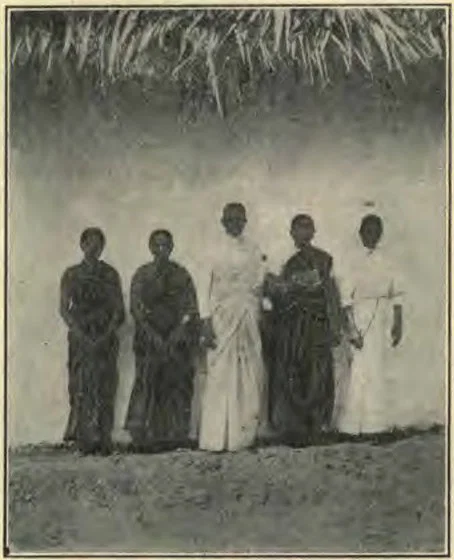
CHRISTIAN INDIAN WOMEN, WITHOUT OUTWARD ADORNING

Results of a Little Missionary Effort

IN 1894 a lonely wayfarer stood one evening on one of the streets of one of our cities. He was observed by a Christian worker, and invited to a meeting being held near by, which resulted in his acceptance of Jesus as his Saviour and of the gospel message for these last days.
This naturally bound him to the brother who had taken an interest in him and invited him to the meeting. So a few days later when this brother was about to leave for his home in another State, he was besieged by the new convert to take him along, which he finally consented to do. The man was taught the truth more fully, and finally entered the field as a colporteur for the good books telling of the message that had so recently come to his own heart. He remained in the work for about a year, when for some unknown reason he disappeared and was not heard of again by the brother who had brought him into the truth and helped him into the work, until at a recent camp meeting a sister told the following story: “Several years ago, while looking over the Monday morning paper, my eyes caught the headlines to a bit of news. It was an account of a young man who the day before, at the Catholic church, had put in the collection box a note to the priest, telling him if he did not stop worshiping idols, he could never be saved. This was observed by the man sitting next to him, who complained that it disturbed him, and the young man was arrested and imprisoned.”
The woman was so impressed by reading the account that she prevailed on her husband to go to the jail and visit the man, for, she said, “I am impressed with the words of the Saviour, ‘I was in prison, and ye came unto me.’” Upon reaching the jail the husband met their pastor just coming out, and when asked by the latter why he was there, he told of the news in the paper, and said he was going to see the prisoner. The pastor remarked, “I, too, saw the news, and have just been to see the prisoner; and if ever there was a Christian, surely he is one;” and he added, “Now, John, if you can get him out, do so, and I will stand by you.”
John visited the prisoner, and was convinced that he was a Christian, and after consulting with the officers found he could get him out by going on his bond. He returned to his home, and told his wife the result of his visit to the jail. She, upon hearing her husband’s account of the prisoner, said, “Let us take him out.” “But,” said the husband, “Mary, the man has no money, and what shall we do with him?” “Why, just bring him to our home,” said the wife, “and we shall care for him.”
The prisoner was brought to their comfortable home, and they felt they were doing the will of God. After supper they all went to the sitting room, where the prisoner began to converse on the theme evidently nearest his heart. He said, “Sister, are you a Sabbath keeper?” She replied in the affirmative. “That is good,” he said, “let us read about it in the Bible.” He took from his pocket his well-worn Bible and began reading the fourth commandment. To the woman, the room seemed filled with light; and for the first time in her life, like a flash of lightning, she saw that the seventh day is the Sabbath, and that she had been keeping the first day. That night she decided to obey God and keep the Sabbath. Later the prisoner’s fine was gladly paid by the good man and his wife, and he went on his way a free man, and was never heard of again by them. The sister said, “How often we have wished we might know what became of the man whom God used to bring to us the light of this glorious truth.” Upon the conclusion of her story, a brother arose and said that he had known the man, and that he had died a few years before.
This sister had formerly been a Catholic, as had also her present husband, who with her was in attendance at the meeting and followed his Lord in the ordinance of baptism. The worker who spoke to the wayfarer on the street and invited him into the meeting was present and heard the story, and rejoiced that he had spoken a word in season to him that was weary, and that it had resulted in at least two other persons accepting the gospel message.
“In the morning sow thy seed, and in the evening withhold not thine hand: for thou knowest not whether shall prosper, either this or that, or whether they both shall be alike good.” W. W. EASTMAN.

Sources of the Best

Mrs. C. B. Lesher, a Baptist missionary to China, writes: “In looking over some of the new books for use in the Chinese schools all over China, in the preface of six primers and educational books prepared by a Chinese, I found this statement: ‘As we study the history of the world, we find that the blessings of education, science, discovery, etc., have all emanated from the disciples of the Christian religion. All that has really benefited our country, the best books, the best schools, the most helpful ideas, have had their source in Christianity and been handed to us by its teachers.’”
Continue reading: The Story of the Rebellion Against the Government of King Jehovah