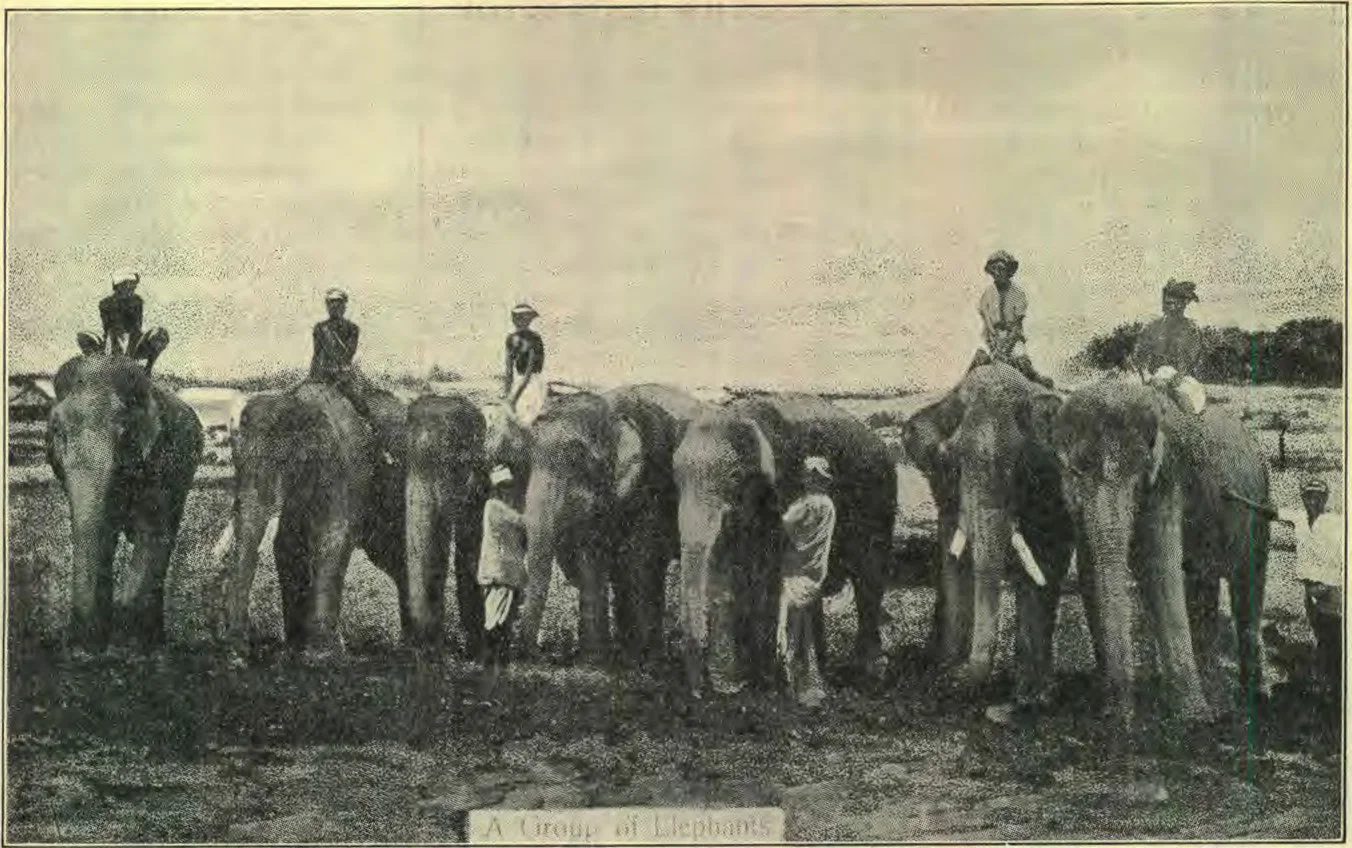
THE impression prevails in many countries that the chief use of the elephant is to look big, to carry around the reputation of being the bulkiest of land animals. It would indeed be a pity if such mountains of bone and muscle could not be harnessed to at least lean against the world’s work and help to make it move. To hundreds of the tame elephants in Burma, life is more than a circus or a zoo. Their deliberate movements and loosely hung skin often deceive one into thinking that they are awkward and clumsy; but rather they are capable of moving quickly, and of performing work which requires skill, intelligence, and delicacy. In this country there are still thousands of these beasts, the wild ones roaming in herds in the jungles, browsing upon the foliage, and at times sporting at the favorite baths in the rivers. Those in captivity are used principally by the large lumber companies, gathering and piling teakwood logs in the forests. The Karen people own many of them, and are expert in their handling. Their value here ranges from two thousand to four thousand dollars each.
A touching story is told of one of these huge log rollers which recently died here in Rangoon. His keeper had been with him for many years; and in his old age, though blind, the affectionate beast was very devoted to the man. As his last moments approached, the great fellow lay upon the ground and swung his trunk around as if reaching for something. The keeper knew what he wanted and came nearer. The trunk gently wrapped him round and drew him closer in loving embrace, while tears gushed from the eyes of both man and beast. In this attitude the huge body breathed its last. Those who saw it say this was a most affecting scene.
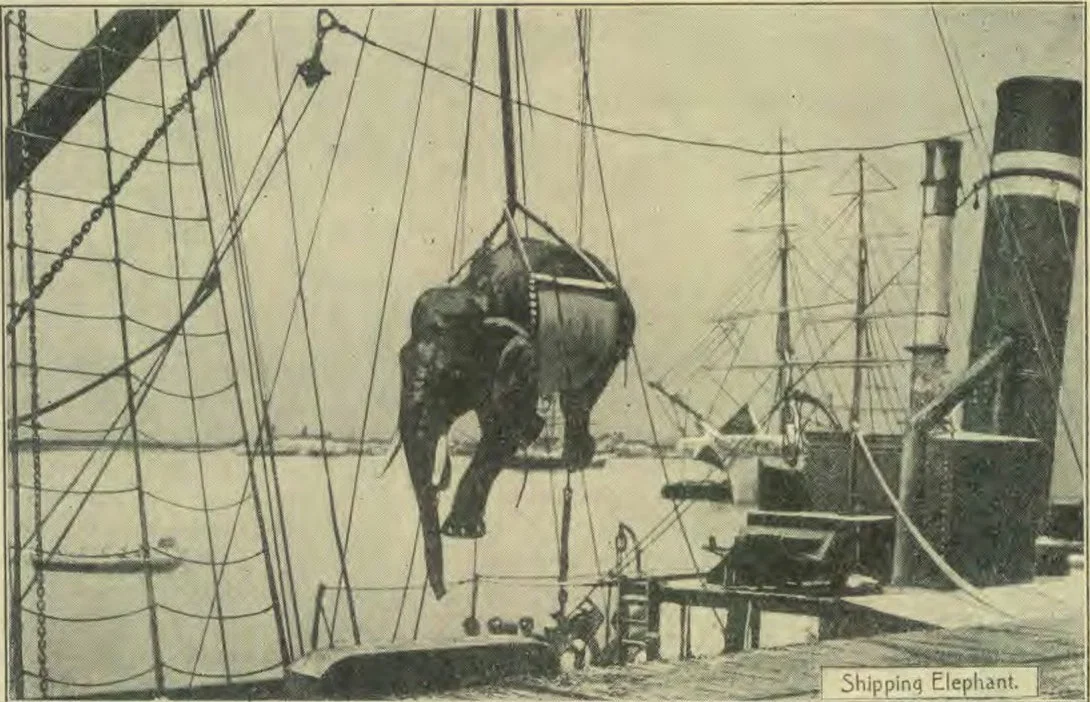
It is often necessary in lumbering operations to move these docile animals long distances to other parts of the country. They walk when possible, of course, but bodies of water present obstacles not easily overcome. Sometimes they are transferred from the wharf to the deck of the ship by means of a derrick. Elephants can swim the rivers even though they do not look as if they could, but they are likely to be very independent and obstinate. Recently we saw a novel way of getting a herd across the Salween River.
We had been doing some prospecting in the Karen country, and had returned the previous evening to the head of steam navigation at Shwegun. The Salween is one of the longest rivers in the world, but it cannot be navigated far because of numerous falls in its lower course. At Shwegun the stream was about half a mile wide at low water, the time we were there. The sixty miles to the sea is traveled in a day by little two-deck steam launches about seventy-five feet in length. We were on board all night, due to start downstream at 9 A. M. the next day. But at daylight steam was got up, and the boat started upstream. We were surprised, but soon saw the reason. In a few minutes we arrived at a place on the river where a high clay bank was topped by forest trees; and among them stood a herd of twenty-one elephants, many of them towering giants with long tusks. A crowd of Burmese and Karens stood on the bank — early comers to see the show.
At the water’s edge stood the first victim — a huge fellow whose small eyes blinked dubiously at the obvious prospect of a forced bath. He was fastened by the forefeet to two firmly set posts. A heavy rope was passed from the chain holding his feet together to the stern of the steamboat. A tin float, shaped like an ordinary harbor buoy, but only about three feet in diameter, was fastened on his back to help keep him on the surface. His keeper took the usual seat back of his ears. The signal was given, and the boat started across the river, soon pulling the rope taut. At this critical moment the fastenings were loosed from the posts, the driver gave a last prod before making a wild leap for the bank, and Mr. Elephant was drawn down the slippery incline into the water. He trumpeted12loudly with fear, and fought desperately to hold back and regain the bank; but steam power triumphed, and he was towed with ever-increasing swiftness into deep water. When beyond his depth, he disappeared entirely, only the float telling his whereabouts; and even it was dragged under at times. Then suddenly his trunk appeared with a snort, and, waving about wildly, quickly took on a snakelike curve and seemed to point an accusing finger at us as we stood at the back end of the steamer. Then the huge body rose and thrashed the water into foam as it rolled from side to side and over, struggling to get free. Again it disappeared as if to seek the river bed for a foothold, only to reappear and rest content to be dragged rapidly along near the surface, with the water pouring over the gigantic head as it pours over a smooth rock in a rapid river. Soon the opposite bank was reached, which was sandy and shallow far out. As the launch could not approach very near, the elephant was left for a minute floundering in about fifteen feet of water. Meanwhile a Burmese racing boat full of men had paddled at top speed with the driver from the other bank. Now they approached the big fellow cautiously, and at a favorable moment the driver adroitly jumped from the prow of the canoe onto the elephant’s head. Hastily setting free the float, he urged the beast toward the bank with peculiar twitchings of his knees back of the elephant’s ears. While this was being done, the rope was carried to the bank, and a number of men exerted their puny strength to tow him in. And he seemed to have no power nor inclination to resist.
The whole herd of twenty-one was taken over in the same manner. This way of doing it may seem cruel, and some men engaged in the business think it is. The animals looked none the worse for it, and some seemed actually to enjoy it. We could understand how they might if their forefeet had been free.
One of them, which was so unfortunate as not to have a float at his back, went entirely under as soon as he reached deep water, and stayed there till the other side was nearly gained. We could tell by the length and angle of the rope that he must have been about twenty-five feet down. As time passed and he did not come up for air, and seemed to hang as a dead weight, the owners became alarmed, and there was much shouting and ado; but beyond an extra powerful spout when his trunk appeared, he acted the same as did the others.
Another gigantic tusker was determined after the first outrage not to submit tamely to such indignities. When his driver gained his back and tried to prod and urge him to land, he wouldn’t go. Instead, he headed for the middle of the river. All the shouting and pulling by the men on shore hadn’t the least effect. He reached the current and swam rapidly downstream. The driver was game and held his seat, but he might as well have been a fly. The launch gave chase, when there was no other way, and after an exciting few minutes the runaway was rounded up half a mile down. He was so tired when he finally landed that he could scarcely walk.
Our boat was so late in getting down the river that we missed the train for Rangoon, but the sight was worth the sacrifice.
Shipping Elephant.
Mr. Bok
By Marvin Ferree
THE first thing that impresses you upon meeting this man is the difference between the Edward W. Bok of the endless newspaper paragraph and the Edward W. Bok of real life. Few men have been more paragraphed, made fun of, and ridiculed than Mr. Bok.
Your preconceived notion is quickly shattered the first moment you meet the man. Tall and spare, he radiates virility. He is masculine to his finger tips. He has the lean look of the man in whom mentality dominates appetite. He has, too, a suggestion of the great out of doors about him, for there is a dash of ruddy color in his cheeks, and a little swing in his movements that hints of long country walks and intimate acquaintance with outdoor sports. He is, as a matter of fact, inordinately fond of golf and tennis.
Mr. Bok is fifty-odd years of age, and looks younger despite the touches of gray in his hair. The dominant note in his facial harmony is power. There is no consciousness of self. He lives out a phrase of his own: “A man should take his work seriously, but never himself.” Seldom is the person of exceeding earnestness agreeable. Still less often is the exceedingly agreeable person a thoroughly earnest one. Mr. Bok presents that anomaly in character.
“I am not an American,” he said, when he began to talk of himself. “I was born in the Netherlands. My father was a man of wealth in the old country, but he lost his fortune, and we came here. I was six years of age. My father’s struggle to establish himself in a strange country was too much for his health, and he soon passed away, leaving my mother, my brother, and me. We lived in Brooklyn, in a tenement house of13three stories. My father adopted strenuous measures with my brother and me. As soon as we arrived here, he placed us in a public school. Neither of us knew a word of the English language. It was hard, of course, but I see now that it was right.”
“The first money I ever earned was by selling water to passengers on the horse cars bound to Coney Island, at a cent a glass. I noticed that at a point near our home, where they changed horses, the passengers used to get out and run for a drink of water on hot days. I thought I could save them the walk and earn a little money by carrying water to the car. I filled a pail with cold water, jumped on the cars, and sold it.
“The other boys in the neighborhood took it up, and I had my first taste of competition. Then I got some sugar and lemons and sold what I called lemonade, at two cents a glass. This was my first lesson in one of the basic facts of success. To be successful one must do the common thing in an uncommon way.
“My father left us very poor. My mother, who had been accustomed to luxury and servants in the Netherlands, had to do her own housework. My brother and I tried to help her. Every afternoon when we came home from school, we helped her in every way we could. We used to scrub the floors of our rooms and the flight of stairs leading to our floor once a week, and every three weeks the whole three flights. I washed the dishes for her. I learned to cook, and used to relieve her of that as much as I could. In this way I learned what I have never forgotten—the fearful, interminable routine of a housewife’s life.”
A smile here lighted up Mr. Bok’s face as he said:—
“It always makes me smile when some woman, a reader of our magazine, writes me and asks: ‘What do you know about the needs, the life, or the struggles of poor people—you, who were born with a silver spoon in your mouth?’ Bless her heart, she little knows that I have been through it all, and know it, hoof and heel. I know what it is to live on practically nothing; to leave the house stealthily at night, go through the streets and pick up old pieces of wood, because we had not the four cents to buy a bundle of kindling; to pick up odd bits of coal; to sift the ashes until my fingers bled; to get up before dawn and make the fire; to have a horror of passing a grocery store because we owed the man and couldn’t pay; to go around afraid to stop, because of the patches on my clothes. Know it? Oh, yes, I know what it is to be poor; knew it not for a six month, either, but for a number of years.
“And it was fine, I tell you,” said this man, unexpectedly.
“Fine? You mean poverty?” I asked.
“I do,” he said emphatically. “The finest thing that ever happened to me, the finest thing that ever happened to any young fellow is to be poor. There is no greater stimulant than poverty—not as a condition in which to stay, but as a condition to work out of.”
“About this time,” continued Mr. Bok, “I conceived the idea of securing the autographs of celebrities. I have now the second largest collection of autographs in this country. Every evening I would read about famous people and then write to them, but not directly, for their autographs. They have little value. I wanted characteristic letters. I wrote to General Grant, for example, asking him the exact spot where Lee surrendered to him. He wrote me a four-page letter in reply. So I secured interesting letters by first familiarizing myself with the lives of the people I wanted to write to, and then asking each some question about the pivotal point in his or her career.
“At thirteen I left school. I was then in the grammar grade. I never went to school again. I have hustled from that time until now.
“I went to work as an office boy in the Western Union Telegraph Company. Clarence Cary, a friend of my father, said to me: ‘If you learn stenography, you will find your advancement will be more rapid wherever you work.’ I took up stenography at once in a night school, and in a few weeks I could take dictation. Meanwhile, I was, of course, doing an office boy’s work, running errands, copying letters—all valuable to any man, no matter how high he rises, because going through these positions he knows the possibility of every position below him. He has been there.
“While working in the Western Union and studying at the night school, it occurred to me that the theater programs could be made larger with profit. At that time they were single sheets printed on one side, like those used in the upper galleries of a theater now. Frederic Colver and my brother joined me in the venture of enlarging the programs to four sheets and filling them with advertisements. We did this for four theaters in Brooklyn, and soon cleared a good thing out of it every week.”
The inventor of the modern theater program! That, in itself, is a bit of fame which any business man would be proud to own.
“While doing this we also got out the Brooklyn Magazine, which we made out of a little sheet that had been the organ of the Philomathean Society. We published in it the sermons of Dr. T. De Witt Talmage and Henry Ward Beecher. So in the monthly we published eight sermons besides other matter. I got some of the most notable men to write for us for nothing. It was cheek. I was a Plymouth Church boy, and Mr. Beecher helped me as much as he could. We ran the magazine for two years, and sold it at a profit.
“I was not seventeen, and my friend, Clarence Cary, asked me what I thought I should like to do since I had learned stenography. I said I should like to be in some work that would throw me among books. He introduced me to Henry Holt, the publisher, and I became his stenographer. I remained there for a year. Then an opportunity came for me to go with Scribners as stenographer. After four years I was promoted to do advertising writing, something I always liked. I prefer writing an advertisement today to an editorial. Business always appeals to me. I remained with Scribners for seven years. During this time my brother and I started the Bok Syndicate Press.
“In the development of the Bok Syndicate Press I did that of which I am not proud. I conceived the idea of getting forty celebrated women to write a letter apiece for the service. I wrote to editors throughout the country, telling them of my plan, saying that if they published these letters, women would read the paper, and that would bring advertising, and added that I must have good rates to get good service, for these women must be well paid. It was a heavy contract.
“The editors liked the plan, and were liberal enough to justify me in securing articles from almost every famous woman living at that time. I secured a weekly New York letter from a writer called ‘Bab,’ who was very popular at that time. Then the editors began writing me: ‘Your own letter, the weekly letter from celebrated women, and Bab’s give us half a page a14week. Can’t you give us three columns more, so that we can make a whole page devoted to women?’ I wrote that I could not. I would furnish the three, and they must provide any further material. They did, and that was the beginning of the present woman’s page that all newspapers now conduct—a product of which I confess I am not very proud. But it familiarized me with women’s needs, and was preparatory, again, for my future work.
“The weekly literary letter of the Bok Syndicate Press I signed by my brother’s name, William Bok, to prevent any embarrassment to my employer, the Scribners. Mr. Cyrus Curtis, the publisher of the Ladies’ Home Journal, was a reader of this letter of mine in the newspapers, and he found out who wrote it.
“Mr. Curtis called upon me, and said that his magazine was being edited by his wife; but that, as they had a little daughter, who was growing up and needed more of her mother’s care, she had no longer the time necessary to be given to the magazine. He asked me if I knew any young man whom I could get for the position.”
“I said I did not. He smiled.
“‘How about you?’ he said.”
“I asked for a few days to consider. I asked my friends what they thought. Every one of them said that I would be buried alive in Philadelphia. Not a friend encouraged me. But that is all nonsense, you know, about a man burying himself anywhere. If he’s got it in him, it’ll come out in Philadelphia as well as in New York. I decided to go. That was twenty-four years ago.
“And that,” said Mr. Bok, with a smile, “is all.”
I asked him to tell me of the development of the magazine.
“You know,” he said earnestly, “folks have a very complimentary way of saying that I ‘made the Ladies’ Home Journal.’ And I have heard some of Mr. Curtis’s best friends say this. They forget that in such an erroneous statement they do an injustice to Mr. Curtis. The basis of the present success of the magazine was laid when I came to it. It already had a circulation of 450,000 copies. It was for me to build it up from that15point. And that,” Mr. Bok said it so simply that one would think it had been the mere turning over of a hand, “is what I have tried to do. Mr. Curtis put the job up to me, and it was for me to make good.”
(Concluded on page sixteen)
“It is said that every man who writes does so with his eye on one woman who shall read what he writes. Do you edit the magazine in that way, with one woman in view?” I asked.
“Yes. For twenty-one years I have edited the magazine with one woman in view. I have never met her, but a year or two after I became editor Mr. Curtis and I made a tour of the smaller cities to study the needs of the American people. In one city, a small city,—I will not mention the name because some one might know,—I saw a woman who seemed to me by her dress and manners, and in every way, to be typical of the best American womanhood. I saw her at church and at a concert with her husband and children. I passed her home and saw about it the same air of typical ‘homeness’ and refinement I had noted in her. ‘That woman,’ I said to myself, ‘is the woman I shall have in view in editing the magazine.’”
“I made inquiries and found she did not read the magazine. Two years later I saw her name on the subscription list. A few years later I received a letter from her telling me how the magazine had helped her in her home and with her family. That woman will never know how gratifying was her letter, for I merely wrote her an ordinary letter of thanks.”
Of his life apart from his work Mr. Bok is absolutely close-mouthed.
“I am married,” he replied, “have been married for seventeen years. We have two children—boys. That is all.”
“Mrs. Bok is the little girl that was growing up so fast that she needed more of her mother’s attention when you took charge of the magazine,” I said. “In other words, you married Miss Curtis, didn’t you?”
He smiled assent.
This was the story of the man who, as editor of a magazine which extends its influence into three million homes, is practically a lay preacher to the largest congregation in the United States. It is impossible to estimate this one man’s power in American home life, or the tremendous range of his appeal. What of his character? What of his philosophy of life?
He thumped his big-knuckled fist:—
“Behind every story of success is a story of hard work and self-denial,” he said.
And Edward Bok works. He has worked—worked since he was thirteen, and he works today. But he loves his work, and there is the secret of his success. He lives his own favorite maxim: “Work for work’s sake, and the rest, the money part, will take care of itself.”
“How can the average man succeed?” I asked.
“If he lacks initiative, if he is not a leader among men,—and few are,—then let him do the common thing in an uncommon way.”—Marvin Ferree, in the Independent.
Thirty-Seventh Week
September 12. Daniel 1 to 4: The test; the great image; the fiery furnace; vision of the great tree.
September 13. Daniel 5 to 8: Belshazzar’s impious feast; the lions’ den; prophetic visions.
September 14. Daniel 9 to 12: The seventy weeks; kings of the north and the south; deliverance.
September 15. Review Jeremiah and Daniel. Note especially the prophecies relating to the closing of earth’s history.
September 16. Hosea 1 to 4: God’s judgments and promises.
September 17. Hosea 5 to 9: Warnings and exhortations.
Monday.—Does my life measure up to God’s standard?
Tuesday.—What should be my chief concern?
Wednesday.—Importance of God’s Word.
Thursday.—Hatefulness of sin.
Friday.—Am I among those who follow on to know the Lord?
Sabbath.—Wonderful mercy of Jehovah.
The Prophet Daniel
“Though we have a more minute account of the early life of Daniel than is recorded of any other prophet, yet his birth and lineage are left in complete obscurity, except that he was of the royal line, probably of the house of David, which had at this time become very numerous. He first appears as one of the noble captives of Judah, in the first year of Nebuchadnezzar, king of Babylon, at the commencement of the seventy years’ captivity, 606 B. C. Jeremiah and Habakkuk were yet uttering their prophecies. Ezekiel commenced soon after, and a little later, Obadiah; but both these finished their work years before the close of the long and brilliant career of Daniel. . . .”
“He is supposed to have died at Shushan, or Susa, in Persia, about the year 530 B. C., aged nearly ninety-four years, his age being the probable reason why he returned not to Judea with other Hebrew captives, under the proclamation of Cyrus.”
“His life affords a most impressive lesson of the importance and advantage of maintaining from earliest youth strict integrity toward God, and furnishes a notable instance of a man’s maintaining eminent piety and faithfully discharging all the duties that pertain to the service of God, while at the same time engaging in the most stirring activities, and bearing the weightiest cares and responsibilities that can devolve upon men in this earthly life.”—U. Smith.
The Book of Daniel
“It seems futile to attempt, in human language, adequately to extol the merits of this portion of divine revelation. This is the book upon which were based the calculations that showed that a great crisis was to take place in the great advent movement of over half a century ago. It is the ‘little book’ spoken of in the tenth chapter of Revelation, which the angel held in his hand, open, and from which he made the proclamation that time should be no longer; the book whose contents were first so sweet and then so bitter, illustrating the experience of the church at the time when its hopes of the soon coming of the Lord were not realized.”—Starr.
“Daniel’s prophecy is, in many respects, the most remarkable of any in the Sacred Record. It is the most comprehensive. It was the first prophecy giving a consecutive history of the world from that time to the end. It located the most of its predictions within well-defined prophetic periods, though reaching many centuries into the future. It gave the first definite chronological prophecy of the coming of the Messiah. It marked the time of this event so definitely that the Jews forbid any attempt to interpret its numbers, since that prophecy shows them to have been without excuse in rejecting Christ.”—U. Smith.
Hosea
The prophetic career of Hosea, the first of the minor prophets, began about 784 B. C., and covered a period of about sixty years, the reigns of the last six of the kings of Israel. He was a contemporary of Isaiah, Joel, and Amos, and, like the latter prophet, was sent to the Israelites. It was a time of great spiritual darkness. Vice and iniquity flourished; the kings were dissolute and profligate; and the priests, lost to all sense of the sacredness of their office, introduced shameful heathen rites into God’s worship. In the vivid pages of Hosea’s prophecy we are given some glimpses of the conditions prevailing at that day, against which his voice was uplifted in fearless and faithful warning. Of the style of the book, Eichhorn says, “His discourse is like a garland, woven of a multiplicity of flowers; images are woven upon images, metaphors strung upon metaphors.” Jesus, Matthew, Peter, and Paul quoted from this book.
Senior Society Program for Sabbath, September 18
1. REVIEW Morning Watch texts. Paper on “The Life of Solomon.”
5. Mission Talks: “Early History of Our Work in India,” and “Our Work in Bengal.” See “Notes on the Mission Studies,” in Gazette; and “An Outline of Mission Fields,” pages 112-118; also article in this INSTRUCTOR, “Village Life in15India.” Use your map. (See INSTRUCTOR of August 31 for copy of map of India.)
6. Symposium: Appoint several persons to tell the stories of the lives of Malta, Rengha, Phuloo, and Chikia. See Gazette.
5. Paper: “Early History of Our Work in India.” See “An Outline of Mission Fields,” pages 112-116. Use your map. (See INSTRUCTOR of August 31 for copy of map of India.)
6. Talk: “Our Work in Bengal.” See “Notes on the Mission Studies,” in Gazette; and “An Outline of Mission Fields,” pages 117, 118.
7. Symposium: Appoint several different persons to tell the stories of the lives of Malta, Rangha, Phuloo, and Chikia. See Gazette.
XII — Spiritual Discernment
(September 18)
Daily-Study Outline
Sab. ..... Read the lesson scripture.
Sun. ..... Discern the signs of the times. Questions 1-5.
Mon. ..... The sign of Jonah. Questions 6-8.
Tues. ..... Little discernment. Questions 9-12.
Wed. ..... Beware of men’s doctrine. Questions 11-16.
Thurs. ..... Review.
Fri. ..... Read “The Desire of Ages,” pages 404-409.
1. What two classes now came to Jesus? In what spirit? Matt. 16: 1, first part. Note 1.
2. What request did they make of Jesus? Verse 1, last part.
3. What common saying did their request for a sign suggest to Jesus? Verse 2.
4. What was a common saying in the morning about weather? Verse 3, first part.
5. What comparison did Jesus then draw? Verse 3, last part.
6. How did he characterize these seekers after a sign? Verse 4, first part.
7. What did he say about giving them a sign? Verse 4, middle part. Note 2.
8. What did Jesus then do? Verse 4, last part.
9. What did the disciples forget as they went with him? Verse 5.
10. What did Jesus say to them? Verse 6.
11. How did they reason about his saying? Verse 7.
12. How did Jesus reprove them? Verse 8.
13. What pointed question did he ask them? Verse 9.
14. Of what other miracle did he remind them? Verse 10.
15. What further question did Jesus ask them? Verse 11.
16. How did they understand Jesus’ saying in verse 6? Verse 12.
Notes
1. Though the Pharisees and the Sadducees were opposed to each other in many of their beliefs, and were often at enmity in their dealings, yet they frequently united in their efforts to overthrow the teachings of Jesus and weaken his influence. Here they sought to “tempt” or test him, that they might entangle him in his talk.
2. The sign that the Jews most needed had already been given them—the sign of the prophet Jonah, with the lesson of Jonah’s message of repentance to Nineveh. This was also the message of John the Baptist. If the Pharisees and the Sadducees could have the experience of repentance, this would clear up their spiritual perceptions; but without repentance and belief on the Lord Jesus Christ, it would be useless to give them other signs.