The Story of the Rebellion Against the Government of King Jehovah
By Carlyle B. Haynes
The Great War—No. 5
The Story of the Rebellion Against the Government of King Jehovah
The Other Worlds Are Inhabited
CARLYLE B. HAYNES
The other planets of our solar system and the millions of worlds of the stellar system are inhabited by intelligent and reasoning creatures. This is not merely a theory, but is a proposition for which there is abundant proof. And it is important that those who study the history of the great war between Jehovah and Satan should be familiar with the truth that there is a plurality of inhabited worlds; for we shall not be able to understand why God permitted Satan to sin and to introduce sin into this world unless we realize that the decision of the great controversy between good and evil affects much more than one small planet. Not only are the inhabitants of this world learning lessons of eternal value by their experience with sin, but their experience is affording a demonstration of the love and justice of the Creator which could have been given in no other way.
It is, therefore, of the utmost importance for the student of this great question to understand that the other worlds are inhabited. And in order that this truth may be established, this chapter will be devoted to a consideration of the evidences which prove its truth.
The Purpose of Creation
In the preceding chapters we have caught a glimpse of the immensity of the dominion of the great King of kings. Such a wonderful system of worlds, suns, stars, and planets must have been brought into existence by the Creator of all for some purpose which would be worthy of his infinite wisdom and love. It would be utterly unreasonable to suppose that all these rushing systems were brought into existence merely that a few astronomers in these days might enjoy an awe-inspiring spectacle. Even men have some purpose in making the things which are formed by their hands. To say that God had no other purpose in the creation of the universe than to afford himself the pleasure of seeing these great globes whirl through space would be to charge him with folly.
The Creator himself deigns to inform us of the purpose he had in creating this earth. He says: “For thus saith the Lord that created the heavens; God himself that formed the earth and made it; . . . he created it not in vain, he formed it to be inhabited: I am the Lord; and there is none else.” Isa. 45:18.
Here is a plain declaration that for the Lord to have created the earth without the purpose of peopling it, would have been a piece of folly. “He created it not in vain, he formed it to be inhabited.” If this earth had not been populated, it would have been created in vain. If it had been left empty and useless, it would have been created in vain. This world exists for the sake of intelligent and reasoning beings.
With this thought before us, and the additional consideration that the combined surface of all the planets of the solar system alone is equivalent to 27,000 such worlds as ours, we are forced to the conclusion that it would have been infinitely greater folly to create that vast amount of matter to be useless and empty. From this verse alone we are led to conclude that the other planets are inhabited.
Other Races on the Other Worlds
As David, the sweet singer of Israel, viewed the glory of the heavens while out on the plains of Judea at night, he exclaimed, “When I consider thy heavens, the work of thy fingers, the moon and the stars, which thou hast ordained; what is man, that thou art mindful of him? and the son of man, that thou visitest him?” Ps. 8:3, 4.
If all the planets and the unnumbered worlds of the stellar system were devoid of inhabitants, and there were no intelligent beings in the universe except man and a comparatively small colony of angels, such an exclamation as this of the psalmist’s would seem to me to be without propriety or emphasis, for there would be nothing remarkable under those circumstances in the Creator’s exercising particular care over one half of his intelligent creatures. If the inhabitants of this earth are the only rational creatures in the universe, the psalmist would scarcely be justified in uttering such an exclamation. But David knew that the universe was composed of ten thousand times ten thousand worlds, unnumbered worlds, all of which are peopled with millions of intellectual beings of various orders; and when he thought of this, he became so affected by the idea of the vast population of the universe that he seems to have been fearful lest he should be overlooked among the immensity of beings who must come under the care and superintendence of Jehovah.
The words of Isa. 40:12-17 and of Neh. 9:6, to my mind, strongly imply that the universe is great and extensive, utterly beyond the limits of human comprehension; that its worlds and systems are peopled with myriads of inhabitants; that these beings are in possession of intellectual natures, and fully capable of appreciating the perfection and attributes of their Creator, and that they unite in adoring him. “The host of heaven worshipeth thee.”
The Lord says through his prophet, “It is he that sitteth upon the circle of the earth, and the inhabitants thereof are as grasshoppers; that stretcheth out the heavens as a curtain, and spreadeth them out as a tent to dwell in.” Isa. 40:22. The far-outspread heavens, therefore, exist for the specific purpose of being dwelt in, and this is here clearly stated.
That the heavens are inhabited is seen again in the verse penned by John on the isle of Patmos: “And the great dragon was cast out, that old serpent, called the Devil, and Satan, which deceiveth the whole world: he was cast out into the earth, and his angels were cast out with him. . . . Therefore rejoice, ye heavens, and ye that dwell in them. Woe to the inhabitants of the earth and of the sea! for the devil is come down unto you, having great wrath, because he knoweth that he hath but a short time.” Rev. 12:9-12. Here a clear distinction is made between the inhabitants of the heavens and the inhabitants of the earth.
Jehovah’s Kingdom Over All
The following passages of Scripture, to my mind, all bear on the subject of this chapter, and need little, if any, comment:—8
“And the heavens shall praise thy wonders, O Lord: thy faithfulness also in the congregation of the saints. For who in the heaven can be compared unto the Lord? who among the sons of the mighty can be likened unto the Lord?” Ps. 89:5, 6.
“The Lord hath prepared his throne in the heavens; and his kingdom ruleth over all.” Ps. 103:19.
“Praise ye the Lord. Praise ye the Lord from the heavens: praise him in the heights. Praise ye him, all his angels: praise him, all his hosts. Praise ye him, sun and moon: praise him, all ye stars of light.”
Read also in this connection these passages: 1 Chron. 29:11; Dan. 4:35; Ps. 145:9, 10; 108:4; 113:4-6. There are numerous other scriptures which might be pointed out as bearing on this subject, but these that have been selected will serve as a key to illustrate others as they may come under the observation of the student of the Bible. Attention is directed to the force of such expressions as Jehovah’s doing according to his will “in the army [or armies] of heaven,” as well as “among the inhabitants of the earth,” and to the thought that “all the inhabitants of the earth are reputed as nothing” in his sight. Notice also the expressions found in different parts of the Psalms regarding the inhabitants of the heavens, and the “heavens of heavens;” “angels that excel in strength;” “all ye his hosts” (or legions of intelligences), “in all places of his dominion,” “that do his commandments, hearkening unto the voice of his word.”
All these ranks of intelligent creatures are exhorted to unite in one glorious song of praise and thanksgiving to him whose “name alone is exalted; his glory is above the earth and the heavens.”
The book of Job contains many descriptions of the grandeur of Jehovah. Among them we read that “by his Spirit the heavens are garnished,” and that the astounding displays of his omnipotent power which are revealed in the heavens “are but the outskirts of his ways: and how small a whisper do we hear of him! But the thunder of his power who can understand?” Job 26:13, 14.
Myriads of Inhabited Worlds
Surely these verses, and the many others which bear on the subject but which we have no space to quote, clearly establish the truth, not only of a plurality but of myriads of inhabited worlds existing in the universe, all of which are included in the territory of King Jehovah.
It cannot be disputed that there are numerous bodies in the universe of God which have an adequate surface area to contain vast hosts of intelligent beings, and to give them enjoyment. From a study of many of these bodies in our own solar system, with the aid of such instruments as bring them near to astronomers, it is clear that in them all there is a variety of arrangements which evidently adapt them for habitation. In all of them conditions have been revealed strikingly similar to those of the earth itself, such as daily and yearly motions, moons, atmospheres, light, heat, and color, which things would be necessary only to provide existence and happiness to intelligent beings. These same circumstances seem to exist on this earth solely for the sake of human beings.
When these passages of Scripture and the arguments adduced from them are considered in connection with the wisdom and other attributes of God, they surely show not only to a high degree of probability, but amount to an actual demonstration, that the great systems which swing through space under the direction of Jehovah, are peopled with myriads of intelligences created for their happiness and his glory, and of every rank and order.
Highest in rank among them all was Lucifer, the son of the morning, the leader of the great choir of heaven, standing in the presence and at the court of the great King of the universe.
Answered Prayer
By Hazel Orcutt
EARLY last June, Margaret Blakeslee had a partial nervous collapse. She was just finishing her junior year in college, which had been unusually hard. To the duties that fell naturally to a popular and capable girl, were added sorrows attending illness at home, worry over a purse inconveniently light, and the responsibility of the presidency of the Young Women's Christian Association, in which she felt that the spiritual aim of the organization had been too little emphasized.
After completing her examinations, she made sufficient gain in health to justify her in attending the Association Summer Conference, where she hoped to receive help for her task of trying to raise the ideals in her own college. Upon her return, she expected to work during the summer in order to make enough to pay her college fees.
The week by the lake was full of enjoyment and inspiration, but Margaret was the head of a large delegation. Several of the girls were young in years and even younger in experience, and Margaret's duties left little time for rest.
On the next to the last day, there came a second collapse. The conference doctor said that unless she had complete rest all summer, she could not hope to reenter college in the fall. Margaret knew that if she did not work, she could not enter: there would not be money enough in the family purse. She could live at home, but even with no board to pay there were other expenses that must be attended to.
All afternoon the problem stayed with her: health forbade her summer work; her senior year and the carefully planned campaign in the association were absolutely dependent upon it; and her mother, overtired by the long strain of illness in the family, needed her at home during the summer.
With the twilight she turned to prayer. She knew that she had given herself unreservedly to the Master, that he might use her as to him seemed best; and when she ceased her petition, she was sure that in some manner he would open the way for her to continue that which he had placed in her hands and laid upon her heart. Then she slept—slept as she had not done for weeks.
The next morning some one tapped at Margaret's door. A girl whom she had met once or twice, casually, came in hesitatingly. She blushed and stammered in her greeting, but finally leaned over Margaret's bed and said: “I don't want you to think I'm 'fresh,' Miss Blakeslee; I don't mean it that way. You won't think so, will you?” Her old smile made Margaret's pallor forgotten as she responded: “Of course I'll understand, you foolish child. What can I do for you, Miss— Miss— why, I have forgotten your name; what is it, please?” “I am Rebecca Goldstein, Miss Blakeslee. I heard you tell that little curly-headed girl in your delegation that you were going to work this summer. Please excuse9me” (the words came very fast, now), “but you look so ill that I think you must need to do something, or you would rest.”
She stopped, flushed and breathless, and Margaret nodded a surprised assent. Then the visitor went on.
“Won't you forget your pride, and for His sake whom we both love let me give you what you had hoped to earn?”
Margaret gasped and started to protest, but Miss Goldstein continued: “My grandmother left me more money than I can use for myself. Please let me do this for our Lord, and when you want to pay it back you can pass it on.”
Margaret considered. She was proud, but this money was to be used for him. And then she thought, Why, I should have expected just this; it's what I asked him for.
And so this fall, in one of our Middle Western colleges, the Young Women's Christian Association has begun its work with its president rested and ready for all her duties, and with a cabinet fired to new endeavor and unfaltering faith; for they are now sure that the Lord is mindful of his own.—Hazel Orcutt.
The Score Made in the First Minute of Play
THERE is a baseball game on record which was won in the first minute of play, when the ball was pitched that gave the visiting team the only run that was scored. The game was a long one; there was plenty of time in the innings that followed that first run to add others to the score, but neither team was able to do it; and when at last time was called, late in the afternoon, the score made by the first minute’s play had not been changed.
One morning a slender girl was seated at a writing machine in a big publishing house. It was her first morning with the firm, and a pile of form letters had been given her with a list of the ones they were to be prepared for. A little to one side the manager of the department, noticing the slender girl, wondered if they had done wisely in adding her to the force. “She looks inexperienced,” was the manager’s thought. But it was not the look of inexperience that the woman of experience was questioning. It was, Will she show intelligence, or will she work simply mechanically?
Even as these thoughts were going through the department manager’s mind, she saw the one at the writing machine pause, then study the list and the letter closely. A moment later the new worker was by her side.
“Miss Grenshaw, isn’t this the same man who is mentioned in this very letter?” asked the new worker in an evenly modulated voice as she pointed to a name in the letter, then to a name on the list. “I wondered if you wished me to send a letter to him.”
The eyes of the one in charge widened as she looked from the list to the letter, and a flush swept her face, even as a gladness lighted the eye.
“Miss Sundall, you are right. And you have placed me under obligations. The gentleman in question gave us permission to use his experience for the benefit of others, but it would have been poor form for us to have sent him one of the letters. I arranged the list myself. It is proof of how we all have to watch over one another, is it not?”
The young girl went back to her machine strengthened. She had done her best, and it had been recognized. The one in charge settled back before her desk strengthened; there was also a feeling of gladness with her.
“She shows intelligence at the start. She isn’t a machine worker. She is alert and watchful, and better still, she places upon her own shoulders the obligation to stand by the honor of the company.” So another “in the first minute of play” gained the game.
On the first day of school in a rural district, one of the board pushed back his papers upon his desk, and reaching for his hat, said, “Think I’ll take a little turn over to the school and see how the new teacher proceeds.” With the thought had come remembrance of other first days of school, when the children, drawn in from their freedom, gave an inexperienced teacher trouble. “She may like a little help getting hold of the lines.”
The gentleman walked quietly into the schoolroom and took a seat near the door. What he looked upon was perfect order. Near the blackboard an intermediate class was busy taking turns in pointing out on a big map the cities and towns mentioned in their history lesson. Down near the front, the younger scholars were busy with drawing cards. Back, the older pupils seemed intent on problems that for some reason held great interest. There was no notice taken of his entrance, save a quiet bow of recognition from the teacher. A little later she approached the visitor.
“You seem to be making a master stroke at the beginning,” said the latter.
The teacher smiled. “I try to have the first day’s work carefully planned. You know, there is never anything that tells quite so well as the first strokes.”
Back over the green went the visitor well satisfied. Here was a worker who recognized that at the very beginning a game may be won.—Selected.
The Life Was the Light
Among recent converts in China is Mr. Wen Shih-Tsen, secretary of state for Che-kiang Province, who has been baptized into the Presbyterian Church. Mr. Wen’s statement of the particular influences which led him to Christ is delightful:—
“My first impulse toward Christianity was received when I was a student in Tientsin. The students of the medical college of the city were notorious for their immorality. Every effort was made to bring about their reform, but without success. Finally President Liu of the medical college induced some of the students to join a Bible class in the Tientsin Union Church. At first there was no perceptible change, but presently surprising results came out. Most of the men in the class were baptized. They became diligent in study, patient in healing, and energetic in preaching the gospel in other schools. The evidence furnished in the lives of these students convinced me that God has real power to make young men repent and to purify their hearts. I have been much influenced by the Young Men’s Christian Association. To me it is the embodiment of what is simple, happy, and progressive in religion. The conception of Christianity it reveals prepared me to become a Christian and a church member.
“I have decided to become a Christian because I wish to be like Christian men whom I have observed—a man with a pure, strong heart, strong blood, true patriotism, and perfect zeal. I believe that Christianity is able to save China. I believe the Bible is the weapon with which she can work out her salvation and face the civilized world.” — Record of Christian Work.
A Practical Kite
By O. C. Durham
AMERICANS, as a rule, are not proficient nor enthusiastic kite makers. I do not know why, unless it is that the stores do not often carry kites, and few boys make their own playthings. It may be that it calls for too much perseverance for the average boy; for until he learns the principles governing wind resistance and balancing, he will make many failures.
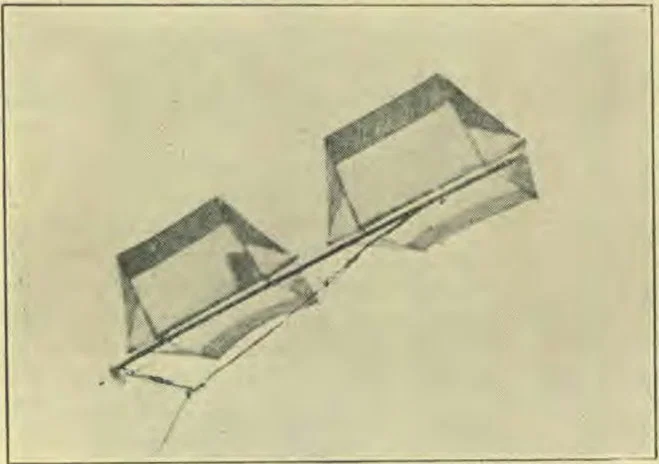
A PRACTICAL KITE
This contribution is not for the uninitiated unless it may happen to touch the right chord of response, but for those who have tasted the joys of success in kiting, and wish to go on. Just a general word or two. There are at least two ways of balancing kites, by tails and by planes. By balancing, I mean holding the lifting surface in the proper position to the wind. The common two-stick and three-stick flat kite must have a tail, while the so-called “box” kite is kept in position by vertical planes, acting on much the same principle as the rudder of a ship. The great objection to the tail kites is the tail. If properly made, the tail is long and inconvenient, frequently getting tangled and broken—an awkward servant for so simple a service. The ordinary box kite is a fragile affair, hard to make, and because of its rigidity and lightness, easily broken.
The kite pictured here has neither of the objectional features, awkwardness nor fragility. It is a wonder for endurance. While it has all the stability of the cross-sticker, it is perfectly flexible, either plane being able to oscillate with the wind independently of the other. In coming to the ground, it settles down gracefully like a bird, or dips like an aeroplane. It will go through a score of scrapes unharmed.
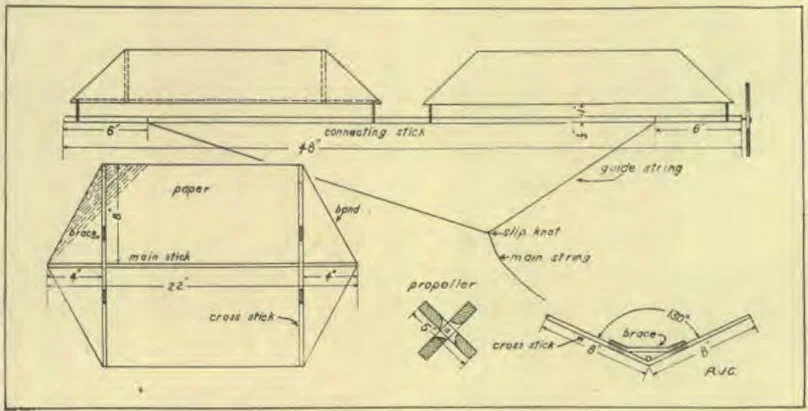
WORKING PLAN OF THE PRACTICAL KITE
The principle is simple—two V-shaped planes tied to a long stick. For all sticks except the long connecting stick use the lightest material you can secure. For the long stick get a piece of hard wood. Each kite is twenty-two inches long and sixteen inches wide. It is best to make the cross sticks sixteen inches long, and wet and bend them in the middle before tying them to the main stick. The bend is about one hundred and thirty degrees. The braces are similarly wet, bent, and tied. Around the ends goes the bellyband, and then it is ready for the paper, which should be of a light, tough variety such as is used by grocers. It will spoil the best kite ever made to use heavy paper. Tie each kite or plane to the long connecting stick, as shown in the diagram. Put on a guide string, and fasten the main string to it so that the main string may be adjusted according to the strength of the wind.
If you have a light breeze, have the main string eight or ten inches from the top or front end; and if the wind is strong, slip it down toward the center. If the kite shows any tendency to dive or cut circles, it is quite likely that the main string is too far forward. Slip it back on the guide string. On the front end of the connecting stick you may put a little windmill for “effect.” It is possible that it may have a slight gyroscopic effect. For the main string ordinary carpet warp, which sells for about thirty cents a pound, will answer well. There are about three thousand feet in a half pound of it. If your machine pulls too hard for this twine, you have not made it properly. Try again.
O. C. DURHAM.
Chickadee
By H. L. Gordon
CHICKADEE, chickadee, chickadee-dee!
That was the song that he sang to me,
Sang from his perch in the willow tree:
Chickadee, chickadee, chickadee-dee.
My little brown bird,
The song that I heard
Was a happier song than the minstrels sing,
A pean of joy and a carol of spring;
And my heart leaped throbbing and sang with thee,
Chickadee, chickadee, chickadee-dee.
My birdie looked wise
With his little black eyes,
As he peeked and peered from his perch at me,
With a throbbing throat and a flutter of glee,
As if he would say:
Sing trouble away;
Chickadee, chickadee, chickadee-dee.
Only one note
From his silver throat,
Only one word
From my wise little bird,
But a sweeter note or a wiser word
From the tongue of mortal I never heard
Than my little philosopher sang to me
From his bending perch in the willow tree—
Chickadee, chickadee, chickadee-dee.
Come foul or fair,
Come trouble and care—
No, never a sigh
Or a thought of despair!
For my little bird sings in my heart to me,
As he sang from his perch in the willow tree—
Chickadee, chickadee, chickadee-dee;
Chickadee-dee, chickadee-dee;
Chickadee, chickadee, chickadee-dee;