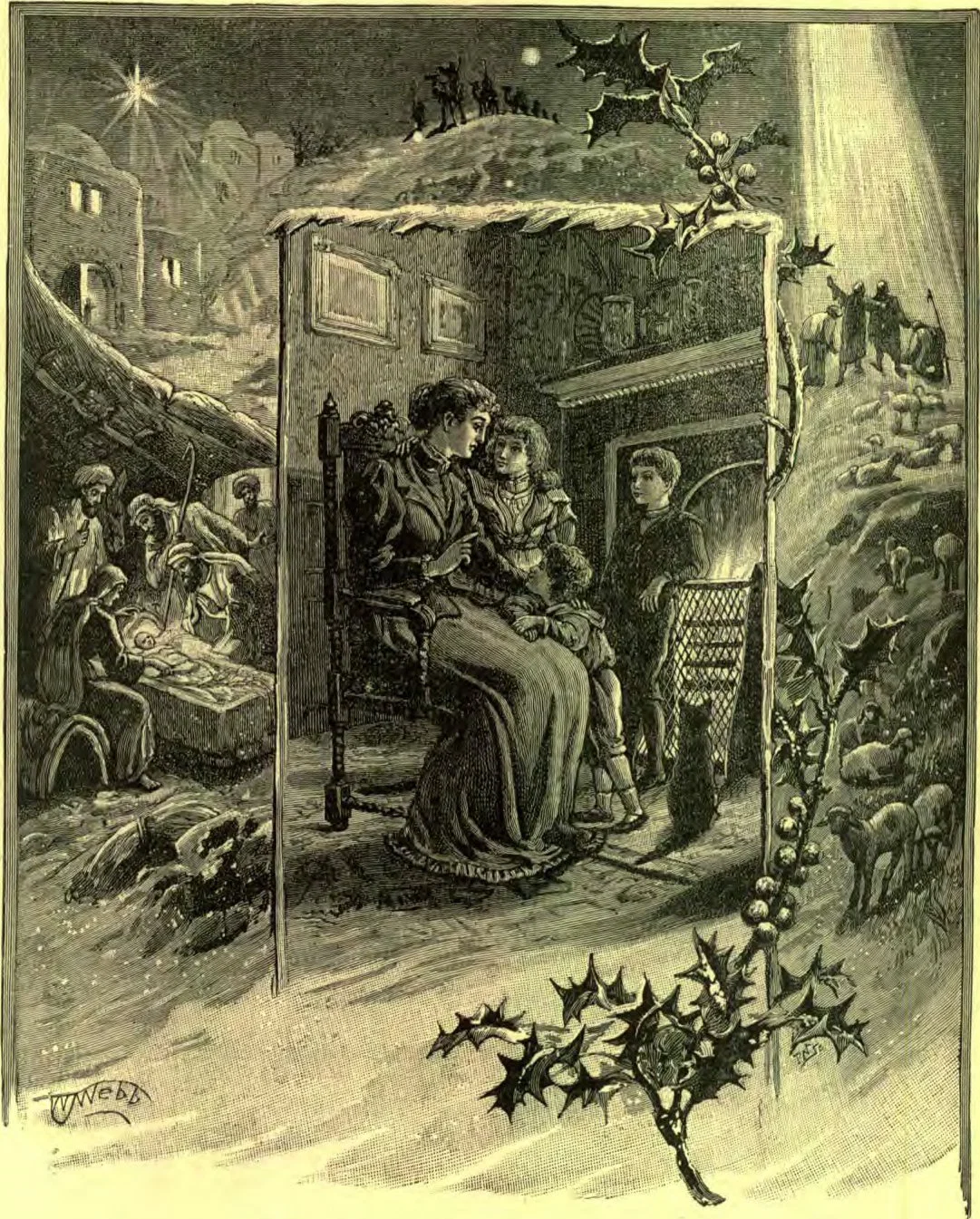
ANGELS rejoiced and sang for joy when this beautiful world was created, and man was formed to be its king. But their songs of joy were soon changed to mourning when they saw that earth had lost its king, and the blight of sin had come over the fair world.
How glad, then, they must have been to bear to earth, to the sons of men, the good tidings of the coming King, through whom the curse should be taken away from the whole earth, and of whose kingdom there should be no end.
This was the message, you remember, sent to Mary by the angel Gabriel. Mary was then living at Nazareth, but the word of God had said that the King, the shepherd and ruler of his people, should come forth out of Bethlehem.
So when the time for the royal birth drew near, the emperor of Rome sent out a decree that all the world should be taxed, and this made it necessary for Joseph and Mary to go to Bethlehem. And while they were there, in fulfillment of the prophecy, Mary “brought forth her first-born son, and wrapped him in swaddling clothes, and laid him in a manger; because there was no room for them in the inn.”
“Cold on His cradle the dewdrops are shining,
Low lies his head with the beasts of the stall;
Angels adore him, in slumber reclining,
Maker and Monarch and Saviour of all!”
What a sight for the angels to see,—their Maker and Monarch, their Creator and King, a tiny, helpless babe wrapped in swaddling clothes, and lying in a manger!
And did they honor him any less, or cease to worship him, when they saw his helpless human form?—No! Listen to the words of their glad song of praise: “Glory to God in the highest, and on earth peace, good will toward men.”
That little baby lying in the Bethlehem stable with the beasts of the stall was “God in the highest,”—the Most High,—to whom the angels of God were offering deeper love and adoration than ever before; for when God brought the First-begotten into the world, he said, “Let all the angels of God worship him!”
The Son of God did not “lay his glory by” when he came to our world, but he veiled its bright shining in our weak, human flesh, so that he might come near to bless and save us. But this very veiling only made his true glory, his grace and truth, even more plainly seen.
When he became a little human child, and lived and died on this earth for our sakes, he was showing to angels and to men the depths of shame and sorrow to which he, the Creator and King of all, will go so that he may help and save any of his creatures who are in trouble, even through their own folly and sin.
So even the angels knew him better than before when they saw the babe lying in the manger.
THE OLD, SWEET STORY
They saw more of his glory, and sang with deeper gladness songs of praise to God in the highest, to whom belongs “the kingdom, and the power, and the glory,” because he is the Saviour of all.
But “earth asleep unconscious lies” while all the angels of God are worshiping the babe “with joy unspeakable and full of glory.” How they must have longed to give the message of salvation, and to share their joy with those for whose sake the King of glory had become a poor babe, that they through his poverty might be rich.
But the children of men were wrapped in slumber. Yet not all. “There were in the same country shepherds abiding in the field, keeping watch over their flock by night;” and to these was given the high honor of being the first to hear and carry the good tidings.
“And, lo, the angel of the Lord came upon them, and the glory of the Lord shone round about them: and they were sore afraid. And the angel said unto them: Fear not; for, behold, I bring you good tidings of great joy, which shall be to all people. For unto you is born this day in the city of David a Saviour, which is Christ the Lord. And this shall be a sign unto you: Ye shall find the babe wrapped in swaddling clothes, lying in a manger.
“And suddenly there was with the angel a multitude of the heavenly host, praising God and saying, Glory to God in the highest, and on earth peace, good will toward men.
“And it came to pass, as the angels were gone away from them into heaven, the shepherds said one to another, Let us now go even unto Bethlehem, and see this thing which is come to pass, which the Lord has made known unto us. And they came with haste, and found Mary, and Joseph, and the babe lying in a manger. And when they had seen it, they made known abroad the saying which was told them concerning this child.”
This glad tidings, this beautiful gospel message, which the angel said should “be to all people,” is for each one of you, dear children. “Unto you is born this day . . . a Saviour, which is Christ the Lord,”—“Christ in you,” to be your King, to save from sin, and to make you pure and holy.
Are you not glad, as the shepherds were when they heard this good news, and will you not, like them, carry the joyful tidings to others, and make known what God has made known to you about his holy child Jesus?
EDITH E. ADAMS.
BEREAN LIBRARY STUDY
Revelation 8: “Thoughts on the Revelation,” pages 452–468
(December 23–29)
The Sanctuary.—Notice closely the picture of the interior of the sanctuary. The golden altar was in front of the ark, above which rested the bright light, the visible presence of God. From that golden altar the incense was constantly ascending. The priest carried the censer in his hand, from which also incense ascended. This is the shadow given us to study, that we may know of the work being carried forward now by our High Priest in the real sanctuary in the heavens.
The Incense.—In Rev. 8:3 we are permitted to have a glimpse of the real golden altar, the shadow of which is given in this picture. It is before the real throne of God, of which the ark and the mercy-seat were a shadow. The holy one officiating at that heavenly altar is given much incense; there is no meager supply, but an abundance; for “there is an inexhaustible fund of perfect obedience accruing from his [Christ’s] obedience. How is it that such an infinite treasure is not appreciated? In heaven the merits of Christ, his self-denial and self-sacrifice, are treasured up as incense, to be offered up with the prayers of his people. As sincere and humble prayers ascend to the throne of God, Christ mingles with them the merits of his life of perfect obedience. Our prayers are made fragrant by this incense.”
Prayers of All Saints.—This precious incense is offered with the prayers of all saints. But who are saints? Listen to the Lord’s definition, in Ps. 50:5: “Those that have made a covenant with me by sacrifice.” Whenever a soul reaches up after God, and longs to exchange his sins for the fragrance of Christ’s righteousness, our great High Priest takes the feeble, broken prayer, and from that “inexhaustible fund of perfect obedience” he adds “much” incense to the prayer, and it is accepted by the Father; for “the Father always hears his Son. Pray, then; pray without ceasing: an answer is sure to come.” Our sins are taken by the Lord, and the fragrance of Christ’s righteousness comes into our lives. Let us ever keep the perfume of Christ’s righteousness in our words and actions. Those who come about you will then detect that lovely perfume more quickly than you note the scent of cologne on the handkerchief of a friend. Perhaps you have seen an unpretentious-looking rose-jar on a mantel among beautiful ornaments. It did not attract any attention by its outward appearance; but the fragrance of the rose petals within the jar filled the whole room, and contributed to the pleasure of all. In like manner the perfume of the Christlike character is diffused abroad.
The Golden Altar.—This altar in the shadowy service was called the “altar of perpetual intercession.” “The priest was to burn incense upon it every morning and evening. Its horns were touched with the blood of the sin-offering, and it was sprinkled with the blood upon the great day of atonement. The fire upon this altar was kindled by God himself, and was sacredly cherished. Day and night the holy incense diffused its fragrance throughout the sacred apartments, and without, far around the tabernacle.” Imagine a stranger coming into that camp,—how quickly he would detect the fragrance. That was the shadow; we are the congregation around the real tabernacle in heaven. It is the privilege of every one of you who reads these lines to be among the number whose prayers are offered with “much” incense upon the golden altar before the throne, and to “keep the perfume of Christ’s character” in your words and actions. Those who come about you will then detect that lovely perfume more quickly than you note the scent of cologne on the handkerchief of a friend. Perhaps you have seen an unpretentious-looking rose-jar on a mantel among beautiful ornaments. It did not attract any attention by its outward appearance; but the fragrance of the rose petals within the jar filled the whole room, and contributed to the pleasure of all. In like manner the perfume of the Christlike character is diffused abroad.
THE INTERIOR OF THE SANCTUARY
The Censer.—In the shadowy service the priest was ever to carry the censer when he came into the most holy place, that the smoke ascending from the censer might protect him from death in the presence of the bright light overshadowing the mercy-seat. In the real sanctuary in heaven the censer is also used in offering up our prayers before the Father; and when all the prayers have been offered, the censer is cast into the earth, the court of the heavenly sanctuary. Then there will be “voices, and thunderings, and lightnings, and an earthquake;” probation will be forever closed,—every case decided for eternity.
The Loud Cry of the Loud Cry.—Every prayer offered in faith has been heard and treasured in heaven. In Rev. 5:8 we read of those officiating in the heavenly sanctuary as having golden vials full of the prayers of saints,—prayers of parents for their children, children for parents, etc. We may offer the prayer in faith, and yet in our ignorance be in a position where God can not trust us with an answer; then he treasures up the prayers in those golden vials until the proper time to answer them. In Rev. 8:3–5 we read of a time when the last prayer will be offered, the last golden vial full of prayers will be poured out before God, and an answer to every one will be sent to the earth. Souls that are scattered all through the world will then answer to the call; the precious will be separated from the vile, as Lot was hurried out of Sodom before her destruction. Keep your prayers by faith upon the golden altar; and in the loud cry of the loud cry, angels will bear an answer to the earth, and souls for whom you have pleaded will be set free.
The Ten Divisions of Rome and the Fourth Trumpet
The Ten Divisions of Rome.—As the result of the work under the first trumpet, seven of the ten divisions into which Rome was divided were established as independent kingdoms; namely, the Huns, Ostrogoths, Visigoths, Franks, Burgundians , Vandals, and Suevi. When the fourth trumpet had finished, the division of Rome was complete; and the Heruli, Anglo-Saxons, and Lombards had taken their positions among the powers of Europe. The great iron kingdom was no more. The iron was now mixed with miry clay. Dan. 2:41.
Fourth Trumpet.—A third part of the emperors, or suns, were extinguished 476 A. D., on the downfall of Western Rome. A third part of the consulship, or moon, was extinguished A. D. 541; and the senate, or stars, in 552 A. D.
GOD’S BEING AND POWER
By Joseph S. Johnson
LET us for a moment think about the immensity of God’s being and power. We begin to perceive the immensity of his being when we remember what he is doing for ourselves. We can not lift a finger, nor move a muscle, nor perform any act or exercise of the will without him. We should remember, too, that all that he is doing for us he is doing for each one of the hundreds of millions of other human beings who live on the earth. He exercises the same care, every moment, over every bird that flies in the air, every insect that creeps upon the earth, every fish that swims in the seas; yes, over every leaf of the forest, every lily and flower of the field, and every tiny, waving spear of moss and grain and grass.
Let us consider, also, the immensity of God’s power. Nature is filled with monuments of his power, beyond all comparison greater than the monuments of the power of man. The power of nations is seen in navies and fleets, yet these are tossed like a feather upon God’s mighty deep. We often speak of the grandeur of cities, yet the mere shaking of the earth overthrows them.
Man’s power is adequate only to mold, or fashion, the works of God already existing, but God’s power is creative. He speaks, and creation springs forth at his word; he speaks again, and creation vanishes in the twinkling of an eye.
As we think of the immensity of space, filled with worlds and systems of worlds, all revolving with awful rapidity, yet so gently that an infant’s slumber is not broken, and all upheld by the arm of God, we have a glimmering of God’s omnipotent power.
Let us adore his majesty, let us revere his goodness. “Lift up your eyes on high, and behold who hath created these things, that bringeth out their host by number: he calleth them all by names by the greatness of his might; for that he is strong in power; not one faileth.” Isa. 40: 26. JOSEPH S. JOHNSON,
NOTES AND COMMENTS
By Augustin J. Bourdeau
Knowledge and Wisdom Defined.—William Cowper, the great poet, has left us the following concise pen-pictures of the words “knowledge” and “wisdom:”—
“Knowledge is proud that he has learned so much; Wisdom is humble that he knows no more.”
Three Inscriptions Worth Remembering.—Over the triple doorways of the famous Cathedral of Milan are three inscriptions spanning the beautiful arches. Under a carved wreath of roses over one of the smaller arches are the words: “All that which pleases is but for a moment.” Over the other small arch is the following: “All that which troubles is but for a moment.” And underneath the great central entrance to the main aisle is found the inscription: “That only is important which is eternal.”
South African Sneeze-Wood.—“Among its many peculiarities, South Africa includes the ‘sneeze-wood’ tree,” says the Building News, “which takes its name from the fact that one can not cut it with a saw without sneezing, as the fine dust has exactly the effect of snuff. Even in planing the wood, it will sometimes cause sneezing. No insect, worm, or barnacle will touch it. It is very bitter to the taste, and its specific gravity is heavier than water. The color is light-brown, the grain very close and hard. It is a nice-looking wood, and takes a good polish. For dock-work, piers, or jetties it is a useful timber, lasting a long time under water.”
A Large Diving-Bell.—Among the sights to be seen at the Paris Exposition was “a large diving-bell, one hundred and thirty-eight feet in length, forty-six feet in width, with a working space height of eight feet. It is being utilized in connection with the new dry docks at Kiel, for the German navy. The fittings of this diving-bell comprise a suspension frame supported by two barges, and two air-chambers for the workmen, one of which is set apart for the concreting, and one fitted with electric lifts for the supply of materials to the workmen. Two large electric cranes serve for the bulk transportation of the materials; while the concrete is prepared by two electric mixers with a capacity of five hundred and twenty-three cubic yards an hour. It is expected that the docks will be completed by 1903.”
Editing a Chinese Newspaper.—Unique indeed must be the life of a Chinese editor, for according to the dictum of the Literary World, “he is free from care and thought, and allows all the work of the establishment to be done by the pressman. The Chinese compositor has not yet arrived. The Chinese editor, like the rest of his countrymen, is imitative. He does not depend upon his brain for editorials, but translates them from all the contemporaneous American papers he can get. There is no humorous department in the Chinese newspaper. The newspaper office has no exchanges scattered over the floor, and in nearly all other things it differs from the American establishment. The editorial room is connected by a ladder with bunks in a loft above, where the managing editor sleeps; and next to it is, invariably, a room fitted with an opium bunk and ‘layout.’ Evidences of domestic life are about the place,—pots, kettles, and dishes taking up about as much room as the press. If an editor finds that journalism does not pay, he gets a job at washing dishes or chopping wood, and he does not think he has descended far, either.” AUGUSTIN J. BOURDEAU.
WORDS FROM APPRECIATIVE READERS.
BATTLE CREEK, MICH.
God would have the story of creation; of the flood; of his servants Abraham, Isaac, and Jacob; of Joseph and Moses; and the deliverance of the children of Israel,—of his wonderful dealings with mankind,—repeated in the language of the people. This is what “Easy Steps” does. It gives the story of what God says, and what he has done in his dealings with the children of men. ELDER S. N. HASKELL.
FRESNO, CAL., Nov. 30, 1900.
REVIEW AND HERALD PUB. CO.: The morning “Easy Steps” came I sat down to examine it briefly, and became so intensely interested in it that I did not rise from my chair until I had read it from the first word to the last. I think the name is very appropriate. It certainly leads by easy steps through the Bible story to the point where it closes. The illustrations are designed to make the book interesting to those to whom it is dedicated,—the children. They are expressive and instructive. My little four-and-one-half-year-old boy is fast learning the story by asking the meaning of the pictures. I hope your book will have a large sale. A. G. DANIELLS.
BEDFORD, MICH., Dec. 6, 1900.
REVIEW AND HERALD PUB. CO.: My copy of “Easy Steps” is at hand, and I have read it with much pleasure. The book arrived before I came home, and my wife read it to our little girl, three-and-one-half years old, and she is completely carried away with it. I brought home some other books of a like description, but my wife and little girl think “Easy Steps” the most interesting of all. It is a veritable jewel in text and gem in art. I believe that book bids fair to have a large sale.
When the little girl was asleep, I sold the book to a canvasser to use as a sample book; and when she awoke, I had to put her off by telling her that I would find it for her. I made haste to procure another one at once. S. E. WIGHT.
MINNEAPOLIS, MINN.
I received my copy of “Easy Steps in the Bible Story.” I am delighted with it. The old, old story is so quaintly told that it is charming in the extreme. The children will like it, I am sure. The illustrations greatly add to the attractiveness of the book. It can not fail to be of interest to whoever reads it. I hope it may find a place in every home. MRS. L. FLORA PLUMMER.
I went out a little while one afternoon with “Easy Steps in the Bible Story,” and sold twelve copies. The same day, before and after school, my little girls sold six copies. It sells like hot cakes. Mothers are delighted with it. MRS. H. M. SPEER.
ROFF, I. T.
A wonderful book. It will sell rapidly. NELIA C. ROFF.
ATTALLA, ALA.
Copy of “Easy Steps in the Bible Story” received several days ago. I am so thankful that such books are being published. We need to present the truth to the people in a variety of forms, in order to reach every one; and all truth leads to its Author. You may depend upon my co-operation in circulating this little book. C. J. DART.
OAKLAND, CAL.
My copy of “Easy Steps in the Bible Story” duly received. In this little work the story is made very attractive, being told in a simple, easy, and interesting style. The pen-and-ink sketches are a pleasing feature. I am sure the children will find the book a real treat, and I wish it a successful career. E. J. BURNHAM.
SARGENT BLUFFS, IOWA.
My little ten-year-old girl was so eager to read “Easy Steps in the Bible Story” that I could hardly get hold of it at first. It is safe to say that for the child who has read this book, and gazed upon its impressive illustrations, the Bible will possess new attractions. It is alike helpful to parent and teacher. VIOLA E. SMITH.
ELLIOTT, PA.
I have examined “Easy Steps in the Bible Story,” and find it very helpful in the study of the Bible, and think it would be a good work to put in the hands of the young. I will do all I can to scatter it through the State. J. Q. HERRINGTON.
STRONG CITY, KAN.
The book, “Easy Steps in the Bible Story,” speaks for itself. A neighbor who happened to come in as I was looking at it, said, “I will give you my order for one.” It is no trouble to sell such books. C. A. ERIKSON.
ALTOONA, PA.
So interesting and simple that any child who can read can not fail to find valuable lessons in it. I shall do all I can to push forward its sale. A. F. SHULTZBERGER.
PIQUA, OHIO.
“Easy Steps in the Bible Story” was received and read with interest and pleasure. The story of the Bible is told in language that a little child can understand. A few days ago a lady where I was canvassing said to me, “Have you any story of the Bible, in language a little child can understand? If you have, that is what I want.” I was glad I could supply her. I believe “Easy Steps in the Bible Story” will meet with a ready sale, and I shall endeavor to place it in many homes. MRS. A. E. BERRY.
LANSING, MICH.
I think the book “Easy Steps in the Bible Story” will be a good seller. E. I. BEEBE.
RUTLAND, VT.
Very timely and helpful. I expect to take it with me into the field to-morrow. G. H. CLARK.
The book contains 160 pages, more than 150 pen-drawings, and 18 full-page illustrations. Beautifully and substantially bound in two styles of binding:—
Tag-board —————————— 25 cents
Cloth ————————————— 50 cents
Agents wanted in every locality. For particulars address your tract society, or the—
REVIEW AND HERALD PUB. CO., Battle Creek, Mich.,
Or the PACIFIC PRESS PUB. CO., Oakland, Cal.
Easy Steps in the Bible Story
Sold in Four Weeks, the First Edition of our Beautiful New Subscription Book,
ENTITLED
“Easy Steps in the Bible Story”
By ADELAIDE BEE COOPER,
Introduction by ELDER STEPHEN N. HASKELL.
The second edition just from the press, and will also soon be in the homes of the people.
The ready sale with which the book is meeting, demonstrates that there is a real demand for books of this character. Profits to the General Conference Association.
The Better Way
There is a danger, in the selfish use to which people have come to put the custom of bringing gifts on Christmas day, that it will degenerate into a mere exchange. And when it becomes that, as is too often the case, nothing is left to distinguish this season from any other buying and selling time—unless, indeed, it be that it is attended with more heartburnings, worry, fretfulness, and purely selfish planning than would attend an ordinary marketing.
There is a way to avoid all this, and to restore to the day the blessing that should accompany it. It is a very simple way, too,—just to follow the example of those three wise men, who, nineteen hundred years ago, came from the East to Jerusalem, with anxious questioning, “Where is he that is born king of the Jews?” And when they had found him,—not in a royal palace in the capital city, not even in a quiet room in some comfortable home, but in a stable in the humble town of Bethlehem,—what did they do? Did they say to one another, “This is a blessed and happy time; let us make a feast, and give presents to one another in remembrance of it;” and then, having distributed among themselves the rich gifts each had brought from his own country, afterward return to their homes, with no further thought of the Child who had come to save the world?
Not so; but when they had found the Saviour, they “rejoiced with exceeding great joy. And when they were come into the house, they saw the young child with Mary his mother, and fell down and worshiped him: and when they had opened their treasures, they presented gifts; gold, and frankincense, and myrrh.”
Jesus’ earthly parents were very poor, and in the long exile that followed the cruel decree of the wicked Herod, we are told that these gifts of the wise men were of practical use.
As we think of the old, sweet story, how our hearts are touched with the desire to have been among those who were thus allowed to provide for this little Child. “We, too,” we cry, with eager longing, “we, too, would have traveled gladly over mountain and plain and burning desert, if only we might have brought our all to lay at his feet!”
But—would we?
For—and it can not be told in our dull ears too often—the opportunity of bringing our gifts to him is ours, to-day, as truly as it was theirs then; and if we are not glad, if we do not count it our highest joy, to do this now, it is more than likely that we should have been found among the unheeding, uncaring majority then. As long as there are wistful-eyed children, overburdened parents, neglected and forgotten old people—as long as any are sick, suffering, poor, or in trouble,—so long may we bring our gifts to him, and know that he accepts them as if given directly to himself. These opportunities to minister to him in this way, he has told us, will be with us always; therefore we have no need to confine our ministry to one special occasion. Always, everywhere, we are besieged with opportunities to carry it on; always, everywhere, there waits for those who will do this work the blessing known only to those who have learned for themselves the meaning of the words: “Inasmuch as ye have done it unto one of the least of these my brethren, ye have done it unto me.”
But perhaps it is fitting that one day in the year should be set apart as a time of special gift-bringing. And as we think of all the day commemorates, and what it means to us, personally and individually,—each one of us, on this Christmas day of 1900,—we shall surely rejoice to bring of our choicest and best to our “Saviour, . . . Christ the Lord.” This is the true spirit of the day; and if it is so kept, it will bring into the life a joy that is impossible to describe to those who have never felt it.
FOLLOWING THE STAR
THE following excellent thoughts on “following the star” are from the editor of the Young People’s Weekly, and are especially appropriate to this season:—
“The wonderful Christmas star led the wise men who were seeking the Saviour to the stable of a Bethlehem inn. To-day the star guides those who love Christ to humble scenes, to the homes of the very poor, to the bedsides of the sick, wherever there is suffering or poverty or loneliness.
“The wise men came bringing gifts. And so you, boys and girls, as you follow the star, should bring gifts with you, even though you have little to bestow but love and sympathy. Moreover, it is certain that when the heart overflows with kindliness, the eyes will see chances for showing further helpfulness.
“The guiding Christmas star leads you to Jesus. No matter how dark and dreary the spot into which you try to carry some Christmas cheer, he is sure to be there awaiting you. Indeed, many people fail to find him just because they do not look for him in those places where suffering and heartache cry out for aid.”
FOR EVERY DAY OF THE WEEK
Sunday:
“All Christ’s biddings are enablings.”
Monday:
“The smallest speck of fault must not willingly be allowed to remain on the whiteness of the soul.”
Tuesday:
All dear to God must learn to endure. Christians conquer when they suffer. When they resist, they lose the day.—Luther.
Wednesday:
“Out of the peace of an accepted sorrow there is full often developed, according to God’s wondrous spiritual alchemy, deepest spiritual joy.”
Thursday:
What a blessed thing it is to lose one’s will! Since I have lost my will, I have found happiness. There can be no such thing as disappointment for me; for I have no desire but that God’s will shall be accomplished.—Payson.
Friday:
Every witness to the supreme claim of God’s will, to the blessedness of full surrender and obedience, every act of Christlike love and humility, every act in which the light of Christ’s life shines out, is fruit—the hidden sap of the heavenly Vine made manifest.—Andrew Murray.
Sabbath:
“Come unto me, all ye that labor and are heavy laden, and I will give you rest. Take my yoke upon you, and learn of me; for I am meek and lowly in heart: and ye shall find rest unto your souls.” Matt. 11:28, 29.
Proceedings of the First Conference of Seventh-day Adventist Teachers
June 20 to July 12, 1900, there was held in Battle Creek, Mich., the First Conference of Seventh-day Adventist Teachers. During this time the church-school work in its various phases received consideration, lectures bearing on the subject of Christian education in general, were given, and many additional points were brought out in friendly discussion. For the benefit of those who did not have the privilege of attending this conference, no less than for convenient reference for those who were here, the Proceedings of the session, with reports of the papers and lectures, have been published in pamphlet form. Two hundred and twenty-eight good-sized pages. Price, fifty cents, postpaid. Address E. A. Sutherland, Battle Creek, Mich.
Correction to Berean Library Lesson Notes Dates
By Editor
By an error the Notes on the Berean Library lesson in the INSTRUCTOR of December 13 bore the same heading and date as those of the preceding week. These notes were to accompany the General Review of the first seven chapters of Revelation, and the date should have been December 16-22. We hope all will make note of this. The Notes in this issue are on the eighth chapter, and to be studied from December 23-29.
SELF-PRONOUNCING S.S. Teachers' Reference Bible
Contains the Celebrated Teachers' Helps,
Comprising nearly 400 pages. Also a complete series of fourteen new maps.
DESCRIPTION
Imperial Seal Binding, Tuck Edges, known as “Divinity Circuit,” Rounded Corners, Full Red under Gilt Edges.
We offer this Bible, postpaid, for only six new yearly subscriptions at 75 cents; or twelve new six months' subscriptions at 40 cents.
We will also send it, postpaid, with the Instructor one year for $2.25. For 20 cents extra we will stamp your name in gold upon the cover. Address—