The Youth’s Instructor, Vol. 48, No. 50.

DECEMBER IN THE PLANT-WORLD

The Youth’s Instructor

Dec 20, 1900

Review and Herald Publishing Company · Battle Creek, Mich. · Dec 20, 1900

DECEMBER IN THE PLANT-WORLD

“The wind-flower and the violet, they perished long ago, And the brier-rose and the orchis died amid the summer glow; But on the hill the goldrenrod, and the aster in the wood, And the yellow sunflower by the brook, in autumn beauty stood, Till fell the frost from the clear, cold heaven, as falls the plague on men, And the brightness of their smile was gone from upland, glade, and glen.”
To the most of us, winter and desolation are inseparably yoked together in thought. We peep through frost-covered glass upon leafless trees, ice-bound brooks, and snow-wrapped earth, all covered by a dull-gray sky; and from this superficial view our mental picture is formed. But let us walk out this bright, chill afternoon in later December, and see if nature is as much asleep as she appears.
We will go across the meadow, which was the home of daisy and buttercup, but which now presents an unbroken surface of glittering white, and on into a belt of wood by the brook. All our friends of the summer are gone; and what has nature to show us in their place?
Did I say all our friends? Not all. The mosses are as beautiful as ever; brush away the snow from the rich, velvet-like cushion of green, and we shall discover beauties that we had no eyes for in the gorgeous summer-time. Somehow we appreciate the rich color and soft appearance more as we see it contrasted with the cold white of the snow. But let us go more into detail. (In these walks we should always carry a small microscope of some sort. God’s work is always the more beautiful the closer it is investigated; it is only man’s work that must be viewed at a distance.) First notice the variety of shades of green presented in the bright little sessile leaves so closely packed along the main stem. Here and there we shall find, shooting up from the mass of green, slender, reddish-brown stems terminating in a tiny urn-shaped spore-cup. Over this tiny cup is a little pointed cover like a wee brownie cap. This protects the spores from the moisture, and prevents them from escaping too soon. They are further protected by a row of tiny notches, or teeth, around the urn’s top. In damp weather, when they would only be washed at once to the ground, these teeth close down over the spores, and keep them at home until the air is dry, and will carry them away. The moss family is varied and numerous, though in the temperate zones we find only the smaller members of it.
After the mosses the lichens demand our attention. Like the mosses, the death of the flowers and the falling of the snow have made the lichens seem more beautiful. Their somber gray, dull-green, and black, dotted here and there with scarlet and yellow, seem more worthy our attention now than they did a few months ago.
Curious plants are these lichens: long-lived and irregular, both in the time of their growth and the periods of their productiveness, all seasons are alike to them. We are told that members of this family have been known to live fifty years without seeming to grow at all,—appearing, indeed, entirely lifeless,—and then, for some unknown reason, suddenly to revive, and begin growth anew.
The plant world in general is quite willing to disclose the secrets of its life and growth to the thoughtful student; but of this curious, capricious, common plant, we know comparatively little . Lichens have no roots, simply adhering to lifeless wood, bare rock, or even naked glass,—substances from which they can receive no nourishment whatever. From air and water alone they draw their sustenance. This absorbing process is carried on by the entire surface, except the base, by which they are fastened to their place of dwelling. These strange plants are a bit fastidious, too, about the sort of air from which their food is drawn, refusing, for the most part, to live in the foul air of cities, but growing abundantly in the open country.
“Of what use are these strange plants?” The Eskimo could answer this question more knowingly than we; for in his ice-bound, snow-covered country, lichens are much valued as food for both men and animals. The reindeer of these northern lands find their chief food in the lichens, which they paw from beneath the snow. Perhaps the most nutritious of all the lichens is what is known as “Iceland moss,” which, ground to a powder and mixed with milk, often forms the chief diet of the poor Icelanders. This is also used as a food for invalids. On the barren steppes of Asia, where little other vegetable life is found, the “manna lichen” grows in beds from four to six inches deep, giving sustenance to the dwellers in this desolate region.
Somber as they appear, the lichens have furnished the arts and manufactures with some of the most exquisite dyes. They produce a valuable scarlet, a rich and costly purple, many and beautiful shades of brown, and some splendid hues of blue and yellow. They have also furnished many other more or less valuable products to commerce, and, humble as they appear, occupy no mean place in the economy of life.
The red glow in the sky warns us that the short winter day is near its close, and that we must retrace our steps, having only begun to study the beauties that the plant-world has to show us in this, the coldest and bleakest of the winter months; for—
“Never quite shall disappear The glory of the circling year.”
ETHEL TERRY REXNER.

CHRYSANTHEMUMS

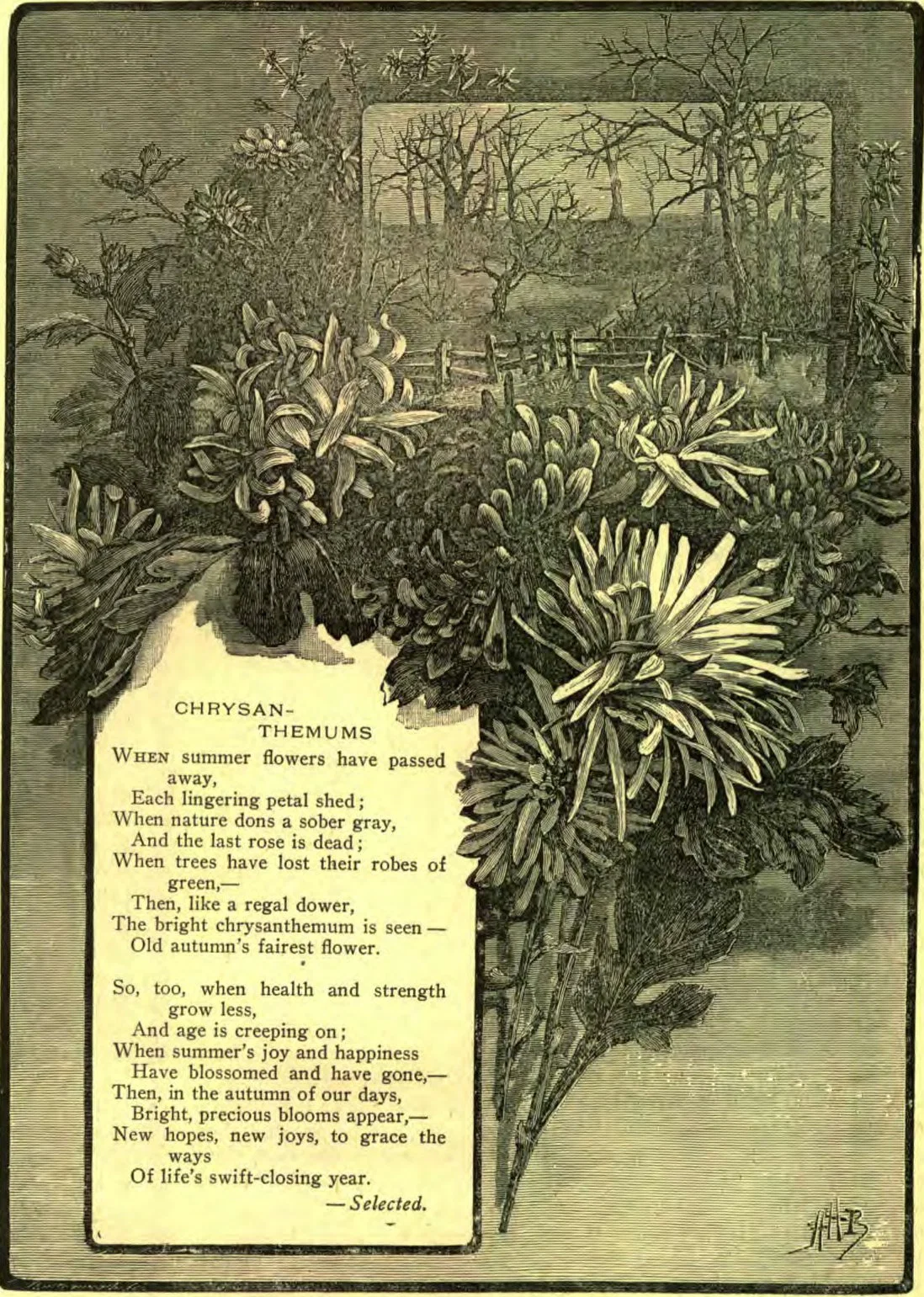
When summer flowers have passed away, Each lingering petal shed; When nature dons a sober gray, And the last rose is dead; When trees have lost their robes of green,— Then, like a regal dower, The bright chrysanthemum is seen — Old autumn’s fairest flower.
So, too, when health and strength grow less, And age is creeping on; When summer’s joy and happiness Have blossomed and have gone,— Then, in the autumn of our days, Bright, precious blooms appear,— New hopes, new joys, to grace the ways Of life’s swift-closing year.
—Selected.
CHRYSANTHEMUMS
CHRYSANTHEMUMS

CHRIST’S HUMILIATION

It will baffle the keenest intellect to interpret the divine manifestation of the burning bush. It was not a dream; it was not a vision; it was a living reality,—something that Moses saw with his eyes. He heard the voice of God calling to him out of the bush, and he covered his face, realizing that he stood in the immediate presence of God. God was conversing with humanity. Never could Moses describe the impression made upon his mind by the sight he then saw, and by the sound of the voice that spoke to him; but this impression was never effaced. Heaven came very near to him as, with reverent awe, he listened to the words, “I am the God of thy father, the God of Abraham, the God of Isaac, and the God of Jacob.” What wondrous condescension for God to leave the heavenly courts, and manifest himself to Moses, talking with him face to face, “as a man speaketh unto his friend.”
This lesson contains instruction that is profitable for all. Here is revealed a symbol radiant with the glory of Christ, the Great Teacher. The symbol chosen for the representation of the Deity was not a cedar of Lebanon, but a lowly bush, that seemingly had no attractions. This enshrined the Infinite. The all-merciful God shrouded his glory in a most humble type, that Moses might look upon it, and live. God declared: “Thou canst not see my face: for there shall no man see me, and live.” All the manifestations of God’s glory have been shrouded, that man might behold it, and not be consumed. Veiled in a pillar of cloud by day, and a pillar of fire by night, God could honor finite man by communicating to him his will, and imparting to him his grace. God’s glory must be subdued, and his majesty veiled, that the weak vision of finite man may look upon it.
This symbol, obscuring the manifestation of God’s glory, foreshadowed Christ’s appearance in our world, his divinity clothed with humanity. Surely in the eyes of the world Christ possessed no beauty that they should desire him, yet he was the incarnate God. This is the mystery of godliness. Human science, even though it be of the highest order, can not explain it. Men may think that they possess superior qualities, represented by the noble oak, or the stately cedar. Mark the humble birth of Christ, his condescending grace, his infinite humility, the depths to which he descended. He is the eternal Word. Yet he was made flesh, and dwelt among us.
Before Christ came in the likeness of men, he existed in the express image of his Father. He thought it not robbery to be equal with God. Nevertheless he voluntarily emptied himself, and took the form of a servant. He was the incarnate God, the light of heaven and earth. In him are hid all the treasures of wisdom and knowledge. Yet he was born in a stable, in Bethlehem of Judea. He was the son of Mary, supposed to be the son of Joseph, and he grew up as any other child. His earthly life was one of self-denial and self-sacrifice. “The foxes have holes,” he said, “and the birds of the air have nests; but the Son of man hath not where to lay his head.”
“We see Jesus,” writes Paul, “who was made a little lower than the angels for the suffering of death, crowned with glory and honor; that he by the grace of God should taste death for every man.” Thus will the testimony appear in clear lines in that day when all must hear the final decision of a righteous Judge, when every case will be decided, and every man rewarded according to his works. The loyal and believing children of God will then be separated from the children of the wicked one, as the sheep are divided from the goats. The righteous will be placed on the right hand of God, while the transgressors will be placed on his left hand.
Prophecy foretold that Christ was to appear as a root out of dry ground. “He hath no form nor comeliness,” wrote Isaiah, “and when we shall see him, there is no beauty that we should desire him. He is despised and rejected of men; a man of sorrows, and acquainted with grief: and we hid as it were our faces from him; he was despised, and we esteemed him not.” This chapter should be studied. It presents Christ as the Lamb of God. Those who are lifted up with pride, whose souls are filled with vanity, should look upon this picture of their Redeemer, and humble themselves in the dust. The entire chapter should be committed to memory. Its influence will subdue and humble the soul defiled by sin and uplifted by self-exaltation.
Think of Christ’s humiliation. He took upon himself fallen, suffering human nature, degraded and defiled by sin. He took our sorrows, bearing our grief and shame. He endured all the temptations wherewith man is beset. He united humanity with divinity: a divine spirit dwelt in a temple of flesh. He united himself with the temple. “The Word was made flesh, and dwelt among us,” because by so doing he could associate with the sinful, sorrowing sons and daughters of Adam.
The glory of Christ was veiled, that the majesty and beauty of his outward form might not become an object of attraction. In this is a lesson for all humanity. “Verily man at his best state is altogether vanity.” Christ came with no outward display. Finding himself in fashion as a man, he humbled himself, showing that fallen man must ever walk humbly before God. Riches, worldly honor, human greatness, can never save a soul from death. “To this man will I look,” declares the Lord, “even to him that is poor and of a contrite spirit, and trembleth at my word.”
MRS. E. G. WHITE.

THE HARVEST

The rain came down on the thirsty field,— The mellow field that was sown and tilled,— And the seed sprang up with so rich a yield That Autumn found her garners filled. The rain came down on the flinty rock,— The very same rain on the very same day,— But it yielded neither bud nor stalk, And Autumn found it bare and gray.
The sun shone warm on the tender blade That held the promise of toothsome bread; And so quick an answer the wheatfield made The wide, wide world from it was fed. The sun shone warm on the bramble-vine,— The very same sun on the very same morn,— But it yielded neither corn nor wine, And Autumn found it piled to burn.
ELIZABETH ROSSER.

THE BEST DAY

Some skies may be gloomy, Some moments be sad, But everywhere, always, Some souls must be glad; For true is the saying Proclaimed by the seer,— “Each day is the best day Of somebody’s year.”
Each day finds a hero, Each day helps a saint, Each day brings to some one A joy without taint; Though it may not be my turn Or yours that is near, “Each day is the best day Of somebody’s year.”
The calendar sparkles With days that have brought Some prize that was hoped for, Some good that was sought; High deeds happen daily, Wide truths grow more clear: “Each day is the best day Of somebody’s year.”
No sun ever rises, But leaves joy behind, No sorrow in fetters The whole earth can bind; How selfish our fretting, How narrow our fear! “Each day is the best day Of somebody’s year.”
— Priscilla Leonard.

THE DAY OF SMALL THINGS

God can not always trust us with what appear to be great opportunities; for very often, if he did, the human side of our characters would assert themselves sufficiently to gain the supremacy. If we faithfully perform the little duties that come in our pathway, such as giving the cup of cold water, either literally or spiritually, and keep continually trying to impart to others the little, insignificant attentions, which, after all, tend to make life so pleasant, we shall be surprised to discover, in the day of judgment, that we have been making real master-strokes in this world.
If the father of John the Baptist had not been a Christian, he would certainly have been tempted to think, during those long years of preparation, that his son was wasting his time. The friends and associates of Elisha must certainly have come to the conclusion that he was in small business when he left the twelve yoke of oxen, and spent ten years pouring water on Elijah’s hands (2 Kings 3:11), and performing other similarly insignificant duties.
So when we give our lives to helping the unfortunate, and assisting the fallen and downtrodden of earth to rise again, when we might be commanding tempting salaries or the empty applause of the world, our friends will often suggest that we are throwing ourselves away; but to the Christian worker in this world “it doth not yet appear.” Much of the time it will seem, even to ourselves, as if we were accomplishing but little,—almost as if we were laboring in vain. But bear in mind that work done for God, be it ever so humble or even contemptible in human judgment, is wholly fruitful. The seed of good may be as tiny as a grain of mustard-seed; but if it is planted for God, he will water it every moment; and never until the day of God shall we know the far-reaching consequences that will spring forth from it. Again and again it will become necessary for us to demonstrate our willingness to toil for God under the most humble circumstances.
DAVID PAULSON, M. D.

Christmas in Jamaica

The word “Christmas,” in cold climates, always brings visions of ice and snow, skates and jingling sleigh-bells; also, perhaps, of a Christmas tree, with sundry presents of more or less utility. Not so in Jamaica. Snow is an unknown quantity. The only ice known is the manufactured product. Even with that, the average Jamaican knows so little of extreme cold that he says, “The ice burns me.”
Perhaps the first intimation the stranger has that some unusual event is at hand, is the fact that the shopkeepers begin to fill their shelves with extra supplies of ham, bacon, and all kinds of potted and preserved meats; also jellies, jams, and candies, locally called “sweets.” In Jamaica the Christmas-tide is the festival time of all the year.
Soon, too, the firecrackers begin to pop. I think the Jamaican small boy enjoys firecrackers above all other Christmas pleasures.
On the day before Christmas the lottery shops are allowed to open. All the rest of the year the law strictly forbids them to operate their unlawful schemes. The man who is to conduct the lottery works hard for some time behind closed doors. He shows great ingenuity in arranging his stock, placing everything valuable or showy in a conspicuous position; while the great majority of his goods, which are of little value, are carefully set out of sight, or where they will attract little attention.
In the front of the shops is a large board, resembling the bulletin-boards seen in most parts of the United States during the war. The face of this board is covered with playing-cards, face out. On the back of these cards is the name of some article found in the shop. A round stick about six feet long lies on the table. Then all is ready. Tinsel and gilt are seen everywhere. The shop is brilliantly lighted, the doors are thrown open, and a music-box on the counter is set to grinding out the latest street tunes in monotonous regularity.
Then the master of ceremonies, who is usually much puffed up with the importance of his position, begins to call on the “gentlemen and ladies” to “walk up and try their luck,” at the same time calling their attention to the valuable articles arranged so conspicuously, which they may get for only a “thruppence” (threepence, or six cents). Then some young man, or, just as likely, some old man, walks up, lays down his hard-earned threepence, grasps the stick, and with ill-suppressed nervousness surveys the board with the playing-cards. At last, after several uncertain pauses, the end of a stick rests on a card. The man in charge pulls out the card, and solemnly announces, “A sheet of writing paper!” The crowd roars. The master of ceremonies consoles the loser in his disappointment, and encourages him to try again and again, until at last he has spent all his money, receiving therefor only a few worthless trinkets.
It does not take long to become thoroughly disgusted with all lottery business. It is evident to the onlooker that it would be many times cheaper to purchase, in the customary places, whatever articles one needed. We gladly turn from this scene, sorry for the poor people who are so easily duped.
There are others who have also been preparing for Christmas week, but their preparation has been made secretly. The masqueraders have been making their costumes, many spending much time and money upon them. In 1899 the masqueraders came out dressed as American Indians, with a gorgeous display of feathers, wampum, and long, glittering tomahawks. The law gives them the right of way in the streets, and merry times they have. They are accompanied by a string-band, and sing, dance, and talk in queer, unnatural tones.
The houses of the town are thrown open to them. They send one of their number before, dressed in his own queer costume, with a card requesting the use of that house. If the owner consents, he writes on the card an invitation, and announces the time when they may be entertained there. At the appointed time they enter the house to inspiring strains of music. Before leaving, the host or hostess provides them with refreshments, and then on they go. In the larger towns they keep this up all night, almost every night of Christmas week. As with most of the pleasures of this world, the onlookers and masqueraders soon become satiated. The crowd on the last night is much smaller than that of the first.
As far as I have been able to learn, the Christmas-tree is unknown here; neither is the custom of giving presents to be compared with the American custom. The average presents are Christmas cards and sweets. These, with the fefe, or some other simple noise-producing, nerve-grating device, fill the small child’s horizon. The fefe is a small, thin rubber sack of various colors, inflated from one end through a wooden nipple.
Tropical mornings are very beautiful,—the loveliest part of all the day. Long before sunrise, the people of all classes turn out for a promenade. The streets are crowded, and fefes, etc., fill the air with their babel. But then the people, young and old, seem to enjoy themselves.
The religious aspect of the day is an important one. The majority of Jamaicans like to appear religious—on state occasions. In the Church of England the sacrament is given four times on Christmas. Dec. 25, 1899, the first one was given at three o’clock in the morning in Port Antonio. Many from the country receive the sacrament on Christmas and New-year’s, and do not come back to church again during the year.
In almost all the churches the old custom of “watch-night” is observed on the last night of the year. The people assemble in the churches, and sing until the hands of the clock point to twelve; then all is as silent as the grave. Every one listens, with strained attention, to hear the Old Year go out, and the New Year come in. Many persons have solemnly declared to me that they have heard it.
George F. Enoch.
Hope Bay, Jamaica.

SUNRISE ON LAKE MICHIGAN

It was a bright morning in the early winter. The first light fall of snow was on the ground, and the air was sharp and crisp with frost.
The writer’s viewpoint was the Chicago and Northwestern passenger station, most beautifully situated on the lake front at Milwaukee. In the foreground were perfectly ballasted railroad tracks, the steel kept ever bright with almost constantly moving cars and busy, puffing engines, the latter sending forth clouds of steam, which floated away on the rapidly moving air, turning to frost as it receded from the hot stacks of the smoking locomotives.
Stretching eastward for many miles were the waters of Lake Michigan, broken only by ripples more suggestive of the dimples that come and go on the face of a laughing child than of the snowstorm of the previous night.
Four hundred yards from the shore, and a little to the left of the line of the rising sun, lay at anchor three large sailing-vessels, their dark hulls and masts silhouetted against the steel-gray background furnished by the waters of the lake. In a few moments the color changed to silver, mingled with gold, as each tiny wavelet was painted by the bright rays of the rising sun.
On the line of the horizon, resting upon the waters of the lake, was a low bank of clouds looking like a range of ragged hills, or perhaps more suggestive of the saw-like Sierra Nevada Mountains seen from a great distance.
Deep down in one of the irregular valleys between the saw-teeth of these vapor mountains was seen the sun rising in all his majestic beauty. Higher and still higher mounted the great luminary, until the dark-gray — almost black — of the cloud-formed mountain range changed to silver, tinged on its crest with yellow gold, and showing only here and there great dark spots where projecting points cast their shadows, suggestive of extinct craters so deep that Old Sol’s rays never could fathom them; or of irregular caverns formed under overhanging rocks by the ever-restless surging of the ever-restless sea.
It was a scene not soon to be forgotten, and one that could turn the thoughts only to God, the Creator of all things, whose mind conceived all this beauty before it was brought forth; whose word made, and whose hand placed, the sun, the lake, and the cloud; and whose brush laid the rich colors as a crown of glory upon his own handiwork. And yet eye hath not seen, nor ear heard, neither hath it entered into the heart of man to conceive, the glory still to be revealed: and God’s glory, boundless as it is, is the measure of his grace toward us in Christ Jesus. C. P. BOLLMAN.

NO ROOM IN THE INN

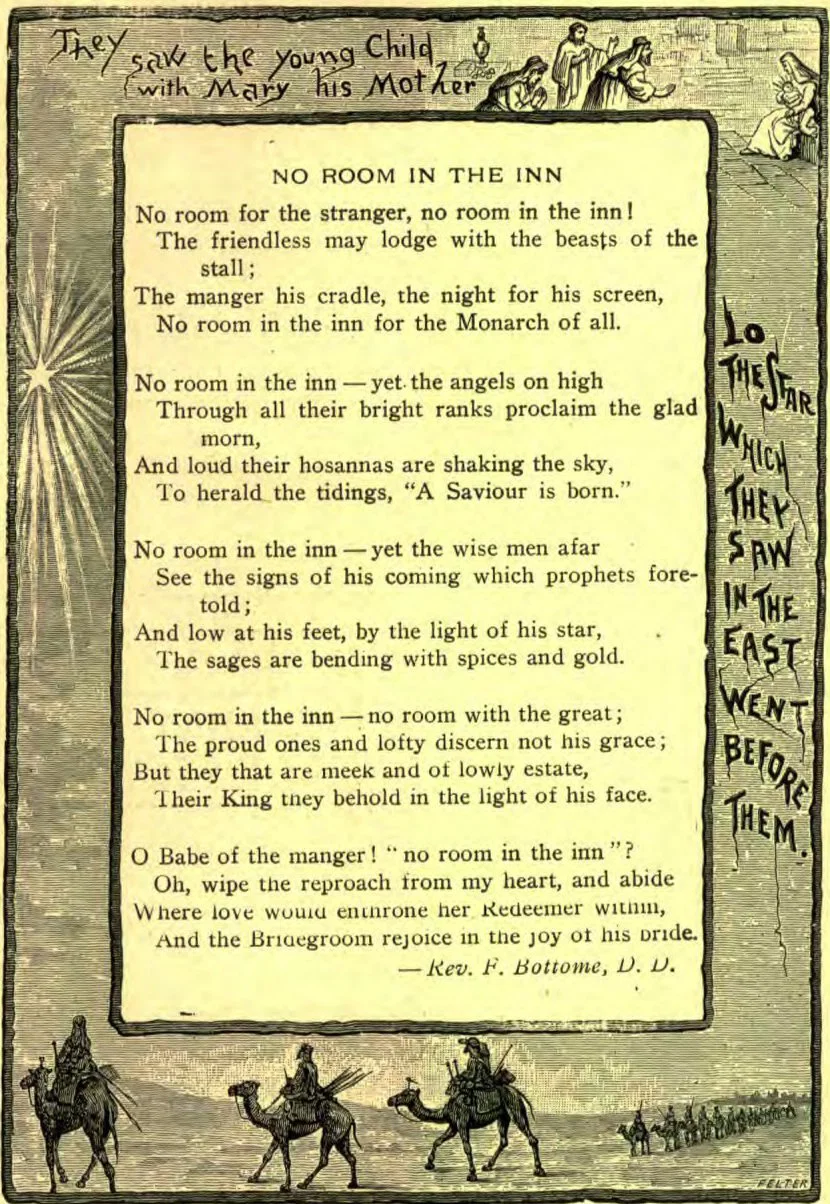
No room for the stranger, no room in the inn! The friendless may lodge with the beasts of the stall; The manger his cradle, the night for his screen, No room in the inn for the Monarch of all.
No room in the inn—yet the angels on high Through all their bright ranks proclaim the glad morn, And loud their hosannas are shaking the sky, To herald the tidings, “A Saviour is born.”
No room in the inn—yet the wise men afar See the signs of his coming which prophets foretold; And low at his feet, by the light of his star, The sages are bending with spices and gold.
No room in the inn—no room with the great; The proud ones and lofty discern not his grace; But they that are meek and of lowly estate, Their King they behold in the light of his face.
O Babe of the manger! “no room in the inn”? Oh, wipe the reproach from my heart, and abide Where love would enthrone her Redeemer within, And the Bridegroom rejoice in the joy of his bride.
— Rev. F. Bottom[e], D. D.

GIRLS AND THEIR OPPORTUNITIES

Perhaps the happiest girl in all the world is she who makes the best use of her opportunities. Opportunity is a large word; but it is sometimes like a plain path that leads us out into large fields of usefulness. These paths present themselves to everybody, everywhere, and we can not help seeing them. They are a part of our daily duty; and if we shun them, we neglect our duty. Men and women who have become well known have improved their opportunities. The following testimonies of great and useful lives ought to be an inspiration to girls who think they have no opportunities, or who fail to see those that are right around them.
When Mary A. Livermore was a girl, she was an eager scholar; she was also a great favorite at school, because she took the part of all poor children. If a little child was a cripple, or was shabbily clothed, or had scanty dinners, or was made fun of, he found an earnest friend and defender in the courageous girl. When but twelve years old, she was eager to begin to earn something.
Emily Judson, the great missionary, who could not foresee the wonderful work she was to accomplish in the world, began life as a factory girl. Her opportunity came to her when least expected. She seized it, and her subsequent career won many stars for her heavenly crown.
Harriet Hosmer, the sculptor, when quite a young girl, saw her opportunity and discovered her gift in a clay-pit in her father's garden, where she molded horses and dogs to her heart's content.
Ella Grant Campbell, by her steadfast perseverance and earnestness of purpose from early girlhood is now the owner and operator of one of the largest greenhouses in the country,—that at Cleveland, Ohio.
Mrs. Alice Freeman Palmer, the educator, early took upon herself the responsibilities of life, and in the conscientious discharge of all her duties has worked out for herself a character as beautiful as it is rare.
Clara Barton began to teach school when she was sixteen. Susan B. Anthony and Frances Willard also taught school early in life. The wide world knows whether or no they have made good use of their opportunities.
Lucy Larcom, the sweet poet, was a poor mill-girl. It was she who said, “Even poorer people's windows will give us a new horizon, and often a far broader one, than our own.”
Rosa Bonheur, the great animal painter, sought and found her opportunity in her father's studio, where she spent her happiest days. At the Louvre, where she was early sent to copy the works of old masters, an English gentleman one day said to her: “Your copy, my child, is superb, faultless. Persevere as you have begun, and I prophesy that you will be a great artist.” How happy these words made her!
One might fill pages with instances like these, to encourage the faint-hearted. The thing to remember is that all these brave and great and good women built their wonderful experiences upon the way in which they sought every little opportunity to fulfill life's duties. Let us remember that nothing happens, nothing is by chance, but that Heaven rules the greatest and the smallest things in all our lives.
FRANK WALCOTT HUTT.

REVIEW

(December 29)
LESSON TEXT.—Galatians 3 and 4.
MEMORY VERSE.—Gal. 5:1.
The review of these two chapters will make a long lesson, unless each lesson has been well learned from week to week. Those who have been thorough in studying each lesson will find much pleasure and profit in this review. In studying the third chapter, look up the review lesson we had a few weeks ago on this chapter. The synopsis of the chapter given then will not be repeated here. The following synopsis of the fourth chapter may prove helpful:—
In verses 1-7 Paul likens our experience to that of a child under age. While in sin, we are in bondage under the rudiments of the world. But when Christ redeems us from sin, we become sons of God, and free in him.
In verses 8-11 the apostle refers to the experience of the Galatians before they became Christians, and reproves them for returning to their old heathen ways.
In verses 12-20 he speaks of his first coming among them, of their love for him, and then reproves them for their change of feelings toward him.
In the remaining verses the subject is the two covenants. The old covenant of works made at Sinai is represented by Hagar, and genders to bondage. Ishmael represents those who are under this covenant, and Jerusalem in Judea is their city. Then Sarah, the free woman, represents the new covenant; and all who are under this covenant are free, like Isaac. Their city is the heavenly Jerusalem.

QUESTIONS

1. What kind of experience had the Galatians at first enjoyed in the gospel? What spiritual blessings had they enjoyed? How had they received these? How were they departing from the gospel? Gal. 3:1-5.
2. How did Abraham become righteous? Who are children of Abraham? What was preached to him? In what words was the gospel preached? Who enjoy the gospel blessings with Abraham? Vs. 6-9.
3. Who are under the curse? What is the curse of the law? How is no man justified? How do the just live? Whom only does the law justify? What has Christ redeemed us from? Why has he done this? Vs. 10-14.
4. How is a covenant among men made sure? To whom had God made promises? Who is the seed? When was this covenant with Abraham made? When was the law given? What effect did the giving of the law have upon the covenant? How did God give the inheritance to Abraham? Vs. 15-18.
5. Why was the law given at Sinai? Till what time was it given? What is the relation of the law to the promises? Who are under sin? What was our condition before faith came? What was the work of the law in bringing us to Christ? What, then, is our relation to the law? Vs. 19-25.
6. How do we become children of God? Whom do we put on? What does it mean to put on Christ? What classes of people become one in Christ? Whose seed are they? They are heirs of what? Vs. 26-29.
7. To what are we compared when we were in sin? In what bondage were we? What did God do to set us free? When free, what do we become? What has God sent into our hearts? What besides sons are we? Gal. 4:1-7.
8. Whom had the Galatians formerly served? Whom had they learned to know? Yet to what were they returning? What is the proof of this? Of what was Paul afraid? Vs. 8-11.
9. What had been the occasion of Paul's first work among them? How had they received him? What would they have done for him if possible? Was he still their friend? How does he admonish them to be steadfast? Vs. 13-20.
10. What sons had Abraham? How were they born? Who were their mothers? What do these two women represent? When and where was the first covenant made? What was the condition of those under this covenant? Vs. 22-25.
11. Who represents the new covenant? Who was the son of promise? How are we like him? What city represents this covenant? Who are children of this city? How did Ishmael treat Isaac? How is it now? What is to be done with the bondwoman and her son? What does this mean in our experience? Whose children are we? Vs. 26-31.

Then Pealed the Bells: Longfellow Verse

THEN pealed the bells, more loud and deep, God is not dead, nor doth he sleep! The wrong shall fail, the right prevail, With “peace on earth, good will to men!” —Longfellow.

ONE'S WILL

One day a little wave—indeed, he wasn't naughty, Though the others tried to hush and keep him still— Said: “You mustn't think, my comrades, that I'm quarrelsome or haughty, But I want to be a rainbow, and I will!”
So the sun came shining gladly, and the wind came blowing madly, And the little wave leaped up to catch the light; And for half a glorious minute, with only sunshine in it, He flashed in seven colors on the sight.
So when behind your task the harder ones come trooping, While the senses only peace and pleasure crave, And o'er the humdrum work your head is drooping,— Just think you of that rainbow and that wave.
—St. Nicholas.

CHRISTMAS

See! ere first bright streaks of day Gleam on Christmas skies, How a wakeful little lad Thinks ’tis time to rise. Down into his stockings peeps, Then he leaps for joy, Happy with the presents found For a little boy.
Oh, the gladness of the day! Little brother man Makes the very most of it— Do you think he can? Well, we all were children once, And, if we confess, Some have still a love for it,— May it not grow less!
Yet the truest Christmas joy Is that older one Which adoring angels sang, Of the holy Son, By the Heavenly Father given As a pledge of love, Guiding, lifting, leading us To the home above.
Not your stockings, but your hearts. Let him fill them all Full of his own blessed love,— Biggest hearts and small; So shall this and every day, Till he comes again, Be with loving-kindness fraught; For the sons of men.
B. F. M. Sours.
Continue reading: The King of Glory