To this question the Scriptures give full and definite answer, as they do also to every question which directly concerns the salvation of souls.
On one occasion, as Jesus “went out, and departed from the temple,” “His disciples came to Him for to show Him the buildings of the temple. And Jesus said unto them, See ye not all these things? verily I say unto you, There shall not be left here one stone upon another, that shall not be thrown down.” Matt. 24: 1, 2.
This statement greatly surprised the twelve, and a little later, “as He sat upon the Mount of Olives, the disciples came unto Him privately, saying, Tell us, when shall these things be? and what shall be the sign of Thy coming, and of the end of the world?” Verse 3.
Instead of rebuking His disciples for trying to “pry into the secrets of the Almighty,” our Lord answered their question specifically, saying, in part, “There shall be signs in the sun, and in the moon, and in the stars; and upon the earth distress of nations, with perplexity; the sea and the waves roaring; men’s hearts failing them for fear, and for looking after those things which are coming on the earth.” Luke 21: 25, 26.
Location of First Sign
Not only did our Lord say there would be signs of His coming, and that they would appear “in the sun, and in the moon, and in the stars; and upon the earth,” but He told the nature of these signs, and fixed the chronology of the first one, namely, the sign in the sun, so definitely as to leave no reasonable question in the mind of any one as to its literal fulfilment.
The chronology of this sign was upon this wise: In the 7th chapter of the book of Daniel is a prophecy of a persecuting power that was to arise, as we learn from a comparison of other scriptures, in the year A.D. 538, and continue his cruel and blasphemous work for twelve hundred and sixty years, or until A.D. 1798. Of this power the prophet said: “He shall speak great words against the Most High, and shall wear out the saints of the Most High, and think to change times and laws: and they shall be given into His hand until a time and times and the dividing of time.” Verse 25.
As before stated, this prophecy covers a period of twelve hundred and sixty years. In answering the question asked by His disciples, “What shall be the sign of Thy coming, and of the end of the world?” our Lord referred to this long period of oppression of His people, saying: “Then shall be great tribulation, such as was not since the beginning of the world to this time, no, nor ever shall be. And except those days should be shortened, there should no flesh be saved: but for the elect’s sake those days shall be shortened.” Matt. 24: 21, 22.
This great time of trouble was the period of papal supremacy and persecution between the years A.D. 538 and 1798. Unlike the time of trouble “such as never was since there was a nation even to that same time,” foretold in Dan. 12: 1, this time of trouble foretold by our Saviour, and also in Dan. 7: 25, was a time of trouble to the people of God; and it was for their sakes that the days were to be shortened.
Let the reader remember that our purpose in discussing this time of trouble, or tribulation, is to show how our Lord definitely located the chronology of the sign of His coming which was to be seen in the sun. In Matt. 24: 29 Jesus said, “Immediately after the tribulation of those days shall the sun be darkened.” Or as recorded by Mark, “In those days, after that tribulation, the sun shall be darkened.” Mark 13: 24.
In Those Days but After the Persecution
Now it must be evident to every one, that the days themselves could not be shortened, or cut short; but the tribulation could be and actually was shortened, or cut short, to such an extent that so far as putting to death “heretics” was concerned it entirely ceased several years prior to the end of the days in 1798. Perhaps the most potent factor in shortening, not the 1,260 years of papal supremacy, but the days of persecution to the death, was the decree of religious toleration issued by Maria Theresa, the Empress of Austria, in 1776, the same year of the Declaration of Independence in this country. History testifies how literally this sign was fulfilled, not only as to the actual darkening of the sun, but as to the time when that darkening occurred, “in those days, after that tribulation.”
Heavenly Bodies for Signs
When the Lord created the heavenly bodies, He said, “And let them be for signs, and for seasons, and for days, and for years.” Gen. 1: 14. It ought not therefore to be a matter of surprise that the sun, moon, and stars were to be, and that they have actually been, used to warn the world of the approach of the second advent.
But the signs of our Lord’s second coming are not limited to the sun, moon, and stars; there were to be also signs upon the earth, or in other words, phenomena that would cause people to think of the judgment and of the end of the world. How these signs have been fulfilled and are fulfilling can not be told in this brief article; but it is scarcely possible for any careful student of the Scriptures, who is also an observer of the signs of the times, to be ignorant of these things. To those who wilfully close their eyes to these tokens, our Lord says, “Ye hypocrites, ye can discern the face of the sky and of the earth; but how is it that ye do not discern this time?”
The Bible
THIS Book contains the mind of God, the state of man, the way of salvation, doom of sinners, and happiness of believers. Its doctrines are holy, its principles are binding, its histories are true, and its decisions are immitigable. Read it to be wise, believe it to be safe, and practise it to be holy. It is the traveler’s map, the pilgrim’s staff, the pilot’s compass, the soldier’s sword, and the Christian’s charter. Here Paradise is restored, heaven opened. Christ is its grand subject, our good its design, and the glory of God its end. It should fill the memory, rule the heart, and guide the feet. Read it slowly, prayerfully, and frequently. It is a mine of wealth, a paradise of glory, and a river of pleasure. It is given you in life, will be opened at the judgment, and be remembered forever. It involves the highest opportunity, rewards the greatest labor, and condemns all who trifle with its holy contents.—Anon.
Have You Gained This Year—
A BIBLE better loved because better known?
A new experience of communion with God?
A wider outlook over the field of Christian service?
A new conviction and a new interest in missions?
A better notion of your stewardship over your possessions?
A larger knowledge of the truths of your religion?
A truer appreciation of the value of a soul?
A sincere love for the kingdom of God?
A wiser use of your opportunities for personal evangelism?
A greater willingness to be taught in the things of God?
A keener sense of the sinfulness of sin?
An intenser love for Him who has saved you?
A surer hope of heaven?
A more definite acceptance of God’s leading in your life?
A warmer love for the church in which you labor?
If not:
Will you not make this day the time when you will begin to seek all these things, and all else which God is seeking to give you? —Selected.
Afflictions as Christ’s Refining Fire
By A. Thompson
ALL our afflictions are Christ’s refinings, and the purer the gold, the hotter will be the fire; the whiter the garment, the harder the cleansing.—A. Thompson.
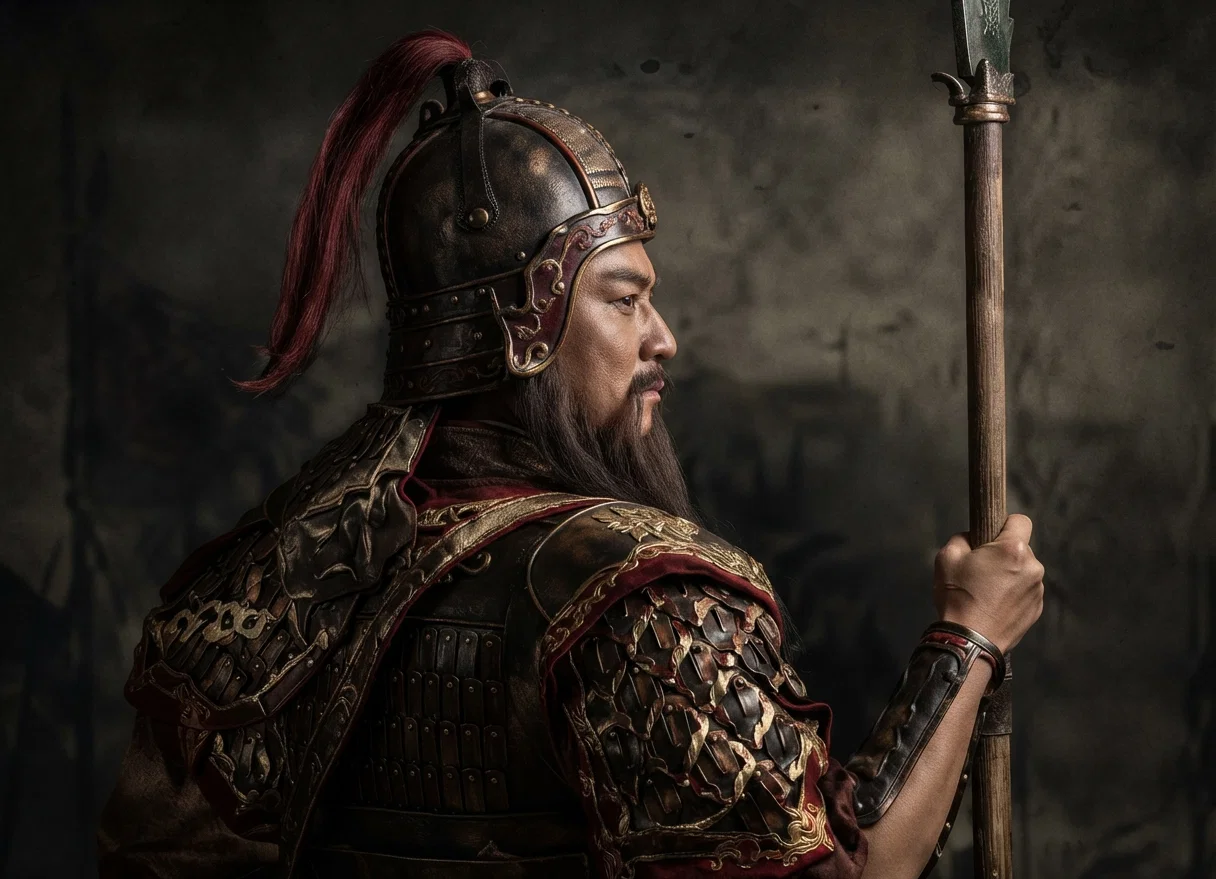
GUAN YU
The Chinese Revolution
By F. E. Stafford
By Our Own Correspondent
LITTLE did we think a week ago that to-day we would be writing this article under the protection of the rebel government, that rebel soldiers would be pacing the streets in front of our house, and all the shops would be emblazoned with the red and white flags, emblems of the new China, the "PEOPLE'S KINGDOM," as it is now called. Yet such is the case; and during the last few days, momentous events have followed one another in such rapid succession that it is practically impossible to realize to the full extent the meaning and significance of all of them.
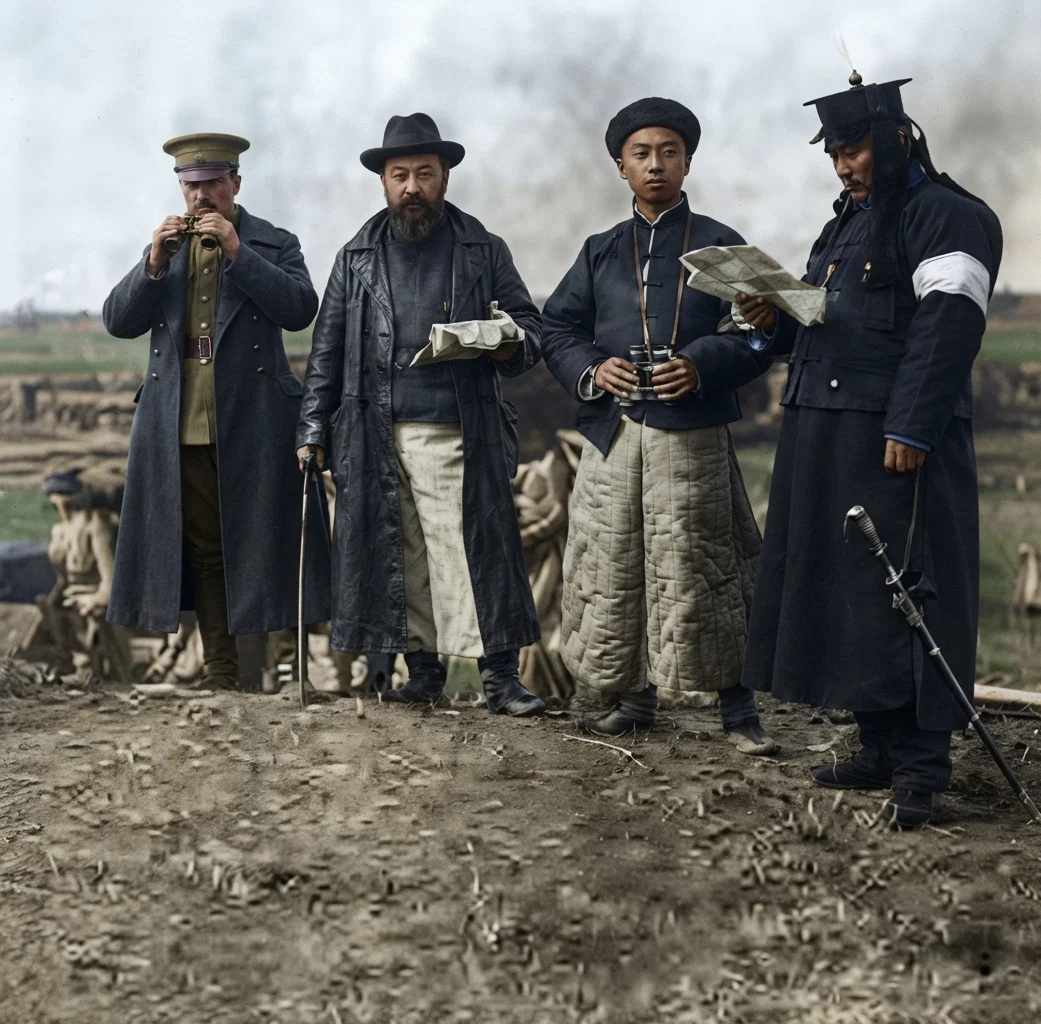
General Li, the rebel commander, and his staff on the battle-field at Hankow, directing operations. Note the white band on his sleeve - the revolutionary mark.
The attack on Shanghai was systematically planned and well carried out, and to-day the rebel flag flies from every gate of the native city, and the Chapei constabulary, the Kiangnan dock and arsenal, the Shanghai-Nanking railway station, and the Woosung fort are all in their hands, while soldiers with loaded guns and the customary rebel mark, the white band on the arm, are guarding all the principal street corners.
From the proclamation issued by the "Republic of the Han" the following is selected:
Our aim is not anti-foreign nor even anti-Manchu, and not more than to turn out a tyrannical, cruel, insane, and unconscious Manchu Dynasty, whose reign has been a source of great suffering to the people.
You have our solemn assurances that as far as we can control, every single foreigner will receive our best protection, we will respect all treaties entered into before the proclamation of the republic, undertake payment of indemnities and loans and all
lawful obligations, and any damage done will be sufficiently and reasonably remunerated.
We aim at a reconstruction of the government, to lead China into a strong power, which is the key-note of the world's peace. Under the new régime foreigners will no longer be limited to treaty ports to carry on business operations.
The identical program seems to be carried out in every place. Some "unknown" person suddenly fires the yamen; the revolutionary leaders promptly take steps to extinguish the fire as soon as they see that the yamen is in ruins, and thus take credit to themselves for protecting property from damage, and urge the incident as confirmation of their promise that they come not to destroy but to build up. Incidentally, however, the burning of the yamen serves, in the very characteristic Chinese fashion, to emphasize their contempt for the powers that be by destroying the place from whose portals that power was exercised.
Through the courtesy of a Chinese friend, I was permitted to-day to visit the headquarters of Li Ping Shu, the Shanghai rebel leader, at his place in the native city. I was treated very courteously, and while not permitted to enter the private office, we were escorted around the grounds by a guard.
Soldiers were drilling on one side, and on the other side were several hundred raw recruits waiting to be enlisted. Messengers were running here and there with an air of expectancy and tensity which impressed one with the idea of a determination to do or die. Directly in the center of the compound were three large pools of blood, where only a short time before three men had been beheaded. There is no trifling with the new government. They govern at present by military force, and while not favoring bloodshed, yet they do not hesitate to execute summarily all offenders.
Eclipsing all these things in interest is the proclamation from the emperor to the people on October 30, which grants a constitution at once, the resignation of the whole imperial cabinet, and the appointment of Yuan Shi Kai to be prime minister.
The yielding to the assembly in the matter of cashiering Sheng King Pao opened the way for further demands upon the throne, but no one was prepared to hear of such demands as were immediately presented, and much less prepared to hear that they had been granted.
The demand for a constitution came from the officers and troops stationed at Lwangchow, in Chili Province, who drew up a circular addressed to the government, demanding many important reforms, and threatened to march on Peking 25,000 strong if their demands were not granted.
It has been suggested that Yuan Shi Kai is back of all these movements, and that now that he is in power once more, he is playing a deep game with the government. Whoever is playing the game is certainly playing to win; because the next day all the extraordinary demands were granted with one exception, and in addition to that the emperor makes the most humbling proclamation that has ever been recorded in Chinese history. Some of the most striking features of the proclamation are the following:
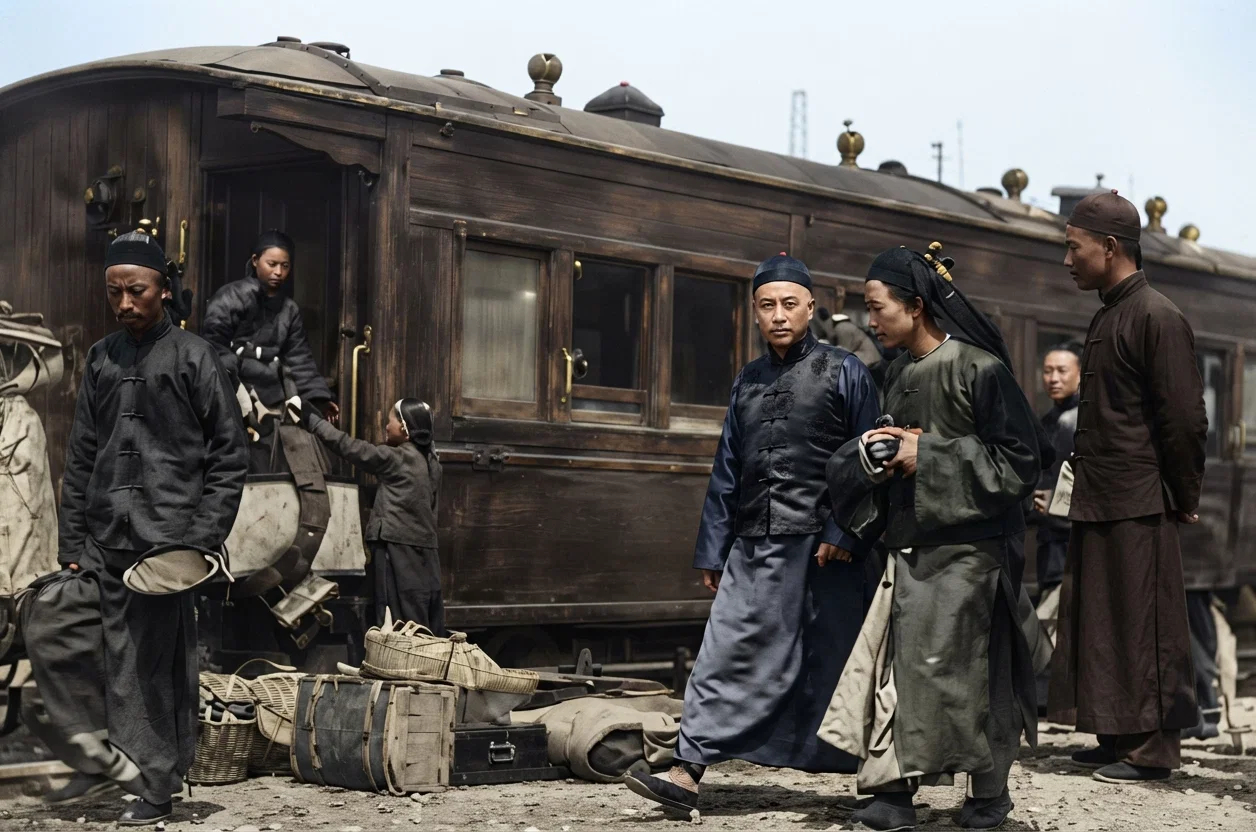
Prominent Chinese official of Soochow, the capital of Kiang-su Province, about to board a train for Shanghai
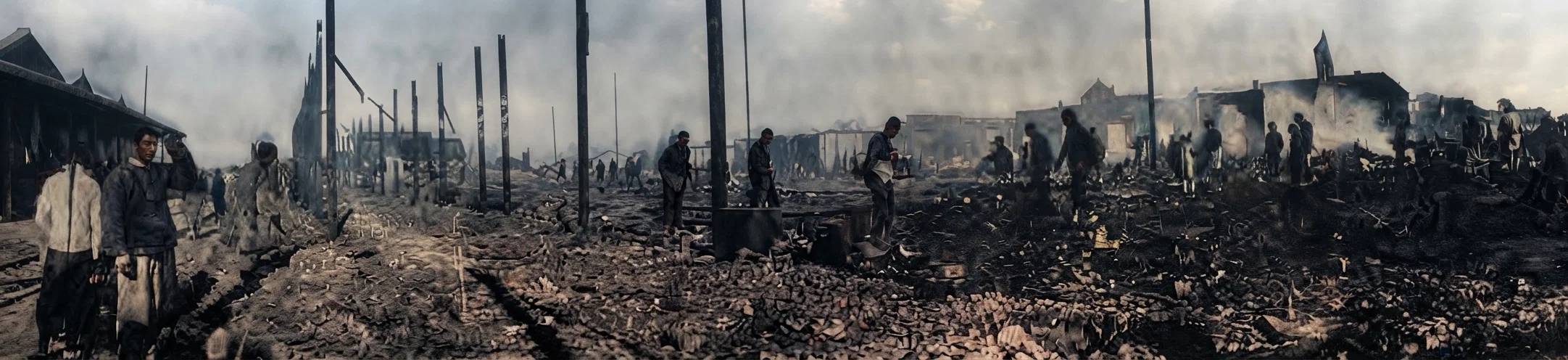
Back of the foreign concessions in Hankow, fired by the imperialists — blocks and blocks of ruins
I have reigned for three years, and have always acted conscientiously in the interests of the people. But I have not employed men properly, not having political skill. I have employed too many nobles in political positions, an act which has contravened constitutionalism.
When I urge reform, officials and gentry seize the opportunity to embezzle. When old laws are abolished, high officials serve their own ends. Much of the people's money has been taken, but nothing to benefit the people has been achieved. On several occasions edicts have promulgated laws, but none have been obeyed. The people are grumbling, yet I do not know of it. Disasters loom ahead, but I do not see them.
The whole empire is seething, the minds of the people are perturbed, and the spirits of our nine late emperors are not able properly to enjoy the sacrifices made to them, while it is feared that the people will suffer grievously.11
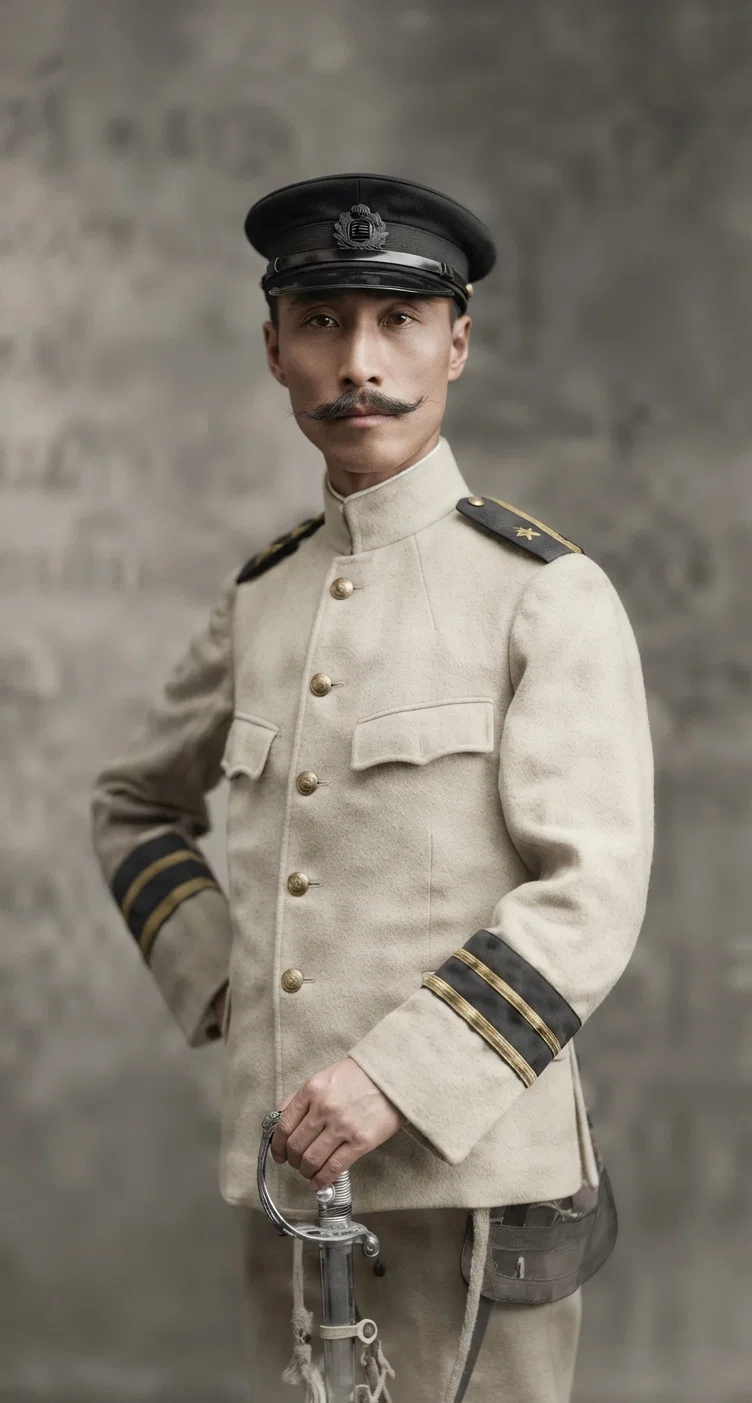
Yin Chang, minister of War, as commander-in-chief of government troops
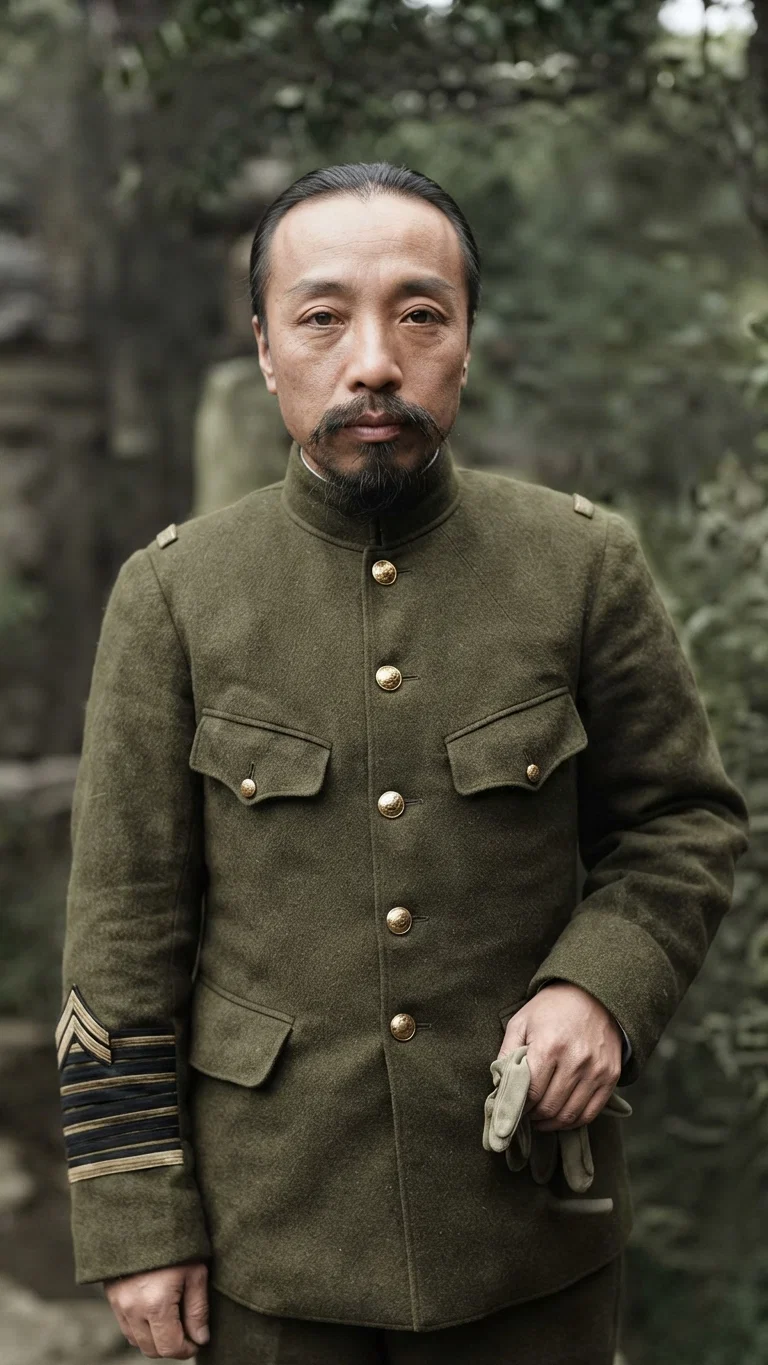
Jui Chung, the viceroy of Wuchang, who fled to Japan. Both sides have a price upon his head.
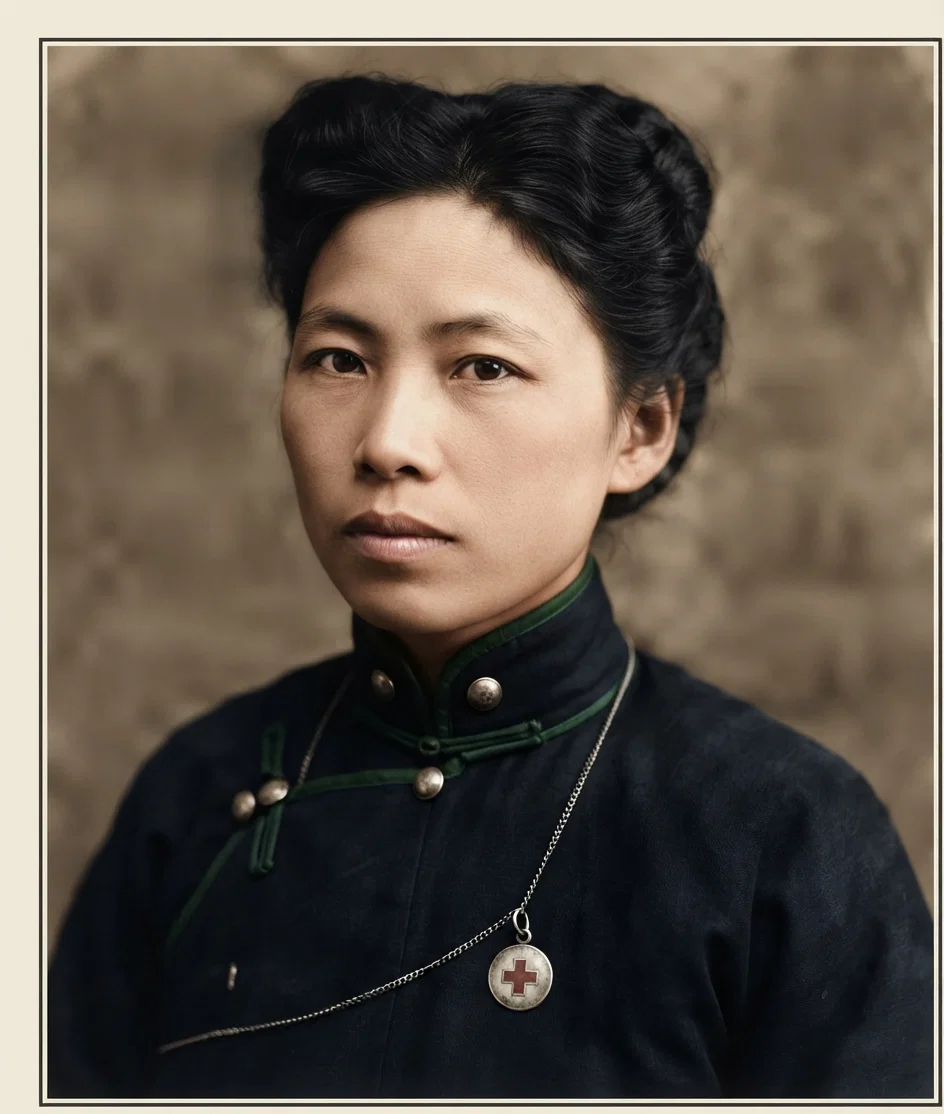
Dr. Chang Chu Chun, head of Red Cross volunteers in Shanghai
All these things are my own fault. Hereby I announce to the world that I swear to reform, and with our soldiers and people to carry out the constitution faithfully, modifying legislation, developing the interests of the people, and abolishing their hardships, all in accordance with the wishes and interests of the people.
Being a very small person standing at the head of my subjects, I see that my heritage is nearly falling to the ground.
Now finances and diplomacy have reached bedrock. Even if all unite, there is still fear of falling. But if the empire's subjects will not regard nor honor the State, and are easily misled by outlaws, then the future of China is unthinkable. I am most anxious by day and night. I only hope my subjects will thoroly understand.
Immediately following this move, comes the resignation of the whole imperial cabinet, and the appointment of Yuan Shi Kai as the premier, with power to select his own cabinet.
Will these wholesale concessions satisfy the people? A month ago they would have more than satisfied them. Now very likely it is too late. Nothing will satisfy the people now but the downfall of the Manchu Dynasty and the establishment of the new Chinese republic, the kingdom by the people for the people.
F. E. STAFFORD.
A Methodist on Mormons
A STRANGE defender of Mormonism is a Methodist minister who has recently written an article in the New York Outlook. According to Current Literature for November, Mr. Fisher declares that to understand Mormonism, one must understand first that it is a deeply religious body, "an evangelical Protestant church if the test of the Federal Council of Churches be a true test." He says: "It is to-day a church of half a million praying, Bible-reading, law-abiding, thrifty, God-fearing men and women. America has no more strong, genuine, devoted Christians than some of the 'first presidency,' apostles and leaders of the Mormon Church." The second thing to remember is that the Mormon Church was born of some of the best blood of England and the Middle West in the early days; and thirdly, that they are not peasants or illiterate. Their leaders are graduates of Harvard, Cornell, Michigan, or German universities, and some of their young men lead the world to-day in scholarship.
Now Mr. Fisher, and every other man who truly understands Christianity, ought to know that mere intellectual education, or mere descent according to the flesh, has absolutely nothing to do in demonstrating the truthfulness or falsity of a religious system. The whole history of the world is proof of the statement. As to whether it is an evangelical Protestant church, the only test of that is the Bible. And measured by that test, certainly Mormonism is not evangelical. It does not know Jesus Christ, Creator and Redeemer. And it has been demonstrated in actual courts of law, contrary to the statement of Mr. Fisher, even tho he lives in Utah, that polygamy is not dead. He does admit, however, that Mormonism is in politics; but the object of world empire, Mr. Fisher says, does not constitute a sin. Yet the root idea of sin is missing the mark; and surely a world-wide Mormon empire, or a world-wide empire of any other religion, is a tremendous missing of the mark. Current Literature intimates that the frank utterance of Mr. Fisher may cost him his pastoral position in the Methodist Church. His bishop declares that he expects his resignation. If this be so, Mr. Fisher will probably find a home in the Mormon Church.
The McNamaras and the Condition of the Country
By Editor
JUST now the sensation of the country is the confession of the two McNamara brothers in Los Angeles. The country is scanning the papers eagerly each day for the accounts of the promised arrests of others "higher up" in the labor world.
It is averred that the evidence is in hand to show that a great conspiracy has been formed among labor leaders to intimidate capital by a wholesale use of dynamite. The confessions of the McNamaras clinch the evidence, and the United States Government is to step in to stop "the conspiracy to advance crime."
The McNamaras have confessed to one of the most dastardly wicked crimes that could have been conceived. When they planned the exploding of that bomb in the Times Building, they had no means of knowing how many lives would be sacrificed, and perhaps they did not care. Other bombs were placed to explode at the same time, and it is evident that they were designed to destroy the lives of other men who had been active in the capital and labor controversy.
Now that the McNamaras have confessed their guilt, and, as is stated, "have involved a lot of the higher ups," there seems to be a disposition on the part of capital to push the prosecution hard in order to take advantage of the strong sentiment that has been aroused by the confessions that have been made. But it must be apparent to any one that this will make the controversy only the more bitter and determined.
The discussions that have centered around this case, and the light that has been thrown on it by these unexpected confessions, incidentally show some conditions in the country that should cause men to think. It has been proved and also admitted that wholesale bribery has been resorted to in this McNamara case. Money running up into the hundreds of thousands of dollars has been placed at the disposal of those who were making their defense. This shows a shameful condition of corruption. But it must be admitted that the briberies that have marked this case are only a sample of the conditions that are coming to obtain all through the country. Bribery was one of the great features of the notorious cases that so recently attracted the attention of the world to San Francisco, and it crops out in all parts of the nation, and is no worse in this nation than in the other nations of the globe.
Greed for money and for power is cursing the world, and it is getting worse and worse, and will continue still to get worse as the days come and go. Capital has organized and combined so as to squeeze out of the people every dollar that it possibly can. And labor has followed the example of capital and also perfected colossal international combines, and the rank and file of laboring men place hundreds of thousands of dollars in the hands of their leaders with which to wage their wars. The conflict has become tense, and between the leaders of both capital and labor the common people are continuing to be ground as between the stones of the mill, and the end is not yet. There is an abundance in the world to supply the needs and give comfort to every individual. But greed, greed, greed, is clutching at everything of value, and the scramble grows in intensity.
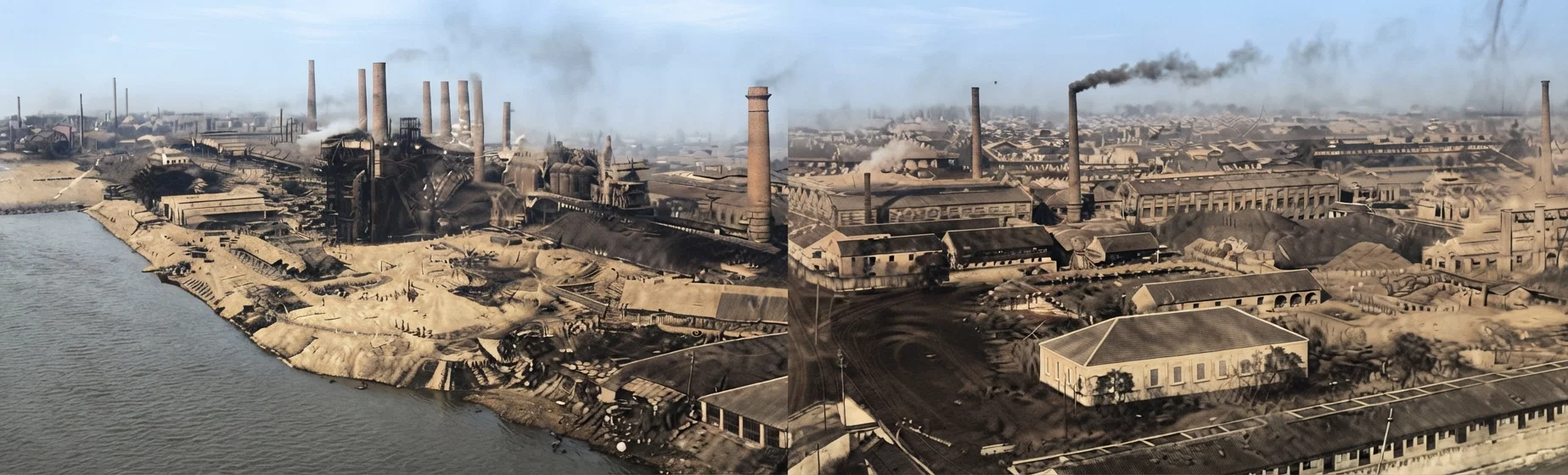
Hanyang iron works, the largest in China, and a great help to the revolutionists, who early captured it; Hanyang arsenal, in possession of the revolutionists, now turning out arms and munitions of war
What is the meaning of it? do you ask? Let a word of Scripture make the reply: "But know this, that in the last days grievous times shall come. For men shall be lovers of self, lovers of money." 2 Tim. 3:1, 2. Love of self and love of money, says Inspiration, are to make grievous times in the last days. And farther on in the same chapter the same apostle says, "Evil men and impostors shall wax worse and worse, deceiving and being deceived."
Things are bad enough now. What will they be as they continue to "wax worse and worse"? The one bright ray of hope is that when crime reaches the point that it seems about to engulf the earth, then the blessed Jesus of Nazareth will come in person to put an everlasting end to it. Nothing could be clearer than the prophecies which show it. Are you studying them?
Insect Pests and the Signs of the Times
Any one who has ever eaten imported figs has, upon breaking some of them open, found them full of little worms. The Government is12finding out that these worms produce moths that again produce their kind, and these little worm pests are becoming quite a menace to the dried fruit industry of the country, as well as spreading their depredations to grocery stores by infesting the various grains, such as rice, wheat, etc. International travel not only permits men to go from place to place, but through the exports of various kinds of foods many of these insect pests which previously have been confined to some particular locality are gradually spread over the earth. One of the strongest departments that the national Government has to sustain is the department of entomology. It is interesting to follow the work and development of this department, for we know that according to the prophecy of Joel insect pests are to become more and more numerous until it will become almost impossible to reap any kind of crop. This is one of the striking signs of the times in which we are living, and men should watch it with interest. Sometimes people laugh when this matter is suggested, but if you persist in laughing, do not forget to watch the developments, for the departments of entomology in the various nations of the world will have more and more to do until they are finally overwhelmed with their tasks. If you have never read the short prophecy of Joel with this thought in view, please do so.
Labor and Capital
By Editor
Labor and Capital.—It is an interesting, illuminating, and well-written story that Henry White, formerly president of the Garment Workers' Union of the American Federation of Labor, gives us in the World's Work, closing in the November issue. His theories seem to be borne out by facts, and his statements are abundantly illustrated by events. His last instalment states that the contrast in the character of violence a few years ago and now is significant. Then it was sudden, capricious, spontaneous, emotional; "now this violence has the marks of premeditation and direction. It occurs between strikes as well as during strikes. A systematic terrorism prevails in many organized trades," manifested in explosions, isolated assaults with special weapons, etc. These things are justified on the ground that they are good for the group as against the individual. The open shop is a call to battle. He closes by saying: "It has been found that the labor conflict implies more than a quarreling over pay, to be met by a splitting of differences—that it has to do with underlying human nature. The question still remains open and acute." Its only settlement, we have often pointed out, can be wrought through Jesus Christ upon the individual life.