The Christian religion is itself educational, and has been the builder and fosterer of educational institutions. The sad thing is that Christian men have not held and controlled the institutions which Christianity has founded. Yale owes its existence to the Congregationalists; Princeton, to the Presbyterians; Chicago, to the Baptists. The University of California was once a denominational school—California College. Such are instances. These institutions have grown materially and in numbers far beyond the dreams of their founders; but the religious education is in the past. They are great worldly institutions now, with skeptical tendencies, to say the least. The College of California was opened as a religious school in 1880 with an enrolment of eight students. November 1, 1911, it had under systematic instruction in its various subdivisions almost 7,000 persons, nor does this include a large and increasing number who avail themselves of lecture courses and special instruction.
Shallow Conceptions.
One paper, in reporting the confessions of the McNamara brothers, said:
But out of all the crowded day's developments, that which stands out with compelling distinctness is the sacrifice which each of the McNamaras attempted to make for the other.Fiction holds no parallel to the extraordinary self-sacrificing devotion evinced by each brother for the other in this the supreme crisis of their lives.Sentiment of the truest and most tender character shines out in this the last chapter of a tragic story.
But why should they confess? The next sentence tells us:
No hope of escaping the penalty for their crimes actuated the two McNamaras.
We confess that we do not see the noble sentiment exalted by this newspaper. Two criminals come to that place where for weeks their lawyers have no hope, and they are brought by their counsel to see that there is no hope; knowing that they both are guilty, that this guilt will be proved, then they confess, and each wishes to save the other from what he knew was inevitable. We are not judging these men or any others; but on the face of this report, taken at its best, all such sacrifice and love does not reach the primer of Christianity. True brotherly love would have felt for the men working in the Times Building.
The Burden of War.
In the United States there are 1.86 soldiers to 1,000 population; in Japan 4.51 to 1,000; in England 8.44 to 1,000; in Germany 11.29 to 1,000; in Russia 11.68 to 1,000; in France 15.13 to 1,000. Russia spends 27 per cent of her total expenditures on her navy; Japan 27 per cent; France 26; United States 32; Germany 37; England 38.5. It is an awful burden for the navy alone. What would we think of a man in private life using from twenty-seven to thirty-eight per cent of his income in purchasing or building deadly weapons of war, and that in a time of profound peace?
One of the races of strong individuality in the world is the Jewish. They have mingled among other nationalities everywhere nearly, and preserved their racial characteristics; but the Jews in China, who twenty centuries ago formed a strong colony, have succumbed to the overpowering influence of the Chinese. William Edgar Geil, in his book "The Eighteen Capitals of China," tells us that there are only seven families remaining. Some had turned Buddhist, some Moslem; but they still eat no pork, nor worship idols, nor burn incense to their ancestors. This poor remnant is found in Kaifong.
It is reported that the tobacco users of the country are asking Dr. Wiley to go after the adulterators of cigars and tobacco, it being generally understood that there is much adulterating matter used in the manufacture of these goods. The genuine are bad enough, and all can be dispensed with in the interest of morals, health, and economy. Hence it would be better to give up the use of tobacco, and if all would do this the adulterations would have to stop.
Practically one hundred million dollars' worth of domestic merchandise from the United States was transported across the isthmuses of Panama and Tehuantepec in the fiscal year 1911 by way of the two railway lines connecting, in the one case, Panama on the Pacific with Colon on the Atlantic, and in the other, Salina Cruz, the Pacific terminal, and Tehuantepec with Puerto Mexico on the Atlantic. Traffic by way of Tehuantepec began January 1, 1907.
The town of Hancock, Michigan, has adopted the plan of having all the names of all her habitual drunkards posted in the various saloons of the city, and has appointed a man whose duty it is to see that the names are sought out and kept in place.
Our Work and Workers
By Editor
From Pitcairn Island
BROTHER J. R. MCCOY, who is at the head of the little colony in Pitcairn Island, writes under date of October 7 (the letter just reaching us), that “September 25 a heavy gale from southeast and south, then from all around the compass, lasting for two days, with heavy showers of rain, had visited the island, causing the greatest destruction of everything in the island since it was inhabited. Many houses were blown down, among the largest of which was Moses Young’s dwelling, 60x30, boys’ home at Shady Nook, 80x30, Gates’s house at Flatland, 40x20, and others rendered unsafe to stay inside. But few banana trees were left standing, thousands were destroyed, some coconut trees were blown down, and others ruined for ten or twelve years. All field crops were destroyed, such as beans, corn, young sweet potatoes, save a few that were ready for digging.” The only thing that they have to depend upon for a living at present, if assistance does not come through a kind Providence, is the few sweet potatoes which are left, and the few remaining coconut tops—that is, the branches themselves. Several goats, he tells us, were killed by falling trees during the storm, and hundreds of chickens. “But,” he concludes, “thanks to our loving Father, there is not a human being hurt or killed. The sea was terrible, and went into the boat sheds, and one boat was damaged. The weather is fine now, and much work is being done in cleaning up the island and repairing the houses, and in looking after the fields.” Any of our readers who desire to help the islanders in this awful time of need may send offerings direct to the SIGNS OF THE TIMES, and we will gladly forward it.13(Continued on page 15)
Our Work and Workers
(Continued from page 12)
Off to the Fields.—Accompanied by Miss Eunice LeMaster, a stenographer and office helper, Elder I. H. Evans and wife sailed from San Francisco Wednesday, November 22, for China, on the Tenyo Maru. Elder Evans is one of the vice-presidents of the General Conference, and in charge of the Asiatic Division. Elder Elbridge Adams and wife, and Mr. Floyd Ashbaugh, under appointment to the Philippines, sailed on the same boat. Elder F. L. Perry, wife, and son sailed from New York Monday, November 20, for South America. He was accompanied by Miss Cassie Wilson, and Elder Henry Meyer, wife, and three children. They are all to engage in mission work in various parts of South America. B. B. Aldrich, wife, and child sailed from New York Wednesday, November 15, for the Canary Islands, off the west coast of North Africa, where they will open a new mission station. They will also provide a place for workers on the Gold Coast, West Africa, for rest and recuperation.
SABBATH, November 4, nineteen souls at Buffalo, New York, were baptized. Over twenty more, who are obeying the Lord, will soon go forward in this ordinance. A German church of fifteen members has been organized at this place. A church was also organized at Troy, on Sabbath, November 18, consisting of thirty-one members.
THE first Norwegian church in the State of Iowa was organized on November 4, at Decorah, with a membership of fifteen. Another new church, consisting of thirteen members, was organized at Shellsburg, on November 18. Two were recently baptized at Davenport.
SIX young persons, all members of one family, were recently baptized at Culbertson, Nebraska. On Sabbath and Sunday, November 4 and 5, a new church building was dedicated at North Platte. This church was dedicated free from debt.
FOUR at Blueford, Illinois, have taken their stand for present truth, and several more are deeply interested. Four persons came over from Orchardville on a recent Sabbath, and received baptism at Blueford.
EIGHTEEN persons were baptized at the close of the camp-meeting at Sanford, Florida, and ten at the close of the meeting for the colored people. A new church was dedicated at Orlando October 14.
SEVENTEEN conversions in Denver, Colorado, are reported, the result of a tent effort conducted at that place. Three have been baptized at Capitol Hill.
FOLLOWING a tent effort at Citronelle, Alabama, eleven took their stand for the message, seven of whom have already united with the church.
ON a recent Sabbath three at Philadelphia, Pennsylvania, were baptized, and united with the First African Church at that place.
THIRTEEN at Melrose, Massachusetts, have recently been baptized, and united with the Sanitarium church at that place.
SEVEN at Wewoka, Oklahoma, have accepted the truth. Baptism was administered to six at Afton, and three at Washington.
DURING the last year and a half about one hundred German persons in Oklahoma were baptized.
THE summer's campaign among the colored people in New York City resulted in seventeen conversions.
TWENTY at Hopewell, Oregon, have been baptized, two at Gravel Ford, and eight more at Portland.
A SABBATH-SCHOOL of forty-five members has been organized at Lufkin, Texas.
FIVE at La Plata, Missouri, have expressed their intention to obey the message.
BAPTISM was recently administered to four souls at Indianapolis, Indiana.
FIVE at Cottage Grove, Oregon, were baptized on a recent Sabbath.
THREE Hollanders at Paterson, New Jersey, have been baptized.
SIX members have been added to the church at Cambridge, Idaho, five by baptism and one on profession of faith.
NINE souls at Ruston, Louisiana, have embraced the truth.
FOUR souls at Butte, Montana, recently received baptism.
TEN at New London, Wisconsin, recently received baptism.
TWELVE at Eureka, California, have accepted the truth.
A Pitiful, Unchristian Thing
By Editor
A Pitiful, Unchristian Thing.—An Oklahoma paper, the Boynton Index, of November 24, tells of a disgraceful occurrence in that little town. It appears that a Baptist "evangelist" began a series of revival meetings. As he is a "special enforcement officer" of the prohibition law, he undertook to clean out saloons. With a number of citizens, he demanded that a certain saloon-keeper should close up. The saloon-keeper cursed the "evangelist," and the evangelist knocked the saloon man down, who seems from another paper to have been a cripple. He cursed again, and the minister of the law struck him again, whereupon the saloon man declared he was going for his gun. The minister borrowed a gun from a man, and shot the saloon man, who fell dead almost instantly. The minister gave himself up, and was released on $5,000 bail! Think of it! Think of an "evangelist" doing work of that sort! Think of a professed ambassador of the Prince of Peace taking life with carnal weapons! Think of a "Baptist" "evangelist" as an officer of the State executing law and taking life instead of seeking to save it. Hear Jesus: "For the Son of Man is not come to destroy men's lives, but to save them." Luke 9:56. Hear Paul: "For the weapons of our warfare are not carnal, but mighty through God to the pulling down of strongholds." 2 Cor. 10:4. "Knowing therefore the terror of the Lord [not, we destroy men, but], we persuade men." 2 Cor. 5:11. We do not know the saloon man; but whether black or white, Hindu or Hottentot, Eurasian or Esthonian, Irish or Italian, German or Greek, Norman or Negro, he was a human, with all the potentialities, through Christ, of noble, immortal manhood. No minister of the Gospel has any business to become a minister of law. We are grieved for the cause of Christ. We pity the poor deluded "evangelist" who mistook his calling. We are sorry to see any paper or man defending such a course.
Our Work and Workers
By Editor
“Blessed Are the Peacemakers”
WHEN men, urged on by selfish interests, are waging warfare, burning homes, slaughtering humanity, how good it is to know that other souls are sacrificing all that life holds dear to carry the blessed message of the Gospel of peace to hearts that are at war with God and hence are not at rest! China in some parts is devastated by war, but notwithstanding this the Gospel of peace is going forward. It may be hindered a little for a time, but God is overruling human ambition, human greed, and human hate, to make things better in China, and give greater freedom to God’s Word. Our report of funds is for two months. All are open, and the fields are needy:
CHINA PRESS
Previously reported
$591.48
Nebraska Conference
1.00
Mrs. B. Montgomery
3.75
A Friend
33.24
Mrs. J. A. Hardy
3.65
A Friend
1.46
Fred Hopcroft
5.00
A Friend
3.41
C. Kommenoh
2.50
A Friend
8.62
George Benner, Sr.
2.50
Mrs. Nellie Lytle
3.00
Mrs. C. H. Richardson
.40
G. D. Lyons
50.00
“Mobile”
7.50
Lewis Witsten
.50
Mrs. Mary C. White
1.00
Mrs. George L. Arkebauer
1.00
Total
$720.01
JAPAN
Previously reported
$33.75
Through “Our Little Friend”
11.00
Total
$44.75
INDIA MISSION
Previously reported
$173.80
Eva May Peterson (Hindu widows)
9.00
C. Kommenoh
2.50
George Benner, Sr.
2.50
G. D. Lyons
12.40
“Mobile”
2.50
Total
$202.70
KOREA
Previously reported
$60.32
Emma E. Ochs
.65
Total
$60.97
BURMA
Previously reported
$16.27
Olive Kearns
1.36
Total
$17.63
HOME AND FIRESIDE
By Mrs. M. Smith
A Christmas Basket
HERE! At last I have everything ready. O, what hard work it is to get suitable gifts for all of my friends! The hardest one to suit is Ethel Jordan, but she certainly can not find any fault with this beautiful brooch. It cost so much more than any of the other presents. "I wonder what she is going to give me!"
These words were uttered by Julia Delman, as she stood looking with satisfaction upon the different packages just done up, and tied with pretty ribbons, ready to send away to her friends.
"What a lot of work," she sighed. For several weeks she had gone from one store to the other to find what she wanted, and at last she was satisfied.
As she stood looking upon her work, a shiver went through her when she heard the wind whistle and saw the snowflakes come dancing down on the window-panes. She went to the window and looked out on the street. The sleigh-bells jingled, and the people were hurrying back and forth with their arms full, laden with Christmas packages. They did not feel the cold wind nor care for the snow blowing in their faces. They were too much taken up with the spirit of Christmas to care about the weather.
Julia stood looking at the scene. Her eyes fell upon an old woman who walked with feeble steps on the other side of the street. She looked cold and frozen, and carried an empty basket on her arm. As her form swayed in the wind, her thin clothing hardly covered her limbs. Julia watched her until she turned the corner; and as she gazed after the vanishing figure, she heard a voice saying, "I was an hungred, and ye gave Me no meat: I was thirsty, and ye gave Me no drink: I was a stranger, and ye took Me not in: naked, and ye clothed Me not: sick, and in prison, and ye visited Me not." The voice was so audible that Julia turned around to see if some one was in the room. The door had been left partly open, but no one was there. She was ready to say, "Lord, when saw I Thee an hungred, or—" but ere she finished the sentence, the voice answered, "Inasmuch as ye did it not to one of the least of these, ye did it not to Me."
The old woman's frozen hands and empty basket came up before her eyes. She began to feel a little uneasy. She professed to be a Christian, and these Bible verses were not unfamiliar to her. She turned to the table where the Christmas presents were piled up, but the interest in them was not quite the same.
Again she heard the voice: "For if ye love them which love you, what reward have ye? do not even the publicans the same?"
Now Julia commenced to make excuses: "I can not see that it is a sin to give one's friends a Christmas present. Every one does that. We can not shut ourselves out from everything that we love, and it certainly is not wrong to give those whom we love a present."
While she was thus reasoning, the sound of Martha's rich contralto voice was heard from the kitchen:
I gave, I gave My life for thee;
What hast thou given for Me?
"I wish Martha would do her work and not always be singing!" She felt like putting her fingers in her ears and running away, but she could not move. She sank down in a chair, and, laying her face in her hands, she said to herself, "What have I done for Thee?" Again the old woman stood before her eyes. Could she be one of His little ones? Then she began to examine herself. What had she done for her Saviour all these years during which she had professed to be a Christian? To be sure, she had gone to church and Sabbath-school, but really to sacrifice anything for her Saviour, that she had not thought much about.
Still the melody from the kitchen came pouring in:
I suffered much for thee,
More than thy tongue can tell,
Of bitterest agony,
To rescue thee from hell.
"I suffered much for thee," repeated Julia. A vision of Jesus began to appear before her, not as a babe in the manger—as one thinks of Him at Christmas time; but she saw Him in Gethsemane in agony of soul, His form prostrated on the ground, sweat falling from His brow as great drops of blood. She followed Him to Calvary, and saw Him stagger under the heavy burden of the cross. She beheld Him hang between two malefactors, suffering the cruel death.
She could endure the sight no longer. Casting herself on her knees, she cried for mercy, and that the blood which was shed on the cross might wash her sins away. As she lay pleading, the same voice whispered, "Tho your sins be as scarlet, they shall be as white as snow; tho they be red like crimson, they shall be as wool."
Martha had entered the dining-room, and was arranging the table for dinner. She was chanting in a soft, subdued tone the anthem:
Glory to God in the highest,
And on earth peace,
Good will toward men.
As the sweet notes poured into the room where Julia was, so the sweet peace and joy poured into her soul; and before she realized it, she leaped to her feet, singing:
Blessed assurance, Jesus is mine!
O, what a foretaste of glory divine!
Heir of salvation, purchase of God,
Born of the Spirit, washed in His blood!
There were sunshine and joy in her heart and soul now. Wiping the tears from her eyes, she looked around. It seemed as if everything had changed. The storm had ceased, and the sun was peeping out between the clouds. She heard the bells and the merry crowd out on the street, and it seemed to her that even they had changed. But the change was in her own heart.
She turned and looked at her Christmas gifts; and before she knew it, she was saying, "Inasmuch as ye did it not to one of the least of these, ye did it not to Me." She began to open the packages one after another. A knock came at the door, and Martha entered, saying:
"Mis' Reynolds, president of the Missionary Society, come to ask would you give sompin' for a Christmas tree for poor children."
"For poor children!" repeated Julia with joy. Then added: "Martha, tell Mrs. Reynolds to come right in. I am so glad she has come."
Martha wondered, as she turned to go out, what had come over Miss Julia. But when she heard the story Julia told Mrs. Reynolds, she said, "Praise the Lord," and went into the kitchen.
Julia assured Mrs. Reynolds that the Lord had sent her; and she, with her own deep Christian experience, also saw the wonderful work of the Lord.
Through Mrs. Reynolds Julia learned the old woman's name and address; and after her departure, she took the beautiful brooch down to Mr. Martin, the jeweler. Mr. Martin greeted her with a pleasant smile and nod, thinking that now he had a good sale before him. Julia told him her wonderful experience from beginning to end, and, when finished, handed him the brooch. "I must fill up that woman's basket with this," she said.
Mr. Martin had listened to her story with deep interest, then silently he took the brooch and put it back in the case. Taking from the drawer currency twice the amount Julia had paid, he handed it to her.
"I also must help to fill the basket."
His Boundless Love
An old soldier walked up and down the streets of Vienna playing a violin to earn his daily bread. After a time his hand became feeble and tremulous, and he could no more make music. One day the old man sat on the curb weeping. A man came along and said:
"My friend, you are too feeble to play; give me your violin."
He took the instrument and began to discourse most exquisite music. People who were passing stopped. A crowd gathered. While the stranger played the violin, the old man held his hat, and into it fell the coins which the enraptured townspeople willingly gave. When the hat was full the stranger said:14"Now put that coin in your pocket, and hold your hat again."
Then the man played more sweetly than he had before, and the tears ran down the faces of the people who listened. When the hat was filled the second time, the violinist dropped the instrument and passed on.
"Who can it be?" the people exclaimed. "Why," said a man in the crowd, "it is Bucher, the greatest of violinists."
And so it was. He just took the old soldier's place, and assumed his poverty, and shouldered his burden, and played his instrument, and earned for him the coin he needed so much.
That is precisely what Jesus did for us. He found us in poverty and distress and across the broken strings of His own broken heart He struck a strain of infinite music which called forth the plaudits of earth and heaven. He stood in our place. He assumed our poverty. He carried our burden. — Christian Herald.
Dwell with Us
(One stanza belonging to the poem on our cover page)
Dwell in our homes, most holy One, forever;
Dwell in our hearts, and "God with us" abide.
Be Thou our peace along life's dreary pathway;
When shadows deepen, be our strength and guide.
Peace on the earth! We hear the joyful story.
Peace unto all, help us, O Lord, to tell,
That souls may find "God with us," now and ever,
Immanuel! Immanuel!
Temperance Brochures
A Chat with My Tobacco-Using Brother
A brotherly heart-to-heart talk with his tobacco-using friends, by Mr. R. W. Parmele. Some of the questions considered are: Do You Use Tobacco for Moral Benefit? Are You Benefited Mentally? Is Tobacco-Using Beneficial Physically? Does It Pay? Does It Increase Your or Your Neighbor's Happiness?
Contains eight pages. Price, 50 cents a hundred.
SUNSET LIMITED—TRAIN DE LUXE
In accordance with announcement made some weeks ago, the Southern Pacific Company, on Tuesday last, re-inaugurated its famous "Sunset Limited" service between San Francisco, Los Angeles, and New Orleans, giving the State of California one more splendid train de luxe to connect it with the East. The "Sunset Limited," which represents the very highest type of latter-day railroad construction, will leave San Francisco every Tuesday and Friday, arriving at the Southern metropolis the following Friday or Monday, as the case may be. Coming westward the train will leave New Orleans every Monday and Thursday, arriving in San Francisco on Thursdays and Sundays. The running time between the two cities is thus shortened twenty-four hours — or one full day.
Every luxury which the human brain could devise for the comfort, enjoyment, and safety of transcontinental railway passengers has been employed in the construction, equipment, and proposed operation of the "Sunset Limited." For the busy man there are stenographers, valets, barbers, telephones, special mail boxes, daily stock reports, and the like; for the ladies there are maids, manicures, hair-dressers, electric fans, writing-rooms, and an elaborate array of current magazines, popular fiction, etc.; while for every one there are the diners, the observation cars, the shower-baths, electric lights, buffet, and a hundred other large and small conveniences. "Sunset Limited" is a train de luxe in every particular.
A trip to New York City via "Sunset Limited" offers many delights. Whirling across the continent for three days, the traveler lands in New Orleans, "the Carnival Capital of America," and one of the most interesting and captivating cities in the world. After spending as many days as the traveler pleases in the Creole city, he (or she) may board one of the Southern Pacific liners which ply across the Gulf of Mexico and up the Atlantic coast to New York. In this way a delightful break in the otherwise tedious coast-to-coast trip is accomplished. First-class tickets from San Francisco to New York are good on the Southern Pacific vessels.
Thousands of dollars have been expended by the railroad company in an effort to make the "Sunset Limited" a peerless conveyance for the discriminating transcontinental traveler. The all-steel Pullman cars which compose the train have been especially constructed for this new service, and all elaborations have been made with the idea of insuring the comfort of "Sunset Limited" patrons.
The Emmanuel Children's Home, of Mountain Grove, Missouri, has added a self-supporting department, and will gladly send a beautiful catalog and colored circulars describing and showing over one hundred and eighty Scriptural text wall cards and mottoes retailing at from 5 cents to 25 cents each. Be sure and send your address at once before Christmas. Their line will please every one.
Food; Its Mental and Moral Value
Says the author, "God can not make or keep a man or woman pure who persists in keeping his or her blood at fever heat with condiments and stimulants."
A leaflet that will especially recommend itself to housewives.
Eight pages; 50 cents a hundred.
from "It Doesn't Pay."
From "It Doesn't Pay."
It Doesn't Pay
Made up of the following articles: It Doesn't Pay, Charged with Murder, He Saves to the Uttermost, Disease and the Remedy, and What He Lost.
Filled with very valuable statistics, and fully illustrated.
Sixteen pages. Price, one dollar a hundred.
"I am not alone responsible for the murder of my wife!" From "It Doesn't Pay."
From “It Doesn’t Pay.”
The Demons' Council
By Editor
We quote the following from the first page of this unique document: "And it came to pass that in the process of time Satan called a great council of all his evil angels, and said, 'Who will take the world captive for me, and ensnare the souls and bodies of men? Whoever will do this shall sit next to me in my throne of disgrace, and I alone will be more vile than he.'"
A startling way of illustrating the power of the wine cup.
Eight pages; 50 cents a hundred.
THE NAME
A very touching story of how the "Name" took away the taste for drink from a poor native of South Africa.
In relating his last temptation and victory, the old heathen said: "When I was going to the canteen, all at once the old disease came back. I felt it burn in me. I wanted the drink. I felt it all over my body; the sickness was on me again. I was so frightened; but just as I was half way to the canteen, there by that bush, I called out softly three times, 'Jesus! Jesus! Jesus!' and the disease just left me at once, and my body felt cool, and I turned back; and so, wife, you see it's just a Name."
Sixteen pages. Price, one dollar a hundred.
Drunkenness and Crime
That drunkenness and the resulting crime are signs of the times, is one of the points made in this valuable booklet. It also takes up the Bible side of the question in a very forcible way.
Taken as a whole, it is a document calculated to make the reader think, and enable him to act intelligently.
Sixteen pages. Price, one dollar a hundred.
Prohibition and Sunday Legislation
If it is right to work and vote for prohibition, is it not equally right to vote for Sunday laws? A very important question, and one that is satisfactorily answered in this leaflet.
Sixteen pages. Price, one dollar a hundred.
Medical Use of Alcohol
Filled with such expert testimony as the following from the late Dr. N. S. Davis, who was known as the "Father of the American Medical Association:" "I have found no case of disease and no emergency arising from accident, that I could not treat more successfully without any form of fermented or distilled liquors than with."
Twelve pages. Price, 75 cents a hundred.
Address your state tract society, or
Pacific Press Publishing Association
Mountain View, Cal.
61 Park St. N., Portland, Oregon
1109 E. 12th St., Kansas City, Mo.
Box 1599, Calgary, Alberta, Canada
ELO THE EAGLE
By Floyd Bralliar
AND OTHER STORIES
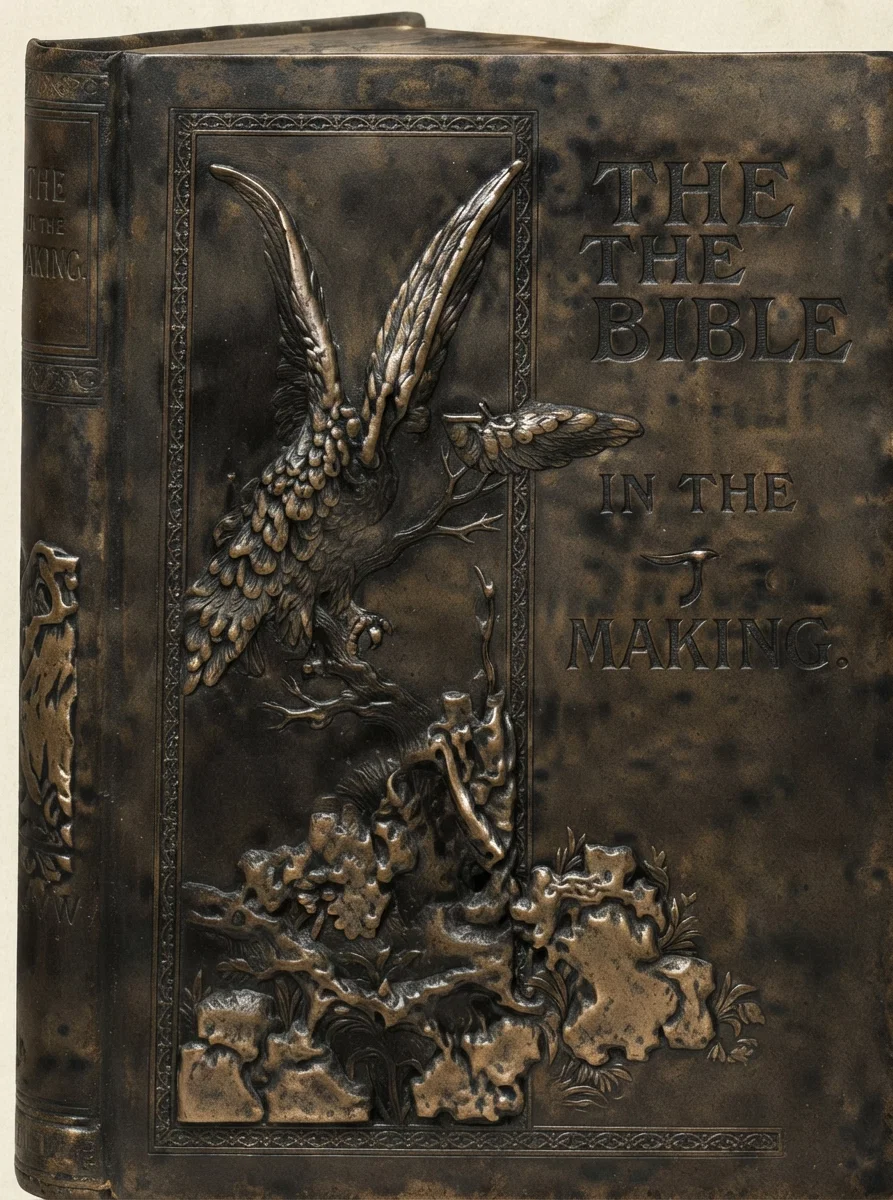
THE BIBLE IN THE MAKING.
BY FLOYD BRALLIAR
THIS new animal book for young folks is receiving an eager welcome by all nature lovers. ELO THE EAGLE is the first of a series of ten interesting stories of animals, wild and otherwise; being, with one exception, the life histories of boyhood friends of the author. Many strange and laughable anecdotes are related by Mr. Bralliar, all of which are strictly true and vouched for by reliable witnesses.
The book is lavishly illustrated by special drawings, with a full-page half-tone design printed in Luxotype at the beginning of each chapter. Two hundred pages, printed on egg-shell paper, beautifully bound in red cloth. Price, post-paid, $1.00.
Easily sold by young people. Agents wanted.
Pacific Press Publishing Assn.
Mountain View, California
Portland, Ore. Calgary, Alberta Kansas City, Mo.
The Vegetarian Cook Book
By E. G. Fulton
By E. G. FULTON
THE author has had years of experience in vegetarian cookery and in the management of vegetarian cafes and cafeterias. With its aid the chef, cook, or housewife is able to prepare appetizing, healthful meals without the use of any flesh food.
This book contains 419 pages, including a handy and well-arranged index of all the recipes given.
Tastily bound in cloth, price, post-paid, $1.00
Pacific Press Publishing Assn.
Mountain View, California
Portland, Ore. Calgary, Alberta. Kansas City, Mo.
Wanted
CLEAN copies of Seventh-day Adventist literature, by G. D. Bennett, 1023 Rockton Avenue, Rockford, Illinois.