When John the Baptist was preaching to the people, on a certain occasion, the soldiers “demanded of him, saying, And what shall we do?” His reply was, “Do violence to no man, neither accuse any falsely; and be content with your wages.” This incident is cited by certain religious “patriots” as an argument that Christians may properly join the world’s armies. They say that “John did not exhort the soldiers to leave the army.” That is very true; but he was preaching to men already in the army, and of course he would not advise them to desert, and, if captured, lose their lives. However, if they would “do violence to no man,” of how much use would they be in battle? A soldier is especially drilled to do all the violence in his power to the enemies of his country, while the Christian is emphatically enjoined to “resist not evil; but whosoever shall smite thee on thy right cheek, turn to him the other also.” To “be content with one’s wages” was good advice; for being discontented would not raise the wages, and in whatever place one may be situated, “godliness with contentment is great gain.” If one should be converted while in the army, let him do as any other convert should, trust his case to God, who will work out the problem for him. But no one can point to any words of John the Baptist counseling his converts to enlist in any worldly army.
W. N. G.
Not a “Christian Nation.”
By W. N. G.
We often hear the so-called patriotic sentiment that the 266 American lives lost by the sinking of the Maine must be “atoned for by the lives of Spaniards.” This sentiment is entirely retaliative, and wholly infidel. If the destruction of those lives was wrong—and it surely was if premeditated—then the life of every Spaniard in the world would not atone for the deed. This is not because the life of a Spaniard is not worth as much in the sight of God as the life of an American, but it is because no atonement for the loss of life is worthy the name that does not include the sin attached to that life. From this point of view, all the lives in the universe (save One) could not atone for one of the victims of the Maine disaster. Therefore, supposing that catastrophe to have been deliberately premeditated, to destroy any more lives on that account is to add murder to murder. The taking of human life as an atonement for the loss of life does not at all comport with the claim that “this is a Christian nation.” Indeed, the present attitude of our government is sufficient proof that this dictum of the Supreme Court is erroneous, and that Washington’s treaty with Tripoli was right, which declared that “the government of the United States is not in any sense founded upon the Christian religion.” W. N. G.
PATRIOTISM AND RELIGION.
HERE is a characteristic picture of these days of confusion, when so few seem to know how to discriminate between religion and patriotism, because they do not know the religion of Jesus Christ. It is a despatch to the St. Louis Globe Democrat:—
“Chicago, Ill., June 12. During the morning service to-day in Fullerton Avenue Presbyterian Church, the pastor, the Rev. J. A. Redthaler, noticed among his congregation an army officer in full uniform. Postponing his service, he expressed the hope that the soldier would speak, and induced him to ascend the lecturn, where he was introduced as Captain Charles T. Wilt, Jr., Company G, 1st Illinois Volunteers, in Chicago on recruiting duty.
“Captain Wilt talked of the volunteers and of the war. When he spoke of the war and the sacrifices the volunteers were making to free Cuba, the church rang with applause. Of the troops, he said that since the departure of the first there had not been a case requiring discipline in the entire command.
“As he walked down the aisle, an usher followed, waving an American flag over his head, and the congregation cheered, wept, and sang ‘America.’”
Here Is a Precious Promise
Here is a precious promise to the child of God in these days of spiritual drought: “I will pour water upon him that is thirsty, and floods upon the dry ground; I will pour My Spirit upon thy seed, and My blessing upon thine offspring.” Fellow-pilgrim, let your parched ground open toward heaven. Keep your cup right side up.
THE EVILS OF ALL INTEMPERANCE.
By John G. Woolley
“The drunkard and the glutton shall come to poverty.”
Here is what comes of having a Bible written by “holy [but unscientific] men of old,” simply “as they were moved by the Holy Spirit.” Many subjects no doubt could be accurately treated that way; but no man who is not a “Ph.D.” ought to monkey with sociology. It has been definitely ascertained by up-to-date men of science who have been to Berlin and learned how not to be “moved” by anything human—and of course much less by anything so empiric as the divine—that this bit of Holy Writ is “wrong end to;” that, in fact, the pauper comes to drunkenness; and, but for strong, benevolent combinations of employers, would come to gluttony also.
The certainty of this order amounts really to a demonstration; for the inmates of county “poorhouses” have been canvassed and have admitted it—notwithstanding their well-known natural modesty about permitting their stories to reflect credit, or bring sympathy, upon themselves. It follows, necessarily, that the beverage liquor traffic ought not to be abolished; for since the pauper comes to drunkenness, as has been shown, it would be an insult to science if, in the face of the fact, the saloon should be closed.
On the other hand, if we simply abolish poverty, we shall avoid inconsistency and the powerful opposition of the saloon; for it stands to reason that it could not complain if it were left free to “work” the people for its present income of twelve hundred millions per annum, with the prospect, in addition, of swelling its receipts by the increase of the general prosperity. But I presume that, strange as it is, the newspaper for which these comments are written has a large, belated constituency who believe that the Bible was written right; and perhaps I ought to concede to them a brief review of the topic from that point of view.
Who hath wo? who hath sorrow? who hath contentions? who hath babbling? who hath wounds without cause? who hath redness of eyes? whose eyes behold strange women? whose heart uttereth perverse things? who lies down in the midst of the sea? who lies down on the top of a mast? who is stricken and does not know it? who is beaten and does not feel? who hunts ruin for himself and all of his?—They that tarry long at the wine. And if you believe the Bible to be true—and I confess that to an unscientific mind there is some evidence that it is—then intemperance is the well-hole of a winding stairway, whence descend
poverty,
idleness,
rags,
wo,
sorrow,
quarrels,
babbling
wounds,
red eyes,
prostitution,
fear,
wreck,
imbecility,
insensibility,
fixity,
which is the newel post of hell. There is no hand rail down that flight, and anywhere, over the edge, is crime.
So, then, it is clear enough that if you believe the Bible, the saloon ought to be abolished, and if that is so, it is the most important issue on the hands of every Christian government. Or if you believe the church—but there! nobody believes the church. What, nobody?—Hardly anybody.—John G. Woolley, in N. Y. Voice.
SIXTY-FOUR’S MISTAKE.
By Mary B. Sleight
It was a warm spring day, the close, lifeless sort of a day that makes the spring shopper feel like a wilted dandelion, and sets city folks to longing for a whiff of air from meadow and sea.
All the morning the store had been crowded with customers; for it was one of the most popular stores on the avenue, and the fact that it was a bargain day had helped to swell the throng. The saleswomen had their hands full, and by twelve o’clock some of them began to feel too jaded, in their own estimation, at least, to be more than half civil to the equally jaded customers.
“Pardon me,” said an elderly woman to a pert-looking girl who was carrying on a giggling confab with one of her companions, “but can you tell me whether my change has come back?”
She was plainly dressed, and it was easy to see that she was from the country, but her face, as well as her manner of speech, showed that she was a gentlewoman. The girl of whom she had asked the question simply stared at her, and went on talking with her friend.
“She ain’t the one,” volunteered a young woman who stood on the other side of her, doing up a package. “She’s Sixty-four. The saleslady that waited on you was Fifty-six, and she’s gone to her lunch.”
“And must I wait till she comes back?” asked the customer in dismay. But the saleslady was giving her attention to some one else.
“I’ll see to your change when it comes, madam,” said a gentle-voiced girl who had overheard the question. And, pointing to an unoccupied seat at the end of the counter, she advised her to sit down.
“It is tiresome standing so long,” she said with friendly sympathy.
“Mercy, Forty-five! Anybody’d think that countrified-looking creature was the queen o’ Sheba, the way you perlite to her,” jeered Sixty-four, in a stage whisper.
“O, Forty-five’d be perlite to a street sweeper!” chimed in another.
“Every one to their likin’,” said Sixty-four, with a shrug. “For my part, I don’t think it pays.”
“She makes me think of my mother,” said Forty-five gently. “And, besides, she looks so tired.”
“Guess we’re tired, too, and nobody asks us to sit down,” complained Sixty-four.
The elderly woman did not seem to be listening; she was evidently watching some one at the farther end of the room, but she had sharp ears.
“Sh-sh! Here comes the boss,” whispered Sixty-four. The next girl nudged her neighbor, and in an instant all the talking and tittering came to an end. The “boss” was the manager of the department, and when he made his rounds, the most indifferent of the girls took good care to seem absorbed in business.
Forty-five, who at the moment was hurrying to the other end of the counter, did not see who was coming.
“Here’s your change at last,” she said. “It’s too bad you had to wait so long.”
“O, thank you, my dear!” said the old lady, in her kind, motherly voice. “I was only afraid of losing my train.”
She had thrown off her jacket, and Forty-five stopped to help her put it on.
“Why, Aunt Phebe!” cried some one at her elbow. “Well, well, this is a surprise!” And there was the “boss,” standing in front of the old lady, with both her hands in his.
Forty-five, who had just finished buttoning her jacket, slipped quietly back to her place.
“That girl, David, is a lady,” said “Aunt Phebe,” as she took her nephew’s arm. “I don’t know her name, but her number is ‘Forty-five.’ If all the shop girls were equally courteous, they would prove their right to be called ‘salesladies.’”
“‘Forty-five,’ I must remember that,” said the “boss,” stopping to jot down the number.
Forty-five was promoted the next day. Her courtesy, which had been born of no selfish motive, did not fail of receiving reward and recognition.—Mary B. Sleight, in Christian Intelligencer.
“GIVE US A CALL.”
[Suggested by seeing these words in a saloon notice.]
GIVE us a call. We keep good beer,
Wine, brandy, gin, and whisky here.
Our doors are open to boys and men,
And even women now and then.
We lighten their purse,
We taint their breaths,
We swell up the column of awful deaths.
All kinds of crimes we sell for dimes
In our sugared poison so sweet to taste.
If you've money, position, or time to waste,
. Give us a call.
Give us a call! In a pint of gin
We sell more wickedness,
Shame, and sin
Than a score of clergymen,
Preaching all day
From dawn to darkness,
Could preach away.
And in our beer (tho it may take longer
To get a man drunk
Than drinks that are stronger),
We sell our poverty, shame, and wo.
Who want to purchase?
Our prices are low.
Give us a call.
—New Crusade.
"PER-ALGRETTA" FOR PRESERVING EGGS.
By Editor
We gave a recipe for preserving eggs in this department in our issue of June 9. Since that time we have received several letters stating that per-algretta could not be obtained, that there was no such drug, etc. The statement is also made in certain newspapers to the same effect, and warning against the recipe. To our correspondents we have this to say, once for all:—
1. We gave the recipe for what it was worth, and do not hold ourselves responsible in any way.
2. We inquired of a wholesale chemical firm in San Francisco, and learned that the preparation or compound called per-algretta is kept by them at the rate of $2.00 per four ounces.
3. We believe all these recipes are emanations from the manufacturers of “per-algretta,” New Concord, Ohio, to work up sale of the article.
4. We seriously question its preserving power, and regret that we published the recipes.
Galilee and Southward
By H. P. H.
JOTTINGS FROM PALESTINE. NO. 6.
Galilee and Southward.
As we enter the hospice, our room has little attraction; Galilee acts like a magnet on the heart; we leave the building, walk down the garden, and spend the evening hours listening to the whisperings of the sea as it recounts the sweet stories of old. Soon the moon rises above the hills of the Gergesenes, on the opposite shore, enabling us to see the dim outlines of the land where the fierce men dwelt among the tombs. Should we ascend the hills just back of Tiberias in the morning, in a clear day we could not only distinctly see across to the shores of Gergesa, but from one end of the sea to the other.
As we stand on the shore, we hear the quacking of ducks, playing in the water a short distance out. As there are so few inhabitants about Galilee, water-fowls are plenty, and, as anciently, the sea is teeming with fish. At present, there are very few fishermen. There are also but few boats; these are kept at Tiberias, mostly for renting to tourists. To cross the lake from Tiberias, or to go to either end, requires from two and a half to three hours’ rowing.
As the sea lies so deep down among the mountains, its waters are tranquil except when the wind sweeps down from the mountains, when it becomes furious. Hence, storms are apt to rise very suddenly. The hospice garden wall was some distance from the water’s edge, and some ten feet high; yet the waves are sometimes high enough to reach the wall, and even to jump over it.
While we stand on the shore, we are joined by an Italian monk, who is stopping at the hospice for his health. He has been at a monastery in the vicinity of Capernaum; but that region is so infested with fever that he was obliged to leave it. Even Tiberias is considered a sickly place, specially in the hot season. As the Sea of Galilee lies so low, the heat is much greater here than on the shores of the Mediterranean.
In the morning, I hire a horse of an Arab to take me to Nazareth, a ride of six hours. He11sends along a servant, a young man, to bring the horse back. The January morning is cold and rainy, and the road quite muddy. The young man is barefoot, and has only thin cotton trousers on, about the thickness of an ordinary bed-sheet. With my winter underclothing and overcoat, I feel none too warm. Where the road permits, I trot my horse, and the young man runs along behind, making as good time as the horse without difficulty.
While ascending the mountain, we turn again and again to view the lake, which at every turn seems to reveal new beauties; and our heart is animated with the sentiment of the poet as he wrote:—
“O thou dear Galilee, we would linger by thee,
Where the voice of our Lord stilled the tempest’s loud roar;
And His servants are we, whom He comes now to see,
As He stands in the morning on the shore.”
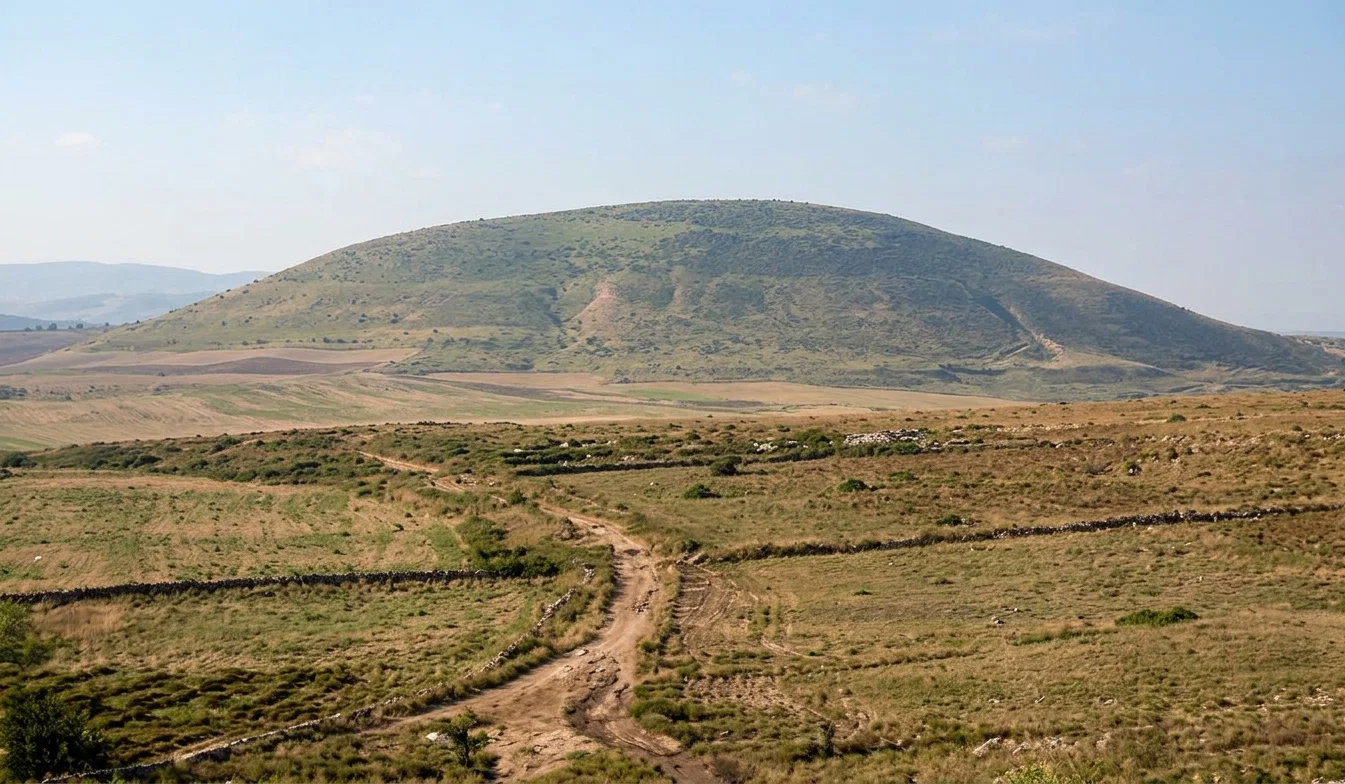
MOUNT TABOR AND A PORTION OF THE PLAIN OF JEZREEL.
We must now bid thee adieu; but thy fair picture will ever remain, and thy cherished memories be more sacred and tender! We now continue along the main route leading from the Sea of Galilee to Jerusalem. We again pass by the Mount of Beatitudes, from whose summit we can plainly see Safed, high, high up, over three thousand feet above the Sea of Galilee, but only four hours distant from it; it is thought by some that it was to this city that Jesus referred when in the sermon on this mount He said, “A city that is set on a hill can not be hid.”
We return to Nazareth by the same road over which we came; we gladly dismount, for six hours in an Arabic saddle is not like six hours in a modern railway car. Many tourists in Palestine go to the extra expense of obtaining European saddles, as they can ride in them much easier. On the way, we passed some caravans; for we crossed the caravan line leading from Carmel to Damascus. This was also the ancient route between Egypt and Damascus. All the way from Galilee to Nazareth, there are but few villages, and very few farmers working in the fields. In the days of Christ, this whole region was teeming with a dense population.
As we entered Nazareth, on passing Mary’s well, an Arab rode past us on a fiery steed in great style; then he continued just in front of us all the way to our hotel, displaying the fine qualities of his animal. Scarce had we dismounted when he was at hand to offer his animal for the next part of the journey. On investigation, we found him to be a reliable man, and his horses good; so we bargained with him to take us to Jerusalem, by way of Samaria and Nablous, a journey of three days. As he knew a few words of French, we were able to communicate what was necessary.
Having already visited Nazareth, we will spend no more time here, and arrange to leave at daylight next morning. Promptly as agreed, the Arab is here with his two horses, one for me and one for himself. Just back of the saddle is a large sack, with a pocket hanging down each side of the horse, to receive our luggage and provisions for the journey. In anticipation of this part of the journey, we have very little baggage, and thus avoid the expense of an extra horse. Our horses were full of life, and pranced about impatiently till we were off. Just as the sun sent forth its first heraldic rays above the hills of Gilead, we were coursing our way along the hills to the south of Nazareth.
In a short time we reached their limit, and began the rapid descent to the great plain of Jezreel. From these heights near Nazareth, the view is extensive and interesting. The whole plain of Jezreel spreads out before us; to the southwest and west stretches the Carmel range, with the place of Elijah’s sacrifice in plain view; to the east is Mount Tabor, and to the southeast little Hermon and the hills of Gilboa; to the south rise the mountains of Samaria, to which we are now to go, across the plain of Jezreel.
Looking out from these hills of Nazareth, one can readily see across the plain to the hills of Megiddo, not far from Elijah’s place of sacrifice; it is from these hills that the name of Armageddon is derived—the place where the final gathering of the armies of earth is to take place. Rev. 16:12–16. This has been the scene of some of the most noted conflicts in the history of Israel; here was the test between Elijah and the prophets of Baal; here Josiah met Pharaoh-necho and was slain; and it was here that the remarkable victory was gained by Deborah and Barak over Sisera with his nine hundred chariots of iron. It was an interesting fact to me to observe that from Mount Tabor, where Barak had assembled his ten thousand, one can see across the plain of Jezreel to the waters of Megiddo, where Sisera assembled his host. It is about six hours’ walk from Mount Tabor to Mount Megiddo.
We now descend the steep banks to the plain, going nearly straight south towards Jenin (the En-gannim of the Old Testament). Our way is over pasture lands and grain fields; part of the time along the single telegraph wire which runs from Nazareth to Nablous and Joppa. The plain of Jezreel is quite free from stones and very fertile, but poorly cultivated. Well tilled, it would support an immense population; but at the present, it is very thinly peopled. We have now come from the shores of Galilee to the plain of Jezreel in a ride of seven hours; our further journey must be left for the future.
H. P. H.
Basel, Switzerland.
THE WORLD’S BIGGEST PUMP.
In a letter to the Chicago Record from Houghton, Mich., a correspondent describes the Calumet and Hecla pump, named the Michigan, and the largest in the world. It can deliver 2,500,000 gallons of water every hour in the 24 without being crowded to its limit of capacity, and it will do the work with scarcely as much noise as is made by the operation of an old-style sewing-machine. Outside the doors of the great building which houses it, no sound is heard from within, and, standing beside the monster, upon the brink of the pit connected with the lake from which the water is taken, almost the only sound heard is the noise of the suction, as with every stroke more than 1,000 gallons are lifted.
Briefly, it is a triple expansion pumping-engine, with a capacity of 60,000,000 gallons, standing nearly 50 feet in height and requiring 1,500 horse-power for its operation. It has been proved by actual tests that the nominal capacity can be easily maintained for an indefinite time without injury or strain, and that pushed to its full capacity the pump could handle approximately 75,000,000 gallons in 24 consecutive hours.
The duty of the pump is to furnish water for the great stamp mills of the Calumet and Hecla Company, which has 22 steam pumps in continuous operation, daily pulverizing 5,000 tons of conglomerate rock into sand so fine that it can be carried away by a stream of swiftly running water. The pump is housed in a special building near the shore of Torch Lake, and below the mills, and it forces a steady stream of water to the upper portions of the mills, where innumerable small jets play upon the great slime tables and jigs. Here the specific gravity of the fine particles of copper contained in the rock separate the mineral from worthless sand, and the size and force of the streams of water are so nicely regulated as to wash away the sand and yet carry with it the minimum of copper.
BIRDS, INSECTS, AND CROPS.
THE food of our small birds consists very largely of the insects which feed on the plants grown by the farmer. These insects multiply with such astounding rapidity that a single pair may in the course of one season be the progenitors of six billions of their kind. All through the season at which this insect life is most active, the birds are constantly at work destroying, for their young and for themselves, tens of thousands of hurtful creatures which, but for them, would swarm upon the farmer’s crops, and lessen the results of his labors.
A painstaking and ardent naturalist not very long ago watched the nest of a pair of martins for sixteen hours, from 4 A.M. till 8 P.M., just to see how many visits the parent birds made to their young. He found that in that time 312 visits to the four young were made, 119 by the male and 193 by the female. If we suppose only six insects to have been brought at each visit, this pair of birds would have destroyed, for their young alone, in this one summer’s day, not far from 2,000 insects.
The important relations which our birds bear to the agricultural interests, and so to the general welfare, are recognized by the governments of all our States. Laws exist for their protection, but these laws are rendered inoperative by the lack of an intelligent public sentiment to support them. They are nowhere enforced. It is for the interest of every one that such a public sentiment should be created. It is time that this destruction should be stopped.—Audubon Magazine.
A WISE WORD.
Do not jest with your wife upon a subject in which there is danger of wounding her feelings. Remember that she treasures every word you utter. Do not speak of great virtues in another man’s wife to remind your own of a fault. Do not reproach your wife with personal defects; for if she has sensibility, you inflict a wound difficult to heal. Do not treat your wife with inattention in company; it touches her pride, and she will not respect you more or love you better for it. Do not upbraid your wife in the presence of a third party; the sense of your disregard for her feelings will prevent her from acknowledging her fault. Do not entertain your wife by praising the beauty and accomplishments of other women. If you would have a pleasant home and a cheerful wife, pass your evenings under your own roof. Do not be stern and silent in your own house, and remarkable for sociability elsewhere.—Anon.
IF
If none were sick and none were sad,
What service could we render?
I think if we were always glad
We scarcely could be tender.
Did our beloved never need
Our patient ministration,
Earth would grow cold, and miss indeed
Its sweetest consolation.
If sorrow never claimed our heart,
And every wish were granted,
Patience would die and hope depart—
Life would be disenchanted.
—Anon.
A DISGRACEFUL THING TO CELEBRATE.
GERMANY, so we are informed, has recently celebrated the thousandth anniversary of its national food specialty, the sausage. This bag of mystery is referred back—we know not upon what authority—to the year 897. In those days it consisted simply of a goat’s stomach stuffed with fat and blood. This scarcely sounds appetizing, but the description is not ours. The introduction of cinnamon and saffron into the manufacture of the sausages of Frankfort and Strasburg, about the year 1500, first gained for them their world-wide fame. Since that time these flavorings have been employed in all parts of the world to disguise and render palatable the nauseous scraps and gleanings of the shambles and the knacker’s yard [where broken-down horses are slaughtered and sold] even to this present year of grace, as our newspaper reports are constantly demonstrating.—London (England) Herald of the Golden Age.
THOUGHTS FOR THE TWILIGHT.
Our Master has a torn brow and pierced feet.
We can not have Christ’s joys unless we have His pains.
It is not with a crown that Christ would win disciples.
We know why Christ helps us when we are helping others.
It is unnatural for a Christian not to wait to serve Christ.
When Christ calls for followers, He is on a ministering journey.
The vessel in which we are passing over the sea of life is always driven by contrary winds till the Lord embarks.—John Pulsford.
AS YE WOULD.
IF I should see
A brother languishing in sore distress,
And I should turn and leave him comfortless
When I might be
A messenger of hope and happiness,
How could I ask to have what I denied,
In my own hour of bitterness supplied?
If I might sing
A little song to cheer a fainting heart,
And I should seal my lips and sit apart
When I might bring
A bit of sunshine for life's ache and smart,
How could I hope to have my grief relieved
If I kept silent when my brother grieved?
And so I know
That day is lost wherein I fail to lend
A helping hand to some wayfaring friend,
But if it show
A burden lightened by the cheer I send,
Then do I hold the golden hours well spent
And lay me down to sleep—sweet content.
—Jewish Comment.
OUR WORK AND WORKERS.
The practical value of the industrial feature now introduced into most of our denominational schools is manifested in several lines. For instance, of the comparatively new institution at Cooranbong, N. S. W., the Bible Echo says: “Through the kindness of Pastor W. C. White, who recently arrived in Melbourne to attend to important business matters, we had presented to us the other day several luscious-looking bunches of grapes grown this season on the Avondale school land. They were indeed fine specimens of their kind, and made us think of the sample which the spies brought back from the promised land.”
The Avondale School, at Cooranbong, N. S. W., reports one hundred students.
Brother T. H. Purdon writes from Rutland, Vt., that a new house of worship has just been completed in that place, and will be dedicated in the near future.
At Kadina, South Australia, where Brethren Woods and Ballingall have been laboring, a church of twenty members has been organized, and they are contemplating the erection of a house of worship.
In St. Lawrence County, N. Y., the brethren have decided to revive a former custom of union quarterly meetings of all the churches in the county. Good! We remember the meetings of old.
New York Conference now has five tents in the field for the season.
Brother P. Z. Kinne reports to the New York Indicator that he has baptized four candidates, but the place is not mentioned.
The Maine Tract Society (headquarters at North Deering) recently sent a liberal supply of our periodicals to the soldiers at Key West.
At the late camp-meeting held in St. Helena, Cal., a successful canvassing class was conducted, and twenty-eight workers were prepared to enter the field to circulate our books and papers.
Arrangements have been made for establishing a broom factory at South Lancaster, Mass., for the purpose of furnishing employment to students who desire an opportunity to pay their way through school at the academy by useful labor. Those who have the work in charge hope to furnish employment to about twenty-five or thirty by the first of October.
Brother W. H. Thurston, missionary in Rio Janeiro, Brazil, tells the Wisconsin Reporter of a visit he recently made to an American colony in the interior, about 350 miles from Rio. He says there are about forty families in the colony, living within a radius of fifteen miles, and their principal crops are melons and sugar-cane, altho they raise some rice, corn, beans, and a few potatoes. “The sugar-cane is mostly used to make a cheap grade of intoxicating liquor, called paraty. It is drunk freely all over Brazil. The majority of the people in the colony belong to some church—Methodist, Baptist, or Presbyterian.” Altho the main crops were almost a failure this year, Brother Thurston sold a number of books, and was requested by some to send them other reading matter and to visit them again.12
Brother Swin Swinson recently baptized five candidates at Eleva, Wis.
Brother F. Stebbeds has been holding meetings with the church in Omaha, an account of which in the Reporter says, “We baptized ten last week, and have more for this week.”
Brother C. L. Boyd reports to the Review concerning work in North Carolina, and notes the baptism of three at Asheville, three at Silverstone, five at New Light, four at Kelvin Grove, and two at Raleigh.
Prof. W. T. Bland has been chosen to preside over the faculty of Union College, at College View, Neb., and his place at the Southern Industrial School, Graysville, Tenn., is to be filled by Prof. C. W. Irwin, formerly of Union College.
Of the Christian Help Mission in Omaha, Brother A. J. Howard says: “Our work is still onward, and increasing daily. We are still crowded, and can not accommodate the dear men that come to us. We have given 346 baths, given away 401 pieces of clothing, 18 pairs of shoes; 757 meals have been given away; about 25,000 dishes have been served; have held Gospel meetings every night, 20 open-air meetings, Sunday-school every Sunday at 10 A.M., sewing school every Thursday afternoon at four o’clock for girls.”
The Adventist doctrine is not popular, for the same reason that Jesus and His immediate followers were not popular. (See Mark 7:5-9; John 17:14-17.) But Adventists are liked well enough when they can be used to advantage. Instance the following from the Minnesota Worker: “Quite a number of the members of the Minneapolis church have gone to Lake Minnetonka, about twenty miles from Minneapolis, to pick berries on the fruit farms there. Some farmers have twenty acres of raspberries. They are glad to get Adventists, because they will pick berries on Sunday for the Monday market. No berries are picked on Saturday, as they do not keep well till Monday.”