“The Christian Gentleman! A Series of Addresses to Young Men,” by Louis Albert Banks, D.D. Cloth, 12mo. Price, 75 cents. New York and London: Funk & Wagnalls Company.
The addresses which make up the above book, ten in number, were delivered to men only in Association Hall, Cleveland, Ohio. They take in the following points in the development of the character of a true Christian gentleman: “In the Temple of the Human Body,” “In the Secret Chambers of His Imagination,” “As One of the World’s Workers,” “In the Pursuit of Ideals,” “In His Relation to Women,” “With His Friends,” “In the Treatment of His Enemies,” “In Prosperity,” “In Adversity,” “As a Knight of the New Chivalry.” These addresses are full of inspiration and courage to young men, and must prove helpful to workers among that class. We bid it Godspeed.
Parasitic Wealth or Money Reform, a Manifesto to the People of the United States. By John Brown. Charles H. Kerr & Co., Chicago.
The author makes a striking presentation of rapidly separating classes which wealth is differentiating. By successive and striking diagrams and tables, he shows the rapid increase of wealth and its aggregation in the hands of the few, and the no less rapid increase among the masses, becoming more and more a dependent , needy, indigent, discontented class. It is from such as these that anarchists are recruited. Mr. Brown thinks that the remedy of all this evil is political. Politics might help matters if all reforms were united, but political reforms devour one another. There can be and will be no lasting reform until there reigns in the hearts of men the Golden Rule; but this will not be till Christ reigns by faith in the hearts of all His subjects, and He appears again to reign in everlasting glory. The author sustains his charges against the present conditions of society, and we are glad of the agitation it may raise, but his remedy is inadequate. The source of the difficulty lies deeper than bad politics; its source is sin and selfishness, the only eradicator of which is the Gospel of Jesus Christ. The book is well written and printed, but chapter headings and sub-titles would have helped it.
“The Old Testament and the Critics,” by the Rev. John Milton Williams, D.D., author of “The Empire of the Pulpit,” “Rational Theology,” etc. Charles H. Kerr & Co., Chicago. 100 pp.; neatly bound in cloth; price, 50 cents.
This is not designed as an exhaustive treatise on the subject title, but is a frank, candid, devout endeavor to assist in clearing up some of the doubts in the minds of Christendom which false but professed Christian teachers have thrown in the way. The author discusses the subject under the following heads: “The Difficulties of the Old Testament,” “The Old Testament Corroborated by the New,” “Old Testament Inspiration,” “Allegorical Interpretations,” and “Are the Two Testaments Identical in Spirit?” With the writer’s ideas of inspiration we do not agree. The Book tells us God gave the words, not merely the truth. How could God give the thoughts for hundreds of years in the future, to one who knew not of what would then be? But, notwithstanding the writer’s view of inspiration, which is a thousand times better than others extant, the book is worthy of circulation, suggestive to the devout, and helpful to the honest doubter.
“A Study of the Pentateuch for Popular Reading: Being an inquiry into the age of the so-called ‘Books of Moses,’ with an Introductory Examination of Recent Dutch Theories, as Represented by Dr. Kuenen’s ‘Religion of Israel,’” by the late Rufus P. Stebbins, D.D., Professor of Theology in the Meadville Theological School, and Lecturer on Hebrew Literature; with a preface by H. L. Hastings, editor of the Christian. Third edition. Nearly 300 pages, manila cover. Price, 40 cents. Scriptural Tract Repository, 47 Cornhill, Boston.
This work is No. 48 of the Anti-Infidel Library. Beside the trenchant review of Kuenen’s “Religion of Israel,” it discusses the authenticity of the Pentateuch from the viewpoints of external evidence, evidence from the historical writings, Biblical and apocryphal, from the poetic books, from David to Moses, from the style and language, from contents and structure, and from undesigned coincidences. Beside this mass of matter the book contains 14 tractlets, entitled “Grapeshot.” The volume is an arsenal of weapons, and well worthy of circulation.
“Instruction Relating to the Principles of Healthful Living,” compiled from the writings of Mrs. E. G. White. Published by the Medical Missionary Board, Battle Creek, Mich. Nearly 300 pages; cloth, 50 cents; paper covers, 25 cents.
This little work, composed of extracts, presents the very basic principles of healthful living from a Christian standpoint. It is not exhaustive; it is a seed book. These extracts are arranged in forty-two chapters, among which are the following: “Our Bodies Temples of the Holy Ghost,” “Duty to Study the Laws of Life,” “The Great Decalogue,” “Natural Law Part of the Law of God,” “The Consequence of Violating Natural Law,” “Health Reform,” “Disease and Providence,” “Influence of Disease upon Mind and Morals,” “Heredity,” “Causes of Disease,” “Ventilation,” “Diet,” “Flesh Foods,” “Stimulants,” “Dress,” “Exercise,” “Prayer for the Sick,” “Drugs,” “The Missionary Nurse,” etc., etc. It is a compendium of wisdom on healthful living.
“The Science of Health, Holiness, and Happiness. A Complete Treatise on the Practise and Principles of Divine Healing. How to Get Well and Remain Well, in a Divinely Natural Way. The True Plan of Salvation.” By Samuel Grant Shroyer. Oklahoma City, O. T.
This is the tremendous title of a good-sized pamphlet of 206 pages. It is a succotash of the corn of truth and the beans of error. The assumption of its author is shown in the designation, “A complete treatise.” He only can give complete instruction who is infinite in knowledge and wisdom.
“Looking Within; the Misleading Tendencies of ‘Looking Backward’ Made Manifest,” by J. W. Roberts. A. S. Barnes & Co., New York. This is a work of romance done up in the usual style of 25-cent works of fiction, and in a way modeled after “Looking Backward.” Tho not as easily readable to some minds, perhaps, it contains a thousand times more truth and common sense. It is hardly to be hoped that it will have as wide a circulation as “Looking Backward,” but it ought to be read by every one who was carried away by Mr. Bellamy’s scheme of making the world better by law.
The “Patriot” No. 3 has come to our table. It is a series of American character studies, published by the University Association, Association Building, Chicago. This number deals with James Otis, and is written by the historian, John Clark Ridpath, LL.D. Illustrated. Price, 15 cents.
“The Credibility of the Christian Religion, or Thoughts on Modern Rationalism,” by Samuel Smith, M.P. Scriptural Tract Repository, 47 Cornhill, Boston. Bound in manila boards, 25 cents. To one who desires a candid discussion of the above subject from the standpoint of a layman, we commend the above work. Mr. Smith is a native of Liverpool, England, member of Parliament, a business man, and an intelligent, cultured gentleman.
The well-known firm, Geo. P. Rowell Advertising Company, 10 Spruce Street, New York, sends us a neatly-printed, well-classified pamphlet, illustrated with maps on “Newspaper Advertising in the United States, a Complete Catalog of Papers Printing over a Thousand Copies.” Just the thing for advertisers, and interesting to many who are not.
“Remarks on the Mistakes of Moses,” by H. L. Hastings, 47 Cornhill, Boston. With paper covers. Illustrated; price, 15 cents. This has already had a sale well up toward 300,000. It is a trenchant review of Ingersoll’s “Mistakes of Moses.”
“Report of Fifty Cases Illustrating the Successful Treatment of Pulmonary Tuberculosis,” by W. H. Riley, M.D., of Colorado Sanitarium, Boulder, Colo. Reprinted from Modern Medicine and Bacteriological Review. Dr. Riley is having large and successful experience in treating those afflicted with this dread disease. Are you afflicted?—Write him.
PERIODICALS WANTED.
CLEAN copies of SIGNS, Review, Instructor, and Our Little Friend, for missionary work. Please send post-paid to Mrs. Columbia Talbut, Keller, I. T.
B. Watson, Box 459, Portage la Prairie, Manitoba, desires late clean copies of the SIGNS and health publications; also the Instructor, and a few copies of Our Little Friend.
Walter Scott, 120 Townsend Street, Thurlow, Pa., wishes for missionary work clean copies of SIGNS, Sentinel, and Review, post-paid.
WHERE IS HE?
THE parents of J. L. Thatcher, formerly of the firm of “Thatcher & Co., Wholesale Grocer Store,” of Seattle, Washington, desire to learn his whereabouts, dead or alive. His store was burned five or six years ago, and it is thought that he went from Seattle to the South Sea Islands. His parents have written him, but received no word. Any information concerning him will be gladly received by his mother, Mrs. M. L. Thatcher, Arlington, Kansas. Will not our Seattle friends look this matter up and report to us?
How to See the Point and Place It.
Punctuation without Rules of Grammar.
A book of forty pages which teaches punctuating rapidly by example. Many people who have studied English, Latin, and Greek Grammar are very careless and slovenly punctuators. This book is indispensable to all writers. Memorizing rules and exceptions wastes time and they are soon forgotten. By mail, 20 cents. Cloth, 40 cents.
Lacon Pub. Co., 123 Liberty St., N. Y.
When you write, please mention the SIGNS OF THE TIMES.
400 RECITATIONS AND READINGS.
A book designed for Parlor Readings, Sabbath-schools, Temperance Organizations, Debating Societies, Young People's Associations, Reading Clubs and Home Circles. This is a handsome book, bound in paper cover, and contains 400 of the best recitations ever issued, and other choice reading. Price, 40 cents, post-paid. Send order, with remittance, to Laconie Publishing Co., 123 Liberty St., New York.
When you write, please mention the SIGNS OF THE TIMES.
NUT FOODS.
WE manufacture these goods and sell so low that you can not afford to be without them. We sell mill outfits, nuts, malt, and all material used in these foods. Nut Butter made and shipped day order is received. Recipes free with Mills. Write for prices of foods, mills, etc. KNAPP BROS., 71 N. 11th St., E. Portland, Oregon.
When you write, please mention the SIGNS OF THE TIMES.
The “Signs” Free Five Years
By Editor
Would you like to have your subscription to the SIGNS OF THE TIMES paid up for five years in advance without any cash outlay on your part? If so,
YOU CAN HAVE IT
Read this offer and see how it can be done.
We propose to give to the first 5,000 of our readers who will send us five new yearly subscribers to this paper at $1.00 each, a
FIVE YEARS’ SUBSCRIPTION FREE
Any one can, in a few hours’ time, secure five subscribers for the “Signs” by showing copies of it to their friends and neighbors. If we knew all your friends and could send samples and circulars to them, this offer might not be necessary. But we don’t, and we want to enlist your services to help us reach them and thus push our circulation up to 100,000 copies weekly. To accomplish this, and at once, we offer the equivalent of
$10.00 FOR $5.00
Does this interest you? If so, write at once and send us your name and address, and say that we can count on you for five new subscribers, but do not send us any subscriptions until we notify you. Then if there are a sufficiently large number who respond to warrant us in going ahead with such a liberal offer, we will advise you, and you can then send on your subscriptions. Don’t delay, but write us to-day. Address
SIGNS OF THE TIMES
OAKLAND, CAL.
Healthful Delicious Nut Foods
Easily and cheaply made in any household by the use of our complete equipment for grinding and emulsifying nuts. The production of our mills is unsurpassed. Full directions and a booklet containing many valuable nut food recipes, free with each mill.
NUTS
Shelled and unshelled, of all kinds at reasonable prices
For further information, catalog, price-list, etc., write to
1 “And the man knew Eve his wife; and she conceived, and bare Cain, and said, I have gotten a man with the help of the Lord. 2 And again she bare his brother Abel. And Abel was a keeper of sheep, but Cain was a tiller of the ground. 3 And in process of time it came to pass, that Cain brought of 4 the fruit of the ground an offering unto the Lord. And Abel, he also brought of the firstlings of his flock and of the fat thereof. And the Lord had respect unto Abel and to his offering; but unto Cain and to his offering he had not respect. And 5 Cain was very wroth, and his countenance fell. And the Lord said unto Cain, Why art thou wroth? and why is thy countenance fallen? If thou doest well, shalt thou not be accepted? and if thou doest not well, sin coucheth at the door; and unto 8 thee shall be his desire, and thou shalt rule over him. And Cain told Abel his brother. And it came to pass, when they were in the field, that Cain rose up against Abel his brother, 9 and slew him. And the Lord said unto Cain, Where is Abel 10 thy brother? And he said, I know not; am I my brother’s keeper? And he said, What hast thou done? the voice of thy 11 brother’s blood crieth unto Me from the ground. And now 12 cursed art thou from the ground, which hath opened her mouth to receive thy brother’s blood from thy hand; when thou tillest the ground, it shall not henceforth yield unto thee her strength; a fugitive and a wanderer shalt thou be in the 13 earth. And Cain said unto the Lord, My punishment is 14 greater than I can bear. Behold, thou hast driven me out this day from the face of the ground; and from Thy face shall I be hid; and I shall be a fugitive and a wanderer in the earth; and it shall come to pass, that whosoever findeth me shall slay 15 me. And the Lord said unto him, Therefore whosoever slayeth Cain, vengeance shall be taken on him sevenfold. And the Lord appointed a sign for Cain, lest any finding him should smite him. 16 “And Cain went out from the presence of the Lord, and dwelt in the land of Nod, on the east of Eden. 25 “And Adam knew his wife again; and she bare a son, and called his name Seth: For, said she, God hath appointed me 26 another seed instead of Abel; for Cain slew him. And to Seth, to him also there was born a son; and he called his name Enosh; then began men to call upon the name of the Lord.”
QUESTIONS.
(1) What two representatives of the human race are introduced in verses 1 and 2? Note 1. (2) What were their respective occupations? V. 2. (3) What offering did Cain bring to the Lord? V. 3. Note 2. (4) What was Abel’s offering? V. 4. Note 3. (5) How did the Lord regard these offerings? Vs. 4, 5. (6) What effect did this have upon Cain? Verse 5. (7) What two questions did the Lord ask Cain? V. 6. (8) What would be the result of his doing well? of his not doing well? V. 7. What respect did the Lord show toward the first-born? V. 7. Note 4. (9) Notwithstanding this what did Cain do? V. 8. Why? 1 John 3:12. Note 5. (10) What question did the Lord now ask Cain? What reply did Cain make? Gen. 4:9. (11) What spoke the crime of Cain? V. 10. (12) What curse was pronounced upon Cain? Vs. 11, 12. Note 6. (13) What did Cain say in regard to his punishment? V. 13. Note 7. (14) Was he able to see the Lord after this? How did he feel toward his fellow-men? V. 14. (15) What did the Lord do to show Cain that he still desired him to repent? V. 15. (16) Where did Cain now take up his abode? V. 16. (17) Who took the place of Abel? Vs. 25, 26. Note 8. (18) What lessons do you learn from Cain’s life? From Abel’s?
ADDITIONAL NOTES.
(For original notes, see Lesson Quarterly and Patriarchs and Prophets, pp. 71-79.)
NOTES.
1. Knew his wife.—False modesty should not keep us from noting the fact that the verb “know” is here used, and many times elsewhere, to signify perfect union—harmony—such as resulted in fruit-bearing. So God’s children must be known of God, come into perfect union and harmony with Him. So only can they bring forth fruit to eternal life. See John 17:3; 1 Cor. 8:3; 2 Tim. 2:19; Rom. 7:4.
Gotten a man.—If Eve had ever kept before her the thought that Cain was to be a man trained for the Lord, his end might have been different. Here is a suggestion for parents. Take your children, not as pets or unwelcome intruders, but as gifts from God, to be trained as men and women for Him.
2. In process of time.—Margin, common version “at the end of days,” evidently the regular Sabbath offering, at the end of the seven days, the only period of days thus far definitely named.
3. Cain . . . Abel.—The representatives of two classes for all time. Self-righteous, self-sufficient, feeling no need of the Saviour, Cain offered a mere thank-offering. Abel, humble, sinful, showed his simple faith in the all-sufficient atonement of the Saviour’s blood, implicitly obedient to His command. To which class do you belong? See Heb. 11:4; 1 John 3:12.
4. Sin coucheth at the door.—A beast of prey. Note the marginal reading, “Unto thee is its desire, but thou shouldest rule over it.” Sin, represented as a wild beast, desires Cain, but he should not be destroyed. He should rule over sin. If he did well, God would give the victory.
5. Told his brother.—The margin seems to make it plainer,—“said unto Abel his brother, Let us go into the field.” He comes, rebellious from God’s instructions, to kill his brother. His sin seems to have been presumptuous.
6. Not yield.—The ground was cursed for man’s sake, that man might know the evil of sin, that he might long for a better world, that his time might be employed more fully than it would otherwise have been.
7. My punishment.—The margin reads, “My iniquity is greater than can be forgiven.” This is never true. Cain probably sinned to that extent that he could never truly repent.
8. On the name of the Lord.—“Call themselves by the name of the Lord.” A.V., margin. Here began the divisions between the sons of God and the world.
ADDITIONAL STUDY.
(1) How did the Lord show respect unto Abel and to his offering? See Judges 6:21; Lev. 9:24; 1 Kings 18:38. (2) What in this lesson shows that partial obedience is insufficient? (3) Did Abel have faith in the coming Redeemer? Did Cain? Heb. 11:4. (4) Was Cain the victim of an arbitrary purpose? (5) Note the order of Cain’s fall: lack of faith, wilful, wroth, fallen countenance, did not do well, unrepentant, committed the sin which lay at the door. (6) Why did Cain slay his brother? 1 John 3:12. Why does the world hate Christ and His followers? John 3:20; 15:18-20. (7) How did Cain show his lack of belief in the omnipresence, omniscience, and omnipotence of God? (8) Trace the connection between Cain’s sin and the flood. (9) Did Cain and his descendants observe the Sabbath? Why not? James 2:10. (10) Through which line of descendants did polygamy enter? Gen. 4:19. (11) In whose image and likeness was Adam? Seth? Gen. 5:1, 3. “Patriarchs and Prophets,” p. 80. (12) From the genealogy of the ten antediluvian patriarchs determine the age of the world before the flood.
4 “And Ahab came into his house heavy and displeased because of the word which Naboth the Jezreelite had spoken to him; for he had said, I will not give thee the inheritance of my fathers. And he laid him down upon his bed, and turned 5 away his face, and would eat no bread. But Jezebel his wife came to him, and said unto him, Why is thy spirit so sad, that 6 thou eatest no bread? And he said unto her, Because I spake unto Naboth the Jezreelite, and said unto him, Give me thy vineyard for money; or else, if it please thee, I will give thee another vineyard for it; and he answered, I will not give thee my 7 vineyard. And Jezebel his wife said unto him, Dost thou now govern the kingdom of Israel? arise, and eat bread, and let thine heart be merry; I will give thee the vineyard of Naboth 8 the Jezreelite. So she wrote letters in Ahab’s name, and sealed them with his seal, and sent the letters unto the elders and to the nobles that were in his city, and that dwelt with 9 Naboth. And she wrote in the letters, saying, Proclaim a fast, and set Naboth on high among the people; and set two men, sons of Belial, before him, and let them bear witness against him, saying, Thou didst curse God and the king. And then 10 carry him out, and stone him, that he die. And the men of his 11 city, even the elders and the nobles who dwelt in his city, did as Jezebel had sent unto them, according as it was written in 12 the letters which she had sent unto them. They proclaimed a 13 fast, and set Naboth on high among the people. And the two men, sons of Belial, came in and sat before him; and the men of Belial bare witness against him, even against Naboth, in the presence of the people, saying, Naboth did curse God and the king. Then they carried him forth out of the city, and 14 stoned him with stones, that he died. Then they sent to Jezebel, saying, Naboth is stoned, and is dead. And it came to pass, when Jezebel heard that Naboth was stoned, and was dead, that Jezebel said to Ahab, Arise, take possession of the vineyard of Naboth the Jezreelite, which he refused to give 15 thee for money; for Naboth is not alive, but dead. And it came to pass, when Ahab heard that Naboth was dead, that Ahab rose up to go down to the vineyard of Naboth the Jezreelite, to take possession of it.”
Golden Text: “Thou shalt not covet thy neighbor’s house.” Ex. 20: 17.
SUGGESTIVE QUESTIONS.
(1) What occurred to greatly displease King Ahab? What had Naboth said? How did the king manifest his displeasure? V. 4. Note 1. (2) What did his wife say when she noticed his sullen mood? V. 5. (3) What explanation did the king give? V. 6. (4) What sarcastic question did Jezebel ask? In order to dispel his gloom, what assurance did she give him? V. 7. Note 2. (5) How did she undertake to carry out her purpose? V. 8. Note 3. (6) What plan was suggested in her letters? V. 9. Note 4. (7) What further directions were given? V. 10. Note 5. (8) How did the men of the city regard the queen’s proclamation? Vs. 11, 12. (9) What witnesses testified against Naboth? What was their testimony? What was the result of the trial? V. 13. Note 6. (10) Then what word was sent to Jezebel? V. 14. (11) When Jezebel heard this word, what did she say to Ahab? V. 15. Note 7. (12) Then what did Ahab do? V. 16. Note 8.
NOTES.
1. Would eat no bread.—Samaria was the capital of the kingdom of Israel, and Jezreel was a country village about twenty-five miles north, where King Ahab had a favorite residence and probably extensive grounds. Because Naboth’s vineyard was close to the royal grounds, Ahab wanted it; and, like a spoiled child, he sulked because he could not have his way.
2. Dost thou now govern?—Jezebel’s idea of royalty was that a subject had no rights that the king was bound to respect; that it was simply the privilege and power of gratifying selfish desire—an idea by no means extinct in our own time.
3. In the king’s name.—That Jezebel ruled the king had been manifested often before, and now she would show him that she had more power than he had dared to exercise. Her arrogant influence in the government was indicated by her assuming to write letters in the king’s name.
4. Proclaim a fast.—To “proclaim a fast” was a very pious tho hypocritical act designed to cover the wickedness of her purpose. It portended some great public exigency that could be met only by extraordinary means. See Joel 1: 13-20; Isa. 58: 4-7. Under the solemnity of the fast, Naboth was “set on high;” that is, he was set up before the court on grave charges, perhaps as the cause of an approaching calamity. To this day oriental rulers are wont to issue public proclamations, of very virtuous or pious pretense, and then give secret instructions to officials about carrying out the hidden object of the demonstration.
5. Two men.—It was necessary to have two witnesses in order to condemn one to death. See Deut. 19: 15; Matt. 18: 16; 26: 59-61. Sons of Belial means reckless, lawless fellows. Only such would bear false witness. Altho the word “Belial” is capitalized in the Bible, it is not a proper noun.
6. Cursed God and the king.—The witnesses declared that Naboth had blasphemed God and the king. The case was somewhat similar to that of Stephen, who was condemned on the charge of blasphemy, on the testimony of two suborned witnesses, and stoned to death. Of course there was a semblance of lawfulness in the matter; for the legal penalty for blasphemy was death. See Lev. 24: 16. These cases illustrate how the law can be made to subserve evil purposes. In fact, all evil is good perverted. It appears from 2 Kings 9: 26 that Naboth’s sons were also put to death; thus, there being no heirs, the land would lawfully fall to the crown.
7. Arise, take possession.—Apparently Ahab knew nothing of the plan that Jezebel had in mind until it was consummated. The fast was evidently a local affair, and only the people of the village of Jezreel were included in the proclamation. The rashness of the deed would indicate that it was a summary proceeding.
8. Ahab rose up to . . . take possession.—This whole transaction was the result of “covetousness, which is idolatry.” Col. 3: 5. But Jezebel overreached her mark, as ambitious, covetous people usually do. She gave Ahab the vineyard of Naboth, but with it she sealed the king’s doom and her own also. See remainder of lesson chapter, and 2 Kings 9.
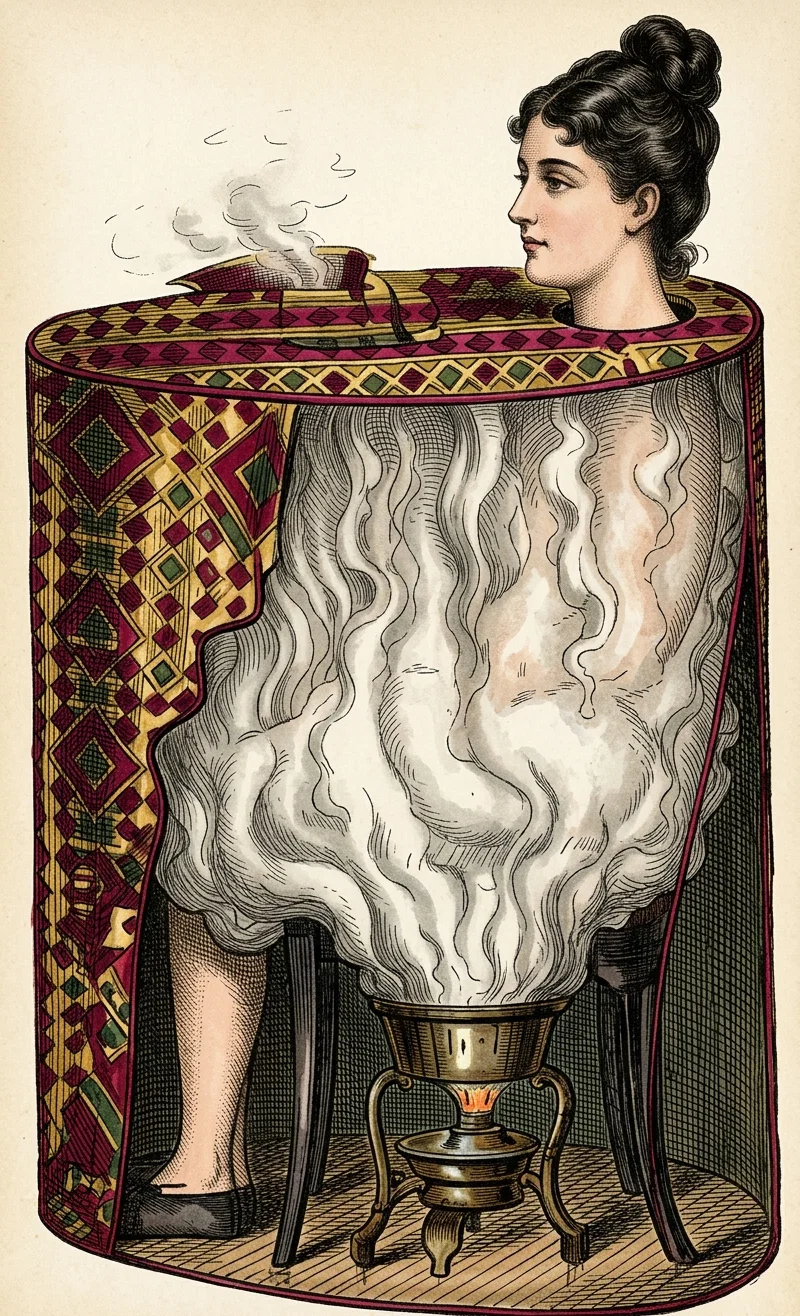
Niagara Vapor Baths
We Are the Original Manufacturers of Portable Vapor Baths.
We have during the last ten years supplied thousands of our Baths to physicians, hospitals, sanitariums, etc., and we are now for the first time advertising them direct to the general public.
In Buying a Vapor Bath
Get one with a steel frame that stands on the floor. If a manufacturer does not show you a cut, you may take it for granted that his “steel frame” is a wire hoop that rests on the shoulders of the bather.
Get one that is covered with proper material. Insist on seeing a sample of material before ordering.
Get one with a thermometer attachment. Don’t go it blind. A bath that is too hot or not hot enough will be of no benefit to you.
Get one that you can return and have your money back, if not satisfactory in every way.
Send for sample of material and interesting booklet that will tell you all about Vapor Baths.