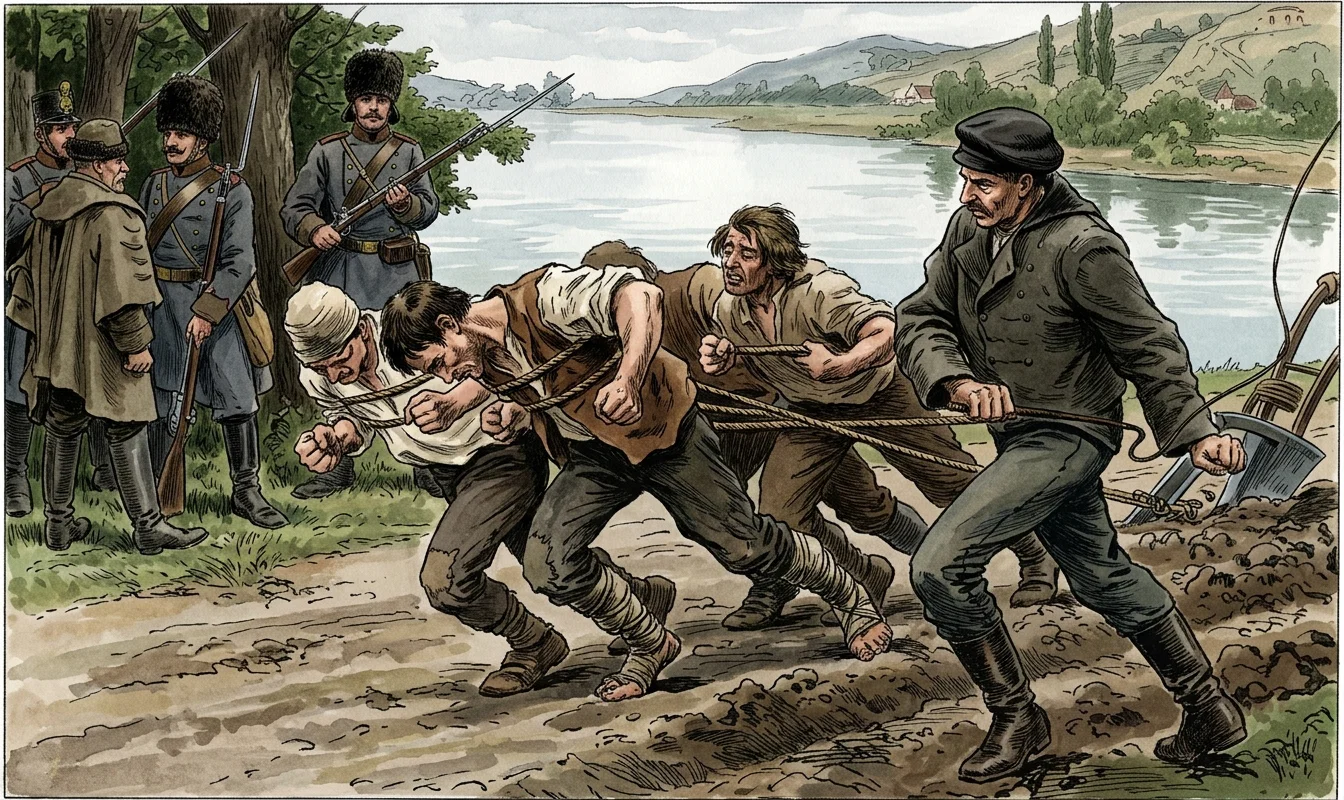
OUR cut on this page gives a view of men in Hungary harnessed to a plow. The man walking at their side with whip in hand has all the appearance of an ox-driver. The soldiers standing guard in the background illustrate the military despotism that is exercised over these unfortunate men. If the slavery that was in this country forty years ago stirred to the depths the hearts of Garrison and Lovejoy and Lincoln, what would be the effect produced on such men by a scene like this? God “hath made of one blood all nations of men for to dwell on all the face of the earth.” Acts 17:26. But when one class of men assume the complete ownership of another class, what will they be able to answer to their Maker when He calls them to give an account?
Throughout the northwest of Hungary the “noble landowners” have the habit of demanding fifty days’ labor out of each year from the laborers or peasants on their estates, without any pay whatever for their services. All the male population of the village located on his domain is summoned before the “noble,” and he selects the number he wants and sends the rest to their homes. The spread of the educating principles of freedom among these poor people has awakened them to the awful injustice of their degrading servitude, and the recent revolt and rioting there was an expression in a very forcible manner of the rising discontent. The landlords, by the aid of the army, have been able to suppress the revolt for the present, but the discontent is even greater than ever.
HUNGARIAN PEASANTS HITCHED TO A PLOW AS HORSES.
What must be the mental darkness and the supremacy of selfishness on the part of those who can so brutally enslave their fellow-men! How is it possible for a person to use as he would a horse, a fellow-man, who has the same feelings, the same impulses, and the same rights to freedom as himself? The one cheering thought in connection with it is that very often the oppressed slave is not nearly so degraded as his tyrannical oppressor.
But oppression is not confined to Hungary by any means. The wealthy men of that country still cling to their medieval forms of tyranny, and so it looks worse from a superficial view than what may be found elsewhere. But how much worse is it than the “sweat shops” and other forms of oppressing the weak and poor in the large cities of this and other countries? We say that it is hard-hearted tyranny to take fifty days of a man’s time and render him no equivalent in return. But is it not as great hard-heartedness and as cruel tyranny when we see fellow-mortals by the thousands dragging about the alleys and dark lanes of our cities, destitute of the barest necessities of life, while we are surfeiting ourselves in riotous and wanton living, and never so much as thinking to extend a helping hand? Hungary is truly in a deplorable condition. But the misery there is only a different type of the same oppression that exists under a differing garb in every corner of the earth.
The great sin that caused Satan’s expulsion from heaven was the exaltation of self. He began to think upon the promotion of himself. He did not have the good of others in view. It was only his personal desires, ambitions, and gratifications that were considered. And as we scan the records of the past or look at the condition of things as they are to-day, we must be impressed with the wonderful hold that selfishness has gained. As a general rule, there is a motive of self-interest at the bottom of every act. This statement may seem extravagant at first, but closely analyze all your acts, and the motives which prompt them, then place beside them the life and teachings of the one unselfish person—the Son of God—and see how truly destitute you are of unselfishness without alloy.
It may seem to men that such oppression as is found in Hungary and elsewhere to-day is passing without notice by the divine Father. But hear His startling words concerning it:—
“Behold, the hire of the laborers who have reaped down your fields, which is of you kept back by fraud, crieth; and the cries of them which have reaped are entered into the ears of the Lord of Sabaoth.” James 5:4.
Then this oppression of the laborer is being carefully noted, and there is a time coming when an account will have to be rendered.
If we are careful to study the whole of this fifth chapter of James, and particularly the first few verses, we will see that the oppression of the laborer results in the “heaping together of treasure for [or, as by the Revised Version, “in”] the last days.” Great reformers are striking hard against the evils growing out of this “heaping” up of wealth. But all that they can do seems to be of little avail against it. Plainly the “last days”—the time in which selfishness reaches its supreme and unbearable limit—are reached, and the one remedy, the one and only star of hope, is the promise of the soon coming of the Lord; for when He comes, all this sin will be destroyed.
He is coming very soon. Everything shows it. The very elements are loaded with the signs that foretell it. And toward that glad day of His appearing every one may turn with joy. For every sin, every oppression, will then be consumed by the brightness of His righteous glory. Get ready to enter into the joy of that longed-for time. T.
A WHOLE OFFERING.
By W. N. G.
IN the eleventh chapter of 1 Corinthians, verse 24, referring to the institution of the Lord’s supper, we read that Jesus took bread, “and when He had given thanks, He brake it, and said, Take, eat; this is My body, which is broken for you.” The Revised Version and Rotherham’s Version omit the word “broken.” This is worthy of notice, as the expression “the broken body of Christ” is very commonly used, and it is evidently erroneous. None of the evangelists use the word “broken.” Luke has it, “This is my body which is given for you.” Chapter 22:19. Matthew and Mark simply say, “This is My body.”
Christ is everywhere presented in the Scriptures as a whole offering. In giving directions concerning the Passover lamb, the Lord said, “In one house shall it be eaten; thou shalt not carry forth aught of the flesh abroad out of the house; neither shall ye break a bone thereof.” Ex. 12:46. David refers to this in Ps. 34:20: “He keepeth all His bones; not one of them is broken.” When officers were sent to break the legs of the victims on the day of the Crucifixion, they broke the legs of the thieves, but, on coming to Jesus, they found that He was dead, and “they brake not His legs.” Thus was fulfilled the scripture which says, “A bone of Him shall not be broken.” See John 19:31-37. Christ’s body was stricken, wounded, bruised (Isa. 53:4, 5, 10), and pierced (Zech. 12:10; John 19:34), but it was not broken. Christ can not be divided amongst the believers; each one receives a whole Saviour; nothing short of this would suffice as a substitute for the sinner. It would have required the whole offering for one sinner’s salvation just as much as for the whole world. His body was given for you. He suffered for you, “the just for the unjust.” He is now making intercession for those who will accept His services at the judgment bar. Now is the time for you to employ Him as your Counselor. His word is, “Come unto Me, all ye that labor and are heavy-laden, and I will give you rest.” Matt. 11:28. “Now is the accepted time; behold, now is the day of salvation.” 2 Cor. 6:2.
W. N. G.
THE CHRISTIAN WAY.
By C. A. Bartol
FORBEAR; give up a little; take less than belongs to you; endure more than should be put upon you. Make allowance for another’s judgment of the case: differing in constitution, circumstances, and interests, we shall often decide differently about the justice and integrity of things; and mutual concessions alone can heal the breaches and bridge over the chasms between us, while quick resentment and stiff maintenance of our position will breed endless dispute and bitterness.—C. A. Bartol.
The Greatness of Little Things
How LITTLE do men, even men of God, realize the littleness of little things and the greatness of great things! How much time is frequently used in the discussion of minor matters without prayer; whereas if the greatness of the need of God’s blessing and the greatness of the help of His presence were but realized, and a part of the time were spent in seeking Him, much time would have been saved and mistakes avoided!
CHRIST OUR LIFE.
As Jesus Christ is to us the righteousness of God (Rom. 3:21, 22), so He is to us the life of God (Rom. 5:18, 21); for righteousness—right being, right doing—is life. “In the way of righteousness is life; and in the pathway thereof there is no death.” “For as the Father hath life in Himself; so hath He given to the Son to have life in Himself.” Said Jesus again, “I am come that they might have life, and that they might have it more abundantly.” “I am the Way, the Truth, and the Life.” He “did no sin.” In Him was “the law of the Spirit of life,” and so, possessing righteousness, He possessed life.
As the soul who comes to God obtains righteousness by faith, so also he obtains life by faith—“even the righteousness of God which is by faith of Jesus Christ unto all and upon all them that believe; for there is no difference.” “And this is the will of Him that sent Me, that every one which seeth the Son, and believeth on Him, may have everlasting life; and I will raise Him up at the last day.” “He that believeth on the Son of God hath the witness in him; he that believeth not God hath made Him a liar; because he hath not believed in the witness that God hath borne concerning His Son. And the witness is this, that God gave unto us eternal life, and this life is in His Son. He that hath the Son hath the life; he that hath not the Son of God hath not the life. These things have I written unto you, that ye may know that ye have eternal life, even unto you that believe on the name of the Son of God.” “That Christ may dwell in your hearts by faith.” “If any man have not the Spirit of Christ, he is none of His. And if Christ be in you, the body is dead because of sin; but the Spirit is life because of righteousness.”
The above scriptures clearly teach that the righteousness of God comes to us by faith in Christ; that the life of God comes through the same One and by the same means; that that life is the Spirit of God and Christ, given only to them that believe. He who believes can therefore truly say, “I am crucified with Christ; nevertheless I live; yet not I, but Christ liveth in me; and the life which I now live in the flesh, I live by the faith of the Son of God, who loved me, and gave Himself for me.”
As the Spirit, or life, of God must be in harmony with the righteousness, or law, of God, the Lord must first make us righteous before He gives us that life, or Spirit. This is taught in the following scriptures: “If Christ be in you, the body is dead because of sin; but the Spirit is life because of righteousness.” “That the blessing of Abraham [righteousness by faith, Rom. 4:3–7] might come on the Gentiles through Jesus Christ; that we might receive the promise of the Spirit through faith.”
The sinner who receives the Spirit of God dies. The sin perverts the life and makes it death. If that Spirit were given in its fulness, he would immediately die. It is life to the righteous only.
It is all by faith, and faith is harmony with God, yielding to God, believing what He says; receiving His Word.
Are we sinners before God, condemned by His law, convicted by His Spirit, disheartened in endeavoring to make ourselves better?—We need not wait for years, or months, or days, or hours, to become reconciled. Jesus Christ has purchased your reconciliation by His own perfect life, the righteousness of God, wrought out in His obedience. If we will accept that righteousness as ours, it is at once imputed to us, given to us, set to our account, and the sins are all forgiven.
More than this: If we desire to be His for all time, to serve Him with all the heart, anywhen, anyhow, anywhere, and so yield to Him, we are given His Spirit, or life, more abundantly, even as our hearts are submitted to do His service. For God gives life for fruit-bearing, for service. If we possess that life at all, we must receive it for His cause and work.
NATIONAL REFORM INTOLERANT AND OPPRESSIVE.
Why Not Learn the Lesson?
THERE doubtless are many tolerant, good men connected with the National Reform Association, the organ of which is the Christian Statesman; but we have contended for years that the principles of the movement were intolerant, un-American, oppressive, unchristian. The chief objects of the association are thus set forth in Article II. of its constitution:—
The objects of this society shall be to maintain existing Christian features in the American Government; to promote needed reforms in the action of the government touching the Sabbath, the institution of the family, the religious element in education, the oath, and public morality as affected by the liquor traffic, and other kindred evils; and to secure such an amendment to the Constitution of the United States as will declare the nation’s allegiance to Jesus Christ and its acceptance of the moral laws of the Christian religion, and to indicate that this is a Christian nation, and place all the Christian laws, institutions, and usages of our government on an undeniably legal basis in the fundamental law of the land.
Of course one can easily see that this means, not the Sabbath of the fourth commandment, not “the moral laws of the Christian religion,” not “Christian laws, institutions, and usages,” but man’s interpretation of all these—human laws. And human interpretation of God’s law by those having power, whether in Church or State, has always resulted in intolerance and oppression.
Well, the editor of the Christian Statesman is himself tasting an intolerance which is to him distasteful. Would that he might see that it is but the logical outworking of the principles he has been advocating for years. He thus states his case in an editorial titled “The Statesman Still Fettered,” in that paper of June, 1898:—
As recorded in this paper a year ago, the Christian liberty of its editor-in-chief was restricted by the action of the highest court of the branch of the visible church with which he is connected. At its meeting in June, 1897, the editor was placed under the necessity on the one hand of setting himself in conflict with the authority of that court, or on the other hand of discontinuing his discussions in these columns on the subject of the organic unity of the church of Christ.
Not wishing to withdraw from his church, the National Reformed Presbyterian, he announced that he would bring the matter up the following year. The editor tells us that during the year past he has not attempted “to edit, in any proper sense of the word, a paper such as the Statesman was for thirty years—a paper in which were discussed with unrestricted Christian liberty all possible questions in Church and State.” Previous to a year ago the editor presented what he thought to be the teachings of the Bible on “the unity of the visible church.” He says:—
But when liberty to do this was denied, the editor, in self-respect, could not keep up the sham of appearing to do it, while in fact wearing a muzzle, softly cushioned as it might be. So he has simply kept the paper in a state of suspended animation. In a sense it is but the shriveled dead body of the Statesman, but it is yet unburied, and it awaits, under much contumely heaped upon it, its deliverance from the ecclesiastical bonds that might have been expected to consign it hopelessly to the grave.
Of the editor’s appeal this year, he speaks as follows:—
At the last meeting of the Reformed Presbyterian Synod just held at Walton, N. Y., a respectful request was made for the removal of this limitation of the right of free discussion. Attention was called to the reproach put upon the grand old church which has ever heretofore stood in the front rank of the champions of all true Christian liberty, by the authoritative placing of a gag in the mouth of one of her members who has served her as well as he knew how for over thirty-five years of public life. It was calmly and clearly stated to the court that the spirit which would impose and perpetuate such a restriction of Christian liberty was in essence the same as that which makes human interpretation of divine law the infallible standard of morals, in the room of the divine law itself. It is this spirit of intolerance toward other interpretations of the divine law, and of human standards accepted by different interpreters, all equally fallible, as in harmony with the ultimate standard of God’s law, that will yet slay the witnesses for Christ’s full and finished testimony, if they be not already slain. But in view of such considerations the court imposing the restriction decided by a large majority for the present not to remove it.
The editor states the absolute truth; but why can he not see that the association which he upholds demands the very thing he condemns. The only true interpreter of God’s law is God’s Spirit, and the decision rests between the individual soul and God. Stepping between that soul and God is the essence of the Papacy, whether it be found in the Vatican, the Spanish Inquisition, the National Reform Association, the Reformed Presbyterian Church, or any other religious organization or church whatsoever.
There is also revealed in this another principle which has mightily helped on the work of persecution in all ages. Speaking of the failure to remove the restrictions on his liberty, the editor continues:—
It is due to many of the majority to say that had the vote been taken squarely on the main question they would not have consented to what they are convinced is a violation of the law of Christian freedom of discussion. But as the vote was taken to postpone indefinitely the request of the editor of the Statesman for the restoration of his editorial freedom, and as many feared that the consideration of this request at the time would be injurious to the peace and welfare of the church, they voted with7those whose conscientious judgment regards the bonds imposed by the court as the perpetual obligation of righteous law.
And so also many believed in Jesus, “but because of the Pharisees they did not confess Him, lest they should be put out of the synagogue.” Expediency and policy, other names for moral cowardice, where right principles are at stake, have many times crucified Christ in the suppression of His truth. A brave thought uttered at the time the Spirit gave it, a true word spoken at the time God placed it on the tongue, would have saved many a man and church from a degrading and worldly bondage, but the thought was crucified, the word died, and through expediency and policy, slavery was exalted. Of course the editor in question sees it when applied to himself; God wants him and everybody else to see it as it would be when applied by themselves to others. Put yourself in the place of the “heretic;” in other words, practise the Golden Rule.
Now we are not particularly concerned in this intra-church squabble in the Reformed Presbyterian body. What we write this for is to show that the principles so clearly condemned by the editor of the Christian Statesman are the very principles of the National Reform Association, principles which are permeating the young people’s organizations, the W. C. T. U., and the Law and Order and Citizenship Leagues, the Sunday Unions, and kindred organizations. It is not with the persons who compose these organizations that the evil lies, but in the principles which make men evil. The more conscientious the man, the worse tyrant he becomes when controlled by a tyrannical principle.
We pray, we hope, that many will read the truth in this object lesson, and among them the editor of the Christian Statesman, and have the courage to act the truth.
OBEYING ORDERS.
By T.
ONE of the first and most essential duties of the soldier is that he obey orders. He can not be a good soldier without it. Military leaders insist upon this and are severe in their punishments when orders are not obeyed.
Now in this age when wars and rumors of wars are all over the world, are there not to be found true Christian soldiers that will implicitly obey their Commander? If they are good soldiers of the cross of Christ, they surely will. Listen to one of the clear commands of the divine Master, “Put up again thy sword into his place; for all they that take the sword shall perish with the sword.” Matt. 26:52.
Then it is evident from this scripture that there is to be no carnal sword in the Christian’s armor. Peter had drawn his sword, and “smote off” the ear of a servant of the high priest. But no sooner had he done this than the startled apostle hears the command, “Put up thy sword,” and in astonishment he beholds the Saviour with sympathetic and tender touch exercising His wonderful power in restoring the ear that had been smitten off.
That was wonderful courage manifested by Peter. No doubt he felt like a hero as he drew his, one of the only two swords that the apostles had with them. Some of those looking on would doubtless say, “What a wonderful deed of valor; just see that man, single-handed, drawing his sword against all the company of armed men that have been sent out to take his Lord!” Then how immeasurably deep must have been the opposite impression when the Son of God calmly said, “Put up again thy sword into his place; for all they that take the sword shall perish with the sword!”
The disciples, in common with the rest of the Jewish people, were possessed with the idea that the Messiah was to establish a temporal throne, overthrow the Romans, and reign supreme in this present world. None of the words of the Master, nor all that he did to the contrary, had completely dispelled this delusion. Even after Christ was crucified and resurrected, the disciples were still expecting him to establish a temporal throne. Coming right down to the very day on which the Saviour made His ascension to the Father’s throne, we find the disciples still asking, “Lord, wilt Thou at this time restore again the kingdom to Israel?” Acts 1:6.
Jesus affirmed, in Pilate’s judgment-hall, “My kingdom is not of this world.” John 18:36. He had told the disciples again and again that He was to be crucified, buried, and to be resurrected, and ascend to the Father, and not until His second coming would He establish His kingdom. Even then this earth will have to be melted over, and its sin destroyed by the great fires of the last days before it can become the kingdom of the Lord and His Christ.
These things in various ways had been taught the disciples, but their minds had cherished very different and erroneous ideas, and they were loath to give them up. They still kept thinking that in some way the Lord was to march at their head as king, and by sword and spear they would conquer the world and establish His kingdom. With what an intense tenacity do preconceived opinions hold to one’s mind! And how hard it is for wrong ideas to be driven out before divine truth!
We look back upon the disciples and wonder at their failure to understand and heed the words of the Saviour. But if common ordinary attention had been given to what the Lord had said, there would have been no difficulty. His words were plain. And we can see it so far as they were concerned. But how about ourselves now? Can we not see those plain words still? Are they not there in the divine Book just as emphatically clear as when the voice of the Son of man first uttered them?
To bring the matter a little closer and if possible make it more impressive, what would you do if you were a soldier in one of the armies of this world when your general would give the command, “Put up thy sword”? Would you not promptly and almost instinctively obey? You know you would. It would mean death to do otherwise.
Now ask yourself the question, if you profess to be a soldier under the Lord Jesus Christ, what right have you to explain away your Commander’s words. He says, “Put up thy sword.” Then how can I be a true follower of Him and still refuse to promptly obey His commands. If we are going to be Christians indeed, we must obey the voice of the Christian Commander. Are you doing it? If not, will you obey Him, not in one point only, but study His Word closely so as to know how to obey Him in everything? T.
Isa. 66:24 is simply a comprehensive statement of the punishment of the wicked, and how the righteous will see the results of that punishment. Compare with Rev. 20:9. Note that it is not living persons on which the worm preys and which the fire consumes; but it is “the carcasses of the men that have transgressed against” God. The worm and fire will not cease their work of purification till the corruption is utterly consumed. See Matt. 3:12. The fire is not quenched till it does its work. Compare with Isa. 51:8; Jer. 17:27; 2 Chron. 36:19, 21. It will be seen that the work of worm and fire denotes not continual punishing, but completed punishment.
828. Satan and This World.
Why should Satan fall to the earth, our world, instead of to other worlds? C. F.
Is reference made to Luke 10:18 and Rev. 12:9? If so, he fell unto his own, to the world he had led astray, whose throne he had usurped. “Why did he come here at first?”—From the fact probably that the inhabitants of this world were youngest in experience. Suffice to say he is here, our adversary; but Jesus Christ, our Captain, is his conqueror.
829. H. P.—James 5:12 and Matt. 5:34–37 refer to extra judicial oaths between men and in common conversation, where such things are utterly uncalled for. We often hear such expressions as, “I hope to die if it is not so,” “as true as Gospel,” etc. All such things are condemned by the above scriptures. That it is proper to take an oath in a legal court when required by authority is shown by our Saviour’s example. In all the informal questions of the chief priests He answered little or nothing, but when the priest put Him under oath in the usual way, “I adjure Thee by the living God,” etc., Jesus answered. It is proper to take oath under proper circumstances, before proper officials.
830. J. J. J.—“If a married man is known to be an adulterer,” and his wife of her own free will continues to live with him as wife, condoning his sin, she becomes partner with him in the sin, and is an adulteress in that sense. See 1 Cor. 6:15, 16.
831. L. E. H.—“Eternal life” is the life of God given to and existing in all those who are in harmony with God’s eternal law; in other words, those who by faith obtain and maintain living connection with God through Christ. Immortality pertains to the body, the material being. When man, by faith, through “the power of an endless life,” by the power of “the eternal Spirit,” perfects an incorruptible character, Christ will make that man incorruptible or immortal at His coming. The immortality of being is God’s stamp of incorruptibility of character. John 11:26 refers to those who are living and believing in Christ at the resurrection. Those who believe and have died will be raised. Verse 24. But those who live at that time and believe will never die. 1 Cor. 15:51–55.
832. L. L. W.—No; all the righteous dead were not raised at Christ’s resurrection. The text (Matt. 27:52, 53) says “many bodies of the saints.” This was the first-fruits of Christ’s victory, the antitypical wave-sheaf, which He presented before God when He ascended (Eph. 4:8, margin), typical of all that will be raised when He comes the second time (1 Thess. 4:16, 17). The graves were opened by the quaking of the earth when He died (Hosea 13:14), and, having referred to this fact, the record then completes the account.
A Good Heart
A GOOD heart is the sun and the moon—or, rather, the sun; for it shines bright, and never changes.—Shakespeare.
BUY COMPOUND PROFITS AND GET RICH.
By T.
A FEW days since the following was sent to this office with the request that we give it space in our advertising columns:—
“GET RICH! Buy ‘COMPOUND PROFITS,’ a book giving points on making and accumulating money, by a Wall Street operator, showing, in combination, how $1,000 grows to $348,000 in ten years, $100 to $34,800, and $10 to $3,480. Worth its weight in gold. Whether you have a million or only $10 you should have it and can profit by it.”
Following the foregoing advertisement was given the price of the book and the name and address of the publisher, which items we omit. Of course you will agree that the SIGNS OF THE TIMES could not advertise such books. But the reading of the advertisement will show you how the hope is held out to men that a few dollars invested in Wall Street will soon result in a comfortable fortune.
Many will doubtless buy the book, but will not try the experiment of gambling in Wall Street stocks and bonds. Others will doubtless try the experiment of investing a little “just as a venture.” But be assured that even with all the experience of the “Wall Street operator” at your command, you will not always win. And when you do win, there must be a pang of remorse—a keen suffering of the conscience—at the thought that your success means the failure and loss of some one else.
But generally such kindly sentiments do not seem to come into mind in this grasping age. Paul, in 2 Tim. 3:1, 2, mentions “covetousness” as one of the sins that make the “perilous times” of the “last days.” And who that is viewing the multiplied schemes for seizing money and property without taking the trouble to work for it, can fail to see the marked “covetousness” of these days. Ever since the time when sin entered this fair world, there has been covetousness, but never was it so marked and so mercilessly aggressive and grasping as to-day.
This is one of the many signs of our times. It will pay you to closely watch developments. We are living in the “last days,” and the end can not be long delayed. Get ready for the great events that the future will so quickly unfold.
T.
“THIS KNOW.”
By T.
‘THIS know also, that in the last days perilous times shall come.” The foregoing sentence is not the language of man. Neither is it a statement to be lightly set aside; for it is the authoritative Word of the living God.
Mankind has been saying for a long time that we are approaching an age in which there is to be no peril. There is nothing more intensely popular than the eulogies upon this “glorious age,” “the marvelous civilization of the nineteenth century,” “the great humanitarian spirit of these times,” and the “approaching millennium.” Any one who dares to suggest a doubt about the enduring goodness into which this world is about to be immersed, is immediately and with sarcastic indignation and ire denounced as a pessimistic fellow, unworthy of the air he breathes.
But praise the good times if you must, and denounce as pessimists all who differ from you if you feel constrained to do so, yet there stands the Word of God confronting you fairly and squarely. Do you not tremble at the thought of taking issue with the Most High? Since He who is as infinite and perfect in His knowledge of the future as He is of the past, has said, “This know also, that in the last days perilous times shall come,” what a terrible responsibility we take upon ourselves in affirming the contrary!
We are not to conjecture about this either. For He says this “KNOW.” And that which may be known is not something to be merely guessed at. It is actual knowledge, to be definitely, positively, and clearly understood.
Who has ever heard of greater perils than those threatening our world to-day? The mutterings of war can not be suppressed. Every nation is strung to its highest tension in marshaling its vast armies and equipping its navies. The internal strife of contending factions and the poorly-disguised and feebly-suppressed plottings of anarchy is a most perplexing menace to every government in the world. Political and social corruption, official dishonesty, moral vice and debauchery, along with all the army of evils in this time, never were greater or more menacing since the days of Noah and Lot.
And yet men will look right into the face of all this, and say that only good times can result. All who are talking thus in the presence of the appalling perils of this time, must have great-hearted courage, yet lacking in a definite knowledge of what God’s Word teaches, or else they are stupidly asleep. Look at the facts squarely. And as you do, your inmost heart and soul are impressed by the perils of this time.
The Book of books tells what these “perilous times” signify. It plainly says that they are a token of the “last days.” To make a mistake on what God has so plainly revealed is both fatal and eternal. Don’t do it. Read the Word of God and heed it. It is the one illuminated fortress of hope amid the darkness and “perilous times” of these “last days.”
T.
THE CARDINAL’S LIST OF CHAPLAIN CANDIDATES.
By T
The papers report that Cardinal Gibbons recently visited President McKinley to present to him a list of priests that are qualified to act as chaplains in the army and navy. The report says that the cardinal “reminded the President that in the long list of army appointments recently made nearly all the newly-made chaplains had been Protestants. The cardinal made no complaint, but he suggested that there are a number of good, brave priests in the Catholic Church who are anxious and willing to go to the front.”
Cardinal Gibbons has the same right to press such a petition upon the President that the leaders in any other church have. There should be no question upon that point, for the United States has it established in her foundations that a man’s religion shall not of itself disqualify him for office. But it should be apparent that chaplaincies are too frequently procured by political wire-pulling, the same as any other political office. And a minister who has true respect for his spiritual calling will not descend to such methods. Hence men who misrepresent the cause of Christ often crowd themselves into the army to act as chaplains. There the soldier is thrown into daily contact with these political chaplains, and their utter lack of the real, genuine Christianity so unselfishly manifested in the life of the Master, not only casts discredit upon the chaplain, but also upon the Christianity that he misrepresents.
If Christian workers really desire to help the soldiers, let them go as nurses. Then, whether in the camp or on the battle-field, let them work for Christ and Him alone, having no other person in mind. As they do such work as this, the soldier will learn more of the real Christianity of the real Christ than from all the masses that can be said or sermons that can be preached by chaplains who are fired with the partisan spirit of militarism.
It should ever be kept before the world that the Master has said, “My kingdom is not of this world; if My kingdom were of this world, then would My servants fight, that I should not be delivered to the Jews.” John 18:36. Christ showed none of the war spirit through all His life. So far as the government of this world was concerned, He was most distinctly and marvelously neutral. We have never been able to find anything in His teaching that requires His followers to lead a different life from the one He led. What a wonderful transformation would be wrought in the lives of professors if they would follow Christ instead of blindly adhering to the customs of their time! Customs, however dear, should not guide Christians. They should be guided by Christ, and by Him alone. T.