The Youth's Instructor, Vol. LII, No. 52

A Peace Carol!
Earlier text: A Peace Carol!

Two Young Apple Peddlers

“HULLO, Jule! Going down to Leyland?”
“Yes, soon as I can change my clothes. I’ve just got loaded up.”
“Oh, come along as you are!” And the boy in the wagon gave his whip a cut across the weeds by the roadside, sending some yellow blossoms flying. “It doesn’t pay to put on good clothes just to peddle apples. Leyland folks’ll never stop to think whether your coat is last year’s fashion or this.”
“They might know whether it was clean or not,” laughed the other boy, “and somebody might spy that hole in my elbow.” He held up his arm, showing a tear in the sleeve.
“Caught that on a nail this morning. Guess I’ll put on my other coat and trousers. Want to wait? It won’t take long.”
Alonzo Taylor settled himself comfortably in his seat, reached back and took an apple from one of the baskets in the wagon, looked at it dubiously, then replaced it, and selected a fairer one.
“Jule’s always so pernickety about his clothes,” he mused. “Now he’ll waste a good ten minutes, when there wouldn’t a soul have known the difference if he’d gone just as he was.” He glanced down at his own worn and soiled garments, and brushed some dust from his sleeve. “Just as good to handle those apples in as anything better,” he decided.
Julius Merrick drove around the side of the house, looking trim and neat in his suit of dark gray, his hat squarely on his head, and everything about himself and his team betokening the thrifty, prosperous young farmer.
His neighbor gathered up his reins, and started his horse, and then turned half way in his seat, the better to pursue his talk.
“What you got,—windfalls?” he queried.
“Yes. Father thought I’d better dispose of them first. They won’t keep so well as the others.”
“That’s true; but they’re all right now. What are yours? Baldwins and Northern Spies? Just what I’ve got! I say, how shall we manage it? One of us ought to have waited till next week. Suppose you take one side of the street, and I the other. Why, this is your first apple trip, isn’t it? You weren’t here last fall. Well, let me give you a few pointers. You want to pick out three or four extra nice ones to carry round to the doors—mine are beauties! I’ve got ’em rubbed up fine. See! don’t they shine?”
Julius Merrick’s face was grave. “Are those windfalls?” he asked, slowly.
“Oh, you greeny!” chuckled the boy ahead. “You don’t s’pose I’d offer such a little gnarly thing as that!” taking up a knotted specimen.
“Why not, if you have such for sale?”
“Now see here, Jule Merrick, don’t you go and be a ninny! Of course they aren’t all as bad as that. If you want to carry around to people’s doors such measly looking apples, you can; but I tell you what, you won’t sell many!”
“I should think the fairest way would be to take them as they come, and then customers wouldn’t be disappointed.”
Alonzo Taylor gave a long, low whistle. “You try it!” he said. “Then if it pays, you let me know! Get up, there! We shall make an all-day’s job of it if we keep on at this pace. Get up, I say!”
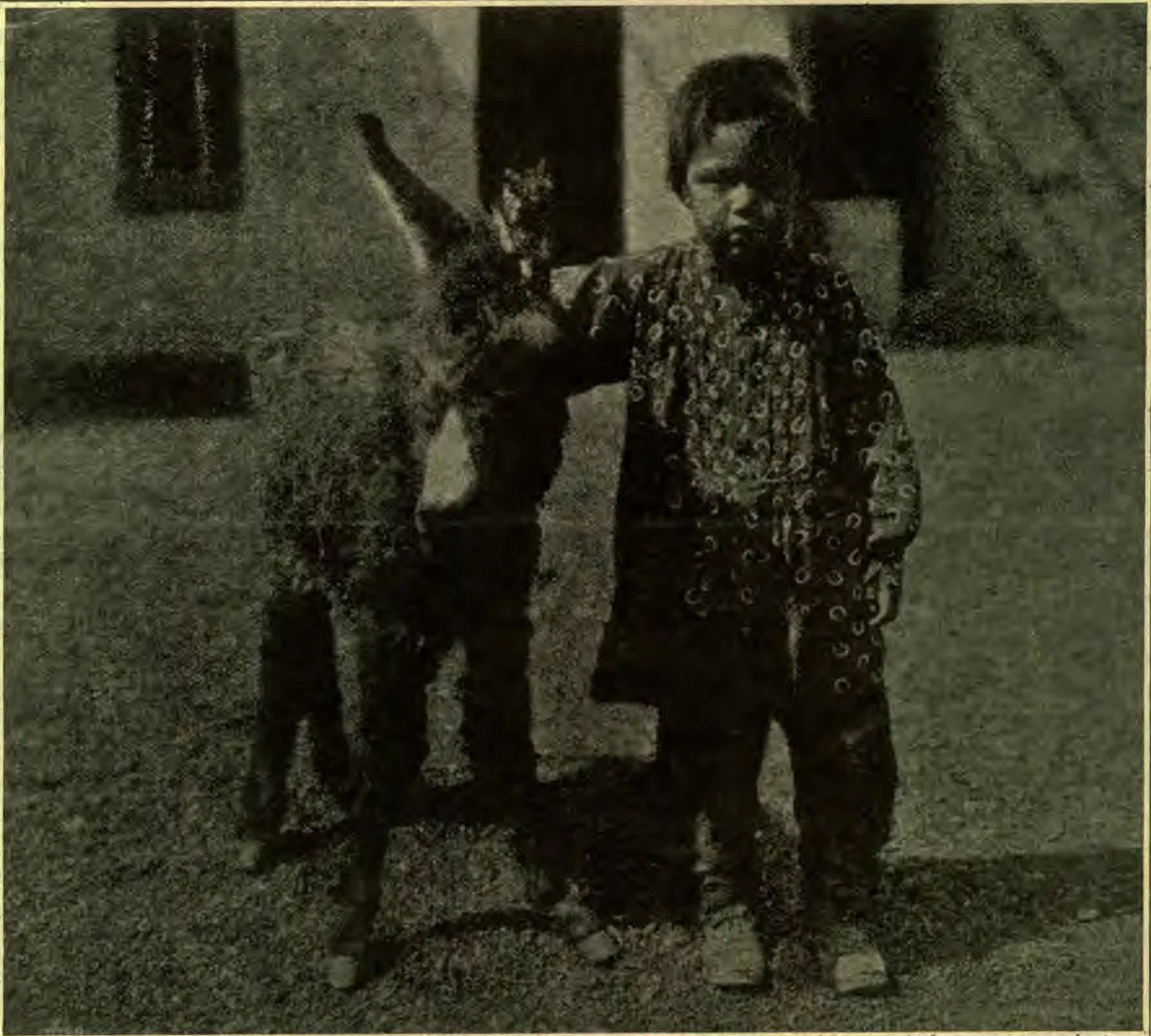
AN ESKIMO BOY AND HIS ST. LOUIS FRIEND
For a while the boys jogged on in silence; but Alonzo was of a social turn, and he soon called out good-naturedly: “Have you set your price?”
“Father thinks fifteen cents a peck and half a dollar a bushel will be about right.”
“Too low!” asserted the other. “I shall ask twenty and seventy-five cents for mine. You’d better, too. It’ll look kind o’ queer for us to have different prices—both together, as you may say—don’t you see? Neighbors talk over things sometimes.”
Julius thought a moment. “I won’t take the same streets that you do, if you rather I wouldn’t,” he said.
“Pshaw! don’t let’s separate. All you’ve got to do is to ask my prices, and—do my way. That’s fair, isn’t it?”
Julius hesitated before answering, and his sun-browned face took on a deeper color. “I think I’d better not ask any more than father said,” he replied, at last. “We don’t expect to make much on these, anyway.”
“All right!” returned Alonzo, in an injured tone. “But you won’t have so much money in your pocket, when you go home, as I’ll have—I can tell you that!”
“I’ll risk that part of it,” said Julius, pleasantly, and then the talk turned to other matters.
The boys followed out Alonzo’s plan of keeping together, and they peddled their apples from house to house on opposite sides of the streets which they selected. Alonzo’s spirits rose as they went on; for his apples sold far more rapidly than did his companion’s.
“What did I tell you!” he said. “Better take my advice! I’ll let you have two o’ my shiny ones as a starter.”
Julius shook his head. “Thank you,” he answered; “but I haven’t any apples in my load to back up such samples as those, and I can’t do it.”
“Oh, pshaw! you’re too squeamish!” was Alonzo’s reply. “Your apples are as good as mine!”
The other did not gainsay him, and the peddling went on in silence.
Alonzo’s wagon was empty, when his comrade was still going from house to house in a vain attempt to sell his remaining two bushels. At last they were disposed of to a grocer, and the two boys turned their teams in the direction of home.
Julius Merrick was obliged to hear a good deal of bantering during the succeeding days concerning his apple peddling, for Alonzo told the story, with embellishments of his own, to his neighborhood friends; and although not all of the boys agreed with Alonzo in his methods of marketing his fruit, yet few had the courage to stand by Julius. Most of them agreed that apples couldn’t be sold in such a “greenhorn way,” as one termed it; but through it all Julius stuck to his principles in his good-natured, smiling fashion, and bore the jibes with at least outward composure.
About a fortnight after the trip to Leyland, the two boys went down again with apples, this time with choice, picked fruit. Julius would have preferred to go alone; but Alonzo, being a near neighbor, usually learned his plans, and formed his own accordingly. So Julius was not greatly surprised to find that a second time they were to be companions in peddling.
“I didn’t mean to go to-day,” Alonzo explained; “but when your father said you were going, I hurried around and got ready. I wouldn’t miss the fun for anything. Going to sell your Northern Spies for fifteen cents a peck?” he laughed.
“No; I shall get twenty-eight, if I can,” was the answer, “and one dollar a bushel.”
“Whew! haven’t we gone up! You’re ahead of me! Don’t believe you’ll get it, either!”
“They’re worth it, father says. They are regular bouncers, and just as fair. We threw out every poor one.”
“I didn’t take that trouble, I can tell you! They sell just as well, take ’em as they come.”
“Father doesn’t think so. We want to get up a reputation for good fruit, and then folks will know they can depend on us.”
“Well, maybe,” acquiesced the other; “but it hardly pays in the long run. We generally manage to sell our things, and at pretty fair prices, too. You mustn’t be too nice in business, old chap.”
Going over the route of the fortnight previous, Julius found his apples selling readily at the prices he had decided upon; but Alonzo’s went slowly. As Julius came from one house with an order for two bushels, his companion was waiting for him.
“They want you over yonder,” he said, soberly. “Leastways they don’t want me! I’d ought to have worn my best clothes! They inquired for ‘that neat-dressed boy’ that was with me ‘two weeks ago,’ and that answers your description pretty straight. I told ’em I’d send you across.”
As soon as Julius was at liberty, he presented himself at the house designated, full of wonder at the summons.
“Oh, yes, you’re the chap!” exclaimed an old gentleman, who came from an inner room. “What have you to-day? We don’t want any more apples from that other fellow. He cheated my daughter last time he was here. His samples were good, fair apples, but those he put in the cellar were about fit for pigs. They told me across the street that if I traded with you, I’d get my money’s worth. You may bring me in three bushels if they are as good as those in your hand.”
Alonzo watched the measuring of those apples with mingled anger and mortification; and twice again, within a single block, was he obliged to give way to his friend. This was too much for the proud Alonzo, and at the corner he turned into a cross-street.
“Guess I’ll try my luck down this way,” he said, “and leave free sailing for you.”
Julius protested, but Alonzo was determined, and the two boys did not meet again that day.
Julius’s load was early sold, and he returned home with orders for eight more bushels, to be delivered the next week.
“You’ve made a lot of friends in this neighborhood,” one woman had assured him, “by your fair-and-square dealing. You’ve begun on the right track. Treat customers well, and you can keep them; let them find out that you’ve cheated them once, and you’ll find it a hard matter to get back their trust.”
Alonzo Taylor learned in sorrow the truth of this last statement. Even when he adopted more honest methods, people still disbelieved him. His chosen field, which included the best portion of Leyland, he was forced to leave to the boy whom he had ridiculed as a “greeny.” Even if Julius had not sold any apples, his way would still have been the only right way.—Emma C. Dowd.

Our Aim and Our Motto

OUR AIM,—“The Advent Message to All the World in This Generation.” Why is that our aim? What will be the result of the accomplishment of that aim? How shall we accomplish it?
First, it is our aim because it is the purpose of God for this time,—the advent message to all the world in this generation. That is the will of God. That is the purpose of God. That is the climax of this great work of the gospel to a lost world. Sometime, according to that plan of God, Jesus Christ will come a second time to this world. His advent will be heralded by a message of his coming. That message will be the advent message, and it will be given to all the world in a single generation. That is my understanding of the reason why we have chosen that for our aim.
This is a great aim, a great purpose. It is great for two reasons: first, it is a great thing to do; and second, the results will be unspeakably great. What does it mean?—It means self-denying, consecrated service. I wonder if our young people who have chosen this as their aim realize the greatness of it?
In this country we have only about one twentieth of the people to whom this message must be given. There are fifteen hundred millions of them in the world. When we look over this land with its great cities, its teeming millions, we can see that we have a great work to do here; but, my friends, it is only one twentieth of the work that must be done if this aim is accomplished. Here in this country we have a common language, we have religious liberty and freedom, great railway, telegraphic, printing, and postal facilities,—we have everything to be desired to aid us in the speedy proclamation of this message. But when we leave this country, we enter upon difficulties that are wholly unknown here. When we cross to China, we find a people in the darkness of heathendom, speaking another and very difficult language. We find them without the modern appliances and facilities that we have here. Crossing from China to India, we find conditions not quite so bad, but yet very forbidding. Yet our aim is to proclaim the advent message to every one of these nations in this generation. Can we do it? Is this aim a reasonable one? If it is God’s purpose, it is a consistent aim for us to take.
One thing young men and women need to get hold of is a positive assurance that this aim is well founded; that is, that Jesus Christ is to come in this generation. If that is true, a definite message must be given to the world in this generation. How shall we get this positiveness?—We must go to the Word of God, and get it there.
I remember how some of these truths first came to me. It was not altogether by the preaching of the ministers who came to our church when I was a boy. When I felt called to the ministry, I went out to give this message. I was very hopeful and courageous. On my way to Texas, where I was going to begin work, I began to do missionary work. I had a little tract, “Elihu on the Sabbath.” I handed a gentleman in front of me this little tract. He read it, turned around, and began to question me. He proved to be a Baptist minister. I found that I did not exactly know my bearings. When he saw that I was perplexed, he began to give me some counsel, telling me what he believed about it. This was the first time a man had talked to me about such a thing. I did not know what answer to give, so I said nothing. When I got away from that man, I took my Bible and searched for every scripture that said a word about Sunday, the first day of the week, and I was astonished to find out how little there was in all that man had said. My mind was firmly established upon the truth of the Sabbath, and from that day to this no man has ever been able to shake my confidence in it. I learned from the Bible the facts, and there my confidence rested. I had a like experience over the question of the state of the dead.
There are young men and young women who have not positive assurance in their souls that Jesus Christ is coming in this generation, and the reason is that they have not gone into the world to proclaim that message, and hence have not come face to face with people who made them think, and made them go to the Word of God to get the truth for this time.
What will be the result of giving the advent message to all the world in this generation?—Jesus Christ will come in this generation, the kingdoms of this world will become the kingdoms of our Lord and his Christ, the consummation of the gospel in all its fulness and glory will come; the righteous will have that blessed experience of going up to heaven without seeing death; the righteous who have fallen asleep in Christ will come up, an exceeding great army, in this generation. What tremendous events these are! What a thought for me to stand and see my Lord in his glory! Will that not be a wonderful scene? I want to ask you if results warrant the service required? What do you say?
You ask, What is the service?—It is all that you can possibly render. All that you can render, and far more than you are capable of rendering, for the service you render to-day will increase your power to serve, and to-morrow you can render greater service. God asks us to take only a step at a time, and the step that we take strengthens us for another forward step.
OUR MOTTO,—“For the Love of Christ Constraineth Us.” I feel more anxious regarding this motto than I do regarding the aim; because when this becomes a fact, the problem is solved. What does the word “constrain” mean? It means the love of Christ compels, impels, moves, influences us. O that this were so! Let us read, “Because we thus judge, that if one died for all, then were all dead: and that he died for all, that they which live should not henceforth live unto themselves, but unto him which died for them and rose again.” Look at that argument—the love of Christ constraineth us because we thus judge, or reason. Here is the reasoning: Christ died for all because all have died—were dead through sin. He died for all that they should no longer live unto themselves, but unto him who died for them. Paul said, “That love constraineth me.”
Dear friends, this is the only power that can ever enable us to give the advent message to all the world in this generation. The secret of our failure to-day is that the love of Christ has not sufficiently constrained us.
This brings us face to face with the greatest problem that we have: How can we be filled to overflowing with this blessed love of the Lord Jesus Christ? I read in Romans that the love of Christ is shed abroad in our hearts by the Holy Spirit, which is given us. Then in order to have that fulness of his love, we must have the fulness of the Spirit of God. What will bring the Holy Spirit to us?—Unconditional and unreserved surrender of our lives to God.
The young people of this denomination have the greatest aim, the most glorious motto in the world,—“The Advent Message to All the World in This Generation; for the Love of Christ Constraineth Us.” If something could come to us to make this actual, make it more than a motto, more than an aim, something would go forth from us that would take effect on the hearts of men. I do not say that all would be converted, but, my friends, something would be accomplished. We can not go on much longer in this indifference. The question is, What can we do to bring a change?
We can get on our knees, we can throw to the winds all the selfish ambitions of our lives and hearts, we can let go of every trifling thing, every side issue, and get right with God. I sincerely pray that the Lord will bring us to the one great purpose which he has for us.
A. G. DANIELLS.

On Speaking Kindly of Others

“If thou knowest no good to say Of thy brother, foe, or friend, Take thou, then, the silent way, Lest in word thou shouldst offend.”

INTERMEDIATE LESSON

I—The Decree of Cyrus

  • (January 7)
LESSON SCRIPTURE: Ezra 1 and 3.
MEMORY VERSE: “For thus saith the Lord, That after seventy years be accomplished at Babylon I will visit you, and perform my good word toward you, in causing you to return to this place.” Jer. 29: 10.
Years before they were carried into Babylon the Lord had told his people, through the prophet Jeremiah, that their captivity would last only seventy years; after that he would bring them again to their own country. So, in the first year of King Darius, Daniel fasted, and, in sackcloth and ashes, prayed earnestly, confessing the sins of Israel, and asking that God would forgive them.
While he was still praying, the angel Gabriel touched him, and said: “O Daniel, I am now come forth to give thee skill and understanding.” He assured Daniel that he was “greatly beloved,” and told him how long it would take to restore and build Jerusalem, when the Saviour would come, and how long he would preach.
Darius reigned only two years. Then Cyrus the Persian took the throne. This man had been raised up by the Lord to do a great work. Many years before the birth of Cyrus, the Lord had called him by name, in the writings of Isaiah, and had told the very work that he would do,—that he would give the command to rebuild Jerusalem, and lay the foundation of the temple. This shows us once more how interested the Lord is in all that concerns his people.
It was now just about seventy years since the first company of captives had been brought to Babylon from Jerusalem, and was therefore time for the children of Israel to return to their own land. Verses 1 to 4 of our lesson scripture tell us how King Cyrus did his part in fulfilling this promise that the Lord had made to Israel:—
“Now in the first year of Cyrus king of Persia, that the word of the Lord by the mouth of Jeremiah might be fulfilled, the Lord stirred up the spirit of Cyrus king of Persia, that he made a proclamation throughout all his kingdom, and put it also in writing, saying, Thus saith Cyrus king of Persia, The Lord God of heaven hath given me all the kingdoms of the earth; and he hath charged me to build him an house at Jerusalem, which is in Judah. Who is there among you of all his people? his God be with him, and let him go up to Jerusalem, which is in Judah, and build the house of the Lord God of Israel (he is the God), which is in Jerusalem. And whosoever remaineth in any place where he sojourneth, let the men of his place help him with silver, and with gold, and with goods, and with beasts, beside the free-will offering for the house of God that is in Jerusalem.”
All the vessels of gold and silver, five thousand in number, that had been taken from the temple and carried away to Babylon, were also given to one of the princes of Judah to be taken back to Jerusalem.
Then all the people gathered together at Jerusalem. The altar of burnt offerings was repaired, sacrifices were offered, and the worship of the Lord was re-established.
A free-will offering was also brought by the people; and money was set aside to hire masons and carpenters, to buy food for the workmen, and to bring cedar logs from Lebanon to use in rebuilding the Lord’s house.
After many months the foundation of the temple was laid. This was a time of great rejoicing; but while some shouted for joy, others, who remembered the glory of the former house, wept aloud. Mingled with the jubilant song of thanksgiving was the voice of weeping and sorrow for the beautiful lost temple that Solomon had built; “so that the people could not discern the noise of the shout of joy from the noise of the weeping of the people: for the people shouted with a loud shout and the noise was heard afar off.”

Questions

1. What kingdom was represented by the head of gold in Nebuchadnezzar’s dream of the great image? Dan. 2: 38. Name the two nations that united to form the next kingdom. Who was Darius? How did he honor Daniel? Dan. 6: 1, 2.
2. What promise had the Lord made to Israel concerning the time of their captivity in Babylon? Memory verse. What did Daniel’s study of Jeremiah’s prophecies lead him to do? How were his prayers answered? See Daniel 9.
3. After Darius had reigned two years, who was made king? What had been written about Cyrus many years before this? See Isa. 44: 28; 45: 1-6.
4. In the first year of his reign, what proclamation did Cyrus make? What were those who did not return to Jerusalem to do? Ezra 1: 1-4. What was done with the vessels that had been taken from the temple? Verses 7-11.
5. Tell how the worship of the Lord was re-established at Jerusalem. For what purpose were free-will offerings brought? Ezra 3: 7.
6. When the foundation of the temple was laid, how did the people praise the Lord? Verses 10, 11. What sound was mingled with the songs of rejoicing?
7. Tell at least one way in which our faith may be strengthened by our study of this lesson.

I—The Bible and Liberty

(January 7)
MEMORY VERSE: “Where the Spirit of the Lord is, there is liberty.” 2 Cor. 3: 17.

Questions

1. What is the condition of the sinner? 2 Peter 2: 19.
2. What is involved in this bondage of sin? Rom. 6: 16; note 1.
3. For what purpose was Christ manifested? 1 John 3: 8.
4. What was his mission to this earth? Isa. 61: 1.
5. Tell how Jesus announced his mission in Nazareth. Luke 4: 16-19.
6. What condition always exists where the Spirit of the Lord is? 2 Cor. 3: 17.
7. For what purpose was Israel delivered from Egyptian bondage? Deut. 5: 15.
8. What command was given them for the release of their Hebrew servants from perpetual bondage? Ex. 21: 2.
9. What arrangement was made whereby there would be release from the bondage of debt? Deut. 15: 7-9.
10. What command was given concerning land lost through debt or misfortune? Lev. 27: 24.
11. When was universal liberty from all servitude, debt, and unfortunate loss of possessions to be proclaimed? Lev. 25: 10.
12. For refusing to proclaim this liberty to their brethren, what message was sent to Israel through the prophet Jeremiah? Jer. 34: 17.
13. When will final and complete liberty come to God’s people? Dan. 12: 1. By what was this deliverance typified? Note 2.
14. What are we encouraged to do that we may be prepared for that great day of deliverance? Gal. 5: 1.

Notes

1. Satan’s plan is, and ever has been, to bring man into bondage—the bondage of sin, the bondage of self, the bondage of selfishness, the bondage of fear, the bondage of slavery, the bondage of debt, the bondage of disease, the bondage of death. How well he has succeeded, the amount of sin, selfishness, fear, slavery, debt, disease, and death there is and has been in the world testifies.
2. “In the time of trouble, we all fled from the cities and villages, but were pursued by the wicked, who entered the houses of the saints with the sword. They raised the sword to kill us, but it broke, and fell as powerless as a straw. Then we all cried day and night for deliverance, and the cry came up before God. The sun came up, and the moon stood still. The streams ceased to flow. Dark, heavy clouds came up, and clashed against each other. But there was one clear place of settled glory, whence came the voice of God like many waters, which shook the heavens and the earth. The sky opened and shut, and was in commotion. The mountains shook like a reed in the wind, and cast out ragged rocks all around. The sea boiled like a pot, and cast out stones upon the land. And as God spoke the day and hour of Jesus’ coming, and delivered the everlasting covenant to his people, he spoke one sentence, and then paused, while the words were rolling through the earth. . . . And when the never-ending blessing was pronounced on those who had honored God, in keeping his Sabbath holy, there was a mighty shout of victory over the beast and over his image.”—“Early Writings,” pages 27, 28.
“Then commenced the jubilee, when the land should rest. . . . Soon appeared the great white cloud. It looked more lovely than ever before. On it sat the Son of man.”—“Early Writings,” pages 27, 28.

“Read of All Men”

“By their fruits ye shall know them.” Matt. 7: 20.
OUR deeds, and the words that we utter, To the eyes of the world will unroll The desires that rest in the bosom, The thoughts that abide in the soul, No matter what creed or profession We make, while our life is a scroll That the world reads, and marks our progression, As we act out the thoughts of the soul.
Oh, then, may our thoughts be the purest, And the heart be renewed from above! For heaven is sweetest and surest When the actions are guided by love. There’s a rapture, if we will but learn it, In making the broken heart whole, And the world is not slow to discern it When Jesus abides in the soul.
Life opens in glory before us, And the bright years of heaven draw nigh, The grand bow of promise bends o’er us, In a land where its dwellers ne’er die; As the hush of the night, it is holy, Where its bright, countless seasons unroll, And the joy of the high and the lowly Is Jesus, who dwells in the soul.
L. D. SANTEE.

Once to Every Man and Nation

“ONCE to every man and nation Comes the moment to decide, In the strife ’twixt truth and falsehood, For the good or evil side.”

“The Shining Shore”

Dr. George F. Root, the author of “Shouting the Battle Cry of Freedom,” was sitting, in his younger days, at his desk on the old home farm at Reading, Massachusetts, composing and compiling a music book.
His mother, a saintly woman, entered the room softly, and placed over his shoulder before his eyes a paper, in the poets’ corner of which was a ballad full of spiritual figures.
“I wish, George,” said she, “that you would sometime write music for those words.”
She slipped away, leaving the composer the paper.
He dropped his eyes on the ballad. The words read strangely; there seemed to be some mystery in them:—
“My days are gliding swiftly by, And I, a pilgrim stranger, Would not detain them as they fly, Those hours of toil and danger; For, oh, we stand on Jordan’s strand, And soon we’ll all pass over, And, just before, the shining shore We may almost discover.”
What followed was as tender, beautiful, and unexpected:—
“We’ll gird our loins, my brethren dear, Our distant home discerning; Our absent Lord has left us word, Let every lamp be burning.”
The tune came to him immediately, after the manner in which inspirations suddenly come to tone-poets. He wrote down the music, put it aside, and some time afterward published it. The ballad went over the world. For many years there was scarcely a social religious meeting in certain parts of America, England, or Scotland at which “The Shining Shore” was not sung.
The singers did not fully comprehend it, but they found in it something that met the needs of their souls. It entered into the inner consciousness.
Some years after it was published, an aged man entered Dr. Root’s office, and said: “You have set to music some words of mine, which people love to sing. You call it ‘The Shining Shore.’”
Dr. Root started. “I have hoped to meet the author of these words ever since I first saw them. How came you to write it? What does it mean? What is your name?”
“My name is Nelson. I am a clergyman. I was driven from my home by a mob in the times of the Kansas-Missouri troubles, and I hid in the river weeds of the Mississippi. I was a free-State man.”
“It was near night, and I hoped that I could hail some boatman who would take me across the river. While I was hiding in the river weeds, the sunset passed, and the shadows of evening fell. Across the river was a city, a free city, and I saw a light shine out there in the street along the shore. Then another light, and another, as the lamplighter did his work. Then the stores and the houses shone down on the waters. It seemed as if the city were lighted for me. The shore shone. I gazed on that shining shore, and I longed to be there.”
“While thus longing and waiting, the substance of the verses came to me. I found a boatman, and was taken across the river to the shining shore; and there, on the following day, I wrote down my thoughts in the river weeds in the verses you have set to music.”
I was told the story by Dr. Root himself, after the manner in which I have given it, though not in the same words. I recently visited the old house at Reading where the song was written. The farm was very beautiful, with its willows, gardens, and orchards, but had passed out of the hands of the musical family, and was occupied by Canadians.—Hezekiah Butterworth.

The Artist and His Ideals

GEORGE FREDERIC WATTS is described by his biographers as the simplest and most humble of men. His personal humility and self-effacement, says a writer in the Monthly Review, formed a striking contrast to the loftiness of his aims and the passionate strength of his convictions.
His daily actions were a living illustration of his belief in the old German motto which the Queen of Rumania, “Carmen Sylva,” suggested to him as the text of one of his most touching pictures: “What I spent, I had; what I saved, I lost; what I gave, I have.”
“Our little life,” he wrote once, “is poor indeed if bounded by our own personal wants and fancied requirements.”
Among countless instances of his generosity is one which he often recalled because of its connection with his picture, “Love and Life,” now hanging in the White House in Washington, a work which he considered his most important message to the world.
A poor artist’s wife, whom he had never seen before, came to his studio in sore distress one day, and begged for a loan of a few pounds to enable her to join her husband, who lay dangerously ill in New York. Watts gave her all, and more than all she asked, and she left him with tears of gratitude in her eyes, promising to come and see him on her return. Two years afterward she appeared, accompanied by her husband, who was restored to health, and had found work in America, and repaid the money which Watts had lent her.
When the painter asked what had led her to apply to a total stranger like himself, she replied, “The sight of your picture, ‘Love and Life.’” She felt that the man who had painted that picture must have a heart over-flowing with love and pity for sorrowing humanity, and the issue proved that she was right.
In his candor and guilelessness, Watts never shrank from giving his sitters good advice. A thoroughgoing idealist himself, Watts expected his friends to live up to the level of their art, and was pained to see any inconsistencies in their conduct. “Come, King Arthur would not have talked in that way!” he said to Tennyson one day, when the poet was in a more bearish mood than usual. But when the laureate showed him his knotted and swollen fingers, he understood, and felt satisfied that it was “all the gout.”—Christian Endeavor World.

Two Interesting Features of the St. Louis Fair

LOOK on page five for two interesting features of the St. Louis Fair.

Elder Daniells on the Young People's Aim and Motto

ELDER DANIELLS's article on the aim and motto adopted by the young people of this denomination is full of stirring truths. Read it individually, and have it read in the Young People's Societies.

Was Christ Born in December? Considering the Date of Christmas

From various texts of Scripture it is evident that the Saviour was not born in December. There are facts that seem to place his birth about the middle of October. Christmas is a mere heathen festival, which was originated long before the birth of the Saviour. This knowledge prevents our celebrating Christmas as the world does; yet it is well that we stop often to think of God's wonderful gift of love to our world. It is well, too, that we bring our heart's best gifts and lay at his feet even at this Christmas-tide if we have not done so before.
Continue reading: Letters from Rock Hall Young Readers