The Youth’s Instructor, Vol. 33, No. 49 (Pacific Coast Edition).

WASHINGTON'S MONUMENT
Earlier text: WASHINGTON'S MONUMENT

Living a Life for Christ

A SENSE of our own unsupported weakness will keep us humble, and impel us to the exercise of prayer, that knowledge, strength, and wisdom may be dispensed to us by Him who is enthroned on the mercy-seat. And thus, divine efficacy being imparted to our humble yet faithful efforts to qualify ourselves for service in His cause, we shall be made wise to win souls to Him, and become the instruments of promoting that “godliness” which, whether in the child or in the man, is “profitable for the life that now is, as well as for that which is to come.”
A LIFE for Christ must always be a life of love, of usefulness, and of helpfulness. It is just living for God, day by day, hour by hour. It is nothing strained and unnatural; beginning in the heart, in a true devotion to Christ, it is lived out in simple obedience and quiet faithfulness in whatever sphere our lot may be cast.

How Bank Notes Are Printed.

To look at a bright, new bank note, or bill, when first put in circulation, our young readers would see that care had been taken in printing it to give it its fine appearance; but we doubt if they would ever mistrust what a smutty, dirty job it is to manufacture it. If our exchange gives the process correctly, most any of us would rather earn the bills in some other way than by doing the printer’s part in their manufacture. It is given as follows:—
“At each press stand a man and woman. The man’s arms are bare to the shoulders, his face and hands grimy and besmeared with the thick, pasty black or green ink used in the printing. In front of him is his female attendant. She moistens the paper and places it on the press, and the printer applies the pressure, and the impression is made. The attendant removes the sheet, examines it carefully to see that the impression is perfect, and then lays it aside. The printer removes the plate from the press, wipes it with a wet cloth, plunges his hand into a mass of the inky paste, rubs it carefully over the plate with his naked hand, then smooths it with a handful of whitening, replaces the plate on the press, the attendant lays another sheet under it, the pressure is again applied, and another sheet is printed and removed. This goes on from 8 o’clock in the morning until 4 o’clock in the afternoon, with a half hour at noon for lunch.
“There are 235 hand presses in this division, each press being provided with an automatic contrivance that registers every impression made by the press. At the end of each day a clerk examines the registers and enters the number indicated, in a book. The number thus found must correspond with the number of sheets reported by the printer as printed.
“The notes are printed on one side only at a time. A package is made of them, and they are then sent to the office, accompanied by a memorandum of the number returned. In this office are a number of female accountants, who enter the numbers on the slips into large books, which serve as permanent records. The packages are then placed in a chest mounted on wheels. The chest is locked and rolled into the examining division, where it is opened by the chief of the division, and the contents distributed to expert and rapid counters, who count the number in each package and compare the result with the memorandum. The number of employees in this division is eighty-five—all females. They earn on an average $2 a day.
“If the work is printed on one side only, it is returned to the wetting division. If printed on both sides, it goes to the drying-room, where it is placed in a machine, and dried by a hot-air process. The next day it is placed for a few hours under a hydraulic press, whence it is removed and sent to the sealing and numbering division. In this division the red seal and the red numbers are impressed upon the notes. The work is done on small presses, propelled by steam and operated by women. There are seventy-five ladies in this division. The sheets are then run through the separating machines and cut into four parts, each part forming a treasury or bank note. From the numbering divisions the notes are sent to the counting division and delivered to expert counters, all females; they count the notes and put them into parcels of thirty packages, each package containing 100 notes. The packages are conveyed to the money vault, where they remain over night, and the next day are delivered to the treasurer’s division of the treasury department.”

INTERESTING INCIDENTS.

Last autumn, a bookseller named Meyer, of Ronneburg, in Germany, tied a waterproof label under the wing of a swallow which had built a nest at his house, and which had become quite tame. On the label he wrote a question to the effect that he wished to know where the swallow would pass the winter. This summer the swallow returned to its nest at Ronneburg, bearing an exchange label, saying, in German also: “In Florence, at Castellari's house, and I bear many salutations.” In this connection it may be worth while to tell the meaning of the word “swallow.” According to Scandinavian tradition, the bird hovered over the cross of our Lord, crying, “Svala! Svala!” (console! console!) whence it was called svalow, the bird of consolation.
It has been observed that when a charge of cavalry pass near to any of the stray horses in a battle, they will set off, form themselves in the rear of their mounted companions, and though without riders, gallop strenuously along with the rest, not stopping nor flinching when the fatal shock with the enemy takes place. At the battle of Kirk, in 1745, Major Mac Donald, having unhorsed an English officer, took possession of his horse, which was very beautiful, and immediately mounted it. When the English cavalry fled, the horse ran away with its captor, notwithstanding all his efforts to restrain him; nor did it stop until it was at the head of the regiment, of which, apparently, its master was commander. The melancholy and at the same time ludicrous figure which Mac Donald presented when he saw himself the victim of his ambition to possess a fine horse, ultimately costing him his life upon the scaffold, may be easily conceived.—Golden Days.

NOVEL FISH LINES.

On the European coast of the Atlantic there is found a variety of seaweed known as “Lucky Minney’s Lines.” The arms, or fronds, grow to a length of forty feet. When the outer bark, or covering, is removed, the arm is found to be composed of a single filament like a thread of silk. This filament, when braided up in a four-ply cord, makes a fish-line of extraordinary strength.

“BIBLE GLADNESS.”

WHEN Mollie Denham and her mother were visiting in the city, they spent a few days with a friend just on the outskirts of town. Mollie, who was fond of pretty things, was very much pleased with the bed-room that was given them. It had colored matting on the floor, and the furniture, though simple, was of a rich red color.
There was a beautiful picture outside the window. In front of the house was a large garden, with graceful shade-trees, smooth walks, and wide stretches of the greenest grass, studded with flower-beds of different shapes. On the other side of the street was a green field sprinkled with buttercups, and beyond that a pretty little stone church standing in a shady yard.
When Mollie ran to the window the next morning, she found all this looking beautiful in the early sunlight. “Everything is so lovely, it just makes me feel glad,” she exclaimed.
Presently, turning to make some remark to her mother, she saw something in the room she had not noticed before. Hanging by the window, in a small, neat frame, was the representation of a banner, with a cross and crown over it. On the banner, in red, blue, and gilt letters, were the words, “Serve the Lord with gladness.”
“Oh! that’s pretty!” she cried. “Is it a Bible verse, mamma?”
“Yes,” her mother replied.
“Where is it?”
“In the hundredth Psalm. Take that Bible on the table there and find it.”
“Here it is, in the second verse,” said she, “and the whole Psalm seems to be full of ‘joy,’ and ‘thanksgiving,’ and ‘praise,’ and ‘singing.’ This second verse makes me think of that other ‘glad’ verse.”
“Which one?”
“I was glad when they said unto me, Let us go into the house of the Lord.” You know I learned it for a breakfast verse one Sabbath morning.”
“But that isn’t the only other ‘glad’ verse; there are ever so many. I remember once finding quite a number of verses about joy and gladness in just two or three pages.”
“Where did you find them?” Mollie asked.
“I think I began at the ninetieth Psalm.”
Mollie turned to that place.
“Ninetieth Psalm? No, that can’t be the place; it is a little mournful. Oh, yes; down in the fourteenth verse there is something glad. It is, ‘O satisfy us early with thy mercy, that we may rejoice and be glad all our days.’”
“There,” said her mother, “that’s a good verse for a little girl. I want you to learn that.”
“Then in the next verse,” said Mollie, “there is something about gladness. Then in the ninety-second Psalm, ‘For thou, Lord, hast made me glad through thy work.’ The ninety-fifth seems to have a good deal of ‘joyful noise’ in it, and the next one has singing and praise. Yes, here is joy and gladness too: ‘Let the heavens rejoice and the earth be glad. Let the fields be joyful and all that is therein.’ The buttercups over in that field look glad this morning. The ninety-seventh begins with, ‘The Lord reigneth; let the earth rejoice; let the multitude of isles be glad thereof.’ Further on is this verse: ‘Light is sown for the righteous, and gladness for the upright in heart.’ Are there glad and joyful verses in other parts of the Bible besides the Psalms?”
“Plenty of them,” said her mother, “but we haven’t time to hunt them out now. When we go home, we will do so. We shall have to go down stairs soon; but before we go, suppose we each learn a verse,” and Mrs. Denham took up her own Bible.
“I’ll learn the one you told me to, about being ‘glad all our days;’ or may I have two?”
“Certainly.”
“Then I’ll take the one on the banner besides.”
Mrs. Denham also had two: “The Lord hath done great things for us, whereof we are glad;” and, “My meditation of him shall be sweet; I will be glad in the Lord.”
“Those are good,” said Mollie. “Why, I didn’t know there was so much Bible gladness.”—Selected.

Letter Budget.

The letter box has been kindly remembered for a few days. The letters have been written with care, too, and are such as will please the little readers. We hope to receive a great many more just as good. The first two on the list were written by two sisters, and both sent in one envelope:—
Maud Dunning writes from Adair Co., Iowa. She says: “As I have never written for the Budget, or seen a letter from our Sabbath-school, I thought I would write one. My sister Mabel and I have signed for the Instructor twice, and we like it very much. We have a little church, and attend Sabbath-school and meeting every Sabbath, and I take part in the Bible-readings. I go to day school, and mamma thinks I am a pretty good little scholar. We have a piano, and mamma gives sister and me music lessons. I learn my Sabbath-school lessons on the Sabbath, and so I keep busy all the time. Mamma let me go to camp-meeting at Des Moines. I had a good time. We had children’s meetings, conducted by Eld. Daniels. I saw seventy baptized. While at Des Moines, I also visited the capitol. I want to be one of Christ’s jewels.”
Mabel Dunning writes from the same place. She says: “Maud and I are two little sisters. I am eight years old, and she is nine. We are very fond of each other. We both keep the Sabbath with our mother. We learned the truth of Eld. Pegg more than a year ago. Our papa does not keep the Sabbath, but we pray for him every night. We have raised flowers every year until this year, but now we have a little baby sister. We have to set good examples before her, and help mamma bring her up. They all call her the little ‘Adventist’s Budget.’ I have earned money enough herding, picking berries, and doing chores for papa, to buy myself ‘Stories of the Bible’ and ‘Better than Pearls.’ I want to be a good girl, so I can be one of the Instructor family in the new earth.”
These two little busy bodies, Maud and Mabel, tell us of their home-life in a way to make us feel almost as if we had seen them in their daily round of duties, and with that little choice plant they take so much interest in “helping mamma to bring up.” Indeed, little friends, by always “setting good examples before her,” you may help even more than you think in making her character pure and lovely, and in the meantime be perfecting your own ways.
Lydia O. M. Kellogg, of Oneida Co., N. Y., writes: “I have never written for the Budget before, but would like to see my letter in print. I am now taking the paper, and like it very much. I am eleven years old. My mother and I keep the Sabbath. There are no others that do in this place. We cannot often go to church and Sabbath-school, but sometimes we go to Rome. I was at the Sanitarium during the summer of 1883. I had spasms, and took treatment there. The Lord has healed me, and I am very thankful to be well. I wish some of my playmates would keep the Sabbath. Mother has canvassed the town, and given away many tracts, but few care for them. I attend the Baptist church and Sunday-school. My studies are reading, spelling, writing, arithmetic, and geography. The teacher also gives us instruction in physiology. I am trying to be a good girl, and hope to go to heaven when the Lord comes.”
We will call Lydia’s our thanksgiving letter, although, no doubt, many others have thankful hearts too. Lydia has been made well, after months of suffering. Such persons know how to value health; and to be relieved from pain, makes them feel glad and thankful. But persons who have never had to suffer pain, owe a debt of gratitude which ought to be paid in thanksgiving.
Andrew Johnson, of Pott. Co., Iowa, writes: “As we are now picking corn, I do not have much time to write, but I see that your Letter Budget is getting small, so I thought I would write a few words. I am thirteen years old. I keep the Sabbath with my parents. We have a Sabbath-school of four Sabbath-keepers. I have one brother and one sister. We have taken the Instructor nearly a year, and I can say that I like it much. This is the first letter I have written for it; but I hope it may not be the last. Pray that I may have a place with the saved in the new earth.”
We thank you, Andrew, for your interest in the Budget. Yours is the right kind of interest,—to take hold and help when you realize the box is nearly empty. May you always have that kind of interest in every good cause,—to put your shoulder to the wheel over the hard places, so that it may be said to you that you have done well.
Orlando O. Branstetter, of Metcalfe Co., Ky., writes: “I am a little white-headed, blue-eyed boy, seven years old. I am four feet high, and weigh sixty-five pounds. I will tell you what I have been doing. I went to school until a few weeks ago, when we had to stay at home to help make sorghum. We have a ‘Palace Self-skimming Evaporator.’ We made as many as ninety-five gallons per day. We made about 3,000 hot gallons. But we are through now, and have begun to go to school again. We learn our Sabbath-school lessons at home, as there is no Sabbath-school near us now. We have a baby sister two years old. Her name is Daisy. We have a little pet chicken, which Daisy calls ‘our little pet cuckoo.’ This is my first letter; I hope you will print it.”
It was with interest, Orlando, that we read what you have been doing. A good many of our readers know how to make maple syrup; but comparatively few know how sorghum is made. Don’t you think Daisy is a “little pet cuckoo,” herself? We once knew a man who always called good little girls cuckoos, and he always sang to them, “I am a cuckoo, My name is cuckoo, The children call me cuckoo.”

Idleness Leads to Evil

By having nothing to do, one learns to do evil.

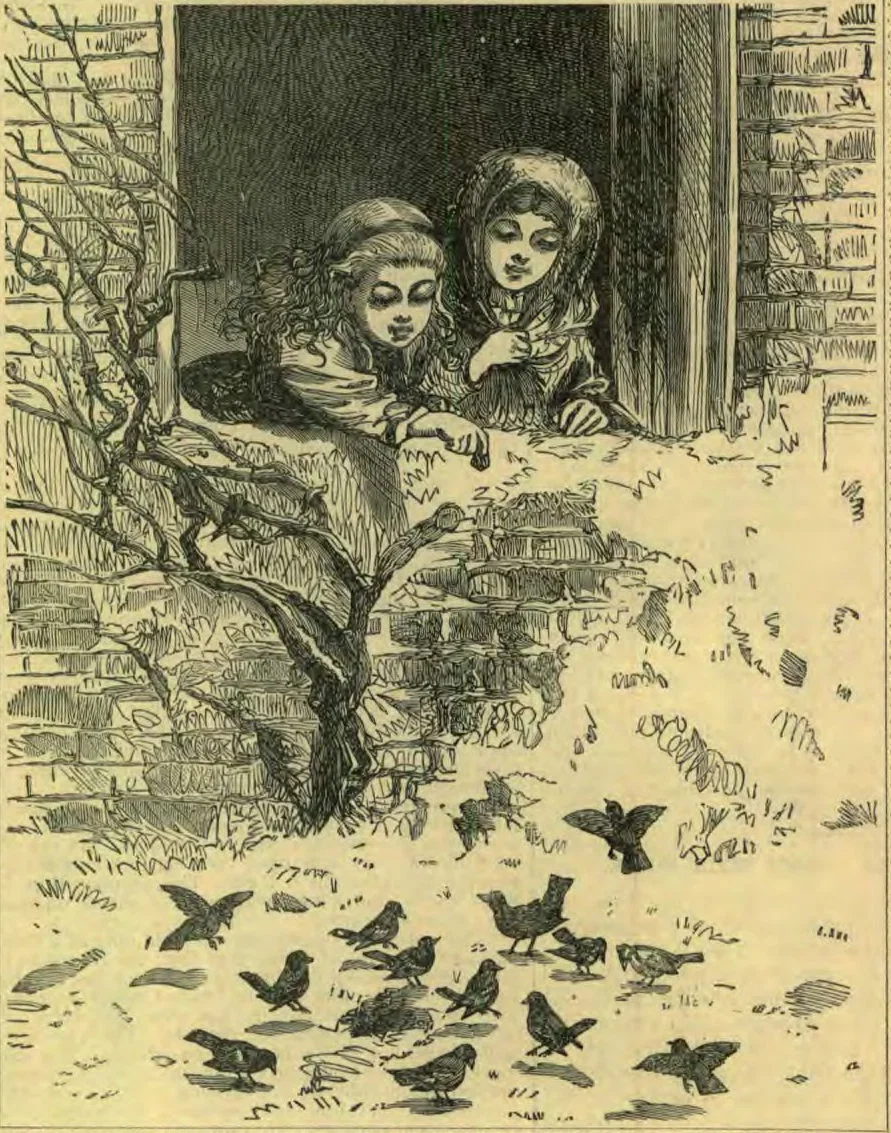
THE SPARROWS AND THE SNOW-FLAKES.

SAID the sparrows to the snow-flakes, "Where did you come from, pray? You make the trees all wet and cold; We wish you'd go away."
Said the snow-flakes to the sparrows, "Don't be so rude and bold; Your feather coats are nice and warm, You cannot feel the cold."
Said the sparrows to the snow-flakes, "You cover up the way; We'll starve, because we cannot find A thing to eat to-day."
"Dear sparrows," said the snow-flakes, Now do not get so mad. We come from yonder cloudland, To make the children glad;
"And the little ones who love us, They love the sparrows too; They'll scatter crumbs each morning, And houses build for you."
"Of course we will, and gladly," Said the little children all. "We love the tiny snow-flakes; We love the sparrows small."
—Nellie M. Garabrant.

You have reached the end of this edition.

The Youth’s Instructor · Dec 23, 1885