The Youth’s Instructor, Vol. 33, No. 49 (Pacific Coast Edition).
WASHINGTON'S MONUMENT
Page 1
The Youth’s Instructor
Dec 23, 1885
S. D. A. Publishing Association · Battle Creek, Mich. · Dec 23, 1885
WASHINGTON'S MONUMENT.
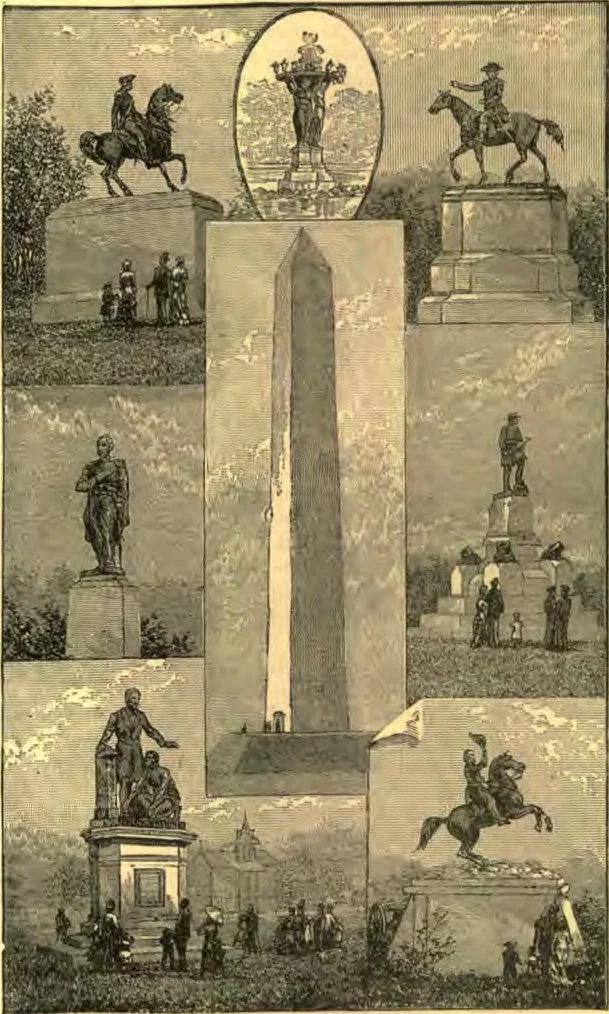
In the picture on this page, we give our readers a view of the monuments in Washington City. The central one of the group is the Washington monument, commenced in 1848 and completed in 1884. It was dedicated on Washington's birthday, February 22, 1885. The following, from Harper's Weekly, will give you some idea of it:—
“Though Washington's deeds erected a monument to himself more durable than stone, yet it is becoming that the white marble obelisk in the capital should commemorate his patriotic life. It is the tallest structure in the world, being five hundred and fifty-five feet in height. It is forty-five feet higher than the spires of Cologne Cathedral, the tallest in Europe; one hundred and five feet higher than the pyramid of Cheops, the highest building in Africa, and three hundred and sixty-three feet higher than the tallest pagoda in Asia. Its great height is appropriate to the memory of the man who was ‘first in peace, first in war, and first in the hearts of his countrymen,’ and of whom an English poet wrote,—
‘Where Washington hath left
His awful memory
A light for after times!’
“It is a singular trait, showing the close connection between the early and the later discoveries of science, that the Washington Monument is built almost with the exact proportions of an Egyptian obelisk. This was found to be the best guide for the construction of so tall a pillar. The monument is ten times as high as it is broad at its base.
“It is an enlarged obelisk, a copy of the solitary shaft that still points out the deserted site of Heliopolis, or the ruddy pillars that adorn the Central Park and nearly all the great capitals of Europe—exiles of Egypt.
“But our American column will add to its attractions many conveniences unknown to the ancient, or even modern, builders. Wren's monument, or Trajan's Column at Rome, could only be ascended by a weary flight of steps. In Washington's the visitor is seized upon by the genius of steam, and raised in a few moments in a comfortable elevator almost to the copper apex at its top.
“It is white marble on the outside, granite within. Globes of electric light adorn the interior. There is no darkness in the shaft. The copper point at the top conducts the lightning to the ground. The electric experiments of Franklin will be remembered by every visitor.
“No one can examine this remarkable column without feeling that a new advance has been made in architecture; and the various devices used in its construction show the triumph of modern skill.
“Before the visitor to the Washington Monument opens a prospect as fair as any the eye of man has rested on. He looks down upon a land of freedom.
“The scene is crowned with historical memories—some sad, some full of hope and joy. Before him flows the broad Potomac; not far away is Mt. Vernon. Beneath him are battle-fields and scenes of bitter struggle in the past, and now the quiet city, hid in groves and gardens, sleeping in the shades of perpetual peace.”
OUR TEACHER KNOWS
By F. S. Hafford
Written for the INSTRUCTOR.
OUR TEACHER KNOWS.
Some time ago, I was visiting the asylum for imbeciles at Columbus, Ohio; and when there, I received some impressions which will always remain with me. Thinking perhaps one incident which fastened itself upon my mind would be of interest to the readers of the INSTRUCTOR, I write it down.
Soon after I went there, I was introduced by the matron to one of the teachers, a Miss Ricks; and, in conversation with her about the children under her charge, I said, “Do you think your children ever become accountable for right and wrong doing?”
She did not seem prepared to answer directly, but after a moment’s thought replied, “I try to make them feel accountable to me, but I do not believe many of them are accountable to God.”
Some time afterward, when I was being shown through the school rooms by the matron, a lady whose invariable kindness toward everybody impressed me greatly, we came to the room where this same teacher was in charge of about twenty pupils. We stopped here a few minutes to watch the exercises.
“Did you ever see Barnum’s show?” asked the matron.
“Yes, I have seen it,” I replied.
“There,” said she, “sits one of his ‘Aztec children.’ His name is Eddie Payne. He and his brother, whom Barnum represented to be a girl, were born in Ashtabula County, Ohio, and are now about nineteen years old.”
Then Miss Ricks spoke and said, “Eddie, come here.”
The boy got up and came promptly to her. I saw nothing like shyness among any of those children. He was rather small for his age, and not quite as tall as his teacher. She placed her hand on his forehead, which sloped back nearly straight from the brows to the crown, and turning to me she said, “Mr. Hafford, do you think a boy with that brain ought to be considered accountable?”
I could only answer, “I should think not.” Then, to show me what mind he really had, she turned to the blackboard, upon which were written several columns of words of three letters, as “cat,” “rat,” etc., and asked, “Eddie, which of these did you write?”
He pointed his finger toward one of the columns.
“Tell us which one,” she persisted, endeavoring to get him to speak.
He stepped up to the board, and put his finger upon one of them. Then the matron spoke up, “Why, no, Eddie, you didn’t write that. That is too good for you to write. I guess Miss Ricks wrote that, didn’t she?”
He placed his hands to his face, and uttered something which sounded like, “Naw.”
But the matron persisted in doubting him, and said, “But surely you didn’t write it. Some one else must have done it.”
The boy looked at us for a moment with a pained expression, then turned to his teacher with such a look of appeal that her heart refused to allow the deception to go on, and she held out her arms to him and said, “Yes, Eddie, you did write it.”
And the great big boy, with the mind of a little child, went to her whom he had learned to love and to trust, and laying his head on her shoulder as she put her arms around him, he looked at us with an expression which said, “Now say or think what you please, my teacher knows all about it. With this poor, weak, stammering, idiotic tongue, I cannot answer you; but she knows, and that is all I care.”
Many times since have the tears come to my eyes as I have thought of this incident; and I have asked my own heart the question, Why cannot I, when I am doubted, and my motives misunderstood, go to the great Teacher who knows all about it, and reposing my confidence in him, wait for him to vindicate me? How hard it is to learn to trust him who has said, “Except ye become as little children, ye cannot enter the kingdom of heaven.”
F. S. HAFFORD.
FAITH
By Margaret E. Sangster
Beyond the shadows of the present hour,
Beyond the deepening gloom,
Past storms that in the distance darkly lower,
Past all life's fleeting bloom,
With steadfast eyes that do not dread disaster,
With heart uncrushed by care,
I follow trustfully the blessed Master
Whose cross I daily share.
In need of guidance always, O my Father,
Thy will I seek, not mine;
In need of patience, strength renewed I gather
Through constant grace divine
As step by step I journey, seeing only
A single step before;
I falter not, though sometimes sad and lonely;
The worst will soon be o'er.
Here clasped hands loosened; here the strong ties broken
(Yet ever God knows best);
Here farewells blending oft with greetings spoken
(But God hath promised rest);
There meetings glad beside the crystal river,
There changeless, endless peace;
No more the severed harp-string's sudden shiver,
For there the discords cease.
I trust thee, Lord, for pardon of my sinning,
Alas, so deep the stain!
Forgiveness through the blood of Jesus winning,
And sweet relief from pain.
Erring and weak and yielding to temptation,
I dare, dear Christ, to claim
The fullness of the offered free salvation
Alone through thy great name.
I have no doubts, no room for aught save clinging,
Through time and changing sense,
To that kind hand that every day is bringing
Rich gifts of providence.
I have no doubts, no fears with baleful voices
May whisper in my soul
Upon the way; that happy soul rejoices
Through Christ, through Christ made whole.
Come want, come trial, come what may, appointed
By Him whose own I am;
I still shall walk with eyes from tears anointed,
Serene, unvexed, and calm.
Faith is my key that sets the gate of blessing
Wide open with no bar;
The glory waiteth for my sure possessing,
The promised Morning Star.
—Margaret E. Sangster.
Showing the Beauty of Christian Life
MAKE your life beautiful in the sight of men, and show them the sweetness and power of Christianity. Be conscientious in little things. Let the Master's spirit shine through every hour of your life. In school, in shop or field, in society, the young Christian ought to be the most faithful, the most courteous, the most generous and kindly, the noblest of any person there.
Bert's Queer Gift.
A careless nail had torn Bert's coat, but Aunt Marion had just finished the bit of delicate darning that made the jagged rent invisible. She was shaking out the garment to hang it away, when something dropped from one of the pockets, and fell on to the carpet at her feet. She picked it up—a little brown leafy roll—sniffed its odor disdainfully, and resisting her first inclination to toss it into the grate, slowly laid it on the table beside her.
“Well, that is just what I have suspected for some time,” she said. “Poor Bert! I suppose he thinks himself on the sure road to manliness now.”
The words were spoken only to herself, however; she said nothing to any one else about it, though she sat for a few minutes with a very thoughtful face, before she hung the coat away, and took up other work. If Bert missed anything from his pocket, he made no inquiries. He was thankful that Aunt Marion made none; and he soon forgot the affair, in what he considered more important matters. Chief among these was his birthday, which came a few days later; and it was a very bright face which greeted the parcels that lay beside his plate at breakfast.
“But what is this?” he asked with a puzzled look, as, in among the books, the telescope, and half a dozen other things that he wanted, he discovered a neat little box holding only a short steel chain.
“That? Why, that is a wrist-chain,” answered Aunt Marion with great earnestness, as if the question were a surprising one. “Is it the right size, I wonder? I had to guess at that.” She came around to his side, and lifting the chain, slipped a steel ring attached to it over his little finger; then drawing the ends of the chain down, she fastened them around his wrist. “Fits exactly, doesn't it?” she said enthusiastically.
“Yes'm, but—” Bert hesitated. From her manner he fancied that it was something he ought to know all about and appreciate very highly, but he really could not see its value. “What is it for, Aunt Marion?”
“Why, to wear on your wrist. Don't you see?” replied his aunt, giving it another twist and settling it to her satisfaction.
“Some new fashion that I haven't heard about, I suppose,” muttered Bert to himself, looking dolefully at his new adornment as he carried his treasures up to his room. “Women have a fancy for every new-fangled notion, so I presume auntie thinks this is something very nice; but I declare, I don't see the sense of it.”
He appreciated it still less as he went about his morning work. It caught, tangled, and obtruded itself disagreeably.
“Not very convenient,” he ventured to suggest to Aunt Marion. But that lady only answered placidly,—
“Oh, I don't think you will mind that very much when you once get accustomed to it.”
So she really expected him to wear the troublesome thing and get used to it! He was pondering the subject when his friend Ralph came in to see the new telescope.
“Hello! what are you wearing that dog-collar for?” he questioned curiously, as Bert displayed his hand in arranging the glass.
“It's a new thing. Didn't you ever see one before?” asked Bert, coloring a little.
“Lots of them—on the necks of canines,” declared Ralph with unceremonious frankness; “but I don't see what you want to wear one on your arm for.”
“Well, the fact is, I don't,” confessed Bert, “but I don't know exactly what to do about it. You see, it is one of my birthday-gifts—some new-fashioned arrangement that has taken auntie's fancy.”
It was a fashion of which Ralph had never heard, and he said so. His visit and comments left Bert still less pleased with the odd gift he had received. At last he decided to talk it over with Aunt Marion.
“You see, I'm ever so much obliged to you, auntie, but I don't know just what to do with the thing,” he explained. “What is the good of wearing it?”
“Oh, I don't suppose there is any good in it,” answered Aunt Marion serenely.
“Well, I don't think it is very—ornamental, you know,” ventured Bert, hesitatingly.
“Oh, dear, no!—not the least bit ornamental,” assented his aunt.
“And, besides, it's inconvenient.”
“Probably; but I think you would grow accustomed to that after awhile, and not notice it much.”
“But what is the use of getting accustomed to it—a chain like that?” demanded Bert, growing more and more bewildered. “What would you want to wear it for?”
“I? Oh, I wouldn't want to wear it for anything,” declared Aunt Marion as placidly as before. “It is unsightly, inconvenient, and utterly useless. I wouldn't wear it, but your taste might be different.”
“You must have a high opinion of my supply of common sense, Aunt Marion!” Bert flushed indignantly. “Do you think I am silly enough to like what nobody else would want?”
“I have been studying your tastes lately, and you seem to like some things that are just what you describe my gifts to be,” pursued Aunt Marion, drawing a cigar from her work-table and laying it in Bert's hand. “Here is this, for instance, that rolled from your pocket the other day. Is the habit of smoking useful to body or soul, Bert? Is it ornamental? Isn't it considerable trouble to acquire? and will it not be expensive and often inconvenient to yourself and disagreeable to others after it is acquired ? Is it anything, after all, but a chain, my boy?”
Bert said nothing; he only threw the cigar into the fire and walked away. But he answered rather curtly a day or two later—though no one but Ralph understood him—when a companion invited him to smoke, “No, thank you. I have one more dog-collar than I have any use for, hanging in my room now.”—S. S. Visitor.
PASS IT ON.
The Rev. Mark Guy Pearse, when about fourteen years old, was returning from a school in Germany. On his way home to the “beautiful wilds of Cornwall,” he came to London, where he stayed long enough to spend all his money, except sufficient to pay his fare home. He traveled by train to Bristol. Then he went on board the vessel to carry him home, and thought, when he had paid the money for his passage, that that included all. He was very hungry, and ordered his meals that day.
At the end of the journey, a dapper little steward, with a gold band round his cap, came to him and presented him his bill. He told the steward he had no money. “Then,” said the man, “you should not have ordered the things you did. What is your name?” The boy told him. The steward took him by the hand, shut up his book, and said, “I never thought that I should ever live to see you.”
Then he told him how, when he had lost his father, his mother was in great distress, and the lad’s father had been so kind to her that he made a solemn promise that, if he ever had the opportunity, he would show kindness to one of his; so he took charge of him, paid his bills, gave him five shillings, and put him into a boat with some sailors, who rowed him in fine style to the shore. His father met him, and the boy said:—
“Father, it is a good thing to have a good father;” and he told him of what had taken place.
“My lad,” said he, “I passed the kindness on to him long ago, in doing what I did; and now he has passed it on to you. Remember, as you grow up, to pass it on to others.”
Well, one day he was going on a train, and intended to take a first-class ticket, as he had writing to do in the train; when he saw a lad at the third-class ticket office, rubbing his eyes to keep back the tears. He asked him what his trouble was, and the lad told him he had not enough money for his fare by four-pence; and he wanted to go, as his friends were expecting him. Mr. Pearse gave him a shilling; and the lad got his ticket, and brought him the change. Mr. Pearse told him to keep it, and said he was going to ride with him. Then in the carriage, he told the lad the story of how he was treated in the boat.
“And now,” he said, “I want you, if ever you have the opportunity, to pass it on to others.” He got out at the junction; and as the train left the station, the lad waved his handkerchief and said, “I will pass it on.”—Selected.
THE STAFF OF LIFE
By Dudley Marvin Canright
Written for the INSTRUCTOR.
THE STAFF OF LIFE.
BREAD, you know, is called the “staff of life;” and it really does seem as if we could get along without everything else better than we can without bread. Let us see what we can learn about it.
The most of our bread is made of wheat,—a grain so common that we hardly ever stop to think about it. Wheat is nowhere found wild, like many other grains. It is supposed to have originated in Central Asia; but it came into such a long while ago that no one knows much about it. Perhaps Noah saved some seed in the ark. At any rate, it has been the principal grain among civilized nations from the earliest times, as may be seen by the references to it in the Bible, and by Egyptian and Chinese records.
Wheat grows best in the temperate zone. The principal wheat-growing countries are the United States, Russia, Turkey, Hungary, and Denmark. Of late, large quantities have been raised in Asia. In 1874, 309,000,000 bushels were raised in this country. Wheat averages about twelve bushels to the acre; yet on good ground it often yields from thirty to forty or more bushels an acre.
No doubt the most of my readers have seen wheat grow; but some may not know about it, and so I will tell them. Wheat kernels are small and yellow, and about the size of rice. The most of it is sown in September; and this is what we call winter wheat. It used to be sown broadcast with the hand; but now it is put in with drills. It covers the ground like grass, and keeps green and fresh all winter. The wheat, when ripe, is clustered in a head, that nods from the top of a stalk from two to five feet high.
Now it is cut with a cradle or reaper, and bound into bundles. Then about twelve bundles are set up together in a shock; and in a few days they are drawn into the barn, or stacked outdoors. In Bible times, the wheat was threshed by driving oxen over it. Later on, it was spread on the barn floor, and beaten out with a stick called a flail. This was a slow, hard way of doing it. Now it is threshed out with machines.
The farmer sells his wheat to the miller, who grinds it into flour. He gets all the way from thirty cents to two dollars a bushel for it. At present, Michigan farmers can get only eighty-four cents a bushel for their wheat. This is a low price; they cannot afford to raise it for less than a dollar. Besides being made into flour, millions of bushels are shipped every year to England.
Out of this wheat is ground the flour that makes our bread. In Bible times, wheat was pounded up in an iron or stone vessel, or it was ground in a hand-mill. Now it is ground in a great mill run by water or steam. It is ground very fine, and all the bran and coarse flour is taken out. But this does not make so healthful a food as when the bran is left in. Flour with the bran in it is called Graham flour, because a man by the name of Graham was the first one to use it. This kind of flour is coming more and more into use, as people have found that it is more healthful than fine flour.
Now the flour is ready to be made into bread. I couldn't tell you very well how this is done, for I never made a loaf of bread in my life; and I expect it would be heavy and sour if I should attempt it. You can find out about that by watching your mother and asking her about it; or better yet, by trying it for yourself. I think you will value a piece of bread more highly than you ever did before.
D. M. CANRIGHT.
HUMBLE DUTY,
O MASTER, Lord! the tiniest work for thee
Finds recompense beyond our highest thought;
And feeble hands, that worked out tremblingly,
The richest color in the fabric wrought.
We are content to take what thou shalt give,
To work or suffer as thy choice shall be;
Forsaking what thy wisdom bids us leave,
Glad in the thought that we are pleasing thee!
—London Christian.
ENEMIES SHAKING HANDS.
“Brotherly kindness” is one of the eight cardinal Christian graces. The softening power of the Divine Spirit can create it between hearts that mutually hate.
The scene of such a melting—a scene full of holy and tender inspirations for all who witnessed it—is described by a clergyman who was preaching at the time in a town in Virginia. It was a region of small reputation for sobriety and godliness.
So far from “following peace,” and copying the mind of the Master, many of the professed Christians were not on speaking terms with each other.
The minister was a stranger, and knew nothing of these personal differences, but his theme on this occasion was, “The duty of a forgiving spirit.” He was faithful, speaking the truth in love. He showed them how necessary it was, if they wanted the blessing from heaven, that all old hostilities should be swept away, and that they should have united hearts. He pictured what the certain effect would be if they yielded up every selfish feeling for Christ’s sake and for the one wish that he might come to them; and he told such apt instances to prove it, and pleaded with such moving words, that his congregation listened with evident emotion.
Suddenly, a woman past middle life rose from her seat, crossed the audience-room directly in front of the minister, and gave her hand to another woman, who grasped it, and burst into tears.
“God bless you!” she sobbed. “We are too old to quarrel any more.”
That ended the sermon. The application had begun sooner than the preacher expected. A wave of audible feeling passed through the assembly that was like the sound of wings. Many who themselves had sins of resentment and unkindness to repent of, looked on and trembled, and some of them wept.
One stern-faced elder reached his arm over three benches and said in a broken voice, “Neighbor Aiken, here’s my hand”—and a feud of years’ standing was settled forever. Then another, a gray-haired man, made his way to a distant part of the house, where sat his old enemy, with face already bathed in tears. He returned the greeting with eager joy. “Oh!” he exclaimed, “I have long been wishing for just this—just this!”
Unworthy worshipers who had come to the house of prayer with hearts and minds at variance, parted with acts of forgiveness and affection.
A great reformation began in the community, and over all that once wicked neighborhood there came a change that honored God’s grace and made the people glad.—Companion.
WHERE TO FIND MARTYRS.
I THINK we often look in the wrong place to find heroes, and conquerors, and martyrs. The greatest battles are often fought on the silent battle-field of the heart, in deciding between right and wrong conduct.
I used to wonder how few there could be in our day who could have the reward promised to martyrs in the Bible. But I learned that there were a great many martyrs besides those in “Fox’s Book of Martyrs,” and whose flames no one ever saw; but who suffered great trials for Jesus’ sake, for the sake of doing good, in the care of sick friends, in watching over bad children, and seeking in great self-denial and patience to make them good. I should not be surprised if some of you should find that your own mother and sister might claim the martyr’s reward. And I have known some boys who helped to make their mother and sisters martyrs, just as cruelly as if they had helped bring the faggots to burn the martyrs of three hundred years ago.
But you can be a hero and a brave boy, and find hard things to do, if you will look for them, close at hand, at home, at school, among your playmates.—Well-Spring.
Lives, Hearts, and Hands That Tell for Christ
It is not stately walls nor beautiful spires that tell for Christ; nor eloquent sermons, nor artistic anthems; but lives that are clean, hearts that are glad with the light of Christ, and hands that are loaded with mercy.
IMPORTANT BIBLE SUBJECTS.
LESSON 16.—RECAPITULATION CONTINUED.
[NOTE TO THE STUDENT.—Do not consider the lesson learned until you can give at least the substance of every text, with the correct reference for each. The references in black letters indicate those texts that should be committed to memory. A little diligent application each day will enable you to learn them, although this need not be considered a test of scholarship.]
1. DURING the period covered by the kingdoms of Babylon, Medo-Persia, and Greece, what form of religious worship prevailed?
2. What name is given to this form of religion in Dan. 8:11–13?
3. How long did this religion prevail after Rome became supreme?
4. What religion then gained the ascendency?
5. Who was the first Roman emperor that favored the Christian religion?
6. When did this emperor reign?
7. How did he try to make the Christian religion popular?
8. How did he cause unprincipled men to profess to be Christians, when they were really heathen at heart?
9. How was the church affected by such a course?
10. What disgraceful course was taken about the middle of the fifth century by several of the leading bishops?
11. How was this question decided in A. D. 533?
12. When and how was the supremacy of the bishop of Rome fully established?
13. What is this Papal religion called in Dan. 8:13?
14. How is pagan Rome symbolized in the seventh of Daniel?
15. How is Papal Rome symbolized in the same chapter?
16. What is meant by the terms “pagan Rome” and “Papal Rome”?
17. By what symbol is the Papacy itself represented in the seventh chapter?
18. What is said of the blasphemous character of the power represented by this little horn? Verses 8, 11, 20, 25.
19. How has this prediction been fulfilled by the Romish Church under the popes?
20. What is said of the persecuting character of this power?
21. How has this prediction been fulfilled by the Papacy?
22. What was to be its character for haughtiness? Dan. 7:20.
23. How was the pride of this power finally humbled?
24. Of what important period did this mark the termination?
Constantine.—This man was the first Roman emperor that favored the Christian religion. He reigned in the first half of the fourth century. This worldly-minded monarch tried to make the Christian religion popular by adding to the church services the most attractive and showy forms of the heathen worship. He even went so far as not to allow any one to hold any high office unless he embraced the Christian faith. This caused thousands of unprincipled men to join the church, although they were still heathen at heart, and carried on their heathen practices in secret. These unconverted heathen members soon outnumbered the true Christians; error, superstition, and wickedness got the upper hands; and the final result was that great apostate body known as the Roman Catholic Church.
Unholy Strife.—During the fifth century there was a great contest among the leading bishops of the churches, each struggling for the supremacy. Among the most active in this disgraceful strife were the bishops of Rome, Constantinople, Antioch, and Jerusalem. In A. D. 533, the matter was decided by a decree of the Emperor Justinian, declaring the pope of Rome to be head over all the churches. The three powers that opposed this decree were the three horns that were to be plucked up by the little horn of Dan. 7. The last of these was conquered in A. D. 538, and the great Papal hierarchy was then established.
LIBRARY OF THE LONDON BIBLE HOUSE.
The following paragraphs, which we clip from the Interior, give an interesting description of some precious Bible relics that may now be seen in the London Bible House; and also give the origin of the London Bible society, which has, in less than a century, distributed more than 100,000,000 Bibles. How wonderful, that after all the efforts of that wicked “man of sin” to rid the earth of this book, “the word of the Lord” has grown to such vast proportions! Verily, “Truth crushed to earth will rise again!” In this age of skepticism, in which time we have been forewarned that a great delusion should manifest itself, to deceive, if possible, the very elect, millions upon millions of Bibles are being scattered in every part of the world. Was it not wisely so ordered of God, to give all an opportunity to try the cunning sophistries of Satan by “the law and the testimony,” so that they should be without excuse? Let us, while we may, hide “the word of the Lord” in the heart, that should it be taken from us, we may feast upon the hidden manna. The extract reads:—
“Here the first thing which claims attention is the venerable Malagasy Bible, one of those buried out of sight during the cruel persecution under Queen Ranavalona, which was in a time when the profession of Christianity and the possession of Christian books were made punishable with imprisonment, slavery, or even death. It is indeed a precious relic, highly prized by its owner, probably a native teacher, whose marks, still visible on the margin, were evidently intended to guide his eye to texts which he meant to preach from or refer to. The original copy must have been so worn by frequent use that several portions of different sizes were stitched together with it. It may have belonged to one of that noble army of martyrs who with such unflinching courage endured torture and death rather than abandon their faith in Christ.”
“Close by this is another Bible, with a more peaceful, but no less important, history. It is the very book that Mary Jones, the Welsh girl, after she had trudged so many miles to obtain one, purchased from Mr. Charles of Bala. The circumstance suggested to him and others the necessity for a Bible society, and led to its formation. Truly God hangs heavy weights on slender wires. This one copy of the Holy Scriptures was the tiny mustard-seed whence there has sprung this noble institution, now like a great tree, under whose branches so many nations have found shelter and refreshment. There is something deeply touching in the simple record roughly inscribed on the blank leaf:—
‘Born 16th December, 1784.
‘I bought this in the 16th year of my age. I am daughter of John Jones and Mary Jones his wife. The Lord may give me grace. Amen.’
“Very appropriately are the portrait of Mr. Charles and a view of his house and shop placed beside it. Such was the beginning of this work, eighty-one years ago; and on the movable bookstands, with glazed wings, we see its marvelous progress illustrated by specimens of Bibles in about 260 different languages or dialects, so that we are ready to exclaim, ‘What hath God wrought!’
“But other precious treasures lie spread out before us. We can glance only at a few. That Jewish roll of the Law has a history of its own. It was found in a cave near Damascus; and it is thought to be several hundred years old, and is composed of some sixty sheep-skins.”
“That Spanish New Testament might pass unnoticed were we not told its pathetic origin. It is one of 3,000 copies, produced by a Protestant printer, who worked by lamplight in a cellar at Malaga during the reign of the persecuting Isabella, at the risk of liberty and life. The confinement and his solitary, unaided labors so undermined his health that he died early of consumption. Very precious must the gospel have been to his own heart. Such self-sacrificing efforts to make it known to others can hardly have been without fruit. Still more remarkable and valuable as a literary curiosity is that very old book. It is a palimpsest, and consists of two books, written one over the other on the same vellum, an instance of economy not unusual in early times. When first found, it appeared to be only a work of the twelfth century, containing lessons on the gospels by various writers; but close investigations proved it to have been originally part of St. Luke’s Gospel, transcribed about 500 A. D., in uncial Greek, and as being found in the Island of Zante, it is known as the Codex Zacynthius. How strikingly it illustrates the way in which the word of God, though for a time obscured by human glosses and traditions, reasserts itself as the only infallible authority.”
“It is a surprising and most cheering fact that during the eighty-one years of its existence, the society has put into circulation upwards of 100 millions of copies of the Holy Scriptures, in about 260 languages or dialects. At the present time 30,000 copies of the Holy Scriptures are sent out each week, or about 5,000 every day.”
SUPPORT
I BARE my head, unshrinking, to the blast,
Because my Father's arm is round me cast;
And if the way seems rough, I only clasp
The hand that leads me, with a firmer grasp.
NUMBER IN LEAVES.
A GOOD dose for that class of skeptics who would have everything come by chance and so dispense with a Great First Cause, may be found in such language as the following quotation from H. L. Hastings’s “Atheism and Arithmetic:”—
“Starting from any leaf of any plant, as a zero, and counting around and upward till we find another leaf which stands exactly above the first—which in grasses will be the second, in sedges the third, in the quince and the raspberry the fourth, in the apple and cherry-tree the fifth, in the peach and pear the sixth, in the holly and aconite the eighth, in the rosettes of the houseleek and cones of the white pine the thirteenth, and in certain pine cones the fifty-fifth; we shall find the principles of mathematical law constantly exhibited in the distribution of these leaves. And we shall find that the number of leaves in a series, and the number of turns of the spiral before a leaf stands directly over the first, as a rule, are in all individual plants or trees of each species exactly the same. We can thus trace arithmetical arrangement in every tree and bough and plant around us. And we shall find each plant made upon its own plan, and its leaves in every instance regularly counted off by this same Mathematical Mind. We are not, of course, to expect mathematical accuracy of division in every instance, any more than we should expect a parlor mirror to be polished like a telescopic reflector, or a jackknife to be finished like a surgical instrument; but we find the same mathematical principles governing the whole vegetable creation, and showing that long before geometers had invented division in ‘extreme and mean ratio,’ He who caused the earth to bring forth plants and trees, understood and acted not only upon the simplest methods of numeration, but also the most obscure mathematical and geometrical principles.”