The Youth’s Instructor, Vol. 47, No. 31.

THE CHARACTER THAT GOD APPROVES

The Youth’s Instructor

Aug 3, 1899

Review and Herald Publishing Company · Battle Creek, Mich. · Aug 3, 1899

THE CHARACTER THAT GOD APPROVES.

II.

I APPEAL to the youth. Consider your ways. Take time to think. Weigh your actions, and see what advantage it will be to you to serve the purposes of Satan, and do his pleasure. In doing this, you dishonor God, and grieve the dear Redeemer, who has paid the ransom for you by dying on the cross of Calvary. No power will be sufficient for you, compassed as you are by temptation, until Christ dwells in the heart by faith. Then you will make him your daily pattern, practising his virtues. You need to cherish that faith which works by love and purifies the soul. This faith will be revealed in your life when you make Christ your personal Saviour. As you cast your helpless soul on Christ, you will receive pardon for past transgression; and the truth, brought into the sanctuary of the soul, will transform the whole character.
No youth can withstand the temptations of Satan if the truth, with its purifying, uplifting power, is not abiding in the heart. Truth has a correcting influence upon the life. It is a divine sentinel, keeping watch in your souls, and rousing to action against Satan’s assaults. Under the divine influence of truth, the mind will be strengthened, the intellect invigorated, and there will be a growing up in the knowledge of the only true God, and Jesus Christ, whom he has sent. Do not tarnish the truth by indulging in habits and practises that are inconsistent with its holy character, but hold it as a treasure of highest value.
If you would resist the temptations around you, you need to be sure that you are on the Lord’s side, serving in the army of Prince Emmanuel. The Lord desires you to understand the position you occupy as sons and daughters of the Most High, children of the Heavenly King. He desires you to live in close connection with him. Cut away from everything frivolous.
Do not think you must indulge in this pleasure and in that. Determine that you will be on the Lord’s side. If you will stand under the blood-stained banner of Prince Emmanuel, faithfully doing his service, you need never yield to temptation; for One stands by your side who is able to keep you from falling. Every youth is granted a probation, in which to form a character for the future, immortal life. Precious, golden moments these will be to you if you improve them according to the light God is permitting to shine upon you from his throne. While every grain of knowledge which parents and teachers are giving you should be carefully cherished, you are to bear in mind that there is a deeper teaching than any that human beings can give. Christ is the greatest Teacher the world has ever known. He must dwell in the heart by living faith. Then his Spirit will be through you a vitalizing power.
Will the youth turn their faces heavenward? Will they open the chambers of the mind to the Sun of Righteousness? Will they throw open the door of the heart, and welcome Jesus in? What beauty of character shone forth in the daily life of Christ! He is to be our pattern. There is a great work to be done in fashioning the character after the divine similitude. The grace of Christ must mold the entire being, and its triumph will not be complete until the heavenly universe shall witness habitual tenderness of feeling, Christlike love, and holy deeds in the department of the children of God. MRS. E. G. WHITE.

“CAN THESE BONES LIVE?”

From mountain-tops in days of old Great visions oft were shown to men. To Abraham’s eyes a scene unrolled Of glories past the power of pen; A world unstained by curse of sin The longing of his heart sufficed, And Abraham and his faith-born kin Were heirs of God, joint-heirs with Christ.
That vision through the ages long The faithful evermore behold, And though they die ’mid pain and wrong, They see the shining gates of gold, And die in faith, believing still That from their graves they shall come forth, And sit with Christ on “Zion’s hill,” And worship in the glorious north.
But to the world, who doubt of God, The valley seems a place of death. “Can these bones live,” which line the sod,— This helpless dust, which lacketh breath? They seem to hear a hopeless moan, The echo of a faithless heart; Men die; and they are dust alone, “Cut off,” and helpless for “our part.”
Hush, faithless world! Come up with God. The prophet mounts the rocks around. The winds of heaven sweep o’er the sod, The place is filled with life and sound; Bone comes to bone, flesh clothes the whole, The breath of heaven’s Holy Ghost Makes every form a living soul; They rise a fair, exceeding host.
Ah! who are these? Their faces shine, Their garments are of glorious light. Elect of God, his sons divine, Who’ve washed their robes and made them white. “Arise and sing,” is the command; “Rise from the dust, O captive host!” Delivered from the grave they stand, Saved from the myriads of the lost.
The pageant in the skies behold: The courts of God are opened wide; Angelic arms about them fold; They mount in chariots, and they ride. As conquerors, and as honored guests, They enter in, the King’s loved own; With heaven’s insignia he invests, They sit with him upon his throne.
Then comes the city of the just— A glittering wonder through the skies. The wicked armies from the dust Nurse old rebellion as they rise. There sweeps love’s overpowering flame; The evil then as chaff consume; The curse is gone from earth: her shame Is lost in everlasting bloom.
“Can these bones live?” Ah! earth shall see Her wastes of evil comforted; The pilgrim stranger yet shall be A dweller in the land he fled. When sin and grief have passed away, The glittering gates of God shall stand Ajar forever. Night and day The righteous rest in their own land.
“THE HOUSE IN THE WOOD.”*

THE HISTORY OF A B C.

The Small Letters.
The Latin alphabet had originally twenty-one letters, and ended with X. As the Latin civilization grew, and Greek was much studied, Greek words and names crept into Latin books, and two Greek letters, Y and Z, had to be borrowed in order to spell the new words. These letters were not put into the places where they were found in the Greek alphabet; but were tacked on at the end, where we now find them.
As books began to multiply, the old square capitals, so easy to cut on stone, were found slow and difficult to write. The scribes were anxious to copy as fast as possible; for they were not paid by the day, but by the number of lines they wrote; and we all know that most people work faster when they are not paid by the day. So they began to round the corners, or angles, of the letters, and to make curves instead of straight lines for the up-and-down strokes. If you will try making straight lines up and down, and work at it quite fast and carelessly for some time, you will find yourself making curves, and these curves will bow out toward the left—unless you write with your left hand. This writing, in which curves took the place of straight lines, is called “uncial.” It was a large, or majuscule, hand, as the old capital hand was.
There was another difficulty to be overcome,—letters had to be crowded close together, because parchment was costly, and books written in the larger hand were very heavy and clumsy. Consequently we soon find a small hand growing into general use, which took up little room, and was very easy to write. The words were also separated, and the letters within the word more or less connected, which made reading easier.
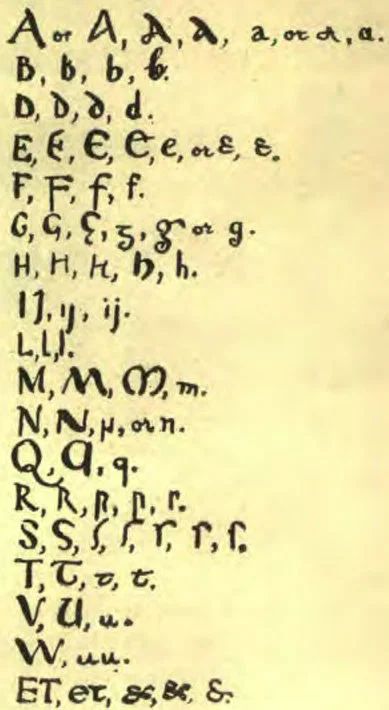
I have copied from various manuscripts a sort of table showing the change from the true capitals to the small letters as the printer found them when he began to cut his types.
The small letters can easily be told from the uncials, as they are not so large. Such letters as C and O, which were not changed in form, have been left out. Most of the others tell their own story; a few have a curious history.
The right-hand stroke of A was the larger and more important; it was probably made first. The hurried scribe then finished the left-hand stroke and cross with a single loop, or else a U-shaped double stroke. This was the uncial A. It was a short and easy step to our small a. The cursive, or script, form, on the other hand, made the loop part the principal thing, and it was formed first. This gave to the letter the form a, which we find in some book-hands and all script.
B had a tendency to become heavy at the bottom, the top loop finally dwindling to nothing, giving something very much like our b. In D, curiously enough, the ease with which straight up-and-down strokes curve toward the left is seen in the bending of the first stroke; while in the course of centuries the second, or curved, stroke actually became a straight bar!
G has a strange history from the first. The sound it stands for is represented by the third letter of the Greek alphabet, gamma, Γ, which, as we now print it, looks like an L turned upside down. But in Italy it got turned over, so, <, and was afterward rounded into a C. This letter became confused with K, so that it got its sound, which it still retains in “cat,” “cup,” etc. Then the Greek letter Ζ (Z), which had no sound in Latin, and looked like an E with its tongue cut out, Ɛ, became also mixed up with K and the half-grown C, and came out of the scrimmage a full-fledged G, with the sound we give it in the word “goat.” What further tortures it had to endure before it became a good g, a glance at the table will show. Those of you who have amused yourselves by learning the Greek alphabet will now see why our G comes between F and H, instead of after B, and why C comes after B. You should not forget that Greek once had an F, which it lost, and that its H was once a breathy consonant, just as ours is.
J, as a letter different from I, is not yet two hundred years old. If you will look in Cruden’s Concordance, you will see that the two make but one letter. J was at first only a long form of I, and was used next to m, n, u, and i, because these letters consisted of up-and-down strokes, and an i might make an n look like an m, or with another i it might make a u; since the letter was not dotted till a short time before the invention of printing. The last i in a Roman numeral was made long, as it is now in druggists’ prescriptions; thus, viij, xij. Before u, where it frequently stood in Latin words, it was always pronounced as a consonant, with the sound of y in “yet,” and finally it became the rule to write the consonant i long, and the vowel i short. The sound we now give to j was brought over from France.
We find the cross-stroke of N making the scribes trouble. In some parts of the world, especially in Ireland, they got it away down at the bottom of the letter, while in the form which has come to us, we find it at the very top.
The serpent-like S was also a troublesome letter. It was hard to make gracefully, and took up much space. The curve at the top was able to hold its own; but the rest of the letter gradually became a straight bar. The older crooked s was used only at the end of words. At last, at about the time when our grandfathers were learning their A B C’s, they threw away the old long f altogether.
V and u were for many hundreds of years only different forms of the same letter. W was simply a pair of V’s run together at the top, and the small letters were never run together, but were always written uu, and for a long time they were printed so. The two letters, or rather one letter, represented three sounds,—a vowel, u; a consonant almost like it, written uu; and a consonant similar to f, written u. Finally the u was left for the vowel, and the form v was written for the f-like consonant, while the u-consonant was written w. The capital was still V for both u and v. Long after printing was invented, a u of a larger size of type was cut down, and used as a capital. Such u’s can be found in books printed in Charles the Second’s time. Finally a capital U was made with every font of type.
The conjunction “and” is so much used, as we all know, particularly by unskilful writers, that some people like to shorten it to a mere hook. That hook is the Latin word et, with the e and the t twisted together, giving the two forms & and &. This little character has a long name all of its own,—“ampersand;” that is “and per se and,”—“and by itself and.”
C. B. MORRILL.

A CHRISTIAN DYÁK.

THOMAS CORNELIUS is a Christian Dyak from the state of Sarawak, on the northwestern coast of Borneo. His father and his grandfather before him were Christians. He came to Singapore eight years ago, and was engaged by the Methodist mission in selling tracts. His knowledge of the Malay language enabled him to do this work successfully. He was a member of the Malay church, and of the Epworth League, and was one of a company of half a dozen young men who stood by me loyally in every good work when I was there.
He is employed in the mission press, and is a genial, good-tempered fellow,—an excellent illustration of what the gospel does for savages. You would never suspect, from his appearance, that his ancestors were bloodthirsty head-hunters. He is extremely particular about his dress, and could not be induced to wear an untidy necktie or a soiled garment when not engaged in his work. He is more or less impulsive, but can always be relied upon to do faithfully what is assigned him. He had a singular habit, or mannerism, of smiling incessantly. I never met him nor spoke to him but that he would begin to smile; the smile would develop into a grin, and in a few minutes he would begin to laugh. I never could quite understand this habit, unless it was caused by embarrassment. I liked Thomas very much, and it would be a great pleasure to meet him, after three years’ separation.
There were half a dozen different races represented in the little Epworth League, that rendered valuable help, especially in my street work,—a Chinese, a Dyak, an Indian, a Siamese, an Eurasian, and an Englishman, besides myself, an American. This will indicate the cosmopolitan character of the population of Singapore. Every one of these faithful boys was an earnest, praying Christian, and was just as eager to see his countrymen converted as was I myself.
Will not the young readers of the INSTRUCTOR remember Malaysia when they pray, and also when they give? It is my dearest hope, God willing, to spend the coming Christmas in Manila, or some other town of the Philippines, where I hope to spend the rest of my days laboring for these people for whom Christ died.
R. W. MUNSON.

ONE HAPPY SONG.

The world is full of sorrow; O, bring one happy song, To make a glad to-morrow For those whose nights are long! Each heart has wells of sadness, Whence bitter tear-drops flow; They need fresh springs of gladness, Without one drop of woe. The friendly voice is clearest, That speaks in cheerful tone, And sweetest lips and dearest Are those that make no moan. — Ruth Raymond.

CLEVELAND, OHIO.

Originally, Cleveland was but one mile square. Now its frontage on Lake Erie is nearly ten miles, running back some six miles, with an area of about thirty-two square miles, making it not only the largest city in the State, but also the largest of all the cities between New York and Chicago.
The city is divided into two sections, East and West Cleveland, by the Cuyahoga River, and all that portion west of the river originally formed a part of the first county created in Michigan. Cuyahoga County, in which Cleveland is situated, was not organized until 1810.
In 1795 a company of thirty-five persons banded together under the title of the “Connecticut Land Company,” and brought three million acres of land in what was then known as the “Western Reserve,” including the site of the present city of Cleveland. At that time General Moses Cleveland was the agent of this company, and in 1796 he laid out the plan of the city. He made a contract with eleven of the employees of the company to settle with their families in the prospective city during the year 1797; eighteen additional families were to follow in 1798, and twelve more in 1799. From this small beginning has arisen a city which, in 1890, contained 53,052 families, occupying 43,835 dwellings. There are but two cities of its size in the United States—Philadelphia and San Francisco—that show an equal average of families to dwellings, with five members to a family. The population in 1895 was 330,279.
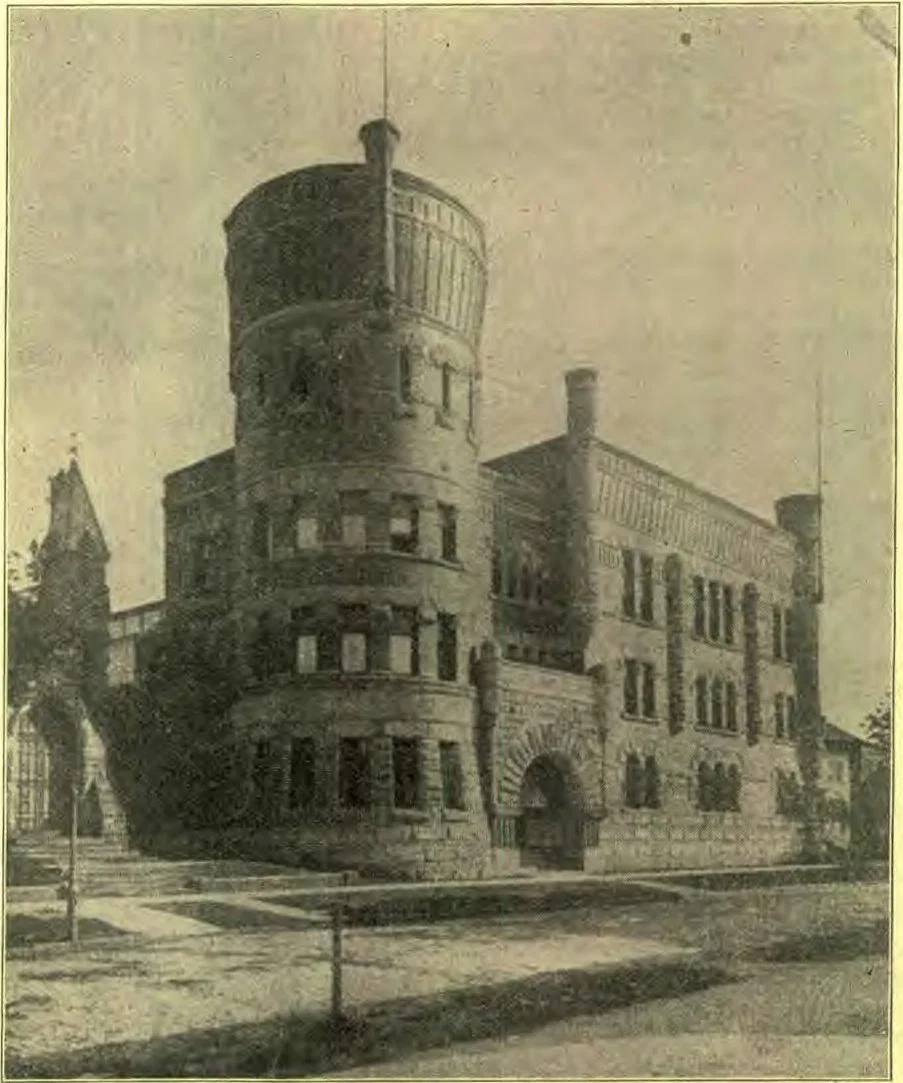
THE ARMORY, CLEVELAND, OHIO.
Originally all this portion of Ohio was under French rule, being a part of Canada, or New France. It reverted to the English at the taking of Quebec in 1760.
The first Indian occupants were the mound-builders. Very little is known of these people, but the supposition is that they came from Asia. Their tribal name means “People of the Lakes.” They left four small mounds in the area now covered by the city of Cleveland. Following these came tribes of Indians,—Eries, Hurons, or Wyandottes,—and eventually the so-called “Five Nations.” For years thousands of Indians would collect at Cleveland, haul their canoes up on the beach, and disappear in the interior in search of game, continuing the hunt all through winter and spring.
From the lake, Cleveland, lying on the south shore, has a commanding appearance because of the long line of high bluffs, which form, as it were, its approaches. Situated on the chain of lakes, and with its intersecting network of railroad lines, together with the Ohio Canal, its advantages are extraordinary. Ship-building is one of the main industries; and with the exception of the Clyde, in Scotland, Cleveland is the largest ship-building port in the world. In fresh-water and salted fish it is the largest fish-market in the world, from sixty to seventy thousand tons of fish being caught annually, Lake Erie furnishing a greater supply of fish than all the other lakes combined. One firm caught one hundred and six tons of herring in a single day.
Among the many industries are large chewing-gum factories, one half of all this product used being manufactured in Cleveland. This city is further noted as having been the first in the United States to open a high school.
The banks of the river being high, with flat approaches of varying widths, covered with buildings, the construction of several massive viaducts, or bridges, has been necessitated. These are of great length and towering height. One is 3,930 feet long, and with approaches, 5,229 feet, costing $675,574. Another is 3,211 feet long, costing $2,250,000. In all, there are sixty-one bridges owned by the city, ten of them with swings for the passage of vessels, and fifty-seven owned by railroads, or railroads and the city.
It would require several days to visit all the parks and boulevards of Cleveland. There are sixteen parks, containing twelve hundred acres of land, and their value is over six million dollars. Wade Park has a very complete Zoo, the delight of the children. The monument to Commodore O. H. Perry, costing six thousand dollars, and erected on the public square, was removed to this park. It is twenty-five feet high, and was unveiled in 1860.
The Garfield Memorial, dedicated in 1890, is situated in Lake View Cemetery. The crypt contains the body of the president and that of his mother.
Nowhere in America are there so many or so varied charitable and philanthropic institutions as here. For the benefit of the poor, afflicted, sick, and destitute, over three million five hundred thousand dollars is invested in lands and buildings alone. Prominent among these charitable institutions stands the Helping Hand Mission of the Seventh-day Adventists, which gives relief, shelter, and food to thousands of destitute and fallen men, besides caring for scores of families. Though enlarging its field of operations from time to time, it is entirely self-supporting and free from debt.
W. S. CHAPMAN.

Chapter VIII

FROM SINAI TO OLIVET

Chapter VIII.
“AND give you the desire of your heart?” said Aunt Nell, softly.
“That’s it, yes; for the desire of my heart is her, happy, free, as God meant her to be, bless her!”
“And yours?”
“If God will, yes. But if he does n’t will it, no—honest, Aunt Nell,—that’s me—now. But I think he wills it—”
“Well,” with a cheery ring, “I’m off. I’ll get the next train, if possible. You’ll hear from me to-morrow. Good-by! bound to win!”
“Good-by! God go with you.”
“Thank you again; and seeing he’s generally around where he ought to be, he’ll see me through this, sure.” Seth swung his hat about his head by way of a parting salute, and started on his journey, going much more briskly than he had come.
In the eyes of the tender-hearted woman who was watching him, he looked a hero indeed.
Seth started out with a fine impatience of delay; but everything seemed to conspire to detain him.
He found that his mother had taken a notion to go off visiting for the day, and he could not enter the house without breaking in; for the old lady, very much afraid of tramps and burglars, kept everything secure. Seth could not go without his clothes. He must also have money, and must get it of a man who could not be seen before night. He must, therefore, curb his impatience and wait.
He registered Aunt Nell’s letter, wrote several on the post-office desk, which he tore up; and finally went home and spent the remainder of the day splitting and piling wood, and making things extra neat about the premises. Since he could not go until morning, he might as well “put in his time at something,” especially as he might be kept in the city some days.
Seth was no loser by this detention; for as he was going by the post-office to the train next morning, the post-mistress, who lived back of the office, and was an early riser, hailed him with Shirley’s letter.
That letter would not have seemed very encouraging to any but an earnest, unselfish friend like Seth. It was not to him a source of unalloyed bliss, but it was something; and he was audacious enough to construe its closing lines into an invitation to follow her with a letter, if nothing more; and that surely was not entirely discouraging.
It was with a lightened heart, therefore, that he boarded the train; and hope was his companion,—hope born of faith, which maketh no man ashamed.
Aunt Nell adhered to her second thought, and waited until the next day before going over to her sister’s. But bright and early the next morning she appeared like a ray of sunlight in the clouded house.
Mrs. Goss was by this time prostrate with grief and anxiety, while Mr. Goss was struggling with the necessary housework; so he was in no mood to be cool or curt to Aunt Nell, whose efficiency and skill were matters of history in that household.
Benjamin Goss had never quite forgiven William Burns for winning her away to another home. She had been missed as a stolen rudder would be to a boat in the channel of a crooked river.
Aunt Nell—as even Mr. Goss called her, having learned it from the earliest lispings of his child, whom he idolized in her baby days—had made up her mind that the way best to serve all who were concerned in the unhappiness of this home, was to win instead of war; hence, quite contrary to her first impulsive thought, she greeted her brother-in-law with a sweet, sympathetic graciousness that he did not quite expect, and which was, therefore, all the more salutary.
He felt that for once he was being treated at least as well as could be expected under the circumstances; for Shirley was almost as much to Aunt Nell as to her mother.
Aunt Nell could not ignore Shirley’s escapade, nor did she wish to; but it was with the spirit of one who “makes for peace” that she said: “I am sorry, Ben, for what has happened. You can’t regret it more than I do. I am sure the poor child will think of home often to-day, and as soon as the novelty of going alone wears off, will be wishing she was back.”
“Well, she left the road behind her,” was the gruff reply.
“Yes, fortunately: people can burn bridges when they get desperate, but they can’t get angry enough to reel in the road,—a very benevolent arrangement,—and bridges can be rebuilt.”
“What did you help her off for, with clothes and things?” and Mr. Goss’s tone became belligerent.
“How do you know I did?” and she laughed a little.
“Because it is just like you; and then I heard Burley Ben say this morning that he saw her on the way to the train, tricked out in your new clothes.”
“Well, I thought that under the circumstances it was the only thing to do. Shirley was in no state of mind to reason. She would not be kept or directed: she would go, and she must go decently, for all our sakes, and must know that the way was open for her to come back. You know, of course, better than I, how she got into such a state of mind; and—”
“That’s just what I do not know, what she would not tell me, what I had a right to know and must know: and it was because I demanded to know—”
“Ben,” interrupted Aunt Nell, “shall I tell you where the trouble lies?”
“Of course, if you know, though why my own child should go to—”
“It was natural, Ben, that she should come to me; you know that perfectly well: she always has, and I intend she always shall. You know I took care of her the first ten years, and we are as much to each other as two sisters could be.”
Mr. Goss was silent,—so much came up out of the past at these words. Aunt Nell had been so unselfish and true that he could have nothing to answer. She went on: “The trouble is here, Ben: Shirley is like you. It used to make you very proud to hear that. She is inventive, like you; she makes plans, has ideas of her own, is ambitious, aggressive. You have not noticed that she has grown out of childhood, and can not any longer be treated like a child.”
“Well, but she is a girl,” began Benjamin Goss.
“And what do you mean by that?” cried Aunt Nell, with a flash in her eyes. She knew very well what he meant, and resented it with all the strength of her nature. She waited a second for him to explain; but for once he seemed not to wish to improve the opportunity.
“I know what you mean,” Aunt Nell continued, and there is the secret of the trouble. If you would treat Shirley as you would if she were a boy, recognizing her for what she is, you would have no trouble with her, nor she with you. Give her just what you insist on for yourself.”
“So you have taken up woman’s rights, have you?” and his lips curled into a sneer.
“Human rights, just human rights, nothing more nor less. I see no sex in rights. I said, Recognize her for what she is, just as you would your son, if you had one. You can’t recognize her for a boy, for she isn’t a boy; but you can just as truly give all she has and is a chance to grow as if she were a boy. That is what she is insisting on in this revolt; and she is doing exactly what you would do under the same circumstances. She never looked so much like you as she did the other night, when she was resisting all I could do and say to prevent her from going away. You have treated a nature which is as like you as it is possible for another to be, in a manner that would make you fight; and then you wonder that she rebels. It is a case of explosion under pressure, that is all; and you have the remedy in your own hands, provided she can be found before some great moral disaster takes place.”
“Stop!” It was a tone full of the fury of pain.
“No, not quite yet; we must face this now, once for all, I hope. The question now is, Where is she? and how shall we get near enough to her to save her from the inevitable consequences of the life she has lived with you? She does not know how to use the money I let her have; she never bought a thing in her life. I wish I could go back to the time when I was here, and had charge of her; but I was too ignorant myself then, until Will taught me; I know just what it means to be perfectly helpless in the face of a dollar that you must spend all alone by yourself; for Will made me face that experience early. Shirley! poor darling! But I must not think of that now. I believe God will help in keeping and finding her, and that she will come home. And when she does—”
“It will not be because I go after her,” stubbornly interrupted Mr. Goss.
“No; knowing you as I do, Ben, I did not for a moment expect you to; but if you are made into the wise father she needs, by the time she does come, you will let this go by in silence, unless you confess your own share in the wrong. More than that, you will give her a regular allowance of money for her own use; put the house into her hands, with money to run it; let her do the buying for it, and pay all the bills, while you let her alone and attend to the farm, and sister lies back and rests. Shirley would make life easy for her mother, and you, too, if she had half a chance. She would be capable of running the farm, and—”
“Absurd!” snorted Mr. Goss, striding out of the room.
Aunt Nell had said more than her sober second thought would have allowed; but the provocation was very great.
She was sorry for a while, very much troubled, in fact; for she felt that the crisis was critical, and would not for any consideration have the heart of Shirley’s father hardened toward her.
However, she could not recall the words, nor apologize for the truth. She knew the motive that had prompted them. She could have said much more,—should have, but for the restraint that prudence had put upon her; so she concluded she could not afford to worry. She had most earnestly asked God, before she started from home that morning, that he would keep her lips and looks, so that she should not do harm but good. She must trust him now to take care of all that had come forth from her, so unpremeditated and yet so true.
As the day passed, she had the satisfaction of seeing that Mr. Goss was more quiet and thoughtful than she had ever known him to be, not defiant, but anxious. She thought he appeared almost like any other father, only that he made no move to institute any inquiry or search.
“You have subdued Ben, I really believe, Nell,” said Mrs. Goss, the next morning. “But you always could say things to him. I don’t see how you do it; I did n’t even dare show him Shirley’s letter. Oh dear! what shall I do if my child does not come back? and what shall I do if she does, unless Benjamin can be made to quit nagging?”
MRS. S. M. L. HENRY.
(To be continued.)

On Resolution and the Power of Determination

To THINK we are able is almost to be so; to determine upon attainment is frequently attainment itself. Thus earnest resolution has often seemed to have about it a savor almost of omnipotence.—Samuel Smiles.

FATHER’S PENHOLDER.

A LITERARY man, who was compelled by circumstances to use the family sitting-room as a study, missed his penholder one evening while absorbed in writing. He looked over his desk, through the pigeon-holes, and in the drawers, but it was nowhere in sight. It was not on the floor, nor behind his ear.
“This is what comes,” he said, impatiently, “of trying to work where there is a houseful of children. Which one of you has taken my pen?”
The children looked at one another, and laughed. “I don’t want any foolishness!” he exclaimed. “Where’s that pen? Who has taken it?”
After a moment’s pause, one of the children said, “If you’ll laugh, papa, you’ll find it.”
He stared at her in astonishment. Then, as her meaning slowly broke in upon him, he joined in the laugh, and the penholder fell out of his mouth, where it had been all the time.
How many of the little difficulties of this life one can extricate one’s self from by a laugh!—Youth’s Companion.

SENSITIVE EARS.

It is told that a telegraph operator at Springfield, Mass., was kept at his post of duty for many hours receiving special news. After losing two nights’ sleep, he was relieved from duty to get some rest. He went to his room at the hotel, and soon was fast asleep. When the time came for him to return to his instrument, he could not be awakened. Loud pounding on the door did not result in arousing him. An operator then, with his knife-handle, tapped “Springfield” on the door, in imitation of the clicking of the instrument. At once the sleeping operator sprang from his bed, and was soon ready to continue his work.
It is said that firemen hear in their sleep the signal calling them to duty, while they sleep right on through any number of signals which do not concern them. In an article on “Heroes Who Fight Fire,” in the Century, Jacob A. Riis tells of a fire-department chief who has a gong right over his head at his home, every stroke of which he hears, although he never hears the baby, while his wife hears the baby if it so much as stirs in its crib, but does not hear the gong.
We hear that for which we listen. The sensitive soul, attuned to hear the voice of God, is surrounded by distracting noises of all kinds, yet it responds instantly to the call of duty, or to words of warning. The gentlest whisper of conscience is sufficient to call to action the one who has trained himself to hear that voice. A single text from God’s word is a louder call than all the noises of the world, to the one who trains himself to obey that voice.—Selected.

Self-Importance

“What would you do,” said the little key To the teak-wood box, “except for me?”
The teak-wood box gave a gentle creak To the little key, but it did not speak.
“I believe,” said the key, “that I will hide In the crack down there by the chimney-side,
“Just so this proud old box may see How little it’s worth except for me.”
It was long, long afterward, in the crack They found the key, and they brought it back.
And it said, as it chuckled and laughed to itself, “Now I’ll be good to the box on the shelf.”
But the little key stopped, with a shiver and shock; For there was a bright new key in the lock.
And the old box said: “I am sorry, you see; But the place is filled, my poor little key.”
— St. Nicholas.
Continue reading: IN THE MEADOW