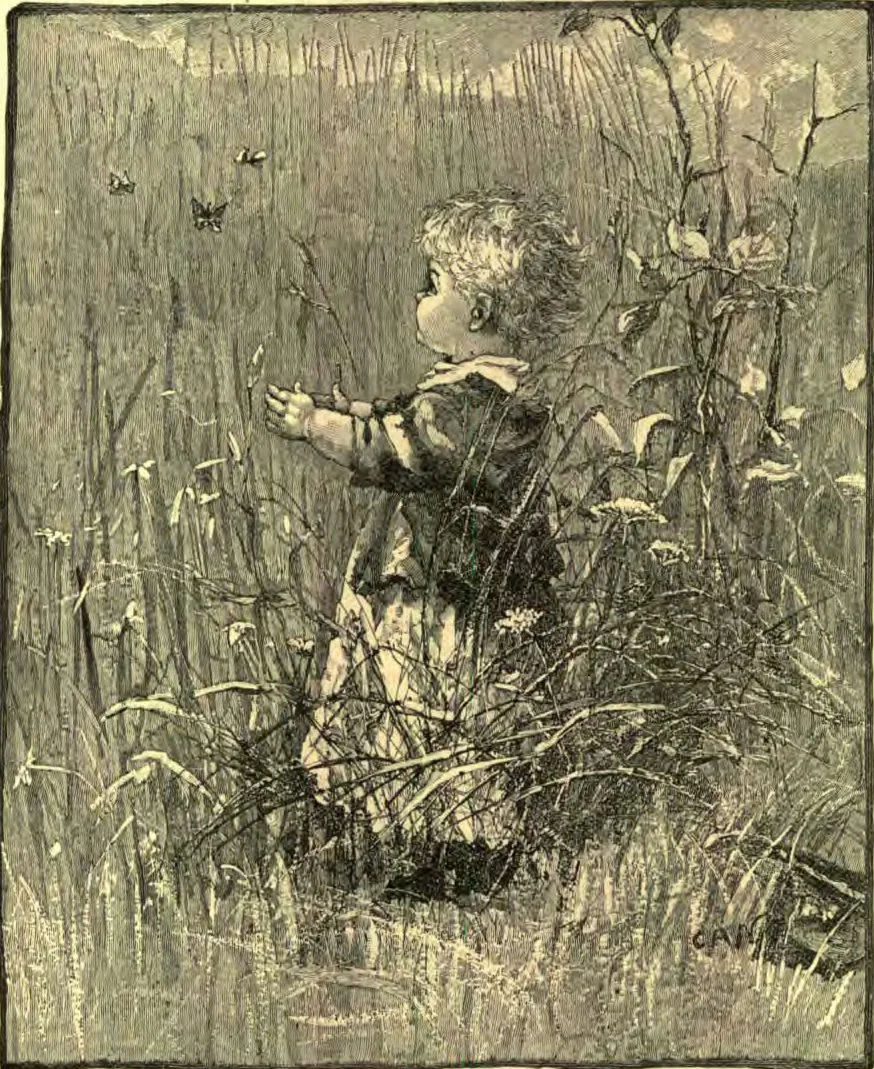
A little song of sunshine,
Of daisies and blue sky!
Alone upon the meadow-sea,
A little ship was I.
The waves of grass and daisies
Around my passage pressed,
The meadow-rue her silvery foam
Tossed up against my breast.
The butterflies were flitting,
The singing birds in tune,
I steered for upland reeds that bore
Red berries ripe with June.
My breeze-blown childish garments
Were all my fluttering sail,
My singing heart was all my crew,
My gladness was the gale.
“ALONE UPON THE MEADOW SEA.”
Along the near horizon
The grasses dipped in sky;
Before me, as I voyaged up,
The summer clouds went by.
And oh, those breaths of gladness
My very being stirred!
I could have leapt into that blue
Like any winged bird.
Ah me! once more to voyage,
My merry crew and I,
A little ship so weather-beat
With summer and blue sky!
To voyage o’er the meadow-sea,
As in the years gone by—
A little song of sunshine,
Of daisies and blue sky!
— Irene Putman.
SUMMER MORNING.
By E. E. Adams
Some time ago we had a little talk together about the equinox, at the time of the Vernal Equinox. This, you may remember, is the time, about the end of March, when the days and nights are of equal length all over the world.
Since then the days on our part of the globe have been growing longer and warmer, because we have been turning nearer and nearer to the sun. And now we have passed mid-summer day, or what is called the “summer solstice.” This time, about June 21, is called the “solstice,” from two Latin words meaning “the sun,” and “to stand,” because at this time the sun seems to stand still for a little while,—to make a pause, and remain for a short time at the same point in the heavens,—before we pass farther away from it again, to the time of short days and nights.
It is at the time of the summer solstice that we have the longest and warmest days in all the year. Only a few hours of darkness, and then the soft dawn of the sweet summer morning,—the smile of God breaking again over the earth in the returning sunlight, causing all nature to rejoice and smile in return; for you know that the light of the sun is all the reflection of the glorious light shining from the beautiful face of Jesus, who is “the Light of the world.”
See how joyfully everything greets him! The clouds blush with soft, rosy tints of beautiful color. The flowers open their petals, and pour forth their sweetest fragrance, as the sunlight kisses the dew from their leaves, and carries it away in the form of vapors to refresh other thirsty plants, perhaps thousands of miles away.
The birds awake, one by one, and begin the day with a glad song of praise to the Light of the world, who has brought them again from their slumbers. First there is a faint, drowsy chirp or twitter here and there, which swells, as others add their notes, to a full chorus of joyful praise.
All this is going on while you are peacefully sleeping in the early morning hours of these glad summer days. But at last you, too, awake; and how do you greet him? God loves the flowers, the birds, and all his other works; but there is something that he loves much more, for which he listens much more eagerly, and that is to hear his children praise him, to see their hearts turning to him in thankfulness for all his loving care for them.
Then, dear children, as you awake each morning, and see “his smile in the glad sunshine,” will not you give him smiles of love and songs of praise, and offer to him the sweet incense of worship, giving yourselves to him who giveth you richly all things to enjoy?
Think how he gave up his own life, that he might be able to give eternal life to you. He desires to give you life, and all the blessings of his love, not for a few years only, but “God so loved the world, that he gave his only begotten Son, that whosoever believeth in him should not perish, but have everlasting life.”
Think how it pleased the dear Saviour when the little children of Jerusalem owned him as their King and shouted his praises. To those who rebuked them for this, he said, “Have ye never read, Out of the mouths of babes and sucklings thou hast perfected praise?”
And he is “the same yesterday, and to-day, and forever.” Just as much now as then he listens for, and loves to hear, the praises of his little ones. E. E. ADAMS.
OUR SEWING CIRCLE.
By Nellie V. Dice
This week we will make a gingham apron for mother. Get two and one-half yards of gingham, of any color that will please her best; straighten the edges, lay them together evenly, and cut the whole strip into two pieces. Fold one piece lengthwise, and out of the center cut a strip one inch wide the whole length of this piece. This strip, when open, will be two inches wide, and we will use it for the band. Take the two narrow pieces thus made, and pin one to each side of the large piece of gingham, being careful to have the edges even, so that the selvedge will be on the outside, to save hemming the sides of the apron. Make the seams about one fourth of an inch wide, and sew them with running-stitch or back-stitch. Crease them out, and press carefully.
To make the hem, turn under the edge of one end of the apron about one fourth of an inch, and baste down with a long stitch; then turn down the hem about an inch and a half wide. Baste this with a short and a long stitch,—about one half and one quarter inch.
See how well you can make this apron. Be faithful in your sewing: this will help you to be faithful in all your work. It is easy to slight or sew carelessly on the “wrong side;” but we should do as careful work on the wrong side and in obscure corners as we do on the right side. Next time we will finish the apron.
NELLIE V. DICE.
DID NOT THINK OF THAT.
As I sat at my window one pleasant summer morning, I saw a little black dog come trotting along the walk, carrying in his mouth something that looked like a package of meat. Just in front of the house he stopped, and laid the package down carefully on the grass, standing guard over it till his master, a boy twelve or thirteen years old, came up.
“Pick it up, Don,” he said, sharply, when he saw the bundle lying on the grass. The little dog capered around, looking up into his master’s face, but made no movement to pick up the bundle.
“Pick it up, Don, I say!” the boy repeated, still more sharply, and with a threatening motion of his hand.
Such a change as came over the happy little dog then! His brown eyes looked up appealingly into his master’s face; his bushy tail, which had been wagging as if it would wag off, dropped suddenly; and he crept across the walk as if he expected every moment to feel a blow. He picked up the package, but dropped it again.
The boy’s face was very angry by this time, and his hand was raised to strike the little black body squirming at his feet, when suddenly I heard a soft voice say, “Please don’t hit him,” and I saw a dainty little maiden in a pink gingham dress, who had come up from the other direction.
“But he won’t carry his meat home,” the boy said, looking up in surprise.
“Maybe the package is too heavy for him,” the soft voice said again. “He’s such a little dog, you know.”
The boy looked for an instant into the pleading blue eyes uplifted to his. “I didn’t think of that,” he said, frankly. “Maybe it is.”
He picked up the package, tried the weight of it with his hand, and looked at the little dog thoughtfully. “I believe it is pretty heavy for you, Don,” he said, at last. “I didn’t think of that at all. Poor little chap!” And he bent over and patted the curly head. “You can take this, Don, and I’ll carry your meat.”
He gave a smaller package to the dog, and the little fellow went frisking off down the street in a most joyful way.
The boy started, too, but paused long enough to say, “I didn’t think about it, you know;” and the little maiden in pink gingham answered, sweetly, “I thought that was the reason.”—Young People’s Weekly.
Messages Travel Swiftly Over Ocean Cables
A MESSAGE travels over an ocean cable at the rate of about seven hundred miles a second.
Notes and Comments
A Diamond Saw.— A circular saw, whose teeth are set with diamonds, is in use in Paris for cutting stone. The saw is run by steam, and revolves about three hundred times a minute. The diamonds used are not the beautiful crystals seen in the jewelers’ stores; but they are very hard, and will cut stone faster than can steel teeth.
A Tomato Tree.— The Bowling Green (Ky.) Times describes a curious and rare plant in a greenhouse of that city. It is a “tomato tree,” now two years old, and six or eight feet high, with a trunk several inches in circumference. The top spreads like other trees, and has large leaves similar to those of the catalpa. This peculiar tree grows in the open air in summer, but needs protection in winter. The fruit is of a rich orange color, and is said to be of delicious flavor.
The Number of Plants.— No one knows the exact number of plants, but the list of those that are known is rapidly increasing. Three hundred years before Christ, a botanist mentioned five hundred species, and by the end of the first century A. D., eight hundred species were classified. Linnæus, the greatest botanist of the eighteenth century, was familiar with eight thousand five hundred species; but since his day the number of known plants has rapidly increased, and at the present time it reaches nearly two hundred thousand.
An Expensive Book.— So far as known, the most expensive book ever published is the official history of the Civil War, now being issued by the United States government. Up to date, two million three hundred thousand dollars has been expended, one half of which has been paid for printing and binding, and the remainder for salaries, rent, stationery, and miscellaneous expenses, including the purchase of records from private individuals; and a further appropriation of half a million dollars has been asked for. The work will consist of one hundred and twelve volumes, and will not be completed for three years. Wars are expensive things; and it would appear that their histories may also be no less so.
The Peace Conference.— This interesting gathering, which has received the attention of the civilized world for so long, is now about to adjourn till the Paris Exposition next year. A few sentences from the papers of different countries show the general view of its results: “That hardly any nation, certainly none of the great powers, is willing to bind itself, is shown by the press everywhere.”—Literary Digest. “The best thing we can say about the suggestion to abolish the dum-dum bullet is that it will be ignored by this country.”—London Saturday Review. “It is England herself who constitutes the greatest danger to the peace of the world.”—Paris Paper. “Who is to disarm first? The experiment was tried in the United States, and look what it cost us to get ready in time, and how we had to fear the issue. We now think differently, and are building forty men-of-war. We shall not be taken by surprise and found unprepared again; and it is hard to believe, in view of our terrific exertions, that the other powers will abandon the advantage of their armaments and give them up.”—Admiral Dewey, in an interview with a representative of the Neue Freie Presse, Vienna. Really, nothing has been gained except a demonstration of the fact that peace does not come by the votes of men, any more than righteousness and true worship can be inaugurated by acts of legislatures and courts. Peace is a gift of God, and comes only to those who follow him. Such are not a majority in the governments of this world.
When and where did Ezekiel probably have this vision? What did the prophet first behold? What was the condition of the bones? How did he gain a view of them? What question was asked him? What was his reply? What was he then directed to do? What was the Lord’s purpose? What did the prophet hear? What followed the shaking? What was found? What did the bodies lack? What did the prophet next do? What was the result? What did the dry bones represent? What were they represented as saying? What did God promise through the prophet? What would the revivifying of Israel prove? How would it be accomplished?
NOTES.
1. The vision of the present lesson was probably given about 594 B. C. At that time Ezekiel lived near the Chebar, and the scene of the vision may have been the valley of Tel-Abib. Some think it was the valley around Jerusalem, to which the prophet was supernaturally taken. Wherever it was, the representation of the resurrection was brought before him. This vision is called “The great vision of Ezekiel,” and because of its sublimity, is linked with Isaiah’s vision of the throne, Daniel’s vision of the kingdoms of man and God, Zachariah’s vision of the coming of the Messiah, Peter’s vision of the universality of Christ’s gospel, Saul’s vision of Christ, and John’s vision on the Isle of Patmos.
2. “The hand of the Lord . . . carried me out in the Spirit of the Lord.” The Spirit of the Lord was the agency by which this vision appeared to the prophet. “The whole world lieth in wickedness;” and those who are not “carried out in the Spirit” do not see this vision. Atheists profess to believe that death ends all; but they are nevertheless susceptible to the so-called proofs of life after death. The majority of earth’s inhabitants believe the first great lie of Satan,—“ye shall not surely die,”—and represent death as the gateway to a larger life. The Chinese sacrifice to the dead, to appease the spirits; the Hindus look reverently upon the meanest of creatures, as the possible form of the deceased; the Spiritualists claim that they commune with the dead through their mediums, not regarding the fact that we are surrounded by fallen and unfallen beings, superior to man, who existed before man’s creation. The fallen angels recognize the advantage they gain by perpetuating the idea that death is not death,—that the dead are not as “dry bones,”—and by simulating the dead, obtain access to the confidence of the living, to lead them into error and perdition. The wise man says, “The dead know not anything.” The righteous dead are represented as asleep. In sound sleep there is no consciousness. The prophet beheld the bones in the valley as “entirely destitute of vitality, and moldering back to dust.”
3. “Can these bones live?” Many commentators and speakers have applied these words to the spiritual condition of backslidden Israel. No doubt the vision is a strong representation of the effect of sin; for “the wages of sin is death.” But that it has a wider meaning is evident from the explanation that the Lord himself gives, in verses 12–14. “From a human standpoint, they could not live; but faith leaves the question of possibility to rest with God, with whom nothing is impossible. Deut. 32:39. This is an image of Christian faith, which believes in the coming resurrection of the dead, in spite of all appearances against it, because God has promised it. John 5:21; Rom. 4:17; 2 Cor. 1:9.—Fausset.
4. “O Lord God, thou knowest.” The prophet had no theory to present, no argument to bring, to prove to God that they could, or could not, live. He was content to acknowledge the omniscience of his Master.
5. “The secret things belong unto the Lord our God: but those things that are revealed belong unto us and to our children forever.” Therefore it belongs unto us to know the state of the dead, the reality of the resurrection, the certainty of the fulfilment of God’s word. Can we lay aside our preconceived ideas, our man-made theories, and take the humble attitude of the man to whom was revealed this great vision?
6. “An exceeding great army.” “The dead in Christ shall rise first.” “Blessed and holy is he that hath part in the first resurrection.” Ezekiel’s vision does not include the wicked. He sees the same company seen by John on Patmos, of whom it is said: “These are they which came out of great tribulation, and have washed their robes, and made them white in the blood of the Lamb.”
7. They are “the whole house of Israel” who say, by their seeming helplessness, “Our hope is lost.” Yet “these all died in faith, not having received the promises, but having seen them afar off, and were persuaded of them, and embraced them, and confessed that they were strangers and pilgrims on the earth. . . . They desire a better country;” for they “looked for a city which hath foundations, whose builder and maker is God.”
8. The whole “house of Israel” is not simply those who were the literal children of Abraham, to whom the whole earth was promised (Rom. 4:11); but those who are of faith. Gal. 3:7. “He is not a Jew, which is one outwardly;” but he is a Jew who is one inwardly; and circumcision is that of the heart, in the spirit, and not in the letter. Literal and spiritual Israel are two distinct nations.
9. “I will open your graves, . . . and I shall place you in your own land.” The restoration from Babylonian captivity could very faintly typify the thought of this chapter. The quickening into spiritual life, the fulness of Canaan’s inheritance in a spiritual sense, is perhaps pictured in the prophet’s vision; but it reaches further. It brings to view the coming of Christ as King of kings, the breaking open of the prison-houses of death, the full victory of redeeming love. It shows to us the triumphant march of the people of God into their own land,—the new earth,—“wherein dwelleth righteousness” (2 Peter 3:13), when the tabernacle of God will be with men, and he will dwell with them.
TIME: A. D. 30. PLACE: Jerusalem. PERSONS: Jesus, Jews.
QUESTIONS.
1. While at the feast of tabernacles, what beautiful parable did Jesus give? John 10:1-6. In this parable, how is the thief, or false shepherd, known? V. 1. By what may the true shepherd be recognized? V. 2. How intimately acquainted with his sheep is the shepherd? V. 3; note 1. What position does he occupy when taking them forth from the fold? V. 4. How do the sheep feel toward a stranger, and why? V. 5.
2. In explaining the parable, what does Jesus declare himself to be? Vs. 11, 14. How can he be both door and shepherd? Note 2.
3. How many and whom does Jesus include among the thieves and robbers? V. 8. Who were those who had come before him? Note 3. What blessings are insured to those who enter the fold through Christ? V. 9. What is the purpose of the thief? Of the shepherd? V. 10. In what way does the true shepherd prove his love for the sheep? Vs. 11, 15. What course does the hireling take? Why? Vs. 12, 13.
4. What did Jesus say he still had to do? What will be the final result? V. 16. What does he say about laying down his life? Vs. 17, 18; note 4.
5. What was the effect of Jesus’ teaching upon the Jews? V. 19. What did they say? Vs. 20, 21.
6. A few weeks later, at the feast of dedication, what did Jesus again say concerning his relations with his sheep? V. 27. What blessed assurances does he give that his sheep will be saved? Vs. 28, 29.
NOTES.
1. Every soul is as fully known to Jesus as if he were the only one for whom the Saviour died. The distress of every one touches his heart. . . . He cares for each one as if there were not another on the face of the earth.—“The Desire of Ages,” pages 479, 480.
2. “He that entereth in by the door is the shepherd of the sheep.” Christ is both the door and the shepherd. He enters in by himself. It is through his own sacrifice that he becomes the shepherd of the sheep.—“The Desire of Ages,” page 478.
3. By the terms “thieves and robbers,” Jesus had special reference to the Pharisees, scribes, and other hypocritical teachers, who were oppressing the people of God. See Jer. 23:1, 2; Eze. 34:4. But he included, as well, all the false teachers of all time and of every nation, who sought to turn the minds of men to other help than Christ Jesus.
4. Jesus lived a life of perfect faith, based on his Father’s word. Both in laying down his life and in taking it again, he acted by faith. Says he, “This commandment have I received of my Father,” John 10:18. By faith he laid down his life, first, in patient, loving service, and, second, in giving himself over to the power of death; and by faith, also, he came again from the tomb. Faith, exercised in life, brought to him the power of God in death. By faith he had accepted the word of God for a resurrection (Hosea 6:2); and when the time came for the word of that promise to act, it was not possible for the grave to hold him. Acts 2:24. Jesus is our example; and by faith we may even follow him in the wonderful experience of laying down life and taking it again. By faith we may now lay hold upon his resurrection power (Phil. 3:10); and though we may sleep, that power will, at his coming, cause us to come forth as he did.
WILLIAM THE CONQUEROR.
By H. E. Simkin
William I, surnamed the Conqueror, was the first Anglo-Norman king of England. He was born in 1027, and died in 1087, near Rouen, France. His father was Duke Robert the Liberal, of Normandy. His mother was a pretty girl named Arletta, the daughter of a tanner, ranking only as one of the common people. According to the custom of royal families, the children of such parentage could not inherit the father’s throne; but this child seems to have been an only son, and Robert, when he was about to start on a pilgrimage to the Holy Land, assembled the Norman barons, and caused them to receive William as their duke, making him his heir at the age of seven years. Robert died soon after his return to Normandy; and the youth of William was passed amid wars and dissensions, in which he encountered great personal dangers.
In 1051 the ambitious young Norman visited England, then under the rule of Edward the Confessor, whose court and offices were filled with Norman favorites. Fourteen years after this, Harold, the son of Earl Goodwin, visited William in Normandy, as mentioned in the article on “Sketches of Early English History,” in the Instructor for July 20. With a skilful and unscrupulous use of the opportunity, yet with apparent confidence and cordiality, William said to Harold: “When King Edward and I once lived like brothers under the same roof, he promised that if he ever became king of England, he would make me heir to his throne. Harold, I wish that thou wouldst assist me to realize this promise.” Being in William’s hands, and fearing to do otherwise, Harold consented.
Like the camel in the proverb, which at first asked consent to put only his head into the tent of his master, but kept on gaining concessions till there was no room left for any but himself, the shrewd Frenchman continued to press his demands upon his Kentish visitor. Before an assembly of Norman barons, Harold was asked to do homage to William, as heir apparent to the English crown! Having been brought into this august congregation not knowing what was to befall him, the Englishman was unprepared to resist; therefore he yielded in this also, kneeling before the duke, placing his hands in William’s, and repeating the solemn form by which he acknowledged him as his lord, and promised to him fealty and true service.
But like the camel, William still wanted more. Both he and Harold were Catholics; and that church at this time held kings as well as common people in dense superstition. At William’s order the sacred relics (bones of the saints, etc.) in the Norman monasteries and churches were collected in a chest in the council-room, and covered with a cloth of gold. On this chest was placed a mass-book. William then said: “Harold, I require thee, before this noble assembly, to confirm by oath the promises which thou hast made me; to assist me to obtain the crown of England after King Edward’s death; to marry my daughter Adela; and to send me thy sister, that I may give her in marriage to one of my barons.” In surprise and fear, Harold laid his hand on the book of the mass, not knowing that the sacred relics were beneath it, and solemnly vowed to do all that was required of him. When he arose from his knees, William uncovered the chest, and showed Harold upon what holy relics he had sworn. History says that “Harold was sorely alarmed at the sight.”
Harold soon returned to England; and on the death of Edward, Jan. 5, 1066, he received the kingdom, being crowned by the archbishop two days later. William soon reminded him of his oath; but Harold said he had promised what at that time did not belong to him, and that he could not, against the wishes of his people, take a foreign wife. As to his sister, whom the Norman duke demanded for one of his chiefs, the king informed the messenger that she had died within the year. Failing to obtain satisfaction at the hand of another messenger, William speedily prepared to invade England. With a well-equipped army, he landed on the undefended coast near Hastings, Sept. 29, 1066. Harold was at York at the time, where he had just triumphed over the Scandinavian invaders; but when he heard of the Norman landing, he marched rapidly to London, stopping only six days, and then proceeding at once to meet William, who had in the meantime erected a wooden fort, from materials previously fitted, which he had brought from France.
The English mistook the first Normans they met for priests, as they had short hair and shaven chins, the Britons being accustomed to wearing long hair and beards. Harold’s army was far inferior to William’s; and some of his advisers counseled him to return to London, and lay the country waste before the Normans. This course would doubtless have enabled him to defend himself successfully, and he might thus have seen his antagonist wearied with famine and disease; but he could not endure to see his subjects suffer, even temporarily, by such a course; so he boldly strengthened his position, and prepared to fight to the end. The details of the battle, like those of the present day in the Philippines, are too terrible to tell here. The results seem even worse than those of modern times, as the weapons used were spears, battle-axes, and swords; and the conflict was waged hand to hand. From nine o’clock in the morning until three in the afternoon, it continued without decisive results; then Harold was wounded in the eye with an arrow. Being thus partially deprived of their leader, the English fought to disadvantage. The Normans pretended to retreat, thus leading their foes to follow them, and become divided, after which they turned, and overcame them. Harold was slain, and William became “the Conqueror.” On Christmas day of that same year, he was crowned king of England in London.
For a time William’s rule was mild; but later, by reason of his strong partiality to his Norman followers, he aroused the prejudices of the English people, whose protests were subdued with a rod of iron. He substituted the French language in all the courts of justice, which innovation remained until the present century. He abolished the Saxon laws, and used in their stead those of Normandy. His son Robert rebelled against him in the country of his birth; and at one time, unknowingly, nearly killed his father with his own hand. William’s voice under his helmet, calling for help, revealed him to his son, who was struck with remorse, and asked for pardon. It was not only granted, but Robert was entrusted with a command against Malcolm, king of Scotland. In 1086 all the landowners of the kingdom in England assembled, and with much ceremony took the oath of fealty to William; and the great record of landed estates—the “Domesday Book”—was finished.
The next year, to avenge a fancied insult of the French king, Philip, and to punish the French barons for their inroads in Normandy, William led an army against them, and burned several cities. His rage brought his ruin. While viewing the ruins of Mantes, his horse stepped on some hot ashes, and threw him against the pommel of his saddle, causing his death in the sixty-first year of his age.
William was one of those men whose names are not forgotten with the passing of time. While one can not see in all his acquirements and actions the elements of true greatness, his career gives us a striking example of what may be attained by perseverance and courage, maintained under the most adverse circumstances.
H. E. SIMKIN.
To Reach BATTLE CREEK
FROM
CHICAGO, BUFFALO, DETROIT, OR TOLEDO,
Purchase Tickets Reading over the MICHIGAN CENTRAL
“The Niagara Falls Route.”
A First-class Line for First-class Travel between Chicago and New York and Boston. Elegantly equipped through trains pass Battle Creek in each direction daily.
R. N. R. WHEELER, Ticket Agent, Battle Creek.
O. W. RUGGLES, Gen'l P. and T. Agt., Chicago, Ill.
TAKE THE Canadian Pacific Railway
for . . . CHATHAM, OTTAWA, MONTREAL, LONDON, GALT, QUEBEC, WOODSTOCK, TORONTO, BOSTON, PORTLAND, and
All points in New England, the Maritime Provinces, Great Britain, and the Continent.
Illustrated literature, time-tables, and full particulars, upon application to—
J. FRANCIS LEE, GEN. AGENT,
Passenger Dept. 228 SOUTH CLARK ST., CHICAGO.
Branch Offices: 76 Ottawa St., Grand Rapids, Mich. Room D, Chamber of Commerce, Cincinnati, Ohio. 315 Chestnut St., St. Louis, Mo.
Grand Trunk Railway System
Time Card in Effect February 5, 1899.
C. & G. T. DIVISION.
WEST-BOUND FROM BATTLE CREEK.
LEAVE.
No. 11, Mail and Express, to Chicago — 12.00 M.
No. 1, Chicago Express, to Chicago — 9.00 A. M.
No. 3, Lehigh Valley Express, to Chicago — 3.40 P. M.
No. 5, Pacific Express, to Chicago, with sleeper — 10.55 A. M.
No. 75, Mixed, to South Bend — 7.30 A. M.
Nos. 11 and 75, daily, except Sunday. Nos. 1, 3, and 5, daily.
EAST-BOUND FROM BATTLE CREEK.
LEAVE.
No. 10, Mail and Express, to Pt. Huron, East, and Detroit — 3.45 P. M.
No. 4, Lehigh Express, to Pt. Huron and East — 8.27 P. M.
No. 6, Atlantic Express, to Pt. Huron, East, and Detroit — 2.25 A. M.
No. 8, Lehigh Exp. to Saginaw, Bay City, Pt. Huron, and East — 6.50 A. M.
No. 74, Mixed, to Durand (Stops at Nichols) — 7.35 A. M.
Nos. 10 and 74, daily, except Sunday. Nos. 4, 6, and 8, daily.
E. H. HUGHES,
A. G. P. & T. Agt. Chicago, Ill.
A. S. PARKER,
Ticket Agent, Battle Creek.
Success Built on Self-Denial
By Hope Onslow
The thing we call “success” is built
On self-denial. The price of gain
Is ministry to whom thou wilt
In costly service, mixed with pain.
And oft the angels write, above,
“Success” when we write “failure” down
For large attempts of o’ermuch love,
That failed thereby, yet starred a crown.
HOPE ONSLOW.
The Remington Standard Typewriter’s New Models
draw old friends closer and attract new ones, by the power of inherent merit and unfailing service.
WYCKOFF, SEAMANS & BENEDICT,
327 Broadway, New York.
THE REMINGTON STANDARD TYPEWRITER CO.,
24 Lafayette Ave., Detroit, Mich.
Represented by H. E. Rogers,
57 Manchester St., Battle Creek, Mich.
Giving Brings the Truest Summer Happiness
In your outings this summer, remember that it isn't receiving, but giving, that brings the truest happiness. There are so many ways! Sometimes the taking into a pleasant party of one who is not altogether congenial, or is something of a stranger, may call for the exercise of considerable self-denial; but if it is done so heartily that self is utterly lost sight of, the pleasure received may even exceed that bestowed,—and that is saying a great deal. You who have many happy days—is there not among your acquaintances some one who is “left out,”—who, because of poverty, or ill-health, or overwork, or some other reason, looks out with wistful eyes on the innocent “good times” that he has no share in? Perhaps you have never stopped to think of the longing with which some plain-faced girl may look upon you, who, so it seems to her, “have everything,” while she “has nothing.” Of course you haven't everything, but would it not be a wise plan to multiply what you have by sharing it with those who have even less? “Give, and it shall be given unto you; good measure, pressed down, and shaken together, and running over.” Try it.
YOU MAY NOT KNOW
By Editor
That if your subscription to the INSTRUCTOR needs renewing, you can secure our Self Pronouncing Sabbath-school Teachers’ Bible by sending us your renewal and $2.25.
WANTED, AT ONCE!
IN order to complete its set of files, the INSTRUCTOR wishes to obtain a copy of Vols. IV; V; XV; XVI; XVII; XXVI; and XXXVI. A year's subscription to the INSTRUCTOR will be sent to the first seven persons who supply the missing volumes. It is not necessary that the year's numbers be bound; but the volume should be complete, clean, and whole. Write at once.