“WHERE is Ah Mui?” the good missionary asked. School had begun, and no little girl of that name was on hand to answer. No one knew where she was, so the teacher closed her book, thinking: “I must go to Ah Mui’s home after school, and see if she is sick.” But the teacher was a busy woman, and there were so many things to do after school that the visit was not made.
“Why, where is Ah Mui?” she asked again the next day, when the little girl was still absent. Nobody knew.
That night the teacher’s own loved girlie was not well, and the mother had to hold little Faith, bathe her hot cheeks, tell her stories, and keep her quiet; for she had a hard, croupy cough. It was no better the next night, nor the next. One of the older girls taught the little ones in the school as well as she could; for little Faith needed her mother’s constant care. So it was many days before the missionary could go back to her school. The first thing she did was to look for Ah Mui, but her place was still vacant; and when she asked if any one could tell why, she was shocked to learn that she had been sold.
As soon as school closed, the teacher put on her coat and hat, and kissed little Faith, telling her to be a good child, and to pray that God would help her find her little Chinese sister.
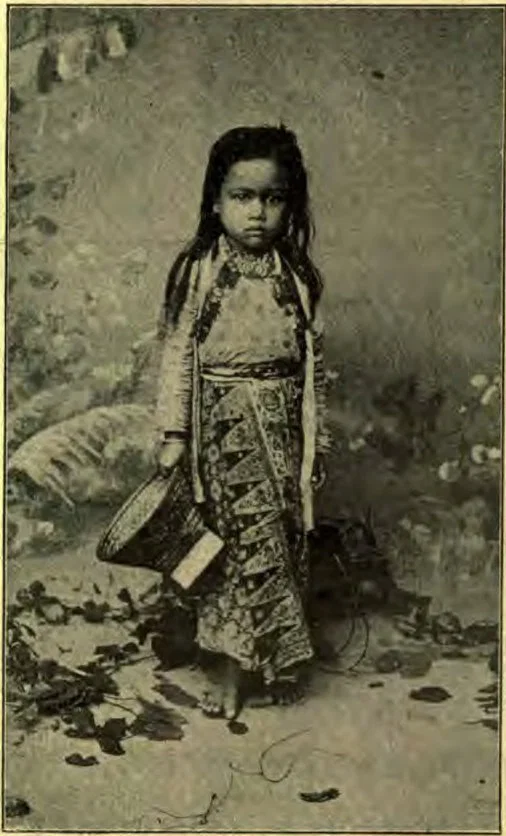
MALAY CHILD, JAVA
Down the dirty streets of Canton she went, scarcely noticing the strange sights as she passed along; for her heart was heavy thinking about poor Ah Mui. When she reached her home, she asked the mother: “Where is your little daughter? You must tell me the truth.”
The poor woman burst into tears; for she really loved her child, and confessed that she was sold. “We had a big debt, and the man kept saying, ‘You must pay, you must pay.’ We had no money, and so we finally sold Ah Mui.”
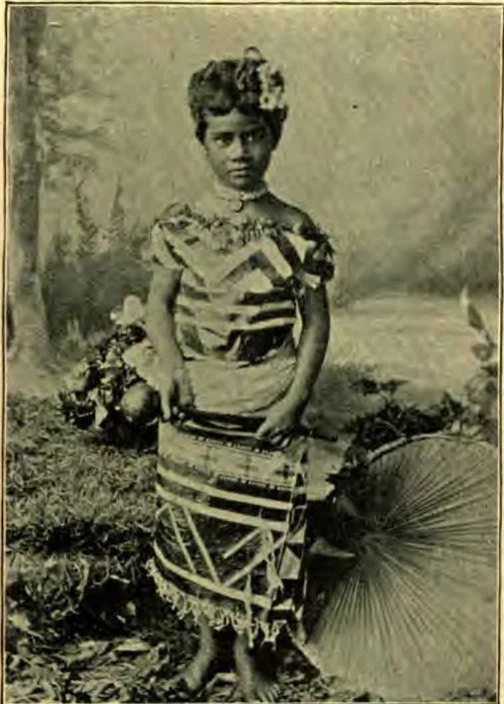
A LITTLE SAMOAN PRINCESS
When the teacher found that the child had been sold, which was sad enough, and not only that, but she had been sold to a bad Chinese woman, she was greatly troubled. “How could you do such a wicked, wicked thing? Tell me at once where is she?”
After a while she did tell; then the American mother and the Chinese mother set out together to see what could be done; but they were not allowed to see the child, and they returned home with sad hearts.
That night, after a long talk with his wife, the missionary decided that he would go himself the next day and see what he could do. After going back and forth many times between the houses of the parents and the Chinese woman, it was finally arranged that if the missionary would pay the large sum which the woman demanded, Ah Mui was to be given up to him. Being a foreigner, she thought he had plenty of money. Really the only money he had was some he and his wife had been saving a long time for a special purpose; but they decided to give that. When it was paid, and he started homeward, he held a little girl by the hand, who looked up smilingly into his face, although her eyes were swollen with crying. Happy little Ah Mui!
They dared not return her to her parents for fear she might be sold again; so the dear little Chinese sister was taken to a good school, where she is now living, as happy as a lark all the day long, learning to love God, and trying to please him more and more every day. Some children in America are helping to support her, and they call her their “little Chinese sister.”—Mission Dayspring.
Let in the Sunshine
By Mrs. H. E. S. Hopkins
Did you ever see the little birds sad and discouraged?—No; they are always busy, happy, and full of life and music. Look at the squirrels222running swiftly along the fence, or springing from bough to bough in the tree above—what a lesson of content their daily life teaches! And the young colts gamboling in the pastures, the lambs capering about in the meadows, or the calves frisking in the lane,—none of these are ever downcast and filled with gloom.
Dear children, do not mar and spoil your life with sad thoughts. God wants you to be happy—the happiest of all the creatures on the earth. For this he has made you—that you might glorify him by happy, gentle, loving lives. Let the sunshine of his love into your hearts, and there will never be any place there for dark, gloomy thoughts. Mrs. H. E. S. Hopkins.
When America Had the Best Roads in the World
Four hundred years and more ago, before the Indians ever heard of white men or their roads, Peru had a road from fifteen hundred to two thousand miles long, twenty feet wide, and as hard and almost as smooth as marble.
“Nothing in Christendom,” exclaimed Pizarro in astonishment, when he crossed the Andes by the Incas’ road, “equals the magnificence of this road over the Sierras!” And Pizarro was right. There was no road in Europe to compare with it.
It is a mystery how people without iron tools or beasts of burden, and who seem to have had no machinery, could build such roads as those old Indians did.
To begin with, the face of the country would seem to make roads impossible. There was a strip of level land along the coast, but back of that rose the Andes with their sheer precipices, frightful chasms, and rushing mountain torrents,—obstacles to discourage engineers of modern times, with all their science.
The plain on which the city of Quito is built is nine or ten thousand feet high, and there are other plains still higher, all separated by lofty peaks or deep gorges. But in the Incas’ time, all the little towns and villages, nestled in their orchards and gardens, were connected by roads through the mountain passes threading the country in every direction.
One great road led by the ocean, where the ground was low and sandy; and the Indian road-makers frequently had to raise it on a high bank of earth, with a clay wall on both sides.
The obstacles to building the road over the mountains which so amazed Pizarro seem insurmountable; but rocks in the way were crushed, excavations miles long made in the side of the mountain, precipices were scaled by steps cut in the rock wall, and ravines were filled up with solid masonry.
These two great roads were built of flags of freestone, often covered with a cement-like glue, which time made harder than stone itself, forming a sort of macadamized road.
Streams of water flowed through stone aqueducts along the sides of the roads, and they were bordered with trees and fragrant shrubs planted to shield the traveler from the burning heat of the tropical sun.
Rivers were crossed by bridges suspended in the air. These bridges were made of maguey fibers, which are very strong and tough. The fibers were woven into ropes as large as a man’s body. The great ropes were stretched across the river, the ends carried through holes cut in immense stone buttresses on the banks and fastened to heavy pieces of timber. The cables were bound together, and a flooring of planks was laid upon them, and the sides were guarded by railings. These bridges looked very frail, but they could bear great weight.
It was a dizzy experience to cross one. Sometimes the bridges were two hundred feet long; and, being fastened only at the ends, they sagged deeply in the center. In addition, the motion given to a bridge by the crossing traveler made it swing violently. In a high wind the bridges were unsafe. They were protected by law, and to burn a bridge was a crime punished by death. This same kind of suspension bridge is even now in use in this part of South America.
Wider waters were crossed on sailboats, and the Peruvians were the only people among the American Indians who knew the use of sails, Their boats were like rafts, being made of huge timbers of very buoyant wood lashed together, with a floor or deck of reeds. They had a kind of rudder and a keel made of plank, and in the middle of the boat were two masts carrying a large, square sail of cotton. This same sort of craft, with a small thatched cabin on its deck, is still used in Peru.
The meeting-place of the roads from the four quarters of the empire was the capital, Cuzco. From its great square ran four principal streets connecting with the highroads of the country. The city streets were long and narrow and perfectly regular, crossing each other at right angles, like the streets of our Western cities.
The empire of the Incas was gained by conquest, and had to be held with a strong hand; and one of the chief purposes of the roads was to help hold the empire together. If an invasion or an uprising occurred in the farthest corner, the post brought swift word of it, and the army was at once on the march over the magnificent roads to end it.
Large numbers of men were always at work on the roads, keeping them in repair, and even sweeping them. The Peruvians had no horses; so all travel over the roads was on foot, and they were not much worn by use. But in the tropics, nature is so destructive that constant care was necessary to keep them in perfect condition. This unceasing care the Incas gave them; but the Spaniards, though they called the roads one of the wonders of the world, took no such pains to preserve them as the Incas had taken, and under the Spanish conquerors the roads gradually went to decay.
Still, a hundred years ago there were enough of them yet to be seen here and there to give the famous traveler Humboldt reason to declare, when he examined the remains, that the roads of the Incas were among the most useful and stupendous works ever executed by man.—Christian Endeavor World.
MEMORY VERSE: “When they knew God, they glorified him not as God, neither were thankful; but became vain in their imaginations, and their foolish heart was darkened.” Rom. 1:21.
(The chapter given as the Lesson Scripture is the lesson to be studied. Read this carefully every day, and think over it until you know just what it teaches. Then the following notes, which should be read carefully several times, will help to a fuller understanding of the lesson. Lastly, go over the questions carefully, and be sure that you can answer each one in the words of Scripture.)
After man sinned, and was cast out of Eden, God no longer met and talked with him face to face as before. Yet he left not himself without witness in the earth. Think of all that we learned in the first chapter of Genesis about his wonderful works, that tell of him, and show that he is still with us.
Yet men forgot God, because they were not thankful to him for his goodness. And they made images of themselves, and of beasts and creeping things, and worshiped those instead of God. So they grew more and more wicked, until all the thoughts of their hearts were “only evil continually.”
Yet God always had in the earth a few who loved and served him. These were the salt of the earth: their good influence kept the world from going to destruction. But at last there was only one true servant of God in all the earth—Noah, the grandson of Methuselah, and great-grandson of Enoch.223
In the book of Hebrews we are told that “by faith Noah, being warned of God of things not seen as yet, moved with fear, prepared an ark to the saving of his house; by the which he condemned the world.”
The ark that Noah built at God’s command was a warning to the world. It told the people that the flood was coming, so that all who would might come to God, and seek for refuge.
All the time that Noah was building the ark,—one hundred and twenty years,—he preached to the people, telling them how they might be saved from the coming flood. And all this time God’s Holy Spirit was striving to bring the people to repentance. “The long-suffering of God waited in the days of Noah, while the ark was a preparing.” But the people did not believe the message, and would not come to God. When the ark was finished, there were none to enter but Noah and his family.
But the animals were obedient to God; they did not resist his Spirit, but came to Noah at his command. We have learned that the Spirit of God in each living creature is its teacher and guide. By his Spirit he causes the birds to fly south in the winter, to preserve their lives during the cold weather. And when he was going to bring the flood of waters, he led the animals to the ark, of clean beasts by sevens, and unclean beasts by twos, to keep seed alive in the earth. This also was a witness to the people; for it showed that they might all have been saved if only they had been led by the Spirit of God.
Jesus said that the days just before his coming will be like the days of Noah, when the earth was full of violence. We are now living in the days of which he spoke, for his coming is near. When he comes, the wicked will all be destroyed, as they were at the time of the flood; but God never brings his judgments upon the world without warning the people, and making a way of escape for all who will let him save them. Jesus is the way of escape,—the ark of safety,—and the warning message is now being given; so that all who will may seek for refuge in him, and be safe when the great day of his wrath shall come.
Questions
What was the world like in the days of Noah?
How did men get into this terrible state?
How many righteous persons were left?
What did God purpose to do because of the wickedness of men?
How long did he wait for them to repent?
Were they left without a warning? Who preached to them? How? 2 Peter 2:5.
How many were saved by Noah’s faithful work?
Since the people did not receive it, what did Noah’s preaching do? Heb. 11:7.
Describe the ark that God commanded Noah to build. What was done to make it water-tight?
Why was it made so large?
How many of each kind of beast and bird were saved?
How were the animals brought to the ark? Who gathered them?
Tell of something of the same kind that takes place every year.
What is it that gives understanding and guidance to all living things?
By leading the birds and animals to the ark, and saving them, what did God show about all men?
What time has Jesus told us will be like the days of Noah? Matt. 24:37. Who will then be our refuge? Ps. 90:1, 2.
The Little Children in Japan
By Caroline MacCormack
THE little children in Japan
Are fearfully polite;
They always thank their bread and milk
Before they take a bite,
And say, “You make us most content,
O honorable nourishment!”
The little children in Japan
Don’t think of being rude.
“O noble, dear mama,” they say,
“We trust we don’t intrude,”
Instead of rushing in to where
All day their mother combs her hair.
The little children in Japan
Wear mittens on their feet;
They have no proper hats to go
A-walking on the street;
And wooden stilts for overshoes
They don’t object at all to use.
The little children in Japan
With toys of paper play,
And carry paper parasols
To keep the rain away;
And, when you go to see, you’ll find
That paper walls they live behind.
—Caroline MacCormack.
A Visit to Northern Michigan
By M. C. Guild
Up in Northern Michigan, in the wilderness, removed from other settlers, where deer still roam in the forest, and lynx and wildcats are not entirely unknown, is a little colony of Sabbath-keepers. Each family have built a small house on their own farm, and a modest church-school house has been erected. Grace Harbor lies five miles to the north on Lake Huron, where the men find plenty of work in a large sawmill. Millions of feet of logs are banked, and rolled into a small lake near the mill. The mill-stream is literally alive with fish, and the people carry them away by the wagon-load.
Huckleberries, raspberries, wintergreen-berries, wild strawberries, and blackberries are very plentiful in their season; and not only do they supply an abundance of fruit during the year, but they are also a source of considerable revenue.
The children, and sometimes the women of the family, assist in clearing the ground, and each family expects to have a fine garden. It was May-day when I was there, and the Mayflowers were in full bloom, while scattered about everywhere in modest profusion was the sweet-scented trailing arbutus. Coming from a large city, with its hurry and bustle and discontent, it was a real pleasure to visit this quiet place. Though living in a primitive way, with few of the conveniences deemed so necessary in this age, these settlers are contented, and the boys and girls keenly enjoy their happy life in woods and fields.
On the Sabbath they all gather for Sabbath-school and social worship, and they are now planning to engage in missionary work in the nearest neighborhoods. What they lack in social pleasures on account of their isolated location is atoned for in large degree by the companionship of good books, with which they are well supplied. I felt on leaving them that the Lord still spreads a table in the wilderness, and that the so-called humble pleasures of life are, after all, the best.
M. C. GUILD.
III — The Sure Results of Sin
(July 19)
MEMORY VERSE: “Let not the wise man glory in his wisdom, neither let the mighty man glory in his might, let not the rich man glory in his riches: but let him that glorieth glory in this, that he understandeth and knoweth me, that I am the Lord which exercise loving-kindness, judgment, and righteousness, in the earth: for in these things I delight, saith the Lord.” Jer. 9:23, 24.
LESSON SCRIPTURE: Same as given in Synopsis.
Synopsis
Josiah was the last good king to reign in Jerusalem, and when he died, great was the lamentation of Israel. 2 Chron. 35:25. The four kings who followed him were very wicked, and during their reign the judgments of the Lord were poured out upon his people. For they mocked his messengers, despised his words, and so misused his prophets that the wrath of the Lord arose against them till there was no remedy. 2 Chron. 36:16.
The first two of these kings were brothers, and also the second two. 2 Chron. 36:1–10. They were truly alliances of evil; in whatever wickedness one failed, the other carried it on. Their sins are faithfully recorded by the prophet Jeremiah. Notice what they were:—
One oppressed the poor; his eyes and his heart were only to shed innocent blood, and for oppression and violence to do it. When the Lord spoke to him, the king said, “I will not hear.” Jer. 22:11–21. Moreover he put to death one of his prophets, sending even unto Egypt to search him out. Jer. 26:20–24. This same king also burned up a message which the Lord had given Jeremiah while in prison. The king was sitting in his winter-house, and a fire was burning on the hearth before him. As his servant read three or four leaves, Jehoiakim cut it with his knife, and cast it into the fire until all was consumed. Jer. 36:2–23. Jeremiah then rewrote the message, and sent it again to the king.
The sins of Zedekiah were even worse; for he allowed himself to be controlled by his princes (Jer. 38:5), and would take no stand himself. The Lord sent one message to this king continually: “Go forth unto the king of Babylon’s princes, then thy soul shall live, and this city shall not be burned with fire.” Jer. 38:17. But Zedekiah was afraid of the Jews, fearing lest they should deliver him into the hands of the Chaldeans and mock him. Verse 18. Therefore he gave no obedience to the Lord’s message, and finally he was compelled to go to Babylon with blinded eyes. Jer. 39:7.
Such were Judah’s last kings. What were the people? “The sin of Judah is written with a pen of iron, and with the point of a diamond.” Jer. 17:1. “Run ye to and fro through the streets of Jerusalem, and see now, and know, and seek in the broad places thereof, if ye can find a man, if there be any that executeth judgment, that seeketh the truth: and I will pardon it.” Jer. 5:1. Read this whole fifth chapter of Jeremiah, and see what “wonderful and horrible” things were committed in the land. “And my people love to have it so,” saith the Lord.
Now while such wickedness was developing in Jerusalem, the Lord had prepared a cradle of refuge in a heathen land for those who loved him. Hither he sent Daniel and his fellows. They must have gone with the captivity mentioned in Jeremiah 24; for the Lord showed his prophet that these people were like good figs, while Zedekiah and the residue of Jerusalem were like evil figs, “that can not be eaten, they are so evil.” Jeremiah 24. Daniel certainly was of the good figs. He and his companions were sent to Babylon to live and teach the gospel. As captives they must do what their fathers had failed to do as conquerors. If Zedekiah had heeded the Lord’s message, and had gone to Babylon, where were Daniel and his fellows, he might have been saved.
The sinful course of Israel brought its sure result. 1 Chron. 9:1. More than a century before it came upon them, the Lord warned his people of the result of their hypocrisy, and only a few years before the captivity, he made it still more definite. Hab. 1:5, 6.
But Israel would not listen. The people gloried, saying, “The temple of the Lord, the temple of the Lord are we;” and then the Lord took away their temple, and put them in a heathen land, that they might learn how to worship him aright. It was serving strange gods in their own land that scattered them in a strange land. Jer. 5:10. Here they were to learn the truth concerning God’s dwelling-place and the folly of glorying in anything except a personal knowledge of God. Jer. 9:23, 24.
Questions
1. How did Israel take the death of their good king Josiah?
2. What four kings followed him?
3. During their reign what is said of the people?
4. What prophet did the Lord send to reprove them?
5. What sins of the kings of Judah does this prophet record?
6. To what message did King Zedekiah give no heed? Why?
7. What was the result upon himself and upon his people?
8. While these kings of Judah were so wicked, what about the people?
9. Yet if they had been willing to execute judgment, what would the Lord have done?
10. How did they regard the “horrible” things done in the land?
11. With what captivity did Daniel and his fellows go to Babylon?
12. To what does the Lord liken them?
13. What does he say of those who were left?
14. Why was it better for Judah to go into captivity than to stay in Jerusalem?
15. What warnings had the Lord given his people of the sure result of their sinful course?
16. At the same time the people were doing so wickedly, what were they saying?
17. When put in a strange land, what lessons were they to learn?
THE INSTRUCTOR PREMIUM BIBLE.
By Editor
A Self-Pronouncing Teachers' Reference Bible, containing the celebrated Teachers' Helps, and comprising nearly 400 pages. Also a complete series of 15 new maps.
This beautiful book is bound in Imperial Seal Binding, Tuck Edges, known as
“Divinity Circuit,” Rounded Corners, Full Red under Gilt Edges.
We offer this Bible, postpaid, for only six new yearly subscriptions at 75 cents; or twelve new six-months' subscriptions at 40 cents.
We will also send it, postpaid, with the INSTRUCTOR one year for $2.25. For 20 cents extra we will stamp your name in gold upon the cover. Address—
THE YOUTH'S INSTRUCTOR,
BATTLE CREEK, - - - MICHIGAN.
Keep at Work
Do not stop work to become an expert stenographer. We successfully teach by correspondence the Graham System of Shorthand by a new method, which enables the stenographer more quickly to attain practical speed than by any former method. Easy to learn, easy to retain. Highly recommended by oldest official court reporters. Complete course for beginners. Special course for advanced writers, who desire to become expert. Write to-day for full particulars to the—
FIRESIDE CORRESPONDENCE SCHOOL, Battle Creek, Mich.
SOLID THROUGH TRAINS OF
WIDE VESTIBULE COACHES and PULLMAN SLEEPING CARS BETWEEN
Battle Creek and Chicago, Buffalo, New York, Philadelphia, Toronto, Montreal, Boston
For time-tables, descriptive matter, and information, apply to any representative of the company.
Waiting on God
NEVER A SUN SO brightly shone
As to form a rainbow all alone.
Never was halo round a life
Borne without need of pain and strife.
Stricken earth, since 'tis ordered so,
Waits on God for his promise bow;
Grows in glory, doth not complain
Over the sunbeams washed with rain.
Soul, that art more than sea and land,
Look on nature and understand!
Blended shadow and light exist,
Wrought upon by the alchemist;
But never sun so fair yet shone
That it made a rainbow all alone.
— Youth's Companion.
The Australian Boomerang
By H. E. Simkin
CONSIDERABLE has been written about the peculiar implement, or weapon, called the “boomerang,” made by the aborigines of Australia; but very few really know what it is like. Many stories are told about the wonderful way in which they throw it from them in such a manner that it returns again to the thrower. It always seems to the writer that there must be more poetry than truth in these stories, as such a return seems so contrary to the laws of force; but once seeing the feat accomplished makes all quite plain.
A few weeks ago I had an opportunity of seeing an old native throw a boomerang of his own manufacture. A party of which the writer was one were returning from an exploring trip on bicycles in the mountainous country east of Melbourne. At Healesville, the end of the railway line, we put our wheels on the train after a long ride; and while waiting for the train, we caught sight of an old-timer, familiarly known as “Tommy,” from the government reservation called by the native name of Coorrandirk, which is only two miles distant from Healesville. He was trying to sell a boomerang which he had made only a few days before. Feeling that the knowledge of exactly how the weapon is thrown, and the possession of the boomerang itself, were worth the cost, I gave the fellow the English equivalent for half a dollar, the value he put upon it, and also induced him to throw it for me seven times into the bargain.
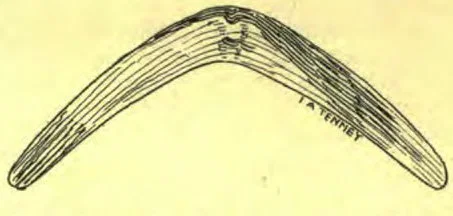
The accompanying cut shows the shape of the implement. It is about twenty-seven inches long, one end being thirteen, and the other fourteen, inches from tip to curve. It is perhaps one fourth of an inch thick in the thickest place, and tapers toward the ends and sides each way from the middle.
In throwing it the man held the smaller, longer end, and threw it out from him toward the wind about thirty feet high with a peculiar turn which caused it to spin round and round very fast. At the same time this motion caused it to describe a circle around the thrower of about one hundred and fifty feet. When thrown with the greatest force, it would thus encircle him two or three times; but as the force diminished, the circle decreased till the boomerang finally dropped almost at his feet. So it is really true that the thing is thrown, and returns again to the thrower, but not as we have sometimes been led to believe. He could not throw it straight out from him, and have it come back; but it flew around him till its force was expended, and then fell in the middle of the circle, the same as a boy rolls a hoop tipped to one side in such a way that it rolls round and round till it stops in the middle of the circle.
The old man seemed anxious to explain just how to throw the boomerang so it would successfully describe a circle. Some day when he is sure no one is looking, the writer intends to practise with his boomerang. It is said, however, that few white men are ever successful in this peculiar exercise. H. E. SIMKIN.