Dorothy lived with her grandparents on a little farm among the mountains. She loved animals, and was never without a pet of some kind.
One day as Dorothy’s grandfather was taking the cow to pasture, he noticed three little creatures playing near a large rock. He thought they were young foxes, and started to catch one; but before he could reach the place, two of the little fellows had tumbled into their hole. The other was about halfway in when Dorothy’s grandfather caught him.
It was not a fox, but a baby woodchuck,—a queer, fuzzy little ball of fur, with beady black eyes, stumpy tail, and big, yellow teeth.
The baby woodchuck bit, and scratched, and struggled to get away. But at last he was tied in a handkerchief, and then he was carried to Dorothy.
Dorothy was delighted with this new and strange pet; and though her grandfather said woodchucks rarely became tame, she was sure this one would. She named him Peter; and then took down her old squirrel cage, and lined it with soft hay, and placed him in it, with some fresh-cut clover and a little dish of water.
For a few days Peter was very wild. He insisted on spilling his water, and he would snap and bite whenever his little mistress replaced it. But by and by he saw that Dorothy did not mean to hurt him. Then he gave up biting. In two weeks he would drink from his dish without upsetting it, and would nibble clover from Dorothy’s hand, and let her scratch his funny little head.
In a month Peter had grown to twice his former size, and had become so tame that he would let Dorothy take him in her arms, and carry him about. One day she forgot to fasten the cage door, and Peter walked out. But he did not go far, and went back to his cage of his own accord. The door was never fastened after that, and all day long Peter would play about the veranda, or nibble grass in front of the house. He always returned to his wire house for the night. By this time he had learned to answer to his name. He would run to Dorothy whenever she called him.
One day Dorothy’s grandmother was baking cookies, and she gave one to Peter. It was amusing to see the little woodchuck taste it, then taste again, as if he were not quite able to make up his mind whether he liked it or not. Finally he decided that he did like it, and he ate it all. From this time, cookies were his favorite food. As soon as Dorothy’s grandmother began to bake, he would run to the kitchen, and sit on his haunches in the doorway, and wait patiently until his cooky was given him; then he would scamper off to one of his grassy nooks, and eat it at his leisure. He would hold it in his fore-paws, and nibble here and there in the cunningest way until it was all gone.
Several times during the summer Peter wandered off to the woods. At last, one cool October day, he went off and did not return.14
Dorothy was afraid some one had killed him. All winter long she mourned for Peter.
One fine morning in April, as Dorothy was walking down the road with her grandfather, they espied a large red woodchuck sitting on a stump in a field.
“O grandpa!” cried Dorothy, “see that woodchuck! does n’t he look just like my dear old Peter?”
“Perhaps it is Peter,” said her grandfather. “Call him, and see.”
Stepping to the side of the road, Dorothy waved her hand, and called, “Peter, Peter! come here, Peter!”
And what do you think happened?—Why, the old fellow first looked at Dorothy for a minute, with his head on one side, and then came running across the field,—and it was Peter, safe and sound, coming back to her after his long winter sleep.
Dorothy took the great red fellow in her arms, and hugged and kissed him. Peter seemed to share her delight. He rubbed his nose against her cheek, and grumbled down in his throat, as woodchucks do when they are pleased.
Of course Dorothy carried Peter home, and fed and petted him, to make up for all the time he had been away. That afternoon Dorothy’s grandmother got out her baking tins and rolling-pin. And the moment Peter heard the sound, he ran to the kitchen door, and took his old place again, to wait for his cooky. So you see that during his long winter sleep he had not forgotten about the cookies.—Little Folks.
Plant Intelligence
By Auntie Wince
PLANTS seem to have a certain degree of intelligence. They seek light, they move toward supports, they reach out for food. The flytrap devours insects; the pitcher plant stores up water; the leaves of the sensitive plant close at the slightest touch; and a “South American vine, called the ‘knotter,’ twines its arms around every living thing that comes in reach, twining its long tentacles about a man, much as a devilfish might. These tentacles sear and burn the flesh like white-hot knives. The victim is dragged into the heart of the foliage, and his juices are slowly drained, as the spider sucks the blood of a fly.” The sunflower turns to the sun, the morning-glory closes when the sun waxes warm, the primrose opens when the twilight begins to fall, and the pretty clover leaves go to sleep. How do they know how and when to do all these things? Can the children tell? Auntie Wince knows that there is a difference between a dead plant and a live one, and so do you. We kill the weed when we pull it up, but whether it has any sense of feeling, we can not tell. AUNTIE WINCE.
WHAT BERNICE LEARNED ABOUT THE APOSTLES
By Mrs. L. D. Avery-Stuttle
III
“The wicked Jews had tried hard to put St. Andrew to death before this,” continued Aunt Emma, “but he was miraculously preserved; for his work was not yet done. It is indeed quite marvelous how the Lord spared this apostle’s life. His enemies hated him so intensely that they tried to burn the house he lived in, but they did not succeed.”
“I presume they thought he would be staying in his house,” said Bernice, “and that they would burn him up, maybe while he was asleep.”
“Perhaps so; anyway, when they found that they had not destroyed him, they were more angry than ever; and they caught him, beat him with cudgels, stoned him, dragged him off into the fields, and left him, supposing he was dead. But when he revived, and went again into the city, a great many persons were converted, because they saw that God was with his servant.”
“What did you learn, grandma?” asked Bernice.
“Yes,” added Aunt Emma, “we are quite prepared to listen. I dare say you have learned much more than either Bernice or I.”
“Perhaps I have not been so busy,” said grandma. But grandpa objected to this version of the case, for he was sure it must have taken a long time to do all the week’s mending, now so neatly folded away in grandma’s basket.
“Well,” began the dear old lady, “I learned a little about the apostle James, called ‘the Great.’”
“Why did they call him ‘great,’ grandma? Was he a greater man than the others?” asked Bernice.
“Oh, no, I think not; people gave him this title only for a surname, and to distinguish him the better from the other apostle James. Besides, he received, with his brother, the name Boanerges, meaning ‘Sons of Thunder.’ It was this James who was present at the wonderful Transfiguration. Can you tell me, Bernice, who else was present at that great event?”
“I’m sure I could not have remembered, grandma, only it happened that I was just reading about it to-day; it was Peter and John who were with James.”
“Yes, Bernice. It was this apostle, also, who was present, with the select few, at the resurrection of the little daughter of Jairus. After the ascension of the Lord, James preached in Judea so earnestly that Herod became very angry with him, and ordered that he be beheaded.”},{
“How did it happen,” asked grandpa, “that King Herod was so angry with a simple man whose only offense was preaching Christ?”
“It was only that Herod wished to please the Jews,” said grandma; “probably he had no personal spite against James. But the courage and Christian fortitude of the apostle were so great that the officer who kept him was converted; and although he had been the accuser of the apostle, he was so deeply sorry for what he had done that he begged James’s pardon most humbly.”
“I suppose James forgave him, didn’t he, grandma? I hope so, seeing he was so very, very sorry,” said Bernice.
“Yes, indeed, he gladly forgave him, and said to him, ‘My son, peace be to thee, and the pardon of thy faults.’”
“I hardly see how he dared do this,—the officer, I mean,”—said Aunt Emma, “for fear the king would punish him, too, with death. You know it was fear of the consequences to himself that caused Peter to curse and swear, and to deny his Lord, which act, besides being cowardly, was hypocritical as well.”
“Oh,” replied grandma, “this man was so soundly converted that he counted not his life dear to himself, and he was executed at the same time as James. This happened in the year 44 after Christ.”
“Is that all you learned, grandma?” asked Bernice.
“No, dear; but I think we had better hear from grandpa next,” suggested grandma.
“Very well,” said grandpa, “we will have a little talk about the Apostle John, called the ‘Evangelist,’ also called the ‘Beloved.’ This apostle is supposed to be the only one who died a natural death. Though the youngest of the apostles, he was the one the Master selected, above all the others, to act the part of a son to his beloved mother, when he, her own Son, was hanging upon the cross. He was also present at the Transfiguration, and at many other of the principal events of our Lord’s life. His disposition was loving and kind, and it was quite likely this fact that influenced the Master to choose him as the protector of his poor, heart-broken mother.”
“How long did Mary live after Christ went back to heaven, grandpa?”
“About fifteen years, the historian says, though in the Scriptures we have no account of her death. John lived in Jerusalem until the death of Mary, and then went into Asia, which province had been assigned to him by the other apostles as his field of labor. He was very successful there, and built up several large churches. He lived in the city of Ephesus for some time, in comparative peace; but after a few years the Emperor Domitian sent him over to Italy; and when he arrived in Rome, he was placed in a large vat of boiling oil.”
“Why, grandpa!” exclaimed Bernice, “you must be forgetting that you said John died a natural death! Aren’t you mistaken? maybe the oil had got cold before they put him in.”
“No, my child; they would not have troubled to place him in cold oil, when they were thirsting for his life,—no, but the Lord sent his angel and preserved him, because his work was not yet done.”
“That is something like a circumstance recorded in the book of Daniel,” said grandma.
“Yes, I remember,” interrupted Bernice, “the story of the three men whom the king put in the furnace, but whom the Lord took care of, and kept from being burned.”
“St. John lived longer than any of the other apostles,” continued grandpa. “When he was15quite an old man, he was banished to the lonely Isle of Patmos, in the Icarian Sea. Here he wrote the wonderful book of Revelation. At last, when the cruel emperor died, John returned to Ephesus, preaching and exhorting until relieved from his labors by death, which occurred when the venerable apostle was almost a hundred years of age.”
MRS. L. D. AVERY-STUTTLE.
BE SOMETHING
Be something in this living age,
And prove your right to be
A light upon some darkened page,
A pilot on some sea.
Find out the place where you may stand
Beneath some burden low,
Take up the task with willing hand—
Be something, somewhere, now!
Be something in this throbbing day
Of busy hands and feet,—
A spring beside some dusty way,
A shadow from the heat;
Be found upon the workmen's roll;
Go sow, or reap, or plow;
Bend to some task with heart and soul—
Be something, somewhere, now!
— Selected.
WHO FOUND THE RIBBON?
“SHUT your eyes and hold your ears,” said Baby Bess; “we’re going to play hunt the handkerchief, only I can’t find my handkerchief, and I’ll hide my ribbon instead.”
So she tiptoed across the room, and laid the ribbon on the window sill behind the flower pots.
Edna and Harold had a long hunt for it; and when they gave it up, Baby Bess herself could not find it. There was the window sill, there were the flower pots, but no ribbon could be seen. What had become of it?
When autumn came, and the leaves fell off the trees, the children saw an oriole’s empty nest in the elm tree. And Harold climbed up and brought it down.
Then what do you think he found in it? How the children all laughed! for there in the bottom of the nest was baby’s blue ribbon, just where Mrs. Oriole wove it in, to make a soft bed for her children.
Then they knew that on that morning Mrs. Oriole was building her nest. And when she spied the baby’s ribbon in the open window, she thought, “Ah that is just what I want for my children’s bed.” So she took it in her bill, and carried it away with her.—Selected.
YOUR LITTLE TONGUE
You have a little prisoner;
He's nimble, sharp, and clever;
He's sure to get away from you
Unless you watch him ever.
And when he once gets out, he makes
More trouble in an hour
Than you can stop in many a day,
Working with all your power.
Quick! fasten tight the ivory gates,
And chain him while he's young!
For this same dangerous prisoner
Is just — your little tongue.
Time: A. D. 31. Place: Jerusalem. Persons: Jesus, disciples.
QUESTIONS
1. After Judas had departed, by what tender title did Jesus address the eleven disciples? What did he say that caused them sorrow? John 13:33. What question did Peter then ask? What answer did he receive? V. 36. What did he say concerning his love for Jesus? V. 37. What mild rebuke did Jesus then give him? V. 38.
2. What warning and what blessed promise were at this time also given to Simon? Luke 22:31, 32; note . What did Peter say, showing that he did not appreciate Jesus’ words? V. 33.
3. Touched by the sorrow of his disciples, what precious instruction concerning his going away did Jesus give them? John 14:1-4. What did Thomas say in response? V. 5. To throw light into his mind, what did Jesus say to him? Vs. 6, 7.
4. Failing to see the real truth of Jesus’ words, what did Philip say? V. 8. Pained at Philip’s dullness, what answer did Jesus give? Vs. 9-11. What promise relative to the work of his followers did Jesus then utter? V. 12.
5. Concerning prayer in his name, what assurance was given? Vs. 13, 14; note . For the benefit of all who keep his commandments, what did Jesus say he would do? With what results? Vs. 15-18. What blessed experience will all have who truly love and obey God? Vs. 19-21.
6. Upon what question did Judas ask for light? V. 22. How did Jesus answer him? Vs. 23, 24. Though the disciples were blessed with Christ’s bodily presence, what better, richer blessing was promised? Vs. 25, 26.
7. That all trouble and anxiety might be dismissed, what did Jesus leave with his people on earth? V. 27; note . In regard to his going away and coming again, what will be the feeling of all who really love Jesus? V. 28.
8. Why would Jesus no longer talk much with his disciples? V. 30. Having concluded his instruction in the Passover chamber, what order did he give? V. 31.
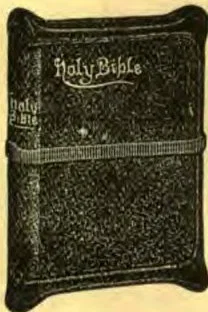
Self-Pronouncing S. S. Teachers' Reference Bible.
CONTAINS the celebrated _Teachers' Helps_, comprising nearly 400 pages. Also a complete series of fifteen new maps.
Description. — Imperial Seal Binding, Tuck Edges, known as “Divinity Circuit,” Rounded Corners, Full Red under Gilt Edges.
We offer this Bible, post-paid, for only _SIX NEW YEARLY SUBSCRIPTIONS_ at 75 cents; or _TWELVE NEW SIX MONTHS' SUBSCRIPTIONS_ at 40 cents.
We will also send it, post-paid, with the INSTRUCTOR one year for $2.25. For 20 cents extra we will stamp your name in gold upon the cover.
Making Home Happy.
By Mrs. L. D. Avery-Stuttle
By Mrs. L. D. Avery-Stuttle.
This subject is presented in an interesting story form, and every reader will feel inspired to strive to make his home cheerful. Happy homes are needed everywhere, and “Making Home Happy” is a good little book to help bring about this result.
The book contains 206 pages, with four full-page illustrations, besides smaller ones. Price, bound in cloth, 50 cents.
We will send it, post-paid, for three new yearly subscriptions to the INSTRUCTOR at 75 cents each; or with the INSTRUCTOR one year for $1.00.
FIVE PENNIES
A boy who had a pocketful of coppers dropped one in the missionary box, laughing as he did so. He had no thought in his heart about Jesus or the heathen. Was not his penny as light as tin?
Another boy put in a penny, and looked around to see if anybody was praising him. His was the brass penny, not the gift of a lowly heart, but of a proud spirit.
A third boy gave a penny, saying, to himself, “I suppose I must, because all the others do.” That was an iron penny. It was the gift of a cold, selfish heart.
As a fourth boy dropped his penny into the box, he shed a tear, and his heart said, “Poor heathen! I am sorry they are so poor, so ignorant, and so miserable.” This was a silver penny,—the gift of a heart full of pity.
But there was one who gave his, saying: “For thy sake, Lord Jesus! Oh, that the heathen may hear of thee, the Saviour of mankind!” That was a golden penny, because it was the gift of faith and love.—Exchange.
To Reach BATTLE CREEK
FROM
CHICAGO, BUFFALO, DETROIT, OR TOLEDO,
Purchase Tickets Reading over the MICHIGAN CENTRAL
“The Niagara Falls Route.”
A First-class Line for First-class Travel between Chicago and New York and Boston. Elegantly equipped through trains pass Battle Creek in each direction daily.
R. N. R. WHEELER, Ticket Agent, Battle Creek. O. W. RUGGLES, Gen'l P. and T. Agt., Chicago, Ill.
TAKE THE Canadian Pacific Railway
for . . . CHATHAM, OTTAWA, MONTREAL, LONDON, GALT, QUEBEC, WOODSTOCK, TORONTO, BOSTON, PORTLAND, and
All points in New England, the Maritime Provinces, Great Britain, and the Continent.
Illustrated literature, time-tables, and full particulars, upon application to—
J. FRANCIS LEE, GEN. AGENT,
Passenger Dept. 228 SOUTH CLARK ST., CHICAGO
Branch Offices: 76 Ottawa St., Grand Rapids, Mich.; Room D, Chamber of Commerce, Cincinnati, Ohio; 315 Chestnut St., St. Louis, Mo.
Cincinnati Northern Railroad Co.
TIME TABLE NO. 3.
IN EFFECT SEPT. 24, 1899.
Trains Pass Battle Creek, as follows:
WEST-BOUND.
No. 21, Mail and Express .................... 6.58 P. M.
No. 23, Accommodation ........................ 2.07 P. M.
No. 27, Local Freight ............................ 8.25 A. M.
EAST-BOUND.
No. 22, Mail and Express .................... 8.25 A. M.
No. 24, Accommodation ........................ 1.45 P. M.
No. 28, Local Freight ............................ 5.30 P. M.
Direct connections are made at Toledo with all roads diverging. Close connections for Detroit and Cincinnati.
J. L. READE,
Ticket Agt., Battle Creek.
E. R. SMITH, City Pass. Agt., 6 West Main St.
GRAND TRUNK RAILWAY SYSTEM.
By A. S. Parker
Time-Card in Effect November 19, 1899.
C. & G. T. DIVISION.
WEST-BOUND FROM BATTLE CREEK.
No. 2, Mail and Express, to Chicago — 12.15 P. M.
No. 1, Chicago Express, to Chicago — 9.00 A. M.
No. 3, Lehigh Valley Express, to Chicago — 3.40 P. M.
No. 5, Pacific Express, to Chicago, with sleeper — 1.10 A. M.
No. 75, Mixed, to South Bend — 8.20 A. M.
Nos. 9 and 75, daily, except Sunday.
Nos. 1, 3, and 5, daily.
EAST-BOUND FROM BATTLE CREEK.
No. 8, Mail and Express, to Pt. Huron, East, and Detroit — 3.45 P. M.
No. 4, Lehigh Express, to Port Huron, and East — 8.27 P. M.
No. 6, Atlantic Express, to Port Huron, East, and Detroit — 2.25 A. M.
No. 2, Leh. Exp., to Saginaw, Bay City, Pt. Huron, and East — 6.50 A. M.
No. 74, Mixed, to Durand (starts at Nichols) — 7.15 A. M.
Nos. 8 and 74, daily, except Sunday.
Nos. 4, 6, and 2, daily.
A. S. PARKER, Ticket Agent,
Battle Creek.
Christ and the Cultivation of the Soil
By Editor
A series of articles by Elder S. N. Haskell, on the general subject of the relation of Christ to the cultivation of the soil, is begun in this number. As Elder Haskell has presented these studies in different places, many have expressed a desire to have them published, and we are glad for the privilege of giving them through the INSTRUCTOR. For the present these articles will alternate with a series by Sister Henry, on “Requisites for Workers,” the first number of which will appear next week.
THE USES OF SNOW
By Mrs. W. C. Sisley
Is the snow useful? — Yes, truly. Being of a loose, fluffy texture, and containing about ten times its bulk of air, it is a poor conductor of heat. For this reason it serves to protect the earth from losing too much of its heat from the effects of radiation. In very cold weather it sometimes happens, says one of good authority, that the soil is forty times warmer than the surface of the overlying snow. Hence the snow makes an admirable covering for a protection to plants and growing grain from the colder atmosphere surrounding the earth. In some countries, snow is familiarly called the poor man's fertilizer, and when abundant, is considered an evidence that the following season will be a fruitful one.
Snow makes rough roads smooth, and affords an easy way of transporting heavy loads. It is much appreciated in lumbering districts.
But to the children the snow is a particular friend. It is useful to them as a means of innocent, life-giving recreation. Ask the rosy-cheeked girls and boys, and hear their reply. They will bear positive testimony to the virtues of health and happiness stored up in the snow.
The Bible makes use of the snow as an emblem of purity, telling us that when the sin-stains are all washed away from our characters, we shall be whiter than snow.
As we look upon the beautiful snow, we may not only admire it, but have awakened anew in our hearts a desire to be as pure and clean.
MRS. W. C. SISLEY.
FOR EVERY DAY OF THE WEEK
Sunday:
Earth is so small, and heaven is so vast!
Eternity so long, and time so brief!
When earth has vanished, and all time is past,
How paltry then will look to-day’s short grief!
— Emma C. Dowd.
Monday:
Kind looks, kind words, kind acts, and warm hand-shakes,— these are the secondary means of grace when men are in trouble, and are fighting their unseen battles.— Dr. John Hall.
Tuesday:
Life is a sheet of paper white,
Whereon each one of us may write
His word or two; and then comes night.
Though thou have time
But for a line, be that sublime;
Not failure, but low aim, is crime.
— J. R. Lowell.
Wednesday:
Nothing of worth or weight can be achieved with half a mind, with a faint heart or a lame endeavor.— Barrow.
Thursday:
“I can not be everywhere, but I can be somewhere: I can not do everything, but I can do some things; and by the grace of God I will do those things for his glory and the good of my fellow men.”
Friday:
Why shadow the beauty of sea or of land
With a doubt or a fear?
God holds all the swift-rolling worlds in his hand,
And sees what no man can as yet understand,—
That out of life here,
With its smile and its tear,
Comes forth into light, from eternity planned,
The soul of good cheer.
Don’t worry—
The end shall appear.
— Elizabeth Porter Gould.
Sabbath:
“And grieve not the holy Spirit of God,
whereby ye are sealed unto the day of redemption.” Eph. 4:30.
The Laurel Wreath Presented to Admiral Dewey
The laurel wreath presented to Admiral Dewey by the United States Senate was made of the silvery leaves of the African laurel,— a plant which is becoming so rare that “its exportation has been prohibited, and the leaves which now come to Europe and the United States are said to be smuggled, the price in New York City being about twenty-five cents a leaf.” The leaves are silvery gray on both sides, and have a beautiful luster. The laurel used by the ancient Greeks and others to crown their heroes was dark-green, and still grows in abundance in the Canary Islands and the countries of the Mediterranean.
Reader Reports for the Instructor Circle
By Editor
We shall be glad to have you write to the INSTRUCTOR about your reading circle, whether you meet with your Sabbath-school class, or have a little home circle, or are doing the work by yourself. There is always room, too, for short, carefully written reports of missionary work done, whether in Christian Help lines, or in the distribution of literature. In writing these, be careful to omit any personalities that might give pain if the report should fall into the hands of those of whom it was written. Use the same heaven-given tact in writing that you must use in order to reach hearts, and your reports will be a help and an inspiration to others.