The Youth’s Instructor, Vol. 48, No. 2.

PUBLISHING IN ANCIENT TIMES

The Youth’s Instructor

Jan 11, 1900

Review and Herald Publishing Company · Battle Creek, Mich. · Jan 11, 1900

PUBLISHING IN ANCIENT TIMES

We of the present day are so accustomed to the product of the printing press that we can scarcely imagine a condition of the civilized world in which no printing presses existed. If we try to imagine it at all, we probably think of a world where books were very rare, and to be found only in great libraries, or in meager collections in the houses of the very rich. We can hardly conceive of their being almost as cheap as they are to-day, and so numerous as often to remain on the market unsold. Yet the scarcity of books in ancient times has probably been exaggerated.
There was even a sort of newspaper in old Rome. The first public records of Roman current history were the Annals kept by the Pontifex Maximus and his associates. These records were engraved on a stone tablet, and set up in the house of the pontiff in a room accessible to the public. They were often very meager. The historian Livy found that the only record for two years was the single sentence, “In this and in the following year a pestilence prevailed.” What is more, they were often, to use the slang of modern newspaperdom, “cooked.” Roman historians of a later day found, in more than one instance, from private records, that truth had been suppressed or violated. It was asserted, for example, that the Gauls, when they sacked Rome, were compelled to disgorge a part of the gold they obtained; but when the test of criticism was brought to bear, it was found that it had all been carried away.
Cæsar, in his consulship struck a blow for the people, by requiring all the doings of the senate to be published daily. “Reporters” were detailed to take down the proceedings and the speeches; and these, with other matters of interest, were published as a sort of newspaper,—the daily Acta. There is evidence that the Acta was delivered regularly at the houses of well-to-do Romans. Cicero, for example, commenting in one of his letters on a certain rumored scandal, says, “I find nothing about it in the Acta.” That it circulated far beyond the walls of Rome, is proved by another letter of Cicero’s, in which he complains that he continually receives letters from foreign princes, thanking him for his kindness in getting them made kings, when he did not even know there were such persons in the world. Can any one deny, after this, that the Acta was in all respects a newspaper?
There were many systems of shorthand in use, but to Cicero belongs the credit of inventing one that made verbatim reporting possible. This was called the Tyronean system, from Tyro, a freedman whom Cicero trained in his new shorthand. The characters were called notæ. Those who used them were able to write a great deal in a small space. Horace, in one of his poems, ironically says to a stenographer, “You will have no occasion for four years to ask for another parchment.” Notæ came to be used all over the Roman world. A table explaining these signs is now in the British Museum.
Books were first multiplied by private collectors, who kept a force of trained slaves transcribing copies. But in the time of Cicero, publishing and selling books had become a large and profitable business. The principal publishers of that day were Atticus, who published for Cicero, Dorus, and Tryphon. An edition must have consisted of several thousand copies. One writer stipulates that one thousand copies of his book shall be made for distribution in the provinces, besides the number that were to be sold in Rome. When Augustus wished to suppress a certain book, we learn that he confiscated and destroyed two thousand copies. Children in the public schools were taught to read from copies of the works of great poets. We may suppose that each pupil had his books, and his bundle of tablets to write on.
Slave labor was the printing press of the Romans. It has been calculated that a poem of the length of Enoch Arden could be transcribed in twelve hours. Five persons, reading each to a hundred trained writers, could produce five hundred copies in a day. As the cost of feeding a slave was but a few cents a day, the poem could probably be sold for about fifteen or twenty cents. It is hardly likely that a first edition of any modern poem of that length would be sold for that price. In our comparison, however, we should not forget that the value of money was much greater then than now.
We learn that the sixth book of Martial’s Epigrams, which in a modern edition covers thirty or forty pages, sold for twenty-five cents; and in an elegant purple vellum wrapper, with carved ivory umbilici, or knobs, the price was only seventy-five cents. He tells us that his thirteenth book sold for sixteen cents, and says a fair profit could have been made by the publishers at half the price.
Even at these prices there was overproduction. Books remained unsold on the shelves of the dealer then as now; for we find Roman satirists recommending these left-over scrolls for wrapping up groceries and lining boxes.
In the Middle Ages, on the other hand, books were rare and very costly. Slavery practically disappeared with the downfall of Rome. Books could no longer be copied by the wholesale at small expense. Transcribing became the work of monks, and was done for love rather than profit. Not only were books scarce, but there was little demand for books in that wild age, when the business of gentlemen was to fight. Books became more and more a part of the furniture of churches, and so were brilliantly illuminated on the inside, and richly embossed and jeweled on their covers. As the times became more settled, and learning began to dawn again upon the world, an attempt was made to multiply books. Endowments of land were settled on large abbeys exclusively to maintain the scriptorium. The Bible and the services of the church were no longer the only books of which copies were needed. Interest in the literature of Rome, and then of Greece, awakened; and all over southern Europe, copies of the classics were multiplied. It is to this revival that we owe our common Italian, or “Roman,” letters: in copying the earlier manuscripts the forms of the letters in which they were written came to be imitated, and black-letter went out of fashion in the south of Europe.
When the revival of learning was nearing its zenith, the dawn of the age of printing began, conferring on the middle classes, and even on the poor, those blessings which were before scarcely to be tasted by princes. With the Scriptures in the hands of the people, religious reformations could find firm ground to stand on. A wonderful light broke in upon the dense ignorance of the medieval peasant. While the treasures of classic literature, with their alloy of moral dross, were locked up in the Latin tongue, the common people of Germany and England found the Hebrew literature a common heritage, free as the air, and as pure. Those whose only book was the Bible lived all their lives long in an intellectual atmosphere of the loftiest and intensest idealism. In that atmosphere both private and public virtue had its growth. The patriotic zeal of the Hebrew prophets was transplanted to the soil of Europe. Out of chaos came forth nations. The printing of the Bible redeemed the Middle Ages, and made modern history what it is.
C. B. MORRILL.

WINTER

THE color and the warmth are gone, The beauty and the glow are fled; And we, who love the summer, mourn Her warblers mute, her flowers dead.
But, ere she left us sorrowing, she A future wealth of beauty planned; Fashioned her buds on every tree, Scattered her seeds with generous hand.
Then patience! they will safely sleep Through winter’s cold; the April rain, Awaking them from slumbers deep, Will bring the bloom to earth again. — Selected.

MAN'S FIRST SCHOOLROOM, AND HOW HE WAS TURNED OUT

“And the Lord God planted a garden eastward in Eden; and there he put the man whom he had formed. And out of the ground made the Lord to grow every tree that is pleasant to the sight, and good for food; the tree of life also in the midst of the garden, and the tree of knowledge of good and evil. . . . And the Lord took the man, and put him into the garden of Eden to dress it and to keep it. And the Lord God commanded the man, saying, Of every tree of the garden thou mayest freely eat: but of the tree of the knowledge of good and evil, thou shalt not eat of it: for in the day that thou eatest thereof thou shalt surely die.” Gen. 2:8, 9, 15-17.
Eden was Adam’s schoolroom; and although he was young in years, being placed there the day he was created, yet God designed that he should be educated. He possessed, even at that time, more intelligence than the combined wisdom of the nineteenth century. The very day that he was created, he gave names to all the cattle, and to the fowl of the air, and to every beast of the field; and these names were so appropriate that they have been handed down to us through six thousand years.
Adam’s education was threefold,—spiritual, mental, and physical. God was not arbitrary, neither did he make man so that he could not sin; but he left him a free moral agent, telling him plainly that in the midst of the garden was the tree of the knowledge of good and evil; and that the day he ate thereof, he would surely die. This was the only test given him. He was to obey and live, or to disobey and die. This was his spiritual education.
The physical education of man was provided for by the requirement to dress and keep the garden. Angels instructed him how to care for the garden. The variety of the trees of the garden manifested the varied forms of the love of God. This education comprised mental and spiritual, as well as physical, development. In doing something to exercise his physical nature, his taste in dressing the garden would be developed, and this would lead him to learn more of the character of God. He could study the laws and operations of nature, and would see God in the growing leaf and flower, and gather from them the secrets of their life, thus fulfilling the Saviour’s words, “Consider the lilies how they grow.” Luke 12:27. He would also learn lessons from every living creature,—from the leviathan in the waters to the insects that float in the sunbeams,—and thus fulfill the instruction that God gave through Job: “Ask now the beasts, and they shall teach thee; and the fowls of the air, and they shall tell thee: or speak to the earth, and it shall teach thee: and the fishes; of the sea shall declare unto thee.” Job 12:7, 8. What a marvelous opportunity for intellectual training!
The garden of Eden was Adam’s and Eve’s schoolroom, and it was to be a pattern of other schoolrooms formed for their children when they should go forth to occupy the earth. The carpet of Eden was of living green and delicate flowers, and its walls were hung with the most magnificent adorning. All the descendants of Adam would have had a schoolroom of the same kind; and men, women, and children would have been instructed from nature. They would have seen God in nature; and while engaged in taking care of their gardens, they would have learned to worship the God of nature.
But Adam sinned. He violated the law of God; and his expulsion from the garden of Eden is thus recorded: “Therefore the Lord God sent him forth from the garden of Eden, to till the ground from whence he was taken. So he drove out the man; and he placed at the east of the garden of Eden cherubims, and a flaming sword which turned every way, to keep the way of the tree of life.” Gen. 3:23, 24.
Thus we have the brief story of man’s first schoolroom, and his expulsion therefrom in consequence of his disobedience to the law of God. As a result of being deprived of the tree of life, he died, and death has been entailed upon all the human family.
S. N. HASKELL.

A MODEL DRESS FOR A YOUNG LADY

Let your earrings be attention, encircled by the pearls of refinement. Let the diamonds of your necklace be truth, and the chain be of Christianity. Let your bracelets be charity, ornamented with the pearls of gentleness. Let your bosom-pin be modesty, set with compassion. Let your rings be affection, set with the diamonds of industry. Let your girdle be simplicity, with a tassel of good humor. Let your garb be virtue; your drapery, politeness. Let your shoes be wisdom, secured with the buckle of perseverance. With such garments and ornaments, long life, prosperity, and the best blessings of God and man will attend you.—Selected.

SPEAK TO THE EARTH, AND IT SHALL TEACH THEE.

“Speak to the earth,” in sorrow! Look at the sunny hills; List to the song-birds’ anthems; List to the laughing rills; Note how the breezes frolic Meadowward, laughing and coy: “Speak to the earth,” in sorrow, And it shall teach thee—joy!
“Speak to the earth,” when weary! Stop by the quiet lake; Search for the brooding wood-dove; Pause in the silent brake; Study the water lilies, Asleep on the river’s breast: “Speak to the earth,” when weary, And it shall teach thee—rest!
“Speak to the earth,” when worried! Stand on the moon-lit plain; Gaze at the starry zenith, And at sunset gaze again. The purple vault will calm you; From worry bring release: “Speak to the earth,” when worried, And it shall teach thee—peace!
“Speak to the earth; it shall teach thee” All that is worthy to know,— Meekness, the daisy’s blossom; Courage, the river’s flow,— And oft when naught else touches The heart, in its solitude, A voice from the earth may utter The soul’s beatitude.
MINNIE STEVENS.

BEREAN LIBRARY STUDY

Dan. 5:1–31; 6:1–28; “Thoughts on Daniel,” pages 94–112
The regular Outline of these studies is published in the Review and Herald and also in the Missionary Magazine. What is here given is only supplementary, and should be studied in connection with the Outline.

NOTES ON LESSON 7

(January 14–20)
1. An Eventful Night.—First came the grand feast, at which a thousand of the nobles, with princesses and ladies of the court, reclined gracefully upon silken couches, at tables glittering with vessels of gold and silver. The magnificent palace, with its decorated walls and ceilings, its priceless carpets, its perfumed air, resounded with the strains of entrancing music. The gorgeous robes and jewels of the invited guests heightened the display. But the carnival of shameless revelry suddenly ceased. In the light of their blazing lamps a mysterious hand was tracing letters on the wall. The consternation and horror upon each face revealed the guilty fear of every heart. Confusion reigned. At length he for whom the king had sent, came in; and amid a hush of terror, the doom of Belshazzar and the passing of the kingdom were solemnly foretold. And the time was at hand. The Persian soldiery made their way through the emptied channel of the river to the heart of the city, aye, to the very palace of the king; and the guests of the Babylonian king became slaves to the king of Persia.
2. The Third Place.—Belshazzar was the grandson of Nebuchadnezzar, and was associated with his father, Nabonadius, in the rulership of the kingdom. There being two kings, Belshazzar could offer as a reward only the third place in the kingdom, this being next to the king himself. In spite of the terrible meaning of the inscription that Daniel interpreted, Belshazzar issued his order to deck out Daniel in the royal splendor he had promised.
3. The Handwriting.—“Mene, Mene, Tekel, Upharsin,” were the words written. In interpreting them, Daniel called the last word peres, which is understood to be the singular form of the word pharsin, the “u” having the significance of “and.” The literal meaning of the writing is said by commentators to be, “Numbered, numbered, weighed, and divisions.”
4. Cyrus and Darius.—It is written that “Darius the Median took the kingdom.” Cyrus, a Persian general, commanded the forces that subdued Babylon, just as prophecy had foretold. In Isa. 45:1–3 the Lord had called him by name (this was one hundred and thirteen years before he was born), and told what he would do, one hundred and seventy-four years before he did it. After Babylon was subdued, Darius the Median was placed upon the throne, and thus he “took” the kingdom. He reigned for two years; and after his death, Cyrus succeeded him.
5. Absolute Power.—The rulers of the Medo-Persian Empire, under their theory of government, were representatives of the gods; hence their power was absolute. A king’s every caprice was accepted without question. He held in his hands the disposal of the life, liberty, and property of each of his subjects. However, he was bound by the national customs as closely as his lowest subject. His command, once given, could not be revoked, even by himself; hence the phrase, “Unchangeable as the laws of the Medes and Persians.”
6. Toward Jerusalem.—Almost five hundred years before, when the temple at Jerusalem was dedicated, Solomon offered a most fervent prayer in behalf of Israel. One of his petitions related to those of his people who thereafter might be carried away as captives. He said: “Yet if they shall bethink themselves in the land whither they were carried captives, . . . and pray unto thee toward their land, which thou gavest unto their fathers, the city which thou hast chosen, and the house which I have built for thy name: then hear thou their prayer, . . . and maintain their cause.” At the time of this lesson there was no longer any temple at Jerusalem, but the spot where God’s glory had shown forth from between the cherubim was still sacred, and devout Jews prayed toward it. On learning of the decree, Daniel made no change in his worship, but his windows looking westward being open, as usual, he knelt and prayed toward the holy hill of his beloved, far-off Zion.
7. The Lions’ Den.—From ancient tablets we learn that the king had huge pits prepared, in which were kept wild bulls or lions used when the royal monarch wished to enjoy a bull or lion hunt; and into these pits special criminals were often thrown, to be gored or eaten.
8. What Daniel Might Have Thought.—That it would do just as well to pray in his heart and in silence; that he could retire to a secluded place for prayer; that his life and work were too valuable to risk in a stubborn quibble over a form; that by a little yielding he might gain increased favor from the king, which would be of advantage to the Jewish people; that one in his position really owed a show of allegiance to the king; that God would understand the circumstances, and would surely not be particular about so little a matter.

MISSIONARY CORRESPONDENCE

Plan of Work

MISSIONARY letters should be accompanied with reading-matter, as we must depend largely upon papers and tracts to give the truth to those for whom we work. Fortunately we are blessed with an abundance of reading-matter on a great variety of subjects, and such as is adapted to the needs of all.
Much importance is attached to the first letter; for it will make an impression, either favorable or unfavorable, upon the receiver; and first impressions are likely to be lasting. This letter should express a kind, benevolent, Christian spirit, giving the reason for sending the paper, in language that will show that the sender has no pecuniary object in view, and that the copies sent will be without cost to the receiver. One of the objects of the first communication is to show from whom the papers come. If no letter accompanies the first paper, the person addressed will often obtain the impression that it comes from the publishers, who are trying to force the paper upon him, that they may collect the subscription. Thus, in addition to the loss sustained in our work,—for many will not take the paper from the post-office,—there is danger of bringing reproach upon the office of publication.
The work should be neatly and correctly done, care being taken to use terms that will be understood. The second communication should be somewhat longer than the first; and in this the writer should seek to call out a reply, and learn what impression has been made by the papers sent, calling attention to the important truths taught, and offering to send the paper longer, or other reading on any particular subject treated, if so desired.
When a response is received, it will guide the worker in the course to pursue in that particular case. ANNA L. INGELS.

JANUARY STUDY: PART II

(January 14-20)
1. Basis of Study.—For the study this week read “Asiatic Turkey” and “In the Kingdom of Greece” in the January Missionary Magazine. Where possible, we trust that our young people will read further upon the field under consideration.
2. Paying Tithe.—The people of Turkey pay as a tax to the government a tithe of all they raise. One of our laborers, in writing of this, says: “I have not heard one of them offer this as an excuse for not paying the Lord’s tithe; and though it is extremely difficult for laborers to travel about, and though they are in constant danger of arrest, I have not heard this obstacle once mentioned or complained of as a hardship. In this, they are an example to those in better circumstances, who are inclined to excuse themselves from paying tithes and to complain of hardships.”
3. Life in Turkey.—The manner of preparing food is one all-prevalent evil. As a rule, more healthful foods are used than in America, but they are rendered difficult of digestion by the use of oil. Many beans are cooked, but they are rarely eaten unless swimming in olive oil. Considerable cracked wheat is also used; but after being well boiled, it is not considered palatable till olive oil or melted tallow is poured over it. The whole land is infested with robbers; and the people are afraid to live on their land, but huddle together in villages. The streets are narrow and crooked, and the houses are packed together at all angles, with no reference to the direction of the street. The sun being shut out, the streets are muddy and filthy long after the fields are dry. The parents marry off the children, often while the girls are mere children. These unfortunate wives are treated as children by the husband and his parents, even in advanced age. Having no opportunity to learn, they are not supposed to know much, and are treated accordingly. This system, which has been in operation for many generations, has had its unfailing effect of debasing women.
4. An Experience in Turkey.—Brother Baharian tells of a brother who had been keeping the Sabbath four years, and was much persecuted by the Armenians. As a last resort the Armenian priest gave him three proofs for Sunday-keeping. The brother objected to them. Then the priest became angry, and gave him two more powerful proofs,—two strong blows in the face with his fist.
5. The Greek Church.—The established religion is supposed to be the same as that instituted by Constantine the Great, and his mother Helena, who are worshiped as saints. The people say that the Roman Catholic Church has degenerated, but that they have the religion of Christ in its purity. They delight to tell how Constantine founded the church at Naples, and how his mother went to Jerusalem, and discovered there the three crosses. Not knowing which was Christ’s, she had a dead woman brought, and her hand placed on the crosses. When it touched that of Christ, she immediately came to life. Under the cross were found a skull and crossbones, which were undoubtedly those of Adam. Thus Christ was crucified over the dead body of Adam, and paid the ransom in this manner. The cross was worshiped, and finally ordered by Helena to be cut into pieces, and distributed to the different churches. No matter how much was cut away, it seemed to remain as large as ever—there were plenty of pieces for all. The people have implicit faith in this story, and look with horror upon those who express any doubt about it.
6. Greece a Bible Land.—There is no land, with the exception of Palestine, which possesses so many stirring memories, so many unrivaled associations, as Greece. When Paul journeyed from Palestine to Athens, he traversed district after district populated by Greeks. As we read of him in Galatia, Pamphylia, Lycaonia, Cilicia, Cyprus, Phrygia, Troas, and Samothracia, we remember that he journeyed constantly among the Greek people. Our own work in Greece covers a period of less than one year. From a recent letter from our laborer there, we learn that one person has accepted the truth, and others appear interested.
7. What reference to Constantinople can you find in the prophecies of Daniel?

Take the Task That Lies Beside Thee

“TAKE the task that beside thee is lying: It waits for thy strenuous trying. Though it taxes thy skill, It will yield to thy will. The brave heart is conqueror ever; Then make but an earnest endeavor, And do what the Master commands With leal heart and diligent hands, And goodness and mercy shall follow.”

“TEMPTED IN ALL POINTS LIKE AS WE ARE”

IV

Christ bids you bring all of heaven you can into your life. Talk of the great reward that awaits the overcomer. Set your face as a flint heavenward, saying, as you advance, Hear what the Lord has wrought for me. Shall we not come up to the help of the Lord against the mighty? Shall we not work with all the power that God has given us to oppose the work of Satan? An eternal weight of glory awaits the overcomer. If we gain heaven, we gain everything. Shall we not put away sin, and let Christ abide in our hearts by faith? Not until we have the mind of Christ shall we be like him, and see him as he is. When the warfare is ended, and we have gained the crown of immortality, the harp of God, the palm branch of victory, and wear the white robe of Christ’s righteousness, we shall say, Heaven is cheap enough.
By right of inheritance the universe belonged to Christ, but for this world he battled and fought; and by a terrible struggle he obtained the territory. When he yielded up his life on Calvary, he drew back into favor with God this world, which was lost. It is here that the saints of the Most High will reign. When the earth is cleansed by the purifying fires of God, those who have laid hold of the merits of Christ will dwell in the kingdom prepared for them. The disciple John writes: “I saw a new heaven and a new earth: for the first heaven and the first earth were passed away; and there was no more sea. And I John saw the holy city, New Jerusalem, coming down from God out of heaven, prepared as a bride adorned for her husband. And I heard a great voice out of heaven saying, Behold, the tabernacle of God is with men, and he will dwell with them, and they shall be his people, and God himself shall be with them, and be their God. And God shall wipe away all tears from their eyes; and there shall be no more death, neither sorrow, nor crying, neither shall there be any more pain: for the former things are passed away.”
It is impossible for us to understand the depth of the ruin from which we have been rescued, only as we realize how deep the Son of God has reached to save us. We may estimate the love of Christ by the chain of mercy let down to lift us up. The disciple John could not find words to express the measureless love of God, and he calls us to “behold what manner of love the Father hath bestowed upon us, that we should be called the sons of God.” We must accept the provisions of the gospel; we must be reconciled to God through obedience to his law, and faith in Christ. Through repentance, faith, and good works, we may perfect a Christian character; and through the merits of Christ we may claim the privileges of sons and daughters of God. The principles of divine truth, received and cherished in the heart, will carry us to a height of moral excellence that we have not dreamed it possible to reach. “It doth not yet appear what we shall be: but we know that, when he shall appear, we shall be like him; for we shall see him as he is. And every man that hath this hope in him purifieth himself, even as he is pure.”
MRS. E. G. WHITE.

OPEN THE DOOR

Open the door of the soul; let in Strong, pure thoughts, which shall banish sin; They will grow and bloom with a grace divine, And their fruit shall be sweeter than that of the vine. Open the door!
Open the door of the heart; let in Sympathy sweet for stranger and kin; It will make the halls of the heart so fair That angels may enter unaware. Open the door!
— Selected.

The Influence of the Sabbath on Daily Life

The influence of the Sabbath, like a precious perfume, should pervade all the days of the week. Its spirit of holiness and reverence should flow down into all the paths of the other days. Its voices of hope and joy should become inspirations in all our cares and toils in the outside world. Its teachings should be the guide of hand and foot in the midst of all trial and temptation. Its words of comfort should be as lamps shining in the sick-room and in the chambers of sorrow. Its visions of spiritual beauty should be translated into reality in conduct, disposition, and character.— Well-Spring.

REST

Rest is not rest to him who labors not; Rest is unknown when toiling is forgot. The desert sands enclose oases fair; By effort only, men their pleasures share.
The mountain top affords a blest retreat For tired limbs and weary, aching feet; And ah! how sweetly restful and sublime To him who has endured the weary climb!
The cot that nestles in the leafy wood, Mid swaying boughs and ample quietude, Has rest, true rest, for him who long has known The din of noisy streets, and weary grown.
And he alone rests in the Lord each day, Who aids some soul to tread the narrow way,— Forgetting self, forsaking every sin, Strives earnestly for heaven souls to win.
Such mariner upon the sea of life, Surrounded with dark clouds and tempests rife, No matter what may be life's stern behest, Can trust in God, and in him calmly rest.
Young Christian, rouse, and labor earnestly; For as thy days, thy strength shall also be. The more to save poor souls the efforts given, The sweeter will be found the rest of heaven.
MRS. A. N. LOPER.

SPIRITUAL VACUUMS

A FEATHER in a vacuum falls with the same rapidity as a stone or a ball of lead. However downy it may be, however well adapted to float high on the breeze, when the support of the atmosphere is taken away, it falls, and is mired in the filth of earth. Before it can again be carried on the wings of the wind, it must be washed in pure water, and dried in the bright beams of the sun.
God has translated “into the kingdom of his dear Son,” those who have accepted Christ, and made them sit together with Christ Jesus in heavenly places. “In the matchless gift of his Son, God has encircled the whole world with an atmosphere of grace, as real as the air that circulates around the globe. All who choose to breathe this life-giving atmosphere will live, and grow up to the stature of men and women in Christ Jesus.”
But there are resorts and places of amusement where the Spirit of God is grieved away—spiritual vacuums. Whatever may have been our experience in things heavenly, however high the position occupied in the cause of our King, when we leave the atmosphere of grace, we fall. The garment of righteousness is spotted and stained with the groveling sins of this world. Then the wicked jeer, demons of darkness taunt angels of light, and heaven weeps because of the shame thus brought upon God’s name.
Before we can again sit together with Christ in the heavenlies, the guilty stain must be washed away by his own precious blood, and the Sun of Righteousness must beam again into our hearts his life-giving rays. Then, praying in the Spirit, we soar again to “heaven’s own light, above the world and sin.”
“Wherefore let him that thinketh he standeth take heed lest he fall;” but “God is able to make him stand.” E. W. CAREY.

BE CAREFUL WITH YOUR FRIEND

DON’T flatter yourselves that friendship authorizes you to say disagreeable things to your intimates. On the contrary, the nearer you come into relation with a person, the more necessary do tact and courtesy become. Except in cases of necessity, which are rare, leave your friend to learn unpleasant truths from his enemies; they are ready enough to tell him.—Oliver Wendell Holmes.

THE PURPOSE OF FRUITS AND SEEDS

II

Now let us follow these children as they are dismissed, while they bend their steps toward home. They cluster together in groups as they go down the hill, and appear to be earnestly engaged in conversation.
“‘I don’t believe it has any other use,’ says John.
“‘Oh, yes, it has,’ says Susan; ‘our teacher would not say so if it had not. Besides, did you not see what a knowing look he had when he drew up his brow, and said he thought we couldn’t find it out?’”
“‘Well, I mean to ask my mother,’ said little Mary; ‘I guess she can tell.’
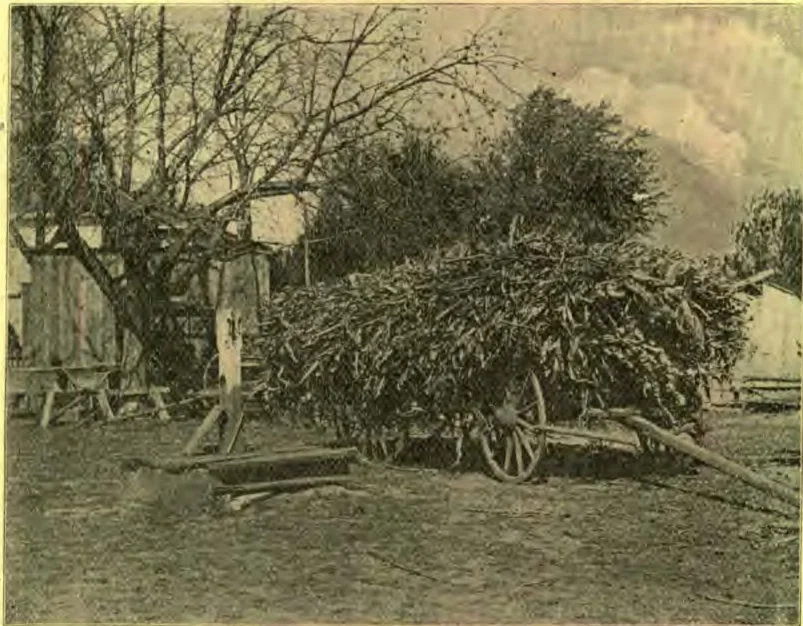
WAGON-LOAD OF CORN.
WAGON-LOAD OF CORN.
“By and by, as they pass a field of corn, Samuel sees a squirrel running across the street, with both cheeks distended with ‘plunder.’
“At home the ear of corn is made the subject of conversation. ‘What is an ear of corn for, mother?’ says little Mary, as soon as they are seated at the dinner-table.
“Mother.—‘An ear of corn, child? Why, don’t you know? It is to feed the fowls, and the pigs, and the cattle; and we make bread of it, too—’
“Mary.—‘Yes, we told all that, but the teacher says that is not all.’
“Mother.—‘The teacher?’
“Mary.—‘Yes, and he had an ear of corn at school, and asked us what it was for; and after we had told him everything we could think of, he said there was another thing still. But now I want to find that out, so I can tell him.’”
“The consequence of this would be that the family—father, mother, and older brothers and sisters—would resolve themselves into a committee of the whole on the ear of corn. The same, or something like this, would be true in other families in the district; and by the next morning, several children would have something further to communicate on the subject. The general exercise would this day be awaited with great interest, and the first signal would produce perfect silence.
“The teacher now takes the ear of corn from the desk, and displays it before the school; and quite a number of hands are instantly raised, their owners eager to be the first to tell what other use they have discovered for corn.
“‘The use I am thinking of,’ says the teacher, pleasantly, ‘you have all observed, I have no doubt; it is a very important use indeed; but as it is a little out of the common course, I shall not be surprised if you can not give it. However, you may try.’”
“‘It is good to boil!’ says little Susan, almost springing from the floor as she speaks.
“‘And it is for squirrels to eat,’ says little Samuel. ‘I saw one carry away a whole mouthful yesterday from the corn-field.’
“Others mention still other uses, which they have observed. They mention other animals that feed upon corn, and other modes of cooking it. The older pupils begin to be interested, and they add to the number of uses named. Perhaps, however, none will name the one the teacher has in his mind. He should cordially welcome the answer if perchance it is given; if none should give it, he may do as he thinks best about giving it himself on this occasion. Perhaps, if there is time, he may do so, after the following manner: ‘I have told you that the answer I am seeking is a simple one; it is something you have all observed, and you may be a little disappointed when I tell you. The use I have been thinking of for the ear of corn is this: it is to plant. It is for seed, to propagate that species of plant called corn.’ Here the children may look disappointed, as much as to say, We knew that before.
“The teacher continues: ‘And this is a very important use for the corn; for if for one year none should be planted, and all the ears that grew the year before should be consumed, we should have no more corn. This, then, is the great primary design of the corn; the other uses you have named are merely secondary. But I mean to make something more of my ear of corn. My next question is, Do other plants have seeds?’” L. A. REED.
Continue reading: PETER