The Youth’s Instructor, Vol. 64, No. 1.

The Teaching of Correct Pronunciation

The Youth’s Instructor

Jan 4, 1916

Review and Herald Publishing Assn. · Takoma Park Station, Washington, D. C. · Jan 4, 1916

The Teaching of Correct Pronunciation

CORRECT pronunciation should be a part of the everyday program in the teaching of English; but this teaching will be ineffectual unless taught by the drill method. It is of no use to look up words unless some method is employed whereby the pronunciation can be remembered. The pupil should be taught to associate words in such a way that the pronunciation can be remembered. To illustrate: Suppose that the word inquiry is before the class. The pupil will find on consulting the dictionary that the accent is on the qui, pronounced kwi, with the sound of I, the personal pronoun. By associating kwi with the pronoun I in the sentence, “I made inquiry,” the pupil can remember the pronunciation if made to repeat this sentence over and over again. Careless speakers are consoled by the thought that the multiplicity of authoritative variations in the pronunciation of the same word is sufficient excuse for their errors. While two recorded pronunciations are often found, sometimes even more, for the same word, our dictionaries show a remarkable sameness in their rulings as to what are preferred; and the cultured speaker endeavors to ascertain and to remember what these are. Many words of common use have but one pronunciation; such words as audacious, aunt, adipose, bouquet, bona fide, sheik, chastisement, combative, interesting, obligatory, diversion, excursion, exquisite, February, obesity. When shall we have the pleasure of hearing hygiene pronounced correctly, with three syllables instead of two, and hygienic; hysteria with e as in he, instead of hystēria; heinous (haynous) instead of heenous. Then there is that united family of “ines” with which we have more or less trouble; glycerine, bandoline, Benedictine, lanoline, butterine, vaseline—all pronounced as if the last syllable were in; then the family of museum, colosseum, lyceum, mausoleum, with the sound e as in he, and the accent on se, ce, le. If these families could be taught in groups, and if the words could be associated together in the student’s mind, and accompanied with the daily drill, we should soon banish all such mispronunciations as “glycereen,” “bandoleen,” “Benedicteen,” “buttereen,” “lanoleen,” “vaseleen.” Instead of going to the flavorist, the pupil would go to the florist, associating flo with go. He would speak of the vodeville (vōd-ville) instead of the vaudeville (vau-de-ville). As to the pronunciation of these words, all authorities agree; so there is no excuse for the mispronunciation of this class of words, used, as they are, so generally, in the everyday usage of the language—usage pronounced usage.—Correct English, How to Use It.

The Most Ancient State Paper

ON the walls of two of Egypt’s greatest temples, that of Karnak and the Ramesseum at Thebes, carved in the everlasting stone of the dry land of the Nile, is the oldest international treaty known to man. Rameses the Great, one of the signers, is the best-known man of remote antiquity. Khetasar (the czar of the Kheta, or Hittites), the other party to the treaty, is unknown, except to a few, and his nation is little known, even to the scholars.
The Hittites were a mighty race, whose empire, equal in rank with the mighty empire of Egypt and Babylonia, once extended over four hundred thousand square miles of territory in Asia Minor and Syria. Three years ago, practically nothing was known of the life and civilization of these mysterious people. They are mentioned in the Bible, and in the Egyptian and Assyrian records, but until very recently their own story had never been read by modern man. Today, thanks to the excavations that were carried on at the capital city of Carchemish, much has been learned about this great group of tribes, and orderly evidence about them is now available for the first time in two thousand years.—The Christian Herald.

Postal Savings Deposits Rise and British Submarine Chasers

THE postal savings deposits during October increased $2,150,000 over the preceding month, giving, according to postal officials, a clear reflection of the great tide of prosperity and commercial activity that is sweeping over the country. Chicago stands third in amount of postal savings. Deposits now aggregate $71,000,000 in the country at large.
THE British have put into service, since the war began, what are known as “submarine chasers.” These are large motor boats with accommodations for two or three men, and carry a rapid-fire gun of three-inch caliber. A carbureting device affords the use of either gasoline or heavy coal oil for fuel. They cost $4,000. They are scattered methodically over areas infested with submarine craft.

Quotations on War and Its Folly

War

A FOREIGN war is preferable to one at home.— Petrarch.
But war’s a game, which, were the subjects wise, kings would not play at.— Cowper.
Every milder method is to be tried before a nation makes an appeal to arms.— Kent.
Good kings never make war but for the sake of peace.— Putnam.
Mad wars destroy in one year the works of many years of peace.— Franklin.
One war brings on another.— German.
Talk of the war, but do not go to it.— Spanish.
The hardest operation of war is to stop it.— Putnam.
In war, reputation is strength.— Ellenborough.
To die or conquer are the terms of war.— Homer.

Patient Trust in God's Providence

“WITH patient mind thy course of duty run; God nothing does, or suffers to be done, But thou wouldst do, if thou couldst see The end of all events as well as he.”

The Treasure Box

THE New Year is a treasure box, And it is filled with all that's free; Each day Old Time the lid unlocks, The treasures come to you and me.
There's father's love and mother's care, There's home, wherein are food and rest; And pleasures waiting everywhere, With tasks enough to give them zest.
There's school that helps your mind to grow, And books to read when school is done, And sunshine warm, and ice and snow, And every kind of outdoor fun.
The wind that helps you fly your kite, The lovely blue that lines the sky, The stars that sparkle in the night, Are nicer things than you can buy.
So count them up, and use them well, And watch for them with eager eyes; The time for some a child can tell, But others are a dear surprise.
The New Year holds these gifts all free. Each day Old Time the lid unlocks, The treasures come to you and me From out his wondrous treasure box.
— A. W. McCullough.

Joy for the New Year

As we step into a new year, let us carry with us the knowledge that joy belongs to us as truly as blossoms belong to flowers, and nuts to the trees in autumn. It is a part of the fruit of life when the days are taken at their best.
If the flowers do not bear blossoms and the trees do not yield nuts, we inquire into the causes. We say, “Something is wrong.” We dig about the roots, we spray the leaves, we use fertilizers, and we call in the neighbors to counsel over the matter. We are disturbed because the flower or the tree is not fulfilling the purpose of its existence.
It must likewise be so with life’s products. If joy fails to be evident in our daily bearing, this should be the occasion for serious inquiry. Paul, writing to the Philippians, said, “Rejoice in the Lord always.” Did it ever occur to you from what place Paul wrote those words? It was from a Roman prison. He was under the guard of a Roman soldier. Should we have felt like rejoicing under those circumstances? If we should not, why did Paul feel so? Was it not that life to him meant the higher, better, truer life that bears the fruit of joy?
Most people think that outward surroundings determine the degree of our joy, but such is not the case. Jesus taught that a man’s life consists not in the abundance of the things which he possesses. Riches and honor do not contribute to joy. It is evident that those who have the largest wealth and carry the greatest honors are not the most joyful persons. One of the world’s wealthiest men, when asked if his great possessions made him happy, said, “What! Me happy?—No!” Joy would be a cheap thing if money could buy it. Its possession is beyond the reach of gold. Joy is found growing like a luxuriant plant in the homes of the poor. It beams from countenances with overflowing expression beyond the terms of language. It is affected by neither poverty nor riches. The Holy Spirit is the joy breeder, and whoever entertains this divine guest will have joy, whether he be rich or poor, whether he be known around the world or unknown beyond a small circle of obscure friends.
The soul reaches for the joyful experiences of life, even as plants in the dark send out their pale, tender leaves toward the cracks in the wall through which comes the light. We have seen that often in the cellars of our homes. Has it no lesson? The plant belongs out of doors where the sun shines. And the soul belongs in the outdoors of freedom where all the attributes of God can grow in it. The light of the sun belongs to the plant. The joy of God belongs to the soul. As the plant is weak and pale without the sunlight, the soul is weak and inexpressive without the joy of God.
Joy belongs in the heart of the young as well as of the aged. It belongs to all, and if we do not begin to produce it when we are young, it will not be with us when we become old.
It is pathetic to see the abnormal Christian whose face does not yield readily to smiles, but looks as if he were already dead to things worth possessing. I sat in the street car yesterday and looked into the face of each in the long row that sat opposite me. Most of them were well dressed, and some were handsome, but there was hardly a face there that I should like to have. There were too many lines of care, of fear, of greed,—faces on which histories of shrewd, grasping power were written. It seemed as if the song of joy had never echoed through these souls. In that more than half an hour’s ride, I saw on no face scarcely one sweep of joy that told of the inexhaustible peace that overflows hearts when joy is the fruit of the days. I felt a protest rising within me against the grim care that had settled upon those faces. It did not belong there any more than barnacles belong on the sides of ships, or rust on the iron wheels of the railway. Anxiety is rust. Nothing will take it off but the oil of joy.
It is proper to scour our cooking utensils and polish the floors and furniture. But what about life? Some heroic scouring needs to be done, and done persistently, until joy in the countenance shall succeed grim care upon the face.
There is an excitement and exhilaration that is sometimes called joy. It feeds on entertainment. It is like the display of fireworks, which attracts great attention for a little while. It is crowded with laughter and hurrahs. But when the entertainment is over, the excitement dies out, and that indescribable ennui steals over the soul. There is more for us in the shining of stars than in the display of fireworks. The stars were eclipsed for a time; but when the display of the fireworks was over, the stars were still steadfastly shining. The fireworks are superficial. The stars are permanent. It is a fair comparison between worldly excitement and spiritual joy. There is in the former a kind of empty laughter and effervescence of spirit; while in the latter the laughter is tempered with love, and joy revels in riches which it has no fear of exhausting. Joy gives poise that develops symmetry and beauty of character.
There is a power in joy that makes the man who practices it worth more to his employer and to society than the man to whom it is an unknown quantity. It puts a new asset in a man’s life. He becomes at once more desirable as a companion and a citizen. Joy lightens loads and makes work easier. Joy cannot exist of itself. There must be a foundation as deep and as wide as Christ, upon which the soul rests with absolute safety. At the same time, there must be an expectation relative to attaining the highest ideals, which are visible to us only in the character of Christ. Here is at once a world in itself—new principles, new laws, new ideals. These foundations must necessarily have in them immortality, for the vision of joy sweeps both this world and the world to come.
If a man sets out to be joyful, he will never attain to it. If he sets out to know God as revealed in Christ, recognizing that knowledge of God is practicing his principles, then joy will come as blossoms crown the green stems of flowers. The petals of the blossom were in the green stem, unseen and unknown. By the law of nature they burst forth. It is so when the roots of our spirituality are in Christ. The spiritual law operates, and joy becomes the experience of the soul. This was the angel’s conception when he announced, “I bring you good tidings of great joy which shall be to all the people: for there is born to you this day in the city of David a Saviour, who is Christ the Lord.” The secret of joy lies in the fact of the personality of Christ. From him comes every good to us. We in turn bear it to others and become faint echoes of Christ.
Christianity presents to every soul vast and unused realms. And yet joy seems the most unused of all the fields of human life. Too many live along the shores of the experiences of others. They dare not plunge in for themselves, consequently they become indifferent, and Christianity is to them only a form. They worry, chafe against conditions, and sometimes lose faith. The wreck is a tragedy. It need not be so. We have to practice all things in which we desire proficiency. I hear now the touch of unskilled fingers upon the piano. Ten years of practice, and those fingers will indicate skill. With unskilled attempts we practice at the principles of joy, but in years to come joy will be as natural to us as music is to the musician. The price of attainment is personal commitment to Christ, “who for the joy that was set before him endured the cross.” Let us be joyful if ten thousand things oppose us. Let us put laughter in our voices and smiles upon our faces. Let us hold to joy as we do to honesty, industry, and integrity. Let us make it the companion of every other virtue. Then our lives will be filled with songs, and we shall help a weary world into the great fellowship of God.—Peter Ainslie, D. D., in Young People’s Weekly.

“I Come, I Come”

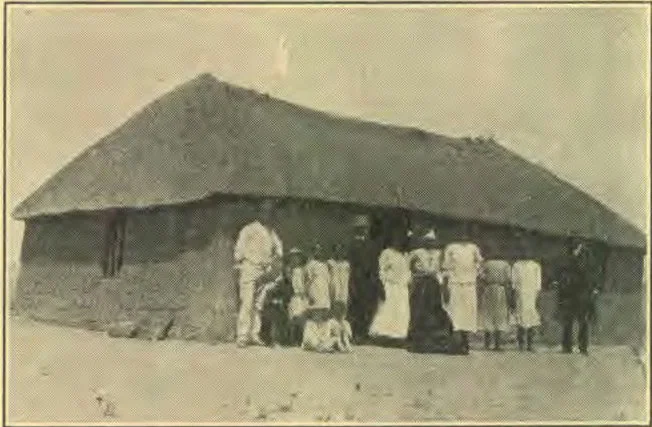
The accompanying picture shows a humble native Seventh-day Adventist church away over in Zululand, in South Africa. It is on the farm of F. R. Stockil, a European brother who loves the natives and is doing all he can to lead them to Christ. Indeed, while this farm is a private one, it is really a missionary farm; and among our people of South Africa there are many such, where our brethren and sisters are doing all they can to lead the natives to a higher life.
The last Sabbath in October, God met with a little company in this grass-thatched meetinghouse. Our meeting was at eleven o’clock, and at the hour appointed the people in the near-by kraals were notified by the striking of a broken plowshare upon a rock. Soon we could see the people leaving their houses and coming toward the church. In a short time about thirty-five had gathered outside the door waiting for the signal to enter. The plowshare struck the stone again, and quietly the people filed in for service, all the women and girls sitting on mats on the floor, while the men and boys occupied a long seat. How queer the women and girls looked in their bright-colored clothing, with turbans of different colors about their heads!
A NATIVE CHURCH IN ZULULAND, SOUTH AFRICA
Most of them were quite well-dressed, as they have been in touch with civilization for a number of years. But one heathen woman was there who has not yet seen her way to leave the old paths of her people for the higher and better life. She was scantily dressed, her clothing was not clean, and her hair was dressed after the fashion of the Zulu women who are married, being mixed with red clay, with a long projection behind the head.
Surely no company ever assembled in the house of God more quietly and orderly than this band of Zulus. The meeting was opened with singing and prayer in their tongue, after which I, through an interpreter, spoke from Matt. 11:28. All closely attended while I pointed them to the Saviour who gives rest of heart, and takes away all sin and gives victory to the life. God’s Spirit was present. It touched hearts and spoke to many in the room. Over in the corner sat two young women whom God had spoken to for years, but who had not yielded. They were thinking seriously, and questioning whether they would not better yield today. Other hearts were affected, too; and then the Spirit told me, “Now is the time to ask these souls to decide for Jesus, whom they have so long slighted.” I appealed to them to come to Christ and to delay no longer. I asked all who desired rest of heart and freedom from sin to come forward, and, kneeling, give their hearts to God. A moment of hesitation followed, then quickly the two young women in the corner made the decision, and coming forward, knelt and gave their hearts to him who loves them. God’s Spirit was at work. A young, well-dressed Zulu was affected, and after a few words of encouragement he knelt with the others and gave himself to the Saviour.
But behind me, in the corner, was Brother Stockil’s eleven-year-old daughter, with a girl friend of about the same age. These girls had never yielded their hearts to Christ, and in our anxiety for the natives, we almost forgot them. But Jesus was speaking to their hearts, saying, “Come,” and their response was, “I come, I come;” and they bowed at the altar with the natives who were seeking Christ. No class or race barrier was there. Together these young people, white and black, sought God. At such a time one sees only Jesus. Others with weeping came, while the Holy Spirit brooded over the scene. And then we prayed that God would impart his peace to them, forgive their sins, and keep them from the evil that is in the world. In the aftermeeting, each one bore a good testimony expressive of his desire to follow Jesus.
To our young people in other lands we say, God’s blessing was upon us in this humble little building as well as with you under more favorable surroundings. This is the work that is being done in these little African meetinghouses from Sabbath to Sabbath. May the Lord send many of you to assist us in carrying a saving knowledge of the truth to this people who have so long sat in darkness and in the shadow of death.
W. B. WHITE.

On the Danger of Impatience

Impatience is a quality sudden, eager, and insatiable, which grasps at all, and admits of no delay; scorning to wait God's leisure, and attend humbly and dutifully upon the issues of his wise and just providence.—South.

The Other Image and Superscription

TEMPTING Jesus, certain Pharisees and Herodians asked, “Is it lawful to give tribute to Cæsar, or not? Shall we give, or shall we not give?”
The Saviour’s clear answer not only astonished the men who heard it, but it has impressed many others since, giving, as do his words, clear light down through the centuries as to the duty Christians owe to civil governments, and where that duty to them ends.
Jesus said, “Why tempt ye me? bring me a penny, that I may see it. And they brought it. And he saith unto them, Whose is this image and superscription? And they said unto him, Cæsar’s. And Jesus answering said unto them, Render to Cæsar the things that are Cæsar’s, and to God the things that are God’s. And they marveled at him.” Mark 12: 14-17.
The reverse side of this statement we do not always think of. Cæsar’s image and superscription were stamped upon a coin piece of metal. Because of that, men honored this coin. A certain value was placed upon it. It passed at this given value anywhere within the king’s realm. What was levied by the king for tribute was to be paid him in his own coin. Render unto Cæsar that which is his.
But this is not all Jesus said. He added, “And to God the things that are God’s.” What did Jesus mean by this? In contradistinction to the coin, what belongs to God that we are to render to him? You may say, Our service, our loyalty, our worship. Very good. But with the thought of the king’s image on the coin and his superscription printed there, it would seem that the Saviour’s thought took in more in his expression, “Render . . . to God the things that are God’s.”
Might there not be another image, another impress, that he wanted his hearers to see and appreciate? By his very life work among men, another seal was being stamped, impressed, not upon cold metal, like gold or silver or brass, but the image of his own divine character and life was making its impress upon the warm, living hearts of men and women. Would this be recognized? Would men give back to God that which was his,— their hearts, their lives, themselves?
All belonged to God by creation. They were formed in God’s image. Now the Son of God was in their very midst to restore that image once more in the soul, so nearly blotted out by sin. Would they yield to his divine imprint? How small, how trivial a matter it was to the Lord of glory, who created and owned all the gold and silver of earth, as to whether Cæsar required tribute of them, compared to whether or not they should be freed from the curse and thralldom of sin, released from their captivity to Satan! This was the main issue in the mind of Jesus. He knew that their souls must receive the divine impress from his life, be transformed into his image, or their shackles would forever hold them captives of Satan. “Render . . . to God the things that are God’s,” is his authoritative command.
And Jesus’ image and superscription were seen by that very generation. His lasting imprint was seen in the lives of those for whom and with whom he labored. The lives of the eleven underwent a marvelous change; so much so that after the Lord had left them and gone back to heaven, it was said of these very men, “Now when they saw the boldness of Peter and John, and perceived that they were unlearned and ignorant men [from their viewpoint of learning], they marveled; and they took knowledge of them, that they had been with Jesus.” The divine image of Jesus’ life was distinctly seen upon the hearts and in the lives of these men.
And it has been seen upon hearts from that time until now. Noble men and women have, because they were true to the new life impressed upon their souls by having been with Jesus, suffered death at the hands of powers whose rulers’ images and superscriptions were placed upon cold coins.
Those who yield to the Spirit and receive Jesus’ impress upon their hearts, are known in heaven. “And they shall be mine, saith the Lord of hosts, in that day when I make up my jewels.” While these blessed coins are being gathered out of all nations in that day, the gold and silver, with the different imprints of the Cæsars of the earth, are left to canker amid the rubbish of earth. “In that day a man shall cast his idols of silver, and his idols of gold . . . to the moles and to the bats; to go into the clefts of the rocks, and into the tops of the ragged rocks, for fear of the Lord, and for the glory of his majesty, when he ariseth to shake terribly the earth.” Isa. 2: 20, 21. But of those who have the divine impress of heaven, this same prophet writes, “The Lord shall arise upon thee, and his glory shall be seen upon thee.” Isa. 60: 2.
Which image and superscription shall we possess? We cannot have both. “Ye cannot serve God and mammon.” Let us not permit the worldly image and superscription, largely seen in the love of money, the display of wealth, to eclipse in our minds the divine image and superscription heaven desires to impress upon our hearts. T. E. BOWEN.

The Joy of a Benevolent Heart

How easy it is for one benevolent being to diffuse pleasure around him; and how truly is a kind heart a fountain of gladness, making everything in its vicinity to freshen into smiles.— W. Irving.

Good Resolutions and the Forgetful Mind

A MAN who is always forgetting his best intentions may be said to be a thoroughfare of good resolutions.—Mrs. Jameson.
Continue reading: Gleanings From Korea