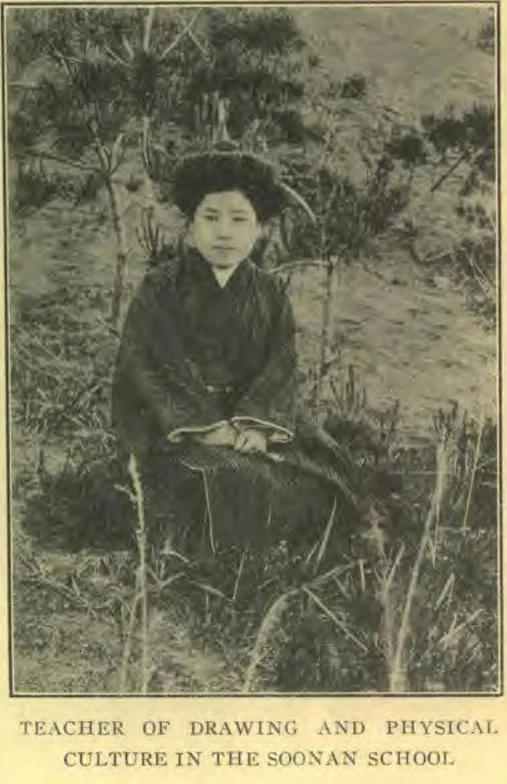
TEACHER OF DRAWING AND PHYSICAL
CULTURE IN THE SOONAN SCHOOL.
It is hard to know where to begin and where to stop in writing of our work in Japan and Korea. We say “our” work, but really it is His work, and it is only as he allows us to be laborers with him, sharing the sacrifice and the joy, that we can call it “ours.” The purpose of this article is not to present a connected history, or outline, of the work in Korea, but a few pictures that will help us to understand some of the conditions in the past, and the progress that has been made.
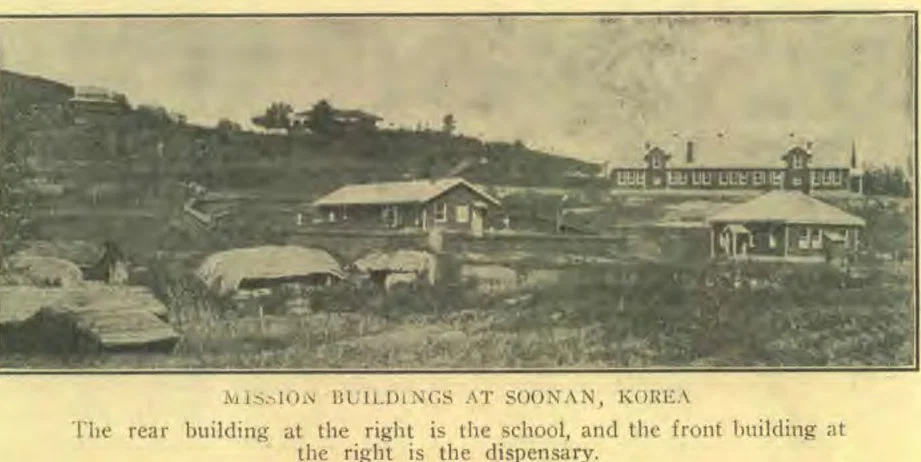
MISSION BUILDINGS AT SOONAN, KOREA
The rear building at the right is the school, and the front building at the right is the dispensary.
Work is carried on in Korea from four central stations,—Seoul, Soonan, Wonsan, and Keizan. The headquarters for the mission have been established at Seoul, the most important city in the country. Outside the East Gate, land has been purchased, and a printing office, foreign residences, and other necessary buildings have been erected. Soonan, in the north division, has the training school and the dispensary.
Korean Industrial School
The school work was begun in 1907 by Elder W. R. Smith and Miss Mimi Scharffenberg. A year or two later Miss Helen May Scott arrived, and took charge of the girls’ department. Brother Howard Lee took the supervision of the school in 1910. Besides the central school, a number of primary schools are conducted in near-by country places.
It is not customary to have boys and girls in the same school in the Eastern countries; but as the cost for equipment and teachers is so great, the two schools are housed in one building. In the west end of the schoolhouse is the boys’ school, and in the east end the girls’. A chapel separates the two.
Subjects Taught
Ten teachers comprise the teaching force. One of these is a Japanese, who gives the required instruction in the Japanese language. Two grades of work are carried—a primary course of four years, and a higher four-year course, which may be supplemented by a teachers’ training course and a ministerial course. The subjects taught are Bible, Japanese, arithmetic, algebra, geometry, Chinese literature, botany, zoology, physics, chemistry, general history, agriculture, silkworm culture, geography, drawing, singing, and physical culture. “Korean young people who have a mind to study seem to do this amount of work in the eight years given to do it,” says Brother Lee.
The first class to be graduated from this school, consisting of four boys and one girl, received their diplomas in March, 1913.
The New Buildings
In October, 1913, the new buildings in Soonan, made possible by the Thirteenth Sabbath Offering of the first quarter of 1913, were dedicated. Only those who had struggled along during the early days, under unfavorable conditions, in small, unsanitary, mud-walled buildings, can realize the happiness that filled the hearts of the faithful teachers when the new buildings were completed. The school chapel, which seats three hundred persons and is our largest assembly room in Korea, is already often too small for the Sabbath congregations. The girls’ dormitory has in one end a suite of rooms for Miss Scott, who is thus enabled to exercise a watchful care over her charges.
When the buildings were occupied, Miss Scott wrote: “I cannot tell you how much we appreciate the new buildings. At first it seemed strange to hold school in a real schoolhouse. Noises coming through brick walls, sounded so different from what they had coming through mud walls. To hear noises above was strange, too; for Korean houses have no second story. The rooms are light and have plenty of sunshine. We use the chapel for church services.”
The Dispensary at Soonan Hill
For more than four years after his arrival in Korea, in 1909, Dr. Riley Russell conducted dispensary work in a small Korean house, mud-walled and poorly lighted. A never-ending stream of suffering humanity passed through this room. More than twenty thousand patients, in every stage of filth, poverty, and suffering, came here for help, and none were turned away. The need for a better building and a more modern equipment was presented to the friends at home, and money was appropriated for this purpose. Writing at7the time of the dedication of the new school buildings and the dispensary, Pastor C. L. Butterfield, superintendent of the Korean Mission, said: “These buildings stand as memorials to the truth in this great heathen field, and they greatly improve the appearance of Soonan Hill.”
In answer to a letter from the homeland, written early in 1914, to ask Dr. Russell if he had any regrets in leaving the little mud hut, the following from Mrs. Russell was received, Dr. Russell being absent from home at the time:— “Your letter came last night, and you wondered if we could do as well with our new equipment, and if we seemed to feel a little homesick for the old ‘mud hut.’ Well, I am not homesick for it. To ease your mind, let me tell you we feel we can do very much better where we can clean up and care properly for the people. “While Dr. Russell was at Seoul attending medical meeting, I took my two babies down every day and looked after the patients. One day a Japanese officer came, bringing a young Korean student from the government school. This boy had met with an accident, and his face was cut so badly I had to put in five stitches. While doing it, several officers stood about and watched. I thought it queer they did not take him to their own Japanese doctor when they found my husband was away; but our fine white operating room, with its professional atmosphere, must have had its influence. The case has made a splendid recovery, and there will be no disfigurement.”
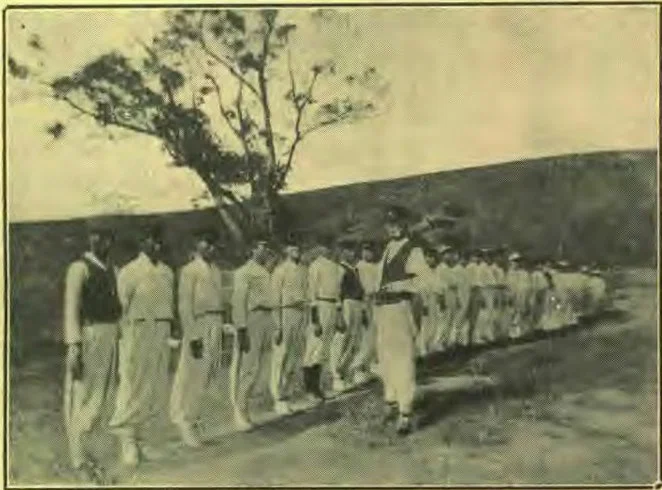
READY FOR THE PHYSICAL CULTURE CLASS, MISSION SCHOOL, SOONAN
The dispensary, complete and fenced, cost nine hundred dollars. The equipment cost six hundred dollars more. The war has seriously affected the work of the dispensary. Dr. Russell writes: “Supplies are getting so expensive that it is a question what to do. Several articles have increased in price three hundred per cent. Grain is so cheap that there is no money in the country districts, and it is hard for the people to pay their taxes. Some have pawned the deeds to their fields for money to pay their taxes.”
Dr. Russell is a firm believer in the work of the medical evangelist,—the man who will spend and be spent in the service of suffering humanity, that he may gain some for the gospel. “We treated over nine hundred patients at the dispensary during the year 1914,” he says, “and best of all, several became Christians.”
Native Workers
A number of efficient and faithful native workers have been developed since the mission was established. At the present time there are ten teachers, twenty-two canvassers, three Bible women, and twenty other workers, giving their full time to the work. Their devotion and earnestness are shown by the following incidents:— “I have just returned from Soonan, where I spent a week in the Bible class and district meeting held there,” writes Pastor C. L. Butterfield, in the Asiatic Division News Letter, for February, 1915. “At the close of each evening meeting an invitation was given to unbelievers to give their hearts to God. Our native Korean brethren did the preaching, and during the six nights that I was there, I gave the invitation. Altogether, over forty responded.” “In January,” says Dr. Russell, “fifteen church members gave two weeks each to preaching. As a result a number are reported as keeping the Sabbath. This was a great help to the men who made the effort, and also to the churches where the meetings were held.”
A Native Report
The following report from Evangelist Kim Na Chun has a sweet, familiar ring:— “With regard to the work here in Ham Heung, I wish to say that it has been my mind to visit every house, distribute literature, and preach the gospel to all who will hear. I began this work by visiting the houses nearest the church, and then those farther away. During one week I sold twenty tracts and gave away three hundred pages of literature, and had many interesting experiences. As a result of this work, one family and one brother have turned from heathenism to worship the true God. They are now keeping the Sabbath. Others are much interested. I praise God for all this. “Brother Pak Nong Hae is giving his full time to the sale of our magazine, Sei Chyensa eui Keuipyel, in this city and throughout this territory. Brother, pray much that the third angel’s message may quickly be preached in all this province. “This province is far north; and the snow and heavy winds make it hard to do much traveling at this time of year. Please pray much for this weak person.”
The Monthly News Letter
A few months ago, feeling that it would prove a bond of union among the native workers, a monthly news letter was started. Items from letters received and the monthly reports of the workers are used, with short, helpful paragraphs from Mrs. E. G. White’s writings. This little sheet is greatly appreciated.
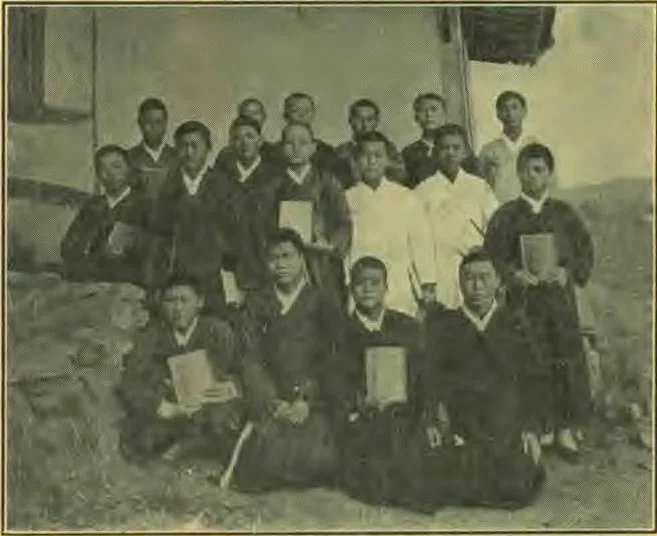
BOYS OF A CANVASSING CLASS AT THE MISSION SCHOOL, SOONAN
The Publishing Work
During 1913 more than 36,000 copies of our missionary magazine, Sei Chyensa eui Keuipyel, were placed in the homes of the people. In 1914 this number was largely increased, 57,185 copies having been8sent out from the office. Including tracts, there were more than 1,500,000 pages of literature distributed, in addition to Bibles. “Our sales,” says Pastor Butterfield, “amounted to $1,235.75 in this little country, where, only three years ago, it was said we could not sell literature, for the people were too poor to buy. The year 1914 was a banner year, magazine sales being sixty-three per cent more than during 1913.”
Sabbath School Work
The first Sabbath school in Korea was organized at Seoul in 1904. The first lessons were translated into the Korean language in 1909, only 250 copies being required at that time. The membership of the schools in Korea is now nearly twelve hundred, divided among forty-two schools. The Koreans are liberal and willing givers, according to their ability. During 1914, gifts to the amount of $390.09 were taken up. Memory Verse Cards and lessons for the children have been added recently, and are doing their part in interesting the little ones.
Helping Others
A glimpse at a missionary report for one quarter of 1915 will be suggestive of the work carried on. Miss Scharffenberg says:— “There are 17 missionary societies, and during the past quarter 289 persons reported work done. There were 70 letters written and 65 letters received; 1,780 missionary visits made and 768 Bible readings given; 33 subscriptions were taken for our magazine, 472 copies sold, and 209 copies mailed. There were 28,310 tracts given away, the poor were helped 118 times, and 93 lessons in reading were given to different persons. One hundred and eighty-nine persons registered for the home study course, and 88 sent in their written examinations.”
Is it not a privilege to have a little part in this great work? Some may go, but many must stay. Let us not forget that “prayer is the rail and boat that carries us in spirit wherever we wish to go. And what we do there, in purpose, in spirit, by prayer, is woven into actual fact and life.” A. B. E.
The Aborigines of Australia
By Bertha Shanks Chaney
The first European ships which touched at the shores of Australia, came in the sixteenth century. It is not known with any certainty who was the Columbus that discovered this wonderful continent of the southern seas. What is known is that Portuguese, Spanish, and Dutch ships were spreading their sails to catch the winds which would carry them to any land where they could establish their trade. Time after time these ships sighted the coast of Australia, some of them sending their boats to shore to reconnoiter for water or fresh food, but going away again quite ignorant of the fact that it was anything but an island which they had reached.
The records give us no glimpse of the natives until the daring Dutch sailor, Tasman, rounded the island far to the south, which now bears his name, but which he called Van Diemen’s Land. He and a small crew went ashore, and there discovered traces of living beings.
Over the hills curled a wreath of blue smoke; a conch shell sounded afar; in the trunks of the trees growing on the shore were notches cut five feet apart. From this last they concluded that the natives were giants, and they discreetly put back to their bluff-bowed boat without having seen any of the dark people whose later history was to be written in blood and cruelty.
More than fifty years after this, the English king sent out the “Roebuck,” with the explorer Dampier in charge, to learn what he could about the strange land of which there were so many vague rumors. For four months Dampier cruised along the barren western coast, making rambling visits ashore. His reports of the land were no more favorable than had been those of the Dutch navigators before him. The land was sandy and waterless, dreary and desolate, to the eye of an Englishman.
To the keen dark eyes of this buccaneer and scholar of two centuries ago, the aborigines presented anything but a pleasing picture. In the report which he wrote when he returned to England his description was:—“The inhabitants of this country are the most miserable people in the world. The Hodmadods of Monomatapa, though a nasty people, yet for wealth are gentlemen to these; and, setting aside their human shape, they differ but little from brutes. They are tall, straight-bodied, and thin, with small, long limbs. They have great heads, round foreheads, and great brows. Their eyelids are always half closed, to keep the flies out of their eyes, they being so troublesome here that no fanning will keep them from coming on one’s face; and without the assistance of both hands to keep them off, they will creep into one’s nostrils, and mouth, too, if the lips are not shut very close. So that, from their infancy, being thus annoyed with these insects, they do never open their eyes as other people do; and, therefore, they cannot see far, unless they hold up their heads as if they were looking at something over them. They have great bottle noses, pretty full lips, and wide mouths. The two fore-teeth of their upper jaws are wanting in all of them, men and women, old and young; whether they draw them out I know not. Neither have they any beards. They are long-visaged, and of a very unpleasing aspect, having no one graceful feature in their faces.”
The first unfavorable impression of the blacks of Australia has never been wholly effaced from the minds of Europeans. Nor have the flies improved on closer intimacy; at certain seasons of the year they are a plague in the land.
There are estimated to be about two hundred thousand natives on the continent, the most of them living outside the settled parts of the commonwealth. Tribes of them occupy the semidesert lands of central Australia, and these come only into occasional contact with the whites. In Queensland there are many camps of them, skirting the edges of the settlements, and living far back in the bush-clad hills.
In the east and southeast of the continent, they are fast dying out; but in other parts, where the whites are few, as in the far north of Queensland, in the Northern Territory, and, in the northwest, they still flourish in a more or less wild state. Year by year the white population pushes back from the coast and brings more land under cultivation for flocks and crops. This destroys the game and wild food upon which the blacks depend. And, as they mix with the settlers, they contract diseases which their uneugenically-born bodies cannot resist, and they fall into habits which, though perhaps harmless to white races, prove deadly to black ones.9They are, too, bringing about their own extinction by carelessness and ignorance in the rearing of their infants. It is not unusual for their little ones to be done away with, as they are a nuisance to the mothers already heavily burdened with the hard work, which all falls to them.
Whence came this people, so few in number compared to the vast continent they have overspread, and so low in civilization, is a question yet unanswered. Their traditions or legends throw little if any light on their ancestry, but it is pretty certain that they were not the original owners of the soil. Their predecessors were probably driven south across the wind-whipped Bass Strait, to the island of Tasmania, where they have become extinct within the memory of our own generation.
The present blacks may be descendants of more than one race, there being several theories on the subject, each of which is vigorously maintained.
In all probability the facts can never be fully determined , but there seems little objection to the theory that they came in canoes from the tropical islands to the north, having drifted or been storm-swept across Torres Strait. Having passed down Cape York Peninsula, they spread out at its bottom fanwise, along three main routes of travel. There is a natural highway across Australia, from northeast to southwest. Some took this route, first ascending the rivers on the northeast and then descending those on the southern watershed, while others crept down the eastern and western coasts, until all converged about Lake Eyre. The traveler who fares across the great table-land, say from St. Vincent Gulf to the Gulf of Carpentaria, finds himself continuously among tribes whose customs are similar. There is, too, a uniformity of dialect among tribes diverging north and south; whereas one traveling from Adelaide to Sydney, from west to east, will find very decided differences in dialects and tribal habits in the various tribes he meets.
Not unlike the Negro in appearance, the Australian black has a higher forehead, a less projecting under jaw, and a nose less flattened and extended than the African. The lips are thick, and the eyes large, black, and sunken.
The scientifically correct give the color of the skin as chocolate brown, but it may vary from a dusky copper to a brownish black, the newborn being singularly fair. The smearing of the body with fat and ocher or pipe clay gives the skin a darker shade, but the smear helps to resist heat and the irritation caused by the mosquitoes, fleas, sand flies, and other insect pests in which Australia is rich.
One summing up of type does not fit all natives, any more than one description would fit all Americans or all Germans. Big differences will be seen in one locality; more in different localities. The black fellow is often pictured as a wretched, emaciated creature whose bones may all be told. That picture may be true of those who live where food is always scarce, or of those who are suffering from shortage in a bad season.
In the fertile coastal districts are to be found the most favorable conditions for the physical development of the tribes, the advantages increasing on coming eastward from Spencer Gulf. The lakes at the mouth of the Murray River, and the extensive lands bordering on them, furnish an abundance of fish and game. And so on around the coast. In well-watered regions wallabies, kangaroos, and small game flourish, and from ponds and lagoons may be obtained edible plants. But in the central deserts, where the fierce heat and the frequent long droughts parch the scanty vegetation and dry up the water holes, life was a miserable existence to the savage.
A very general rule may be given, that the height of the blacks does not exceed five feet, six inches; and yet it is by no means unusual to find a six-footer, especially among the tribes who live in the rich tropical districts of north Queensland. The height and general physique are dependent upon climate, food supply, and it may be, upon descent.
Among native races generally, the young women have an erect and graceful figure, but the drudgery of food collecting and childbearing tells upon them at an early age, and they grow old and wrinkled very fast. A woman of fifty will have reached a stage of ugliness that baffles description.10
The custom of ornamenting the body of the men with scars adds ugliness where there is no original need. On the body, horizontal cuts are made. (A piece of flint was used for this purpose in pre-European days.) On the arms the incisions are longitudinal. These are filled with ashes, earth, or the down of the eagle hawk, to keep the wound apart and make the cicatrices stand out thick. Sometimes they are simply for ornament,—beauty marks,—and again they seem to be a tribal or totem mark.
Other horrible forms of mutilation have existed in the past; some are still practiced. Among some tribes of the Queensland coast, the young women amputate the first two joints of the right forefinger by tightly winding about it a thin skein of strong cobweb. The barbarous habit of knocking out one or more of the front teeth is practiced in many parts. The methods of accomplishing this and other terrible rites are beyond belief in the savage cruelty which accompanies them, and the absolute disregard of human feeling in the young boys and men, women and girls, who have to undergo them. These rites must be undergone during the initiation period into manhood. The details of their performance and of the treatment of the dead are revolting beyond any conception of civilized minds.
BERTHA SHANKS CHANEY.
(To be concluded)
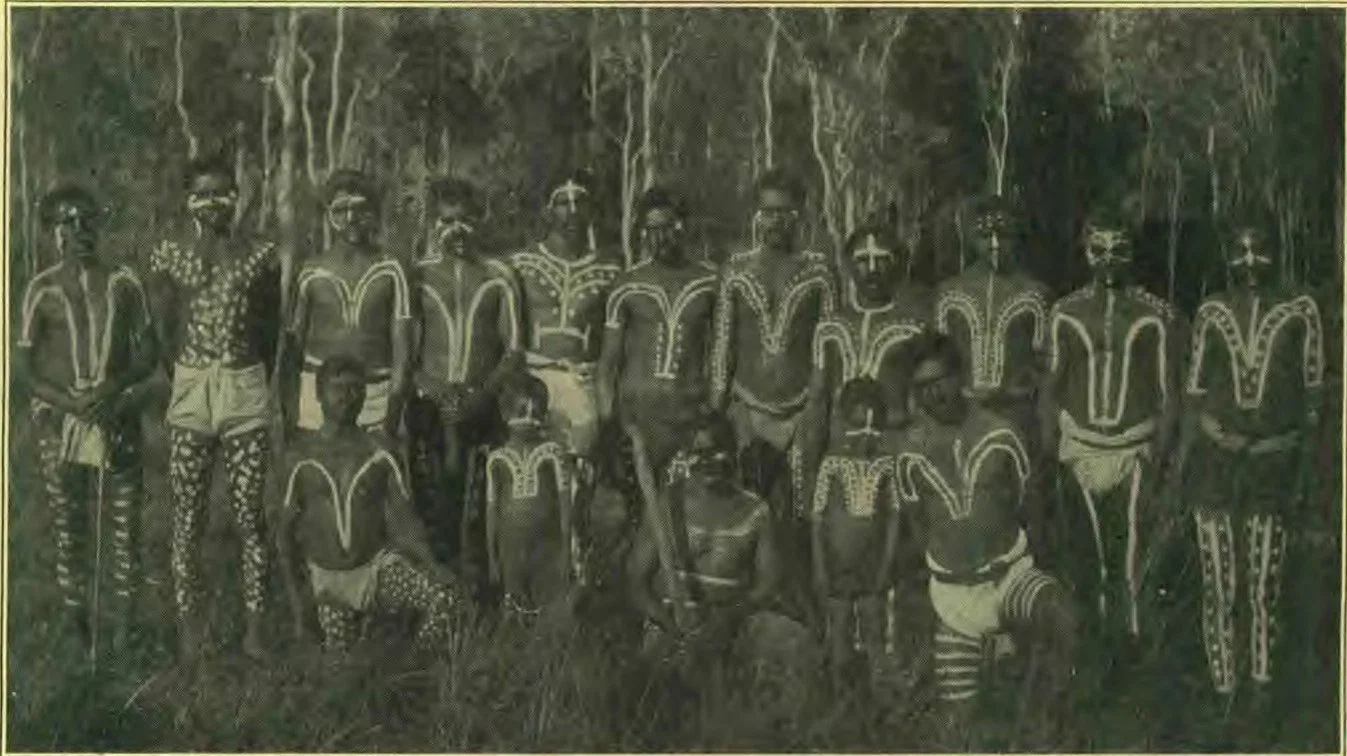
AUSTRALIAN BLACKS IN CORROBOREE, OR DANCE, DRESS
Things I Wish I Had Known Before I Was Twenty-One
RECENTLY three men spoke at a men’s meeting in Cleveland on the subject, “Things I Wish I Had Known Before I Was Twenty-One.” G. Leonard Fels, the first speaker, gave answers sent in to him by twenty-two men. These follow:—
What I was going to do for a living, what my life work would be.
That my health after thirty depended in a large degree on what I put into my stomach before I was twenty-one.
How to take care of money.
The commercial asset of being neatly and sensibly dressed.
That a man’s habits are very hard to change after he is twenty-one.
That a harvest depends upon the seeds sown; wheat produces wheat, thistles bring forth thistles, ragweeds spoil good pasture, and wild oats sown will surely produce all kinds of misery and unhappiness.
That things worth while require time, patience, and work.
That you can’t get something for nothing.
That the world would give me just about what I deserved.
That by the sweat of my brow would I earn my bread.
That a thorough education not only pays better wages than hard labor, but it brings the best of everything else; namely, more enjoyable work, better food, more of the wholesome luxuries and pleasures of life, better folks to live and deal with, and, best of all, the genuine satisfaction that you are somebody worthy of respect, confidence, and the priceless gift of friendship.
That honesty is the best policy, not only in dealing with my neighbors, but also in dealing with myself and with God.
The value of absolute truthfulness in everything.
The folly of not taking older people’s advice.
That everything my mother wanted me to do was right.
That “dad” wasn’t an old fogy after all. If I had done as he wished me to do, I should be much better off physically, mentally, and morally.
What it really meant to father and mother to rear their son.
What hardships and disappointments would be entailed by my leaving home against my parents’ wishes.
More of the helpful and inspiring parts of the Bible, particularly the four Gospels.
The greatness of the opportunity and joy of serving a fellow man.
That Jesus Christ was with me as an Elder Brother and Friend in every activity and relationship of life.
That God’s relationship to me was just as helpful and delightful as that of a good shepherd toward his sheep, or of a father toward his son.
A faithful friend is a strong defense. He that hath found a friend hath found a treasure. A poor man may be said to be rich in the midst of his poverty so long as he enjoys the interior sunshine of a devoted friend.
Friendship cheers like a sunbeam, charms like a good story, inspires like a brave leader, binds like a golden chain, guides like a heavenly star.—The Industrial Enterprise.
“A Little Child Shall Lead Them”
By Bertha Wright
LITTLE Ruth Slaughter is two years old. A few days ago her mamma asked the church librarian for some Harvest Ingathering papers. The librarian informed her that she had no more of them on hand, but that there were a few Temperance INSTRUCTORS which she might have to sell if she wished. So Mrs. Slaughter took the papers. In the evening she was talking with her husband about who might buy them, when baby Ruth spoke up and said, “I buy dampa book.”
The next morning when grandpa, who has always been accustomed to taking what he calls a social glass with his friends, came in to make his regular daily call on Ruthie, her mother told him about the papers, and what the baby had said. When he learned that her desire to buy him a book had sprung from her own mind, that no one had suggested it to her, tears came into his eyes, and he took one of the papers, offering to pay for it; but Mrs. Slaughter said, “No, Ruthie pays for this.”
He took it home, read it through, and then hid it, lest some one not appreciating its value as he did, might destroy it; for he looks upon it as a precious token of the child’s love.
Now when his friends suggest the social glass, he refuses, saying, “My little granddaughter shall never see her grandpa enter a saloon, or put a glass of liquor to his lips.”
Surely, “A little child shall lead them.”
BERTHA WRIGHT.
Temperance Notes
NATIONAL prohibition is a favorite topic of intercollegiate debate in the Eastern colleges this season. The Amherst-Williams-Wesleyan Triangular uses this question, “That the sale, manufacture, importation, and exportation of alcoholic beverages, except for scientific and medicinal purposes, should be prohibited by an amendment to the Constitution.” This is a stronger statement of national prohibition than that of the Hobson bill now before Congress. Williams follows the triangular in a dual debate with Union on the same question.
Student Opinion, a stirring new weekly at the University of California, is perhaps the first student publication launched for the distinctive purpose of raising the standards of student activities in a great university. It came into existence in response to a large student demand for a medium of expression on student “politics,” cleaner athletics, a more popular and democratic expression in the student governing body, and for leadership against drinking and the sort of influences that go with it, both inside and outside of college life. It is leading the movement at California against the serving of intoxicants at student affairs and after the big games.
“When you down Booze, that is personal liberty; when Booze downs you, that is slavery.”
Prof. Irving Fisher, the great economist of Yale, speaking of the conditions which enable an athlete to be at his best, says:—
“I have had occasion to examine the conflicting popular ideas concerning alcohol. I began the study quite willing to be convinced that alcoholic beverages have virtues. I have ended in the conviction that they have none, and I have found that this conclusion is almost universally reached by those who have examined the facts.”
Decided advance against the hoary-with-age social customs has been made at Yale this college year. The serving of liquor in fraternities, clubs, and other undergraduate organizations is in disrepute. Both faculty and alumni are taking advanced steps in the interest of temperance.
A Connecticut State law going into effect in November precipitated the issue of fraternity and club drinking. The law provides that social clubs of all kinds desiring to serve intoxicants shall take out a “Club Certificate,” or special form of license, at an annual fee of $100. The serving of liquors to members of clubs, fraternities, etc., without such license, is punishable by heavy fine or imprisonment. Some fraternities took voluntary action against further use of liquor at their houses; others were stimulated to that end by faculty rulings, the faculty not desiring that undergraduate societies should apply for licenses of this sort.
The Yale Alumni Weekly, commenting on the growth of sentiment both on and off the campus, says: “It looks therefore as if the coincidence of a State law binding upon the Yale organizations including minors in their membership, would reenforce the efforts of those who favor such prohibition on moral grounds. Such as it is, Yale’s drinking problem appears to be nearer solution than it has been for some time in the past.”
The Minnesota Daily, one of the greatest student publications of the West, came out vigorously in support of prohibition in the recent Minneapolis campaign.
Two Early Incidents
By C. A. Stebbens
THE writer's parents were well acquainted with the circumstances of the first organization of a temperance society by Joseph Bates, a retired sea captain. My father has told me often of an incident which happened at a meeting of that society in his father's old barn. A debate was held between the saloon men and the society. At one point in the debate the saloon man was making some extra demonstrations, pounding his fist on the improvised pulpit, and saying, “What shall we do with the corn?” and repeating it with such vehemence as to awaken a drunken man asleep, who immediately replied, “Feed it to the hogs, you old fool you.” This answer from one of his own make was somewhat disconcerting to the speaker.
A few years later, the question arose as to whether liquor was being sold in the Capitol building at Washington, D. C. My father went to Washington, and going to a certain room in the basement of the Capitol, he found what seemed to be a restaurant, and asked for some “cold tea.” He received a pint bottle of whisky, one of those old-fashioned, round-bottomed bottles which could not stand up of itself, a good representative of a drunkard. The whisky was destroyed, but the bottle was kept in the family for many years.
C. A. STEBBENS.
Ohio Students in Recent Campaign
THAT students of today are not limiting their interest in public affairs merely to the academic side, is shown by the activity of Ohio colleges in the State prohibition campaign which ended November 2. At least 650 students at eighteen of the largest universities and colleges took active part in that great civic “drive” of antiliquor sentiment. Sixteen of these colleges, reporting in detail, furnish the following specific data: Number of students engaged in prohibition work during the campaign, speaking, singing, canvassing, using stereopticons, serving without pay for their services, at least 650, of whom 52 were young women; speakers supplied to 243 meetings and singers to 172; number of teams sent out, of two, three, or four students each, 74; college men speakers at work, 175; singers, 189; women singers, 50; students engaged in canvassing of voters, at polls, etc., 388.
Sixteen colleges sent out an average of 33 students each into this laboratory of civic leadership. Their services counted greatly in the campaign. These colleges were: Adelbert (Western Reserve University), Ohio State, Oberlin, Ohio Wesleyan, Wooster, Denison, Otterbein, Ohio Northern, Defiance, Baldwin Wallace, Heidelberg, Ashland, Hiram, Miami, Mount Union, and Lane Theological.
Wooster made use of two stereopticons, which were out practically every night for three weeks. Oberlin made a high record by sending out 61 different students, with the aid of a professor as coach. In Cleveland Western Reserve men did excellent service at the polls on election day and in the previous street meetings. At Defiance the young women furnished most of the 35 students who aided local committees.
The management of this student campaign was under the experienced direction of the Intercollegiate Prohibition, its field secretaries, and the Ohio State president of the association. The work was done with the cooperation of the Anti-Saloon League and the local county and city federation committees.