We are admonished to keep the heart with all diligence, for out of it are the issues of life. And again we are told that as a man thinketh in his heart, so is he. Seeing that what we think upon has so much to do in forming our characters, how important that we feed our minds with the best mental food!
Literature of every description abounds in the world to-day. Some of it is vile, and much is light and trashy, and can not be food for the mind, any more than tobacco and liquor are food for the body.
Should we as Christians waste our time and weaken our minds in reading novels and stories of romance? Many of us have but little time to read. We can not read nearly all our own denominational works. Shall we spend the little time we do have in reading magazines and newspapers, and feeding our minds with the sensational accounts of murders, family troubles of noted people, etc.? This kind of reading usually takes away one's appetite for real, solid reading-matter. It cloys the mind as rich food cloys the appetite, and makes the beautiful story of redemption seem tame and uninteresting. The spirit of prophecy warns us on this point, as follows:—
“Works that do not decidedly mislead and corrupt are yet to be shunned, if they impart a disrelish for the Bible. This word is the true manna. Let all repress the desire for reading-matter that is not food for the mind. You can not possibly do the work of God with clear perception while the mind is occupied with this class of reading. Those who are in God's service should spend neither time nor money for light reading. What is the chaff to the wheat?”
In my own experience, I have learned the truth of these words. When I was a young girl, before I accepted present truth, I spent much time in novel reading. I had no taste for such literature as the Bible, history, and religious works. Very naturally, my ambitions were controlled by false ideas of life obtained from what I read, and I felt a dissatisfaction for the duties and obligations of real life. But when I chose to serve the Lord, I put away such reading-matter, and have learned to love the Word of God for the spiritual life and blessing in it.
Some of our own people have a very limited understanding of the truth. They do not search the Scriptures, but spend most of their time perusing the newspapers and popular magazines of the day. If we would discern the deep, spiritual truths of God's Word, we must search for them as for hidden treasure. Some read the Bible and other good literature as they are in the habit of reading novels, and then because they have merely skimmed over the surface and do not see the point, they come to the conclusion that the author is wrong. If they would only take time to read carefully and to consider the matter, they would find it to be precious truth and food for the soul. But because they have contracted mental dyspepsia through improper reading, and their minds can not properly digest the truth presented, they conclude that it is not truth, and go on in their ignorance. The Spirit of the Lord says to us:—
“Let the truth of God be the subject for contemplation and meditation. Read the Bible, and regard it as the voice of God speaking directly to you. Then will you find inspiration and that wisdom which is divine.”
If we do not love to study God's Word, then we surely have not yet learned to love God with all our heart, might, mind, and strength. We need to cultivate a taste for the Scriptures. But how can we when our minds and time are already fully occupied with worldly literature? We can help ourselves very much by keeping our homes free from questionable literature. When we see it before us, we are tempted to pick it up and read it, and it is also a temptation to our children. Why not discard it entirely, and supply ourselves and our children with our good, wholesome literature, of which we have such an abundance?
In a talk at the last General Conference, Sister White said, “Put novel reading out of your lives. You have none too much time in which to gain an understanding of what saith the Scriptures.” How true this is! Most of us are burdened with many cares which distract the mind, and have but little time to read. Why use that precious time in hurriedly reading this, that, and everything? Why not make it our first business to seek the kingdom of God and his righteousness? When we have a little spare time, and have not yet that day read any of God's message to us, would it not be well to make that first, and read some words of admonition, warning, or comfort from the Lord? Just one verse, read thoughtfully and given a personal application, will do the soul more good than a long chapter read hurriedly and with the mind constantly wandering away to other things. We need all the spiritual food we can get. Through the spirit of prophecy the Lord has told us, “The religious experience is to a great degree determined by the character of the books you read in your leisure moments.” If we choose light reading-matter and neglect God's Word, it will be our eternal loss. So let us learn to feed on the Word of God that we may live and grow spiritually.
Society Islands.
Be True
By R. Hare
Be true, be ever true,
True to thyself and heaven;
Keep conscience clear as noonday sun;
Life’s every task of duty done,
And every wrong forgiven.
Be true, be always true;
True, since the hours that fly
Convey the records traced below,
Of thoughts and deeds and words we sow,
To register on high.
Be true, while time is thine;
The restless years that run,
Unfolding moments as they go,
Can know no pause or backward flow,
Till all of life is done.
Be true, for God is true;
He beckons thee to rest,
Where all is perfect, changeless, pure,
A heritage that must endure,
Where all the true are blest.
— R. Hare.
Franklin’s Maxims
The following maxims of success are attributed to Benjamin Franklin, the two hundredth anniversary of whose birth occurred January 17. They are no less valuable now as rules of life than in his day:—
“Eat not to dulness; drink not to elevation.
“Speak not but what may benefit others or yourself; avoid trifling conversation.
“Lose no time; be always employed in something useful; cut off all unnecessary actions.
“Use no hurtful deceit; think innocently and justly, and, if you speak, speak accordingly.
“Tolerate no uncleanliness in body, clothes, or habitation.
“Be not disturbed at trifles, or at accidents common or unavoidable.
“Drive thy business; let not thy business drive thee.
“Early to bed, early to rise, makes a man healthy, wealthy, and wise.
“He that hath a calling hath an office of profit and honor.
“One to-day is worth two to-morrows.
“Buy what thou hast no need of, and ere long thou shalt sell thy necessaries.
“Keep your eyes wide open before marriage, half shut afterward.
“They that won’t be counseled can’t be helped.
“A man may, if he knows not how to save as he gets, keep his nose all his life to the grindstone, and die not worth a groat at last.”
A Forward Move in Japan
By W. D. Burden
W. D. BURDEN
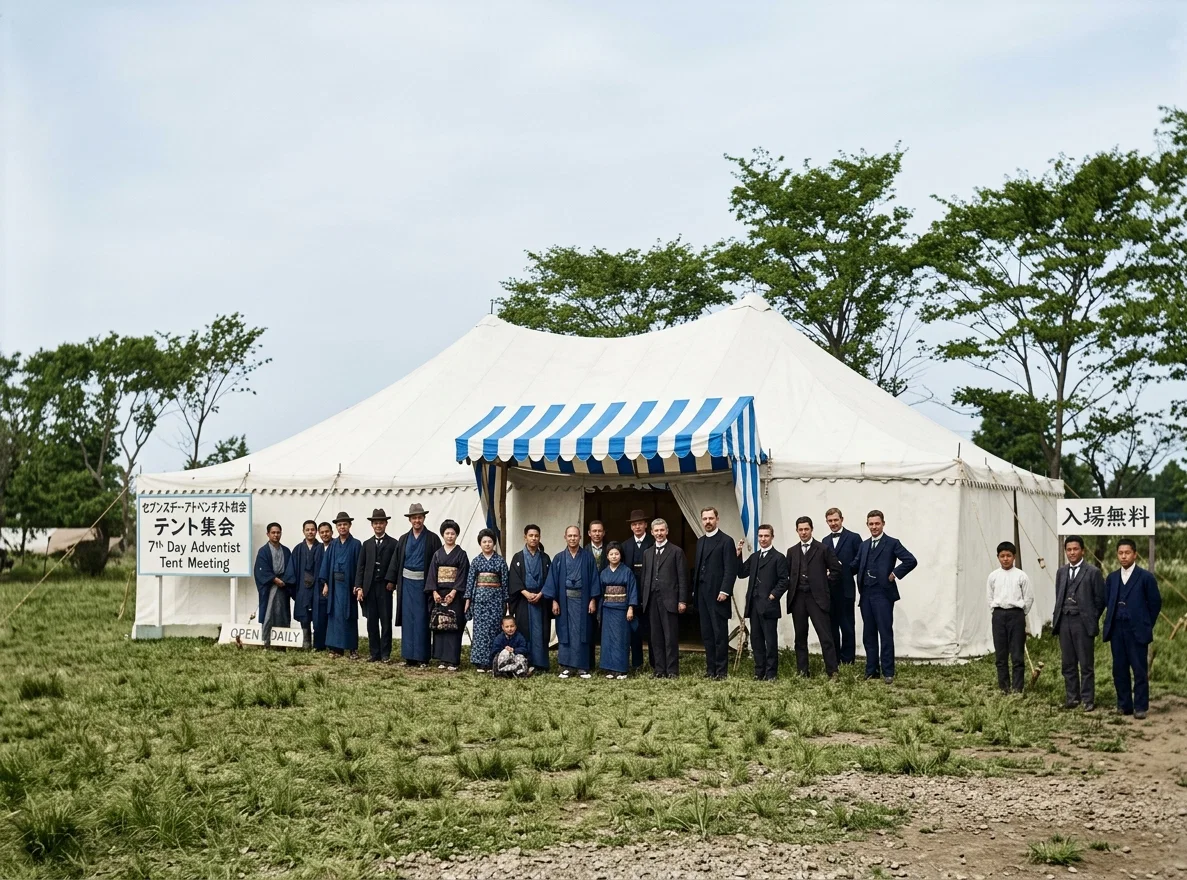
KNOWING the benefit that has resulted from tent-meetings in other countries, we have felt for a long time that they would be a real help in the work in Japan. The need of a tent for this field was presented at a missionary meeting of the students of Healdsburg College, over two years ago, with the result that a nice little tent, twenty-two by thirty-six feet, was made, and donated to the Japan mission field. Ever since the tent reached us, I have been anxious to see it pressed into service; but for various reasons, we were not able to get it set up until last fall.
OUR FIRST TENT IN JAPAN
The city authorities were at first unwilling to allow the holding of such a meeting, because there had been some antichristian demonstrations in the recent troubles in Tokyo; also, I doubt not that they were thinking of how some of our young men opposed the army service not long ago, and feared that our preaching might be along that line. Permission was at last granted, however, and we pitched our tent October 25, and continued the meetings twenty days. We had secured the use of some vacant lots, about half a mile from our house, and only a few steps from two of the Tokyo electric-car lines. The man in charge of the ground at first asked us twenty-five yen ($12.50) for twenty days' use of it. We thought that rather high, and explained that we were not going to use it for making money, as had those who used it before and paid rent at that rate.
Hearing our explanation, he said he would make it fifteen yen. Later, when he had heard more of our work, he said, ‘Well, I will not put a price on the land; you may pay what you wish.’ In settling, however, we paid him the fifteen yen, telling him we did not want to regulate another man's liberality, but if he wished to give anything, it would be thankfully received. He then paid us back ten yen, keeping only five. He said we were welcome to use the ground again whenever we wished.
These meetings were also made a kind of general meeting for our workers and members. Several were present from different parts of the field, and for their benefit we had two hours' special study every morning, while in the evenings we had preaching services for the public.
The city authorities delegated two police officers to be present at all our meetings, as a protection, and to take note of all that should be done. One of these men became deeply interested, and I hope he may sometime have the courage to step out on the side of truth. One day he was telling us how his fellow officers derided him, saying he must be becoming converted, for he acted so differently from what he did before the tent-meetings began. He confessed to us that he had been greatly benefited by what he had heard. The other officer was very cold and rigid, showing no particular interest, but he did confess that we were the first to hold a successful meeting in those parts, though it had often been attempted.
Our attendance was not large, there being usually about forty persons present, about half of whom were our own people.
The strangers who came paid good attention, and we secured the addresses of several interested ones. I think all who attended the meetings felt that they were a real success, and we are now planning to have the tent pitched in several places next season. Three locations have been chosen for this purpose, and between now and next spring workers will be placed in these fields, to prepare the way by scattering literature.
Last month I had the privilege, in company with Brother Kuniya, of visiting one of the camps of Russian prisoners. We went to distribute reading-matter, which had been sent to us for that purpose by the publishing house in Germany. There are about fifteen thousand prisoners in this one camp. We were much pleased to see the care they are receiving from their captors. They have very extensive grounds, comfortable lodgings, comparatively speaking, and many comforts and liberties. Surely Japan, in the care of her prisoners, has shown herself as capable as on the field of battle. The grounds were well kept. The men are classified, and given separate barracks, according to their nationality or peculiar religious beliefs. There were a number of chapels provided, so that the different sects might conduct their own religious services as they chose. We could only think how fortunate these poor fellows were in being taken prisoners, and thus escaping any further dangers and exposures on the battlefield. But of course it would be too much to expect that everything would be just right in a place of that kind. One of their greatest needs seemed to be something to read. It was pitiful to see how starved they were for reading-matter. When we began giving out the papers, they came running from every quarter; and as they thronged around us, begging to receive a copy, we at times had hard work to keep on our feet. What a splendid opportunity this would be for missionary work, if some one were here who could speak to the men in their own tongue. We found none to whom we could talk much, but we were glad to have a little reading-matter which they could understand. In the two days we distributed about eight thousand leaflets, papers, tracts, and pamphlets, and we pray that God will bless the seed sown.
The Lord is blessing the work in Japan, and from time to time we see fruit. To-day we were privileged to witness the baptism of one sister and two brethren, by Elder Field. We are thankful for the few whom we see coming out, but O we need so much the power of God's Spirit poured out upon this work! Remember us in your prayers, that God will give success.
Tokyo.
British Laws Prevent Widow Burning
But for British laws, widows in India would to-day be burned alive on the funeral pyres of their husbands, as was formerly done.
A Word From Cuba
By E. W. SNYDER
E. W. SNYDER
LEAVING New York by the Ward Line steamer “Morro Castle,” we reached Havana, the capital of Cuba, after a sail of three days and a half. Here we received a hearty welcome from Brother I. E. Moore. This brother and his wife are the pioneer missionaries of this field, having come here in May, 1904, to engage in the work of nursing. Having had experience as a pioneer in Argentina, we appreciated meeting with some one who could make us acquainted with our new field. One feature of Havana, however, especially impresses the stranger,—the frequency of English signs, everywhere giving evidence of American influence in the island. In fact, little inconvenience will be experienced without a knowledge of Spanish in most parts of Cuba, and judging from the number of Cubans who speak English, and from the fact that many wish to study it, this language will be more and more known throughout the country.
A COUNTRY HOUSE
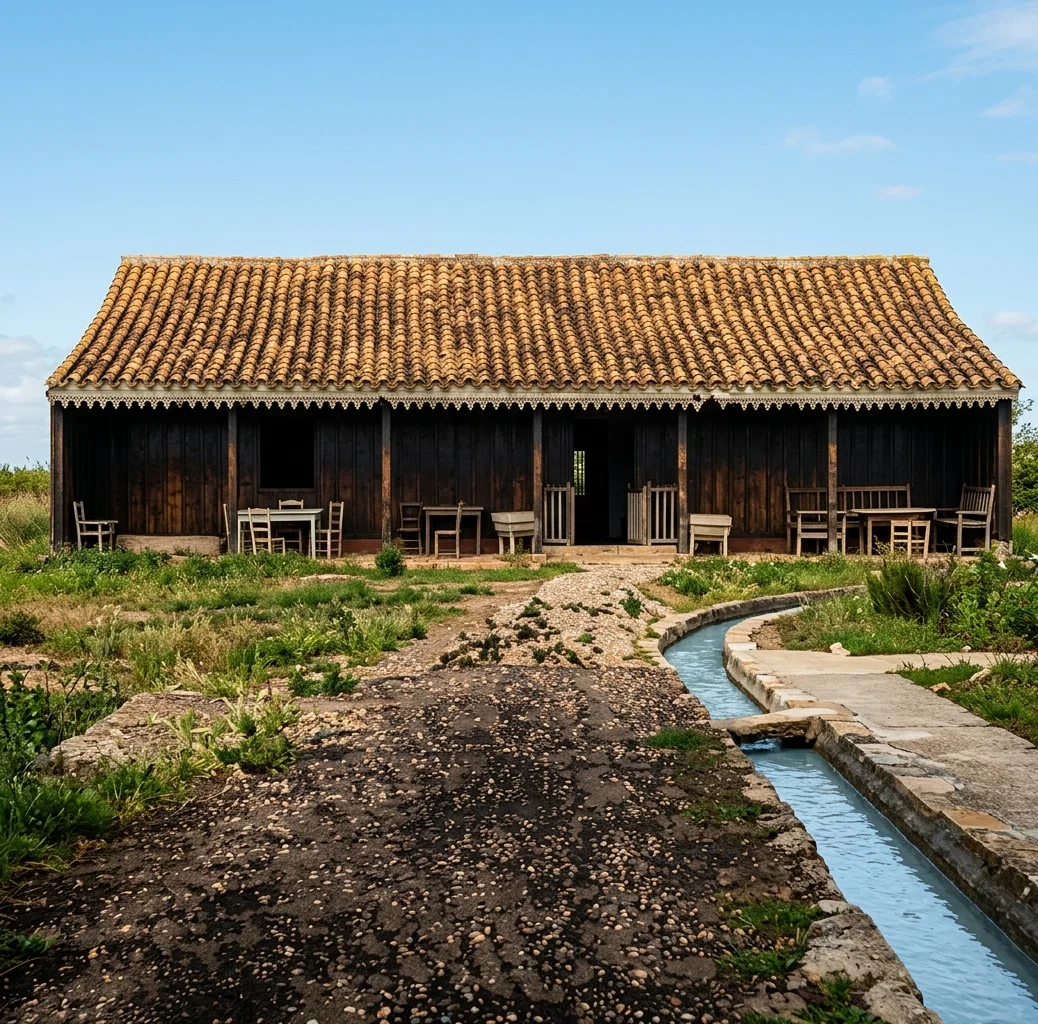
To one accustomed to the cities and country scenes of Brazil and Paraguay, Cuba has very little that is new or interesting. One finds the same narrow streets studded with one-story buildings of the same architecture and roofed with round tile, in all these countries.
Notwithstanding American influence here, it is to be regretted that the “manana” methods still prevail in the business of the Cubans. We are told that owing to insufficient facilities at the custom-house for importation, it is nearly impossible to secure a consignment of freight within two weeks after its arrival here. While the volume of business is increasing by leaps and bounds, the same facilities remain that they had thirty years ago.
After spending a few days in becoming acquainted with Havana, we went to Bahia Honda, a place on the north coast, about sixty miles west of Havana. This is reached by boat once a week, and by several stages or guaguas. By the latter way, owing to poor connections, it required more than twenty-four hours to reach our destination. It was a privilege to meet with the families of our people in that vicinity, and the Lord blessed in the services held. Soon after our return to Havana we left to visit the scattered Sabbath-keepers in the eastern part of the island. At Ceballos and La Gloria the meetings were much appreciated, and the hearts of the believers encouraged.
It was a privilege to become personally acquainted with our brethren in Cuba, who, as pioneers to hold up the truth, have gone out into the regions beyond. Our visit among them tended to enlist their help morally and financially in the upbuilding of the work in this needy field. From our observations as well as from the experiences of others, we believe that there are many of our brethren in the overcrowded churches of the United States who, by coming to Cuba, could not only improve their temporal condition, but what is of far more importance, they could thus hold up the light of present truth in new communities which are now being settled with American people. Doubtless many afflicted with asthma, catarrh, bronchitis, and other maladies could be benefited by coming to this country, as these diseases seem to yield readily in this climate.
American colonization is being carried on to a considerable degree by large syndicates that buy up thousands of acres in a single tract at from three to five dollars an acre. After cutting the land up in small farms of from fifteen to thirty acres, the land is sold at twenty dollars and upward an acre, according to location. In the western end the lands for the greater part are old plantations of sugar-cane, which, owing to their proximity to Havana, sell for fifty dollars and upward, but more fertile virgin soil in the eastern provinces, covered with timber, can be purchased for fifteen or twenty dollars an acre. However, judging from the rapidity with which the best lands are being bought up, in a few years it will not be nearly so favorable for one to locate himself to advantage, as the timbered land is limited in extent.
This fact is impressed on one as he rides over the Cuba Central Railway. For hours he may see only barren grass land with nothing green but scrub palms. Very suddenly, however, the scene gives place to a tract of fertile wooden land, and here are seen signs of progress and activity, of which a saw-mill and homes of settlers are the center. A good proportion of the Cubans, even in the towns, live in palm shacks, and it is not15uncommon to find well-to-do Americans also living in a house of this description. I am informed that a comfortable one can be built for one hundred and fifty dollars. However, the greater part of the people from the United States build much on the same plan that prevails at home, at a cost of four hundred dollars and upward, according to material and size.
As so many colonies are in operation, they naturally come more or less into competition, and each one is seeking for advantages that will serve to advertise. We have received offers from several, giving inducements for an industrial school to be established by our people, one man offering to deed to the school forty acres of his best land, with the option of purchasing more at a low rate. Our school and sanitarium work is so well known in the United States that Americans in Cuba are anxious to secure these advantages for their respective localities.
In conclusion, we would say that we shall be glad to give any information or advice concerning this country that is in our power to give. There are numerous unscrupulous real estate men and sharks in all parts of the island, and our desire is to protect our brethren from these.
We would say, however, that what the cause of present truth needs here is a class who have a burden for souls, and though all can not go into the field to do aggressive work, yet by their influence and financial support, all can assist the work that is now struggling to gain a foothold in this needy field. We would enlist the prayers of all in behalf of the work here.
Apartado 35 Marinao, Cuba.
Widowhood in India
By Mrs. G. A. Burgess
MRS. G. A. BURGESS
“The dark places of the earth are full of the habitations of cruelty.” Nowhere is the truthfulness of these words more manifest than in the condition and treatment of widows in India. The very word “widow,” which in Christian lands awakens the tenderest feelings of compassion in the hearts of men, in India is a synonym of sorrow, grief, shame, contempt, and degradation.
Widowhood is regarded as a punishment for sins committed by the woman in a former existence. Hence she is regarded as under the displeasure of the gods, and must spend the remainder of her life in hard and bitter penances, trying, if possible, to atone for her unknown sin. No sadder sight can be witnessed than to go into one of these Indian homes and see there, shrinking back from observation, a young woman with shaven head, her face wan and pinched with repeated fastings, her form clad in coarse garments, speaking volumes as to her attempts to make atonement for a widowhood for which she was never to blame.
When the husband dies, the beautiful, glossy hair of the wife must be shorn, as a sign of her disgrace; her bright-colored cloths are removed, and a coarse widow’s garment is put on; her ornaments are taken from her; she must eat but one meal a day, and twice each month she must fast. She must never appear with others on the occasion of a marriage festivity or family gathering, as her presence would be regarded as inauspicious, and must shrink guiltily back if she crosses the track of any one, for fear of bringing ill luck to him. She must never think of remarriage, but is often made the family drudge, and is an object of suspicion and solicitude, lest she bring disgrace upon the family.
There is nothing in such a life to uplift them; there is much to debase them. Their only hope of escape is death, or, what is worse, a life of sin—an alternative which hundreds of widows choose every year in order to escape the sorrows of their widowhood.
The number of widows in India is about twenty-three million, which is more than one fourth of the population of the entire United States. The custom of child marriage, which is so prevalent in India, is responsible for this vast number, many of whom are girls, and never knew what it meant to be a wife.
In God’s Word the most tender provision is made for the widow. His instructions are, “Ye shall not afflict any widow, or fatherless child;” and again, “Leave thy fatherless children, I will preserve them alive; and let thy widows trust in me.” What comfort these words have been in times of bereavement to thousands of hearts in Christian lands; and in the light of these tender promises, this loving care, how awful the treatment of Hindu widows appears, and how strongly their sad condition should appeal to every Christian believer.
Calcutta.
Ohio
By D. E. Lindsey
CLEVELAND.—Our meetings during the week of prayer were deeply spiritual, and we had a good attendance. While our donation for 1905 was fifty dollars, for 1906 it was one hundred and twenty dollars, and in addition to that, when I read Brother Anderson's letter from Africa, a good sister said she would give a half year's support for another native worker, and in a few moments one hundred and twenty-five dollars was raised for the African work. Our Friday evening prayer-meetings have so grown in interest during the year that we can hardly close the service, and that, too, sometimes after a two hours' meeting.
I praise the Lord for the hearty co-operation of the members in every good work. We have a noble company of young people here who maintain regular young people's meetings and are doing a good work. We have a large live Sabbath-school. More than a score of good souls have been added to the church during the year, and we have been enabled to pay about eighteen hundred dollars on our church debt. We have had the efficient help of Sister Anna Rice as a Bible worker, and now Brother Moffatt has joined us in the strength and vigor of young manhood. We are encouraged to labor on by the repeated Testimonies which vividly picture the great need of our large cities. The church is not only growing in numbers, but in unity; and we have reconsecrated ourselves to the work, and are pressing on to higher ground.
D. E. LINDSEY.
South Carolina
By R. T. Nash
CAMPOBELLO.— A good substantial work is being done at this place. A church of nine members has been organized here, and a church-school started. We have only seven students, but a teacher is employed, and is doing excellent work. The members of the Campobello church evidently believe in doing what they can to save their own children, and also in educating them for the Lord's work. They have no building for church and school purposes, so hold both in a private house. They,16however, desire to build a small chapel to be used for both purposes, and to this end have secured a suitable lot on which to build, and now have about five thousand feet of lumber on the ground. This little church has been lifting cheerfully and hard, but still lack one hundred dollars of having enough to build.
May the Lord direct some to come to this needy field and help us. The mission-school teacher that we called for some time ago, has come, and is doing good work in a school near Spartanburg, for which we are thankful. We have great reasons for thankfulness as we see God working for us. We feel to hasten our steps to carry the message to those not acquainted with it.
R. T. NASH.
The Gospel Spreads Through a Village
IN the Reformed Presbyterian mission at Takhing, Kwang-tung, China, the way the leaven works has been actually visible to the eye. A little village two days' distant is occupied by one family—an old woman of ninety being at the head, and her descendants to the fourth generation living about her. A man of the third generation went away to work, and was converted. When he came back, he was punished. But he stood firm, told his friends what the Lord had done for him, and prayed for them steadily. Then one of the fourth generation went away, and was converted. There were now two to testify and to pray. Next, two more of the third generation were converted, and there were four to pray. Last fall two more of the third and one of the fourth generation were converted. These then invited the missionaries to visit the village. Out of the forty persons living there, only one was still an idolater, and she was the aged mother of all. In April of this year some of the ladies of the mission succeeded in coaxing the old woman to learn the Lord's prayer, and while the volume of intercession grows, there is reason to hope that she, too, will yield her proud will.
Central America
By I. G. Knight
PANAMA.— We have heard now from nearly all the field, relative to the week of prayer, and cheering reports come in. Some for the first time enjoyed this season. It has done more than anything else to fill our brethren and sisters with missionary zeal. We are glad to send a draft of $68.75 for our annual offering.
I expect to start a tabernacle effort next week on the Canal Zone; but I feel the need of help, as my wife has had to leave the field, for a time at least, to regain her health. I rejoice to learn of the missionary spirit coming in among us so generally; for that is what is required to finish the work in this generation. So let us buckle on the armor, and push the battle to the gate.
I. G. KNIGHT.
West Indies
By D. E. WELLMAN
St. THOMAS.—We are working as hard as our strength will allow, in order to get our church finished and return south, where we can be in closer touch with all departments of our conference work. This is a very inconvenient point for communication with the southern portions of the field, and it is very expensive in the way of postage, it being from five to eight cents for one-half ounce, according to distance. We hope to finish the building the latter part of December.
I am holding three public meetings in the parade grounds each week, besides the Sabbath services. These public meetings are well attended, and are creating an excellent influence in the city among many thinking people.
D. E. WELLMAN.
The Work in Southern Jamaica
By Hubert Fletcher
A BRIEF account of the past year's experience in this field may be of interest to those who are laboring under like circumstances. In the month of January we arrived in this place (the parish of St. Elizabeth). For several weeks we searched in vain for a place to pitch our tent. With these unfavorable experiences, the outlook was very discouraging. Finally on the ninth of March we succeeded in locating in the district of Top-Hill. We had a good hearing at this place, and favorable opportunities to present the message to the people. We expected that our labors would be crowned with a larger company of believers, but we were disappointed. Many believed and were very friendly, but only three stepped out in obedience to the Word, one of whom has since fallen asleep in Jesus. The other two are still firm and zealous for the truth.
On the twentieth of July we removed to the district of Morning-Side. Here also we had a large attendance; but when we looked for fruit, we found none. We next made an effort in the adjoining district, but with no success. This was very discouraging.
On the twentieth of November we pitched our tent in the district of Bull-Savannahs. Since we began holding meetings here, our tent has been always more than full. As the words of truth are presented, the people drink them all in. The Spirit of the Lord has been brooding over the minds of the people, and quite an interest has been manifested. The year of anxious toil is now to be rewarded. The leading and most influential men of the district are deeply interested, and some are taking their stand for the truth. At present there are eight who have decided to keep the commandments of God. Let us never be weary in well-doing, for in due season we shall reap if we faint not.
HUBERT FLETCHER.
Cheapside, Jamaica.
Wisconsin
By C. McREYNOLDS
Special spiritual revivals were received at many places in the State during the week of prayer. Practical results of the renewal of consecration are appearing. Several who had not been willing to enter the field as canvassers have decided to go at once where the Lord has been calling them.
Special revivals were had in Bethel, Milwaukee, Poy Sippi, Green Bay, and Fish Creek. At the latter place word received a week ago from Elder H. W. Reed, who was conducting the meetings there, told of eighteen being added to the church, and the work was still progressing with interest unabated. At La Farge six were received into the church, and three others accepted the Sabbath.
The tithe and offerings are increasing largely. Much hope and courage is coming into the hearts of the remnant who are not being blinded and shaken out.
The educational work is doing well. The enrolment in Bethel Academy at the beginning of the winter term in the academic department reached eighty-four, and in the intermediate twenty-seven. The power of God was clearly manifest in the school during the week of prayer. Almost every one who had not formerly become a Christian made a start for the kingdom.
Seventeen church-schools are in progress, and two or three others open this week, while some are arranging for schools to begin in the spring. Our teachers in many of these schools are doing excellent work, not only for the children, but also for the youth and older members of the church.
A missionary institute to begin in Chippewa Falls, January 16, will train twenty or more workers in the English as canvassers, and a few as Bible workers. A Scandinavian school for workers will be conducted by Elder L. H. Christian in Milwaukee, beginning the middle of January.
The work at the Madison Sanitarium is prospering. The medical staff and experienced nurses are true to the message and the principles which have been revealed to the Seventh-day Adventist denomination through the spirit of prophecy. A new class is being gathered, and the conference is planning work for those who were recently graduated from the nurses' training class. Elder J. B. Scott is again at his post as pastor and Bible teacher, and the Bible study of the doctrine of the third angel's message is a leading feature of the training course. The institution is owned and controlled by the Wisconsin Conference. Young people who can secure a place in the new class will find it a blessing. We need a few more. Address Madison Sanitarium, Madison, Wis., and receive a calendar. We are trying to make progress in all branches of the message.
C. McREYNOLDS.
North Michigan
By S. E. WIGHT
Since camp-meeting most of my time has been spent in visiting churches and working in cities where Bible workers are giving lessons. I am glad to report that the third angel's message is being received by people in this field. Within the last three months twenty-seven have been baptized.
In Munising, a small village in sight of the famous “Pictured Rocks,” of Lake Superior, Miss Isabella Campbell has scattered many thousand pages of literature and given many Bible readings. At the time I was there, she had visited every home in and about Munising except three, and these she expected to visit at her earliest opportunity.
Although she has met with great opposition, and the ministers have tried to hold their members, five have taken their stand for the truth. One of these lived at Mancelona at the time our first camp-meeting was held there, and attended a few of the meetings. At this time she was visited by a Bible worker, but refused to take the studies. Soon after the camp-meeting she moved to Munising, and, remembering the visit of the Bible worker in Mancelona, decided that if another opportunity presented itself, she would accept such help. She made inquiry in this place for Seventh-day Adventists, and finding Sister Campbell, invited her to give readings at her house. This illustrates what just a visit will do for individuals.
There are many nationalities in this conference. The Finnish people enlist my sympathy because we have done so little for them. Their publishing house is located in our territory at Laleva. There are twenty thousand of these people in Hancock and Calumet, and we have only one canvasser to give them the third angel's message.
During my visit in the copper country, in company with a canvasser I called to see a Finnish doctor who has been somewhat interested in the truth. After some conversation about our work, he asked me why we made medical work and health foods essential to salvation. I told him that we did not, but he said, “You do, and I believe you should teach salvation through Christ, and not in such things.” I tried to disabuse his mind of this, but could not until I learned that he had the “Battle Creek Idea.”
After I assured him that we do believe in salvation through Christ, and that the medical missionary work of Seventh-day Adventists is the good Samaritan work, he told me that he had read “Great Controversy,” and that it was filled with the real, genuine gospel that he had not seen in the denomination, viewing it as set forth by some of our professed leaders.
He seemed much pleased to know that Seventh-day Adventists, as a people, believed in the gospel as set forth in the Bible and as taught by the author of the “Great Controversy.” People not of our faith are watching us to see the genuine gospel wrought out in our lives.