Report of the General Meeting at Guadalajara, Mexico
By MIGUEL S. PLACENCIA
[Abridged from the report of the secretary.—Ed.]
This interesting and profitable meeting was held Nov. 3-12, 1905, in the sanitarium, which kindly gave us the use of its parlor and one other room on the second floor. The first meeting was held Friday evening, November 3, and consisted of a short Bible study and a prayer and praise service. Sabbath four services were held, all of which were well attended and characterized by an excellent spirit.
Sunday morning the business sessions began. From the report of the superintendent we note the following items: During the first nine months of 1905 the workers held 86 meetings, gave 177 Bible readings, made 323 visits, gave away 25,299 pages of reading-matter, and sold literature to the amount of 222.04 Mexican pesos, which are worth about fifty cents in United States money. During the greater part of the time covered by this report, there were only three or four persons employed by the mission. The tithe for the first three quarters of the year was $2,330.48, which is a little more than the total amount received during the year 1904. El Mensajero de la Verdad cost $683.27, and there had been received $522.18, of which about $130 was donations, and the rest proceeds of sales and subscriptions.
The treasurer’s report showed that the finances of the mission were in a good condition, and that less had been drawn from the treasury of the Mission Board than in the previous year, and that more money had been raised in the field. Reports were rendered by the various workers.
Throughout the meeting five services were held daily, two of which were devoted to the hearing of reports and the discussion of plans, and three to Bible studies and devotional exercises. All the meetings were in Spanish except one, the meeting at 3 P. M., which was always in English.
One sister was baptized and united with the Guadalajara church. The ordinances were celebrated the last Sabbath of the meeting, and the Lord came very near by his Spirit. One person who had not taken part in the ordinances for several years united in the service to the great joy of all.
There were present at the general meeting about thirty persons, and as some came from Mexico City, and others from Monterey and San Luis Potosi, it was the most representative meeting ever held in the field. In addition to the money raised for the literature fund, $112 was given to the Southern fund, and $373.19 tithe was paid into the treasury.
The meeting was a source of encouragement to all who had the privilege of attending, for the reports presented showed that real progress had been made in reaching the Mexican people with the third angel’s message. Six workers under the employ of the mission went out from the meeting with new courage and zeal to push the work, and those who are not thus17employed as paid workers give us their assurance of hearty support financially and in every other way.
MIGUEL S. PLACENCIA,
Secretary.
Africa
By W. S. HYATT
THE KAFFIR AND SOMABULA MISSION.— The work in Kafir land has not advanced as rapidly as we had hoped it would. Chief Kama promised us that by last March or April he would give us a mission site, but circumstances have been such that he has not done so. Recently we visited him again, and he promised to help us in a short time. Early in 1906, we shall take up the matter in earnest, and find a suitable location as soon as possible. Our Sabbath-schools have donated liberally toward this enterprise, and now we have some funds with which to begin work. If it is the Lord’s will for us to secure a location of Kama, we shall be thankful; but, not knowing what is for the best, we trust God either to open or to close the way before us, and we will go the way his providence indicates.
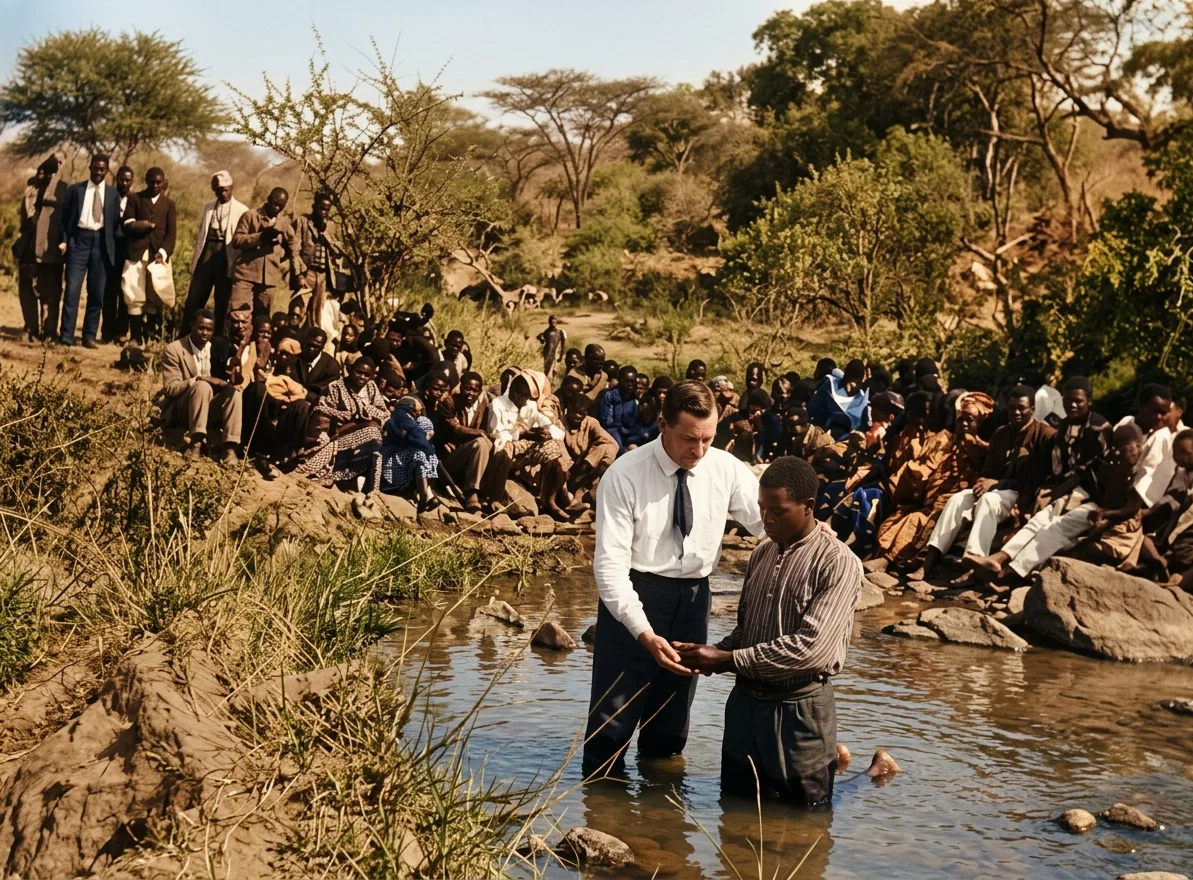
THE BAPTISM AT SOMABULA
The work at the Somabula Mission is onward. It has been but little more than four years since this mission was opened; and during this time nearly one hundred young people have learned to read their Bibles, and fully as many profess to have accepted Jesus as their Saviour. It is true that some of these do not have a very high idea of Christianity; but when we remember that only a short time ago they worshiped stones and snakes, we see a great change. In some villages many of the people refrain from work on the Sabbath, and thus little by little they are learning the ways of the Lord. This fills the hearts of the missionaries with courage and hope.
When we arrived at this mission, we found a class of eleven young people well instructed and accepted as candidates for baptism. Sabbath, November 11, was the day set for the service, and a good day it was for this mission. A large company of people came together, and among them were the eight young men whom we baptized over two years ago. It was encouraging to see all these young men still striving to serve the Lord. They have had their trials, and have made their mistakes, but all expressed a desire to be faithful to the Lord.
Fully two hundred attended the Sabbath-school, and were taught by eleven teachers. The offering was taken, which amounted to $5.30. One person who had no money came the next day with a little basket of grain as his offering. The natives take a real interest in helping to raise the necessary funds to start Sabbath-schools in other places. In the last six months this school has donated $21.04 toward the Kafir Mission, for which we are thankful. At the close of the Sabbath-school we went to the river and held our service
under the trees. Elder Armitage presented Christ as the Good Shepherd, and urged them to hear and follow him. I tried to hold up the Saviour as the Great Physician who only could heal them from their sins. Following these addresses, each of the candidates gave the reason of his hope, and exhorted the people to turn to the Lord. The wild bush rang as they sang, “Say, fathers, will you meet us?” It was a beautiful sight to see these young people hurried with their Lord in baptism. At the close of the Sabbath we celebrated the Lord’s supper, and the next day organized a little church of nineteen members.
Among those baptized was a young man who first came to the mission when it started. He had been away to work, but had searched and found a place where he could keep the Sabbath. Another came from Barotseland, and is a faithful, studious boy. He hopes to be a light among his people some day. Four others, who were baptized, are from Nyassaland. Two of these have traveled as far north as Lake Tanganyika, and know the country and the languages spoken. Some day they hope to join a missionary and return to labor among their people. We thank the Lord for these young men, and hope the way will soon open for some one to take them together, and open work in that far-away country. Their ability to speak the English and the native languages makes them of great value to the one who may go there to labor.
CHURCH DEDICATION AT THE SOLUSI MISSION.— We arrived at this mission, and remained over two Sabbaths. The Lord has blessed Brother and Sister Sturdevant in their labors at this place. They now have fifty-four boys and girls in the mission home, and many more are knocking for admittance, but our funds will not permit us to receive others at present. A real interest is being awakened among the natives in some sections by our native teachers as they labor among the people. At one place the natives are calling upon the teachers of other denominations to give them Bible proof for Sunday as the Sabbath. On another farm two of our teachers were expelled by the owner, because the natives would not work on the Sabbath. We find here the same conflict over the commandments of God as elsewhere.
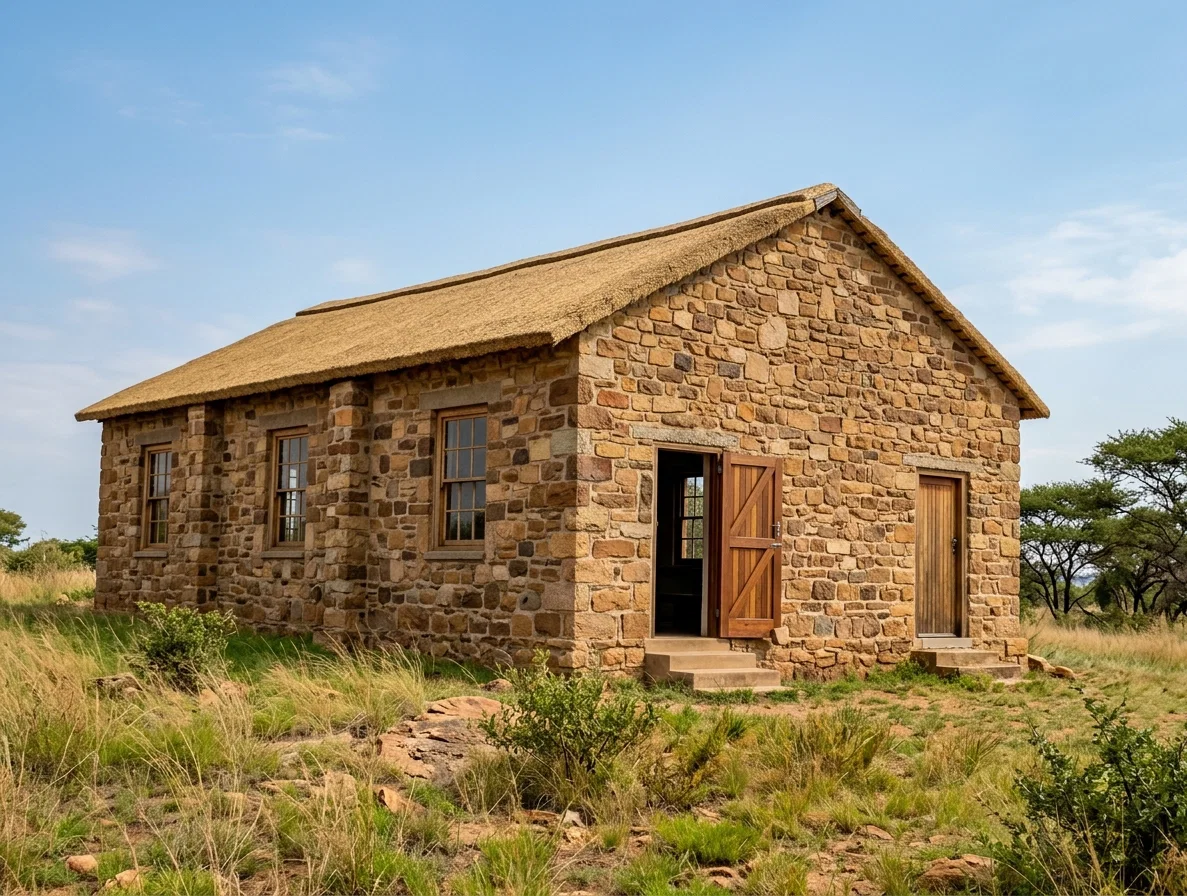
For several years the brethren at this mission have been planning to build a church. Last year, during the winter season, the bricks were made and burned; and this year the building has been erected. Having no money with which to employ a mason, the brethren decided to do their best to put up the church, although they had previously no experience in putting up a brick building. The Lord blessed their efforts, and now they have a neat, comfortable church twenty-six by forty-four feet. The young men assisted in the brick work, and did the plastering, which is a credit to the mission. The schoolgirls and native women spent many days in putting down a native floor. They take the black earth found in the ant-hills, then moisten and pound it down hard, and rub it till it shines. They did excellent work. The foundation of the house was laid in cement, and the roof was made of corrugated iron; hence there is but little danger from the white ants, which are so destructive to our buildings.
THE NEW CHURCH AT SOLUSI
The day set for the dedication was Sabbath, November 18. The people were invited, and a large number came, filling the building to overflowing. A Sabbath-school lesson from the twenty-sixth chapter of Matthew was taught them by fourteen teachers, and then followed the service of the day. Elder Sturdevant gave a short address presenting the love of God, and exhorted the people to believe and obey the gospel. The writer followed, calling their attention to the little temple we were about to give to the Lord for his service. We assured them that God accepted the gift, but he desired most of all that they would dedicate their18bodies to him that they might be temples of the Holy Spirit. The Spirit took these truths home to their hearts with convincing and convicting power. Tears flowed freely. The believers were called upon to renew their consecration, which they did, and then a large number of others gave themselves to the Lord. This was one of the best meetings with the natives I ever attended.
We then spent four days with Brother and Sister Sparrow at the Mkuqavula Mission, where they are doing self-supporting work. We believe that the Lord accepts their efforts to serve him. After a few more days at Solusi, we started for Cape Town. As we passed over this long stretch of country in which we have done nothing, it made us long to see the message going to this people who sit in darkness and the shadow of death. O, how long must they wait?
We spent three days with the church at Kimberley, and held three services with them. Two persons were baptized and united with the church. This was the first Seventh-day Adventist church in South Africa. Although some have fallen by the way, still the light shines out to the people, calling their attention to the truth of the soon-coming Saviour and the necessity of getting ready for that great day.
W. S. HYATT.
General Meetings in South and North Dakota
By R. A. Underwood
RECENTLY I spent some time in South Dakota, attending general meetings. At Beresford a church building was dedicated. A church of sixteen members was organized at Woonsocket, and a church building was dedicated. This is the place where the camp-meeting was held last season. These buildings were dedicated free from debt. A general meeting was held at Bristol. I also spent about one week at Artesian, with Brother C. M. Clark, where a new company of Sabbath-keepers had been raised up the past summer. Here a good church building is nearly finished, which will be dedicated in the spring, when a church will be organized. Elder C. A. Burman and other laborers of the South Dakota Conference were with me at all these meetings, and took an active part in them. These were seasons of rich blessing and much encouragement to all in attendance. I spent the week of prayer with the church at Minneapolis, Minn. This was a precious season.
The annual meeting of the delegates of the North Dakota Conference was held in our academy at Harvey, December 27-31. The school suspended its regular work during this time, and teachers, students, and delegates enjoyed the meetings of the conference together. Many said that this was the best conference they had ever attended. It was a season of refreshing. The business was done with dispatch, and much time was given to Bible study. Brethren J. C. Kunkel and J. S. James and the writer were the only laborers present from outside the conference. The Bible studies and the business of the conference were nearly all translated from the English into the German language. Elder J. G. Walker was unanimously re-elected president of the conference.
As a result of faithful labor on the part of ministers, and the Bible studies on the tithing subject in the Sabbath-school lessons, the past season the tithe of the conference had largely increased. The conference treasurer reported having received $10,884.72 in tithe during the past year. This was an increase of $5.13 a member over the amount paid the previous year, making $14.63 per capita for the last year. The conference voted to donate one thousand dollars of its surplus tithe to the General Conference for the work in foreign fields. It was also voted to donate fourteen dollars a week for the support of a German laborer in the city of Philadelphia. This was gladly done by the delegates.
At the closing meeting Brethren E. H. Huntley and Christian Sulzle were set apart to the work of the gospel ministry by ordination. All felt that the conference was a success, and that it was a real blessing to the school.
At the close of the conference, in company with Elder Lars Neilson I visited the Scandinavian church at Kenmare. Although our stay was not long, the meeting was greatly appreciated by this dear people, who felt to renew their covenant with God, and to move forward to the kingdom.
In company with Elders Walker and Neilson and others I attended a general meeting with the Germans at New Home. This church has a membership of about eighty. Our meetings began Friday evening and continued three days. Considerable time was spent in institute work, such topics as the Sabbath-school, Health and Temperance, and Missionary Work receiving special attention. This church has a large number of children and youth. They have a church-school with forty-one students in attendance. The brethren felt much encouraged, and regarded the meetings as a great blessing to all.
R. A. UNDERWOOD.
The Ministry of Healing
By J. S. WASHBURN
THE tenderness and sweetness of this medical missionary book are truly refreshing. There is nothing technical, nothing professional, about it. It is so practical, so fragrant with the spirit of the great Medical Missionary, that it throws a new light over the whole medical missionary movement in Christ’s time, which is to be repeated in our own day in the lives of his representatives and messengers. Love, hope, blessing, shine out from every page. Healing for the troubled, despondent soul, for the weary, harassed nerves, for the body, weak and lame and full of pain, is here.
How blessed it is to live in a time when God speaks by his Spirit to his people! The simple, sweet old story of the love of Jesus and his power to save to the uttermost is here. I thank God for this book. It is so appropriately illustrated that it is easy to show at a glance what it is to those who need it; and who in this sin-sick world does not need it?
It seems to me that this book would sell more easily than any other that has ever been published, and this is saying much, for through the spirit of prophecy the Lord has surely placed in our hands a wonderful literature.
An elderly gentleman, a deacon and leader in the Methodist Church, came to our tent-meetings with his wife, who had lost her sight several years ago. Both husband and wife believed in God and his power to heal, and were praying, and still are, that the tender Saviour will touch the eyes that are blind, and restore again the gift of sight. ‘Ministry of Healing’ was loaned to this friend, who read it to his wife. He said, “It is the best book I ever read. I read it to my wife, and we both wept over it. Tell me where I can purchase one for myself, and I will go and buy it at once. I must have one of my own.”
There are many others, I am certain, who will not need to be urged to purchase this refreshing presentation of the life of the blessed Healer, of the true Medical Missionary, who spoke not in technical language mysteries which he held in his grasp high above the heads of the common people, but who came near to men in sin and in pain, and brought them refreshing, healing, and life.
What a mighty work can be done with this book, and our medical institutions receive the benefit financially and spiritually. What a mighty power will our own people become when each one realizes in his own life the working of the Spirit that inspired this book, and is a living representative of Christ, who by his Spirit lives with us still, healing, comforting, and saving, now and eternally. J. S. WASHBURN.
Canvassing in Arizona and New Mexico
By Walter Harper
I CAN SAY, to the praise of the Lord, that marvelous success has been granted me. I began a long canvass about the last of August. I went East in September and returned in October, losing about one month’s work. I stopped canvassing about two weeks ago. In ten or eleven weeks the Lord gave me over one thousand orders for books, helps, etc., or about three thousand dollars’ worth, besides about five hundred small19books, or from three hundred to five hundred dollars’ worth,—a total of fifteen hundred or more orders, or from thirty-three hundred to thirty-five hundred dollars’ worth.
Among these orders were many for that grand book, a veritable treasure vault of truth, “Patriarchs and Prophets.” This is one of the three books which the spirit of prophecy has specially stated should be placed in the hands of the people at this time. In this work things are revealed that mortal man never had opened up to him before. How valuable and important is this instruction! I was granted divine aid also in selling many copies of that precious dedicated volume, “Christ’s Object Lessons.” I pray that God may bless the seed sown, and in that great day of final awards there may be seen a multitude of sheaves for Christ.
WALTER HARPER.
A Week's Work in Jamaica
By J. B. Beckner
THE evenings of August 8 and 9 found us with the tent at Crosse, where Brethren Hall and Durrant were just creating an interest in the message. We were glad to meet with the Bird's Hill company during the day of the ninth.
The next day we held quarterly meeting at Waterlane. If this little company stands faithful, others will yet be added to their number.
The two days following were spent with the Portland company. Five of our sisters from this company were fined 9s. 6d. each, for carrying stones on Sunday to the place where they were building a church. The judge threatened them with much severer fines if they are brought before him again for a similar offense.
Thursday and Friday we had some precious meetings with the Grove Town church. The Lord came very near in the ordinance meeting. The following Sabbath was profitably spent with the Font Hill brethren. A few of this company do not sense the time that is now upon us, and are reaching out after the world. Sunday and Monday the Lord blessed in the quarterly meeting at Trinity Ville. All were of good courage.
J. B. BECKNER.
Field Notes
At Leach, Tenn., four persons were baptized by Elder W. R. Burrow, December 31.
ELDER T. W. FIELD reports an addition of eight to the membership of the church at Madge, Tex.
A RECENT report from Lodi, Cal., stated that a new church building was ready for dedication at that place.
Six adults have been won to the way of commandment-keeping under the labors of Brethren Fillman and Bonde, near Hastings, O. T.
Mrs. A. C. HEATON reports that as a result of her work with The Family Bible Teacher and Bible readings, at Oklahoma City, “three are keeping the Sabbath, and others are interested.”
ELDER S. J. HERSUM reports from Maine: “The work in the State of Maine seems to be reviving. Eleven have recently begun to keep all the commandments. Five were baptized last Monday. Four united with the Portland church, and one will unite with the Falmouth church. Two of the brethren have recently entered the Bible work, and we expect to have two or three more at work in the near future. One brother has offered to take his team and circulate the reading-matter that the brethren will furnish him. He does this at his own expense.”
SINCE the dedication of the new church building at Washington, Pa., a course of meetings has been held there by Elder C. S. Longacre, of the result of which he says: “On Sabbath, December 23, we held a baptismal service in which five were buried in the watery grave and rose to walk in newness of life. On Sabbath, December 30, at the quarterly meeting these five were received into church fellowship, together with five others who were taken in on profession of faith. There are others who express a desire to join, and will be added to the list in the near future.”
The Boulder (Colo.) Sanitarium Training-School
By W. A. Spicer
The rare, clear air of Colorado is a tonic to the body. Not less a tonic, but to the soul, I found the earnest spiritual atmosphere about the Boulder Sanitarium. They have their trials, of course, but in the week I spent recently in Boulder, I found in the institution an earnest band of young people, committed to this third angel’s message, and desiring to serve this cause wherever their service will count most in building up the special work for this time.
FACULTY AND GRADUATING CLASS OF 1905, OF THE BOULDER SANITARIUM TRAINING-SCHOOL
The graduating exercises for the class of 1905 were held in the Boulder church. Elders F. M. Wilcox, J. L. Shaw, Watson Zeigler, and H. M. J. Richards, and myself were present as representatives of the ministerial work, to welcome the new nurses as new recruits in the missionary army, while Drs. Lindsay, Herr, and Knox represented the medical staff of the sanitarium that is sending these young workers forth into the field of service.
The graduating class was composed of twelve young men and women, sturdy and hearty, and consecrated to the work of the Lord. I believe some of them will be found in other lands one of these days, and several have in mind pioneer service on the home frontiers. The graduates were Brethren Egner, Herboltzheimer, and June, and Sisters Harriman, Herboltzheimer, McDonald, Daisy McPhee, Florence McPhee, Nesmith, Phillips, Reid, and Talbott.
In behalf of the Colorado Conference Elder Zeigler presented all graduate nurses and physicians of the sanitarium with missionary credentials, in recognition of the fact that medical and evangelistic workers are engaged in the one common cause of pressing the triumphs of the third angel’s message, which this denomination has been raised up to carry to the world.
It is plainly to be seen that the Lord has blessed the management of this institution as it has sought to come wholly into line with all the instruction that has come to us regarding denominational issues and enterprises. After all, the strength of every feature of our work is not in methods, as such, but in the power of the living God, which must vitalize and energize every facility or enterprise that operates for the building up of this advent movement.
I appreciated the privilege of associating with the workers in Boulder. Their eyes are upon the fields. The family has set out to raise several hundred dollars this year for the support of a worker in India. Best of all, however, was the settled purpose of this family of young people to give their own lives to this service that is to bring the coming of the Lord. The Boulder Sanitarium has an ideal location. It is just the right size for a training center, it seems to me. May God’s continued blessing make it and keep it all that it should be in these days when an army of workers must be trained and sent forward to meet the final crisis in the great controversy.
W. A. SPICER.
Aggressive Work in Minnesota
In a report of the year's work in Minnesota, Elder H. S. Shaw says: “During the past year aggressive work has been done at Senjen Detroit City, Two Harbors, Duluth, Stillwater, Minneapolis, Herman, Holmes City, Eden Valley, Kasota, and other places.”
That Proposed Anti-Polygamy Amendment to the Constitution
By K. C. Russell
INTERESTING information has come to us since the publication of the last issue of the REVIEW, regarding the proposed anti-polygamy Constitutional amendment.
It has developed that the campaign which has been carried on by the National Reformers to secure a religious clause incorporated into the proposed anti-polygamy amendment to the Constitution has been aimed at something which had no real existence.
The following is a statement of the matter by the chairman of the Judiciary Committee of the Senate in response to an inquiry concerning the question:—
“In reply I beg to inform you that no such resolution was brought before the committee, nor was the committee instructed to introduce at this session of Congress a form of amendment for polygamy. So far as my information goes, on Feb. 22, 1905, Mr. Dubois introduced in the Senate a resolution to instruct the Committee on Judiciary to prepare and report within thirty days after the beginning of this present session of Congress, a joint resolution providing for the prohibition and punishment of polygamous marriages. This resolution was never acted upon by the Senate, nor was anything done therewith, except on Feb. 28, 1905, a speech was made upon the resolution by Mr. Kearns, of Utah. This is the last indication I have that anything whatever was done with the resolution.”
It appears from this explanation that the introduction of this resolution in the fifty-eighth Congress was made for the first purpose of making a speech on the subject, but there was no motion to adopt, so the resolution was never acted upon.
We are glad to say that, notwithstanding the fact that the National Reformers were beating the air in their campaign, we were not opposing something that was imaginary, but a real thing; for these so-called reformers were attempting to mold sentiment both in and out of Congress in favor of the object which they have sought so many years.
We believe that the efforts which have been put forth by the Religious Liberty Department against the proposition of the National Reformers to secure a religious clause in the Constitution will be effective.
K. C. RUSSELL.
National Reform Literature and Significant Acknowledgments
By C. S. LONGACRE
In a new book just published, entitled “Sabbath Laws in the United States,” by R. C. Wylie, D. D., every Sunday law in every State of the Union is quoted, and is traced back to the colonies, from the colonies to the Act of Charles II of England, and from England the Sunday laws are traced through the divisions of the Roman empire, and from these divisions to the edict of Constantine issued in the year 321 A. D., which the “Reformers” acknowledge as “the first Sunday law.”
Besides this positive proof on their part that Sunday laws originated in the papacy and paganism in the fourth century on this side of Christ, they set forth some interesting facts concerning the exemption clauses in these statutes, which are designed to protect seventh-day observers, and which reveal the dragon voice toward those who refuse to worship the beast and receive his mark.
From the first page of this book I quote the introduction to the Sunday law of Charles II as follows: “At the time of the outbreak of the Revolutionary War the law known as the Twenty-ninth, Charles II, Chapter VII, enacted in 1676, was the Sabbath law in force in all the American colonies. In legal circles it is regarded as the immediate historical antecedent of all our present Sabbath legislation.”
The author then quotes the Sunday law of Charles II of England, and states: “This, with a few supplementary sections, is still the Sabbath law of England,” and “in a few of our States, Sabbath laws are still modeled after the Act of Charles II.”
“Legislation for the protection of the first day of the week as a day of rest may be traced back, through the history of the various nations into which the Roman empire was divided, to the edict of Constantine, issued in the year 321 A. D., which is often called the first ‘Sunday law.’ One very important point of difference is to be noted, however, between English and American legislation and legislation in Continental Europe. In the latter there is but seldom any reference to a divine warrant for Sabbath laws, while Sabbath laws in England, especially from the Reformation period, and in America from the planting of the first colonies, have been based upon the law of God. From this it follows that in our country no other day than the first day of the week is regarded as possessing a sacred character. We have a few holidays, but no other holy day than the Lord’s day. It follows likewise that the day thus recognized among us as holy and protected by law from desecration is a vastly different thing from a continental Sunday.”
What an acknowledgment this is on the part of the “Reformers” that they are upholding an institution that was born in paganism and cradled in the papacy. What an admission that the ancient Sunday laws after which our present Sunday “laws are still modeled,” lacked because they were not “based on the law of God” and made no “reference to a divine warrant.” Why be surprised at this difference when the original Sunday law was drafted by a pagan ruler for pagan subjects only to do homage to “the venerable day of the sun,” dedicated to the sun-god? They knew that there was no divine warrant for such legislation, and no amount of modern legislation will ever change a wolf into a sheep. The best they can do is to clothe the wolf in sheep’s clothing, but he is still a wolf.
The author in referring to the exemption clause of Maine and other States, which exempt from the law those who keep the seventh day, shows forth the true spirit of religious intolerance that is back of the National Reform Association.
The Maine exemption clause reads thus: “No person conscientiously believing that the seventh day of the week ought to be observed as the Sabbath, and actually refraining from secular business and labor on that day, is liable to said penalties for doing such business on the first day of the week, if he does not disturb other persons.”—Section 28. Now note the comment by the author: “The law of this State is deserving of high praise. The exception, however, in favor of those who observe Saturday goes too far in allowing them to do business as well as to labor on the Lord’s day” (Sunday).
Concerning the Sunday laws of Michigan and their exemption, he says: “With the exception of the liberty allowed to Saturday-keepers both to labor and to transact business on the Sabbath [Sunday], this law is of superior excellence.” Concerning the exemption granted by Connecticut, he says: “The law of this State is defective in permitting those who observe the seventh day of the week as the Sabbath to engage in both business and labor on the Lord’s day [Sunday]. In other respects it is an excellent statute.” Similar remarks are made concerning each exemption clause. We do not quote this to give an idea that we are in favor of exemption clauses any more than of the Sunday laws, but to show the real spirit that actuates the so-called “Reformers.”
This is shown still more clearly in the following remark: “In 1886 the Supreme Court of Arkansas, in Seales versus State, upheld the constitutionality of the law whether or not it excepts from its operation, either wholly or in part, those who keep another day. The court said: ‘The law which imposes the penalty operates upon all alike.’” Note the “Reformers’” approval of such a course: “There are few States whose Sabbath laws deserve more praise and less criticism than that of Arkansas.”21
This work contains, besides the Sunday laws of the States, colonies, and the nations of the Roman empire, more than three hundred judicial decisions in favor of or against Sunday laws. It “has been prepared under the direction of the National Reform Association,” and a large edition is to be issued by the association, and “sent to all editors for review, placed in all libraries, and put in the hands of State legislatures when measures affecting the Sabbath [Sunday] are pending before them.” It was also resolved to put the work “in the hands of the bench, the bar, and the ministry.” The organ of the Reformers calls the book “the most important work ever undertaken in the cause of the Sabbath by this association.”
From this we can clearly see that the thirteenth chapter of Revelation will soon have a complete fulfilment to the letter, and God’s commandment-keeping people will be put under the ban of merciless measures. May none imagine that the enemy is asleep. While we are sleeping, he sows the tares and sets his snares. May we awake to issues we shall be compelled to face in the near future.
C. S. LONGACRE.
The Petition Work in Ontario
By A. O. BURRILL
IN five days last week, a brother got three hundred signatures against the enactment of more strict Sunday laws in the Dominion. His experience is thus related:—
“I ask, as soon as the conversation will admit, ‘Do you want stricter Sunday laws enacted by the Dominion Parliament?’ The answer usually is ‘No.’ Then I say, ‘I am circulating a petition asking the Dominion Parliament to leave the Sunday law as it is, and I desire your signature.’ I nearly always secure it, too. Then I hand out a tract, and with a Good-by, say, ‘I will look for the next signature.’”
“Evangelists should be finding their way into all the places where the minds of men are agitated over the question of Sunday legislation.”—Mrs. E. G. White.
This is our time to scatter the literature. Our church-members should be scattering our religious liberty tracts, and others, too, everywhere. This is the time for the servants of God to be endowed with power from on high, and with their faces lighted up, and shining with holy consecration, to scatter the rays of light everywhere. He sends his angels with his children while engaged in this work.
A. O. BURRILL.