The Youth’s Instructor, Vol. XIII, No. 4

Gleanings from the Life of Luther

The Youth’s Instructor

January 24, 1905

Review and Herald Publishing Assn. · Washington, D. C. · January 24, 1905

Gleanings from the Life of Luther
“WHAT! shall one monk, scarce known beyond his cell, Front Rome’s far-reaching bolts and scorn her frown? Brave Luther answered, YES; that thunder’s swell Rocked Europe, and discharged the triple crown.”
As the fond mother rocked her little Martin, who first saw the light Nov. 10, 1483, little did she think that in a few short years he would rock the continent. Well is it, perhaps, that the mothers of the great of earth do not know the future of their children. It might awe them into unfitness to give the training that aids in no small degree in developing them for their illustrious future. Be that as it may, it is sure that the little Martin was dealt with in no uncertain tone. His was the typical German home in which the rod was not spared. But we will not linger to observe methods of training in this boyhood home, but will hasten on, and more carefully note the fruits of this home life in the illustrious years that followed.
At the age of fourteen years our little German was sent to Magdeburg, and later to Eisenach, to prepare for the university. While singing in the street for alms, he attracted the attention of a wealthy lady, who took him to her own home, and gave him an excellent teacher. In due time he entered the university at Erfurt, where he made marked progress until he took his degree.
His father intended him for the law; but Luther determined to devote himself to the church, and we find him at the age of twenty-two an Augustinian monk. He was a student through and through, continuing his studies in the monastery until called to a professorship in the new university at Wittenberg.
During his stay at the monastery, Luther, for the first time in his life, found a copy of the entire Bible. With delight he read and studied this book, and already the light of truth was ready to be kindled into flame.
After his entrance into the university, he was sent as a delegate to the papal court at Rome, where his eyes were opened to the condition of the church in her holiest sanctuaries. This journey to Rome was the notable event in his life. He went there a medieval Catholic. He came away a Protestant. Soon after this he took his second degree, that of Doctor of Divinity. The oath, promising to devote his whole life to study and to faithfully expounding and defending the Holy Scriptures, was surely ever after most scrupulously kept.
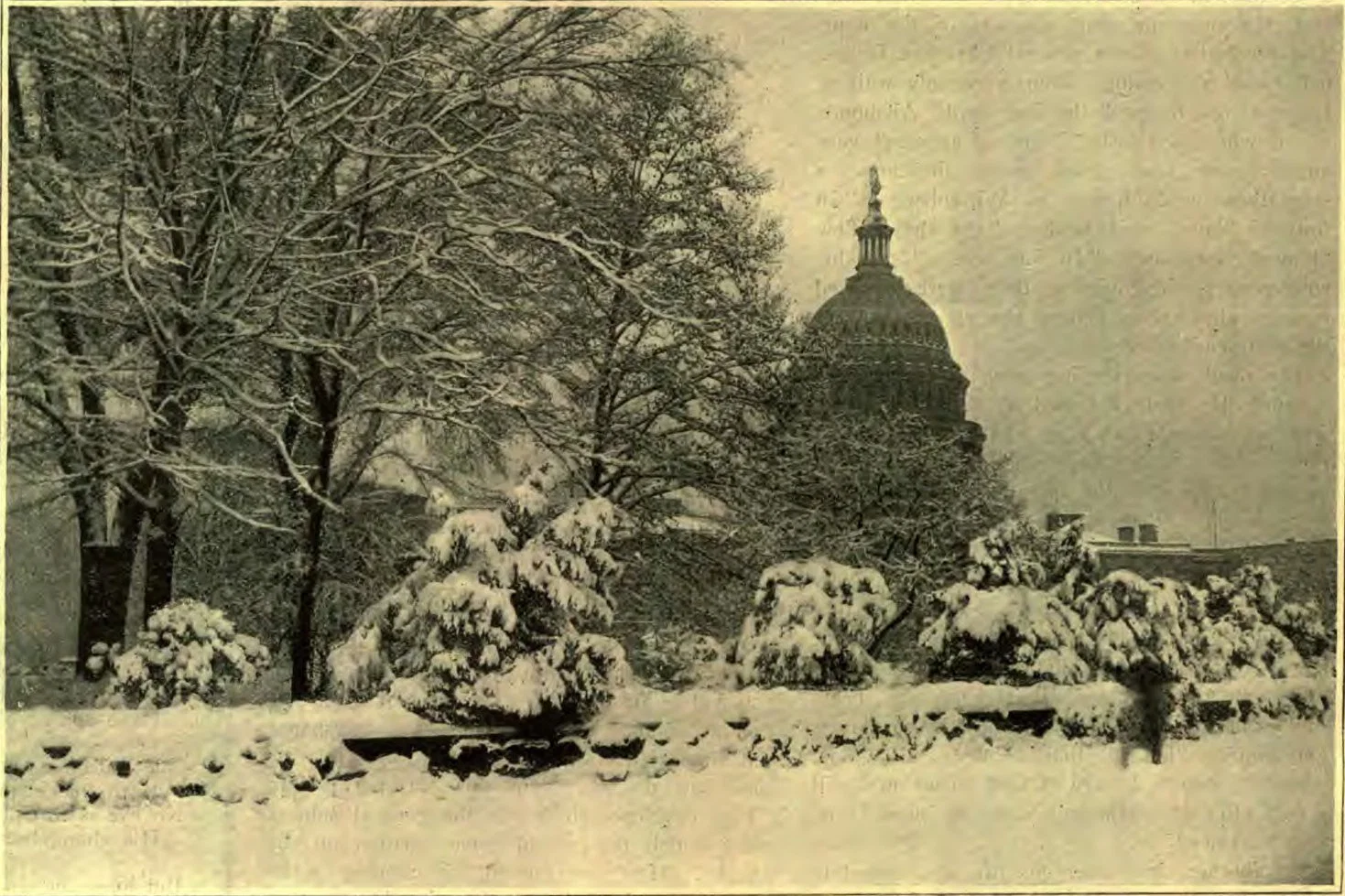
“The trees were plumed with feathery flakes, and the ground was white below.”
At about this time the war being waged against the Turks, the completion of St. Peter’s at Rome, and the luxurious habits of Pope Leo X, induced this same pope to resort to a trade in indulgences on a very large scale. Not the so-called ignorant, but those standing high as leaders in the Renaissance were appointed to superintend this great traffic. As a subcommissioner, the better-known John Tetzel, the Dominican, was appointed to prosecute the infamous business. Wherever he went, the bells of the town and cities announced his approach; the officials of the place, the citizens, and even the school children went in procession to meet him. A red cross on which the coat of arms of the pope was emblazoned, preceded him. On a velvet cushion his papal commission was displayed. Entering a church, the red cross was raised in front of the high altar, and the indulgence chest placed beside it. Sermons were preached by Tetzel, extolling the worth of indulgences, and urging their purchase, declaring that as soon as the penny sounded in the chest, the soul was delivered from purgatory. The language of the advocate of this wretched idea is startling: “For twelve pennies you can deliver your father, and yet you are so ungrateful as not to relieve him in his distress. At the last judgment, I am free, but you are responsible. I tell you, if you have but one garment, you should part with it rather than fail of such grace.”
What wonder that such infamous mockery stirred Luther’s soul to the depths! He who had passed through deep soul struggles ere he won pardon, knew that forgiveness could not be purchased by money. He accordingly thundered against Tetzel’s career from his pulpit with his usual energy. He closes one sermon with these words: “O the dangers of our times! O ye slumbering priests! O darkness denser than Egypt! How secure are we in these extreme evils!” Surely these words might well be sounded in trumpet tones in this our evil day.
There was an expectation that a crisis was coming, but no one could tell when or where it would come. The theologians at Wittenberg were accustomed in regular order to conduct theological discussions, and to prepare and post up in advance the theses which, on a given date, they would discuss. In accordance with this custom, Luther prepared and posted his ninety-five famous theses, discussing God’s ideas of repentance, compared with the indulgence evil. The date of the posting of these theses, Oct. 31, 1517, may aptly be regarded as the birthday of Protestantism. The effect of the publishing of the theses was stirring indeed. Though many disapproved of Tetzel and his traffic, they felt that Luther had spoken unadvisedly. The memory of Savonarola’s death caused them even now to see the stake in the foreground. They did not realize that some one must move first, some one must pioneer; and happy is he, who, regardless of consequences, dares go forward alone, if need be, for Truth’s sake.
“Then to side with Truth is noble, when we share her wretched crust, Ere her cause bring fame and profit, and ’tis prosperous to be just; Then it is the brave man chooses, while the coward stands aside, Doubting in his abject spirit, till his Lord is crucified, And the multitude make virtue of the faith they had denied.”
In reply to a charge against the step he had taken, Luther said: “If the work be of God, who shall prevent it? If it be of man, who shall promote it? Not my will, nor their will, nor our will, but thy will, O holy Father, be done.”
Though for a moment he stood alone at Wittenberg, the theses were immediately circulated through the different universities, and from them, as centers, in all directions. It was a live subject, the most pressing question of the hour. The revolution of the general Christian feeling had found expression. Men were only waiting for some one to speak the first word. All honor to him who dared do it. Words of approval were quickly sent back from many directions to strengthen weak hearts at Wittenberg. “In fourteen days,” said Luther, “the theses flew all over Germany.” “In four weeks,” says his cotemporary, Myconius, “they were diffused through all Christendom, as though angels were the postmen.”
The result was startling, even to the fearless author. He little dreamed of their having so wide an influence. A copy of them was sent to the pope, with the request that strong measures be taken to prevent the spread of such teaching. Accordingly Luther was soon summoned to appear at Rome within sixty days, on charge of heresy. While his friends were in deep anxiety on the subject, Luther wrote: “You know that in all these matters I have nothing to fear. For if, by means of their flattery or power, they cause me to be hated, I have in my heart and conscience this one thing, that I know and confess that all that I have and against which I contend, I have of God, to whom I will gladly offer all. His holy name be blessed forever! Amen!”
At another time when his life was feared to be in danger, he said: “Like Jeremiah, I am clearly a man of strife, since I am daily irritating the Pharisees with what they call new doctrines. But while I am unconscious of having taught anything but the pure doctrine, I nevertheless foresee that I will be an offense to the most holy Jews and the most wise Greeks. I hope that I am debtor to Jesus Christ, who says: ‘I will show him what great things he must suffer for my name.’”
CARRIE E. ROBIE.
(To be concluded)

If Worth Reading, Worth Saving

Next to earnest consecration and a genuine hunger and thirst for truth, the greatest requisites necessary for a really useful career are well-developed systematic methods of study and work. Many men and women who are accomplishing a hundredfold more in the world than you have ever expected to do have no better brains than you; in fact, many of them do not actually possess the native ability that others have who are making almost a complete failure, but they have ready access to what they do know, and they have learned to concentrate their minds on what they have in hand so as to develop something out of it.
To know how to do things according to some system or plan is not only one of the secrets of success, but also is the key to the easy doing of great and complicated work. A train dispatcher has under his control a large number of trains in different parts of a vast railway system; and he regulates their movements with far less strain on his nervous system than many a woman does her ordinary household affairs.
The majority of cases of nervous prostration that have come under my care have been on men who made hard work out of what should have been easy for them. Childhood and youth is the time to acquire right methods of study and work. Those who fail to do this will sooner or later discover the tremendous disadvantage under which they are placed; and they rarely succeed in making up for this early loss. There are, however, encouraging exceptions; but the bend of the young sapling is liable to be found almost unchanged in the full-grown tree.
To have a systematic plan of treasuring jewels of truth found in the reading, and also the many important facts or statistics that come to you in various ways, so that you can have them ready at hand, not only aids, but strengthens the memory. Perhaps you have read in the “Testimonies for the Church” that “all over the world men and women are looking wistfully to heaven. Prayers and tears and inquiries go up from souls longing for light, for grace, for the Holy Spirit. Many are on the very verge of the kingdom, waiting only to be gathered in.” If you are a genius, this grand, encouraging statement will not only instantly photograph itself upon your brain, but will also slip into the proper corridor of your mind, and be right on hand whenever it will be of the greatest service to you. If you have only the talent possessed by ordinary mortals, yet cherish an inspiration for true usefulness, then you can do something that will enable you, with your ordinary abilities, to compete satisfactorily with the genius; in fact, if sufficiently diligent, you may outstrip him in real results.
Have a book on hand in which you classify under appropriate headings a concise statement of every important truth that you read in books. You will be amazed at the treasures of truth that soon accumulate. If you read in a newspaper some important fact concerning tuberculosis, or some new discovery, cut this out, put it into a long envelope which has the general subject under which this would come, written on the outside. After you put in the clipping, write across the end of the envelope its title, so that at any time you can see at a glance what articles you have on this particular subject. You will need an envelope for each general subject.
You know financiers sometimes go over their accounts with a great deal of satisfaction. You may not have any money, but you can accumulate truths that will in the end be of more value to you than any earthly treasure.
Whenever you get access to some new truth, whether it be of a spiritual or a physical nature, or any fact of general importance, show your appreciation sufficiently to bow your head, then and there, and thank God for having brought it to your attention. If you will do this, you will soon be pleasantly surprised at the way in which the Lord will, apparently incidentally or accidentally, bring you in contact with the very things you have longed to get hold of. That is the kind of God we serve. It makes service to him sweet and satisfying. He gives us all we can and will make use of, but he never casts pearls before swine; it is to the righteous that light is sown.
Let this give you a bright outlook. It may seem that you are doomed to a life of uselessness, but could your eyes be opened for even a moment, and you catch a glimpse of the opportunities that God has arranged for you, you would be overcome. For wise reasons God gives but few people such a glimpse in advance. We walk by faith, and not by sight.
For the encouragement of the boys and girls who have been apparently deprived of many opportunities in life, I quote from my index book under subject “Possibilities” the following statement, written by Mrs. E. G. White in the Review of Aug. 19, 1884:—
“Are you ambitious for education that you may have a name and position in the world? Have you thoughts that you dare not express, that you may one day stand upon the summit of intellectual greatness, that you may sit in deliberative and legislative councils, and help enact laws for the nation? There is nothing wrong in these aspirations. You may every one of you make your mark. You should be content with no mean attainments. Aim high, and spare no pains to reach the standard. . . . Balanced by religious principle, you may climb to any height you please.” There is a stimulus, which the devil can scarcely quench, in a sanctified ambition to be all that it is possible to be, mentally, morally, and physically.
The desire to use the faculties for the good of humanity is an ambition upon which the Lord looks with approval. He does not “bid the youth to be less aspiring. The elements of character that make a man successful and honored among men, the irrepressible desire for some greater good, the indomitable will, the strenuous exertion, the untiring perseverance, are not to be crushed out.” DAVID PAULSON, M. D.

Exalted

WHEN June has dressed her children In summer colors gay, And tulip, rose, and lily Nod heads in grand array,
'Tis then the fir-trees, sighing, In gowns of somber green, Find no one to admire Their trim and stately mien.
And when at autumn’s summons The maples, blushing, stand, And elms a “golden glory” Have spread o’er all the land,
The shrinking cedar trembles With shame and sore distress. No eye is turned to notice His changeless, dull, dark dress.
But lo, a change comes slowly; The sky’s a vault of gray, While garments gold and crimson Have all been laid away.
The ermine white of winter Hides hillocks brown and bare, Forms for the constant fir-trees A background wondrous fair.
And now, a thing of beauty, Sought by admiring eyes, The evergreen stands peerless Against the wintry skies.
And thus, sometimes, the humble, The hour when others quail, Find at the post of duty Honor which shall not fail.
CORNELIA SNOW.

Truth and the Trembling Felix

TRUTH is the apostle before whom every cowardly Felix trembles.— Wendell Phillips.

Our Boys in Gray

Scenes In the Life of a Letter-Carrier

When letters come to us in the post-office, we lay them on a table, and arrange them by streets in the same order as the houses to which they are addressed. A little carelessness in this preliminary sorting will often cause the carrier to walk many extra blocks.
Having “routed” the mail, we load up our sacks, and start out. My route begins at the intersection of two of the main business streets.
Taking the letters in the left hand and the papers for the first block over the left forearm, I can look over both letters and papers easily. The papers are held in place by a strap with a spring grip, which, as the papers are delivered, can be readily tightened to keep the remainder in place.
My load in the business districts melts away like a Walla Walla snow-bank before a chinook wind. Soon I have reached the bottom of the sack and the end of the trip. I must return to the post-office, load my sack afresh, and start for the “residence trip.” It is now nine o’clock, and I must return to the post-office by half-past eleven if possible, so as to deliver the Eastern mail, which arrives at that time.
The first letter is for a young lady whose lover is at Manila. Ringing the bell and putting the letter in the box, I start toward the gate, when the girl’s mother recalls me. She walks with me to the gate.
“Do you remember the letter postmarked Spokane that you brought for Nellie yesterday?”
“Yes. Why?”
“Well, I want you to watch out for letters to Nellie in that handwriting. Don’t bring them. Tear them up.”
“But I am not allowed to destroy any mail whatever, so it would be out of the question for me to do it.”
“Very well, deliver all the rest of her mail to her, and put those letters in your pocket to hand to me when you see me alone. I’ll attend to them.”
“I am sorry to seem disobliging, but I am not allowed to deal so with letters.”
“But she isn’t of age.”
“Then you have a right to have all her mail delivered to you.”
“But that will only make matters worse,” says the anxious mother. “I want her to get all her mail but those letters from Spokane, which ought to be destroyed. She will think that man has tired of her and has quit writing. She is engaged already to a man at Manila. Since he sailed, she has met this man from Spokane. He is worthless; he does not pay his bills, and I can’t understand how Nellie can be so fascinated with him. Won’t you help me? I don’t want to see Nellie’s life wrecked.”
I tell her how sorry I am, but that the post-office can not help her to deceive the girl, even in so good a cause.
“Well, put all her mail in the general delivery, and I will call for it,” is the mother’s parting injunction as I leave.
We carriers see many signs of hidden tragedies and narrowly averted disasters. Sometime ago, when I came to a street letter-box on my collecting trip, a man asked me to return a letter which he had dropped in the box a few hours previously. I told him it was impossible. He said that it was very important, and that he must have it.
I said, “One of the sections of the Postal Laws and Regulations says, ‘Carriers are forbidden , under any circumstances, to return to any person whatever, letters deposited in the street letter-boxes, but must take them to the post-office.’”
He said that he had written a letter under a misapprehension; that, since mailing it, he had discovered that he was mistaken, and that if it was delivered, it might cause an estrangement. I told him that if he described the letter to me, I would write on it “Hold for writer,” and that by applying to the postmaster and signing a receipt, it would be returned to him. It is unnecessary to state that the person addressed never received the letter.
There is some one across the street, trying to attract my attention. She may have a letter to mail, and carriers ought to be obliging, so I will go over, even if I do not enjoy wading through the mud to do so.
“Did you want me, Mrs. Smith?”
“Yes,” she replies. “I am going to ask a favor of you. I’ll do as much for you some day. It won’t be much out of your way, and your time is paid for, so I’m going to let you take this note to Mrs. Gray.”
“But it has no stamp on it,” I object; “and even if it had, it must go through the post-office to be canceled and postmarked.”
Of course it hasn’t any stamp on it! It isn’t important enough to waste a stamp on. Just tell Mrs. Gray that I am not going to the lodge to-night, and ask her to stop and get the lodge books.”
“I wish I could, madam. It’s a fact that I am paid for my time, but the government is the paymaster, and it requires me to refuse to deliver private notes or messages. The local postage is designed to help pay my salary.”
“Very well. I can send one of the children over after school,” she replies; and I can tell by the way the door slams that she thinks I lack an accommodating spirit.

“Is This All?”

How thoughtless some persons are! One lady on my route whenever she meets me on the street, although she sees that I have a heavy load and am trying to make up lost time, invariably stops me with the request for her mail. I frequently have almost to empty my sack in order to get the package in which her mail is routed. After I have given it to her, she will say, “Is this all?”
“Yes, ma’am.”
“Did the mail all come?” she asks, fretfully. “You don’t suppose you could have overlooked a letter of mine, or handed it to anybody else by mistake?”
Then she will hand me back the paper which I had delivered to her, and say, “You might as well take this to the house.”
I once ventured to tell her that it would cause me a great deal of trouble to put her mail back in its proper package. She asked me if I supposed she wanted to carry that big roll of paper all round town with her, so I meekly took it back, and stuck it in the side of my sack, meaning to remember it when I came to her house. I remembered it only when I had got two blocks past the house, and so I had the pleasure of retracing my steps that far.
While there are a few such persons on every route, the great majority are thoughtful and considerate. Frequently on hot days one lady on my route has a glass of lemonade or ice-water for me. If I happen to pass her house in a drenching shower without an umbrella, she sends her little boy to the gate with an umbrella for me.
Upon one occasion I rapped at her door when my hands were so numb that I could not shuffle my letters. She drew me out of the rain into her kitchen.
“I know it’s against the rules, but a cup of hot coffee will do you lots of good and keep you from having pneumonia,” she said.
She is the kind of person to whom a carrier never takes the notice, “Call for package; too large for the carrier to deliver.” He delivers the package if he has to make a special trip to do so.—Fred Lockley.
(To be concluded)

Morning: Sleepiness, Dreams, and the Midnight Cry

Morning

How sleepy we all get along toward morning. In olden times, we are told that the Indians chose the early morning hours in which to attack the white settlements; for they knew that in that hour men were more easily surprised and bewildered than at any other.
The other night I was dreaming, and in my dream was carried back to my childhood home in Ohio. In my dream my mother was calling upon me to awake, as it was morning. I could hear her voice, and understand what she said, but how hard it was to get my eyes open, and to make an effort to arise! but by dint of great effort and resistance to the sleepy spell that was upon me, I was soon enabled to do so.
One night I was awakened by the sound of laughter and song. I thought it must be morning, but no, it was only midnight. The voices came from some happy young people coming home from a party.
After a time I heard a rooster crow in the tree back in the yard, and soon there was a sound of crowing all over the country made by these early heralds of the morning. Then I slept, and when the morning really came, it was hard to awaken, because I had been awake in the night.
When one has watched by the side of the sick all night, the sleepiest time is early in the morning. When you get over that sleepy time, it is comparatively easy to keep awake.
Away back in 1844 there was a great awakening from a cry that was being made of “Behold the Bridegroom cometh!” We are told that that was the “midnight cry.” It is one of the landmarks of our faith, of which we may never safely lose sight.
In 1889 there was another cry, and another great awakening. A few good souls who were high up in the gospel tree, saw a new light, and at once heralded the morning. The cry was taken up by nearly all those whose office it was to watch, and soon all were awake and stirring. But it was not yet morning, and the greater number fell asleep again. The light was the true light, and was of the morning, but the morning was not yet.
Our Lord, in speaking of these things, said, “Watch ye therefore: for ye know not when the master of the house cometh, at even, or at midnight, or at the cockcrowing, or in the morning.” Mark 13:35. The Lord did not come at “even,” nor did he come at “midnight,” nor yet even at the “cockcrowing.” So there is only one time left for him to come, and that is the morning, and it is now here. We know it is morning because we are all so sleepy, and feel so much our lack of power. We have been awake so long, or been waked so often, that now when the morning has come, we can not believe it is here.
Awake! Pull yourself together, and open your eyes, and you will see. Now has come the time to make the supreme effort of your life to awaken and to keep awake, “lest coming suddenly He find you sleeping,” but he “come in a day when he [his servant] looketh not for him, and in an hour that he is not aware of, and shall cut him asunder, and appoint him his portion with the hypocrites. There shall be weeping,” such bitter weeping, and regrets, but vain regrets for it will be too late. E. L. PAULDING.

Leadership Requires Going Before Others

“He who would be a leader must go before.”

THE WEEKLY STUDY

Glimpses of Paul from Thessalonians

OPENING EXERCISES.
SCRIPTURE FOR STUDY: 2 Thessalonians.
REFERENCE STUDY: “Sketches from the Life of Paul,” pages 116-118.
A SPECIAL PROMISE: 2 Thess. 3: 3.
OUTLINE OF TOPICS:—
Salutation. 2 Thess. 1: 1, 2.
Commends their faith and love. Verse 3.
Encouraged the troubled to look to the coming of Jesus for rest. Verses 4-9.
Warns the church against expecting the coming of Christ in their day. 2 Thess. 2: 1, 2.
The reason. Verses 3-12.
Thanksgiving and exhortation. Verses 13, 14.
His prayer for them. Verses 16, 17; 2 Thess. 3: 5, 16.
Confidence in God’s faithfulness. Verse 3.
His confidence in them. Verse 4.
Instruction concerning the disorderly. Verse 6.
His own example. Verses 7, 8.

Notes

“In this first epistle to the Thessalonians, Paul’s teachings concerning the second coming of Christ were in perfect harmony with his former instructions to the church, yet his words were misapprehended by some of the Thessalonian brethren. They understood him to express the hope that he himself would live to witness the Saviour’s advent. . . . In his second letter to the church, Paul seeks to correct their misapprehensions, and to set before them his true position. . . . He carries them forward to hope for rest from all their cares and perplexities when the Lord Jesus shall be revealed, “in flaming fire taking vengeance on them that know not God, and that obey not the gospel of our Lord Jesus Christ.”—“Sketches from the Life of Paul.”
“The papal power, so clearly described by the prophet Daniel, was yet to rise, and wage war against God’s people, and trample upon his law. Until this power should have performed its deadly and blasphemous work, it would be vain for the church to look for the coming of their Lord.”—Id.
G. B. T.

Not Appreciated

“I do not try to do my work as well as I can,” said an employee, recently, “because my employer does not appreciate it.”
We often hear this excuse for bad work, for indifferent service, but we have never known a young fellow to get on very far in the world who starts out in life with this skimping, slighting policy,—to do bad work just because his employer does not appreciate good work. Of course, it is pleasanter to work for a man who appreciates you.
A boy once tried to justify himself to his father for being rude to a young man, just “because he was no gentleman.” The father rebuked him by saying: “You should not treat a man politely because he is a gentleman, but because you are one.” You must not gauge your work by the appreciation of your employer. You have a higher master to answer to. You can not afford to stoop to the level of a man who is not a gentleman. If he can afford to thus demoralize and desecrate his manhood, you can not afford it. There is something higher and better in you. You have a grander aim in view than merely to do poor work because your employer does not appreciate you. There is a voice within you which calls for your best under all circumstances; not because your employer is a man, but because you are one.
Many a man is wallowing in failure to-day, buried in the debris of his own mistakes and slipshod methods, just because in boyhood he thought it was not worth while to do his best because it was not appreciated. It is your own future, my young friend, your own character, that is affected by the quality of your work. You are not injuring your employer by bad work half as much as yourself. It may be a matter of a little loss of money with him; it is a loss of manhood in you. Can you afford it? Can you afford to sell yourself for such a contemptible consideration?
The quality of your work, your own efforts, become a part of your life, interwoven in the very texture of your being. You can no more get rid of the slipshod, slovenly task, or half-performed work, even if way back in your boyhood, than you can get rid of the characteristics of your ancestor, or change the color of your eyes. Every blunder you ever made, every piece of slipshod work, every half-done thing, colors, modifies, cheapens, demoralizes everything which comes after it in your life.
What matters it in the long run whether your employer appreciates what you do or not? You can not afford to be cursed with commonness, to be tied down by the curse of half-done, indifferent work, simply to square yourself with your proprietor who does not appreciate you.
There is something within you which will say “Amen” when you have done your best, and which will rebuke you if you slight anything. The approval of this little innate monitor will give you a thousand times more satisfaction than the approval of your employer. You have a master which is above your employer, whose disapproval you can not afford for any amount of pay. If you always keep the approval of this little adviser, you will never drop your standard, you will never lower your ideals, you will never haul down your manhood flag, for she does not give her approval for second place; she does not give it for mediocrity when you are capable of excellence, when you are capable of superiority.—Orison Swett Marden, in Young Americans.

Echoes from the Ozarks

ANOTHER year of work for the Master is completed, its three hundred sixty-five days are on record in the books of heaven. Has each of these days, full of golden opportunities, been improved to the utmost of our powers? Many earnest hearts look back over the road, and question every step of the way. Oh, we miss so much even in all our zeal for the missionary work at home and abroad! but the summer is ended, the harvest is past, and a new year lies just before us. Surely we are all entering it with newness of life and purpose, eager to sacrifice, to spend and to be spent, to spread the glad news of a Saviour’s love. We extend joyful greeting to all our young people everywhere.
Our Sabbath-school pursued the same plan as last year in our work for Central Africa. We held our Harvest Ingathering exercises, using the program given in the INSTRUCTOR, interspersed with added recitations and songs, making an exceedingly interesting and profitable exercise. A unique feature of our program was the thanksgiving offering, which was taken while the song “Hear the pennies dropping” was sung. A silver basket was placed upon the table, and the members of the Sabbath-school came down the outside aisles of the church to the table, and dropped their offering into the basket. More than “pennies” were given, however, by thankful hearts and hands, making a nice little offering which the Sabbath-school had previously donated to the work in Washington. This division of our effort for Central Africa, with Washington, cut short our offering to Africa, which otherwise would have been about the same as last year. The amount received from the sale of needlebooks, pinballs, emerys, and other things during this and last year was about seven dollars.
Our Sabbath-school has just rendered the program for Christmas given in the Review. This also was added to by songs and recitations. “The Macedonian Call of the Nations” was given by little girls dressed to represent the different nations. The noticeable feature of this recitation was the earnest manner of our little maidens as they gravely pleaded for help for their poor sisters over the sea. Nearly every child in our Sabbath-school had some part in this excellent program, and all entered into it with their usual earnest spirit. We often question, What has our dear Lord for these willing hearts to do in this “time of the end”?
MRS. L. E. LA BONTE.

Perfectly Simple

TRYING to give an idea of the size of a molecule, Dr. W. Marshall Watts says that if a drop of water were enlarged to the dimensions of the earth, its molecules would look like a heap of 9,556,000,000,000,000,000,000 tennis balls. If all scientific facts can only be reduced to sporting terms, the general understanding of the wonders of nature might be increased.—Boston Transcript.

Report from Rock Hall, Maryland

As another year draws to a close, we are glad to note that the Young People’s work is onward, and hope that the interest, zeal, and experiences of the past year may be an incentive to each one to do better work for the Master than ever before.
Our Society is one among the many that have joined in the work of the missionary campaign. We appointed committees to take charge of special lines of work, and the plan has proved very successful. The committee in charge of the work of placing the Review in the homes of our people reported seventeen orders. This was done before the week of prayer, and thus those who were not able to attend the meetings in the church had the benefit of the readings.
Four hundred copies of the Signs have been ordered. Different individuals are responsible for nearly three hundred of these.
The postmaster has given us the privilege of placing literature in the post-office. One of our number has charge of this work, and places good reading there every week.
A young lady member is at one of the hospitals in Baltimore. To-day we learned that she is doing a good work, and desires to have some papers sent to her for distribution. We are sorry, indeed, that she is sick, and has to be away from us; but perhaps the Lord has a work for her to do just where she is.
The Society and church-school work go hand in hand, and as the children of the school desired very much to sell the December number of Life and Health, the Society sent for one hundred twenty-five. Seventy-five have already been sold, the children selling over fifty during this past week.
Our last program for this year is to be a missionary one, and we are to have a special collection for the work in India. The children in the school have already one dollar sixty-one cents to add to this as the result of what they have saved and earned during the past two weeks.
We hope that the Lord’s blessing will rest upon the work of all the Young People’s Societies during the coming year.
LULU I. TARBELL, President.

Puss Finefur's Adopted Family

BUNNY BUNCH was the happiest mother rabbit in the land. Blind, naked creatures were her six little baby rabbits, and perhaps you and I would not have considered them beauties; but Bunny Bunch did, and her approval is of much more consequence than ours.
Somebody else thought Bunny Bunch's babies worth admiring, too, and that was Puss Finefur, the handsomest black cat in the country. He thought Bunny Bunch's babies were so pretty that he really tried to adopt them.
Bunny Bunch lived in a wooden box in a coal shed. To protect her from the weather, her owner had nailed a cover over the top of the box, but left an opening at the side large enough for her to creep in and out of as she wished. This made the box warm enough for Bunny Bunch herself, but she knew it would never be cozy enough for her babies. So Bunny Bunch made a comfortable lining for the box out of fur that she pulled from her own breast. When it was all padded and lined, Bunny Bunch thought it was a nest fit for a king rabbit; and so thought the baby rabbits.
Puss Finefur was the pet of the family who lived in the second floor flat, but he was always prowling around the downstairs premises. He liked to visit his neighbors. One day, when Bunny Bunch's babies were a few days old, she left them in the box, and stole out to the yard to stretch her limbs, and hunt something good to eat.
While she was gone, Puss Finefur came nosing around the box. He saw the six blind babies, and determined on a closer acquaintance. So he ushered himself into their box; and instead of gobbling them up, as most cats would have done, he began licking their little bodies quite affectionately.
The little creatures, feeling something big and warm and furry near them, at once concluded it was their own dear mama come back; and forthwith they nestled themselves close against him. Puss Finefur evidently was not displeased with their attentions, for he just lay right down and let the little things crowd as closely to him as they wanted to.
Pretty soon Bunny Bunch came in herself, and at first she was in a great fright to see Pussy Finefur hugging her babies; but he gave her several reassuring “meows,” and, finding, upon investigation, that he hadn't eaten any of the six, Bunny Bunch nestled herself down on the other side of the box; and there they lay, Puss Finefur on one side, Bunny Bunch on the other side, and the six babies between them. That was Puss Finefur's first visit to the rabbit box, but it wasn't his last. Every day regularly, for a long time afterward, whenever Bunny Bunch left the box, Puss Finefur walked in, and the babies grew very fond of him; and, as his fur was good and thick, and he was such a warm, cozy kind of cat, they hardly knew the difference between him and their own mama.
Bunny Bunch was glad enough to leave them in Puss Finefur's charge. She felt that they were safe with him, and that no harm could befall her beloved family while they were in the care of such a devoted nurse. And none ever did. The babies all lived and grew up to be very fine rabbits, and to this day they are great friends with Puss Finefur.—Kindergarten Review.
Continue reading: The Street Corner Brigade