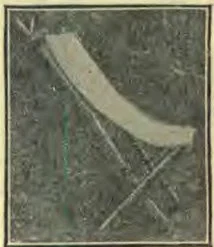
A COMMON roller towel, or any other strip of strong cloth that is approximately sixteen inches wide by two and one-half yards long, with the ends sewed together, will make the seat and the back of a comfortable camp chair that you can build in a few minutes. Cut two stout sticks four feet long, each crotched at one end, and two others of half that length. Drive them firmly into the ground in the relative positions shown in the photograph, and lash them firmly together where they cross. A straight stick thrust through the loop of the towel at the ends, and resting in the crotches, completes the chair, which will be comfortable as well as convenient.—Selected.
The Pantograph
The pantograph is a framework that carries a pencil and a tracing point so arranged that when the tracer is passed along any line of a map or picture the pencil draws an exactly similar line, but to any scale desired. It requires no skill to use it, yet with it one can copy not only maps and plans, but line drawings from newspapers, magazines, or books.
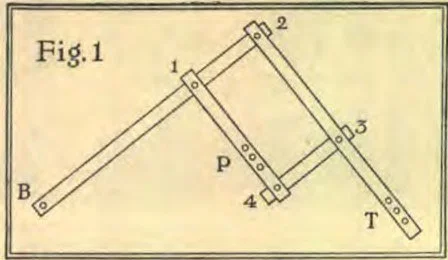
To make a pantograph, get four thin strips of hard wood about three quarters of an inch wide, and put them together as they appear in Fig. 1. The length of the two longer pieces is not important, but for convenience let it be about eighteen inches. The piece 1-4 should be twelve inches long; and the piece 3-4, eight inches long. Bore a small hole near each end of all four pieces. Lay the eight-inch piece on one of the eighteen-inch pieces so the holes at one end of both are directly in line with each other; mark through the center of the hole at the opposite end of the eight-inch piece; that will give the position of hole 1. Then place the twelve-inch piece on the other long arm, and find the place for hole 3 in a similar manner. Bore the holes shown at P and T for pencil and tracer points respectively, and put the apparatus together by slipping wooden pegs or copper rivets through the holes 1, 2, 3, and 4. If the four pieces, when combined as in Fig. 1, will form a perfect rectangle, you may be sure that your work is correct.
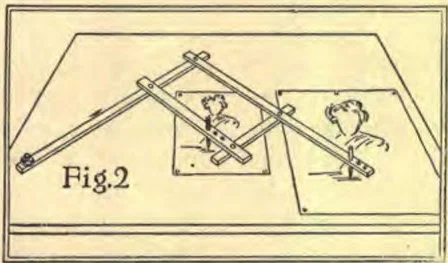
Bore a three-eighths-inch hole in one long arm, at B, and a hole of the same size near the edge of the drawing board or table. Get a three-eighths-inch stove bolt, about an inch and a half long, with nut and washer, and slip the bolt through the table and the leg of the pantograph. Do not screw the nut down tight, for the leg must move freely on point B. The pantograph fixed to the table will now appear as in Fig. 2. The arms should move easily, but not loosely, about the joints 1, 2, 3, and 4, as well as at B.
Fig. 1
To use the pantograph, put a sharpened wooden peg through one of the holes at T, and a pointed pencil through the corresponding hole at P. Put the drawing to be copied on the table under the pantograph, so that the point of the peg T rests near the center; put a piece of paper under the pencil point, and fasten both paper and picture securely. When you move the tracer, T, along the lines of the picture, the pencil will make corresponding lines on the paper.
Fig.2
Arranged as in Fig. 2, the pantograph will make a drawing smaller than the original. If you wish to make an enlarged copy, put the pencil at T and the tracing point at P, and change the position of paper and drawing to correspond.—The Youth’s Companion.
Morning Prayer and Looking Up to God
“My voice shalt thou hear in the morning, O Lord; in the morning will I direct my prayer unto thee, and will look up.” Ps. 5:3.
Burying the Faults of Friends
“EVERY man should keep a fair-sized cemetery in which to bury the faults of his friends.”
Over the Telephone
By Susan M. Martin
It was a dark, lowering afternoon. It had rained all the morning, but now the rain had turned to snow. The pavements and streets were dripping.
Miss Sally sat by the register, wrapped in a gray shawl. She had a cold, and with the cold had come a feeling of depression. Father and mother and brother and sister all were gone. She had no one near to her left. Today Miss Sally felt especially sad. She was a slender little woman of fifty, with soft blue eyes and smooth coils of brown hair that was fast turning gray. Miss Sally did not care for society or clubs. The one joy of her life had been her Sunday school class. Year after year the boys went out from her class into the world, and other boys took their places, but Miss Sally never forgot one of them or neglected to pray for them. Somewhere in the big world they were doing men’s work, she hoped, the better because of her teaching, but how little she knew! None of them ever came back to tell her. She sighed heavily. Somehow, particularly today, she wished she did know—know that one of her boys was the better for having been for a little while her boy.
For over thirty years she had plodded to Sunday school through rain and shine, through heat and cold, to teach that Sunday school class. After all, had it really paid? Had she put the effort and time into another line of work, would it not have yielded better returns? Tomorrow she would go and teach as she always did, but what was there to give her the encouragement she needed? People were so used to seeing her they regarded her as a settled fact. Miss Sally and her Sunday school work were an old story now. One got so tired of always going on, with no word of praise, no little token of love or appreciation. And after all, how did she know she had done any good?
Miss Sally brushed away a tear and sighed again. Suddenly the telephone tinkled. Miss Sally went to it and took down the receiver. “Hello!” said a clear, masculine voice. “Hello!” replied Miss Sally. “Is this Miss Sally McNaughton?” asked the voice. “Yes; this is Miss McNaughton,” replied Miss Sally. “Miss Sally,” cried the voice, “do you remember Carl Burnett, who used to be in your Sunday school class?” The gray shawl slipped unheeded from Miss Sally’s frail shoulders. She was smiling happily. “Remember Carl Burnett! I should say I do!” cried Miss Sally. “Do you think I could ever forget him?”
“Well, this is Carl,” went on the voice, “and I’m at Finley, ten miles away, but I can’t come up to see you. I’m on my way to Oregon to look after a lumber camp, and have only an hour or two here; but, Miss Sally, I couldn’t be this near and not call you up and thank you for what you have been to me. I suppose I was a troublesome little chap, and seemingly indifferent, but I tucked away in that small head of mine most of the things you said. I’ve been living up to them ever since, Miss Sally. I couldn’t give a man less than a square deal, because—well, just because I went to Sunday school to you. Somehow I wanted you to know it. I’m sending you a box of pink carnations. I remember you used to be fond of them; and that reminds me, Are you still teaching, Miss Sally?”
“Yes,” replied Miss Sally, strangely moved. “I am still teaching.”
“Good!” cried the voice. “I might have known you would be. Well, the best thing I can wish for a boy is to have the privilege of being in your Sunday school class. I felt homesick for the sound of your voice, and it sounds as it always did—nice and kind and gentle. Go on teaching, Miss Sally, and be a blessing to other boys as you have been to me.”
“O Carl,” faltered Miss Sally, “have I really helped you?”
“Really, Miss Sally,” replied the cheerful voice, “more than I can tell. It’s been fourteen years since I left your Sunday school class, and I’m still doing the things you told me to do, and they work so well I’m going to keep on. I think I can still repeat the twenty-third psalm. Would you like to hear it, Miss Sally?”
“Better than anything in the world, my dear boy.” And then a clear, musical, manly voice, repeated the psalm that Miss Sally had taught her Sunday school class to say fourteen years before: “The Lord is my shepherd; I shall not want.”
Miss Sally stood very still until the entire psalm was repeated. The good-bys were finally exchanged, and Carl was gone.
As she put up the receiver, somehow Miss Sally’s heart was very full. She had forgotten all about the rain and the snow and the dripping pavements and her cold and her despondency.
“To think I even dared to be discouraged!” cried Miss Sally, with shining eyes. She saw again the little ruddy-faced boy of fourteen years ago, and then she, too, repeated softly, “Thou anointest my head with oil; my cup runneth over.”—Susan M. Martin.
A Phonetic Spelling Bee
By Harry N. Holmes
HERE is a game clever enough for the wisest, exciting enough for boys and girls in their teens, and equally good for the family circle of five or six and the crowd of fifty.
Have two captains divide the party and agree to the conditions of the game. Taking the letters of the alphabet in order, each side selects a word whose first syllable is the name of the letter, and the remaining syllables make up some complete word; for example, “B-knighted,” benighted. Captain Jones may ask the other side, “What word do we have when we give B a title and make him ignorant?”
A referee holds the watch, and allows, say, half a minute for the guess. If Captain Smith’s side guesses correctly within the specified time, they score a point; but if they fail, a point is awarded Captain Jones’s team. Beginning with A, they go down the alphabet, each team having a try at every letter, turn about, of course. The hinting question may refer either to the addition to the letter or to the resulting word.
As a preliminary—and a very jolly one, as it turns out—the teams go to separate rooms, and make up their list of words and descriptions. Here is a list that shows the possibilities of the game:—
Give A a fight, and what do you have? — About (A-bout).
Arm B, and what do you have? — Begun (B-gun).
What do you add to C to make a hunt? — Seeking (C-king).
What sort of coat would you put on D to put it off? — Defer (D-fur).
What letter do you add to E to make it less hard? — Easy (E-z).
With what would you surround F to make it hard to take? — Effort (F-fort).
How would you take a bite out of H and catch cold? — Achew! (A-chew).
Add a goddess to I, and what do you get? — Idea (I-dea).
What color do you add to J to get a fine old Bible name? — Jared (J-red).
Give K a thrashing, and what do you have? — Calyx (K-licks).
What do you add to L to make it part fish and all fairy? — Elfin (L-fin).
Add a letter to M, and leave nothing. — Empty (M-T).
What might you add to N to catch it? — Entrap (N-trap).
Add a girl to O, and get a green spot. — Oasis (O-a sis).
Give P a trick, and what do you have? — Peruse (P-ruse).
What cool thing do you get when you load Q heavily? — Cucumber (Q-cumber).
Add the funniest thing to R, and what do you get? — Article (R-tickle).
What could you tack on to S, to make it fletcherize? — Eschew (S-chew).
Add a word to T to make a baby cross. — Teething (T-thing).
Add a small dog to U to make it play. — Euchre (U-cur).
How close will you bring V to make it thin? — Veneer (V-near).
Better skip W.
What do you have when you add plenty to X? — Example (X-ample).
Add a grain to Y to make it tough. — Wiry (Y-rye).
Put a noise on Z, and what results? — Zebra (Z-bray). — Harry N. Holmes, in Christian Endeavor World.
Telegraph to Jesus
SEVERAL years ago I was traveling on a train in the West. Among the passengers in our car was a young mother traveling alone with her first baby. There was also a well-dressed woman with two children, the older a boy of about twelve years, and the younger a rollicking little chap of four. The latter was so cute, and merry, and restless, that he attracted universal attention.
At noon our train stopped at a station for dinner, and all the passengers left the car except those who had lunch with them.
A few minutes later the conductor came through and ordered us to move to the car forward, as the train was to be broken into sections. After some switching about our train was made up, and the bell began to ring as a signal to the absent passengers.
All at once we were startled by a loud scream, and turned to see the young mother rushing frantically through the car, followed by the conductor and brakeman. She had left her sleeping baby and her luggage in the car we had formerly occupied, and had foolishly gone away to dinner without asking any one to watch over the child. Consequently, in the hurried change of cars it had been unnoticed, and now car and baby were gone. Our train was held while trainmen and passengers hurried about searching for the lost child.
All of us were much excited — none more so than the little four-year-old boy, who danced about and asked innumerable questions of every one. Finally, standing up in one of the foremost seats of the car, his cheeks flushed, his eyes shining with excitement, in an interval of silence, his clear baby voice floated down the car: “Why don’t they telegraph to Jesus? Why don’t they telegraph to Jesus? That’s what I’d do if that was my baby.”
Tears started from my eyes at these words of childish wisdom. His faith had turned to the sure Source of help and deliverance; and I do not doubt that many telegrams went up at once from that crowded car.
The baby was found and delivered to its mother, the trainmen returned to their posts, and our journey was resumed. But the seed sown by the wayside by a baby’s hand, had surely sprung up and brought forth fruit in more than one heart.— Selected.
J. W. LOWE
By J. W. Lowe
Hope
HOPE is the principal thing that buoys up the spirits of many men and women who would without it become most utterly discouraged, and would finally be led to give up the struggle of life altogether. Hope is the anchor that holds one to steadfastness and causes the individual to brave the storms and perplexities of life patiently and unflinchingly.
Without hope one would be driven about and tossed to and fro upon the sea of life, and eventually stranded upon the rocks and shipwrecked. Hope is as essential to success in domestic and business life as it is to the Christian life. In fact, without hope it would be impossible to be successful in any line. Cultivate hope, and, above all things, have a strong hope in God.
J. W. LOWE
Thirty-Ninth Week
September 26. Zephaniah: The day of the Lord is near. Read the introduction to each book as it is taken up.
September 30.Zechariah 9 to 11: Thy King cometh; rain in the time of rain; beauty and bands.
October 1.Zechariah 12 to 14: A fountain for sin; holiness unto the Lord.
October 2. Malachi: Acceptable offerings; idolatry and other sins; the tithe; the book of remembrance. Review the twelve minor prophetic books, and note very briefly the leading thought in each.
To Think About as You Read
Sunday.—Seeking righteousness.
Monday.—God requires service.
Tuesday.—The change of raiment is provided; do I accept it?
Thursday.—The necessity of praying for what God desires to give.
Friday.—Our preparedness for the day that is coming.
Sabbath.—Is my name in the book of remembrance?
Zephaniah
This prophet traces his ancestry, in the first verse of his book, to Hezekiah, supposed to be the well-known Hezekiah, thirteenth king of Judah. Zephaniah lived about the same time as Habakkuk, and prophesied in the beginning of Josiah’s reign. His book is characterized by “the unity and harmony of its composition, the grace, energy, and dignity of its style, and the rapid and effective alternations of threats and promises.” It closes with “the glorious sunlight of God’s mercy bursting forth from behind the clouds.”
Haggai
The prophetic messages of this short book were given during a period of four months in the year 520 B. C. Under the persecution of the Samaritans, and also because of their desire for temporal prosperity, the Jews had become indifferent to the building of the Lord’s house. In pointed utterances Haggai called upon them to consider their ways, and arise and build. A message of encouragement was also sent to Zerubbabel, the valiant son of the governor of Judah, who led the people in their response to this call.
By some Haggai is thought to have been born in Babylon. Others suppose, from his reference to the glory of the first house, that he was among the aged exiles who wept when the foundations of the new temple were laid. Ezra 3:12. He was the tenth of the minor prophets, and the first after the exile.
Zechariah
Closely associated with the aged Haggai was the younger prophet Zechariah, born in Babylon, and returning with the first company of exiles to Jerusalem. “Both prophets had the same great object before them; both directed all their energies to the building of the same temple.”
The book of Zechariah consists of three parts. In chapters 1 to 6 are nine visions of the glory of the kingdom and the worship of the Messiah; chapters 7 and 8 describe the acceptable fast; and the remainder of the book sets forth the future and final glory of Jerusalem and the second coming of Christ. Many allusions are made to the first advent, and the book is frequently referred to in the New Testament. This prophecy, so full of “good words and comfortable words,” is of great consolation and hope to the child of God.
Malachi
Malachi, the twelfth and last of the minor prophets, is sometimes called “the seal.” With his book the Old Testament Scriptures close, and it is well to remember that for four hundred years the Bible ended with Malachi. Little is known, but a great deal is conjectured, about this prophet. It seems certain, however, that he prophesied after Haggai and Zechariah. The new temple was completed, and its services reestablished. The sins of the people and the corruption of the priests are reproved; the obligation of tithing is clearly set forth; and the final utter destruction of the impenitent is foretold. One of the most precious texts in the book is the assurance that the Lord hears those who speak of his goodness, and has their names inscribed in a book of remembrance. Since he so values the faulty expressions of love and gratitude from his frail human children, how often should we speak forth his praises!
8. How do we know that he could not have meant Peter? 1 Cor. 3:11.
9. What did Jesus promise to give to Peter and to all those who would build on this Rock of Ages? Matt. 16:19.
10. From that time on, concerning what did Jesus instruct his disciples? Verse 21.
11. How did Peter tempt Jesus to think that he need not suffer, in order to save us? Verse 22.
12. In what words did Jesus rebuke him? Verse 23.
13. What did Jesus say of every one of his followers? Verses 24, 25.
14. What did Jesus then ask? Verse 26.
15. What vision of glory did he then promise the disciples? Verses 27, 28.
Notes
“Cæsarea Philippi . . . is a town at the base of Mt. Hermon, about twenty miles north of the Sea of Galilee. It was named Cæsarea Philippi to distinguish it from the other Cæsarea, on the Mediterranean. It is now called Banias, and has about fifty houses.”
“Blessed” means “happy.” The fact that Peter recognized Jesus as the Son of God ought to have made him a happy man. It showed that God himself had been teaching him; for he never could have found it out alone. To know Jesus is worth more than to know anything else in the world.
The word Peter means a stone—“a rolling stone.” Peter was not the immovable Rock of Ages upon which the church was founded. The “gates of hell” did prevail against Peter. When Satan tempted him, he was moved to deny his Lord with cursing and swearing. The church needs a foundation which Satan himself cannot move. Jesus our Saviour is the only One who has borne the test. He is a “tried stone, . . . a sure foundation” (Isa. 28:16).
“‘The keys of the kingdom of heaven’ are the words of Christ. . . . These words have power to open and to shut heaven. They declare the conditions upon which men are received or rejected.”—“The Desire of Ages,” page 414.
We read in Matt. 4:9 how Satan himself tempted Jesus on this very point. He tried to make him think that he could escape the suffering by worshiping him.
We are told that in the following chapter the promise of verse 28 was fulfilled. “The Saviour’s promise [Matt. 16:27, 28] to the disciples was now fulfilled. Upon the mount the future kingdom of glory was represented in miniature,—Christ the King, Moses a representative of the risen saints, and Elijah of the translated ones.”—Id., page 422.
A Good Prescription
WORK a little, sing a little,
Whistle and be gay;
Read a little, play a little,
Busy every day;
Talk a little, laugh a little,
Don't forget to pray;
Be a bit of merry sunshine
All the blessed way.
—Selected.
Senior Society Program for Sabbath, October 2
REVIEW Morning Watch texts.
Report of work done.
Bible Study: “The Bad Angels and Their Work.” See Gazette.
Mission Talks: “Early History of South India” and “Our Work in South India.” See “Notes on the Mission Studies,” in Gazette; and “An Outline of Mission Fields,” 1915 edition, page 119. Use your map.
Junior Society Program for Week Ending October 2
NOTE.— This week we will not follow the regular doctrinal Bible study in our lesson. Since the Juniors have been one week ahead of the Seniors in their study, this will enable the Seniors to catch up, and thus both Juniors and Seniors will henceforth study the same subjects each week.
Opening exercises and review of Morning Watch texts.
Study: “Temptation.” See Gazette.
Story: “Resisting Temptation.” See Gazette.
Symposium. See Gazette.
Song: “Yield Not to Temptation,” “Christ in Song,” page 66.
Mission Study: “Our Work in South India.” See “Notes on the Mission Studies,” in Gazette; and “An Outline of Mission Fields,” 1915 edition, page 119.