The Story of the Rebellion Against the Government of King Jehovah
By Carlyle B. Haynes
The Great War — No. 7
The Story of the Rebellion Against the Government of King Jehovah
Lucifer Rebels Against King Jehovah
(Concluded)
CARLYLE B. HAYNES
THE story of Lucifer’s apostasy in heaven, as quoted from the writer before referred to, continues as follows:—
“Leaving his place in the immediate presence of the Father, Lucifer went forth to diffuse the spirit of discontent among the angels. He worked with mysterious secrecy, and for a time concealed his real purpose under an appearance of reverence for God. He began to insinuate doubts concerning the laws that governed heavenly beings, intimating that though laws might be necessary for the inhabitants of the worlds, angels, being more exalted, needed no such restraint, for their own wisdom was a sufficient guide. They were not beings that could bring dishonor to God; all their thoughts were holy; it was no more possible for them than for God himself to err. The exaltation of the Son of God as equal with the Father was represented as an injustice to Lucifer, who, it is claimed, was also entitled to reverence and honor. If this prince of angels could but attain to his true, exalted position, great good would accrue to the entire host of heaven; for it was his object to secure freedom for all. But now even the liberty which they had hitherto enjoyed was at an end; for an absolute ruler had been appointed them, and to his authority all must pay homage. Such were the subtle deceptions that through the wiles of Lucifer were fast obtaining in the heavenly courts.
“There had been no change in the position or authority of Christ. Lucifer’s envy and misrepresentation, and his claims to equality with Christ, had made necessary a statement of the true position of the Son of God; but this had been the same from the beginning. Many of the angels were, however, blinded by Lucifer’s deceptions.
Lucifer Deceives the Angels
“Taking advantage of the loving, loyal trust reposed in him by the holy beings under his command, he had so artfully instilled into their minds his own distrust and discontent that his agency was not discerned. Lucifer had presented the purposes of God in a false light,—misconstruing and distorting them, to excite dissent and dissatisfaction. He cunningly drew his hearers on to give utterance to their feelings; then these expressions were repeated by him when it would serve his purpose, as evidence that the angels were not fully in harmony with the government of God. While claiming for himself perfect loyalty to God, he urged that changes in the order and laws of heaven were necessary for the stability of the divine government. Thus while working to incite opposition to the law of God, and to instill his own discontent into the minds of the angels under him, he was ostensibly seeking to remove dissatisfaction, and to reconcile disaffected angels to the order of heaven. While secretly fomenting discord and rebellion, he with consummate craft caused it to appear as his sole purpose to promote loyalty, and to preserve harmony and peace.
The Harmony of Heaven Broken
“The spirit of dissatisfaction thus kindled, was doing its baleful work. While there was no open outbreak, division of feeling imperceptibly grew up among the angels. There were some who looked with favor upon Lucifer’s insinuations against the government of God. Although they had heretofore been in perfect harmony with the order which God had established, they were now discontented and unhappy because they could not penetrate his unsearchable counsels; they were dissatisfied with his purpose in exalting Christ. These stood ready to second Lucifer’s demand for equal authority with the Son of God. But angels who were loyal and true maintained the wisdom and justice of the divine decree, and endeavored to reconcile this disaffected being to the will of God. Christ was the Son of God; he had been one with him before the angels were called into existence. He had ever stood at the right hand of the Father; his supremacy, so full of blessing to all who came under its benignant control, had not heretofore been questioned. The harmony of heaven had never been interrupted; wherefore should there now be discord? The loyal angels could see only terrible consequences from this dissension, and with earnest entreaty they counseled the disaffected ones to renounce their purpose, and prove themselves loyal to God by fidelity to his government.
Pride Prevents Lucifer From Repenting
“In great mercy, according to his divine character, God bore long with Lucifer. The spirit of discontent and disaffection had never before been known in heaven. It was a new element, strange, mysterious, unaccountable. Lucifer himself had not at first been acquainted with the real nature of his feelings; for a time he had feared to express the workings and imaginings of his mind; yet he did not dismiss them. He did not see whither he was drifting. But such efforts as infinite love and wisdom only could devise, were made to convince him of his error. His disaffection was proved to be without cause, and he was made to see what would be the result of persisting in revolt. Lucifer was convinced that he was in the wrong. He saw that ‘the Lord is righteous in all his ways, and holy in all his works;’ that the divine statutes are just, and that he ought to acknowledge them as such before all heaven. Had he done this, he might have saved himself and many angels. He had not at that time fully cast off his allegiance to God. Though he had left his position as covering cherub, yet if he had been willing to return to God, acknowledging the Creator’s wisdom, and satisfied to fill the place appointed him in God’s great plan, he would have been reinstated in his office. The time had come for a final decision; he must fully yield to the divine sovereignty, or place himself in open rebellion. He nearly reached the decision to return; but pride forbade him. It was too great a sacrifice for one who had been so highly honored to confess that he had been in error, that his imaginings were false, and to yield to the authority which he had been working to prove unjust.
Lucifer Becomes Satan
“A compassionate Creator, in yearning pity for Lucifer and his followers, was seeking to draw them back from the abyss of ruin into which they were7about to plunge. But his mercy was misinterpreted. Lucifer pointed to the long-suffering of God as an evidence of his own superiority, an indication that the King of the universe would yet accede to his terms. If the angels would stand firmly with him, he declared, they could yet gain all that they desired. He persistently defended his own course, and fully committed himself to the great controversy against his Maker. Thus it was that Lucifer, ‘the light bearer,’ the sharer of God’s glory, the attendant of his throne, by transgression became Satan, ‘the adversary’ of God and holy beings, and the destroyer of those whom Heaven had committed to his guidance and guardianship.
An Open Break
“Rejecting with disdain the arguments and entreaties of the loyal angels, he denounced them as deluded slaves. The preference shown to Christ he declared an act of injustice both to himself and to all the heavenly host, and announced that he would no longer submit to this invasion of his rights and theirs. He would never again acknowledge the supremacy of Christ. He had determined to claim the honor which should have been given him, and take command of all who would become his followers; and he promised those who would enter his ranks a new and better government, under which all would enjoy freedom. Great numbers of the angels signified their purpose to accept him as their leader. Flattered by the favor with which his advances were received, he hoped to win all the angels to his side, to become equal with God himself, and to be obeyed by the entire host of heaven.
Loyal Angels Plead With Satan
“Still the loyal angels urged him and his sympathizers to submit to God; and they set before them the inevitable result should they refuse. He who had created them could overthrow their power, and signally punish their rebellious daring. No angel could successfully oppose the law of God, which was as sacred as himself. They warned all to close their ears against Lucifer’s deceptive reasoning, and urged him and his followers to seek the presence of God without delay, and confess the error of questioning his wisdom and authority.
“Many were disposed to heed this counsel, to repent of their disaffection, and seek to be again received into favor with the Father and his Son. But Lucifer had another deception ready. The mighty revolter now declared that the angels who had united with him had gone too far to return; that he was acquainted with the divine law, and knew that God would not forgive. He declared that all who should submit to the authority of Heaven would be stripped of their honor, degraded from their position. For himself, he was determined never again to acknowledge the authority of Christ. The only course remaining for him and his followers, he said, was to assert their liberty, and gain by force the rights which had not been willingly accorded them.
Rebellion Decided Upon
“So far as Satan himself was concerned, it was true that he had now gone too far to return. But not so with those who had been blinded by his deceptions. To them the counsel and entreaties of the loyal angels opened a door of hope; and had they heeded the warning, they might have broken away from the snare of Satan. But pride, love for their leader, and the desire for unrestricted freedom, were permitted to bear sway, and the pleadings of divine love and mercy were finally rejected.”—Mrs. E. G. White, in “Patriarchs and Prophets,” pages 37-41.
War in Heaven
And now it was, when Lucifer had fully determined to break once for all with the divine government, that “there was war in heaven: Michael and his angels fought against the dragon; and the dragon fought and his angels, and prevailed not; neither was their place found any more in heaven.” Rev. 12:7, 8. Michael is one of the names of Christ. This will be seen by reference to Jude 9, where Michael is called the archangel, in connection with 1 Thess. 4:16, where the “Lord himself” is said to be the archangel, whose voice will wake the dead, and John 5:25, where it is said that it is the voice of Christ that raises the dead.
Satan Decides to Capture the Earth
Thus, as a result of his rebellion in heaven against the government of King Jehovah, Satan and the angels who followed him were cast out of heaven. “And the great dragon was cast out, that old serpent, called the Devil, and Satan, which deceiveth the whole world: he was cast out into the earth, and his angels were cast out with him.” Rev 12:9. Satan undoubtedly knew that it was the plan of God to people this earth, as the other worlds had been peopled, with intelligent, obedient creatures, and he determined to thwart this plan by causing the human race to join him in his revolt against the Majesty of heaven. How he succeeded in this plan we shall see in another article.
An Invocation
By Cora Ferris
THE din of battle echoes far o’er slope and level plain,
As forth to stern command go those who ne’er come back again;
For swift as the cannon’s hail flies forth, the ghastly trophies fall;
And the God of love, in his books above, makes record of it all.
Father of all, we lift our hearts to thee,
In this great, solemn crisis for the lands across the sea;
Where fires of anger burn, and the war demon’s towering crest
Floats high in mocking triumph o’er dead bodies of men’s best.
O Father, comfort thou the souls that mourn their valiant dead,
As ’neath wet battle fields they lie in one great, common bed.
Pour healing balm on hearts that bleed to think no more shall come
The fathers, brothers, husbands, sons, who left with beat of drum.
Lead on and on, till roll the war clouds by,
And on a new horizon peace dawns across the sky;
Then speed thy kingdom’s coming to this weary, tired old world,
When banners red of wrath and hate no more shall be unfurled.
CORA FERRIS.
Caleb Cobweb’s Black List
You will note a tendency on the part of uncultured persons to speak of magazines as “books.” They even refer to papers as “books.” A magazine or a pamphlet or even a newspaper may contain as much reading matter as a book, and it may be of finer quality than many a book; but save the word “book” for printed matter appearing in substantial binding—leather, cloth, or boards.—Christian Endeavor World.
Work Done for Love Accomplishes More
“THREE hours’ work for the love of the work will accomplish more than six hours without the love. Zeal, enthusiasm, earnestness, are simply ‘falling in love with one’s work.’”
“The Spare-Time Savings Bank”
By A. B. E.
“If time were actually money, then most men would be rich,” says a modern writer; and this is only another way of saying that though time is money, most people are too thoughtless, or too indolent, or too indifferent to turn it into cash.
The United States government, realizing the value of the “littles,” and wishing to encourage thrift in its people, has established postal savings banks, in which even children may deposit their nickels and dimes, and where older persons may have a safe place to lay aside larger sums that might otherwise be wasted.
Nor is money the only thing that is saved by littles. Modern industry has turned many a scrap heap into a veritable gold mine. Take, for example, the tiny seeds of the cotton plant, once a menace to the financial success of the cotton growers, and later, after the invention of the cotton gin, joyfully discarded as waste. From the crushed seeds is now extracted a valuable oil, twenty-five million dollars’ worth of which is used every year in the manufacture of substitutes for lard and butter. Twenty million gallons more are refined, and used as “salad oil” and for various other culinary purposes. After the seed has been crushed and pressed, it is ground into meal and pressed into cakes, which are used to feed stock and to fertilize land. More than forty million dollars’ worth of this product is used every year. The tough, fibrous cotton seed bolls are utilized in the making of fiber board, and the bran is used in the manufacture of paper. Nothing is wasted; and today the by-products from this one industry aggregate more than a hundred million dollars a year.
More to be desired than a good savings account or even a thrifty use of material things, is a right appreciation of the value of time. We must be “misers of moments,” we must plan and strive to save their “golden dust,” if we would gain the riches of a well-informed mind. Says Gladstone: “Believe me when I tell you that thrift of time will repay you in after life with a usury of profit beyond your most sanguine dreams, and that the waste of it would make you dwindle in intellectual and in moral stature alike, beyond your darkest reckonings.”
Regular reading, with a well-defined aim in view, such as is furnished by the Missionary Volunteer Reading Courses, is of far greater value in character making than desultory, aimless browsing even in good books. “Every book that we take up without a purpose is an opportunity lost of taking up a book with a purpose,” says Frederick Harrison; and nothing is more certain than that a poor choice of spare-minute reading is almost worse than none at all. It is like bringing to our “spare-time savings bank” coins of copper and nickel when we might bring gold and silver and precious stones.
“If I could recover the hours idly given to the newspaper, not for my own gratification, but solely for my neighbor at the breakfast table,” says James Herbert Morse, “I could compass a solid course of English and American history, get at the antecedents of political parties in the two continents, and give the reasons for the existence of Gladstone and Parnell, of Blaine and Edmunds, in modern politics—and there is undoubtedly a reason for them all. Two columns a day in the newspapers—which I could easily have spared, for they were given mainly to murder trials and the search for corpses, or to the romance of the reporter concerning the same—have during the last ten years absorbed time that I might have spent in reading a very respectable course in history,—one embracing, say, Curtius and Grote for Greece; Mommsen, Merivale, and Gibbon for Rome; Macaulay and Green for my roots in Saxondom; Bancroft, Hildreth, and Palfrey for the ancestral tree in America; together with a very notable excursion into Spain and Holland with Motley and Prescott,—a course which I consider very desirable, and which should set a man of middle age up very fairly in historical knowledge. I am sure I could have saved this amount out of any ten years of my newspaper reading alone, without cutting off any portion of that really valuable contribution for which the daily paper is to be honored, and which would be needed to make me an intelligent man in the history of my own times.”
A purpose to fulfill, a plan to carry out, a set task to perform, will lead one to watch the moments, and to lay up in his “spare-time savings bank” a precious treasure of well-improved hours. This bank is—
“Always Open”
and wonderful things have been accomplished by its depositors. Matthew Hale composed his “Contemplations, Moral and Divine,” while traveling as a judge on a circuit; Pope often arose during the night to set down thoughts that came in his wakeful hours; Dr. Benjamin Rush, honored as one of the signers of the Declaration of Independence and as the “father of modern temperance reform,” studied in his carriage as he drove from place to place to visit his patients; Benjamin Franklin, who said, “Dost thou love life? then do not squander time, for that is the stuff life is made of,” often stole time from his meals for study; Henry Kirke White, an English poet, learned Greek on his daily walks to and from his place of business; Eli Whitney, son of a nail maker at Westboro, Massachusetts, and the inventor of the cotton gin, studied nights until he was able to enter Yale; and Elihu Burritt, “the Learned Blacksmith,” mastered eighteen languages and twenty-two dialects by diligently improving his fragments of time.
Instances of this kind—of men who, while their companions were asleep to their opportunities, were “toiling upward” by making the most of them—might be multiplied almost without end; but these are sufficient to show that the depositors in the “spare-time savings bank” draw high dividends.
Will you join their ranks? The door of opportunity is now open to you in the new Missionary Volunteer Reading Course, the first list of questions for which will appear in the INSTRUCTOR of September 28. Three books are offered in Senior Course No. 9: (1) “Things as They Are,” by Amy Wilson Carmichael, a thrilling narrative showing the dark side of mission life in India; (2) “History of the Sabbath,” by J. N. Andrews and L. R. Conradi, tracing the existence of true Sabbath observance from the days of the disciples to the twentieth century, and furnishing historical evidence for the same, with much other valuable information; and (3) “History of William Miller,” described as “a challenge to Bible study and a deeper consecration.” The set of three books—1,491 pages in all—will be sent postpaid for only $2.35.
Junior Course No. 8 also contains three books: (1) “Livingstone the Pathfinder,” by Basil Mathews;9(2) “Friends and Foes in Field and Forest,” by Vesta J. Farnsworth; and (3) “Sketches of Bible Child Life,” by Mary Alicia Steward. These valuable books, comprising 602 pages, may be obtained at the special price of $1.75, postpaid.
All orders for the Reading Course books should be sent immediately to your conference tract society. If you cannot buy the whole set at once, do not fail to order the first one in the list, and begin your reading with the others. There is inspiration in the thought that others are starting on this journey with you, and that you will visit the same scenes and study the same things in their company. Plan to read the assignment each week, and after you have read it, test your knowledge by the questions given. A. B. E.
Post-Office Stones
By W. B. White
MANY years before Europeans established settlements in South Africa, their sailing vessels, in passing to and from the Indies and Australia, frequently called at the Cape of Good Hope for fresh water, meat, and vegetables, which they obtained from the Hottentots, who were numerous in that section of the country. Anthony Marlow, on board the English ship “Hector,” in 1602, in speaking of Table Bay, says, “It is the best and cheapest place to refresh men in these voyages that ever ship can come to.”
Many times in those early days cattle could be purchased from the natives very cheap, an instance being recorded of a passing vessel securing a number of head of oxen for two pocketknives for each ox. Sheep also could be secured for a penny bracelet. This trading with passing vessels was carried on for many years, the Europeans obtaining their fresh supplies from the natives, and the latter in turn being supplied with many useful things by the Europeans.
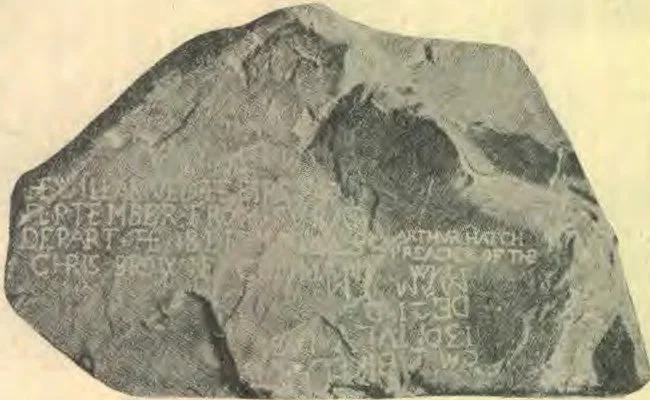
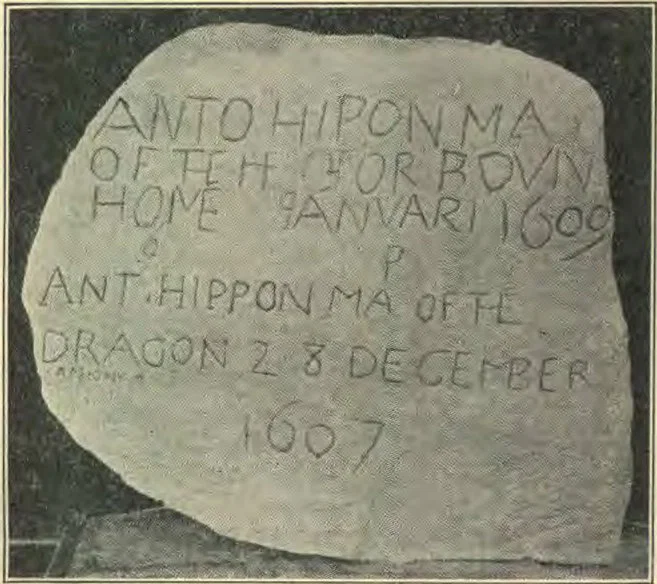
Navigators would also frequently chisel on the large rocks or bowlders the date of the arrival of their vessel and from what port they had sailed, with the name of the vessel and of its captain, also the time of its departure, and to what place it was bound. Many of these inscribed stones have been found along the South African coast as excavations have been made. They are now seen in the museums.
From the fact that many of the stones were used as post offices by the early navigators, they were called post-office stones. Vessels in transit between Europe and the Far East would carefully prepare packages of letters or gifts to their loved ones at home, and deposit them underneath these rocks, that perchance the sailors of the homeward-bound vessel might see them and take them to the homeland. These packages had to be placed in oil bags, then carefully wrapped in canvas and thoroughly pitched, making them water-tight, for oftentimes they had to withstand the elements for many months. To the credit of the native people, let it be said that, although they well knew the location of these little packets, seldom was one disturbed.
The accompanying pictures show two of these post-office stones probably used for securing home letters by early navigators visiting the southern shores of the Dark Continent. W. B. WHITE.
At Our Mountain School
By S. A. Wellman
It was beautiful weather. The sun shone clear and bright, just a fleck of cloud here and there in the sky, and the habitual haze which fails to more than slightly obscure the sky at the horizon’s rim, because of the intense brilliance of the sunlight. We had journeyed up from the plains and had alighted at the terminal station, Kotdwara, at the end of the short branch of the railway running from Najibabad to this place. By ekka we made the next ten miles, through a beautiful mountain valley with overhanging rocks, while beneath was a pretty little river, to Dogada, where we needs must change to horses for the sixteen miles yet ahead of us. Having lunched under a tree from our tiffin baskets, and seen our luggage safely loaded on the pack ponies, we mounted our steeds and started up the bridle path toward Garhwal.
At one side of us for about six miles ran a pretty mountain stream. Where the river passes through a cut in the hills, having hewn its way in past centuries through about forty feet of solid rock, we essayed a bath in some beautiful pools hidden from the road.
At Dwarikhal, where is the post office which serves our school and the surrounding villages, and where the road caps the ridge for the first time in its winding toward Pauri, the seat of the Garhwal deputy commissioner, we paused a moment and listened, for from the ridge above us was heard the roll of drums.
It is a weird sound when first heard, these drumbeats of India. We all know how, when the drum and fife roll out their message in the West, it stirs the blood and brings the martial spirit into being. Even without the other instruments the drum sends its soul-stirring call upon the still air, and it some way strikes a chord in the martial nature of the race. Here in India, as in all central and southern Asia, the drum has ever been the means of calling the people together. Yet here it seems more than elsewhere to have its message. Oft in the stillness of the shadowy night, as one sits in some10quiet corner on the plain, or on the mountain top, listening to the night sounds, there will come rolling in from some neighboring village the stirring note of the drum, or the low moaning of its hushed voice from a distant hamlet across the valley. It is said that all the great raids of the past years were signaled by such drum calls. And if ever the central Asiatic band should send forth its hordes upon the West as in the days of Ghengis Khan, the call would come through the message of the drums, each stroke of which is known and heeded by the wild tribes of central Asia and the Indian frontiers. How quickly the call could be sounded can only be realized by one who knows how soon such calls are heard and heeded throughout the length and breadth of the East.
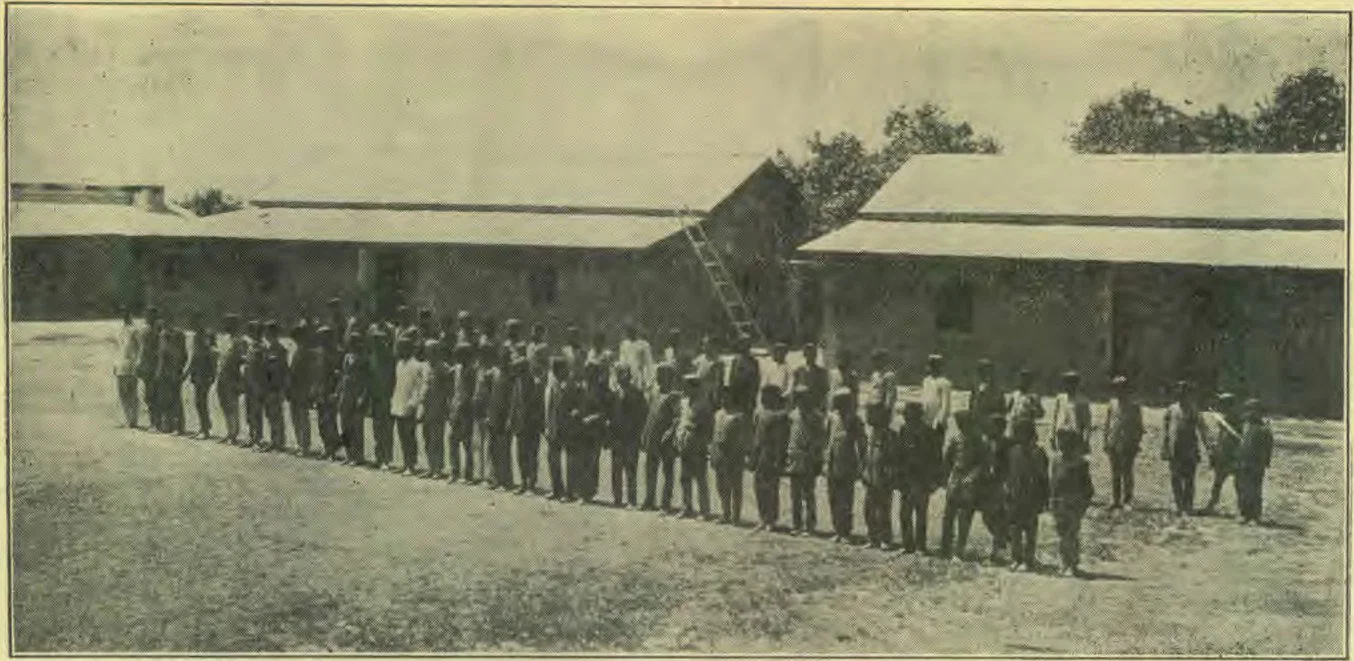
BOYS OF CHILASSIN SCHOOL. AT DRILL.
But in these hastening hours of the day, when the sun had already disappeared behind the intervening peaks, the roll of the drums were sending us a message of welcome, for on the ridge above us the masters and boys of the school were waiting the coming of our party; and during the intervening mile of difficult mountain road we strained our eyes to catch the first glimpse of the waiting school.
As we came up to them, we were requested to dismount, and in accord with the custom of these quaint and ancient people, we were garlanded with flowers. Remounted, we started along the ridge to the school, three miles distant, the drums leading, followed by our party and the two head teachers on horseback, and behind us, double file, marched the boys of the school, cheery, disciplined, and making light of their long tramp and longer wait. They are hardy chaps, inured to the heights of the Himalayas and the tedious climbs up the precipitous mountain sides.
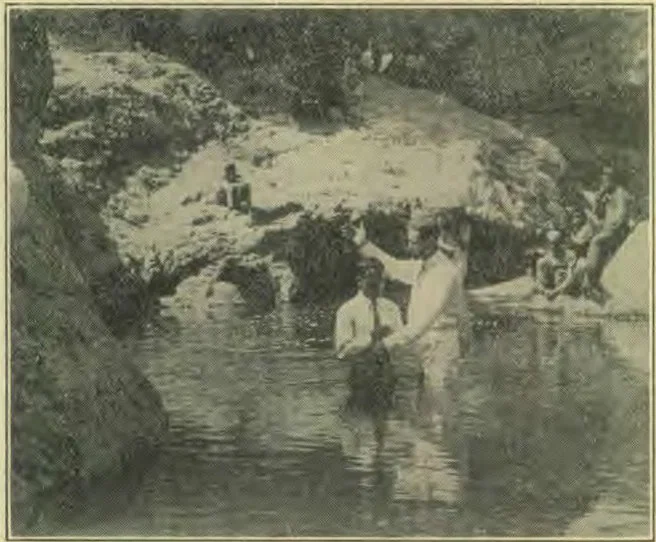
PROF. H. R. SALISBURY BAPTIZING THE HEAD MASTER OF THE SCHOOL
Arriving at the school at sunset, we were treated to a series of physical drills by the school, under the leadership of the head master, all of which showed the excellent training the boys had received. The accompanying picture shows the school just after these drills were completed.
The school yard itself was neatly and tastily decorated, with “Welcome” over the front entrance, and the avenue to the bungalow in which the principal lives arched with bent bamboo. But to us the most precious memory lies not in the decorations themselves, but in the spirit of good will and hospitality which prompted the work and urged to the effort. Such a spirit is found everywhere in India by one who is looking toward understanding this people, with their long centuries of curious customs and their inherent hospitality.
Three nights and two days were spent with the school, the first day in an inspection of the school and property by Professor Salisbury, and in consultation with the teachers regarding their work. The second day we prepared to go to one of the mountain streams about nine miles distant, for the baptism of the head master. Leaving the school in the early morning, we descended into the valley, several miles of the road being steep and rough, then along the bottom of the valley, up another ridge and over, deep again into the valley, and finally, after a slight climb, down into the valley in which flowed a beautiful stream, a confluent of the Ganges, below the falls of which a pool, beautifully situated and clear as crystal, had been selected for the rite. The boys of the school had come to witness the scene, and sat grouped on the rocks at the side of the pool, while an explanation of the meaning of baptism was made, and prayer was offered, both in their own language. Then the head master of the school, who for four years has walked and taught among them, identified himself with this people, and signified his intention of being more like his Lord, by burial in baptism. Professor Salisbury performed the ceremony. This baptism is the first fruits of the work in Garhwal,11but we believe it is the beginning of a work that will develop into strong Christian communities in coming years.
Boys in India are much like boys at home. Outside of school hours these lads of the school play games similar to those of our boyhood days, and are as honorable about their play as the majority of home lads. As the day of baptism was a holiday for the school, the time after the baptism was theirs, and they made good use of it, bathing, swimming, diving, some of them showing much skill. Like the American boy, they enjoy a joke, and many an unexpected ducking was the portion of the unwary. But it was taken in good part, and returned if possible.
The return journey, mostly uphill, rising by heavy gradients to nearly six thousand feet, was a weary trip, and when we walked into the school yard as it was growing dusk, we were eager for rest and refreshment.
In India one does not dare to drink of the streams, nor eat promiscuously from the bazaars. Milk, unboiled, is dangerous also, for from all these sources come cholera and the enteric fevers which are so prevalent in India. So in these long journeys one must either carry water and food or go without. After our long tramp and the shortness of food and drink, we gladly welcomed the water of the mountain spring, and the food found at the school, so hospitably prepared by Mr. and Mrs. Belgrave. The journey down again to the heat of the plains was uneventful.
We had enjoyed, despite the toilsomeness of our journey, the opportunities for service in a growing and hopeful work. In days to come we believe we shall see some of these bright boys wholly given to the Master’s service, and devoting their lives to the salvation of others. Several have already signified their love for Christ, and their desire to yield their lives to him.