This name is given to the society organized in many of our churches where several copies of the SIGNS OF THE TIMES are sent to one address, and are systematically distributed. This society is generally conducted by those sisters whose household duties confine them principally at home, many of whom have good address, and can find time to send a few papers to individuals and to correspond with them. The plan is this: They organize by selecting a president, secretary, and treasurer of their own number. They then meet regularly once a week, have first a season of prayer for God to guide them in all their deliberations, and in their work. Secondly, they read the letters they have received during the week. Thirdly, if any special case comes up, after consultation they decide who shall write to such a person. Fourthly, after dividing up their papers, they conclude their interview with another season of prayer.
During the week they send their papers to persons whose addresses they have obtained from various sources. When they find an interested reader, tracts are sent with the SIGNS. They also obtain addresses from them, so there is no end to names of persons with whom to correspond. One sister who has been engaged in this branch of the work for years has, during the past season, managed one hundred copies of the SIGNS alone, besides filling the office of State Tract Society secretary, S. B. treasurer and collector of a church of ninety members, and she has also a class in the Sabbath-school. Usually they do not send more than three papers before writing.
Thus they connect labor and prayer in their efforts. And none but those who have been thus employed can tell of the inspiration and joy there is to those engaged in the work when individuals become interested, embrace the truth, turn missionaries, and work for others. Individuals and small companies in the West and South who have never seen the face of a Sabbath-keeper save their own company, and who one year ago had never heard of the truth, are to-day rejoicing in the light. They embraced the truth in the manner above described. Thousands of copies of the SIGNS are thus sent out each week, and hundreds of copies of the TIDENDE and HAROLD each month; while there are a goodly number of such societies formed both in Europe and America to distribute LES SIGNES DES TEMPS. We can but hope that this work will go on until every company of Seventh-day Adventists, whether French, German, Danish, Norwegian, Swedish, or American, will co-operate in this manner. Only think of it! Thousands of new families weekly thus receiving the truths of the third angel’s message in six different tongues! May God speed the day.
THE PROPOSED CONSTITUTION.
By Editor
At the late camp-meeting in Michigan, a committee was appointed to revise the Constitution of the various Tract Societies. When the Constitution was first gotten up, it was an experiment. It had not been tried. No constitution of any other society was followed. The necessity of the case called for something to be done. After seven years’ experience, it is no marvel that some changes can be made for the better. The Constitution is now presented with slight alterations and explanations, and proposed to the different T. and M. Societies for their consideration, and if they find it unobjectionable, their adoption. In this no one claims perfection. We shall wait a short time before it is put in book form. If any have suggestions to make or questions to ask in reference to the system, the committee will be happy to receive them and give them proper consideration. The basis of this is a plan drawn up by J. E. White, a practical book-keeper at the Signs Office, at the suggestion of the General Conference Committee.
CONSTITUTION.
ARTICLE I. NAME.
This society shall be called the Tract and Missionary Society of the Seventh-day Adventists of the Conference of ______.
ARTICLE II. OFFICERS.
The officers of this society shall be a President; Vice-president; State secretary, who shall also act as Treasurer; and a Board of Directors of ______, of which the President, Vice-president, and State secretary shall, by virtue of their offices, be considered as members. These officers shall be elected yearly. In the district the director shall appoint a secretary, and in each church he shall appoint a librarian. He may also appoint a business agent in large churches where such an officer is needed.
ARTICLE III. OBJECTS.
The objects of this society shall be: 1. The proper distribution of our tracts, pamphlets, and books. 2. To obtain subscribers for our periodicals; to collect dues and renew subscriptions; and to pay subscriptions for the worthy poor. 3. To visit and labor (by correspondence or otherwise) for the encouragement and help of the scattered ones of like precious faith; for those who are falling back because of discouragements; and to interest all within our reach in the great truths connected with the last message of mercy to the world. 4. To find homes for those who may be destitute and needy for the truth’s sake. 5. To bring about among our people that uniform liberality in the payment of Systematic Benevolence which is indicated in the plan, and to encourage equality in the taking of stock in our several denominational institutions, and in donations to other benevolent enterprises which may arise for the advancement of the work.
ARTICLE IV. MEMBERSHIP.
Any person of good standing in a Seventh-day Adventist church, or who is recommended by such a church, may become a member by the payment of one dollar.
ARTICLE V. DUTIES OF OFFICERS.
Section 1. President. The duties of the President shall be (1) To preside over all State or district meetings wherever he may be present; (2) To see that there is a full supply of tracts, books, and papers for the entire State; (3) In fine, to keep his eye on the workings of the society throughout the State, and see that uniformity of action is maintained, and that directors and officers are doing their duty.
Sec. 2. Vice-president. It is the duty of the Vice-president to act in the place of the president in his absence, and to work in connection with the president at his request.
Sec. 3. State Secretary. The State secretary shall keep on hand a full supply of tracts, books, papers, &c., and shall supply the different districts as their wants may require. All the credit business of the State with the offices of publication shall be done through the State secretary, who shall keep an account of all such transactions. In his duty as treasurer he shall receive all moneys from the districts, and from time to time forward the same to the offices of publication as the indebtedness of the society may demand.
Sec. 4. Directors. There shall be a director for each district in the State, and his duties in the district shall be similar to the duties of the president in the State. In the absence of the president and vice-president the director of the district shall preside at all district meetings, and at all church meetings at which he may be present.
Sec. 5. District Secretary. His duties in the district shall be similar to the duties of the State secretary in the State.
Sec. 6. Librarian. His duties in the church shall be similar to the duties of the district secretary in the district. He should preside at all church missionary meetings where the director is not present, or he may request the business agent, or some active member, to preside, when it will be for the interest of the society to do so.
Sec. 7. Business Agent. He shall act as collector for the society.
ARTICLE VI. QUARTERLY MEETINGS.
General quarterly meetings shall be held under the direction of the board of directors, at which time all business of importance that relates to the Tract and Missionary Society, shall be considered.
ARTICLE VII. FUNDS.
The funds to be employed by this society shall consist of the one-third and money received for memberships, book sales, and as free-will offerings.
ARTICLE VIII. MANAGEMENT.
The Board of Directors shall have the general management and oversight of the work of this society, both in disbursing funds and in counseling in regard to labor.
ARTICLE IX. AMENDMENTS.
This Constitution may be amended at any annual meeting, by a vote of two-thirds of the members present.
INSTRUCTIONS TO OFFICERS AND MEMBERS.
All the business of the Society is done through three grades of secretaries: (1) The librarians, who are secretaries of the church societies; (2) The district secretaries; and (3) the State secretary.
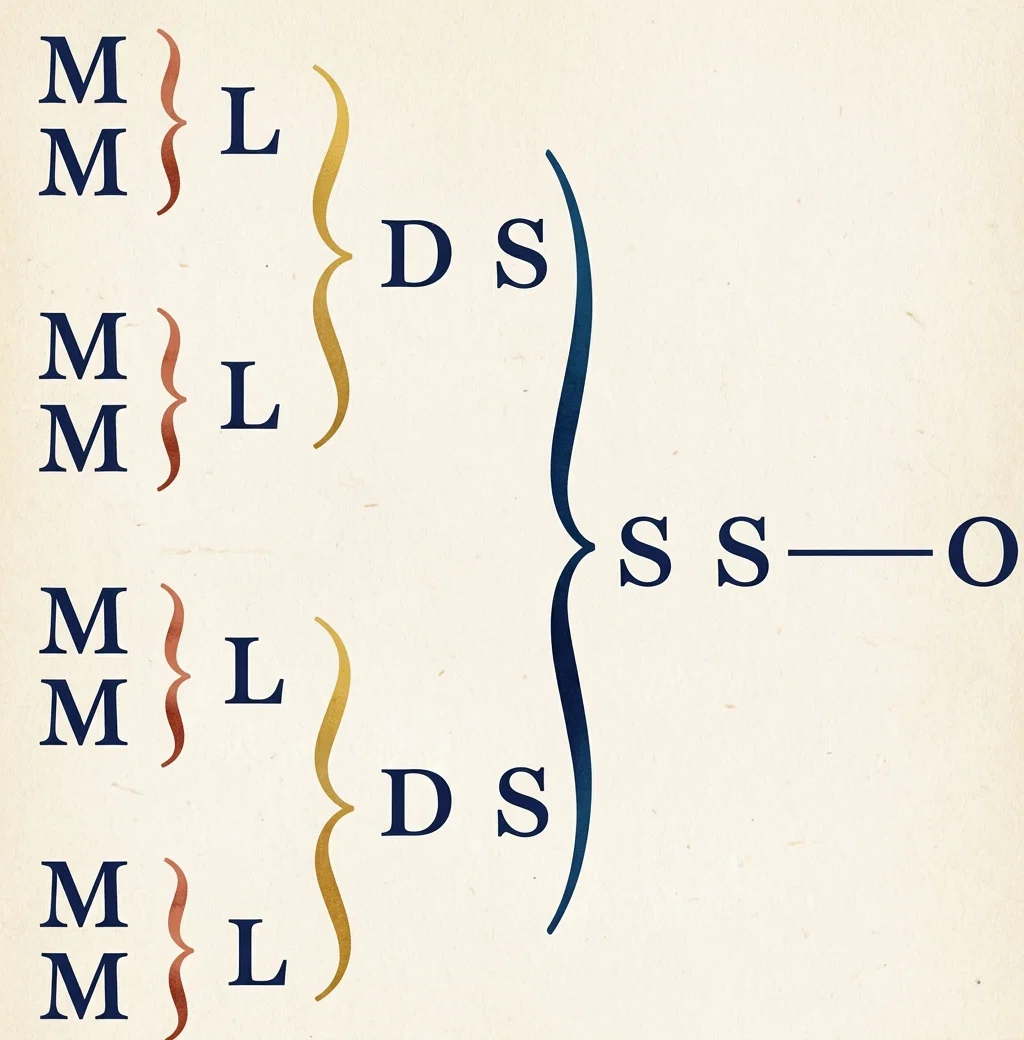
The method of doing business according to this system may well be illustrated by the following diagram:—
M represents the members, L the librarians, D S the district secretaries, S S the State secretary, and O the offices of publication.
The members in the church society, (and the business agent also, when there be one,) bring their business to the librarian. The librarian forwards it to the district secretary. The district secretary forwards to the State secretary all business received from the librarians in his district; and the State secretary forwards the same to the offices of publication.
MEMBERS.
However capable the officers of a T. and M. society may be, its real efficiency depends upon the activity of its members. After joining the society each member should obtain from the librarian a pass book in which to keep a record of all work performed, and any items of interest which may arise while engaged in missionary labor. From the record kept in this pass book the quarterly report is to be made out. He shall also draw from the librarian such reading matter as he may wish to use in his missionary work. A full record of such reading matter drawn should be entered in the pass book, with the number of pages of each kind and the value of the same.
One week before the church quarterly meeting each member will receive from the librarian a blank report, which should be filled out from the record kept in the pass book, to be read at the quarterly meeting. See article on Reporting.
The real work of the members consists in obtaining subscriptions to our periodicals; distributing copies of the same; lending and giving tracts to those who are willing to read; visiting those who are interested in the truth, praying with and for them, and endeavoring to interest those who are still indifferent; calling upon the poor and needy, ascertaining their circumstances, and reporting the same to the proper officers in the church; relieving the widows and orphans; and corresponding with those who may be benefited by such correspondence. A record of all such work should be entered in the pass book.
All moneys received by members, whether on subscriptions for periodicals, from book sales, or from any other source, should be promptly handed to the librarian with a full statement of the business.
BUSINESS AGENT.
The business agent should see that all pledges to the society are promptly paid, and collect dues from old subscribers to our periodicals. He is to collect money on all enterprises that may be entered upon by the society. When money is received on periodicals great care should be taken to give the name of the individual in a clear, legible hand, so that there may be no mistake.
The business agent will need but one book, which may be called a Record Book. In this he will enter the different transactions in full as they occur, and from it a statement should be made out once a week, or oftener if much business is done, to be handed, with the money, to the librarian. Business on periodicals should be reported immediately.
LIBRARIAN.
The work of the librarian is three-fold. First, as librarian, second, as secretary, and third, as treasurer.
1. In his duty as librarian he shall keep in some convenient place, the church is frequently the best, a supply of papers, tracts, &c., to be used by the members in their missionary operations. Care should be taken that a full assortment be kept on hand. He shall supply each member with a pass book in which to enter a record of all work accomplished, and give instruction in regard to its use. He shall keep a supply of blank reports, and hand them out to the members one week before the church quarterly meeting, and see that they are promptly and properly filled out. See article on Reporting.
2. As secretary of the church missionary society he shall keep a list of members, a record of all meetings, and an account of all business transactions. In order to do this, two books will be necessary: a Record book and a Journal. In the first part of the record book should be entered a list of all missionary members in the church, and a record of all meetings of the church missionary society. In the last half of this book should be kept a copy of all business letters. See article, Business Letters.
In the Journal an account should be opened with the district, and with each member in the church. The district should be credited with all books, &c., received by the librarian, and for all periodicals ordered; and charged with all money sent to the district secretary on account. Each member should be charged with all reading matter drawn, and credited with all money paid in by him. The object of these individual accounts is to show what each member is doing, and to guard against the indiscriminate drawing of large quantities of reading matter which may not be judiciously used.
3. As treasurer he shall receive all moneys from the members, and from the business agent, and shall forward the same to the district secretary once a month with a statement specifying for what received. All business on periodicals should be reported the same day that it is received. Accompanying this monthly statement should be a list of those who have joined the society during the month, with their post-office address; and also a list of members who have withdrawn from the district, who have withdrawn from the society, or whose names have been dropped on account of inactivity and failure to report. This is necessary that the record of the district secretary may be complete and correct. As treasurer he shall keep a Cash book, on the debit side of which shall be entered all moneys received, and on the credit side all moneys paid out. See article, How to do Business.
DISTRICT SECRETARY.
The District Secretary shall keep a list of the members in the district, a record of all district meetings, and an account of all business transactions. He shall supply the librarians in his district with blank reports, and see that the reporting in the district is promptly and properly done. See instructions on Reporting. He shall also keep on hand a full supply of tracts, pamphlets, &c., for the supply of the districts, and shall see that the supply does not become exhausted. Immediately after the district quarterly meeting an inventory should be taken of the books on hand, that a full supply for the next quarter may be drawn from the State secretary at the State quarterly meeting.
As secretary two books will be needed, a Record book and a Journal. In the first part of the Record book will be entered, first, a list of members in the district, keeping each church by itself, and giving the post-office address of each member; and second, a record of all district meetings. In the last half should be kept a copy of all business letters. See article, Business Letters.
In the Journal should be opened an account with each church in the district, and with the State. Each church should be charged with all missionary documents sent to it, and for all periodicals ordered by it; and credited with all money received from it. If any church is overdrawing its account, notice of the fact should be sent to the director of the district, and to the librarian of the church overdrawing, that more funds may be raised. Each church should pay its own way as far as possible.
The State should be credited with all books, &c., received by the district, and for all periodicals ordered; and charged with all moneys sent to the State secretary.
As treasurer he shall receive all moneys from the librarians in his district, and forward the same to the State secretary once a month, with a statement of account. Accompanying this statement should be a list of members who have joined during the month, specifying the church which they have joined and giving their post-office address. This is necessary that the State secretary may keep a full record of the membership in the State.
As treasurer he shall keep a Cash book, on the debit side of which shall be entered all moneys received, and on the credit side all moneys paid out. See article, How to do Business.
STATE SECRETARY.
The State secretary shall keep a list of members in the State, a record of all State and directors’ meetings, and an account of all business transactions. He shall keep on hand a full supply of tracts, pamphlets, books, specimen copies of our periodicals, and such other missionary documents as are needed throughout the State. The wants of the society should be anticipated by the State secretary, and the greatest care taken that nothing shall hinder its activity. He should keep a supply of blank reports for the State, and see that the districts are supplied with them, and that reporting is properly attended to. See article on Reporting.
As Secretary three books will be required; a Record book, a Letter book, and a Journal. In the first part of the Record book will be kept a list of members, classified according to the church and district to which they belong, giving also the post-office address of each. In the latter part of the Record book should be kept a record of all State and directors’ meetings. In the Letter book will be kept a copy of all business letters. See article Business Letters. In the Journal, an account should be opened with each district in the State, and an account with each of the offices of publication. In this book, each district should be charged with all books sent to it, and for periodicals ordered by it, and credited with all moneys received from it on account. If any district is overdrawing its account, the State secretary shall notify the president and the director of the district, that more funds may be raised in the district, as each district should bear its own burden. On the accounts with the offices of publication, they should be credited with everything received from them, and charged with all money sent on account.
As treasurer, he shall receive all moneys from the district secretaries, and forward the same to the offices of publication once a month with a statement of account. As treasurer, he shall keep a Cash book, on the debit side of which3shall be entered all moneys received, and on the credit side all moneys paid out. See article, How to do Business.
PRESIDENT.
The President shall preside at all T. and M. meetings in the State whenever he may be present. He shall see that the whole State is supplied with everything necessary for the successful prosecution of the work. He shall thoroughly acquaint himself with the duties of all officers in the State, and be prepared to give them full instructions in regard to their duties and how to perform them. He shall make himself familiar with the plans for keeping accounts for all the officers in the State, as brought out in article, How to do Business, and be prepared to audit any officer’s account in the State, and give instructions to all who do not fully understand how to keep their books. In fine, his eye shall be open to the wants of the whole State, and his efforts shall be exerted to produce harmony and efficient work.
VICE-PRESIDENT.
Too often the Vice-president has acted as though no responsibility rested upon him. By reading Art. II. of the Constitution, it will be seen that he is one of the Board of Directors, although he may have no district specially allotted to him. In Art. V., Sec. 2, it will be seen that he is expected to preside over all meetings of the society which he may attend in the absence of the president.
He is also to work in the interests of the society as the president may request. It will therefore be necessary that he become fully acquainted with the workings of the society, and the method of book-keeping adopted.
DIRECTORS.
The first work of the director after his election will be to make himself conversant with the plan of doing business adopted by the society.
The same work will be required of the director in the district as is required of the president in the State. Please read instructions to president. After acquainting himself with the duties of each officer in the district, he shall appoint a secretary for the district, and a librarian and a business agent for each church. In the absence of the president and vice-president, the director shall preside at all district meetings and at all church missionary meetings at which he may be present.
REPORTING.
The object of the reporting system is to obtain a summary each quarter of all the missionary work accomplished in the State.
If this is properly done, it will show whether the State is accomplishing the work it should, and what branches of the work, if any, are being neglected. It will also show which districts are alive and active, and which districts need arousing to greater activity. The same will be manifest to each director in regard to the churches in his district. The reporting system will prove an incentive to activity to every member and officer in the State, which cannot well be neglected. One week before the church quarterly meeting, the librarian should hand to each member a blank report, which should be filled out by the member from the record kept in his pass book. The manner of filling out this report is fully described on the back of the report. These reports should be read by the members at the church quarterly meetings and passed to the librarian.
The librarian makes out upon a similar blank a summary of the reports of members, which he reads at the district quarterly meeting and passes to the district secretary. The district secretary makes up a summary from all the reports received from the librarians, which he shall read at the State quarterly meeting and pass to the State secretary. From these district reports, the State secretary makes out a summary for the State. The plan of holding the church quarterly meeting the first Sunday in the quarter, the district quarterly meeting the second Sunday, and the State quarterly meeting the third, makes the plan of reporting easy to carry out.
Any member who fails to report for two quarters in succession should be dropped from the list of working members. They may be re-instated again upon resuming work. This is necessary to prevent the list becoming encumbered with names of inactive members.
BUSINESS LETTERS.
Perhaps nothing gives rise to so much difficulty in the missionary work, as the careless manner in which business letters are frequently written. A few rules if adopted and always followed will soon establish a correct habit in letter writing, which is no mean accomplishment. Below is a sample showing the principal features which should be embodied in a business letter:
(1.) Oakland, Cal., Jan. 10th, 1877.
(2.) Review and Herald, Battle Creek, Mich. :—
(3.) Please send by freight, addressed SIGNS OF THE TIMES, Oakland, Cal., 200 copies Life of Urgos, 250 copies History of the Sabbath. Charge the same to the account of the SIGNS OF THE TIMES. Yours truly,
(4.) James White.
In our explanation the following figures will be noticed:—
(1.) The date line. This should specify the post-office address of the writer, and the date of writing. Nothing is so aggravating as to receive a letter in which the address of the writer is not given, unless it be the failure to sign the name. If either of these particulars is omitted the letter is valueless.
(2.) The party addressed. This should specify both the name and post-office address of the party to whom the letter is written. If this is done it is almost sure to reach the person intended, even if, through carelessness, it should fall into other hands.
(3.) The body of the letter. This should be plain, right to the point, and stated in as few words as possible. When business is sent it should not be mixed up with other communications. Where a person has a large number of business letters to read and attend to each day, it is very tiresome to be obliged to wade through two or three pages on other topics to find the one item of business contained. If anything is to be said on any other topic, or to the editors, let it be on another piece of paper. Keep the business by itself.
(4.) The signature. Of whatever other carelessness you may be guilty, do not forget to sign your name clear, and in full. Make every letter so plain that it could be read if standing alone.
Finally, be careful. Remember that what may be so plain to you may not be so plain to the person to whom you are writing. Don’t leave out half you wish to say, and leave the reader to guess the rest.
All missionary letters should be copied in the Record or Letter book, and numbered at the head. The same number should be placed over the letter, and over the copy in the letter book, so that in case of future reference the letter can be referred to by number.
It has also been suggested that each item of business in the letter should be numbered, so that any item may be referred to by number. This is a good plan, especially when many items are introduced into one letter.
A FULL CANVASS.
When a thorough canvass of any place is desired, it is a good plan to divide the territory into districts, and divide the workers into as many companies as there are districts, and appoint a leader from their number for each district. The leader apportions to each individual the streets, or portions of the territory he is to canvass, receives the business done by the members in his district, and passes the same to the librarian. By following this system the same ground will not be gone over by two or more individuals.
PERIODICALS AND BOOKS FREE.
One part of the tract and missionary work is to furnish librarians and reading rooms with such books and periodicals as the judgment of proper individuals would approve. But this work should be done with deliberation and care. If a church is not in debt to the district it may furnish books to libraries by obtaining the consent of the president, and the director of the district. If in debt the matter should be referred to the State quarterly meeting. Periodicals may be furnished to libraries, reading rooms, or to the worthy poor, by the vote of any church missionary meeting, provided the church is not in debt to the district. If in debt to the district the matter should be referred to the director.
QUARTERLY MEETINGS.
According to the plan suggested by the General Conference Committee, the missionary year should commence with January, and the quarters commence with the months of January, April, July, and October. The church quarterly meeting should be held the first Sunday in the quarter, the district quarterly meeting the second Sunday, and the State quarterly meeting the third. By following this plan, reports can be ready in time for the State secretary’s summary. At the church quarterly meetings, every member should, if possible, be present. At the district quarterly meeting, the librarian and business agent from each church, and as many of the members as possible, should be present. It is important that all the church officers should be present at these meetings, for there plans are matured which can be taken home and put into active operation. At this time the librarians should obtain a supply of books and papers for the next quarter. At the State quarterly meetings the director and secretary of each district, and as many of the church officers and members as possible, should be present. Every district officer should be present at the State quarterly meetings, as the workings of the society in the whole State are here discussed, and the spirit of the work should be fully entered into and carried to their respective districts. At this time the district secretaries should obtain a supply of books and papers for the coming quarter.
EXPLANATIONS.
It will be noticed in article V., sections 3 and 5, of the Constitution, that the State secretary is made treasurer of the State, and that the district secretary is made treasurer of the district, instead of the director. The utility of this plan is readily seen, especially in the latter case, as the district secretary keeps the records of all business done in the district, and therefore should have a correct account of all moneys received, for what purpose, and from whom, and also a record of all moneys paid out. His being treasurer will save much of the director’s time, and will obviate confusion which is liable to occur. He does the corresponding, acting under the direction and supervision of the director; and the director sustains the same relation to the district secretary that the president does to the State secretary. All money received by the district secretary should be forwarded to the State secretary, at regular intervals.
THE LOSS OF TIME.
It will be seen by the diagram and its explanation that the business when properly done, passes through the hands of three different secretaries before reaching the Office of publication. This in most cases is the very best and easiest, as well as the most thorough way of doing the work; but in some of our large States where the brethren are mostly farmers, and are widely scattered from each other and the post office, a difficulty has arisen from the loss of time in getting business to the Office. This trouble can be largely alleviated by choosing secretaries, and especially a State secretary, who live near a post office, and who are prompt in doing the business sent to them.
Where this does not remove the difficulty, those large Conferences, such as Iowa, Missouri, and Kansas, where the brethren are scattered, can arrange the matter among themselves, allowing the different librarians or individuals to send business direct to the State secretary. All moneys, however, should go through the hands of your district secretary. When the Board of Directors decide upon this plan, the individual who does business thus must notify the secretary in his district of the business thus done. All the tract business in the Conference should be done through your State secretary with the Offices of publication; for all charges are made to the State Tract Society. A copy of all business letters to the Office should be numbered and preserved by your State secretary. This will save all confusion. Should any misunderstanding arise, an exact copy of the letter can be referred to.
“THE BOOK.”
A DIRECT argument is found in what follows, in favor of the utility of the Bible, and its heavenly origin, making it “the Book” for the ages of human trial, the revealer and decider of human destiny. A gentleman in New York was personally acquainted with Thomas Paine, the author of the “Age of Reason,” in which with ribald jest he scoffs at the Bible, the best of books, of which Robert Pollock, the Scotch bard, thus sweetly sings:—
“The book—this mighty book—on every line
Marked with the seal of high divinity;
On every leaf bedewed with drops of love
Divine, and with eternal heraldry
And signature of God Almighty sprinkled
From first to last.”
This gentleman, being often in Paine’s company during the last years of his life, gave the following account of a conversation he had with him respecting the Bible:— “One evening I found Paine haranguing his disciples on the great mischief done to mankind by the production of the Bible and Christianity. When he paused, I said: ‘Mr. Paine, you have been in Scotland. You know there is not a more rigid set of people in the world than they are in their attachment to the Bible. Is it not one of the school books?’ Their churches are full of Bibles. When a young man leaves his father’s house, his mother, in packing his chest, always puts a Bible on top of his clothes.’ He replied that it was true. I continued: ‘You have been in Spain and Portugal, where they have no Bibles; and there you can hire a man for a dollar to murder his neighbor, who never gave him any offense.’ He assented. ‘You have been in districts in Europe where not one man in fifty can read, and you have been in Ireland where the majority never saw a Bible. Now you know that it is a historical fact that in one county in England or Ireland there are more capital convictions in six months than there are in the whole population of Scotland in twelve months. Besides this there is not one Scotchman in the almshouse, state’s prison, Bridewell, or penitentiary of New York. Now then if the Bible was so bad a book as you represent it to be, those who use it would be the worst members of society; but the contrary is the fact. Our prisons, almshouses, and penitentiaries are filled with men and women whose ignorance or unbelief prevents their reading the Bible.’”
“It was now near ten o’clock at night. Paine answered not a word, but taking his candle from the table walked up stairs, leaving his friends and myself staring at one another.”
This was indeed the easiest way for him to dispose of the weighty argument; but silence gives consent. This incident is well worth remembering, and invites a more extended examination into all the facts found in connection with our race, pertaining to the free and proper use or the neglect of the Bible, and consequent results. In the light of abundant facts we may well query with Dryden:—
“Whence but from Heaven could men unskilled in arts,
In several ages born, in several parts,
Weave such agreeing truths? Or how, or why
Should all conspire to cheat us with a lie?
Unasked their pains, ungrateful their advice,
Starving their gains—and martyrdom their price.”
—Sel.
A PROSPEROUS BLIND CRIPPLE.
In a sermon in Troy, N. Y., lately, upon contentment and godliness, the Rev. Dr. Webber said: “On my visiting list is the family of a cripple who supports his wife and little ones by making shoes. Not many weeks ago I called upon them, and found that in addition to the affliction resulting from the loss of his lower limbs, the husband and father had become blind. Poverty stared the little family in the face, but even then I heard no word of complaint from him. On the contrary, he made an effort to be cheerful. At a subsequent visit I found the man at work again, and when I entered his shop he exclaimed, ‘I have news for you, sir. I have good news. Last week I recovered my sight a little, and by feeling I made a pair of shoes. I got $3 for them, which paid the rent, and, thank God, we don’t owe a cent. We are prosperous: we are prosperous, sir.’ I went away ashamed of myself feeling that this poor cripple was the only person I had heard say he was prosperous during the last twelve months. Prosperous on $3 a week, while merchants who are making thousands of dollars each year, are grumbling about hard times.”—Presbyterian.
TAKE HEED HOW YE HEAR.
A heathen Indian woman once said to a Christian Indian, named Esther, “I often go to your meetings, and always hear something. One Sunday lately the minister exactly described the state of my heart. Indeed, I fully thought he would soon say, There sits a woman who is just what I have said. Do tell me how the minister knows, and who it is that tells him?”
“Oh, yes,” said Esther, “I will tell you. The minister preaches the pure word of God, and that word speaks to the heart. If we are willing to listen to it, God works in our hearts by His Spirit, and shows us that it is spoken to us. Then we see and hear what is our real state; and every one thinks, ‘That was spoken to me!’”
Old Reviews and Reformers.
By M. L. Huntley
THE call for reading matter having become extensive in the Southern States and elsewhere, we are unable to furnish Signs to all who desire them. If our brethren and sisters have old REVIEWS, REFORMERS, etc., which are lying idle, and will bring them to South Lancaster when they come to attend the quarterly meeting, we can make good use of them. There are many Southern ministers having charge of large Sunday-schools, who are eager to obtain this reading matter for the use of their schools, and gladly send us sufficient to pay the postage. Thus the same papers are read by whole schools of from twenty-five to seventy-five members; and if we can judge anything from letters received, these papers are sought after with great eagerness, both by preachers and people.