God has given to every man and woman talents to be used to his name’s glory. All have not the same gifts; all are not called to do the same work; but to each God has given the ability to do the work appointed him. There are some who think that unless they are directly connected with public religious work, they are not doing the will of God; but this is a mistake. Every one has a work to do for the Master. Just as verily as the minister has his appointed work, the mother has hers. By educating their children to love God, and to fear to offend him, parents can just as surely serve God as can the minister in the pulpit.
It is a wonderful work to make home pleasant, and all that it ought to be. If the heart is given to God, the humblest talents will make the home life all that God would have it. In the home a bright light will shine forth as the result of whole-hearted service to God. The mother is to bring her children to Jesus for his blessing. She is to cherish the words of Christ and teach them to her children. From their babyhood she is to discipline them to self-restraint and self-denial, to habits of neatness and order. The mother can bring her children up so that they will come with open, tender hearts to hear the words of God’s servants. The Lord has need of mothers who in every line of the home life will improve their God-given talents, and fit their children for the family of heaven.
The Lord is served as much, yes, more, by the faithful home worker as by the one who preaches the Word. Fathers and mothers should realize that they are the educators of their children. Children are the heritage of the Lord, and they should be trained and disciplined to form characters that the Lord can approve. When this work is carried on judiciously, and with faithfulness and prayer, angels of God will guard the family, and the most commonplace life will be made sacred. All heaven recognized Abraham’s faithfulness in this respect; and he who blesses the habitation of the righteous said: I know Abraham. He is the priest of his household, and patriarch in his home. He will command his children and his household after him, to keep the way of the Lord, to do justice and judgment.
Symmetry of character is to be restored in men and women, and God calls upon parents with all their capabilities to co-operate with him in this work of restoration. Uncleanness in the home is a great mistake; for it is educating in its effects, and casts its influence abroad. Even in babyhood a right direction should be given to the habits of children. Teach them to keep their bodies clean by bathing at morning and at night. Show them that uncleanness, whether in body or dress, is offensive to God. Constant vigilance must be exercised, that these habits may become second nature to the youth. There must be no lax methods in the home; for the children will never outgrow what they become familiar with in their childhood. If they have been trained to habits of neatness and order, untidiness and slackness will be offensive to them; and impurity will be despised, as it should be.
The Lord commanded the children of Israel to wash their clothes, and put away all impurity from their encampment, lest, in passing by, he should see their uncleanness. God is passing by our homes to-day, and he sees the unsanitary conditions and lax methods of families. Should we not reform, and that without delay? Parents, God has made you his agents, that you may instil right principles into the minds of your children. You have in trust the Lord’s little ones, and that God who was so particular that the children of Israel should grow up with habits of cleanliness will not sanction any impurity in the home to-day. In training your children in habits of cleanliness, you are teaching them spiritual lessons. They see that God would have them clean in heart as well as in body, and will be led to understand pure principles, which God designs7should prompt every act of our lives.
O, that all would understand that these apparently small duties are not to be neglected! Children are peculiarly susceptible to impressions; and the lessons which they receive in early years, they will carry with them through life. All the learning they may acquire will never undo the evil resulting from lax discipline in childhood. One neglect, often repeated, forms habit. One wrong act prepares the way for another. That act, repeated, forms habit. Bad habits are more easily formed than good ones, and are given up with more difficulty. It takes far less time and pains to spoil the disposition of a child than it does to imprint principles and habits of righteousness upon the tablets of the soul. It is only by constantly watching and counterworking the wrong that we can hope to make the disposition right. The Lord will be with you, mothers, as you try to form right habits in your children. But you must begin the training process early, or your future work will be very difficult. Teach them line upon line, precept upon precept, here a little, and there a little. Bear in mind that your children belong to God, and are to become his sons and daughters. He designs that the families on earth shall be samples of the family in heaven.
Children should be clad in plain garments, without ruffles or ornaments. The time spent in needless sewing, God would have devoted to educating them, or in devotional exercises. That garment you are sewing on, that extra dish you plan to prepare, let it be neglected rather than the education of your children. The labor due to your child during the first years of his life will admit of no neglect. No time in his life should the rule be forgotten, Line upon line, precept upon precept, here a little, and there a little. Parents, the Lord knows what kind of work you are doing in the formation of the characters of your children. Will you consider the responsibilities resting upon you as their natural guardians?
Overindulgence always proves an injury to children. It is the veriest cruelty to allow wrong habits to be formed, to give the lines of control into the hands of the child, and let him rule. Children are not to be taught that everything in the house is their plaything, to do with as they please. Instruction in this line should be given even to the smallest children. God designs that the perversities natural to childhood shall be rooted out before they become habit. In the discipline of your children, do not release them from that which you have required them to do. Do not allow yourself to be so absorbed in other things as to become careless. And do not become weary in your guardianship, because your children forget, and do that which you have forbidden. If you lose your temper, you forfeit that which no mother or father can afford to lose — the respect of your children. Never scold, nor permit scolding, in the home.8Never give your child a passionate blow, unless you wish him to learn to quarrel and fight. As parents, you stand in the place of God to your children, and you are to be on guard.
Parents, never act from impulse. Never correct your child when you are angry; for if you do this, you will mold him after your own image — to be impulsive, passionate, and unreasonable. You can be firm without violent threatenings or scoldings. I have seen a mother snatch from the hand of her child something that was giving it special pleasure. The child did not know the reason for this, and naturally felt abused. Then followed a quarrel between parent and child, and a sharp chastisement ended the scene as far as outward appearances were concerned. But that battle left on the tender mind an impression that could not be easily effaced. I said to the mother: “You have wronged your child deeply; you have hurt his soul, and lost his confidence. How this will be restored I know not.” This mother acted unwisely. She did not reason from cause to effect. Her harsh, injudicious management stirred up the worst passions in the heart of her child, and on every similar occasion these passions are aroused and strengthened. This is the worst policy that can be used in family government, — advanced age and maturity of strength warring against a helpless, ignorant little child confirms rebellion in the heart.
But, you ask, shall I never punish my child? Whipping may be essential when every other resort fails; but before you cause your child pain, you will, if you are a Christian father or mother, let your erring little one see that you love him. You will manifest real sorrow because you are compelled to cause him suffering. You will bow before God with your child, and with a heart full of sorrow ask the Lord to forgive. You will pray that Satan may not have control of his mind. You will present before the sympathizing Redeemer his own words, “Suffer little children, and forbid them not, to come unto me: for of such is the kingdom of heaven.” That prayer will bring angels to your side, and your child’s heart will be broken in penitence.
It is a very nice work to deal with human minds. All children can not be treated in the same way; for that restraint which must be kept on one would crush out the life of another. Study the minds and characters of your children. During the first years of their lives is the time to work and watch and pray and encourage every good inclination. This work must go on without interruption. You may be urged to attend mothers’ meetings and sewing-circles, that you may do missionary work; but unless there is a faithful, understanding instructor to be left with your children, it is your duty to reply, “The Lord has committed to me another work, which I can in no wise neglect.” You can not overwork in any line without becoming disqualified for the work of training your little ones, and making them what God would have them be. As Christ’s coworker, you must bring them to him, and ask for grace to discipline and train them for the kingdom of heaven.
Both parents and children should be under the government of God. They are to be ruled by him. By combining the influences of authority and affection, parents can rule in their homes after the order God has given in his Word. There should be no ruling by impulse, no parental oppression; but at the same time no disobedience is to be overlooked. We are not to reach the standard of worldlings, but the standard which God himself has erected. We are diligently to inquire, What hath God said? God’s holy Word is to be our rule, and from this we must never turn aside. No waywardness must be permitted on the part of the children, no disregard of obligations on the part of the parents. Our motto must be, “As for me and my house, we will serve the Lord.”
Seasonable Suggestions
By MRS. J. H. EVANS
MRS. J. H. EVANS
IN canning peaches, try putting up a few for extra occasions this way: Select perfectly ripe fruit, smooth and sound. Pare, divide, and place in heated pint or quart cans. Have boiling a sirup made in the proportion of one cup of sugar to two cups of water (the amount of sugar used is dependent on the sweetness of the fruit and the taste of the user); fill the cans with the boiling sirup at once, adjust rubber rings, and screw down covers. Place each can, as soon as sealed, in a pail or kettle of water heated just to the boiling-point, but not boiling; cover, and let stand till cool. When perfectly cold, remove cans from water, tighten the covers, and set away. Experience shows that the best results are gained when small cans are used, and only a few prepared at one time. Berries, peaches, and other fruits that do not require boiling to make them tender, are most delicious to the taste and delightful to the sight when put up in this way.
SAVE all juice left over in canning berries, cherries, currants, etc. If it is strained, heated, and sealed in glass jars, it will be found very useful in making fruit punches, sherberts, etc.
Fruit Ice.—Fruit ices, properly made, are delicious and refreshing, and far more healthful than ice-cream. All ices should be eaten slowly—and in moderation. An excellent ice, or sherbert, is made as follows: Drain the juice from a can of grated pineapple, and add to it the juice of four large oranges and two lemons, and a small teaspoonful of vanilla. Boil together one pint of water and one and one-half cups of sugar; when cold, add to the fruit juices, and freeze. When frozen to the consistency of custard, open the freezer, and add the white of one egg, beaten stiff with a little powdered sugar. Work the egg well down into the mixture; replace cover of freezer, taking care that no particles of salt get inside; and finish freezing. When frozen, cover, and let stand till ready to serve.
Takoma Park, D. C.
The Time to Trust Him
By Adelbert F. Caldwell
When I meet no opposition
In my way,
When no threatening cloud of doubt
Obscures my day,
When I feel my Master’s presence
By my side,
When I hear his whisper, “Here,
My child, abide,”
When I feel temptation has no
Power to sting,—
It is easy—easy then to trust
My King!
When there’s only opposition
In my way,
When I’m tempted so it seems
I can not pray,
When I grope amid the darkness
For his hand,
When I fail his mysteries
To understand,
When to faith I feel I can no
Longer cling,—
Then it is I need—I need to trust
My King.
— Adelbert F. Caldwell.
Marriage Maxims
The following “marriage maxims” are worthy of more than a hasty reading. Gentlemen need not pass them by, for they are designed for wives; and women should not despise them, for they are addressed to husbands. The nearest approach to domestic felicity on earth is in the mutual cultivation of an absolute unselfishness. Never talk at each other, either alone or in company. Never reflect on a past action, which was done with a good motive and the best judgment at the time. Let each strive to yield oftenest to the wishes of the other. Let self-abnegation be the daily aim and effort of each. Never find fault, unless it is perfectly certain that a fault has been committed; then always speak lovingly. Never taunt with a past mistake. Neglect the whole world besides, rather than each other. Never allow a request to be repeated. Never make a remark at the expense of the other: it is a meanness. Never part for a day without loving words to think of during absence. Never meet without a loving welcome. Never let the sun go down upon any anger or grievance. Never consider any fault you have committed settled until you have frankly confessed it, and asked forgiveness. Never forget the happy hours of early love. Never sigh over what might have been, but try to make the best of what is. Never forget that marriage is ordained of God, and that his blessing alone can make it what it should ever be. Never be contented till you know you are both walking in the narrow way. Never let your hopes rest this side of the eternal home of glory. — Selected.
Communion
By WORTHIE HARRIS HOLDEN
WORTHIE HARRIS HOLDEN
WHAT greater boon to man is given,
What joy more tense with bliss of
heaven,—
That man may talk with God!
To hold communion with our King,
To supplicate as offering
Unto our gracious Lord.
So merciful, so near, thou art,
So patient with each humble heart
That bows before thy throne!
And by thy word an answer given
Is borne us through the gates of heaven
To make thy purpose known.
Communion at the mercy-seat,
Communion in the busy street,
Wherever we may be;
By day, by night, if dark or bright,—
All gloom shall vanish with thy light;
When talking, Lord, with thee.
Portland, Ore.
Somabula (Africa) Mission
By R. C. PORTER
R. C. PORTER
On Tuesday, April 26, accompanied by Sister M. C. Sturdevant, I left Bulawayo for Gwelo. We reached Gwelo at 6:30 in the evening after an uneventful all day’s ride on a slow train. We were met at the station by Elder W. C. Walston and two of the mission boys with an ox-team. As they came prepared for camping, we soon transferred our baggage from the train to the wagon, and were on our way to the mission. After a three hours’ drive through the veldt, dotted here and there with scrubby trees, we camped for the night.
At five o’clock in the morning we were again on the road. Two hours later we camped on the river-bank for breakfast. As this was about four miles from the mission, I walked in after breakfast for exercise. We spent the afternoon looking about the mission and cottages. In the evening I was shown to my sleeping-room in the pole-and-mud mission house. The ceiling was thin white muslin. Elder Walston informed me that a short time before my visit, a large, venomous snake had poked its head through the ceiling, and looked down upon himself and wife; but while he was preparing to kill it, it drew back out of sight behind the ceiling and disappeared. Later, he said, they killed a similar looking snake in the yard before the door. With these thoughts I retired, and soon fell asleep. It may not be thought strange that I dreamed of snakes that night, and that in my dreams I killed them all.
The Farm
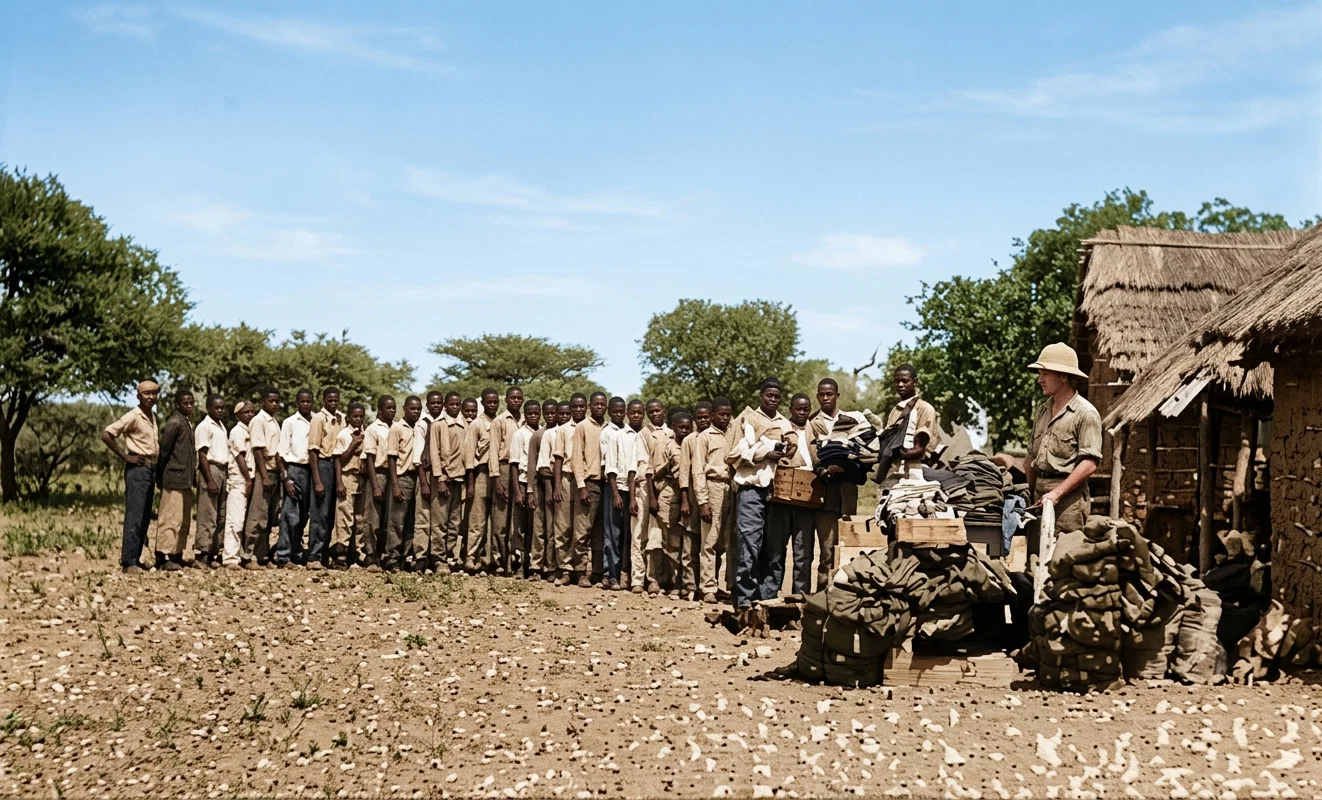
The Somabula Mission owns no farm, but is on a native reserve, which can be leased for only three years at a time. For this reason the buildings are constructed of poles set up on end, and daubed and plastered with dogger (mud). The roofs are thatched with coarse grass. Houses built in this way are comfortable, and very cozy and pleasant inside.
The main station holds a lease of one hundred acres of farming land, and the right to graze over five hundred acres of pasture land. Besides the main mission building, which is occupied by Elder Walston and family and T. J. Gibson and family, the mission has a store building, a wagon-shed, a twelve-by-thirty-foot house for girls, and ten new huts for boys. It also has a study-room for boys, a new kitchen, a dining-room, and a school building. There are now on the mission farm seventy head of cattle, consisting of twenty-one calves, sixteen cows, and thirty-three oxen. The mission workers have recently sold five hundred dollars’ worth of cows, with a view to buying a better class of dairy cows. They have also sixteen donkeys, which they use when, on account of cattle sickness, they can not drive the oxen to Gwelo.
SUPPLYING MISSION BOYS WITH CLOTHES
The mission has about one hundred acres of mealies (corn), four acres of sweet potatoes, and two acres of garden truck. Last year about the same amount of mealies was raised, the workers selling 425 bags (1,500 bushels), besides saving enough to provide for the needs of the family and school. Five acres was planted to sweet potatoes last year, which yielded heavily. The profit from the store during this time was $400. The farming equipment, besides oxen and donkeys, consists of one breaking-plow, one disk-plow, one iron-tooth harrow, two double cultivators, one ox-wagon, one corn-sheller, one corn-grinder, a milk-separator, and a barrel churn.
The School
The main boarding-school is well managed, and is doing good work. There are fifty-four students now enrolled, eight of whom are girls. The three out-schools have an attendance of twenty-five students in each school. Their teaching force consists of four white and eight colored teachers. They have opportunity to start other out-schools on other reserves, if they can be supplied with white teachers to supervise the schools on each reserve. It is contrary to the law to have a white supervisor on one reserve look after the schools on another reserve. This law makes it difficult to extend the work at this station.
THE SOMABULA MISSION SCHOOL
Gold-mines are interspersed through this section of Rhodesia, and this makes it hard to hold the students long enough to get them thoroughly settled in the truth. However, the people must be reached, and I see no other way than to furnish the white supervisors and go forward.
Results
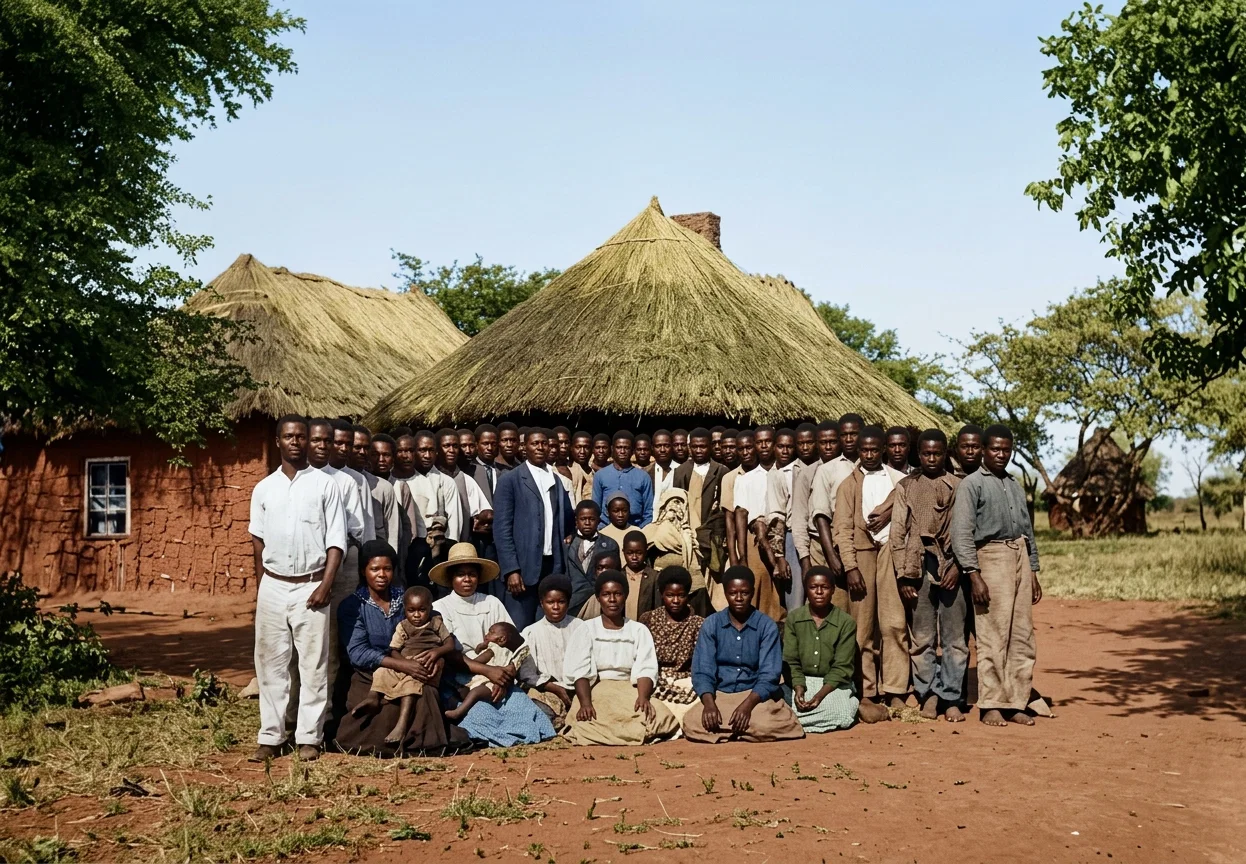
This mission has been in operation eight years. There are fifty-five church-members as the result of the work done during that time. Ten have apostatized, leaving forty-five who have remained faithful. Another class are now taking instruction preparatory to baptism. The tithe last year, including that paid by9the white teachers, was $150; Sabbath-school offerings, $25; annual offering, $25.
The outlook for the future of this station is very promising. If Brother and Sister M. C. Sturdevant go on to open the new station near Umtali, as they hope to do, Brother and Sister Walston will go to Solusi, to take charge of that station, and Brother and Sister Gibson will be provided with help, and will take charge of the work at this station.
We shall long remember our first visit to the Somabula Mission. On Sabbath there were 148 present at the services. One white sister walked twelve miles to attend the meeting, and the natives came in from the surrounding kraals, and paid respectful attention to the word spoken. Most of those present requested prayer, that they might have their sins forgiven and become Christians. When Brother and Sister Walston visited one of their out-schools on the Que Que reserve recently, they were made to weep as they saw the natives coming to attend the Sabbath service, singing the praises of God as they came. They had an audience of two hundred for the Sabbath service.
So the work goes forward. The Lord has it in hand, and it will soon close in glorious triumph. I now go to Nyassaland to visit the Malamulo Mission. Pray for the work in Africa.
Claremont.
The Syrian Mission
By W. C. ISING
W. C. ISING
Nine months have passed since my return from the General Conference in America. Short as this time is, when measured by the conditions prevailing in this country, where things move slowly, we feel grateful to God that he is opening the way before us for the entrance of his message. During the fall and winter of 1909, some work was done in Haifa, at the foot of Mount Carmel, and among the German colonists in Jerusalem. A number of difficulties were encountered, yet we are convinced that the seed sown will bring forth fruit. In Jerusalem we met much opposition, and were obliged to conduct our meetings in five different places. One young girl has taken a definite stand for the truth, and has now kept the Sabbath for three months in spite of opposition from her family. Others are interested, but the fear of man keeps them from testifying to the truth.
THE SOMABULA MISSION FAMILY.
With the beginning of this year our health institution in Jerusalem has been transferred to a more central location. The equipment being much worn through ten years’ use, since the treatment-rooms were established, one thousand dollars was appropriated by the General Conference for refurnishing. The present central location will insure a better and larger patronage, and the improvements will also meet the demands of the better classes. We pray that physical and spiritual help may be effectively administered to those who come for treatment.
In April a German brother seventy-four years old was baptized. He had been studying the truth for about a year. As the water in the sea was still too cold, the ordinance was administered in the fountain basin in our garden. We were made glad to witness the change of nature wrought by the power of God’s message even in a man of this age. The brother is full of joy, and although single and without any person to care for him, he is busily pursuing his work as a printer to earn his living, walking sometimes a hundred miles to another place of labor. When he accepted the truth, he gave fifty dollars of his earnings to the cause, keeping only ten dollars for himself. He said he knew that God would help him to gain his support during the few years of the future after finding the truth, as without it he had never forsaken him during all his life.
It has given us much encouragement to see our first canvasser established at Beirut. Brother Zachary, who came from Persia to Cairo, and found and accepted the truth there a year ago, has been engaged in this important work since February, and is doing well in view of the situation. While we consider the dissemination of our literature one of the most essential factors in the spread of the message, we find many difficulties which hinder its wide circulation in this field. Our experience has caused us to proceed very cautiously.
Representatives of the British and Foreign Bible Society, who established a depository in Beirut in January, and put their first canvasser, a young Armenian, to work, have had serious difficulties. Apparently the young man has been somewhat injudicious in answering questions put to him by the Mohammedans with regard to their faith. He has been imprisoned several times, and they now threaten to kill him if he continues his work.
We are glad that Brother Zachary, who is also an Armenian, has not had to meet with such difficulties as yet. In some instances Catholic priests have torn his tracts and opposed their distribution. The population being chiefly Mohammedan and Catholic, such things are to be expected. But our aim is to find the honest souls by laboring cautiously, rather than to stir up these fanatic masses against us by too vigorous efforts. We are confident that God will help us to find some who are searching for his truth.
The political situation is still unsettled, and there seems little prospect for improvement. Continually new incidents are provoked to deepen the hostility between Mohammedan and Christian. Men go armed, ready to meet calamity. Only recently several persons were wounded and killed in a quarrel over some trifling thing. It was just a year ago that a telegram in cipher from the deposed sultan was sent to the governor of Beirut, urging the slaughter of the Christians at the same time of the massacres of the Armenians. Next to God, the commander-in-chief of the army here deserves the thanks that, on account of his sympathy with the Union and Progress movement, this horrible suggestion was not carried into effect. The chief of the army required that the telegram be read and interpreted to him.
While these conditions continue, we thank God that he has given us an understanding of the signs of his near coming, and a message that brings peace to the soul, even amid such troubles, teaching us to realize the truth of his word: “For ye are dead, and your life is hid with Christ in God. When Christ, who is our life, shall appear, then shall ye also appear with him in glory.” Col. 3: 3, 4.
When we reflect upon the work of the past year, although the material results may appear small, viewed from without, we feel grateful to God for every little success. While our hearts long for greater returns, we bear in mind that in these few seeds God has hidden the germ for the growth and final triumph of his work in this needy mission field.
Beirut.
India
By G. K. OWEN
As Seen by a Native of Michigan
G. K. OWEN
A MAN from the “sunset land,” on his first visit to the Orient, will be sure to meet many surprises. After his long voyage, he is landed amid strange scenes. We left the boat at Bombay, and longing for a little rest, boarded the train for Calcutta. We supposed it to be a train of cars, but soon discovered it to be a string of prisons on wheels, with no doors of communication between. The doors are in the side, none being in the ends of the cars. Between stations, the prisoners are locked in. At stations where the train stops, the doors are opened, and those who wish to do so have opportunity to leave the apartments. As we rode hour after hour through a country so long celebrated for the density of its population, we were disappointed as we looked in vain for numerous fine country residences, surrounded by charming gardens and every home attraction. Instead, we beheld what appeared to be an almost boundless and desolate wilderness. Could it be that those who had taken the census of the country had made a mistake of several hundred millions in their figures?—No, no; this vast country has inhabitants; but they are crowded into cities and villages, the majority living in small huts, leaving the broad plains free to the play of the wild winds.
If I have ever seen a country that needed to have its agricultural and horticultural interests built up, it is India. What is needed most is not so much a few more colleges, and the solution of longer problems in chemistry, but men with minds to think, hearts to dare, and hands to do. Possibilities of wealth lie buried in the soil of India, of which her most venerable sages have never dreamed. Teachers are needed, it is true, but teachers whose hands and feet have felt the soil; whose mental resources have not been limited to the perusal of the printed page, but who have ventured “forth under the open sky, and listened to nature’s teachings;” who have studied the living tree,—its stem, roots, branches, leaves, buds, flowers, fruit, and seed,—as well as the soil in which it grows.
When I first visited the Annfield estate at Mussoorie, I looked around among the rocks, crags, and peaks, and almost decided that the place presented no prospect for the smallest garden spot; but, after more careful search, I found beds of rich black soil three feet deep. This soil had been formed by the decaying leaves that had for generations rolled down the mountainside.
India has the soil, the climate, the seeds, the plants, of the right quality and variety to produce an abundant supply of fruits and other kinds of foods to feed all her children; yet there is such a lack of enterprise in bringing seed and soil together, that the people go hungry, and famine annually brings a vast army of them to an untimely grave. There is a lack of enterprise that seems hard to believe until one sees it. In the great city of Calcutta, with its million inhabitants, its university and other large institutions of learning, and its immense market, piled with tons upon tons of the various productions of the surrounding country, you can get your market-basket filled for a few annas, and a coolie will carry it to your home for a few pice. But when the food comes to the table, what have you? Instead of the large, plump bananas, such as you find in most markets of the world, you have an inferior variety, cut from the plant when about half grown, and about the size of a man’s thumb.
Do you ask why, in the very heart of a country with climate and soil suited to the production of the finest bananas in the world, such fruit is accepted? The only answer I have found to this question is that several generations ago, there was dropped the seed of a poor variety of banana in the vicinity of Calcutta, and there is not enterprise enough in the vicinity of that city to send away for a good variety; so only the poor kind finds a place in the Calcutta market.
Having completed our ride from Bombay to Calcutta, and taken some refreshment and a little rest, let us walk out on the road toward the country. We soon approach a drove of cattle. What strange burden is each one carrying? Is a monkey stealing a ride on each one of them?—No, that large lump just above the shoulders is a part of the anatomy of the animal; and as long as you remain in India, you look in vain for such animals as you have been accustomed to call cows and oxen.
Some buffaloes are just passing. Not such lion-like beasts as the American buffalo or bison, which used to thunder across the Western plains in large herds, tearing up the earth as they moved. No; these have spreading horns, wide bodies, and move slowly, but haul large loads. They seem to enjoy soaking themselves for hours in lake or pond during sultry midday. Large monkeys travel over the tree-tops, leaping long distances from tree to tree, and venturing quite near the Annfield house when they can find fruit on the orchard trees. Barking deer are also troublesome, injuring the young and tender fruit-trees.
The wild birds here are an interesting study, especially those that seem to sing in plain English. One of the most cheerful songs I have heard in this country is sung by a bird that sings very sweetly and distinctly. Rhythm, emphasis, and inflection are perfect. The flattering address in the first line seems to be irrelevant, and intended for some other person; but in the second line, he pours out the music and melody of his soul as if composing the song for that special occasion, and intending it only for the ear of the listener. If there is power in this sweet little song to cheer the heart of some other missionary, who may hear it warbled by one of the same feathered songsters, and he understands and appreciates it as the writer does, it may not be amiss to publish it; though the lack of music can not but be a matter of regret. Here are the words:—
Pretty, bright boy,
Cheer! Cheer, boy,
Wewywy.
Many other creatures of the lower orders attract the attention of the missionaries who visit this part of the Orient, but their special interest is in those who may be able to understand the message of eternal interest, which they have come so far to bring.
Mussoorie.
An Unexpected Answer
In the hill country of southern Rajputana there was in 1909 an earthquake of sufficient magnitude to occasion much anxiety among the people, easily moved to superstitious fears. What does it mean? they asked. What calamities are impending? What can we do to prevent them? Many answers were given, but no one could speak with authority. Messages were sent from village to village, calling on the men of wisdom, the religious guides and teachers of the people. Among those called was a village guru named Chimman, who had come under the influence of a Christian woman, and whose boy she had taught to read.
At the place appointed some four hundred persons assembled, among them half a hundred gurus of repute. For several hours they gave their opinions. At length one called on Chimman to speak. He said, “I can not read well, but my boy has with him the Book of God.” The lad, only thirteen years of age, stood up before them all. He opened his Bible, and read in the Hindu version our Saviour’s words, as given in the twenty-first chapter of Luke: “For these things must needs come to pass first; but the end is not immediately.”
“In your patience possess ye your souls.” Then the judgments of the latter days; the coming of the Son of man from heaven with power and great glory; and the assuring promise, “Heaven and earth shall pass away: but my words shall not pass away.”
A great hush came over the people as these words were read. It was as if a divine answer had come to the perplexities and questionings of men, and a solution was found for the mysteries of earth and heaven.
Then one said, “Chimman, you can pray. Pray to Jesus Christ for us.” And Chimman, who could not read very well, lifted his voice in prayer, while Hindu and Mussulman, guru and cheda, bowed the head in reverence: “Jesus, Lord, have mercy on us. Wash us in thy precious blood. Make us fit to stand before thee, accepted in thy kingdom of righteousness and peace.”—Selected.
Two Classes of Men
There are but two classes of men: the righteous, who think themselves to be sinners; and the sinners, who think themselves righteous.—Pascal.