Your ShelfYour Projects

Review and Herald, Vol. 87, No. 30.

Denial
Earlier text: Unity of the Body

Our Mission Fields and the Foreign Mission Seminary

THE selecting and training of suitable workers for the mission fields is one of the great and necessary problems continually before us in our foreign mission program. The growth and present development of the work demand a larger and more efficient force of workers to meet the pressing calls coming to us.
Up to the present our workers have entered every continent and many of the islands of the sea. Organized conferences and mission fields are embracing the darkest corners of the earth. We are now printing literature in more than sixty languages. Schools, sanitariums, and printing-houses are springing up in various places. All these enterprises call for more men and women fitted to undertake various kinds of work in the cause. If this movement shall advance the next few years as it has in the past, a large company of young people must be selected and trained for work both in the home land and in the mission field. Our great need in the finishing of the work is a strong, trained, spirit-filled corps of missionaries.
In the past, in selecting recruits for mission lands, the lists of workers in State and local conferences have been carefully studied, and missionaries selected. We have drawn until local trained forces have become very much reduced. Many of our most devoted and gifted laborers have been chosen and sent abroad to start work in other lands. From some conferences so many workers have been taken that it seems unwise and unjust to the interests at stake to ask for another worker at the present time.
And yet the calls from the regions beyond are steadily increasing. In the great heathen lands of the East we have scarcely begun. What is our small band of fifty workers in India among the three hundred millions?—Only a drop in the bucket. At the last General Conference forty families were voted for China, yet only twelve have been sent forward. Of the twenty-five families voted for India only six have gone to the field. How shall we answer these definite calls? where shall we find suitable recruits to fill these orders?
Seeing the position we were coming to in answering the growing calls for mission workers, the General Conference Committee, three years ago, while in council at Gland, Switzerland, conceived the idea of changing the Washington Training College to the Washington Foreign Mission Seminary, with the purpose in view of providing at headquarters a place of training for foreign missionaries. This was an advance step in our missionary undertaking, but a very needful and important one.
The aim of the Foreign Mission Seminary is to give the necessary training for the mission field. Missionaries who have spent a number of years in mission fields have very definite convictions regarding the preparation required by those who go to the regions beyond. They urge that volunteers for missions should obtain a good knowledge of the geography of the country to which they are going; should be familiar with the history of the people, and their customs and habits; and should have a knowledge of the history of Christian missions, and the many problems which must be met and surmounted. Still more important is it that they should have a knowledge of the religions to be met, the specious, subtle errors they contain, and the wise and effective manner of displacing these by the Word of God. These alone, if no other reasons were presented, make necessary a place of special training for foreign missionaries.
Other missionary societies have felt this need, and provided schools for this purpose. From a pamphlet giving an account of the recent World’s Missionary Conference in Edinburgh, Scotland, we quote: “A number of experienced and distinguished missionaries have impressed upon the commission their conviction that one of the most urgent requirements of the missionary situation at the present day is that missionaries should be given a more thorough training in the language, customs, history, and religion of the people to whom they go. It also seems necessary for their efficient equipment that they should have some knowledge of missionary effort, the main practical problems which they will have to face, and views regarding the solution of these problems which have commended themselves to the most experienced missionaries in different lands.”
Residence in an Oriental country makes the missionary feel the need of special training for work in those fields. Life from many aspects in these lands is so entirely different than at home that a previous acquaintance with conditions which obtain, a knowledge of the people, their history, and religion, gives the prospective missionary great advantage. A commission on Oriental studies appointed by the British government has recently issued a report pointing out that Great Britain, in spite of its pre-eminence as a colonial power, is far behind Germany and France in its provision for the study of Oriental subjects, and recommending the establishment in London of a school of Oriental studies at an estimated cost of £12,000 a year for the training of civil servants, officers, merchants, and missionaries in these subjects.
The Foreign Mission Seminary is not to do the same work that our academies and colleges undertake. The Seminary receives young men and women for the most part of some maturity, and gives them a fitting for the gospel ministry, general missionary work, and other lines of effort to which they have dedicated their lives, and it seeks to adapt the instruction in these subjects to the special needs of the foreign field.
We may call the Foreign Mission Seminary a gate to the mission field. Here it is that workers going abroad receive their final fitting up for service in their respective fields. Here the General Conference Committee, who have the responsibility of appointing workers to foreign fields, may have the opportunity of becoming acquainted with those who are sent abroad. It is wise that they should avail themselves of every possible opportunity of knowing personally the men and women they choose to be representatives of this truth in mission lands. Many thousands of dollars are spent yearly in the transportation of missionaries to far-distant fields. If the worker is unsuited to the work and climate to which he is sent, not only is money spent to no purpose, but the individual who goes, and finds, or thinks he finds, himself a misfit, returns disheartened and discouraged. It may take years for him to get back the bright Christian experience of previous days, and in some instances the truth is given up, and a life of discouraging worldliness follows. In justice to the mission funds and to prospective foreign mission candidates, a place of final fitting up, under the immediate observation of the Mission Board, is not only desirable, but very necessary.
The Foreign Mission Seminary should have one hundred strong, consecrated young men and women in attendance this coming year. Urgent calls for evangelists, teachers, and medical missionaries come from many lands. To answer these repeated calls our mature, strong, promising young people should be gathered in for final training and acquaintance preparatory to service at the front. The writer would be pleased to correspond with such as have a foreign field in view. Full information as to work, experience, age, health, previous training, etc., is also desired.
There never was a time in the history of our work when greater openings presented themselves in the mission fields. Those whom God is calling should not delay in answering the call. In conclusion we quote the following words of earnest advice from a foreign missionary: “While vast continents are shrouded in almost utter darkness, and hundreds of millions suffer the horrors of heathenism, the burden of proof rests on you to show that the circumstances in which God has placed you were meant by God to keep you from foreign fields.”
J. L. SHAW,
President Foreign Mission Seminary.

The North Dakota Conference

The annual camp-meeting and conference of North Dakota were held June 23 to July 3 at Jamestown, in a beautiful grove on the banks of the James River. About one thousand of our people were in attendance. The conference business passed off very harmoniously. Several gave their hearts to the Lord for the first time, backsliders were reclaimed, and nearly all renewed their consecration to God. Over forty were baptized the last day of the meeting.
A severe drought is affecting this part of the country, and it looks as if the crops would be nearly a failure; yet a liberal donation was made for the general missionary work. A deep interest was also manifested for the work among the colored people in this country, and donations were made to assist that work. The young people raised $125 in cash and pledges to buy a tent to replace the old one that had just been destroyed by a storm in Memphis, Tenn. One brother gave $25 toward a printing outfit for the Oakwood training-school; another gave $20 for the press, and $20 to assist a student to attend the school. Another gave a sewing-machine. The school was in great need of these and other things, and we rejoiced to see our brethren in this conference take such a deep interest in this work.
One experience in this meeting was of special interest to me. A lady and her grown daughter came to Jamestown to attend a Methodist camp-meeting, which began about a week before ours, in another part of the city. They asked at the depot where the camp-meeting was being held, and were directed to the place where our meeting was to be. This was nearly a week before our meeting began, but they found our brethren on the grounds, getting the camp ready. They became interested in our work, and decided to remain for our meeting. This they did, and both accepted the truth. The daughter attended the meetings of our canvassers and colporteurs, and decided to give her time to scattering our good literature.
I might relate other interesting experiences. We all felt that it was good to attend this meeting.
A. J. HAYSMER.

The Montana Camp-Meeting

The five hundred members of the Montana Conference are scattered over a territory greater than the combined area of Maine, New Hampshire, Vermont, Massachusetts, Rhode Island, New York, New Jersey, and Maryland. The surface of the State is diversified by plains, deep, fertile valleys, and high mountain ranges. The scattered condition of the members makes it more difficult for them to attend a general meeting than for our people in most other sections of the country.
The annual camp-meeting this year was held at Helena, June 16-26, and the attendance of about one hundred of our people camped on the grounds was considered quite satisfactory. The business meetings of the conference had been held in January, so the entire time of the meeting was devoted to the spiritual interests of the people. Besides nearly all the laborers of the conference, Elders E. W. Farnsworth, G. B. Thompson, O. A. Johnson, A. J. Breed, and the writer were present a portion of the time during the meeting. The burden of the preaching, which was very practical, was carried by Elders Farnsworth, Thompson, and Johnson. The evening services were devoted to doctrinal themes.
The attendance from outside was not large, but a deep interest was manifested by those who did attend. Several persons, four of whom were soldiers from the near-by barracks, were converted, and took their stand for the truth. The last Sabbath was indeed a blessed day. Without unusual effort, one after another felt constrained to yield to God. The sweet influence of the Holy Spirit was felt in every heart. Confessions were made, and the good work went on with but a short intermission until time for the evening service. The brethren returned to their homes greatly refreshed and strengthened.
Montana is a good field. Union and harmony prevail, and under the blessing of God a strong conference should be developed. The people are alive to the needs of the foreign field, and are making an earnest effort to raise their quota of the $300,000 Fund. More than enough to cover the amount has been pledged, and the conference will endeavor to realize on these pledges during the present year. We left the meeting with the conviction that this conference may be depended upon to bear its full share of responsibility in carrying forward the message.
C. W. FLAIZ.

Georgia

CARTERSVILLE.— In “Gospel Workers,” pages 328-331, there is recorded a beautiful dream about gathering fruit, which we understand illustrates the gospel work. We have been trying to gather some of the ripe fruit in this little town, the home of the noted evangelist, recently deceased, Sam. P. Jones. But just previous to, and in connection with the beginning of, our house-to-house work, about the first of September last, one of our faithful canvassers did some work here, leaving an excellent influence, which we have appreciated very much in our Bible work.
The conference committee had planned to follow up and bind off our Bible work with a tent effort. Being thus instructed, we did all we could to gain the confidence and good will of the people, that there might be a good hearing at the tent; and the Lord has blessed our efforts. The tent-meetings opened May 13, and closed June 19. Never have we heard the message presented more forcibly in any effort. As a result of the work done, six or seven new Sabbath-keepers, all heads of families, have taken a stand for the truth.
Though we had not pressed the doctrinal points very hard in our Bible work, knowing that this would be done in the tent effort, one of these new believers had begun to observe the Sabbath and attend Sabbath-school some time before the tent-meetings were begun. It is also a matter of encouragement to know that all but one who have begun to obey are those with whom we had held Bible readings.
We are of good courage in the Lord and his work, and we praise him that we can have a humble part in the Bible work. May the Lord lay on many others the burden to enter this heaven-born work, and may his blessing rest upon all branches of his cause.
ARTHUR AND TENNIE MANOUS.

West Virginia

The present outlook in West Virginia is very encouraging, and an excellent spirit seems to prevail throughout the entire conference. The tithe is slowly coming up among some of our churches, and our Sabbath-schools are giving all their donations to missions. We are glad for the interest West Virginia is taking in the “Ministry of Healing” campaign, and we hope the tithe will keep on increasing, so that we can support another laborer before long.
It is only as we become connected with the great plan of salvation, and work for God and humanity, that we are of much value in the sight of Heaven. All we save, after all, is what we invest in the cause of God. The one thing worth living for, and the thing which will stand when the voice of God shakes the heavens and the earth, is the third angel’s message. Everything we do to help this message triumph is noticed and recorded on the ledger of heaven.
Our coming camp-meeting, which will be held August 18-28, will be a golden opportunity for our brethren and sisters in West Virginia to work for our young people. Let us seek God earnestly, that the coming camp-meeting season may witness the strongest and most effective effort that has ever been made for our children. God has committed to our hands the sacred work of giving the third angel’s message, and we need to meet together to have our spiritual strength renewed, and also to lay plans for the upbuilding of his cause. If ancient Israel needed to assemble in their holy convocations three times a year, how much more do we at the present time need to meet together to receive spiritual help and blessing.
Elder B. G. Wilkinson will attend our camp-meeting, and we are expecting a number of other leading workers to be with us. On account of not being able to secure suitable camp-grounds in Parkersburg, and taking into consideration the good interest, and an excellent camp-ground offered free of charge at Twelfth and Marshall streets in McMechen, the conference committee has changed the place of camp-meeting from Parkersburg to McMechen, which is a suburb of Wheeling. We believe a good camp-meeting at McMechen will bind off the tent effort, and will be the means of developing a substantial company of believers at that place. Ten have already promised to keep the Sabbath, and about twenty more are under deep conviction. A camp-meeting will be a strong influence in bringing these souls to a right decision.
Let us pray that an influence for good may be felt at our next camp-meeting which will go out as a mighty wave, and keep on going till Jesus comes. The first thing that we need to do at our homes to prepare us for camp-meeting, is to begin to pray earnestly that the divine finger of God’s love may touch every heart in this conference. God has committed to our hands a sacred work, and every individual who knows this solemn message is under great responsibility. Satan will try to prevent you and your family from attending this meeting. He will present the financial side of the question, and will suggest that you can not afford to go; and a hundred and one things will come up in your imagination that might happen while you are away. Ancient Israel reasoned in this same way, and many of them remained away from their yearly feasts; and then the protecting hand of God was withdrawn from them, and the wild beasts got in among their flocks, and tore them to pieces.
Satan holds up only one side of the question; he does not even intimate what God promises if you attend his holy convocations. The Lord has promised to bless every one who will step out by faith, and attend these yearly camp-meetings. You will never miss what you spend to come; for the spiritual benefits will far outweigh what it will cost, and you will be enabled better to fight life’s battles.
Please order tents early; send all orders to Mr. C. V. Hamer, 1212 Seventh Street, Parkersburg, W. Va.
F. H. ROBBINS, President.

The German Seminary

The committee appointed by the General Conference Council at College View, Neb., to secure a location for a German training-school for the United States and Canada, has just purchased what is known as Baird College, located at Clinton, Mo.
This building was erected in 1885 by W. T. Baird, of Mexico, Mo., at a cost of $75,000. In the original college holdings there was only one block of land. The committee has secured the plant, and about 112 acres of good agricultural land, for the sum of $27,000. The total monetary consideration in the purchase of the property was $37,500. Of this amount the citizens of Clinton paid $10,500, and, besides cash donations, concessions were made by persons owning the land purchased with the building, else we could not have secured the plant and land for the price named. It will cost about $5,000 to put everything in good repair, well fitted for our work; and then the entire plant, including land, ought to be worth from $75,000 to $100,000. We feel that God has led us in securing this property.

Buildings and Grounds

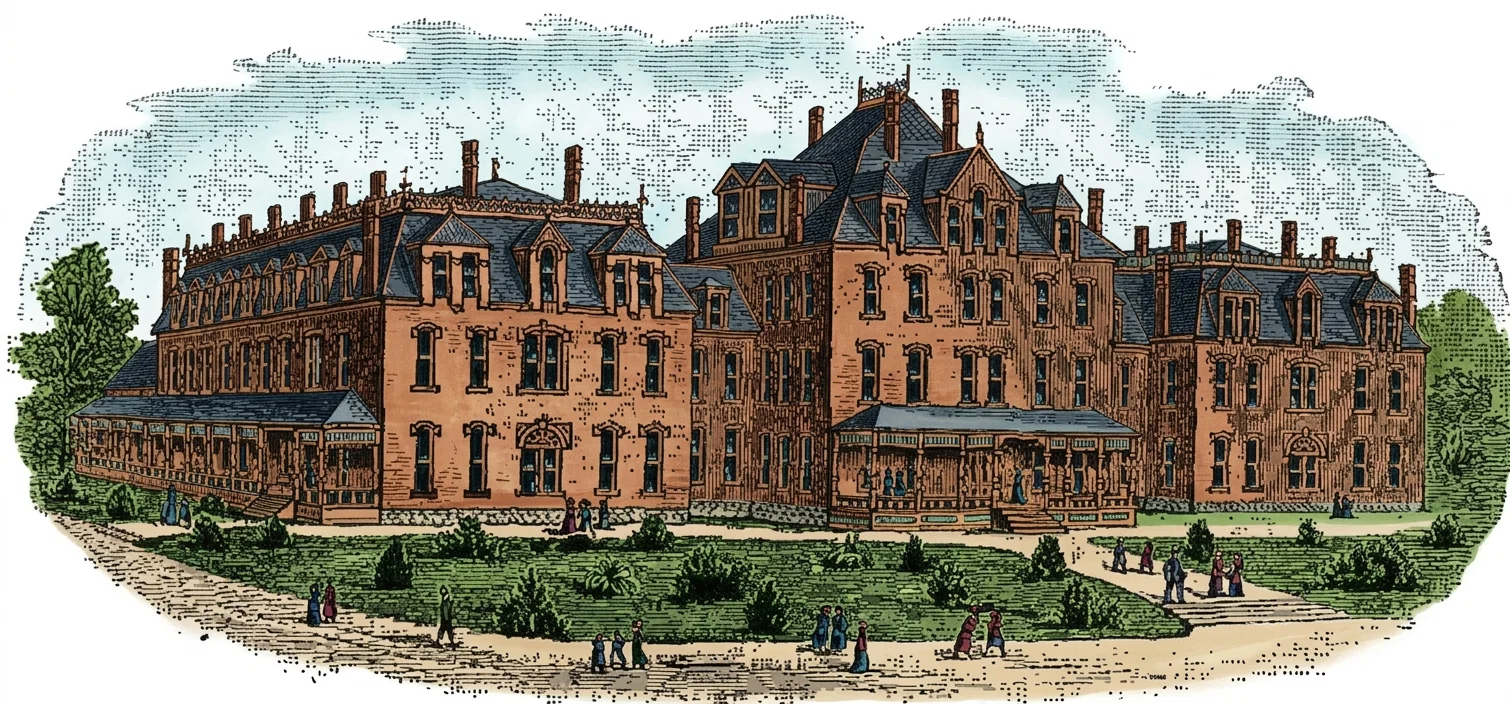
The college has been named by the committee the Clinton German Seminary. It is an imposing structure three and four stories in height, having a frontage of 185 feet, with a commodious veranda; the north wing is 120 feet deep, and the south wing, 110. The center elevation is four stories high, 75 feet from ground to pinnacle, and the wings are three stories. The building has 110 rooms, besides halls and corridors, and two large stairways (arranged to give convenient and easy access to, and egress from, all parts), together with an elevator. It has fifty-five bedrooms, and will accommodate over one hundred boarding-pupils, two to a room. The building is constructed of brick on a dressed stone foundation rising several feet above the surface, and presents a substantial and beautiful appearance. Its style of architecture is in keeping with the demands of this progressive age, and embodies every modern appliance and convenience which experience shows to be necessary to the health, security, comfort, and happiness of its inmates. It is provided with fire-escapes, lighted with gas, and supplied with bath-rooms on every floor, as well as speaking-tubes and electric bells. The building is constructed with a view to enlargement without destroying its architectural beauty or perfect interior arrangement. The seminary grounds consist of five acres situated in the southeastern part of the city, and reached by sidewalk. They are covered with grass and beautiful shade-trees. Aside from the campus there have been secured half a block immediately at the north, a six-acre tract at the south, and, on the east, farm land to the extent of 106 acres.

City of Clinton

THE CLINTON GERMAN SEMINARY
Clinton is the county-seat of Henry County, one of the leading counties of Missouri. It has seven thousand inhabitants, and is eighty-seven miles by rail southeast of Kansas City. It is on the main line of the Missouri, Kansas, and Texas Railway, and branches of the Kansas City, Fort Scott, and Memphis, and the St. Louis and San Francisco railroads, giving excellent railway facilities. It has a good system of public schools and colleges, and churches of different denominations. There is also a good system of water-works affording excellent water, besides well-equipped gas and electric-light plants. The city is supplied with banks, newspapers, and various manufacturing interests, including flouring-mills, broom factories, iron-foundry, potteries, brick-yard, and planing-mill. It is called the “model city of the prairie,” and is situated upon a natural elevation, and surrounded by a rich agricultural country, well watered by many streams. Abundant timber affords fuel, and, in addition, in the surrounding vicinity are several thick veins of choice coal. Clinton is fortunately located in a land of cheap coal, as Kansas mine run coal can be delivered free on board cars at Clinton for two dollars a ton, or placed in the college coal pit for $2.50 a ton.
We feel, all things considered, that the committee has been exceedingly fortunate in securing this property.
E. T. RUSSELL, Chairman.

Twelve Take Their Stand at Salem

TWELVE have taken their stand to walk in the way of God's commandments, at Salem, Mass., and a splendid interest prevails. Among this number is the president of the W. C. T. U., a woman of intelligence and means.

Attending Camp-Meetings

I HAVE recently attended camp-meetings at Hutchinson, Minn., Chamberlain, S. D., Jamestown, N. D., and Kenosha, Wis. These were all interesting and profitable meetings. In the States named we have a large foreign constituency, and a goodly number of Germans and Scandinavians were at each gathering. Meetings were held each day in these languages as well as the English with a good attendance and interest. The Kenosha meeting was wholly Scandinavian. In North Dakota we had Russian brethren in addition to the three nationalities already mentioned. I was much pleased to make the acquaintance of these brethren, and to see their interest and love for the truth.
There was one feature in these camp-meetings this year, especially among the foreign brethren, that was more prominent than at any former meeting I have attended; namely, the educational question. Much was said about our schools, and a great interest was manifested in them. The importance of having our young people attend these schools, and thus gain a preparation for such a place in the work as the providence of God may have in store for them, was especially dwelt upon.
This increased interest has no doubt come about through the movement on the part of the General Conference to establish three foreign schools,—the German, the Swedish, and the Danish-Norwegian. The establishment of these schools should mark the beginning of a decided forward movement in the development of the educational work among these nationalities, and a rapid increase of laborers to meet the urgent call for workers among the foreigners of the United States. From the increasing interest manifested, we have every reason to believe that this will be so.
At the North Dakota meeting the Russian brethren made an earnest plea that steps be taken to provide educational facilities for the children and youth of our Russian believers. This is a matter that will need to be taken under careful advisement. Certainly something should be done as quickly as possible to provide for this need. These brethren are already calling for Russian church-school teachers. We are glad to see this interest; for its development will be an important feature in the extension of the message among these different nationalities.
Much more importance attaches to this foreign educational move than many of us appreciate at present, but this will become more and more manifest as the days go by. The agitation on this question that has taken place in connection with locating these foreign schools, and raising funds for them, is already bearing good fruit, as is seen in the increased interest among both young and old in the matter of education and a desire for a training for the work.
May the signal blessing of the Lord be more and more manifest in the Foreign Department of our work in this country, that the many millions of foreign nationalities in the United States may soon hear the message.
O. A. OLSEN.

For the Weekly Rest Day

FROM the journal, L'Egypte, published in Cairo, Egypt, bearing date of June 26, 1910, we take the following striking utterance of the labor union of that place:—

“Ultimatum to Stubborn Employers

“After having exhausted all the means of conciliation and harmony in its power, the International Society of the Employees of Alexandria declares that, notwithstanding all its efforts to obtain—

“The General Sunday Rest,

some unfair shopkeepers seek to exempt themselves from this just obligation, at the same time urging others to follow their evil example.
“Consequently, in order to safeguard the interests of the good employers and reputable houses, who have granted us their generous support, and whose loyalty can not be questioned, we do from this day forward declare bitter war on all those who will not adhere to

“Sunday Closing,

that just rule of hygiene, justice, and humanity.
“This war will not limit itself to simple manifestations, but it will be carried without mercy in every direction where we can possibly reach these inhuman sweaters; and we shall not hesitate at any means to discredit them, promote their ruin, and precipitate the overthrow of their business.
“Know, then, that:—
“1. A commission of inquiry named by the committee shall make every Sunday morning, beginning with the twenty-sixth of the month, a tour of inspection, with the purpose of pointing out to the committee the shops which are not closed.
“2. These shops shall be immediately put on the index, for a boycott to the bitter end.
“3. A general list of the shops put on the index, with the names of the employers, shall be printed by the thousand, together with a vigorous appeal to the boycott. This list shall be distributed broadcast, and given to the press.
“4. The most energetic means of coercion shall be set on foot at once against the delinquents, by every possible means to increase their expenses, diminish their receipts, and drive them to ruin.
“We hope this ultimatum will be understood, and that, in view of the energetic decisions which it contains—decisions which we shall carry out to the end—the delinquents will understand that there remains but one thing for them to do—

“Close Their Shops on Sunday

“Enough brazen-faced sweating! Enough tyranny, enough slavery!
“The most sacred rights of the workers have been too long trampled underfoot through the rapacity, stubbornness, or ignorance of a few shameless shopkeepers!
“We wish henceforth that these rights be recognized and respected by all, both in Egypt and everywhere else.”
From the above it can readily be seen how the spirit of religious intolerance is working in Egypt, fostered by the labor unions. This brings to mind that striking statement made a few years ago by the New York Independent, which reads as follows: “If they [labor unionists] are all to become dogmatic religionists, the days of persecution for the faithful are not over.” The spirit manifested in the above ultimatum raises the declaration of the Independent to the dignity of prophecy, and the movements on foot in this country for the enforced observance of Sunday also indicate that in the labor unions of the country the Sunday-law advocates will have their stanchest supporters. C. M. S.

North Carolina

HIGH POINT.—Meetings were begun at this place on June 24 by Elders G. W. Wells and W. L. Killen and the writer. Present truth has been more or less known here for some years; therefore the attendance at first was small, but it is slowly increasing. At present the attendance ranges from forty-five to ninety; this is not as we would have it, and we are doing what we can to increase the interest. Those who come for a few evenings usually desire to hear more, and a few are deeply interested.
As we labor and pray, we greatly desire the co-operation and prayers of God's people for the triumph of the message in this city.
Clean copies of our periodicals, papers, and tracts will be an aid to us. Please send them post-paid.
R. T. NASH.

A Good Report

THE success that God is giving many of our canvassers in the book work this year is indeed little less than marvelous. As an illustration of this, we will mention the first report from Hersel Butka, one of our student canvassers who has gone to south Texas to canvass for “Home and Health.” During the first two and one-half days he worked twenty-eight hours, and secured thirty-three orders, amounting in value to $105.85, including helps. Of these orders fifteen were English and eighteen Spanish. In sending his report, he writes:
“I am pleased to be permitted to send in my first report. I think it has cost me about fifty miles of good, hard walking over rough rocks, which have made my feet sore. The people here generally live about one-half mile from the road, and often the men are in the field a mile or so from the house. So you see it is not very easy. It doesn't matter if the Mexican ladies are at home; we have to hunt the men and secure their orders. The Mexicans are a sociable people, and treat a canvasser well.”
R. L. PIERCE.

Christian Liberty

Reports, Notes, and Comments Pertaining to the Current History of the Rights of Conscience
Conducted by the Religious Liberty Bureau
K. C. RUSSELL     Secretary
C. M. SNOW     Corresponding Secretary

Religious Liberty at the Minnesota Camp-Meeting

A DEEP interest was manifested in the religious liberty work at the Minnesota camp-meeting, the conference unanimously adopting the following resolution:—
“Whereas, There is a growing and wide-spread demand throughout the country for religious legislation, which threatens our civil and religious rights, and means the formation of the image to the beast; therefore,—
“Resolved, That we organize a strong and aggressive campaign in all our churches for the dissemination of the principles of religious liberty—
“1. By the circulation of the Liberty magazine.
“2. By a generous use of our religious liberty leaflets.
“3. By placing a copy of the forthcoming revised edition of ‘American State Papers’ in the hands of State legislators and other State officials.
“4. By utilizing the public press in presenting the principles of religious liberty.
“5. By conducting religious liberty institutes wherever practicable, for the purpose of educating our own people concerning these principles.
“6. By public lectures.”
The item relating to Liberty magazine was responded to in a practical way, a large number subscribing for the journal. There is no better way to keep in touch with this important department of our work than by being a constant reader of this magazine.
The evening following the last Sabbath of the meeting, we gave a stereopticon lecture on the subject of religious liberty to one of the largest congregations present during the meeting. Among those in attendance were resident ministers of the town and other prominent citizens.
K. C. R.
Continue reading: Religious Liberty Notes