Signs of the Times, Vol. 32, No. 16

FAITH NOT VAIN

Earlier text: Sufficient Exercise

“THE FIERY DEMON.”

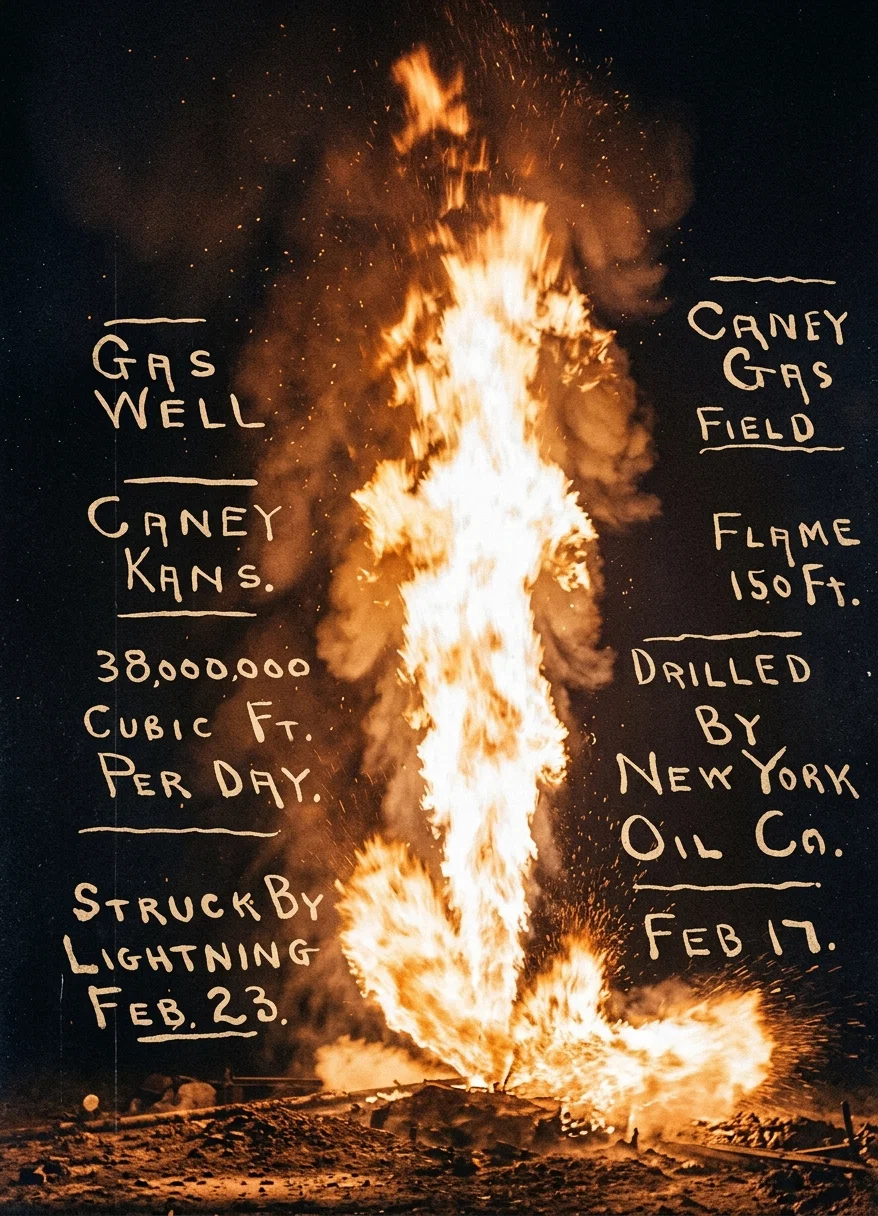
For more than a month a gas well, in the edge of the Indian Territory, about seven miles southeast of Caney, Kansas, has been burning with terrific fury. Words are entirely inadequate to describe the awful grandeur of the scene as a flame of burning gas shoots one hundred and fifty feet into the air.
The well was drilled by the New York Gas Company, February 17. After striking gas at a depth of about fifteen hundred feet, the men were working for days under extreme difficulty to get the combustible stuff under control.
On Friday afternoon, February 23, there occurred a thunder storm in the vicinity of the well where the gas has been escaping for several days at the rate of thirty-eight million cubic feet per day, filling the upper regions full of the gas.
At the sound of a loud clap of thunder, the workmen looked upward, and to their consternation saw the heavens ablaze with the burning gas. They immediately fled from the scene, just in time to escape being caught in the fiery flame. In an instant the well was on fire, and the burning gas set up such a scream and roar that it could be heard twenty miles away. Nothing can describe the terror of the spectacle. Stones weighing several pounds were thrown a thousand feet into the air. Soon an opening in the shape of a funnel was made at the mouth of the well.
Since then the volume of the gas being consumed has increased to nearly double that at the beginning; the daily consumption is now estimated at 700,000,000 cubic feet. The ground is completely burnt for a radius of fifty feet, and it is impossible to get nearer than seventy-five feet from the well, on account of the intense heat.
Gas experts are at their wits’ end to know how to extinguish the flames which, up to the present, have shown no signs of diminishing. Over fifty men have since been employed in the effort to harness the “fiery demon,” but the heat is so terrible that water must be thrown continually upon the men while they are at work.
At first it was thought that the fire could be extinguished in the usual way by turning steam on at the bottom of the flame. But that seemed to make it burn all the more furiously. It was then thought that by means of an immense crane, a hood in the shape of a funnel turned upside down and weighing several tons, could be placed over the top of the well. The first attempt was made on February 19, but they were unable to swing the immense hood over the well.
A few days later another and more successful attempt was made to place the hood in position, but it had been over the well but a short time when it was burned up, the great crane which was used to swing it was melted and burned down, and soon all was but a pile of scrap iron. The rubbish was immediately cleared away, and a larger and heavier hood was prepared, and weighed down with several extra tons of iron, and another attempt was made, but with the same result. Thus the fiery monster is still at large, defying all their efforts to bring it into subjection.
Nothing that I have ever seen in any way surpasses, or even equals, the awful grandeur of the scene, excepting an active volcano. But this is a volcano on a small scale.
The people in the vicinity of the great gasser are becoming considerably concerned, and can begin to comprehend how the world can be destroyed by fire. If men can drill a few feet into the earth and find gas in the quantity that they are unable to extinguish after it has been ignited, how much more of this combustible is hidden away in the heart of the earth, kept in store for the great day of God’s wrath.
Some people scoff at the idea of the earth being destroyed by fire, but Peter says that such are “willingly ignorant” of the facts and conditions as they exist to-day. Science has proved that the earth is filled with the most combustible elements which, under certain conditions, would envelop this world in a mass of flames.
The Word of God declares that “the heavens and the earth which are now, by the same word are kept in store, reserved unto fire against the day of judgment and perdition of ungodly men.” 2 Peter 3:7.
We read that God by a look causes the earth to tremble, and that by simply touching the mountains He causes them to smoke (Ps. 104:32); how terrible will be the scene when “fire comes down from God out of heaven” and ignites the gases composing the earth, causing the earth to melt, and all things therein to be burned up.
And so we read: “But the day of the Lord will come as a thief in the night; in the which the heavens shall pass away with a great noise, and the elements shall melt with fervent heat, the earth also and the works that are therein shall be burned up. Seeing then that all these things shall be dissolved, what manner of persons ought ye to be in all holy conversation and godliness, looking for and hasting unto the coming of the day of God, wherein the heavens being on fire shall be dissolved, and the elements shall melt with fervent heat. Nevertheless we, according to His promise, look for new heavens and a new earth, wherein dwelleth righteousness.” 2 Peter 3:10-13. H. F. KETRING.

Increasing Insanity.

The New York World, condensing the report of the commission of the London County Council, charged with the supervision of the asylums for the insane, says that the report shows that insanity is on the increase in the United Kingdom. The number of insane poor reported in 1904 in the institutions of the county was 23,948, in 1905, 24,652. The principal cause is set down as alcoholism, which caused thirty per cent. of all cases registered. Inherited tendency has a high per cent. also. The whole tendency of the world is toward such a condition. The increased use of alcohol, the use of various substitutes for liquor, such as absinthe, cocaine, the large increase of narcotic drugs like morphia, nicotine, through tobacco, could result in no other way than in the unbalancing of the minds of their devotees. If every one of these powerful stimulants and narcotics could be abolished from the earth, humanity would be greatly benefited by the act. The only good that they do is mighty poor compensation for the untold evil which they accomplish.
Right in this connection the following item from Yale University is worthy of note. Out of the 334 freshmen who took examination in the gymnasium, 148 confessed to the use of tobacco, 44.3 per cent., the largest percentage of men who smoke ever observed in the annual examination of the physical condition of the incoming class. Sixty stated their inability to swim, and 113 were obliged to wear glasses. Of course the inability to swim might not be due to tobacco-using, and probably not all the defective eyes are due to the same cause, but tobacco-using has its bad effects upon the eyes, and it so unfits the physical man that it makes him disinclined to follow the natural sports of boys, among which is swimming. Would that all young men could see that the use of tobacco in any form is an enemy and only an enemy.

THE EVIL OF HYPNOTISM.

A CLIPPING is kindly sent to us dated New York, February 3, giving a report of a student in criminology stating that he hoped to be able to win the consent of parents or guardians to use hypnotic suggestion in the treatment of children who are in the hands of the law in the jurisdiction of children's courts. This hypnotist declares, “Give me any child, I do not care who, under fourteen, and I will bring out the good side of his nature so that it will predominate over the bad and abolish his tendency to crime. I have done it in scores of cases, and almost invariably—yes, in 100 per cent. of cases—the treatment has been successful. Between the ages of five and fourteen years every child is susceptible to suggestion; after that some of them are less amenable to it.”
Now all this from a moral view-point is sheer nonsense. The hypnotist contends that unruly children taught by this method would grow up and become good and useful members of society instead of the prison or perhaps the gallows. All this is theory and, to some extent, demonstrated temporarily in practise; but the very worst evil—the worst of all evils that can come to a soul—is what we have repeatedly pointed out, the destruction of individuality of the person who submits to be hypnotized. The absolute subjection of the will of one creature to another places the will of that creature in that condition where he is susceptible to every evil influence of stronger wills. It is upon such minds as this that the devil will delight to play, and hypnotism is one of his ablest evangelistic propagandists in this world to-day. Given a race with wills controlled by others, creatures as themselves, and you have a class of minds upon which Satan can play his triumphant march to the lower regions at his will.
It is God's design that the will shall be absolutely free; even submitted to Him, He does not enchain it or deprive it of its freedom. The highest angel in heaven is bound to God only by free choice; but the demons of Satan are enslaved by a chain from which, once made, they can not break. We shall have more to say on this subject in the future.

AN INTERESTING PHENOMENON.

The accompanying illustration is from a drawing made by Mr. A. D. Benton of Ukiah. This appearance in the heavens occurred March 1 at 5:30 P.M., and was witnessed by many persons in Ukiah, where the drawing was made. The sun is at the horizon. The moon is above. In all the circles and segments of circles, except the two arms at the right and left, all the colors of the solar rainbow were visible. The “festoon,” so to speak, above the first bow was as strongly colored as any. The outer rings, or arms, were white, as were also the two spots on either side of the sun. The phenomenon remained till sunset. There was no rain; a light haze covered the sky. It was watched with intense interest by the people. It was one of God’s wonders in nature. Joel 2:30.

RECENT EXPERIENCES IN NEW ORLEANS.

A Wrong Stand for a Baptist.

SUNDAY law agitation has found its way to New Orleans, and from now until the meeting of the Legislature in May a campaign in behalf of more stringent Sunday enactments will be prosecuted in this city especially.
On Sunday, March 4, a mass meeting of barbers was held in New Orleans in behalf of laying plans for forcing all barber shops to close on Sunday. Some of the barbers desire a day off, but fearing that other shops might secure their trade, they desire a law to force all to close up.
A Baptist minister was present and made the principal speech. Among other things he said:
“I am here to help your cause, as it is a righteous cause. As to Sunday rest, I am an American, and we have an American Sabbath. Sunday rest is so ingrained in our American Sabbath that for any to oppose its observance is to invite anarchy. Our chief executive, legislators, and other officials lay aside their labors and observe the day; and why not accord this privilege to the barbers? We want to claim our rights in this government. The nation and state have the right to rest, and why should not this right permeate even the barber shops? Shaving on Sunday is not an act of mercy or necessity. On the contrary, it is merciless to demand a shave on Sunday. And when one barber would like to close up on Sunday he sees the possibility of his competitors securing his trade; this is merciless, and so we should have a law to compel all to close to conserve equal rights. There are those who would like to go to the house of God on Sunday, but they can not do this under present conditions. My appeal to you is to contend for your rights on this day. You have the right as an American citizen to do so. I shall help you all I can.”
A lawyer, who will probably represent the barbers before the Legislature, in his address advised that great care be used in “tinkering” with the present Sunday law. Several barbers spoke. One said that he had not enjoyed a Sunday rest for sixteen years, except when he had the typhoid fever, and that he had not been inside of a church for the three years of his married life. He thought that a law should be passed to help along that line.
On the same day the president of the Anti-Saloon League of Louisiana spoke in two of the churches, giving expression to thoughts which are to serve as texts for the pulpits from this time onward. Such incidents are indicative of the stirring times which are before us in this section, and we must be aroused, and rise to the opportunities afforded us in giving this message to the people of our country.
S. B. HORTON.

BOOK NOTICES.

“A Critical Greek and English Concordance of the New Testament,” by Chas. F. Hudson, containing also a Greek-English Lexicon to the New Testament by Thomas S. Green, M.A. Cloth; 716 pages; price not given.
Both the Critical Concordance and the Greek-English Lexicon were prepared under the direction of the late H. L. Hastings, of Boston, Mass. The revision and completion of the Concordance by Ezra Abbot, D.D., LL.D., of Harvard University, an eminent linguistic scholar and critic, should be an assurance to the reader of the excellence and accuracy of the work. The book is adapted to the use of the common people. A knowledge of the Greek is not necessary to the one who would acquire the knowledge of the New Testament that is to be gained from this book. In its renderings of the original words, no pains has been spared to give the best possible, by comparison of the various authentic manuscripts of the New Testament. The book is well arranged for the quick finding of any desired word, and will be a valuable acquisition to the library of any student of the Word.
“The Missionary Idea,” by Mrs. A. E. Ellis. Cloth, 244 pages, price 75 cents. Union College Press, College View, Neb.
No one can read “The Missionary Idea” without feeling his heart drawn out in the interests of the missionary work. From cover to cover the cause in which Christ lived and died, the salvation of those in darkness, is set forth in sweet, pleading sincerity. The first half of the book is a helpful heart-to-heart talk upon the importance of Gospel work and preparation therefor. Then follows Bible studies on missionary topics, stories of special texts, facts and items, missionary biographies, missionary consecration, etc., and an outline of Seventh-day Adventist mission fields, giving the history of our work in the various countries entered. This is a book which we can commend to the prayerful study of every reader of this paper.
“The Boy’s Life of Christ,” by William B. Forbush. Cloth, 318 pages. Funk & Wagnalls, New York City.
There is in this book much that is interesting, and not a little that is not true. The author has essayed to bind together the various incidents in the life of Christ as one would write a biography of men who lived in our own time, and supplies what is lacking by drawing upon his imagination and upon the customs of the people of those times. He has fallen into many manifest errors. In his reference to the story of Jephthah’s daughter, he perpetuates the exploded idea that the daughter of Jephthah was slain, whereas the Word plainly indicates that the sacrifice was nothing more serious than her life-long celibacy. Another error of the author is that the “wise men of the east” were astrologers. God did not reveal through a heathen, idolatrous star-philosophy that greatest event in the world’s history, the birth of Christ. Throughout this book the miracles of our Lord are touched lightly and given a turn to discredit the Biblical record of those events. The author even has the Jewish leaders censuring Christ for “healing people on Sunday.” A more inexcusable blunder could hardly be imagined. Perhaps the idea is to teach the readers that Christ kept Sunday. He even attempts to explain away the reality of the transfiguration scene, putting the moonlight and the snow on the mountain in place of the vivid language of Mark 9: 2-4 and Luke 9: 29-32. We prefer the inspired life of Christ as written by Matthew, Mark, Luke, and John, and translated in the lives of His believing followers.
“Proceedings of the American Forest Congress,” held at Washington, D. C., January 2-6, 1905. Cloth, 474 pages. Published for the American Forestry Association by the H. M. Suter Publishing Company, Box 356, Washington, D. C. Price not given.
This is a complete record of the proceedings of the above-named forestry congress, including the speeches given and papers read by the leading delegates to whom specific topics had been assigned. The first address is by President Roosevelt on “The Forest in the Life of a Nation;” the second by Secretary of Agriculture Wilson on “The General Need of Forest Preservation.” The book is divided into seven parts, as follows: Forestry as a National Question; Importance of the Public Forest Lands to Irrigation; The Lumber Industry and the Forests; Importance of the Public Forest Lands to Grazing; Railroads in Relation to the Forest; Importance of the Public Forest Lands to Mining; National and State Forest Policy.

Sunday Laws and the Church-State Connection

When the modern Preacher (nominally of the Gospel) gets into politics, his first consideration is enforced Sunday observance; in other words, he moves toward an establishment of religion by state law. He would fain have this course pass as a temperance movement, but this ruse is exposed in most instances, by the fact that he is willing to concede a license to the liquor seller six days in the week if he be restrained on Sunday. He will even concede the privilege for half of that day, for the sake of an entering wedge that will lead to an extension of his established religion. The Cincinnati Evangelical Alliance has a Law Enforcement Committee that is just now especially active, being encouraged by a new municipal administration somewhat favorable to that kind of politics.

Dowie Deposed as Leader of Zion City

John Alexander Dowie, self-styled Elijah III, and first apostle, general overseer of Zion City, has been deprived of his rulership in the Dowieite movement, and all the vast accumulation of means and houses and institutions has been stripped from him by the persons left in power while he was in Mexico. Even his own wife and son have turned against him, and serious charges have been brought by them and others. It is expected that on Mr. Dowie’s return to Zion City, there will be a bitter contest between the two factions. At the present time the majority of the members are against their former leader.
Those who are conducting the crusade against tuberculosis in this country have found it necessary to publish a journal devoted to the study and prevention of that disease. This crusade is under the medical direction of Dr. Herman M. Biggs, Medical Director of the New York City Health Department. The name of this new periodical is the “Journal of the Outdoor Life,” and is published at Trudeau, N. Y., at $1.00 a year. The journal aims to be helpful to those suffering from tuberculosis or having a tendency toward lung trouble.
The great strike of coal miners has taken place, and more than 500,000 men in the hard and soft coal fields left the mines. Propositions for arbitration have been made by the miners, but so far the companies have not made any move looking to the settlement of the question by that method. It is understood that the coal companies are well prepared for a long strike, having large quantities of coal stored in various places. Some of the roads are reported to have ceased shipping coal west.
Serious trouble seems possible between Russia and China. The latter country is not satisfied with the slow movements of the Russian troops in the evacuation of Manchuria. Russia and Japan were allowed to maintain a certain number of railroad guards; but Russia still has a large army in Manchuria, and China is becoming very insistent in the matter of their withdrawal.
The British Government has yielded to the demands of the Labor Party and has granted labor unions exemption for their funds from any process of law. This frees the unions from the payment of damages in any case where their agents have committed breaches of the peace or destroyed property.
The Russian Government is again issuing a call for an international congress at The Hague, naming the various questions that it desires to have discussed, among which is compulsory arbitration in certain cases. If the other governments accept the call, the congress will convene in July next.
The rebel Zulu chief, Bumbatta, with his followers, is causing much trouble in Natal, South Africa. The British force there is small, and has had to retire before the Zulus. Reinforcements are being sent to that district to cope with the insurgents.
The earthquake on the Island of Formosa appears to have been fully as disastrous as at first reported. Incomplete returns from the island show that 1,087 persons were killed and 6,163 were injured in that cataclysm.
The municipality of Chicago, as a result of the recent election, is to take over the street railways of that city, but has not been given the right to operate them under its own management.
The Russian Government has renewed the press censorship in what Russian editors consider a most offensive form.

The Resurrection: Power of God Over Sin

The Resurrection has an entirely different meaning. It is the demonstration of the power of God in Jesus Christ over sin and sin's fruitage—death. When Adam was created, he was the son of God. It was the plan of the all-wise Father that God should be incarnate in the flesh of man; but man yielded, and sin became incarnate, infleshed. As man's heart, soul, mind, yielded when the flesh was yielded, the mind became carnal, at enmity with God. Rom. 8:7. Into this citadel of the enemy came the Son of God, born Jesus in Bethlehem, “made of the seed of David according to the flesh” (Rom. 1:3), yet living triumphantly over sin the life of the Son of God. By “prayers and supplications, with strong crying and tears” unto God He was heard and saved and “learned obedience by the things which He suffered,” and was “made perfect,” “the author of eternal salvation” “unto all them that obey Him.” Heb. 5:7-9. He conquered that we in Him might conquer. He “emptied Himself,” and God came in and filled Him. Phil. 2:7; 2 Cor. 5:19. When the same mind is exercised in us, and we renounce self, Christ will come into us and dwell, so that by the power of His life we shall live for Him above the sin. Phil. 2:5; Luke 14:33; Gal. 2:20.
This power in Christ Jesus is resurrection power. Men counted Him only man, of the seed of David. Living without sin in God's sight, well-pleasing to Him who judges perfectly, He died adjudged guilty of blasphemy by His own people, and of sedition by the world. He was buried; but on the dawning of that first-day morning He arose from the grave, because He could not be holden of it (Acts 2:24); and that resurrection from death, the ripened fruit of sin, “declared Him to be the Son of God with power, according to the spirit of holiness.”
Should There Not Be Memorials?—“Is it not right that the Christian church should have a memorial of that power? And what is more appropriate than the day on which He rose from the dead?” These are the questions which are raised in behalf of the Sunday and the Easter celebrations, solely because they are existing institutions. If we did not now find them in general vogue, no Bible believer would offer a word for their introduction. To reply to the questions: It is right that there should be remembrancers of our Lord's death and resurrection, because He has given them. It is not a good thing to use a day for that purpose, (1) because God has designated no such thing in His Word; and (2) because the observance of a day has nothing befitting such an event or has anything in common with it. As to Christ's death, He has given us a memorial of that in the Lord's Supper; for “As often as ye eat this bread, and drink this cup, ye proclaim the Lord's death till He come.” “This do in remembrance of Me.” 1 Cor. 11:23-26.
The Memorial of His Resurrection means more than a day. The resurrection was the manifestation of a life which the world knew not, a life in which was power over sin and death. That life the children of God must live; for “he that hath the Son, hath the life; he that hath not the Son of God hath not the life” (1 John 5:12), whatever his claim to the contrary. This is the essential thing in Christianity. Listen: “I count all things to be loss for the excellency of the knowledge of Christ Jesus my Lord; that I may know Him and the power of His resurrection.” Phil. 3:8-10. Again the apostle prays for God's children as the very climax of their needs. “That ye may know the . . . exceeding greatness of His power to us-ward who believe, according to that working of the strength of His might which He wrought in Christ, when He raised Him from the dead, and made Him to sit at His right hand in the heavenly places, far above all rule and authority and power and dominion and every name that is named.” Eph. 1:18-21. Normally, regularly, the beginning of this manifestation to the world is at the Christian's baptism, in his marriage with Christ (Gal. 3:28; Rom. 7:4); but it must continue all through his life of service, else his baptism is a mere mockery of form: “All we who were baptised into Christ Jesus were baptised into His death.” “We are buried therefore with Him through baptism into death; that like as Christ was raised from the dead through the glory of the Father, so we also might walk in newness of life.” Rom. 6:3,4. For that new life, Bible baptism stands. The memorial, the only memorial of His resurrection is His regenerate, renewed believers, living above the world, overcoming sin. Such life speaks louder than a million Easters, “Christ is risen indeed.”

The Right to Sing

The Right to Sing.—In North Carolina “a strict member of the church and a man of most exemplary deportment” was prosecuted for singing in the church. His singing made “one part of the congregation laugh and the other mad.” Both preacher and presiding elder had been troubled. The lower court found him guilty, but the Supreme Court decided that as he had no intention of disturbing the congregation, he was not guilty, and had, therefore, a perfect right to take part in the public worship.
Man’s Individuality.—A correspondent, an old man, writing of the incongruous federations of to-day, says: “It is a pity that so many people will not use their own judgment on God’s holy Word, as they do when they buy and sell among themselves. They let the preachers do their thinking for them, and so become spiritual slaves in mind.” And this is true. Every man must “give account of himself to God.” God will not ask us how some one else did; but what did we do? We may do our thinking by proxy; we shall have no proxy in the judgment.
A New Chart.—A photo reproduction of a new chart which will be of great use to Bible workers has been received from Brother W. H. Wild, of Hinsdale, Ill. The great central figure is Christ, the Way, the Truth, the Life. It is designed to show the harmony of the great truths of the Bible, and so appeal to mind and heart through the eyes as well as through the ear. The author has been a diligent student of God’s Word for forty years, is rooted and grounded in the great threefold message, and his chart is the product of this study and earnest prayer to God that the good way may be shown those who know it not. When completed in its large form it will be lithographed in nine colors, size 22x30 inches. A key will accompany it. Brother Wild says that those who will send him one dollar for the chart will be sent a copy as soon as published. If they do not like it then, let them return it, and the money will be refunded. Address, Wm. H. Wild, Hinsdale, Ill.

“SIGNS” INDIA MISSION FUND.

In our Missions department will be found an appeal by a missionary to the millions of India, who feels India’s needs, who longs to save India’s perishing souls, who has given his life to that work, yet who also recognizes dangers which may be avoided. Prof. J. L. Shaw and wife are staying in America this year to recruit from disease contracted in the low, fever-stricken, disease-laden, coast districts of India. They soon expect to return and face those dangers again; but Professor Shaw feels that the wiser way to give one’s life for the Master is to preserve it for the strongest service, unless God calls otherwise.
Not for himself is he pleading, but for India and the better service of India’s workers. He would build a mission, a center, a school of prophets, so to speak, in the cooler, more elevated, healthier hill country of India, toward the white Himalayas, among millions and millions who know not God. Here, in the hottest months, missionaries will come from the man-devouring lowlands to recruit and at the same time to labor. From here they will go forth refreshed to battle again for souls in miasma-laden and famine-stricken fields of the lowlands. Who wishes to give to this noble work of these self-sacrificing missionaries? To whom does this neediest of all needy mission fields appeal? Are there not those who have thousands in earthly banks, but who wish to transfer their treasures to securer places? Why not try the Bank of Heaven, and purchase India Mission stock? God has already turned the hearts of some this way. We credit the following:
Alex Gilmore — $2,000.00 Lover of missions per M. C. W. — 5.00 Lover of missions per M. C. W. — .50 A Friend, San Jose — 1.25 Mrs. H. A. Holland — 3.40 Mrs. L. Luce — 3.25 A. Daniells — 1.75 Kathrina B. Wilcox — 5.00 Archie Nelson — 1.90

Easter Versus Resurrection: Origins of the Festival

Easter.—This issue of the SIGNS OF THE TIMES is not an “Easter Number,” but a “Resurrection Number.” There is a wide difference between the two terms. “Easter” comes from the Anglo Saxon “Eostre,” Teutonic, “Austro,” goddess of Spring, worshiped with feasting and flowers, a pure nature worship, and while having many things about it beautiful, yet tending ever to the lower, sensuous life. The Passover was in the Spring. Our Lord’s resurrection occurred in the Spring. The heathen worshiped with special ceremony the goddess Eostre in the Spring. And the half-converted “fathers” of the early church who came from Paganism or were saturated with pagan philosophy thought that it would be a good stroke in heathen-winning to adopt as many heathen customs as possible. Easter was one of these customs in which name and character were transferred to the so-called “Christian” festival, but one wholly unscriptural. Sunday was another such; and the old Roman Saturnalia was another, transformed into our Christmas.

Japanese Famine Donations Acknowledgment

Our Japanese Famine donations will be acknowledged next week.
The Home of the "Signs of the Times."

You have reached the end of this edition.

Signs of the Times · Apr 18, 1906