I have raised a number of frogs, but will tell the story of one, and let that do for all. In this story I will tell some things that I noticed with one frog, and some that I observed with others.
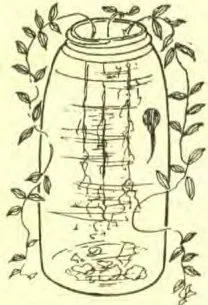
My first frog was a very young tadpole when I put him into a jar of water, and took him to the house. In the jar were planted some water-plants, and of course there were a great many microscopic beings in the water. The tadpole lived mostly on the little organisms that grew on the stems of the plant, though I have no doubt that he also ate some of the germs that were too small for me to see. Tad was a young bullfrog, and of course grew to be about three inches long before he became a frog. When he was a baby, he had gills, and breathed water like a fish. At first he lay near the bottom of the jar most of the time. When he was about three months old, he began to show signs of something happening, and soon he had two little feet growing out where his front legs were to be. Pretty soon legs began to grow, and before long his front legs were fully developed. But so far he had no hind legs. Some frogs get their hind legs first, some their front ones first, and some all at once. There seems to be no rule about it.
About the time Tad got his first legs, he began to show a disposition to come to the top of the water very often. On examining him, I could see that his gills were growing smaller, and that he liked to get a breath of real air once in a while. Now he would eat bread-crumbs or bits of egg. In about a month his hind legs began to grow, and in another month he had four real legs, as well as his tail. Now he stayed at the top of the water most of the time, unless some one was too near. The pollywogs of some kinds of frogs are to be found at the top of the water, breathing air as soon as they hatch from the egg.
When Tad was five or six months old, he began to use his legs as much as he could, and his tail grew smaller every day. A support for him was not thought of, and of course he could not climb on the glass. He breathed air entirely now. One day he was found dead in one part of the jar, and his tail lay in another. He had become a frog, and lost his tail. Then, as he could not swim enough to keep on top, he had drowned.
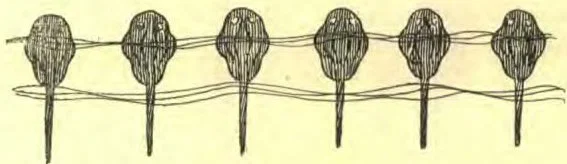
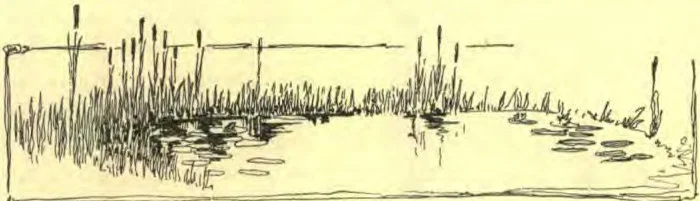
Most of my other frogs lived in a pond by the side of the road on my way to school. They were little fellows, and used to make things merry with their songs. In April the frogs would lay their eggs, which looked very much like a bunch of the gum that sometimes runs out of the limbs of peach or apple trees, except that it was in little round drops. Each drop had a spot in it about the size of a pin-head. This was the yolk of the egg. The eggs were stuck fast in bunches to grass and sticks that happened to be in the water. By the last of June they had hatched, and developed into frogs. The only time I ever played truant from school was to watch them crawl out on the bank, try to hop, and finally lose their tails. I have seen many boys get their first pair of trousers; but I have never seen one more pleased than a frog when he loses his tail, and can jump and croak.
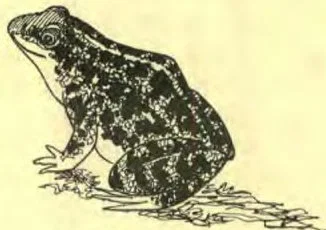
Next to losing his tail, the most interesting time in a frog’s life is when he gets a new suit of clothes. On the great day a number of frogs which were ready to shed their skin would hop out on the bank, blink their eyes, and croak a few words in frog language. First one or two would catch a third around the waist, and hold him firmly in their arms. Then another would catch around him just behind the front legs, and several others would begin to nibble and bite at the skin on his back. Soon it would loosen and come off. Then all would scramble for the skin, and those that succeeded in getting it proceeded to eat it. Afterward they would skin another in the same way. They all acted very proud when they got rid of their old skin. Frogs eat any kind of meat that they can get, even their own young. Sometimes, too, they eat the seeds of weeds.
FLOYD BRALLIAR.
The Captive Girl
A True Story
Not very far from Philadelphia lives a little girl named Regina. She is a dear little girl, with a very fair face, blue eyes, bright hair, and pink cheeks. Grandma says she is the very image of the little Regina who was carried off by the Indians so long, long ago.
Then Regina runs to grandma, and says: “O grandma! please tell me again about poor little lost Regina!”
Grandma loves to tell that old story. She remembers just how the country looked when the lost Regina was an old woman; and she had heard so often how it looked when Regina was a little girl, that it seems to her that she must have seen it all just as it was then.
This story of grandma’s is one of the saddest stories in our early history,—a true story and a wonderful one; and all through it we can see what care God takes of his children, even in the greatest trials and dangers.
FOUR REAL LEGS
Little Regina—the one who was carried off by the Indians—lived in a cabin in the forest, not far from where Harrisburg now stands. That part of Pennsylvania was then a forest, with wild animals and savage Indians roaming through it.
Regina had a father and mother, a brother fifteen years old, a sister thirteen years old, and a baby brother of three. Regina herself was ten. Regina was a little Christian. She loved the Saviour, and always asked his help in time of danger. There was a little hymn she was very fond of singing. She and her mother sang it every evening after prayers:—
THE POND BY THE SIDE OF THE ROAD
“Alone, and not alone, am I,
Though in this solitude so drear,
I feel my Saviour always nigh;
He comes the weary hours to cheer.
I am with him, and he with me;
E’en here, alone I can not be.”
This is the hymn they sang, and God used it in a wonderful way to bring Regina back to her mother after she had been stolen by the Indians.
One day Regina’s mother went to the mill for flour, taking the little boy with her. The mill was a long way off. It took her all day to make the journey. When she came back in the evening, nothing was left of her home but a heap of smoking ruins. The little house she had loved so well, and the barn that was filled with grain, were burned to the ground. Not far away lay the bodies of her husband and son, murdered by the Indians and scalped. Regina and Barbara, her two daughters, were gone, and she knew well enough that the Indians had carried them away.
Some days after, a party of hunters found Barbara’s dead body lying by a stream of water, with her head cleft by a tomahawk. When the mother heard of this, she knew that she would never see Barbara again in this life; but for nine long years she heard nothing of Regina, and she mourned for her, and hoped and prayed for her, and at last God answered her prayer.
A BRIGHT, NEW SKIN
Poor little Regina was taken by the Indians to their camp, and there given to an old squaw, who was very cruel to her. The squaw was so old and stiff with rheumatism that she could not work, but she was not too stiff to beat poor Regina most brutally. The child was compelled to carry all the wood and water that were needed in their wigwam, to gather roots and berries, trap animals, and catch fish. She had a very hard and bitter life, and6after a while, as the old squaw would not allow her to speak anything but the Indian language, she forgot how to speak her own language; but she never forgot her prayers, nor the hymn her mother used to sing with her every evening.
Regina looked like the other little Regina who lives not far from Philadelphia. Her face was so fair and lovely that the Indian children called her Sawquehanna, which means, in their language, “a white lily.” But after she had lived with the old squaw for some years, her hair and skin became dark and coarse, so that no one would have known her for a white girl, except for her large, clear, blue eyes, which never changed.
During the nine long years that Regina was lost, her mother never ceased to search for her. When she heard of a white girl being seen with the Indians, she immediately set out to find her, always feeling sure it was her own dear daughter, and always coming back home disappointed.
The French and Indian war was being carried on at the time, and when finally it closed, and the English became masters of the country, the Indians were compelled to give up all their white captives. Many white children had been carried off by them, and these were all taken from them by the English soldiers. Good Colonel Boquet, who had charge of this work, was very careful that not one white child should be left with the savages. In this way more than one hundred white children, between five and twenty years of age, were taken from the Indians.
At first the children were taken to Pittsburg, or Fort Pitt, as it was then called, and there about fifty of them were found by their parents. The others were taken to Carlisle, and there almost all of them found parents or friends, though a few of them had no one left in the world after the Indians had slaughtered the family and burned the home.
Regina’s mother went to Carlisle in hopes of finding her long-lost daughter. Regina was nineteen years old at that time. She was very tall and dark. She had forgotten a great deal. She could not tell her last name nor the names of her parents or brothers and sister. She did not know where she had lived, and though she remembered her own name, “Regina,” she could not pronounce it so that others understood it. She remembered her home and her mother, but she had forgotten how her mother looked. She was so changed that her mother did not know her, and she did not know her mother.
Mrs. Hartman—that was her mother’s name—went about among the captives, looking for her daughter, but there was no one there who could possibly be Regina. The captives were in a large room, and Mrs. Hartman looked at them all, and they looked at her. Then she went back to the inn with a heavy heart, sure, now, that Regina was dead. The next morning she was to start early for her home; for the way was rough and slow to travel, and she had to go on horseback. Before she started, however, she decided to take one more look at the captives, who had been brought out on a green square, between the old court-house and the old stone church. Crowds of people from the town and all around the country had gathered to see them. Many parents were there looking for their lost children, and every now and then some one would be made happy by finding a lost child. When this happened, every one shouted for joy. Twenty or thirty children were thus recognized by friends.
Mrs. Hartman lingered until noon, watching all this happiness; then, as she was turning away with a heavy heart and sad face, Colonel Boquet came to her, and asked her whether she was sure her daughter was not with those still unclaimed. He was so anxious to have the mother find her child that he asked whether there was not some sign, or mark, by which she might identify her; for he knew that nine years among the Indians could change a child so that even her mother would not know her.
Mrs. Hartman said that there was nothing by which she could identify Regina.
“Was not there some song or hymn you sang to her when a child?” the colonel asked. “She might remember the song you sang her to sleep with.”
Then Mrs. Hartman remembered that old hymn she and Regina loved so much, and she began to sing, in a clear, loud voice:—
“Alone, and not alone, am I,
Though in this solitude so drear—”
Scarcely had she reached the second line when a tall, straight girl, with blue eyes, uttered a sharp cry, and rushing to Mrs. Hartman, threw her arms around her mother’s neck.
It was Regina. The old hymn that she had never forgotten had brought her mother to her. How God blessed that hymn!
When the mother looked at Regina, she wondered how this tall, dark girl could be her fair little daughter; but she took her into her arms, and wept over her, and loved her, and thanked God again and again that he had answered her prayers.—Presbyterian.
The Cheer-Up Club
There were five of them, if you counted the baby, and they formed a club,—the Cheer-Up Club. Of course mama began it—mama began all the nice things that pleased every one.
“What shall we do now, mama?” Debbie had asked one rain-stormy day; and mama had looked down the scale of four dubious little faces, from Austin’s down through Clem’s and Debbie’s to Jesse’s (the baby wasn’t dubious), and then she had said, “Let’s join a club, every one of us.”
So that was the way it came about. There were laws and by-laws in a blank-book, written out in Austin’s very best writing, and you paid your fines—when you were solemn, and there wasn’t any need of it, you know—into the little tin trunk on mama’s bureau. When the trunk was full of pennies, the club was going to cheer somebody up with them somehow—mama was going to think of a way.
It was dull and “mis’ble,” as Jesse said, one morning when all the little Cheer-ups sat down to breakfast. Little slate-colored clouds scurried across the sky, and bumped against each other. There was not a sunbeam as big as your thumb even.
“Oh my!” cried Debbie, “I’m ’fraid this is going to be a dreadful busy day!”
“Well, maybe, but I can’t think of a single person to be cheered up,” said Austin, thoughtfully.
Papa glanced out of the window. “I can,” he said. “There’s lots of folks. First of all, Uncle Nahum Trott. He always has rheumatism on days like this, and his poor old muscles almost tie up in hard knots.”
“I’ll try to ’tend to Uncle Nahum,” Debbie said, her round little face full of compassion.
Mama laid down her fork with a sudden little click. “I’ve thought of a case,” she exclaimed, “for one of you! Let’s see; first,—”
“Me, mama!” cried Jesse, excitedly.
“Well, you, dear. Mrs. Butterworth’s lame Christy went to the hospital yesterday, and she couldn’t go with him. It almost broke her heart.”
“Oh,” murmured Jesse, pityingly, “but I’m almost sure I’m too little for such a big cheer-upping as that, mama.”
“You can do a little, dear. I think it will help,” said mama, gently.
Austin’s face was creased with little thought lines. Soon he spoke slowly: “There’s Kent Bishop—he’s a case, too. He’s got a bad sore throat, and perhaps ’twould cheer him up to play with him.”
“Yes, dear,” mama said.
“Well, I’ll take Kent,” quietly decided Austin.
“Nobody’s got me a case,” Clem announced, suddenly, such a dismal little look beginning to dawn on her face that mama jingled the spoons to remind her of the tin trunk and the jingling pennies for fines.
“O Clem!” she said, quickly, “there are so many folks for you to cheer up, it will keep you busy all day! First there’s baby, you know, with his little toothies trying to cut their way through his poor little swollen gums. He’s brave, but he needs helping out. And Nora had bad news in her letter this week,—her old father is ill. And Kitty Clover has lost two of her babies, and wants cuddling.”
“And I am sure I need cheering,” said papa, trying to make a very solemn face. “I shall come home to-night worn out with cares of the day, and need a little girl to put some sweetness into me.”
“Why,” laughed Clem, “I think you’d better excuse me, mama, so I can go to work! I’m going to begin on the baby; but I’ll be ready for papa when he comes. Come, baby, we’ll build a beautiful new three-story church.”
That night mama tucked a tired but happy little Cheer-Up Club into bed, and don’t you wonder how many of their “cases” had little warm, cheered-up spots in their hearts?—Selected.
A Single Word of Comfort
A SINGLE word is a little thing,
But a soul may be dying before our eyes
For lack of the comfort a word would bring,
With its welcome help and its sweet surprise.
A kindly look costs nothing at all,
But a heart may be starving for just one glance
That shall show by the eyelids' tender fall
The help of a pitying countenance.
These gifts nor gold nor silver may buy,
Nor wealth alone can love bestow,
But the comfort of word or ear or eye
The poorest may offer wherever he go.
—Selected.
A FLOWERY LAND
By Edith E. Adams
“A LAND flowing with milk and honey.” This was what God said about the land to which he was leading the children of Israel.
Where does honey come from?
“The bees make it,” a little boy told me the other day. But the bees do not make honey. All that they can do is to—
“gather honey all the day
From every opening flower.”
God makes the honey; he uses the plant through which to make it, and he stores it in the beautiful scented cups that we call flowers.
Then what sort of land must it be that flows with honey?—A beautiful land, bright and fragrant with flowers, musical with the hum of busy bees, and gay with butterflies and other insects that the flowers attract.
The bees are attracted to the flowers by their bright colors and their odor. As they flit from flower to flower, they carry the pollen, or fertilizing dust, from one to another, which brings the seeds to perfection. So while the bright flowers feed the bees, and cause them to increase, the bees also help the bright flowers, and cause them to increase to produce more honey.
All who visit Palestine at the present day are struck with the variety and brilliancy of its flowers. One traveler called it “the garden of Eden run wild.”
And the land was to flow with milk as well as honey. This means, of course, that it would be covered with rich pastures and grazing herds. But it could not be so unless it were well watered.
Moses described the promised land as “a land of brooks of water, of fountains and depths that spring out of valleys and hills.” And the result of this abundant watering was that it was “a land of wheat, and barley, vines, and fig-trees, and pomegranates; a land of oil olive, and honey.”
Such was the beautiful land that God prepared for his people, and led them out of the hard and cruel bondage of Egypt that they might go in and possess it. EDITH E. ADAMS.
70 × 7 = “that we are never to become weary of forgiving.”
21. Then came Peter to him, and said, Lord, how oft shall my brother sin against me, and I forgive him? till seven times?
22. Jesus saith unto him, I say not unto thee, Until seven times: but, Until seventy times seven.
23. Therefore is the kingdom of heaven likened unto a certain king, which would take account of his servants.
24. And when he had begun to reckon, one was brought unto him, which owed him ten thousand talents.
25. But forasmuch as he had not to pay, his lord commanded him to be sold, and his wife, and children, and all that he had, and payment to be made.
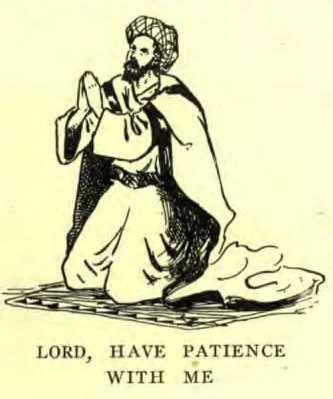
26. The servant therefore fell down, and worshiped him, saying, Lord, have patience with me, and I will pay thee all.
27. Then the lord of that servant was moved with compassion, and loosed him, and forgave him the debt.
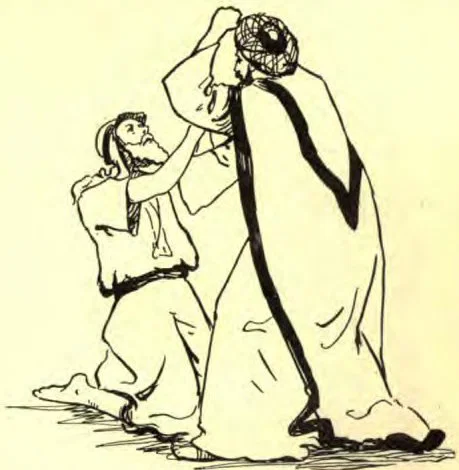
28. But the same servant went out, and found one of his fellow servants, which owed him an hundred pence: and he laid hands on him, and took him by the throat, saying, Pay me that thou owest.
29. And his fellow servant fell down at his feet, and besought him, saying, Have patience with me, and I will pay thee all.
30. And he would not: but went and cast him into prison, till he should pay the debt.
LORD, HAVE PATIENCE
WITH ME
31. So when his fellow servants saw what was done, they were very sorry, and came and told unto their lord all that was done.
32. Then his lord, after that he had called him, said unto him, O thou wicked servant, I forgave thee all that debt, because thou desiredst me:
33. Shouldest not thou also have had compassion on thy fellow servant, even as I had pity on thee?
34. And his lord was wroth, and delivered him to the tormentors, till he should pay all that was due unto him.
35. So likewise shall my heavenly Father do also unto you, if ye from your hearts forgive not every one his brother their trespasses.
Questions
1. With what question did Peter come to Christ?
2. How many times did he think it necessary to forgive his brother?
3. What standard did Jesus set before him?
4. How did he further teach Peter concerning forgiveness?
5. With what comparison does the parable begin?
6. As this king began to reckon with his servants, what enormous sum did he find one owing him? (A talent is worth about $1,600.)
7. What did the king command to be done with this servant?
8. Who were to be sold to help pay his debt?
9. What promise did the servant then make?
PAY ME THAT THOU OWEST
10. Was it accepted?
11. What compassion did the king therefore show him?
12. Although forgiven so much, how did he soon treat a fellow servant who owed him a little? (A Roman penny is worth about fifteen cents.)
13. What appeal did the debtor make?
14. Nevertheless what was done with him?
15. When the king heard how this debtor was treated, what did he do?
16. What did he say to the wicked servant?
17. Because this servant failed to follow his lord’s example, what was therefore done with him?
18. What likewise will be done with us if we are unmerciful?
19. In the Lord’s prayer, according to what measure do we ask God to forgive us?
20. In the parable what measure is set forth according to which we are to forgive our fellow men? Verse 33.
Quotations
1. This parable presents details which are needed for the filling out of the picture, but which have no counterpart in its spiritual significance. The attention should not be diverted to them. Certain great truths are illustrated, and to these our thought should be given. The pardon granted by this king represents a divine forgiveness of all sin. Christ is represented by the king, who, moved with compassion, forgave the debt of his servant.” — “Christ’s Object Lessons,” page 244.
2. But the teaching of this parable should not be misapplied. God’s forgiveness toward us lessens in no wise our duty to obey him. So the spirit of forgiveness toward our fellow men does not lessen the claim of just obligation. In the prayer which Christ taught his disciples he said, “Forgive us our debts, as we forgive our debtors.” By this he did not mean that in order to be forgiven our sins, we must not require our just dues from our debtors. If they can not pay, even though this may be the result of unwise management, they are not to be cast into prison, oppressed, or even treated harshly; but the parable does not teach us to encourage indolence. The word of God declares that if a man will not work, neither shall he eat. The Lord does not require the hard-working man to support others in idleness.—Id., page 247.
3. But the great lesson of the parable lies in the contrast between God’s compassion and man’s hard-heartedness; in the fact that God’s forgiving mercy is to be the measure of our own. “Shouldest not thou also have had compassion on thy fellow servant, even as I had pity on thee?” We are not forgiven because we forgive, but as we forgive. The ground of all forgiveness is found in the unmerited love of God; but by our attitude toward others we show whether we have made that love our own.—Id., page 251.
INDIA MISSION FUND
Rilla Gooden, of Selton, Ontario, sends fifty-six cents for the India Mission Fund.
BIBLE NATURE STUDIES
The revised edition of “Bible Nature Studies” may now be ordered. The new form of this work is much more convenient than that of the first edition. Page and type are the same as “Christ’s Object Lessons,” but the book has between five and six hundred pages. It is strongly bound, and is sold at the nominal price of one dollar.
This work will be especially valuable to parents and teachers, and will serve as an excellent text-book for the sixth to ninth grades. Those desiring copies should address M. E. Cady, Healdsburg, Cal.
SHORTHAND BY MAIL.
YOUR spare time can be well improved by studying shorthand, and this can be done at small expense to you by taking a mail course at your home. We are using “The Rogers Compendium of the Graham System of Shorthand,” a method arranged especially for home study, and giving an epitome of a system of shorthand acknowledged to be the best, the briefest, and the most complete. The only presentation of Standard Phonography in which all shorthand outlines are written as first learned, thus greatly abbreviating the work on the part of the student. A complete course in thirty lessons, illustrated by facsimile notes, with key. The correction of all students’ papers given special attention by experts. Reasonable tuition rates. If interested, write for full particulars. Practicing stenographers wishing to prepare for rapid reporting work should secure the last twenty lessons.
FIRESIDE CORRESPONDENCE SCHOOL,
Battle Creek, Mich.