The Youth’s Instructor, Vol. 50, No. 3.

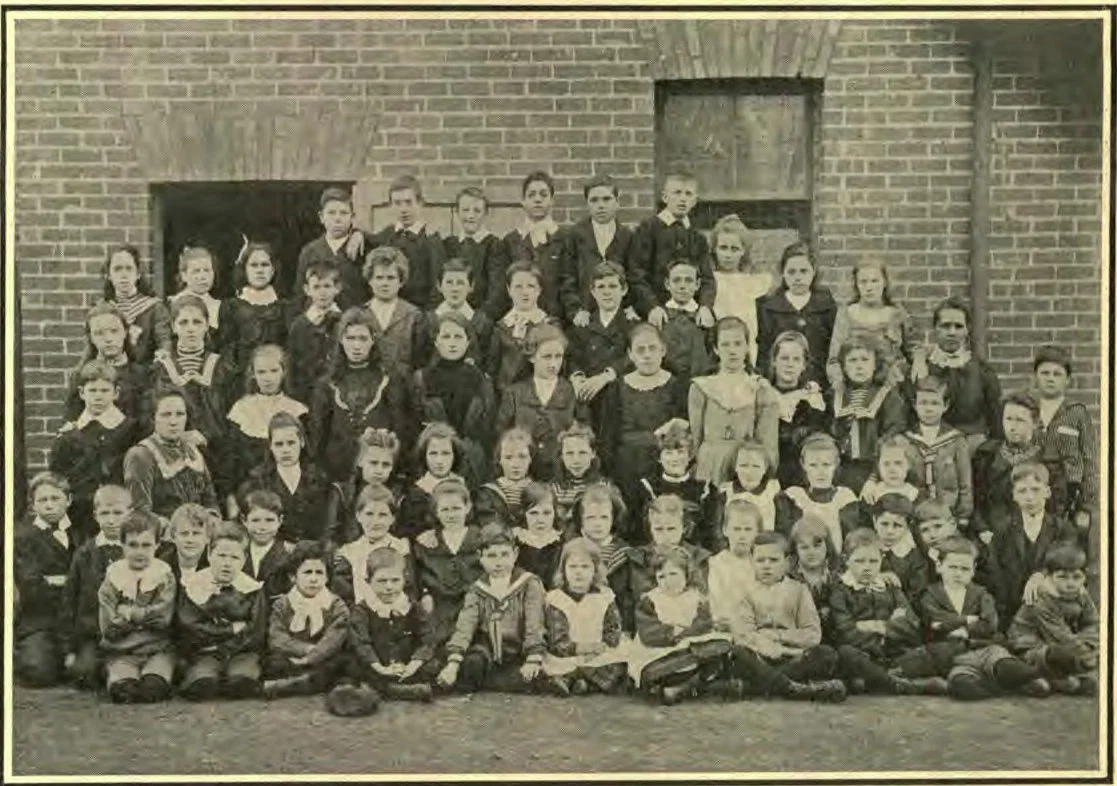
A CHURCH SCHOOL IN AUSTRALIA
Earlier text: THE FROGS

GRAND TRUNK R'Y SYSTEM.

Taking Effect June 2, 1901.
Trains leave Battle Creek.

WEST-BOUND.

No. 9, Mail and Express, to Chicago ................. 12.15 P. M. No. 7, Limited Express, to Chicago .................. 7.10 A. M. No. 3, Lehigh Valley Express, to Chicago ............ 3.50 P. M. No. 5, International Express ........................ 2.17 A. M. No. 75, Mixed, to South Bend ........................ 7.30 A. M. Nos. 9 and 75, daily, except Sunday. Nos. 3, 5, and 7, daily.

EAST-BOUND.

No. 10, Mail and Express, East and Detroit .......... 3.45 P. M. No. 8, Limited Express, East and Detroit ............ 4.14 P. M. No. 4, Lehigh Express, East and Canada .............. 8.22 P. M. No. 6, Atlantic Express, East and Detroit .......... 2.10 A. M. No. 2, Express, East and Detroit ................... 7.00 A. M. No. 74, Mixed (starts from Nichols yard) ........... 7.15 A. M. Nos. 10 and 74, daily, except Sunday. Nos. 4, 6, 8, and 2, daily.
W. C. CUNLIFFE, Agent, BATTLE CREEK.

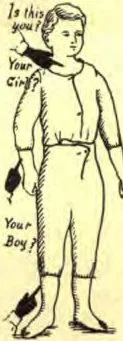
KILL ’EM SAID TO CHILL ’EM,

EXPOSED
EXPOSED
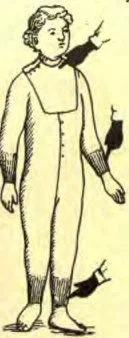
PROTECTED
PROTECTED
“We’re mighty cute together: You get them to be careless, I’ll lay it to the weather. Make under-garments low-neck, With wrist and ankle shortage, While I make up the coffins, All ready for the cortege.”
If CHILL ’EM has not yet turned you over to KILL ’EM, start your blood circulation by clothing your exposed wrists and ankles, and that sensitive hollow at the very gate of the respiratory system.
Put on the new “Common Sense” Health Collar or Throat and Chest Protector, washable, warm as wool, soft as silk, cheaper than dirt in the cemetery. Fits snugly under dress or shirt collar, over low-neck, sore-throat undersuits. First ever devised with throat collar. Made to order for men, women, children. Postpaid 50c, winter weight. Spring and fall, 40c. Both, 85c. Give measure around neck at base.
Adjustable Wristlets and Anklets, child or adult size, 25c, one pair; both, 45c, postpaid.
F. E. Belden, author of “Christ in Song,” says, “I had sore throat and cold hands and feet every winter until I put on these common-sense protectors. I would not take them off for any price. The false theory of hardening these portions of the body by exposure, nearly killed me. Until under-garments are made right, it is sensible to splice on?”
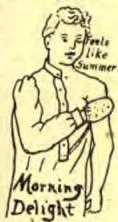
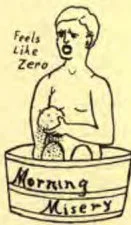
Reversible Health Mit, rough and soft, for DRY FRICTION, evening and morning, or after the bath. Scratches without hurting; prevents chilling. Wrist-fitting, washable. Per pair, 25c, postpaid.
HEALTH AND PURITY LIBRARY ASSOCIATION, Battle Creek, Mich.

A THIRSTY ORCHID

A MOST interesting plant, which draws water for itself when thirsty, has recently been found in South America. Its discoverer, Mr. Suverkrop, thus describes it:—
“One hot afternoon,” he says, “I sat down under some brushwood at the side of a lagoon on the Rio de la Plata. Near at hand there was a forest of dead trees, which had actually been choked to death by orchids and climbing cacti. In front of me, and stretching over the water of the lagoon and about a foot above it, was a branch of one of these dead trees. Here and there clusters of common planta del ayre grew on it, and a network of green cacti twined round it.
“Among the orchids I noted one different from the rest, the leaves, sharp, lance-head shaped, growing all round the root, and radiating from it. From the center, or axis, of the plant hung a long, slender stem about one eighth of an inch thick by one-fourth inch wide, the lower end of which was in the water to a depth of about four inches.
“I at once went over to examine my discovery. Imagine my surprise, when I touched the plant, to see this center stem gradually contract, and convulsively roll itself up, like a tape.
“But more surprising yet was the object and construction of this stem. I found on close examination and dissection that it was a long, slender, flat tube, the walls about one thirty-second of an inch thick, cellular in construction, open at the outer end, and connected at the inner end to the roots of a series of hair-like tubes.
“By subsequent observation I found that when the plant was in want of water, this tube would gradually unwind till it dipped into the water. Then it would slowly coil round and wind up, carrying with it the amount of water that that part of the tube which had been immersed contained, until when the final coil was taken, the water was dumped, as it were, directly into the roots of the plant. The coil remained in this position until the plant required more water. Should the plant, however, be touched while the tube is extended, the orchid acts like the sensitive plant (mimosa), and the coiling is more rapid.”

The Squid and Its Foes

Walking, one summer’s day, across a bridge by the seashore, I chanced to glance over the side, and saw there a school of squids lying quietly in the salt water. They were almost perfectly still, holding their position against the slight tide by gentle motions of their fins. Picking up a pebble, I dropped it into the water near them, and, in a flash, every squid had disappeared. I looked carefully to find out, if possible, where they had gone, and soon discovered, to my surprise, that they had not moved at all. They had simply assumed a color so like that of the sand over which they were swimming that they were only with great difficulty distinguished lying on the sandy bottom.
In the skin of the animal are thousands of minute drops of brilliant colored liquid. The squid can flatten these drops out so as to spread them over his whole surface, thus giving to his body the color of the liquid; or he can contract them into a very small compass, so that they almost disappear, and then the body assumes a grayish, transparent appearance. It is a beautiful sight to hold a live squid in one’s hands, and watch when the play of colors flashing over the body as these color drops contract and expand. Since the drops are not all of the same color, some considerable variation of colors is possible, and by taking on the hue of surrounding objects, the squid frequently escapes the observation of the foes that seek to devour him.
But the chief means of escape is an extraordinary power of locomotion. The squid’s body is surrounded by a large sack, called the mantle, which is attached along the back, but widely open around the neck—much as if one were placed in a meal-bag which was sewed to the back of his coat, but open around his neck. Ordinarily this sack is so widely open at the neck that water flows in freely, and completely fills it. When the squid is frightened by some large enemy trying to capture him, the muscles around the neck are at once contracted, closing the opening entirely. Then the animal violently contracts the muscular walls of the sack, squeezing the water very forcibly. The water thus pressed on must find an exit, even if it can not get out around the neck. Communicating with the cavity of the sack is a little tube having a wide opening into the sack, but a very small one on the outside, underneath the head of the animal. This tube is commonly pointed forward, and is called the siphon. When the water in the sack is so pressed by the muscles, it is squeezed out through this tube in a very forcible jet. The force of the water thus shot out is such as to drive the squid backward with great rapidity. When the squid forces the water out of his mantle cavity in this manner, the whole animal shoots backward, almost with the velocity of an arrow.
But this is not all. Inside the mantle cavity the squid possesses a little sack of very black ink. The mouth of this ink-sack is close to the siphon through which the water is forced out, and when the animal, by its muscular contraction, forces out the water through this siphon, a little jet of ink is forced out with it. This ink spreads rapidly through the water, and in a fraction of a second it effectually conceals the squid beneath its dark cloud. When, therefore, a large fish swims toward a school of squids, hoping to get a meal, he is sure to be met with a cloud of ink.
While the squid feeds upon smaller animals, matters are nicely balanced, since he, in turn, forms the food of larger ones. His body is muscular and soft, and has no skeleton or other hard parts to break the teeth of the fishes which try to devour him. There is hardly a fish of any considerable size that does not regard the squid as a dainty morsel of food. Even large marine animals do not disdain this exquisite delicacy; for squids form a considerable portion of the food of giant whales.
The squid is an animal with a long history, and has, for many thousands of years, been extremely abundant in all seas. It is among the most interesting objects at the seashore. A more beautiful object can hardly be found than a glistening, almost transparent squid, with its bright, greenish eyes, and its flashing play of changing colors.—Prof. H. W. Conn, in St. Nicholas.

“UNITED STATES” IS SINGULAR

In his recently published work on “A Century of American Diplomacy,” General John W. Foster, former Secretary of State, uses the singular verb in connection with the United States, and is called to account therefor by a prominent critic, who admonishes him that “to make United States a singular noun would require an amendment to the Federal Constitution.”
Mr. Foster has spent considerable time and labor in making an investigation of this subject, and concludes from all the testimony he has been able to gather that the point is not well taken.
“I have found,” said Mr. Foster, recently, “that in the early days of the republic the prevailing practice was the use of the plural, but even then many public men employed the singular, and of late years the latter has become the rule. Among statesmen who have habitually used the singular verb are: Hamilton, Jefferson, Seward, Blaine, Edmunds, E. J. Phelps, Webster, Benton, Fish, Frelinghuysen, Motley, Reid, Gresham, Silas Wright, Marcy, Evarts, Bayard, Charles Francis Adams, Depew, Olney.
“Of living professors of international law, Woolsey, of Yale; Moore, of Columbia; Huffcut, of Cornell; and James C. Carter, of New York, use the singular. Andrew Jackson was the first president to adopt the singular verb in his official papers. In the earlier messages of the presidents the plural form is usually found; but since Lincoln, all of them, including Grant, Cleveland, Harrison, and McKinley, have invariably used the singular. In the decisions of the Supreme Court during the first half-century the plural form is generally used, but the singular appears occasionally. In later years the court has used the singular. The same remark applies to treaties with foreign nations.”— Chicago Record-Herald.

THE GUILLOTINE

The guillotine is an instrument used in France and elsewhere for inflicting capital punishment. It came into special prominence during the dark days of the great French Revolution. Traces of the use of a similar instrument long before the Revolution, however, are to be found in Scotland, England, and various parts of the Continent; indeed, it is believed that this method of decapitation originated with the Persians.
In the Antiquarian Museum at Edinburgh, Scotland, is preserved a rude guillotine called the “maiden,” constructed to execute the regent Morton in 1581. It was last used to decapitate the Earl of Argyll in 1685, the father, the Marquis of Argyll, being the previous victim in 1661.
The guillotine was never brought into general use in England; but until 1650 there existed in the forest of Hardwick a mode of trial and execution for theft, called the gibbet, the condemned being beheaded on a machine called the Halifax gibbet. During the Middle Ages the machine was in general use in Germany. From the thirteenth century it was in use in Italy, confined, however, to the execution of criminals of noble birth. It was in use in France until 1632, but for the execution of nobles only; and not until Dr. Guillotin proposed it, was it ever used for all classes of criminals. His resolution was presented to the French Assembly in 1789, but was not formally adopted until October, 1791. After a machine was constructed, and its efficiency tested, it was erected on the Place de Gieve for the execution of the highwayman Pelletier, April 25, 1792. At that time the machine was known as louisette, or la petite louison, but in April, 1792, the French Assembly officially recognized its originator by naming the instrument la guillotine.
The statement is frequently found in print that Dr. Guillotin perished on the guillotine, but this is an error. He survived the Revolution, and died peacefully in 1814.
W. S. CHAPMAN.
THE NORTH FITZROY CHURCH SCHOOL.

You have reached the end of this edition.

The Youth’s Instructor · Jan 16, 1902