How to Make an Electromagnetic Coil That Is Inexpensive
By Uthai Vincent Wilcox
Leyden jar
CONSTRUCTING an electromagnetic coil is quite simple, in spite of the complicated appearance of one. The simple making of a coil will teach you many things about electricity, and besides there is a great deal of amusement that you can obtain from one by giving your friends shocks, or you can have a steady current, similar to that given by the nurse with her electrical medical battery. The shocks will not be such strenuous, hard ones as you may get from the Leyden jar, or from a plate machine; but a prickly, tingling sensation, as when your arm goes to sleep. And then you can control the current, making it so weak as to be scarcely felt, or strong enough for two persons.
FIGURE 1
FIGURE 2.
The most expensive of the materials used are the insulated wire and the platinum, and all that is required of these can be bought for about a dollar, or perhaps less, according to where you live.
The following materials will be necessary in the coil described: 200 feet of No. 36 and 11 feet of No. 20, insulated copper wire; 15 feet of ordinary annealed iron wire, such as is sometimes called stovepipe or telephone wire; a small piece of platinum wire, about ¼ of an inch long; a piece of platinum foil, ¼ of an inch square, and a few pieces of brass, which you can pick up anywhere.
The coil consists of seven parts: the core, primary coil, reel, secondary coil, regulator, contact breaker, and base.
FIGURE 4.
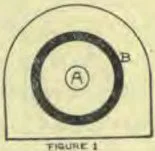
To make the core, get a piece of hard wood half an inch thick, cut off a piece about 1¾ inches square, and round off the two corners so that it will resemble Fig. 1. This is called the head. Through the center of this block, bore a hole ¼ of an inch in diameter. (See A, Fig. 1.) In this, place as many pieces of annealed iron wire, five inches long, as possible, making them project on one side ¼ of an inch; wedge them tight with a soft iron nail, as in D, Fig. 2. This bundle of wire forms the core, and on it is wound the primary coil, composed of No. 20 insulated copper wire.
Both ends of the wire in this, and also in the secondary coil, should be left projecting several inches, for the purpose of making connections, as explained later.
Begin your winding close up to the head, and wind carefully over the core up to the other end, and then back again, so as to form two layers of wire. Cover the coil with a strip of heavy brown paper, and carefully coat it with a thin layer of varnish made of gum shellac dissolved in alcohol.
The reel consists of a paper tube with a head firmly fixed at each end, which should be of the same shape and size as used on the primary coil. One should be ⅛ and the other ½ of an inch thick. Through the center of each bore a hole 1 inch in diameter. You can make the tube by winding brown paper around a stick or cylinder ¾ inch in diameter; the paper should be gummed or glued on one side as you wind. After it is dry, remove from stick, and you should have a tube 5 inches long and 1 inch in diameter. Now glue the heads on.
The secondary coil is wound on the reel. It is made of silk-covered No. 36 copper wire. When you handle this wire, be very careful to avoid breaks or kinks. Leave the ends projecting for making connections. The winding should be up close to the thick head of the reel, and continue until you have wound on 200 feet of wire; finish at the same end at which you began. You may cover this with either paper, leather, or velvet, as preferred.
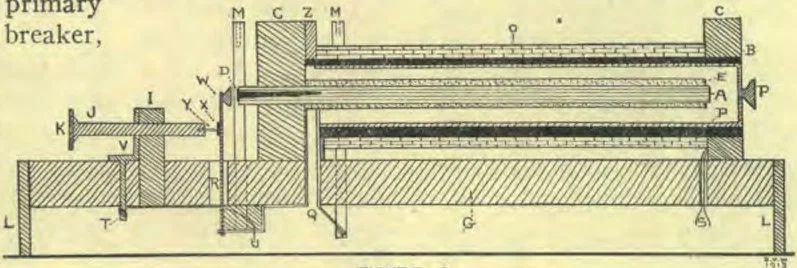
Now glue the thin head of the reel solidly to the head of the primary coil, so that the latter will lie within the paper tube of the former, and the terminals, or two ends, of the primary coil will pass between the two heads, as shown at Q, Fig. 2, Z being the head of the reel, and G the head of the primary coil.
The regulator is a copper or brass tube, equal in length to the paper cylinder of the reel, within which it should slide easily. On one end is a piece of metal with a knob (F) to be used for a handle, to pull the tube out, and to increase the strength of the current.
The contact breaker is of two parts—a vibrator and a platinum screw. The former is composed of the spring (H, Fig. 2), ¼ of an inch wide, made of steel or brass. The lower end is fastened to a small piece of wood or metal (U) placed beneath the baseboard, near a hole through which the vibrator rises vertically, so that the face of the iron clapper (W), fastened at the upper end of the spring, shall be directly in front of the projecting end of the core and about 1-16 of an inch from it. A short distance from the vibrator, place a wooden pillar (I), to which fasten an L-shaped piece of brass (V). Through this pillar pass the platinum screw (J), made of an ordinary13brass screw, on the head of which is soldered a one-cent piece (K), and the point of which is armed with a piece of No. 18 platinum wire (Y), from which the screw receives its name. This platinum wire comes in contact with a piece of sheet platinum (X) soldered on the spring of the vibrator, a little below the clapper.
The base may be made of any well-seasoned wood. Make it 8 inches long, 3 inches wide, and 1 inch deep. Place the coil horizontally at one end, and fasten with screw driven up from below into the heads. Make holes for the primary and secondary wires and the vibrator to pass through. The contact breaker is fastened in its place at the proper end of the coil.
At this end two binding posts (M and M′) for connections with the battery are necessary. These may be easily made by taking a piece of large brass wire, or a screw, and drilling a hole in the top, as indicated by the dotted lines. The lower ends should project beneath the baseboard. Two similar posts (N and N′, Fig. 3) are required on the opposite side of the coil.
The connections are all made beneath the baseboard. Figure 3 represents the appearance of the underside of the coil when all parts are connected. Primary wires (Q) are joined with the vibrator (H), the other with the post (M). The post (M) is connected by a piece of wire with the screw (T), which is screwed through the piece of brass (V, Fig. 2). The secondary wire (S) is connected with the posts (N and N′), which are the binding posts for connecting the electrodes with the coil.
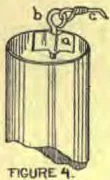
For the handle of the electrodes, make two cylinders of tin, 1 inch in diameter and 4 inches long. Solder a loop of tin (a, Fig. 4) on the inside at one end, into which fit eyes (b), fastened at one end of the conducting cord (c), so that they will jam tight. Connections with the battery and posts (M and M′) may be made in a similar way, by making the eyes fit into the holes drilled into the top of the posts.
Almost any battery may be used with the coil. To use the coil, see that all connections with the battery are properly made, and then turn the platinum screw slowly until the point just touches the vibrator, or until the spring begins to vibrate, then turn it back and forth until the buzzing sound made by the vibrator becomes steady. When all is ready, grasp the handles of the electrodes firmly, one in each hand, and pull out the regulating tube until a current as strong as desired is obtained.
The illustrations are made to be used as working drawings if desired. In all of them the same letter is used to refer to the same thing.
A. The core.
B. Paper tube of the reel.
C and C′ and Z. Heads of primary coil and reel.
D. Soft iron nail used as wedge for core.
E. Primary coil.
F. Knob for moving regulator P.
G. Baseboard.
H. Spring of vibrator (thickness exaggerated).
I. Pillar supporting platinum screw.
J. Platinum screw.
K. One-cent piece fastened to head of screw.
L. Legs supporting baseboard.
M and M′. Binding posts for batteries.
N and N′. Binding posts for electrodes.
O. Secondary coils.
P. Regulating tube.
Q. Ends of wire of primary coil.
R. Hole in baseboard for vibrator to pass through.
S. Ends of wire of secondary coil.
T. Screw for holding V in place.
U. Block supporting vibrator.
V. L-shaped piece of brass for making connection with platinum screw and the post M.
W. Clapper to vibrator.
X. Platinum foil on vibrator.
Y. Platinum wire in front of screw J.
Fig. 1. Shows the shape of the heads.
Fig. 2. Shows a section through length of coil.
Fig. 3. Shows under side of baseboard.
Fig. 4. End of handle to electrode, showing how connection is made with conducting rod.
UTHAI VINCENT WILCOX.
God’s Commands
By M. E.
(Texts for March 25-31)
God’s commands constitute the only complete program for true living; and just think what splendid friends, what ideal Missionary Volunteers, what peaceable home folks you and I would be if we obeyed them fully! How many of the commands given in our Morning Watch verses this week are we really seriously trying to obey? Let us notice them again in the order we study them:—
1. “Stand in awe, and sin not.” God wishes us to look upon life seriously as our greatest opportunity, and then with his help make the most of it. Sin dwarfs—it always dwarfs and hinders us from reaching life’s truest ideals.
2. “Commune with your own heart.” Every young Christian who would live the victorious life should strive first to know God; second, to become acquainted with himself. “Suffer me,” said Abigail Adams to her son, “to recommend to you one of the most useful lessons of life, the knowledge and study of yourself.”
A reckless youth promised his dying father to spend fifteen minutes a day in quiet meditation. He kept his promise. It was not long before he realized that he was “wasting his substance,” and became an earnest Christian. Get acquainted with yourself. Look over your life each day. See if you are really making the best investment of your great opportunity. In quiet communion with your own heart, strive to learn how to make each day a record you will not be ashamed to meet in the judgment.
3. “Keep thy tongue from evil, and thy lips from speaking guile.” Perhaps the greatest offense of the tongue is the unkind things it says about others. What an unruly member it is! How often it brings most of us to grief! And yet, if this command is obeyed, it may become an avenue for great blessing to others.
4. “Depart from evil.” This is all-inclusive. There is nothing evil in act, in word, in thought, to which we can cling and obey this command. Is not gossiping one of the greatest evils among professed Christians? Does it ever pollute your lips? Would it not be well for each one of us to follow the example of Mrs. Chalmers? Whenever any one attempted to pass gossip on to her, she would say: “I will put on my bonnet and go right over and ask the person if it is really true.” It proved a very effectual way of putting out the dreadfully consuming fires which gossipers kindle and feed.14
5. “Do good.” Our Master “went about doing good;” he “lived to bless others;” and he desires us to follow in his footsteps:—
“Others, Lord, yes, others,
Let this my motto be;
Help me to live for others,
That I may live for thee.”
6. “Seek peace, and pursue it.” Unselfishness and peace are bosom companions. God gives his peace—a peace that passeth understanding—to those who surrender their all to him. The more unselfishly we live, the more we shall contribute to the peace of the circles in which we move. All along the way one must give up some of his rights in order to preserve peace.
7. “Trust in him [God] at all times.” If we keep our eyes riveted on God instead of the things that worry and annoy us and fill our hearts with fear, we shall learn to trust him, for we shall see that across the cloud of every trouble shines the rainbow of his love and care, reminding us that nothing—absolutely nothing—can touch us without his permission.
8. “Pour out your heart before him.” Have you tasted the sweet relief that comes from confiding in God? To share our heartaches with a trusted friend helps wondrously, but confiding in God is the one unfailing panacea for all heartaches. Try it.
9. “Trust not in oppression;” “Become not vain in robbery.” Men have amassed large fortunes through “oppression” and “robbery.” They have underpaid their laborers; they have driven sharp bargains; they have become overwhelmingly rich in filthy lucre, but pathetically poor in the great noble elements of character, because they pursued a course against which God had warned them in his Word.
10. “If riches increase, set not your heart upon them;” no, for they are bound to disappoint; they cannot insure life’s choicest gifts, nor shield one from life’s deepest sorrows. He who trusts in riches has, to his own sorrow and loss, misplaced his confidence; and “the curse of misplaced confidence,” says one, “is that it brings a man down to the level of what he trusts in, and the blessing of wisely placed trust is that it lifts him to that level. . . . Men are assimilated by the objects of their trust; if these are empty, ‘so is every one that trusteth in them.’”
11. “Give ear, O my people, to my law;” “Incline your ears to the words of my mouth.” We should put forth the necessary effort to know his commands, for we must know them before we can obey them, and in obeying them lies our only safety.
12. “Defend the poor and fatherless;” “Do justice to the afflicted and needy;” “Deliver the poor and needy; rid them out of the hand of the wicked.” Yes, “do all the good you can, to all the people you can, in all the ways you can, as long as ever you can,” for, “inasmuch as ye have done it unto one of the least of these my brethren, ye have done it unto me.”
13. “Worship the Lord in the beauty of holiness.” We are to present for his service pure hearts and clean hands. Our lives are to be a constant demonstration before others of God’s saving and keeping power.
14. “Fear before him.” I think it was Wesley who said: “Give me ten men who fear nothing but God, . . . and I’ll set the world on fire.” Think what exploits we might do if we never stooped to fear the opinions of others, but feared only to fail of obeying fully our Master’s commands.
15. “Give thanks unto the Lord.” He demands this, for he knows giving thanks to him will increase our courage, strengthen our faith, and enable us to get better acquainted with him “whom to know is life eternal.”
16. “Call upon his name,” for it is our only source of unfailing help for all we meet along life’s pathway. God wishes us to remember to call upon him, for prayer is the secret of true living.
17. “Make known his deeds among the people.” Are you telling the people in your community what God is doing for you? What miracles he has performed in your heart? How he is saving men and women in heathen lands? Do it; it may lead them to call upon the only Name that can save them from sin and death.
MEDITATION.—In quiet communion with my own heart, I come to realize that my success in life is not measured by the things I get or miss, but by my obedience to God’s commands.
SPECIAL PRAYER.—Father, help me to obey thee in all things, that my life may receive thy approval, satisfy my own deepest desires, and be a blessing to others.
M. E.
Missionary Volunteer Society Programs for Week Ending March 31
THE programs for this date, with notes, illustrations, and other helpful material, will be found in the Church Officers’ Gazette for March.
March 31: I Samuel 9. A young man comes to the house of Samuel.
A Hero of Truthfulness
Next to Moses, probably Samuel was the greatest man in the Old Testament. Being the last of the judges during that period of disobedience and weakness, Samuel became the second founder of the Hebrew nation.
It is a great thing to rescue some one from drowning, or otherwise save a life. A boy in Washington, D. C., who jumped into the river and saved a child15from drowning was greatly honored and given a gold medal. But how much more important to save many people from eternal death, or to be the savior of a whole nation! The times were evil, and Samuel was the man of the hour to do a great work for God.
Nor did the Lord just happen to choose Samuel. As a boy he had just those traits of character that the Lord could use. What are those traits of character? The disposition to listen and to obey—listening and obeying.
When the Lord called Samuel, what did he say? He said, “Speak; for thy servant heareth,” didn’t he? Samuel had always hearkened to the voice of Eli and promptly obeyed him. Suppose that on that wonderful night when the Lord called the boy, he had said, “O, that’s just like Eli to wake me up here in the middle of the night! Very likely it can just as well wait till morning. I’m going to pretend I didn’t hear.” Do you think he would ever have been the Lord’s prophet? But he promptly responded, as usual, “Here am I.” Samuel was really and truly a Missionary Volunteer. And we become Missionary Volunteers whom the Lord can use, by careful attention and prompt obedience to parents and conscience.
But that isn’t always easy to do, is it? Do you think Samuel had any hard things to do? Do you think it was easy for the boy to tell the aged priest, Eli, whom he loved, what the Lord had said about the coming destruction of his house? Doubtless he felt that he could never tell him. But Eli asked him. Should he pretend that the Lord had not spoken again? If he had, do you think the Lord could have used him any further? But no, this boy who had been given to God’s work, must not be a coward. Heroically he tells Eli the whole truth. Thus the boy Samuel shows himself worthy of the great work to which God called him. Many times after this, the Lord gave him messages for the people. After Eli’s death he was judge over Israel for many years.
Samuel had other hard things to do. He had to reprove the people for their sins, and he had to tell Saul that the Lord had rejected him. Samuel was the leader of a great reformation. He established schools, the “schools of the prophets,” where men were trained to carry forward the work—men who would listen and obey.
This story is especially interesting to boys and girls because Samuel began in the Lord’s work when he was so young. In reading these stories, look up the places on the map, and try to picture to yourselves conditions as they were back there. M. E. K.
MEMORY VERSES: Review the memory verses for the quarter.
Questions
1. Why was a council held in Jerusalem? Who were the chief speakers? What decision was reached? Acts 15:1-35.
2. Who went with Paul on his second missionary journey? From what city did they start? What churches were visited? Acts 15:36-41.
3. Relate the experience of Paul and Silas at Philippi. What was the result of their labor there? Acts 16:1-40.
4. What cities were next visited? Why did the missionaries leave Thessalonica? What is said of the Bereans? Acts 17:1-15.
5. What city did Paul visit that was “wholly given to idolatry”? In what famous place was Paul called to speak? What was the result of his labors? Acts 17:16-34.
6. To what city did Paul go from Athens? How long did he remain there? How did he get money to pay his expenses? What vision was given to encourage him? To what place did Paul go from Corinth? Acts 18:1-21.
7. Trace his second missionary journey on the map. Acts 18:23.
8. Whom did Paul find when he returned to Ephesus? What question did he ask them? How long did he remain in that city? What special miracles were wrought by his hand? Relate the experience of certain vagabond Jews. Describe the uproar in Ephesus. Acts 19:1-41.
9. What countries did Paul visit after leaving Ephesus? Relate his experience in Troas. Acts 20:1-12.
10. Describe the meeting with the elders in Miletus. Trace the return from the third missionary tour. Acts 20:17 to 21:17.
11. What have you found in Paul's character that is worthy of imitation?
12. Repeat the memory verses for the last twelve Sabbaths.
Question Box
By M. M.
“In the programs in the Gazette, provision is made occasionally for a social service. Would you advise me to try to have this when I am quite sure no more than three or four would take part, and perhaps not that many?”
One of the statements in the “Testimonies for the Church” regarding our young people’s meetings which we should consider carefully is this: “When young men and women are sober-minded, and cultivate piety and devotion, they will let their light shine forth to others, and there will be vital power in the church. It would be well to have an hour appointed for Bible study, and let the youth, both converted and unconverted, gather together for prayer and for the relation of their experiences. The youth should have a chance to give expression to their feelings.”
In view of this, and other similar statements, I believe you would do well to make it a general rule to set apart a little time of every meeting for social or testimony service. In fact, I think the whole program should center in the Bible study and social meeting. However much study and preparation are given to other items on the program, I would give this the most careful study and the most earnest prayer. Consider it with the other officers, and persevere until all recognize it as not only vital, but interesting and helpful, and a part of the meeting to be looked forward to with eager anticipation.
How may you ascertain the spiritual condition of your little flock? Not primarily by the size of their offering, or their report of work done, nor by their apparent interest in the program, but chiefly by the ring of their testimonies. If they are backward in such a meeting, you will not remedy the defect by omitting the social service. Cultivate the spirit of it. Bring into the little prayer bands the warm, loving, sympathetic atmosphere in which testimony thrives, and then transfer this to the larger, public meetings. Soon this will become one of the most attractive forces in your service, and may leave the most lasting impressions upon all present.
M. M.
Memory Verses for the Quarter
“We believe that through the grace of the Lord Jesus Christ we shall be saved, even as they.” Acts 15:11.
“Go ye into all the world, and preach the gospel to every creature.” Mark 16:15.
“Come over into Macedonia, and help us.” Acts 16:9.
“Believe on the Lord Jesus Christ, and thou shalt be saved.” Acts 16:31.
“They received the word with all readiness of mind, and searched the Scriptures daily.” Acts 17:11.
“He giveth to all life, and breath, and all things.” Acts 17:25.
“I am with thee, and no man shall set on thee to hurt thee.” Acts 18:10.
“Many that believed came, and confessed, and showed their deeds.” Acts 19:18.
“Thou shalt not make unto thee any graven image.” Ex. 20:4.
“This is my commandment, That ye love one another, as I have loved you.” John 15:12.
“Remember the words of the Lord Jesus, how he said, It is more blessed to give than to receive.” Acts 20:35.
“God forbid that I should glory, save in the cross of our Lord Jesus Christ.” Gal. 6:14.
Marie Ribot
THE handkerchiefs that Mrs. Lindsay had ordered monogrammed were so exquisitely embroidered that she gave an exclamation of delight when Madame Alphonsine showed them to her.
“Why, madame, they look as if fairies had done them!” she declared, as she bent over the dainty things.
“I am pleased that madame is pleased,” Madame Alphonsine replied. “We do our best; it is our reward to be appreciated.”
Mrs. Lindsay examined still more closely the exquisite work. “I should so like to meet the woman who did this,” she said. “I should like to thank her myself. Would you allow it?”
“But yes,” madame replied quickly; “of a certainty. It would be an honor. It was Marie Ribot. She shall come.”
That was the beginning. It was many months before Marie Ribot would permit even the beginnings of friendship; months more before Mrs. Lindsay felt herself really given the freedom of the tiny, spotless, two-room home where Marie Ribot lived with her little adopted daughter. Marie was forty-four. Her thin face showed the marks of privation, yet she carried an atmosphere of joy that baffled her friend. What in the hard days of work, the meager pay, the endless contrivances necessitated by the “small, heart-breaking arithmetic,” could bestow such radiance? It was Mrs. Lindsay’s problem for months, and at last one day she learned the secret.
Marie, apologizing for keeping at work while she talked, was doing up a tiny jar of jam for a sick friend. From a store of wrapping papers she selected a white piece and cut it thriftily; from a box of string she chose a piece of green, tying it in a tiny rosette; last of all, she picked a leaf of sweet geranium from a plant in the window and slipped it through the bow.
“What an artist you are, Marie!” Mrs. Lindsay exclaimed. “How did you learn it?”
Marie was silent a moment before she answered. Then, “From my grandmother. She—grandmère— talked always of the gifts of the good God—always giving, giving to his children. So those who had his love in their hearts must give, too. I was young then, and impatient; and we were very poor. I cried, ‘How, grandmère, how can we give?’ And she said, ‘The heart that loves never lacks a gift. Look about you and listen, Marie.’ So I looked and listened, especially to her. And I saw how people came to her, and always she gave and gave; and I saw that often what she had to give was courage, or faith, or kind words about another; and after the blindness dropped from my eyes, I saw that that was what people wanted most. Madame’s kind words about my work—what was that but a gift? And then there are so many other things: bits of tin foil, ribbon, bright papers for the children—it is wonderful how they come—a leaf, a blossom. So the good God gives his children the joy of giving.”—Youth’s Companion.
House Passes Sheppard Bill Making District of Columbia Dry
On the last day of February the House of Representatives, by a vote of 273 to 137, passed the Sheppard prohibition bill, which makes the District of Columbia dry after November 1. Just before midnight of March 3, President Wilson placed his signature to the bill.
More Prohibition Legislation
THE prophecy of speedy action on the prohibition question by a number of State legislatures has been verified. Recently the Indiana Assembly passed a statutory prohibitory bill by a majority of about two to one. The bill passed the Senate February 2, by a vote of 38 to 11.
One of the most remarkable dry victories was that in Wyoming a few days ago, where the assembly suspended the rules and passed a prohibition referendum bill without an opposing vote, and the senate also suspended the rules and passed the same bill without opposition. The bill then went to Gov. J. B. Kendrick, who immediately signed it. Not a member would raise his voice or vote against the measure. This bill sends the question to the people, to be voted upon in 1918, to take effect Jan. 1, 1920.
The liquor people were very proud of Wyoming, and often boasted that she remained wet when her sister States went dry. It is said that as a wet State it is worth $25,000,000 a year to the liquor traffic. This is liquor’s last stand in the north-central Rocky Mountain region. Colorado, Washington, Oregon, Montana, Idaho, North and South Dakota and Nebraska are all dry, and Utah will soon join them.
As sixty per cent of the voters of Wyoming are women, there is little doubt that prohibition will be written into the constitution at the election of next year. The United States Senate on January 31 passed a bone-dry law for Alaska without a roll call, in harmony with the action of the Territory in voting for a drastic prohibitory law by a majority of between two and three to one. It is expected that the House of Representatives will follow the action of the Senate.