AMONG the many things here in Korea that are different enough from the things one is accustomed to in America to make a deep impression on the mind of the newcomer, is that Korea instead of having a scattered rural settlement, is primarily a land of villages. One seldom sees an isolated dwelling here. This may be due to the fact that Korea until very recently has been infested with numerous robber bands, whose sole occupation was to rob those who followed peaceful pursuits, and plunder their dwellings. The mountains that abound in all sections of the country formed safe retreats for these outlaw bands, and so they lived and thrived, and the people, in order to protect themselves and their dwellings from these raids, banded together in companies and began to dwell in villages. Now the custom has survived its need. Village has been added to village in number, until today they are scattered over the country by the thousands, having all the way from ten to ten thousand houses. From a mountain commanding a view over a fertile valley, the many villages that are scattered over its length make an attractive sight. From the mountain top to the west of Keizan at least a score of these villages are visible, none of them being more than a mile distant from its neighbor.
Most of the villages are located on a small stream, and usually on ground that is too rough or rocky to be farmed. The creek furnishes a place for the matrons of the village to do the family washing, which they take to the brookside. After dipping the clothes in the water, they lay them on a flat rock and pound them with wooden clubs, redipping them in the water from time to time. After the clothes are fairly clean, they are taken to the house and boiled, after which they are taken back to the creek and the pounding process is repeated until they are clean. By this primitive way of washing, wearing apparel is made surprisingly clean.
The process that is generally followed in ironing is similar to that of washing. The dried garments are laid on a flat rock and pounded with round clubs made for the purpose, although some use what seems to be a small frying pan, into which they place live coals of fire, and pass it back and forth over the clothes, as the American woman does her electric iron. The clothes thus treated more than do credit to the implements and their users, and clothes are worn that one would hardly suspect were so treated.
The houses of the villages are huddled close together, each house having a lot perhaps fifty feet square, and inclosed with a mud or stone wall about five feet high. Thus the dwellings give the impression of being damp and dismal places, as in fact they are. The yards, which are swept smooth, provide threshing places for beans, rice, millet, or other produce. Seldom is anything grown around the houses but pumpkins, the vines of which run profusely over the walls and houses.
The houses are built of stone and mud; or more often by standing up corner posts with intermediate posts every five or six feet, and weaving bamboo between them, which is plastered on both sides with the firm clay that is so plentiful in this country. Sometimes on the exterior of this plastered house is built a wall of mud or stones, to give additional warmth to the dwelling. Windows are unknown to the native, and doors are but open frames over which is pasted a good quality of native paper, to keep out the weather and at the same time furnish light for the house. The houses are small, having from one to three rooms besides the kitchen, which is generally a lean-to contraption with one side open, probably to allow the smoke from the stove to be unhindered in its passage to the open.
The stove referred to is simply a fire box of stone and mud, with an iron kettle in the top. The smoke is supposed to pass through intricate channels under the floors, to provide them with the necessary heat required; but as these flues have no elevated chimneys, simply discharging their smoke at a level with the stove, the draft is poor, hence about one half of the smoke goes the other way, passing out through the open side of the kitchen.
The single kettle of the native stove is the place where all foods are cooked for man and beast, and also where the family washing is boiled from week to week. The kitchen is always minus the floor, while the mud and stone floors of the other rooms are elevated about two feet, to allow space for the smoke channels underneath. The furniture of the kitchen consists of a few brass bowls and crocks. The other rooms of the house are barren, with the exception of a box or two in which are kept the bedding and the clothes of the occupants. At night a thin quilt is laid on the hard floor, which boasts nothing more than a thin straw mat of one thickness of straw. Upon this quilt the native sleeps, with the necessary covering over him. This bed receives its occupant early, doubtless because of a lack of light to brighten the dull hours8of the evening. While the Korean is early to bed, he is also early to rise, and this may be due to the hardness of the couch, which scarcely makes of sleep a pleasure.
The roofs are thatched with rice straw. Very seldom does one see any other roof used by natives. Every fall, after the harvest, the roofs are rethatched with bright new straw. Although these roofs look insufficient to the Westerner, yet they make quite an effectual water and weather break.
From such houses and villages the natives go forth to pursue their daily toil, which, with the majority, is the cultivation of the soil. The Korean valley is cut up into patches from ten feet square to an acre of ground. Upon these little tracts are grown rice, barley, tobacco, and turnips, all of which are plentiful in this country. Barley and rice form the chief food of the people, barley for the poorer class and rice for those better situated financially. To this must be added the native pickle made from the turnips referred to. Meat of all kinds is eaten when obtainable, but is a luxury that few can afford. Mushrooms, fern roots, and quinces are some of the side dishes that are relished. Tobacco is smoked by almost every one, both men and women.
Great quantities of rice are annually shipped from this country. Already this season thousands of carloads have been shipped from here. Hundreds of carloads are stacked up at the station waiting shipment, and still from every direction, all through the day, it is pouring in on wagons, on oxen, and on the backs of the natives themselves. This rice is the second crop of the year, barley and other grains having been harvested from the same ground earlier in the summer. The grains were sown the fall before. At this time, the first of December, the fall grain is well up, and the valley presents a freshness in green that is very pleasing.
When one is on the ground and takes note of the natives' crude ways of farming, it is surprising that they raise such good crops; but nature is very kind in this country. The same policy pursued in America, would put the man behind it in the poorhouse. The ground is partly loosened up to the depth of a few inches by means of a shovel plow drawn by a bullock, but the furrows are at least a foot apart, the intervening ground being untouched. The ground, after being thus treated, is scratched down some by means of a crude harrow with wooden teeth. But the frosts of winter loosen the ground, and the abundant rains of summer nourish the crops, and so a good harvest is reaped.
This land, with its thousands of villages of mud houses with thatched roofs, wherein dwell people who to us seem uneducated, unskilled, and indolent, weakened through filth and disease, corrupted by superstition and false religion, is waiting, sadly waiting, for the pure religion of the Man of Nazareth. Already many have felt the uplifting power of the gospel, and have cleaned up physically and broadened out mentally. Having tasted of the One that is altogether lovely, they themselves have become lovable from a human standpoint. We pray that many thousands more may feel the uplifting influence of the third angel's message.
E. J. URQUHART.
Walking Across Lawns and Parking Lots
Do you quite habitually walk across parkings and public or private lawns, instead of using the sidewalk? If so, you are not possessed of three very desirable traits of character.
A Year of Seven Eclipses
THE present year is remarkable for having seven eclipses, four of the sun and three of the moon—the greatest number of lunar eclipses that can occur in one year. One of them, the first total eclipse of the moon since 1913, has already taken place; the next, which will be invisible in this country, will occur in July; and the third, which also will be total, and which all of us can see, will take place on the morning of December 28.
The last year in which seven eclipses took place was 1805, and there will be only two years in the next century and a half when as many eclipses will occur again. Not since 1787 have there been three lunar and four solar eclipses in one year, and few of us will be alive in 1982, when the sun, the moon, and the earth will again be in precisely the same relation to one another.
None of the four solar eclipses that will occur this year are total, and only one of them can be seen at all in this country. That is the partial eclipse of June 19, which will be visible in the State of Washington and in northern Idaho, northwestern Montana, western Canada, and Alaska.—Youth’s Companion.
Hawaii’s Famous Volcano
THE world’s largest active crater is the volcano Kilauea, Hawaii. It is about one hundred and eighty miles from Honolulu. One of the national dailies gives the following description of what is now going on within this vast crater:—
“The volcano, inclosed by a circular wall from 200 to 700 feet in height, is a black plain of some four square miles in area, within which is the pit of Halemaumau, about 2,000 feet in diameter, recently empty to a depth of a thousand feet, but now nearly level to its mouth with boiling lava. A few months ago the life of the volcano could hardly be discerned, but today the pit is a roaring, boiling, swirling lake of fire of many acres in extent, and at night the glow from the red-hot lava can be seen all over the island and far out at sea. The fiery lake is filled with spouting fountains that shoot the liquid rock hundreds of feet into the air. The rim of the pit is constantly crumbling, eaten away at its base by the surging tide of fire, and tumbling with deafening crashes into the molten mass.
“The temperature of the lake is more than 2,000 degrees Fahrenheit, according to the results obtained by Prof. T. A. Jaggar, of the Massachusetts Institute of Technology. The temperature was found by thrusting into the molten lava lengths of pipe screwed together, into the end of which has been fitted six Seeger cones, conical plugs of fusible clay designed to melt at varying temperatures.
“To reach the living lava, Professor Jaggar and his assistants had to scramble down sixty feet over the rim of the pit, holding on to the knife-edged crags that had been thrown up by the volcano’s activity. One of the party fell when near the bottom, but fortunately regained his feet in time to prevent rolling into a fissure, where he would have been consumed in an instant.”
WILL JESUS COME AGAIN?
By Carlyle B. Haynes
Donald Hears a Sermon on a Most Prominent Doctrine
CARLYLE B. HAYNES
WHEN Donald Hunter reached home after the first meeting at the tent, he said to his father: “Papa, was what Brother Harris said tonight about the coming of Jesus true?”
“Yes, my boy,” answered Mr. Hunter, “Mr. Harris got what he said from the Bible, and the Bible is true.”
“Then, papa, why haven’t you and mamma told me about these things before this?” Donald asked.
“Well, son, you must not blame father, for I, too, learned some things tonight that I had never known before,” Mr. Hunter replied.
“COMING AGAIN, COMING AGAIN!”
“Dorothy Butler told me this evening,” spoke up Margaret Hunter, “that these people are Seventh-day Adventists, and that they are always preaching about the end of the world. She doesn’t believe it at all.”
“They are Christians who keep Saturday, and who teach that the second coming, or the second advent, of Christ is near at hand,” replied Mr. Hunter. “And I have no doubt that Brother Harris is an Adventist. I have known before that they teach the near coming of Christ, and have never felt very much in sympathy with them regarding it, but I did not know before upon what they base their views. It does seem as if they know what they are talking about. We must study this matter more thoroughly.”
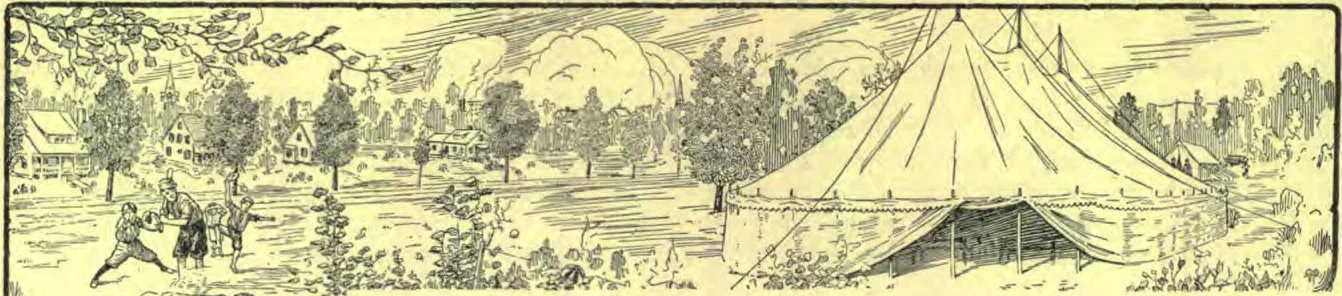
The next night all the Hunter family were back in their places at the tent. There were about four hundred present at the time the second meeting began. The subject was, “Will Jesus Come Again?” There were no pictures at this meeting, but Donald found that he was just as interested as he had been the evening before when there were pictures to entertain him. In the back of his mind he kept wondering why it was that Seventh-day Adventists keep Saturday instead of Sunday, and if Brother Harris was a Seventh-day Adventist.
After the song service and the prayer, Brother Harris began his sermon. He said:—
“The person who believes the Bible can have no doubt that Jesus will come again. The clear and convincing testimony of the Bible from beginning to end is that Jesus will come the second time. This great truth is the most prominent teaching of the New Testament, for it is mentioned there more than three hundred times. Jesus declared again and again to his disciples that he would come again.”
“Just before his death, Christ said to his disciples: ‘I will come again, and receive you unto myself; that where I am, there ye may be also.’ John 14:1-3. There is no possibility of mistaking this language. Jesus is coming again. He also said: ‘I go away, and come again unto you.’ John 14:28. To the unbelieving Pharisees and scribes, just before his death, he said: ‘Ye shall not see me henceforth, till ye shall say, Blessed is he that cometh in the name of the Lord.’ Matt. 23:39.”
“On another occasion he told his disciples that they should ‘see the Son of man coming in the clouds of heaven with power and great glory.’ Matt. 24:30. To them again he said: ‘The Son of man shall come in the glory of his Father with his angels.’ Matt. 16:27. When adjured by the high priest at his trial, Jesus answered: ‘Hereafter shall ye see the Son of man sitting on the right hand of power, and coming in the clouds of heaven.’ Matt. 26:64. In the last chapter of the Bible this same Jesus repeats three times this truth of his second coming: ‘Behold, I come quickly;’ ‘And, behold, I come quickly;’ ‘Surely I come quickly.’ Rev. 22:7, 12, 20.”
“Surely, every soul that accepts Jesus as guide and teacher must be convinced by this strong testimony that this teaching of the return of Jesus is true.”
As Donald looked around on those sitting near him, he realized by the look on their faces that many in the tent were certainly convinced of the truth of what Brother Harris was saying. He looked up at his father’s face, and found him watching the speaker with a look of intense interest. Brother Harris continued:—
“There is more testimony than that of Jesus himself regarding his second coming. This precious doctrine was believed and taught by the patriarchs before the flood. We read, ‘Enoch also, the seventh from10Adam, prophesied of these, saying, Behold, the Lord cometh with ten thousands of his saints, to execute judgment upon all. Jude 14, 15. David, under the inspiration of God, said, ‘When the Lord shall build up Zion, he shall appear in his glory;’ ‘For he cometh, for he cometh to judge the earth: he shall judge the world with righteousness, and the people with his truth.’ Ps. 102:16; 96:13.”
“The prophets also teach this same truth. Isaiah repeatedly mentions it. He says: ‘It shall be said in that day, Lo, this is our God; we have waited for him, and he will save us.’ ‘For, behold, the Lord cometh out of his place to punish the inhabitants of the earth for their iniquity.’ ‘Say to them that are of a fearful heart, Be strong, fear not: behold, your God will come with vengeance, even God with a recompence; he will come and save you.’ ‘Behold, the Lord God will come with strong hand, and his arm shall rule for him.’ ‘Behold, the Lord will come with fire, and with his chariots like a whirlwind.’ Isa. 25:9; 26:21; 35:4; 40:10; 66:15.”
Donald wrote the scriptures carefully as they were announced, intending to look them up before he went to bed.
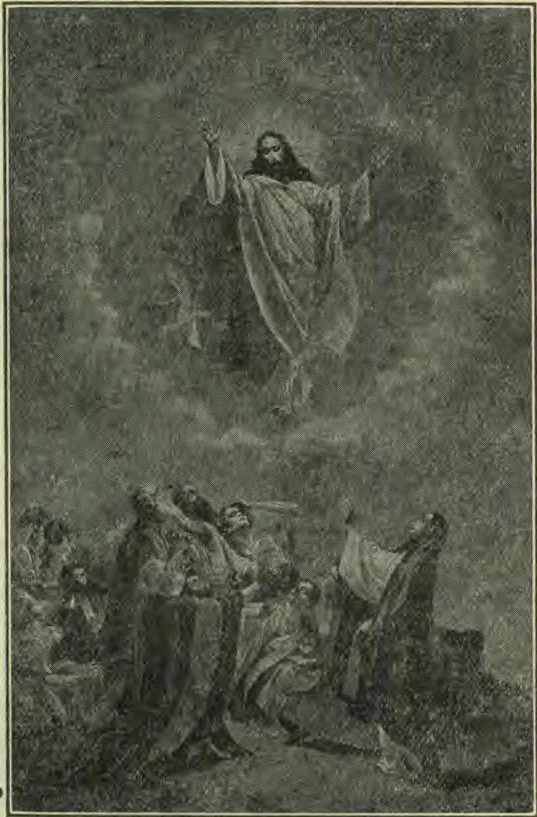
“This same Jesus, which is taken up from you into heaven, shall so come in like manner.”
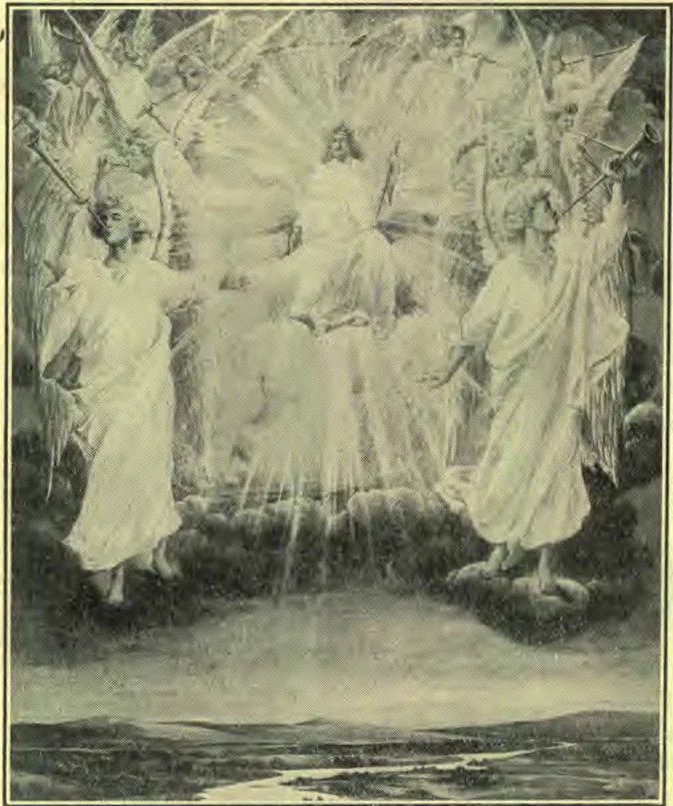
“So important is this truth of the Lord’s second coming,” continued the minister, “that angels have come down from heaven to teach it to men. At the time of the ascension of Christ the record says: ‘While they looked steadfastly toward heaven as he went up, behold, two men stood by them in white apparel; which also said, Ye men of Galilee, why stand ye gazing up into heaven? this same Jesus, which is taken up from you into heaven, shall so come in like manner as ye have seen him go into heaven.’ Acts 1:10, 11.”
“When Jesus comes the second time, the world will not be ready to meet him. His coming will be a surprise. The Bible says, ‘Then shall all the tribes of the earth mourn, and they shall see the Son of man coming.’ Matt. 24:30. Again we read, ‘Behold, he cometh with clouds; and every eye shall see him, and they also which pierced him: and all kindreds of the earth shall wail because of him.’ Rev. 1:7.”
“When Jesus comes, it will be with a great manifestation of power and glory, and not secretly, as many expect. We read that he comes ‘in his own glory, and in his Father’s, and of the holy angels.’ Luke 9:26. That he will not come secretly will be seen by reading Matt. 24:23-27.”
“The purpose of the coming of Christ is sixfold. He will come to raise the dead, as Paul tells us in 1 Thess. 4:16; he will come to judge the world, as Jude says in his fourteenth and fifteenth verses, and David in Ps. 96:13, and Paul in 2 Tim. 4:1, 8; he will come to save his people, as we are told in Heb. 9:28 and Isa. 25:8, 9; he will come to destroy the wicked, as taught in 2 Thess. 1:7, 8, Isa. 11:4, and Rev. 11:18; he will come to restore all things that have been lost by sin, as Peter says in Acts 3:20, 21; and he will come to reign forever and ever, as taught in Rev. 19:11-16, Dan. 2:44, Dan. 7:14, Micah 4:7, and Luke 1:33.”
“Surely, with all these wonderful and glorious purposes to be worked out by the coming of Christ, we cannot afford to give up the precious doctrine of his return. This is indeed a ‘blessed hope.’ As we think of the stupendous events of the near future, the events which cluster around the glorious appearing of Christ, there comes from our eager hearts the cry of John, ‘Even so, come, Lord Jesus.’”
When the Hunters reached home that night, they read from their Bible all the passages which had been mentioned in the sermon. When they had finished, Mr. Hunter said, “Well, mother, I never before met a man who knew so much of the Bible as Brother Harris does. What he is teaching is true. If the other things he teaches are as clear as this, he certainly has the truth. We must plan to attend all of these meetings.”
After going to bed Donald thought a long while before he fell asleep. He wondered why other preachers had not told them these things. Even his father was now learning them for the first time. He wondered, too, about Brother Harris’s keeping Saturday for Sunday, and why he did it, if he did. He wondered if he himself would be ready to meet Jesus, and would be taken with him to heaven; and he made up his mind that he must find out what he must do to be ready.
He fell asleep to dream that he saw Jesus coming with his angels.
Malaria and Crops
FARMERS in malarial districts are being shown by the United States Department of Agriculture that it is to their business interest to adopt preventive measures. Malaria on a plantation, we are assured by D. L. Van Dine, of the United States Bureau of Entomology, who writes on the subject in the Scientific Monthly, means the annual loss of a definite sum to the planter. The more sickness the less work, and the less work the lower the cash return. Malaria may seriously lower profits, or even turn a profit into a loss. This being the case, the expenditure of money to wipe out malaria is as legitimate as if it were to pay for new farm machinery or for the fertilization of soil. In a survey made on a plantation in Madison Parish, Louisiana, the Department has definitely shown that $6,500 was lost in one year through malaria—$2,200 from actual sickness and $4,300 from inefficiency due to the malady.—Literary Digest.
The Boy Who Believed His Head Worth More Than His Hands — John Wanamaker
By Judson D. Stuart
“I’VE got a chance to go to work, father!” exclaimed a fourteen-year-old boy in Philadelphia one evening when his father came home from work.
“Who is the contractor?” asked the father.
“He isn’t a contractor, he’s a bookstore man.”
“Books, is it? You want to make books for a living? Don’t be foolish, boy—”
“No, sir, I don’t expect to make books; this is an errand-boy job—”
“Errand boy!” snorted his father, “you get nowhere as an errand boy. If you’ll start as apprentice with some good building contractor where I can get a job for you, in a few years you’ll be a good bricklayer, and have a good trade. You can work five years at running errands, and then what do you know? What sort of trade have you?”
“But I don’t want to be a bricklayer—”
“Don’t want to be a bricklayer!” the father gasped in his astonishment. He couldn’t understand this sort of reasoning. “Don’t want to be a bricklayer!” he repeated, “and why not? I’m a good bricklayer, and my father before me was a good bricklayer—”
“But, father, you just work with your hands, you can earn only so much. You can do better working with your head than your hands.”
The boy was deeply in earnest about it. His kindly father could see this. He pondered for a while. “All right, Jack, my boy, try out your head. If it doesn’t pay, you’ve still got your hands; come to me, and I’ll make a first-class bricklayer of you—there’s always plenty of work and good pay. It’s honest work, too.”
The man was Nelson Wanamaker. The boy was John Wanamaker, former Postmaster-General of the United States, and one of the greatest retail merchants in America or any other country.
By the time he was fourteen he had used his brains. He knew his father worked hard, made good living wages, and supported his family comfortably. “But I couldn’t see where my father was ever going to be able to make any more than he was making then,” Mr. Wanamaker once said when addressing the boys employed in his Philadelphia store. “I knew he would get old and worn out with the work, and I believed that I should do better than work with my hands all my life. I believed every boy’s head was given to him for something else besides wearing a hat.”
The fourteen-year-old “Jack” Wanamaker went into the bookstore to run errands, and his pay was one dollar a week. He worked faithfully two years, and earned five dollars a week during the second year. He saved half of this and went out to Indiana. He thought perhaps he could make a fortune in the “New West,” as it was then called. But he found that he needed special training, or else must work with his hands. He did work with his hands two more years, and, being a strong boy, earned very nearly man’s wages, one dollar a day, which was considered good pay in those days.
But the boy, then eighteen, continued to use his brains in planning a future while he used his hands to earn his living. He saved much of his money, and returned to Philadelphia, where he looked about for something to do.
“I wanted to own a store,” Mr. Wanamaker once explained, “so I found a tiny place, bought a few things with my savings, took a friend in partnership with me, and started out.”
It cost so much to fit up even the little shop with counters, shelves, and other furnishings that he had little money left for buying his stock of dry goods.
“It looks pretty thin,” his partner said, as he spread it out and opened the store.
“There isn’t enough,” agreed the young merchant.
“Got to be,” sighed young Nathan Brown, his partner.
“Oh, no, I’ll get some more,” insisted young Wanamaker; and he sat down and proceeded to use his head once more. The result was that he called on a wholesaler, and told him what he wanted.
“What security?” he asked him, rather amused.
“My store and stock,” answered Wanamaker; “here’s what is in it,” and he handed out a list he had made, not only of the small amount of stock he had paid for, but his counters, shelves, chairs, and everything.
Any boy of eighteen clever enough to come prepared like that in seeking credit, was clever enough to deserve it, the big wholesale dealer believed; so he said,—
“All right, young man, you may pick out two hundred dollars’ worth.”
Young Wanamaker thanked him coolly, but his heart thumped, for he had only hoped to get one hundred dollars’ worth. He selected what he thought was best suited to the needs of the people in the neighborhood of his store.
“I suppose you will send a truck after it,” remarked the wholesaler.
“I’ll come after it, sir,” answered Wanamaker, and he hurried back to the store, the happiest boy in the city. He rushed out and borrowed a wheelbarrow, and trudged it through the streets more than a mile away to the wholesale store.12
“Where’s your truck?” they asked him.
“Down there,” he said, with a cheerful smile. “I’m the horse,” and he pointed to the wheelbarrow.
“What? You intend to wheel those goods through the streets a mile? Why, my boy, it will take five trips—”
“Glad to do it,” answered Wanamaker, and he loaded the wheelbarrow and trudged back. He made the five trips. The man who extended him the credit recognized that a boy who used his brains and wasn’t afraid of work was a boy worth while, so he told Wanamaker that he could have more credit if he needed it.
But the boy knew better than to overstock. He divided the first week’s income from his store, which was pitifully small, in two parts, paid half of it to the man who gave him credit and the other half for an advertisement in the newspapers.
From that day to this he has been a constant advertiser. Later he bought the old Pennsylvania freight house and opened a department store. Today his store in Philadelphia has forty-five acres of floor space!
He also has a mammoth store in New York City.
He was a boy who used his brains. He believed his head was a better money-maker than his hands—but he wasn’t afraid to use his hands, too, whenever it was necessary.—Judson D. Stuart, in the American Boy.