DEAR soul, whoever you are, read and ponder the wonderful message. As one who has obtained mercy and tasted of its preciousness, we bring it to you. The words—the telling—may be unworthy of the message, but the truth is worthy of your first consideration, your maturest deliberation, your wisest judgment, your joyful acceptation.
God's invitation is multiform, because no human words can in small compass express all that the invitation comprehends, and no human understanding can comprehend all that it expresses. Therefore the great and infinite God has in various forms and many ways brought it down to the understanding of His smallest and weakest children.
Come unto Me.
In the one common Gospel message of all the ages it is the blessed Christ saying to the poor sin-sick, lost, and ruined soul, "Come," "Come unto Me, all ye that labor and are heavy laden, and I will give you rest." "Come now, and let us reason together, saith the Lord; tho your sins be as scarlet, they shall be as white as snow; tho they be red like crimson, they shall be as wool." And these gracious invitations have to the believing sinner lost none of their power and preciousness.
But, as we near the end of the ages-long controversy between good and evil,
God's Last Invitation
forms itself to the demands of the time and the needs of the invited ones. Looking down the ages at the error-scattered and divided forces of His professed people, the Lord with intense earnestness sends this invitation through His prophet:
"Gather yourselves together, yea, gather together, O nation that hath no shame [margin, "nolonging"]; before the decree bring forth, before the day [of salvation] pass as the chaff, before the fierce anger of Jehovah come upon you, before the day of Jehovah's anger come upon you. Seek ye Jehovah, all the meek of the earth, that have kept His ordinances; seek righteousness, seek meekness; it may be ye will be hid in the day of Jehovah's anger." Zeph. 2:1-3.
In Luke 14 the Master holds before us the supper of the Gospel day and bids us "Come; for all things are now ready." And the fulness of the invitation goes into "the streets and lanes," the highways and byways, of the old world of sin.
But in the most comprehensive form in all the Scriptures that invitation is found in the great
Threefold Message
of the fourteenth chapter of The Revelation. The first or positive part of the message fixes the time of its application; it bears the solemn announcement, "The hour of His judgment IS come." Verse 7. The mystery, the Gospel, of God is finishing, as He hath declared by His servants the prophets. Rev. 10:7. The time of the end (Dan. 12:4, 9, 10), the glorious culmination of all the ages is reached; and in view of that is His message, "Fear God, and give glory to Him; . . . and worship Him that made the heaven and the earth," the Creator and Bestower of all.
The next part of that great message declares that Babylon the great has fallen, and in that fall she is involving all the nations, because of the wine of her fornication which she has given them to drink.
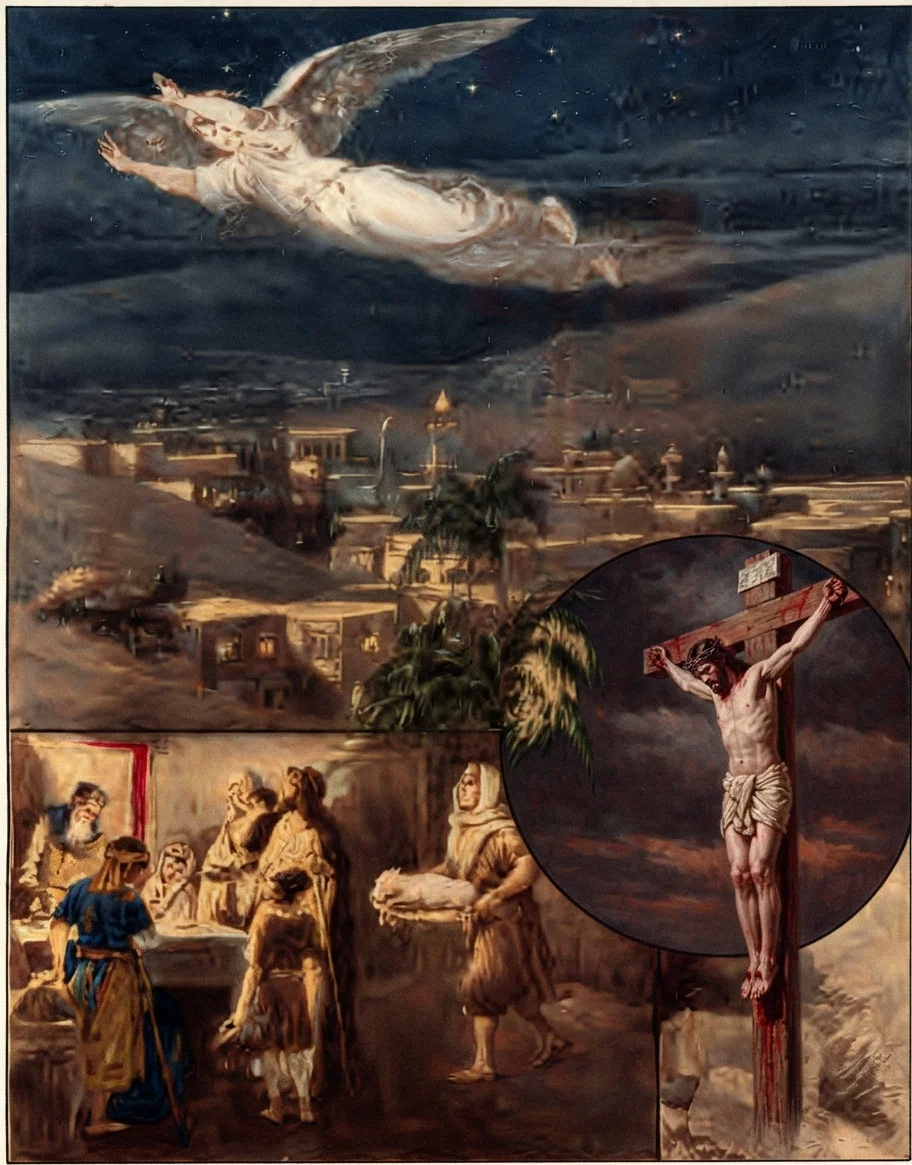
A striking composite drawing is that of Mr. Mente's above. The lower scene carries us back to the slaying of the paschal lamb in Egypt, the blood of which must be placed on the sides of the door of each household and on the lintel above or the first-born would die. The unbelieving in Egypt's land failed to do this, and the first-born of man and beast died throughout the land where the sprinkled blood was not seen by the destroying angel as he passed over, represented in the scene above. In the small drawing we have the deeper meaning of that solemn rite; "for even Christ our Passover is sacrificed for us." But to no soul will that blood apply, no soul will be free from sin when God's plagues fall, unless that soul has put away his sins and by faith washed them in the blood of Jesus. O, there is cleansing, there is healing, in His blood. But are you hidden underneath it? Is your household safe?
In that fall she unites with them and forms the worst of all unions,—church and state,—the monstrous fruit of which is the beast and his image, apostate Christianity of all kind united with the state in rebellion against God. Against yielding to the demands of this great world-wide apostasy,
The Third Part of This Great Threefold Message
warns us. Neglect to heed the warning identifies us with apostasy, and brings upon us the most awful penalties threatened in the Bible. Rev. 14:9-11.
But supplementary to this message is the glorious invitation: "Come forth, my people, out of her [Babylon], that ye have no fellowship with her sins, and that ye receive not of her plagues; for her sins have reached even unto heaven, and God hath remembered her iniquities." Rev. 18:2-5.
The Blessed Result
of heeding this great threefold message, and what the message means in life, is revealed in the characteristic features of those who hear and heed God's call, "Here is the patience of the saints; here are they that keep the commandments of God, and the faith of Jesus."
The commandments of God are comprehended in the Decalogue. The worship of the beast and his image is contrary to the commands of God. The mark, the seal, of the great Creator, and of His law, that which sets forth His character, His power, His authority, as the Creator, is the Sabbath (See Ps. 111:4; Ex. 20:8-11; Eze. 20:12, 20), which those must observe who in full understanding, keep the commandments of God and the faith of Jesus; for the commandment requires the observance of God's seventh-day Sabbath, and the faith of Jesus will lead us to keep it as it led Him to keep it. The mark of the beast is the ages-long mark of apostasy—"the wild solar holiday of all pagan times"—brought into the church through the pagan transformation into the papal apostasy, and cradled by mistaken Protestantism, blindly led by tradition and creed instead of by the Bible.
God's Gospel message for this time comprehends all the above.
Where Does That Message Find Us?
Wherever we are, it must first find us as individuals, for God deals direct with the personal, responsible soul. He may send it through men, but, if truly received, it must come as from God. 1 Thess. 2:13.
It finds many where it has always found human souls, in the bonds of sin and iniquity, "without strength," hopelessly sick with the leprosy of sin. "For all have sinned, and come short of the glory of God." "The heart is deceitful above all things, and it is desperately sick."
Let us not seek in any way to excuse or palliate or minimize the sin, or endeavor to see man's natural heart in a more favorable light. Let it stand out in the white light of God's Word in all its native abhorrence and ugliness, whether manifest in bestial appetite, low criminality, or conventional, fashionable selfishness. Let the great Physician's diagnosis be taken at its full value without question; let us admit that we are poor and naked and miserable and blind and wretched, sick all through and through with sin's leprosy, and subject to death. All manifestations of selfishness and sin are but the outcroppings of the inherited leprosy of sin.
Christ takes us just as we are, and His message of mercy comes to us, not because we are worthy, but needy.
That message finds many in the folds of churches, living perhaps in formality, trusting in a past experience of their own or their fathers, trusting in a church which God has used despite traditional errors, trusting in dead creeds, but without any real living, overcoming experience in the things of God. Christ longs to give all such new life in Him.9That message finds others with hope in God, with living daily experience in the Christian life, yet bound in errors of creed and tradition; and the real test of them will be as to whether they will cling to formal, inherited creed, or accept of the clearer light of the developing Gospel of His grace.
Many of us are not only sinful by nature, but we have cultivated and developed the sin. We have woven and forged and welded for ourselves the cords and cables and chains of sinful habit till they are stronger than steel; and we have demonstrated many and many a time that we have no power to break them. What we would do, that we do not do; and what we would not do, that we practise.
Would You Be Free?
O soul, bound in whatever way you are, would you be free?—Then come to Christ Jesus. Accept of His last great invitation, His last message of everlasting glad tidings, in which there is creative power to cleanse, to heal, to restore. He will forgive the sin; He will give power to resist the sinning.
Excuses That Are Vain.
What excuse have you for not accepting this message?
Is It the World?
It may promise you much, but can not prolong your life; it can not save you. If it should give you all it had to give, to-morrow that all might be another's, and you be lying cold and still in the arms of death. The world's pleasures breed jealousy and envy and its promised joy and happiness are like Dead Sea apples. 'Love not the world, neither the things that are in the world. If any man love the world, the love of the Father is not in him. For all that is in the world, the lust of the flesh and the lust of the eyes and the vain-glory of life, is not of the Father, but is of the world. And the world passeth away, and the lust thereof; but he that doeth the will of God abideth forever.' 1 John 2:15-17. Are you bound by the world?—Jesus replies: 'Be of good cheer; I have overcome the world.' 'This is the victory that overcometh the world, even our faith.'
Is It Unpopular To Obey
the glad tidings of God for this time? So it has ever been. It was unpopular in the days of Noah; unpopular in the days of Lot; unpopular in the days of Moses and Elijah and Jesus and Paul and Luther. But duty demanded, and men with faces set Godward responded. 'Thou shalt not follow a multitude to do evil.' Even so did Aaron, and a nation went into idolatry. Even so did Pilate, and crucified the Lord of glory. Even so did not Abraham and Moses and Elijah and Jesus and Paul, and the good of all ages.
'Then to side with truth is noble when we share her wretched crust,
Ere her cause bring fame and profit, and 'tis prosperous to be just;
Then it is the brave man chooses, while the coward stands aside,
Doubting in his abject spirit, till his Lord is crucified.'
God is on the side of truth; and 'one with God is a majority.'
What of the 'Great Men'?
Do you say, 'There are no great men connected with the heralding of this message'?—We reply that there never has been at the time God gave the message, according to the world's estimate. Invariably God's speaking prophets have been stoned and slain; the dead ones of long ago have been honored. So apostate Israel builded great tombs to the prophets of the past; and declared that if they had lived in the days when the prophets spake, they would not have shared in their persecution, yet the same people put to death Christ the Lord whose Spirit inspired the prophets. Israel plowed wickedness, reaped iniquity, and ate the fruit of lies when she trusted in 'the multitude' of her 'mighty men.' Hosea 10:13. The question in Christ's time was, 'Have any of the rulers believed?' Nay, the rulers condemned Him to death. 'For ye see your calling, brethren, how that not many wise men after the flesh, not many mighty, not many noble, are called; but God hath chosen the foolish things of the world to confound the wise; and God hath chosen the weak things of the world to confound the things which are mighty; and the base things of the world, and the things that are despised, hath God chosen, yea, and things which are not, to bring to naught things that are; that no flesh should glory in His presence.'
'Truth forever on the scaffold, Wrong forever on the throne;
But that scaffold sways the future, and behind the dim unknown
Standeth God amid the shadows, keeping watch above His own.'
The Good of Past Times.
Do you say again, 'The good of past generations have not believed this, such as Luther and Wesley, and were they not accepted Christians? And if we follow in their footsteps will we not be?'
It is sufficient to say in reply that those men followed the light single-eyed and single-hearted as they saw it; and God asked no more. Therefore He saved and accepted them despite, not because, of their errors. Abraham had two wives; Jacob had four. We could not do it and be justified. God accepted them, not because of their sin, but in spite of it, because their hearts were to do His will. Clearer light is now shining than in Luther's or Wesley's day. If you would be a worthy disciple of the men of God in the past, you will walk, not in their light, but in God's light, as its ever-increasing rays reveal more and more of present truth and present duty.
'I Have No Time.'
Do you say, 'I have no time to give to such things.' It is a sad, unutterably sad, reply. No time to consider eternity and your eternal welfare! Time for a thousand and one trifling things, but no time for the greatest interest of your soul! Time to give to acquaintances, to the daily paper, to stock and bonds and farm and shop and trade, but no time to give to the King of Heaven who comes to bring you infinite riches, untold honors, eternal life, and perennial blessings for this life and the life to come! Nay, take time, there is nothing more important than eternity; there is nothing of more value than life.
Sometime other guests may come. Sickness may lay her burning, chilling hand upon body and brain and lay you low, and give you no time or power to think of what may lie before. Calamity may visit you and sweep away all your worldly hopes in a year, a month, a week, a day, an hour. You have not taken time to find the true Refuge, and you are left helpless, hopeless.
That most unwelcome guest of all will visit you somewhere, and he will ask for time. You may say, 'I can not give it; I am too busy.' This will not put him off. He will look into your eyes, and you will take to your bed. He lays his icy hand upon you, and you grow chill and weak. You send for physicians, skilful and experienced. They respond quickly. They counsel together. They do all that men can do; but your grim guest is obdurate; he will not be refused. His icy hand clutches your throat, your heart chills, one last glance upon the world with all its utter empty worthlessness, and you are locked in the embrace of Death, and you, a stranger to truth and righteousness and God. O, it is awful to go out into the great unknown a stranger to God, when He would go with you through the Dark Valley!
'Come unto Me.'
O soul, Christ calls you, whoever you are, wherever you are, to this last Gospel message. He calls you to leave the fear of men, which bringeth a snare, and to fear God and give glory to Him. He calls you to the companionship of the good of all the ages,—the keeping of the commandments of God and the faith of Jesus. He calls you to eternal righteousness and life and glory. He made eternal sacrifice, became man forever that He might save man, save you—to Himself, to be like Himself to all eternity. He comes to you in this message with all10the hoarded love of eternity in His heart and bids you look, believe, live.
Are you a sinner?—He calls you. He died to save sinners; therefore He died for me. "Let the wicked forsake his way, and the unrighteous man his thoughts; and let him return unto the Lord, and He will have mercy upon him; and to our God, for He will abundantly pardon." He desires you to live. Listen to His oath: "As I live, saith the Lord God, I have no pleasure in the death of the wicked; but that the wicked turn from his way and live; turn ye, turn ye from your evil ways; for why will ye die?"
Are you a backslider?—Listen: "Return, ye back-sliding children, I will heal your backslidings." "Who is a God like unto thee, that pardoneth iniquity, and passeth by the transgression of the remnant of His heritage? He retaineth not His anger forever, because He delighteth in mercy. . . . He will subdue our iniquities."
O sinner, fellow Christian, the Truth of Christ, the Love of Christ, the Sacrifice of Christ, all appeal to you to embrace His whole Glad Tidings, His whole salvation from sin and Satan, His righteousness, His service, His life, His companionship, for-evermore. Will you?
[Other articles bearing on this great theme are the following: "God’s Message for This Time," in Nos. 1 and 3. All other articles in this series have a bearing on this message.]
WEALTH and WAGE
By William N. Glenn
THE PRESENT CONFLICT BETWEEN CAPITAL AND LABOR
BY WILLIAM N. GLENN
IN the present status of the conflict between capital and labor we have it practically demonstrated that peace and harmony can not reign where God’s order is ignored. The divine plan, the naturally equitable plan, in the beginning was the union of capital and labor in the individual; and the more human schemes are devised and urged for utilizing these elements separately, the more intense becomes the friction where there should be harmony. Properly united, the interests of capital and labor are one; separated, and represented by different individuals and different parties, they become antagonistic.
We say that this fact is being demonstrated as never before in the present status of the conflict. The natural result of one class becoming capitalists and another class becoming laborers was that the capitalists became the dominant class. As long as the laborers quietly submitted, there was nominal peace; but the condition was an unnatural one, and could not always exist peaceably. There always were men, however poverty-stricken, who would think for themselves. These men knew they were slaves, and they knew that slavery was unjust. Such a sentiment is bound to grow, and in time it will seek some channel of action. But the effort of an oppressed people to be free is always deemed rebellion—until it succeeds—and therefore it is deemed a subject of official discipline.
Rights of Labor Questioned.
For the long past it has been assumed that labor, as a separate element in social and industrial life, has no rights that capital and its adherent aristocracy are bound to respect. About seventy-five years ago the laborers on the Chesapeake and Ohio Canal struck for higher wages, and were arrested and imprisoned. Two or three years later, some of the employees of a factory in Connecticut were arrested for conspiracy, because they incited a strike among their fellow-workmen. And only sixty-four years ago six men in England were exiled to Botany Bay for forming a labor union. The act was adjudged to be in restraint of trade, and therefore unlawful. But the thinking, unrestful class of laborers have continued to increase, and to devise ways and means to be free, while still being willing to occupy dependent positions. Failing, however, to see the cause of the situation, they have sought to enforce another unnatural condition—the subjection of capital to labor. They have assumed that, because capital can do nothing without labor, therefore labor should be master.
The present attitude of the two classes is one of bitter strife. It is a strife, not for equality, but for mastery. Capital will not give up the scepter, and labor (that is, organized labor) claims that anything less than mastery is failure—and no doubt it is; for no position outside of God’s order can be maintained without some kind of force. And in any controversy in which force is an essential element, one party or the other must be the victor, and such victory means mastery. In such contests, too, there is always the theory that the end justifies the means. Therefore imperialism, which is the outgrowth of capital accumulation, always deems it proper to forcibly squelch any resentment of its assumed superiority on the part of the common people. So organized labor, when it endeavors to resent the oppression, deems it essential to employ like methods. In asserting its prerogative, it assumes that its importance is paramount.
Labor’s Weapons.
As weapons of warfare capital employs the black list, the lock-out, and the militia. Organized labor employs the boycott and the strike, and, in anticipation of political power, expects that the military will be its friend, if need be, in course of time. Both parties are using the courts with more or less success. Some men, in advocating the labor side of the controversy, refer to the prophecy (James 5) which foretells labor’s violent uprising in the last days, and infer that because such a course is predicted, it is therefore justified.
The controversy between capital and labor is altogether a conflict of human forces; there is nothing that pertains to Christianity. Men in both parties claim to be Christians, but the Golden Rule is unknown to the methods of either class. It is claimed that Christ sympathized with the laboring man; so He did, but He died for all—for the rich as well as for the poor. “Thou shalt love, thy neighbor as thyself” applies to the laboring man as well as to the capitalist. To His disciples, Christ says, “All ye are brethren;” “resist not evil.” In connection with the violent labor uprising predicted by the apostle James, the “brethren” are not to take any part in it. “Be patient therefore, brethren, unto the coming of the Lord.” “Stablish your hearts; for the coming of the Lord draweth nigh.”
It is complained that the capital class are selfish and grasping. Of course they are. That is the reason that there is a class of human beings known as capitalists. But one of the leading labor leaders counsels the unions to grasp all they can get, and then look for more. And sometimes it happens that a laboring man passes into the capitalist class, when he becomes as oppressive of the laboring man as any of his classmates. Is it the capital that makes him selfish and grasping? or is it his natural disposition?
Political Phases.
The present conflict between capital and organized labor has taken on a decidedly political phase. Because of the growing influence of the larger capitalists in public affairs, and their ability to secure laws that give them a degree of power over their opponents, the labor unions deem it necessary to seek power in the same way. But their voting for men in the old, established parties, on the promise of help in case of election, has not proved encouraging; hence the “labor vote” has sought, in some instances, to sustain independent candidates. Neither has this proved as encouraging as was expected. As in the cases of the Grangers, and the Populists, etc., so with the labor representatives; when a man becomes an office-seeker, he is quite apt to become a politician, and a politician is a politician, under whatever name. As everybody knows, or ought to know, a professional politician is in politics for the money and the honor that attaches to the position. As a rule, he subserves the interests that are most likely to wield the strongest influence toward continuing him in office.
Moral reform, or a reform that will cause men to esteem the rights of others as equal to their own, does not come permanently through politics. Such a condition can be brought about only through allegiance to the law of God. Therefore it is a condition that never will be realized in this world of selfishness and strife. It pertains to that time (soon to come, we trust) when, the wicked being “cut off,” “the meek shall inherit the earth; and shall delight themselves in the abundance of peace.”
[In this series there have already appeared the following: “Labor and Capital in the Beginning,” “Labor Reduced to Slavery,” and “Labor’s Efforts to Be Free.”]
A LESSON FOR THE CHURCH TO-DAY.
FOLLOWING is the lesson which the historian of the Reformation, D'Aubigne, draws from the death of Zwingle and the defeat of the Swiss Reformers at Cappel. In it is a lesson for Protestants now:
Thus the Reformation, that had deviated from the right path, was driven back by the very violence of the blow into its primitive course, having no other power than the Word of God. An inconceivable infatuation had taken possession of the friends of the Bible. They had forgotten that our warfare is not carnal; and they had appealed to arms and to battle. But God reigns; He punishes the churches and the people who turn aside from His ways.
We have thus taken a few stones, and piled them as a monument on the battle-field of Cappel, in order to remind the church of the great lesson which this terrible catastrophe teaches. As we bid farewell to this sad scene, we inscribe on these monumental stones, on the one side, these words from God's Book:
"SOME TRUST IN CHARIOTS, AND SOME IN HORSES; BUT WE WILL REMEMBER THE NAME OF THE LORD OUR GOD. THEY ARE BROUGHT DOWN AND FALLEN; BUT WE ARE RISEN, AND STAND UPRIGHT."
And on the other, this declaration of the Head of the church:—
"MY KINGDOM IS NOT OF THIS WORLD."
If from the ashes of the martyrs at Cappel a voice could be heard, it would be these very words of the Bible that these noble confessors would address, after three centuries, to the Christians of our days. That the church has no other king than Jesus Christ; that she ought not to meddle with the policy of the world, derive from it her inspiration, and call for its swords, its prisons, its treasures; that she will conquer by the spiritual powers which God has deposited in her bosom, and, above all, by the reign of her adorable Head; that she must not expect upon earth thrones and mortal triumphs; but that her march is like that of her king, from the manger to the cross, and from the cross to the crown; such is the lesson to be read on the blood-stained page that has crept into our simple and evangelical narrative.
Longing to Behold Christ
By Charles Wesley
I long to behold Him arrayed
With glory and light from above,
The King in His beauty displayed
His beauty of holiest love.
I languish and sigh to be there,
Where Jesus hath fixed His abode;
O, when shall we meet in the air,
And fly to the mountain of God?
—Charles Wesley.
Fear Not Christ’s Coming
By Rev. Dr. Robinson
SOME people are greatly frightened when the second coming of Christ is mentioned, or when it is deduced from prophecy that the great event is soon to occur. A Christian should be suspicious of himself, if he feels afraid of that glorious day.—Rev. Dr. Robinson.
The News of His Coming
By Charles Wesley
THE news of His coming I hear,
And join in the catholic cry;
O Jesus, in triumph appear,
Appear in the clouds of the sky.
—C. Wesley.
NEARING THE CLOSE.
By Eugene B. Willard
"A little while, but ah! how long it seems!
My Jesus, come;
Surpass the rapture of my sweetest dreams,
And take me home."
The day of the Lord will surely come. Everything in this old world demonstrates that fact. The appointed hour makes haste. The crisis impends. Surely, these are "perilous times." This is an age of startling revolutions and changes in the state of empires and nations. Society everywhere is convulsed—in places almost overturned. But we are nearing the close. Very soon we shall hear the cry, "It is finished," and the time will have come for the saints to inherit the new country, there to remain in perfect bliss forever and ever.
"O! the transporting, rapturous scene,
That rises to our sight—
Sweet fields arrayed in living green,
And rivers of delight."
Only a little while, beloved, and this mortal will put on immortality, and victory, eternal victory, shall be. O, how the song will echo and re-echo through the endless ages of eternity!
Revere, Mass. EUGENE B. WILLARD.
THE GOSPEL GRAIN FIELD.
WHAT is the scope of this field?
"The field is the world." Matt. 13:38.
2. Who is the sower of the good seed?
"He that soweth the good seed is the Son of Man." Verse 37.
3. What is the good seed?
"The seed [represented by wheat, Matt. 13:25] is the Word of God." Luke 8:11.
4. In what does the sowing and growth of the good seed result?
"The good seed are the children of the kingdom." Matt. 13:38.
5. Who sows the evil seed?
"His enemy came and sowed;" "the enemy that sowed them is the devil." Verses 25, 39.
6. What is the evil seed called? and in what does it result?
"His enemy came and sowed tares among the wheat." "The tares are the children of the wicked one; the enemy that sowed them is the devil." Verses 25, 38, 39.
7. Will the evil be rooted out from among the good?
"Nay; lest while ye gather up the tares, ye root up also the wheat with them." Verse 29.
8. How long will these two classes exist together?
"Let both grow together until the harvest." Verse 30.
9. What is the harvest?
"The harvest is the end of the world [age]." Verse 39.
10. Who are the reapers?
"The reapers are the angels." Same verse.
11. What became of those represented by the tares?
"As therefore the tares are gathered and burned in the fire; so shall it be in the end of this world. The Son of Man shall send forth His angels, and they shall gather out of His kingdom all things that offend, and them which do iniquity; and shall cast them into a furnace of fire; there shall be wailing and gnashing of teeth." Verses 40-42.
12. How will it be with the "children of the kingdom?"
"Then shall the righteous shine forth as the sun in the kingdom of their Father." Verse 43.
HE IS COMING AGAIN.
By Milton C. Wilcox
By MILTON C. WILCOX.
Coming again is the Prince of salvation;
Coming again all His own to receive;
Coming again, not in earth's degradation;
Coming, glad tidings to all who believe!
Nevermore tempted in desert wilds dreary;
Nevermore weakened by fasting and fear;
Nevermore burdened, and nevermore weary;
Nevermore anguish, and nevermore tear.
Gone the Gethsemanes, known again never;
Gone the mock trial, with no hand to save;
Gone are the cross and the Calvaries ever;
Gone, and forever, the power of the grave.
Coming again in transcendent glory;
Coming again forever to reign;
Coming again, repeat the glad story,
Jesus, our Saviour, is coming again.
Saving His people from every temptation;
Saving to life He has given so free;
Saving forever from earth's degradation;
Saving to home-land forever to be.
Coming, soon coming, the heavens declare it;
Coming, soon coming, declareth the Word;
Coming the kingdom to give; will you share it?
Coming! all earth with its import is stirred.
Reigning forever in glory supernal;
Reigning in righteousness ever to be;
Reigning in kingdom of peace that's eternal;
Love fills it full as the waters the sea.
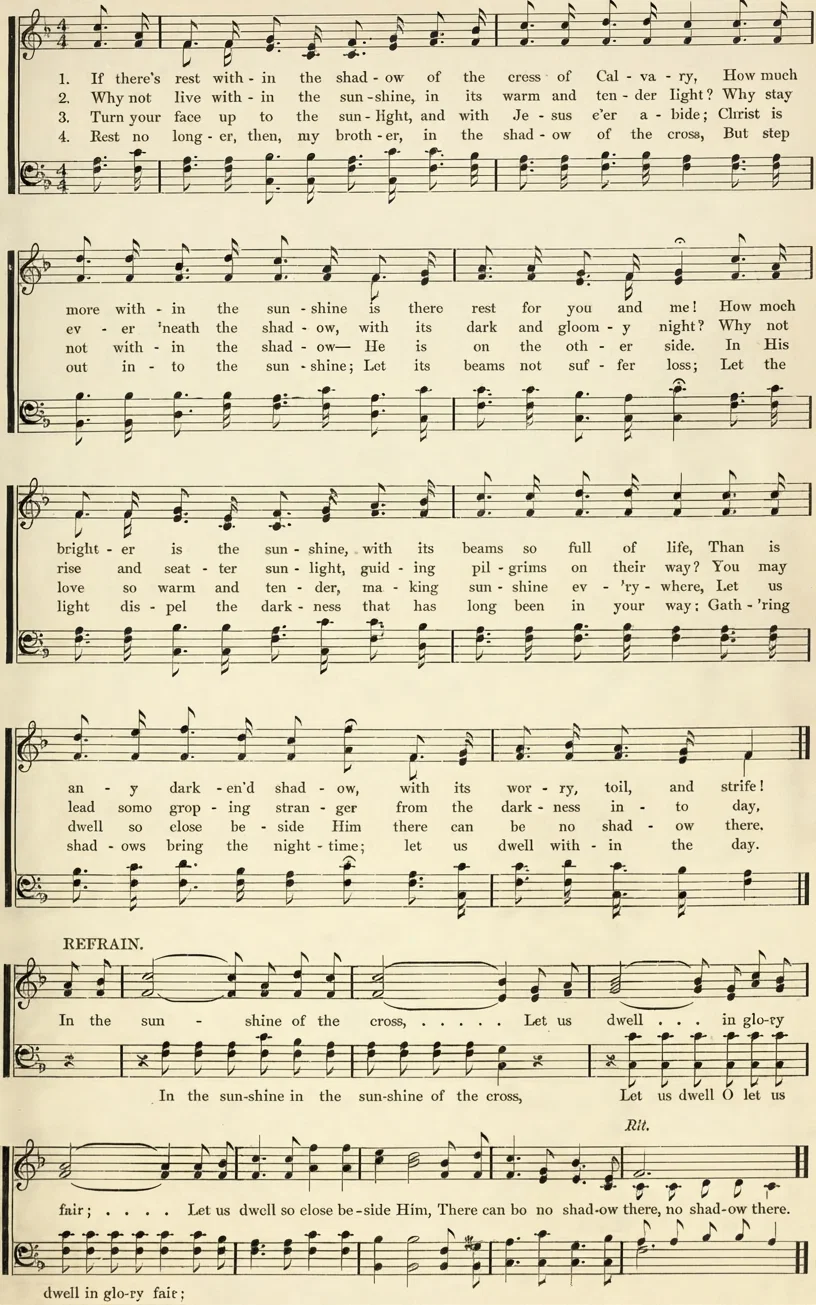
In the Sunshine of the Cross.
"Live not in the shadow of the cross; but on the sunny side of the cross, where the Sun of Righteousness may shine into your heart."
Looking Forward to Christ’s Coming
By Howard Crosby
The Christians of the earliest age were all looking forward. Christ's coming was the controlling and encouraging thought of their daily life.—Howard Crosby, D.D., LL.D.