AMONG the lands whose names are most often spoken and whose associations are most universally loved, perhaps there is none greater than Palestine. It is a little country, not much larger than the State of Massachusetts, and yet it has influenced the world more than great empires that covered quarters of the globe.
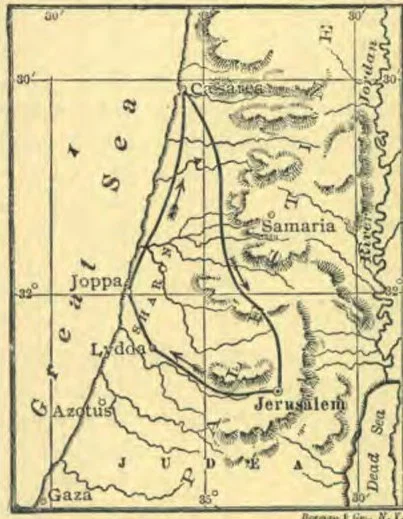
Palestine is not more than fifty miles wide at its farthest extent, and about one hundred and eighty miles long. From the central hills one can see distinctly the blue Mediterranean on the west; and away to the east, the blue hills of Gilead and east Jordan, and even out into the Arabian desert.
MAP OF PALESTINE
Mountain ranges traverse the whole country from north to south, and the only large river, the Jordan, flows in the same line. These are parallel to the coast line. Three different kinds of territory are the result, three meridional belts, traceable all the way from the eastern boundary to the seashore.
On the east is the parched and arid land of the great desert, remarkable for nothing save the steppe lands, rocks, sand, and débris which compose it. A few oases relieve the monotony, and furnish water and rest to the travelers. The great caravan routes lay along this edge of Palestine, and the people who dwell in this part are disposed to commercialism, rather than to the shepherd life.
On the west side of the land is the maritime belt, a narrow strip of land at the best, being never over a few miles wide, and often only a fringe, where projecting hills push it out into the sea. There is a strange lack of good harbors. Farther north, in Phenicia, there are plenty of them. Perhaps this was God's plan, that the two nations might live close together without mixing, and the children of Israel thus be uncorrupted with commercial interests.
The third belt lies intermediate between these other two. It possesses various modifications that must have exerted a powerful influence over the character of the people inhabiting the country. The rounded, grassy hill pastures rise step by step from the sea to the heights of these central mountains. On the east, the mountains drop abruptly to the desert plains. Between these two mountain tops is the wall-like valley of the Jordan, which shows scarcely a trace of likeness to either of the sides.
The Jordan may be called the main artery of the land. It is fed by many springs, and quickens life wherever it runs. It gives occupation to the people of the land, and directs them to the most fertile and fruitful fields. It receives its supply of water from the snowy summits of Lebanon and Hermon; these, together with the rains and numerous wayside springs, insure a constant flow of water in the Jordan; and when other streams are dry, the sacred river flows on. It supplies many blessings to the dwellers in Palestine.9and well may they praise it and its lofty mountain sources in song and story.
There is a close connection between the local geography of Palestine and the mental characteristics of the people. The peculiar simplicity and closeness to nature in which the patriarchs lived, their intimate knowledge of the fields, hills, trees, and water, are traceable in all their literature. Often we see the blue skies of Mesopotamia and Assyria, beneath which shepherds wound their way; Ararat and Hermon lift their lofty peaks into the clouds, and the Jordan and the Euphrates flow peacefully along their courses, or rush in madness before us. It would be hard to imagine the history of the children of Israel taking place in any other land than Palestine. The very hills and valleys were a part of them, and influenced everything they did. One writer has thus expressed the influence of the geography of the land on the literature:
“Two voices are there—one is of the sea,
One of the mountains.”
In every picture we see the deep purple shade of the one or the glittering light of the other.
The rugged beauty of the mountains, the lonely caves and sunny hillsides, all contributed to the character of the people whom God chose for himself, and set in this little paradise. The whole simplicity of the land was reflected in the wonderful characters of the great leaders whom God chose to lead his people righteously.
RACHEL SALISBURY.
Bereaved
LET me come in where you sit weeping, aye,
Let me, who have not any child to die,
Weep with you for the little one whose love
I have known nothing of.
The little arms that slowly, slowly loosed
Their pressure, round your neck; the hands you used
To kiss. Such arms—such hands I never knew.
May I not weep with you?
Fain would I be of service—say something,
Between the tears, that would be comforting.
But ah! so sadder than yourselves am I,
Who have no child to die.
—Selected.
Deeds Done Before Many Eyes
“By valiant knights the selfsame deeds are done Before the eyes of many—or of none.”
Scriptures as the Most Sublime Philosophy
“We count the Scriptures of God to be the most sublime philosophy.”—Sir Isaac Newton.
The Best Travelers in the World
THE complete disappearance of birds in the fall and winter used to be considered a mystery. At one time it was thought that some birds flew to the moon, says Frank M. Chapman in “The Travels of Birds.” “Others, particularly the swallows and swifts, were believed to fly into the mud, and pass the winter hibernating like frogs; while the European cuckoo was said, in the fall, to turn into a hawk.”
It was only gradually that scientists discovered that birds have definite routes of migration, as clearly marked as a telegraph line; that, generation after generation, a bird will follow the same route his ancestors did, even though it takes him half a continent out of his way; and that, in spite of the great distances birds travel, and the dangers they encounter by the way, such as storms, telegraph wires, tall buildings, and lighthouses, they nearly always arrive on time.
“Year after year the bobolink, the Baltimore oriole, the midget humming bird, many warblers, and other birds arrive from journeys thousands of miles in length on exactly or nearly the same day.”
Some birds live off the country as they go. “But the plover and other birds that travel overseas cannot stop for meals. Like bears in winter, they must live on themselves—that is, on their fat. When they start, their body is covered with a thick layer of fat; but when they arrive at their journey’s end it has disappeared.”
Some birds travel only by day; others only by night, and a smaller number travel by both day and night. The day fliers are those that can fly fast enough to escape the bird-killing hawks.
“In March, in the mountains of Vera Cruz, Mexico, I once saw a flock of several thousand white pelicans migrating northward,” the author recounts. “These great birds measure eight feet from tip to tip of their outstretched wings. Their flight was not in a direct line, but in a series of intertwining loops. The sun shone on their snowy plumage, and against the background of blue mountains they were as dazzling white as snowflakes in a squall. So, sweeping gracefully around each other, they were quickly lost to view.”—Every Week.
The Things of My Heart
By Roberta Williams
I LOVE books and music; life and nature; man and God.
I love books because they develop my mind, teach me the lesson of life, give me joy, often chime with my own mood; and through them I gain acquaintance with strong, true, noble men and women.
I love music because it exalts the spirit above the commonplace, and because, listening to it, I am nearest to reaching out and touching God’s hand.10
I love life because it is action, and action is pleasure. I love to draw in God’s pure air, to breathe the fragrance of flowers, to see their rich colors and touch their velvet petals. I love labor and the peace of rest; and I believe that only in congenial work well done lies happiness.
I love nature because it reveals God and leads me to something higher than man can achieve. I love moonlight in a cloud-flecked sky above the pine trees, and star clusters twinkling as I gaze upward. I love sunny meadows, flecked by the shadows of trees. I love the songs of birds.
I love man. I love those most who need me most, and in serving them lies the greatest happiness. I love babies because they are helpless, because they are pure, because the clutch of their fingers leads us nearer God. I love those who sin as I sin, for they suffer as I suffer. I love those who struggle as I struggle.
I love God because he is love; because he guides our lives though we choose our own paths; because he gives us all pleasures, physical, mental, and spiritual. I love to watch his Spirit working in man’s heart, bringing forth sweet fruit.—Roberta Williams.
An Oak a Landowner
THERE is a little college town in north Georgia, Athens by name, the seat of its university, where several generations back lived a man with the heart of a poet, a seer. Would you have expected it in the most eminent jurist of his day? Among the sources of deepest joy in this man’s life was a beautiful tree, growing upon his domain, splendid in size, matchless in symmetry, the earliest always in vernal leafing, the most regal in autumnal glories.
The lawyer loved the oak with a love rooted in his childhood, burgeoning with his youthful joys, waxing more potent, more enduring as manhood’s prime came on, and the golden aftertime was foreshadowed.
The tree lover scarcely believed that there would ever come a despoiler so ruthless, an age so barren of the reverence due nature, as to hurt or mar or wilfully bring destruction upon this perfect handiwork of Him who made trees and loves his creation.
Yet hundreds of chances were to be provided against. Carelessness and ignorance, oftener than not, do the work of vandalism. Changes of every kind must be expected and provided for. Municipal alterations, yes, and errors, might be counted on, in this rapidly developing college town on the hilltops.
So it chanced that in his declining years Judge Jackson formulated a truly unique plan for the protection of this admirable bit of nature’s handicraft. He would make the tree a property owner, he said, and a landed proprietor, indeed, owning eight feet of ground in every direction from its great trunk.
A novel transaction, you will agree; yet, its legal soundness has stood the test of a century. Still upon the record books in Athens you may read, written strong and clear, this record of the deed, which nothing has arisen forceful enough to render invalid:
“I, W. H. Jackson, of the county of Clarke, of the one part, and the oak tree [here defining exact location] of the county of Clarke, of the other part: Witnesseth, that the said W. H. Jackson, of and in consideration of the great affection which he bears said tree, and his great desire to see it protected, has conveyed, and by these presents does convey, unto the said oak tree entire possession of itself and of all lands within eight feet of it on all sides.”
So it stood, so it stands. To this day the tree, with its added century of girth, is as flawless as the record. Naught of man’s doing or of higher ordaining has come to defeat the fine purpose of the tree lover. In the very heart of the pretty, classic town, this majestic oak is pointed out as one of its treasures.—Conservation.
For the Finding-Out Club
By Inez Mortenson
Answers to Questions in “Instructor” of October 2
PART I
THE red corpuscles are formed in the spongy red marrow of the bones. They are the oxygen carriers of the blood.
2. Every muscle is capable of two actions: expanding and contracting. When the muscle expands, it gets long and thin. When it contracts, it gets short and thick.
3. Tight clothing compresses the nerves, and the blood vessels of the spine and the chest, and may cause intense suffering.
4. Harvey discovered the circulation of the blood, but it remained for Malpighi actually to see the circulation in the capillaries.
5. The skeleton is divided into three parts: the head, the trunk, and the limbs.
6. There are thirty bones in the human leg.
7. There are twelve pairs of cranial nerves in the human body. Inez Mortenson.
PART II
1. “Waves in mid-ocean are caused entirely by the action of the wind. The adhesion between the rapidly moving particles of air which compose the wind, and the surface particles of the water, causes the water’s surface to be dragged along with the air. Small ripples are immediately formed. These ripples soon overtake others near them. They unite, and, due to the friction between the water particles, each succeeding ripple piles up on the top of previous ones. Just as soon as oil is spread upon the water, however, the size of the waves is reduced like magic. The reason for this is interesting. Oil, unlike water, has very little internal friction between its particles. The ripples of oil formed by the wind, therefore, cannot pile upon each other to any considerable height. Hence, water waves cannot grow in an area of oil placed about a steamer. They begin to fall down instead. By the time these waves reach the boat they will have lost their formative ripples, and the result is a perfectly calm surface over the portion of the sea through which the boat is making its way.”
2. “The cormorant fishers of Japan ply their trade by night from May to October, when the rivers are full of small migratory fish. The birds can work only on dark nights, for when there is a moon the fish can see both the birds and the men, and the torches that help to attract the fish are then of no avail. The boat, which is very much like the Venetian gondola, carries four fishermen, one of whom stands in the bow with twelve cormorants, and another in the middle with four birds; the remaining two men propel the boat with poles. Generally one cormorant catches seven or eight fish every time it dives. The fishermen take the birds out one by one from their cages and put round the neck of each a small metal ring, which prevents the gullet from expanding to its natural capacity. Consequently none of the fish that the bird swallows, except very small ones, reach its stomach. The fisherman also attaches a long string to the bird, and holds the other end of it in his hand. During the fishing season the birds are never fed in the daytime, and so are always furiously hungry at night. The fisherman must exercise great skill and dexterity to control the cords without getting them hopelessly entangled. He must constantly encourage the birds and watch their movements, for when they have completely filled their gullets they swim idly upon the surface. Under water, in quest of its prey, the cormorant is tremendously active, and in a shallow part of the river rarely misses a fish unless it takes refuge under a stone or in the mud. When the bird has taken all it can carry, it returns to its keeper, who by manipulating its neck forces it to disgorge the fish. He then looses the bird again to renew its thankless task.”
3. “The grain of the popcorn is tightly packed with starch grains. The interior of the grain is divided into a large number of cells, each of which may be likened to a tin box, the walls of which are sufficiently strong to withstand considerable pressure from within. Upon the application of heat, the moisture present in each little box is converted into steam, which finally escapes by explosion. The explosion literally turns the grain of the corn inside out, and transforms it into a relatively large mass of snow-white starch.”
Answers to Questions in “Instructor” of October 9
1. The author of the book of Mark is supposed to have been John Mark, a nephew of Barnabas. He it was who accompanied Paul and Barnabas as far as Perga, on Paul’s first missionary journey. While he grew homesick and forsook the older missionaries at a critical time, his later life bore evidence of his having learned to endure hardship as a good soldier of Jesus Christ. The most important and reliable tradition is that he was the close attendant and interpreter of Peter, and that the Gospel of Mark is a recital of the teachings of the great apostle.
2. Isaac is the first child of whom it is recorded that his parents made a feast for him. Gen. 21:8.
3. Vice-Admiral Sims is in command of the American naval forces across the Atlantic.
4. James Bridger, a guide and mountaineer, discovered Great Salt Lake, and General Fremont explored the lake in 1843. John Colter accidentally discovered the Yellowstone Park while on a mission to an Indian tribe, but it brought him lasting fame.
5. John W. Garrett, of Baltimore, is our ambassador to Holland.
6. “Boston is thirty miles nearer to Rio de Janeiro than New York is, eighty miles nearer than Philadelphia, ninety-two miles nearer than Baltimore, four hundred and eighty miles nearer than New Orleans,11and five hundred and ninety-six miles nearer than Galveston. Virtually all of South America lies to the east of the United States. Draw a line due south from New York City to the Antarctic Ocean and it will pass through the Pacific Ocean, not the Atlantic, and far to the west of Valparaiso. That is why the relations of South America, at least on the eastern side of the continent, have been so much closer with Europe than with us. The distance from South America to Europe is about that from the United States to Europe, yet the coast of Brazil extends to within less than two thousand miles of the nearest point on the coast of Africa. Pernambuco, Brazil, is only three days by fast steamer from Dakar and Cape Verde, and the projected railway from Gibraltar to Dakar will some day make it possible to reach South America from Europe in five days.”12
Answers to Questions in “Instructor” of October 9
(Concluded from page ten)
7. Sinn Fein is the Gaelic for “ourselves alone,” and indicates the object of the party bearing the name. The term is pronounced — Shinn Fain (Standard Dictionary); Sin Fain (Webster’s New International Dictionary).
Working with “Ginger”
By Charles K. Taylor
Ginger was a boy. Of course that was not his real name, but it was what “the fellows” called him.
“Why do you call him ‘Ginger’?” I asked one of them.
“Oh,” he replied, “because he isn’t.”
Boys’ nicknames are usually significant. This lad’s nickname had seemed singularly inappropriate until it was explained that he showed as little “ginger” as a boy could well show and live.
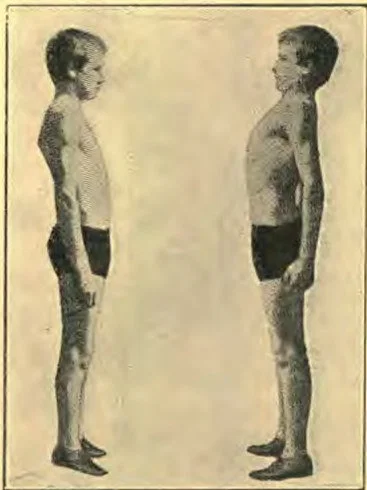
BEFORE AFTER
Watching him that afternoon, I learned that his general behavior bore out the first impression given by his attitude. It was obvious that he was an apathetic lad, inert mentally and physically. What, then, were the causes for this inertness and general slouchiness? He was not breathing through his mouth, although his jaw did sag a little sometimes. As far as I could see, the teeth in his upper jaw were regularly and nicely placed and were not the least crowded or crooked. No, Ginger had no adenoids. There might be no physical defect at all, but he was obviously in a miserable condition. His color was poor and his muscular development wretched.
I cultivated his acquaintance and found that he had a first-rate mind, which at times worked with unusual celerity and effectiveness.
The problem was: Did Ginger go with a bad crowd, was he morose, moody, unpopular, and generally inert because he was physically underdeveloped, or was he physically underdeveloped because he went with a bad crowd and was basically inert, and so on?
One day Ginger was hit a staggering blow in a boy’s most vulnerable spot when he was goaded into running a hundred-yard race with some twelve-year-old boys. He was fourteen, remember, so he could not well refuse such a challenge, no matter how he hated running. The upshot was that he ran and that they beat him outrageously; for he fell flat with exhaustion before the race was more than half over.
He was angry clear through, and as soon as we were alone he wished to know what was the matter with him. His apathy had vanished, and there was a much more hopeful type of boy on hand—a highly enraged youngster whose vanity had been touched and who was anxious to do something about it right away.
The chance was too good to be lost. “What’s your chest expansion?” I asked.
When he found what it meant, he promptly stripped to the waist and had his chest expansion measured.
It was exactly one inch—no more. For his size it should have been three times that at least.
I described a simple but effective breathing exercise, and stipulated that he should walk at a rapid pace such and such a distance each morning. Then I measured his shoulders and arms. Measuring of this kind interests boys hugely. Also I took a photograph of his “profile” as he stood there, stripped to the waist; and then I sent him home.
Next afternoon he reported having done his walk and his exercise. I showed him the photograph taken the day before. There before his very eyes were his flat chest, his stooped shoulders, his prominent shoulder blades, and his protruding abdomen. He looked at the photograph with disgust, and this was doubled when he saw another photograph lying on the table, left there for that very purpose. This was also a “profile”—that of a lad of the same age, who carried himself like a soldier and who showed a muscular development of no mean quality.
The stimulus of his defeat, of the physical measuring, and finally of those two photographs kept him going over a week. When his interest began to flag, another photographic exhibition aroused him promptly. For a month he did his breathing exercises faithfully, and then he was measured again. This time his expansion was two inches and a half!
He was given more exercises; something was said about early hours, and he got a lecture on things which might prevent his gaining a first-class development.
He took his extra exercises, and as a result of increased outdoor exercise, self-confidence, and self-respect, there developed a different and better outlook toward life. His mind became filled with new and better thoughts; his school work became really respectable; his moroseness disappeared, and finally came cheerfulness and good humor.
I lost track of Ginger just before he was sixteen years old, and did not hear another word about him till last spring, when I received as beautiful a letter from him as I have ever had written to me. He was then twenty-one and making a good living as a writer in New York.—Charles K. Taylor.
Isaac Walton on the Bible
ISAAC WALTON said of the Bible:
“Every hour
I read you kills a sin,
Or lets a virtue in
To fight against it.”
Tears as Telescopes of the Heart
“Eyes filled with tears become the telescopes of the heart. The Christian can see farther toward God through his tears than through his smiles.”
Genevieve’s Sacrifice
By Rachel Salisbury
RACHEL SALISBURY
A SHY little girl of eight years swung her feet in a listless fashion from out the big armchair that had been placed for her at the end of the class. The other children had little chairs, the dearest little chairs that she had ever seen, except in the shop windows; and she wanted to sit in one so badly. She was a visitor at the Sabbath school, and felt alone and strange, perched way up there above the others; but she had an opportunity to look around and see what all the other children were doing.
In the class next to Genevieve, there was a girl about her own age who was sitting very straight in her tiny chair. She had a big, shiny, yellow bow on her hair, that just matched the stripe in her silk dress, and her black slippers were laced with yellow ribbons. Genevieve stared at her, and sighed, thinking, “Wouldn’t it be nice to have fine dresses and things like that girl has!” She fancied herself in beautiful clothes, and imagined how she would swell with pride, and sit up real straight in her chair. But what good would it all be to her? She would only spoil the fine things in the dirty kitchen where she made her home.
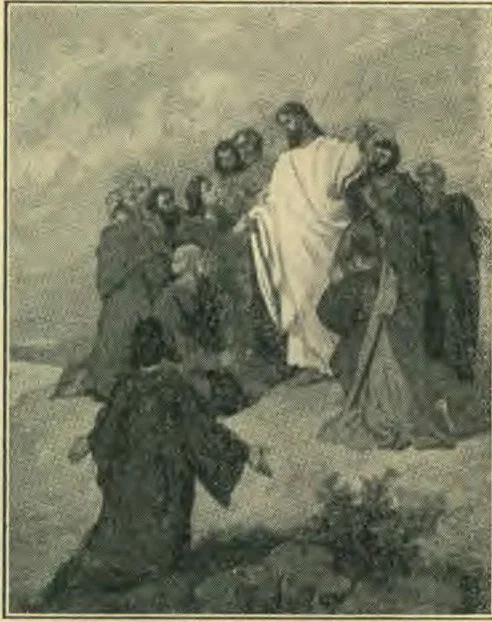
“IN MY FATHER'S HOUSE ARE MANY MANSIONS”
Just then Genevieve’s teacher showed a beautiful picture to the class, and she turned to listen to what the lady was saying. It was a picture of a man dressed in white. He was standing on the top of a hill, and there were many queer-looking people sitting around on the ground in front of him. His arm pointed toward the sky, and he seemed to be talking.
The teacher was telling about some things that Genevieve did not understand. She said that the people were Jews, and that the man was Christ, and that he was going to leave them and go up into heaven. Genevieve wondered who this man Christ was, and where he lived, and how he could talk about going up through the sky, for only the birds, which have wings, can go up into the sky.
The lady continued to talk, saying that the Man loved the people very much, and did not want them to grieve because he was going to leave them. He said: “Let not your hearts be troubled: ye believe in God, believe also in me. In my Father’s house are many mansions: if it were not so, I would have told you. I go to prepare a place for you. And if I go and prepare a place for you, I will come again, and receive you unto myself; that where I am, there ye may be also.” The teacher explained that the man Jesus was going up into heaven, where God lives. He was going up there to build houses for all his children, and when they were finished, and all the beautiful things in the city of gold were completed, that he would come back and get his children who had been faithful to him, and take them up to live with him. While he was gone, he wanted his little boys and girls to be good children, to do kind deeds, and say kind words, and sacrifice their pleasures for the sake of others. They were to do their best to make everybody around them happy.
A bell rang, and the teacher passed colored cards to all the class. On each was a little picture of the man in white, teaching the people; and below it was written the promise he made them on the mountain top. Genevieve took her picture, and very carefully tucked it away in the pocket of her little gingham dress, holding her hand over it all the time, to be sure that it was there. After some singing, which sounded very beautiful to her, the big girl came and took Genevieve home again.
The strange story she had heard lingered in her mind all the next morning. She thought of that wonderful home that the teacher had described to her. And then she thought of the way that every little girl can obtain a place in that beautiful land. The teacher said every girl or boy who is kind and loving, and tries to make every one happy, can go there to live. It must be that if she, Genevieve Briggs, does those things, she can have a place there too. All these thoughts were interwoven with her duties of the morning.
Mr. Briggs was a baker, in rather meager circumstances, and the only errand boy whom he could afford was his own little girl. In the late forenoon he sent her with a basket of rolls to a big house about a mile distant. She did not mind the long walk on this special morning, for her mind was still busy with the impressions of the day before. She often stopped to set down her basket, and pull from her pocket the cherished picture, which her eyes almost devoured.
At length she reached the servants’ door. Entering, she gave the rolls to the portly cook, who was a big-hearted, motherly woman, and on most friendly terms with the little girl.
“Good morning, Genevieve,” she said cheerfully; then, noticing the thoughtful little face, she questioned, “Where has your little ‘imp’ gone this morning? I usually see his red cap and silver slippers dancing around the corners of your eyes by this time of day. Guess you must have forgotten him, eh?”
“You see,” replied Genevieve, brightening her face and responding to the cook’s jovial air, “he got out yesterday afternoon, and I haven’t been able to find him since. Guess he went to the picnic with Master Carl, and maybe he was eaten in a sandwich for a red pepper.”
The cook’s expression changed immediately at the mention of Master Carl. She said, “O that Master Carl had never heard of that picnic! He was taken ill in the night, and the doctor says he is very sick. They even doubt if he will live. But he is better since he had his nap this morning, and his mother has lots of courage. Wouldn’t you like to see him? I think your bright face would cheer him. He always looks forward so much to your weekly visits because he gets so lonely playing by himself. I’m sure he will be glad to see you!”
Genevieve readily assented, and they went up to the13sickroom together. The boy looked up with a pleased smile as she entered. They visited together for a few minutes, and then Genevieve started to go, not wishing to tire him. But she thought, “If I only knew what I could do to make him happy, while he has to lie here in bed! If I were sick, I should want some things to play with, some books to look at, some pictures—” Pictures! Her hand went down involuntarily to her pocket. Yes, there was her picture; could she give it up? It meant so much to her, that picture of the great, good Man in white, that was king up in the sky. Could she part with that dearest treasure of her heart? But the Man had said that any one who did the best he could to make others happy should have a home with him, where there would be no more sin and sorrow. It was the only thing she had to give to Carl, the very best she could do to make him happy.
Reluctantly she drew the little card from her pocket, and slipped it over the white spread to the little boy. Her eyes looked long at the face of the Man, as the lad held the card in his hand, and asked her what it was about. She told him, as well as she could remember, the story that the Sabbath school teacher had told her little class the day before. And then she read in a stammering tongue the words of the promise printed underneath. The boy was greatly interested. He could not understand all about it either, but he said he would ask his mother. With two different feelings tugging at her heart, Genevieve went away, grieving to have lost her picture, glad to have made little Carl happy.
A few mornings later, a servant girl from the big mansion came over to the bakery for some extra supplies, and brought to all the sad news that Master Carl was dead. The fever had attacked him with new force, and he was gone. Genevieve listened in silence while the girl related through her tears the story of his death: how in the early evening he had called his mother to him, and asked her many questions about a little picture he had in bed with him, questions which she satisfied with the simple story of the cross,—a story nearly forgotten in her own heart; and how they had both cried as the old grandmother knelt down by the bedside and prayed, as his mother said the wonderful Man in white often did; and how the lad seemed perfectly happy and ready to sleep, when they all went out and left him for the night.
And then came the terrible crisis, which took his young life away. As they smoothed out his dark curls on the pillow, closed his sweet blue eyes, and folded the little hands across his breast, they found crumpled in his fist, the picture of the Man in white, whose hand was pointed toward heaven, and who promised, in loving words, “In my Father’s house are many mansions: . . . I go to prepare a place for you.”
The warm tears dimmed Genevieve’s eyes, and her throat had a choked feeling; but in her heart was joy and peace, for she had done the best she could.
“Come, Ye Thankful People, Come.”
By Amos R. Wells
HENRY ALFORD was born in London, Oct. 7, 1810. His father was a clergyman of the Church of England, and he followed in his father’s footsteps. When the lad was sixteen years old, he wrote these noble words upon the flyleaf of his Bible: “I do this day, in the presence of God and my own soul, renew my covenant with God, and solemnly determine henceforth to become his, and to do his work as far as in me lies.”
He was graduated from Trinity College, Cambridge University, and became a popular London preacher. In 1857 he was promoted to the position of dean of Canterbury, and held that important post till his death fourteen years later, Jan. 12, 1871.
Dean Alford’s greatest work was a magnificent edition of the Greek Testament. He spent upon it twenty years of hard labor, and produced a work which was the admiration of scholars. He wrote many hymns. Indeed, he prepared a hymn book to which he contributed no fewer than fifty-five hymns of his own. Not many of his hymns, however, have come into common use. Of these, one of the finest is “Ten thousand times ten thousand.” Another is “Forward be our watchword.” But of all his hymns the most popular is “Come, ye thankful people, come.”
This harvest hymn first appeared in 1844, with the title, “After Harvest.” It was originally accompanied by the text, “He that goeth forth and weepeth, bearing precious seed, shall doubtless come again with rejoicing, bringing his sheaves with him.” Ps. 126:6. The hymn originally contained seven stanzas, but only the following four are printed in our hymn books:
“Come, ye thankful people, come,
Raise the song of Harvest Home!
All is safely gathered in,
Ere the winter storms begin:
God, our Maker, doth provide
For our wants to be supplied;
Come to God’s own temple, come,
Raise the song of Harvest Home!
“All the world is God’s own field,
Fruit unto his praise to yield;
Wheat and tares together sown,
Unto joy or sorrow grown:
First the blade, and then the ear,
Then the full corn shall appear:
Lord of harvest, grant that we
Wholesome grain and pure may be.
“For the Lord our God shall come,
And shall take his harvest home;
From his field shall in that day
All offenses purge away;
Give his angels charge at last
In the fire the tares to cast,
But the fruitful ears to store
In his garner evermore.
“Even so, Lord, quickly come
To thy final Harvest Home!
Gather thou thy people in,
Free from sorrow, free from sin;
There forever purified,
In thy presence to abide:
Come, with all thine angels, come,
Raise the glorious Harvest Home!”